Chapter 3 Stoichiometry: Calculations with Chemical Formulas and Equations John D. Bookstaver St. Charles Community College Cottleville, MO Chemistry, The Central Science , 11th edition Theodore L. Brown, H. Eugene LeMay, Jr., and Bruce E. Bursten
Law of Conservation of Mass “ We may lay it down as an incontestable axiom that, in all the operations of art and nature, nothing is created; an equal amount of matter exists both before and after the experiment.  Upon this principle, the whole art of performing chemical experiments depends.” --Antoine Lavoisier, 1789
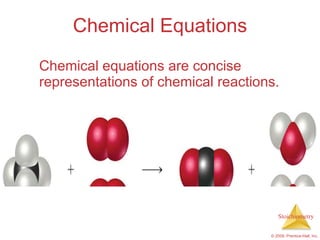
Chemical Equations Chemical equations are concise representations of chemical reactions.
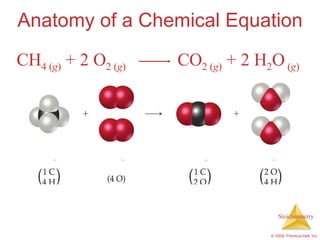
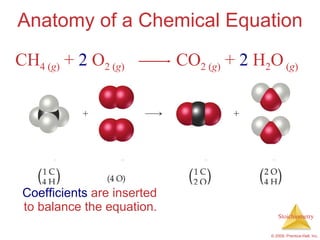
Anatomy of a Chemical Equation CH 4 ( g )  + 2 O 2 ( g )  CO 2 ( g )  + 2 H 2 O  ( g )
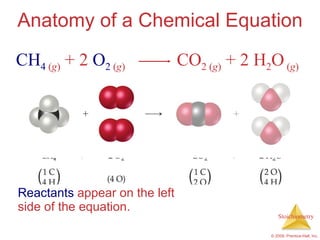
Anatomy of a Chemical Equation Reactants  appear on the left side of the equation. CH 4  ( g )  + 2  O 2  ( g )  CO 2 ( g )  + 2 H 2 O  ( g )
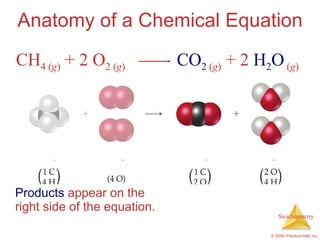
Anatomy of a Chemical Equation Products  appear on the right side of the equation. CH 4 ( g )  + 2 O 2 ( g )  CO 2   ( g )  + 2  H 2 O   ( g )
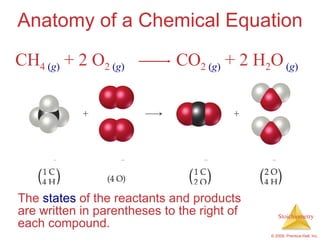
Anatomy of a Chemical Equation The  states  of the reactants and products are written in parentheses to the right of each compound. CH 4  ( g )  + 2 O 2  ( g )   CO 2   ( g )  + 2 H 2 O   ( g )
Anatomy of a Chemical Equation Coefficients  are inserted to balance the equation. CH 4 ( g )  +  2  O 2 ( g )  CO 2   ( g )  +  2  H 2 O   ( g )
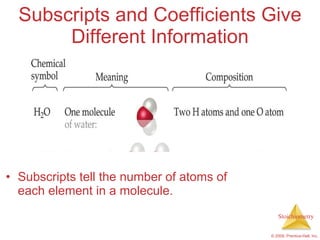
Subscripts and Coefficients Give Different Information Subscripts tell the number of atoms of each element in a molecule.
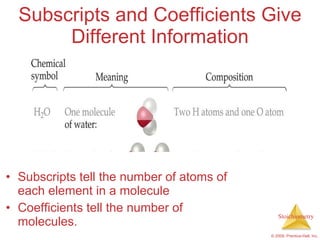
Subscripts and Coefficients Give Different Information Subscripts tell the number of atoms of each element in a molecule Coefficients tell the number of molecules.
Reaction Types
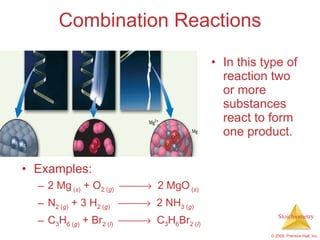
Combination Reactions Examples: 2 Mg  ( s )  + O 2 ( g )      2 MgO  ( s ) N 2 ( g )  + 3 H 2 ( g )      2 NH 3 ( g ) C 3 H 6 ( g )  + Br 2 ( l )      C 3 H 6 Br 2 ( l ) In this type of reaction two or more substances react to form one product.
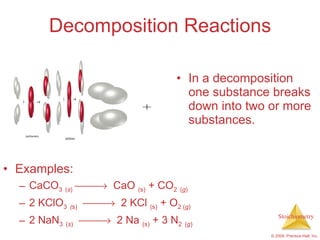
In a decomposition one substance breaks down into two or more substances. Decomposition Reactions Examples: CaCO 3   ( s )      CaO  (s)  + CO 2   ( g ) 2 KClO 3   ( s)      2 KCl  (s)  + O 2 ( g ) 2 NaN 3   ( s )      2 Na  (s)  + 3 N 2   ( g )
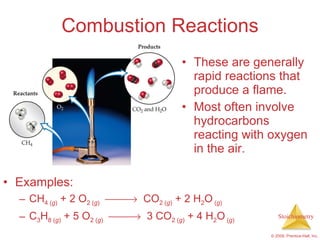
Combustion Reactions Examples: CH 4 ( g )  + 2 O 2 ( g )      CO 2 ( g )  + 2 H 2 O  ( g ) C 3 H 8 ( g )  + 5 O 2 ( g )      3 CO 2 ( g )  + 4 H 2 O  ( g )   These are generally rapid reactions that produce a flame. Most often involve hydrocarbons reacting with oxygen in the air.
Formula Weights
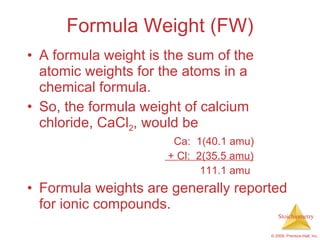
Formula Weight (FW) A formula weight is the sum of the atomic weights for the atoms in a chemical formula. So, the formula weight of calcium chloride, CaCl 2 , would be Ca:  1(40.1 amu) + Cl:  2(35.5 amu) 111.1 amu Formula weights are generally reported for ionic compounds.
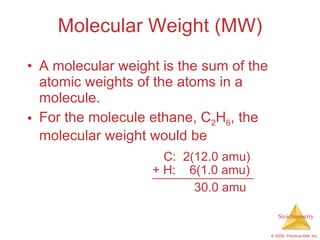
Molecular Weight (MW) A molecular weight is the sum of the atomic weights of the atoms in a molecule. For the molecule ethane, C 2 H 6 , the molecular weight would be C:  2(12.0 amu) 30.0 amu + H:  6(1.0 amu)
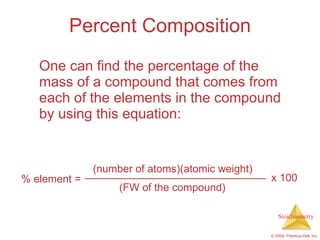
Percent Composition One can find the percentage of the mass of a compound that comes from each of the elements in the compound by using this equation: % element = (number of atoms)(atomic weight) (FW of the compound) x 100
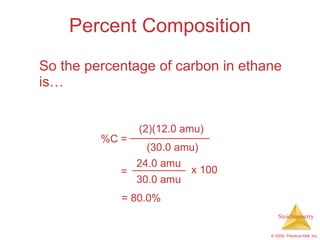
Percent Composition So the percentage of carbon in ethane is… = 80.0% %C = (2)(12.0 amu) (30.0 amu) 24.0 amu 30.0 amu = x 100
Moles
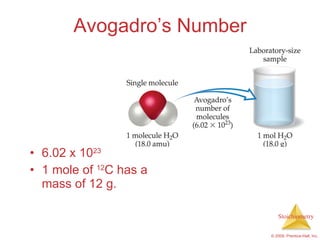
Avogadro’s Number 6.02 x 10 23 1 mole of  12 C has a mass of 12 g.
Molar Mass By definition, a molar mass is the mass of 1 mol of a substance (i.e., g/mol). The molar mass of an element is the mass number for the element that we find on the periodic table. The formula weight (in amu’s) will be the same number as the molar mass (in g/mol).
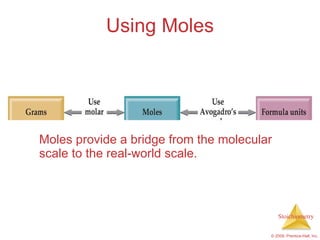
Using Moles Moles provide a bridge from the molecular scale to the real-world scale.
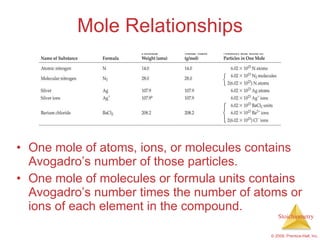
Mole Relationships One mole of atoms, ions, or molecules contains Avogadro’s number of those particles. One mole of molecules or formula units contains Avogadro’s number times the number of atoms or ions of each element in the compound.
Finding Empirical Formulas
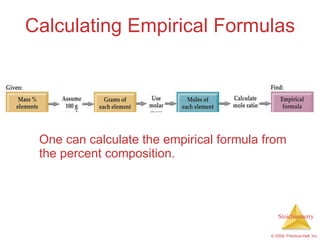
Calculating Empirical Formulas One can calculate the empirical formula from the percent composition.
Calculating Empirical Formulas The compound  para -aminobenzoic acid (you may have seen it listed as PABA on your bottle of sunscreen) is composed of carbon (61.31%), hydrogen (5.14%), nitrogen (10.21%), and oxygen (23.33%).  Find the empirical formula of PABA.
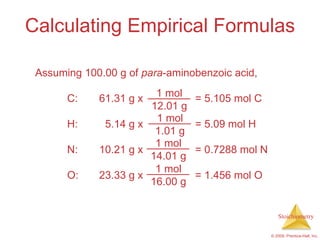
Calculating Empirical Formulas Assuming 100.00 g of  para -aminobenzoic acid, C: 61.31 g x  = 5.105 mol C H:   5.14 g x = 5.09 mol H N: 10.21 g x = 0.7288 mol N O: 23.33 g x  = 1.456 mol O 1 mol 12.01 g 1 mol 14.01 g 1 mol 1.01 g 1 mol 16.00 g
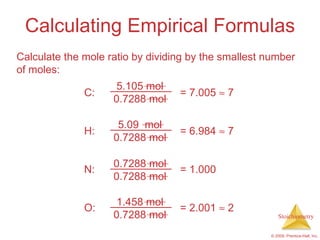
Calculating Empirical Formulas Calculate the mole ratio by dividing by the smallest number of moles: C: = 7.005    7 H: = 6.984    7 N: = 1.000 O: = 2.001    2 5.105 mol 0.7288 mol 5.09  mol 0.7288 mol 0.7288 mol 0.7288 mol 1.458 mol 0.7288 mol
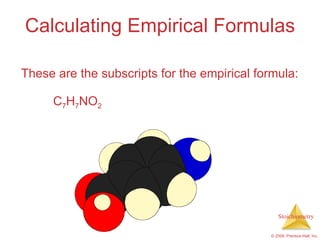
Calculating Empirical Formulas These are the subscripts for the empirical formula: C 7 H 7 NO 2
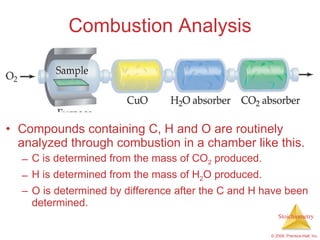
Combustion Analysis Compounds containing C, H and O are routinely analyzed through combustion in a chamber like this. C is determined from the mass of CO 2  produced. H is determined from the mass of H 2 O produced. O is determined by difference after the C and H have been determined.
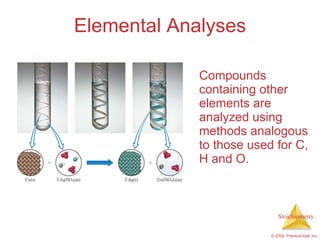
Elemental Analyses Compounds containing other elements are analyzed using methods analogous to those used for C, H and O.
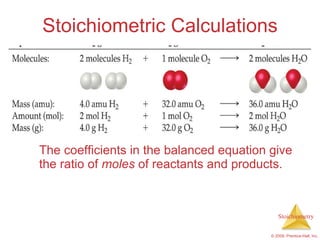
Stoichiometric Calculations The coefficients in the balanced equation give the ratio of  moles  of reactants and products.
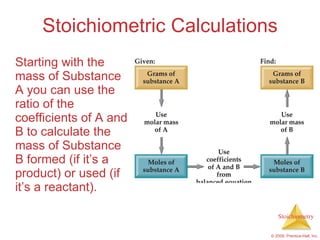
Stoichiometric Calculations Starting with the mass of Substance A you can use the ratio of the coefficients of A and B to calculate the mass of Substance B formed (if it’s a product) or used (if it’s a reactant).
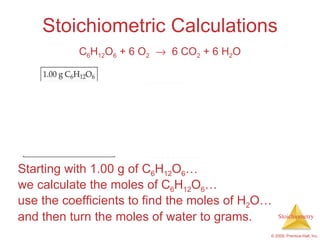
Stoichiometric Calculations Starting with 1.00 g of C 6 H 12 O 6 …  we calculate the moles of C 6 H 12 O 6 … use the coefficients to find the moles of H 2 O… and then turn the moles of water to grams. C 6 H 12 O 6  + 6 O 2      6 CO 2  + 6 H 2 O
Limiting Reactants
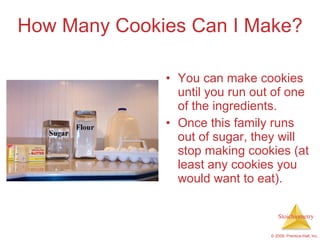
How Many Cookies Can I Make? You can make cookies until you run out of one of the ingredients. Once this family runs out of sugar, they will stop making cookies (at least any cookies you would want to eat).
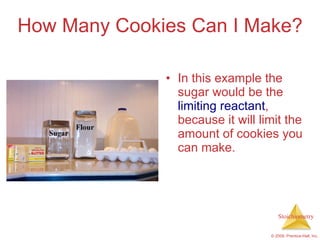
How Many Cookies Can I Make? In this example the sugar would be the  limiting reactant , because it will limit the amount of cookies you can make.
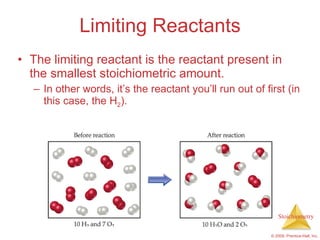
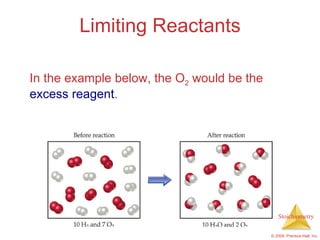
Limiting Reactants The limiting reactant is the reactant present in the smallest stoichiometric amount. In other words, it’s the reactant you’ll run out of first (in this case, the H 2 ).
Limiting Reactants In the example below, the O 2  would be the  excess reagent .
Theoretical Yield The theoretical yield is the maximum amount of product that can be made. In other words it’s the amount of product possible as calculated through the stoichiometry problem. This is different from the actual yield, which is the amount one actually produces and measures.
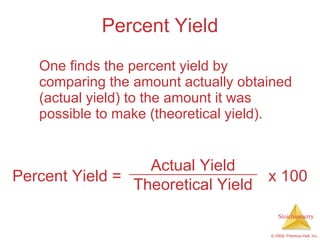
Percent Yield One finds the percent yield by comparing the amount actually obtained (actual yield) to the amount it was possible to make (theoretical yield). Actual Yield Theoretical Yield Percent Yield = x 100

AP Chemistry Chapter 3 Outline

  • 1.
    Chapter 3 Stoichiometry:Calculations with Chemical Formulas and Equations John D. Bookstaver St. Charles Community College Cottleville, MO Chemistry, The Central Science , 11th edition Theodore L. Brown, H. Eugene LeMay, Jr., and Bruce E. Bursten
  • 2.
    Law of Conservationof Mass “ We may lay it down as an incontestable axiom that, in all the operations of art and nature, nothing is created; an equal amount of matter exists both before and after the experiment. Upon this principle, the whole art of performing chemical experiments depends.” --Antoine Lavoisier, 1789
  • 3.
    Chemical Equations Chemicalequations are concise representations of chemical reactions.
  • 4.
    Anatomy of aChemical Equation CH 4 ( g ) + 2 O 2 ( g ) CO 2 ( g ) + 2 H 2 O ( g )
  • 5.
    Anatomy of aChemical Equation Reactants appear on the left side of the equation. CH 4 ( g ) + 2 O 2 ( g ) CO 2 ( g ) + 2 H 2 O ( g )
  • 6.
    Anatomy of aChemical Equation Products appear on the right side of the equation. CH 4 ( g ) + 2 O 2 ( g ) CO 2 ( g ) + 2 H 2 O ( g )
  • 7.
    Anatomy of aChemical Equation The states of the reactants and products are written in parentheses to the right of each compound. CH 4 ( g ) + 2 O 2 ( g ) CO 2 ( g ) + 2 H 2 O ( g )
  • 8.
    Anatomy of aChemical Equation Coefficients are inserted to balance the equation. CH 4 ( g ) + 2 O 2 ( g ) CO 2 ( g ) + 2 H 2 O ( g )
  • 9.
    Subscripts and CoefficientsGive Different Information Subscripts tell the number of atoms of each element in a molecule.
  • 10.
    Subscripts and CoefficientsGive Different Information Subscripts tell the number of atoms of each element in a molecule Coefficients tell the number of molecules.
  • 11.
  • 12.
    Combination Reactions Examples:2 Mg ( s ) + O 2 ( g )  2 MgO ( s ) N 2 ( g ) + 3 H 2 ( g )  2 NH 3 ( g ) C 3 H 6 ( g ) + Br 2 ( l )  C 3 H 6 Br 2 ( l ) In this type of reaction two or more substances react to form one product.
  • 13.
    In a decompositionone substance breaks down into two or more substances. Decomposition Reactions Examples: CaCO 3 ( s )  CaO (s) + CO 2 ( g ) 2 KClO 3 ( s)  2 KCl (s) + O 2 ( g ) 2 NaN 3 ( s )  2 Na (s) + 3 N 2 ( g )
  • 14.
    Combustion Reactions Examples:CH 4 ( g ) + 2 O 2 ( g )  CO 2 ( g ) + 2 H 2 O ( g ) C 3 H 8 ( g ) + 5 O 2 ( g )  3 CO 2 ( g ) + 4 H 2 O ( g ) These are generally rapid reactions that produce a flame. Most often involve hydrocarbons reacting with oxygen in the air.
  • 15.
  • 16.
    Formula Weight (FW)A formula weight is the sum of the atomic weights for the atoms in a chemical formula. So, the formula weight of calcium chloride, CaCl 2 , would be Ca: 1(40.1 amu) + Cl: 2(35.5 amu) 111.1 amu Formula weights are generally reported for ionic compounds.
  • 17.
    Molecular Weight (MW)A molecular weight is the sum of the atomic weights of the atoms in a molecule. For the molecule ethane, C 2 H 6 , the molecular weight would be C: 2(12.0 amu) 30.0 amu + H: 6(1.0 amu)
  • 18.
    Percent Composition Onecan find the percentage of the mass of a compound that comes from each of the elements in the compound by using this equation: % element = (number of atoms)(atomic weight) (FW of the compound) x 100
  • 19.
    Percent Composition Sothe percentage of carbon in ethane is… = 80.0% %C = (2)(12.0 amu) (30.0 amu) 24.0 amu 30.0 amu = x 100
  • 20.
  • 21.
    Avogadro’s Number 6.02x 10 23 1 mole of 12 C has a mass of 12 g.
  • 22.
    Molar Mass Bydefinition, a molar mass is the mass of 1 mol of a substance (i.e., g/mol). The molar mass of an element is the mass number for the element that we find on the periodic table. The formula weight (in amu’s) will be the same number as the molar mass (in g/mol).
  • 23.
    Using Moles Molesprovide a bridge from the molecular scale to the real-world scale.
  • 24.
    Mole Relationships Onemole of atoms, ions, or molecules contains Avogadro’s number of those particles. One mole of molecules or formula units contains Avogadro’s number times the number of atoms or ions of each element in the compound.
  • 25.
  • 26.
    Calculating Empirical FormulasOne can calculate the empirical formula from the percent composition.
  • 27.
    Calculating Empirical FormulasThe compound para -aminobenzoic acid (you may have seen it listed as PABA on your bottle of sunscreen) is composed of carbon (61.31%), hydrogen (5.14%), nitrogen (10.21%), and oxygen (23.33%). Find the empirical formula of PABA.
  • 28.
    Calculating Empirical FormulasAssuming 100.00 g of para -aminobenzoic acid, C: 61.31 g x = 5.105 mol C H: 5.14 g x = 5.09 mol H N: 10.21 g x = 0.7288 mol N O: 23.33 g x = 1.456 mol O 1 mol 12.01 g 1 mol 14.01 g 1 mol 1.01 g 1 mol 16.00 g
  • 29.
    Calculating Empirical FormulasCalculate the mole ratio by dividing by the smallest number of moles: C: = 7.005  7 H: = 6.984  7 N: = 1.000 O: = 2.001  2 5.105 mol 0.7288 mol 5.09 mol 0.7288 mol 0.7288 mol 0.7288 mol 1.458 mol 0.7288 mol
  • 30.
    Calculating Empirical FormulasThese are the subscripts for the empirical formula: C 7 H 7 NO 2
  • 31.
    Combustion Analysis Compoundscontaining C, H and O are routinely analyzed through combustion in a chamber like this. C is determined from the mass of CO 2 produced. H is determined from the mass of H 2 O produced. O is determined by difference after the C and H have been determined.
  • 32.
    Elemental Analyses Compoundscontaining other elements are analyzed using methods analogous to those used for C, H and O.
  • 33.
    Stoichiometric Calculations Thecoefficients in the balanced equation give the ratio of moles of reactants and products.
  • 34.
    Stoichiometric Calculations Startingwith the mass of Substance A you can use the ratio of the coefficients of A and B to calculate the mass of Substance B formed (if it’s a product) or used (if it’s a reactant).
  • 35.
    Stoichiometric Calculations Startingwith 1.00 g of C 6 H 12 O 6 … we calculate the moles of C 6 H 12 O 6 … use the coefficients to find the moles of H 2 O… and then turn the moles of water to grams. C 6 H 12 O 6 + 6 O 2  6 CO 2 + 6 H 2 O
  • 36.
  • 37.
    How Many CookiesCan I Make? You can make cookies until you run out of one of the ingredients. Once this family runs out of sugar, they will stop making cookies (at least any cookies you would want to eat).
  • 38.
    How Many CookiesCan I Make? In this example the sugar would be the limiting reactant , because it will limit the amount of cookies you can make.
  • 39.
    Limiting Reactants Thelimiting reactant is the reactant present in the smallest stoichiometric amount. In other words, it’s the reactant you’ll run out of first (in this case, the H 2 ).
  • 40.
    Limiting Reactants Inthe example below, the O 2 would be the excess reagent .
  • 41.
    Theoretical Yield Thetheoretical yield is the maximum amount of product that can be made. In other words it’s the amount of product possible as calculated through the stoichiometry problem. This is different from the actual yield, which is the amount one actually produces and measures.
  • 42.
    Percent Yield Onefinds the percent yield by comparing the amount actually obtained (actual yield) to the amount it was possible to make (theoretical yield). Actual Yield Theoretical Yield Percent Yield = x 100