At the end of this lesson, students are able to:
 • State the meaning of acid, base and alkali.
 • State uses of acids, bases and alkalis in daily
    life.
 • Explain the role of water in the formation of
    hydrogen ions to show the properties of acids.
 • Explain the role of water in the formation of
    hydroxide ions to show the properties of alkalis.
 • Describe chemical properties of acids and
    alkalis.
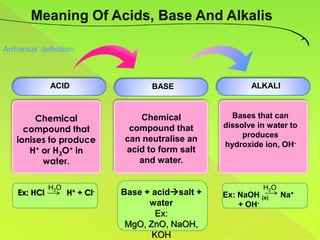
Arrhenius’ definition:


              ACID                   BASE                  ALKALI


         Chemical                 Chemical            Bases that can
                                                    dissolve in water to
      compound that             compound that
                                                         produces
    ionises to produce         can neutralise an
                                                    hydroxide ion, OH-
       H+ or H3O+ in           acid to form salt
          water.                  and water.


              H2O                                             H2O
    Ex: HCl         H+ + Cl-   Base + acidsalt +   Ex: NaOH (s)    Na+
                                     water              + OH-
                                       Ex:
                                MgO, ZnO, NaOH,
                                      KOH
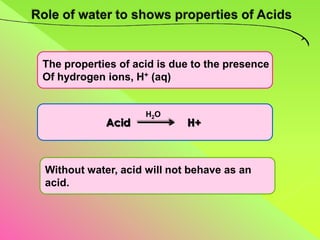
The properties of acid is due to the presence
Of hydrogen ions, H+ (aq)


                    H2O
            Acid            H+


Without water, acid will not behave as an
acid.
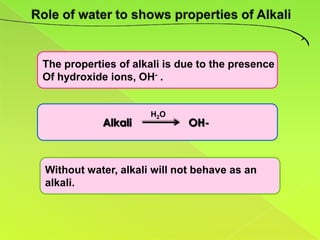
The properties of alkali is due to the presence
Of hydroxide ions, OH- .


                     H2O
            Alkali           OH-


Without water, alkali will not behave as an
alkali.
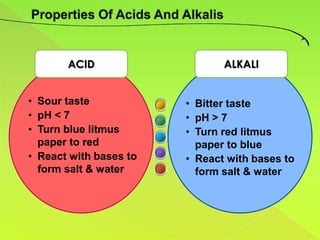
ACID                    ALKALI


• Sour taste            • Bitter taste
• pH < 7                • pH > 7
• Turn blue litmus      • Turn red litmus
  paper to red            paper to blue
• React with bases to   • React with bases to
  form salt & water       form salt & water
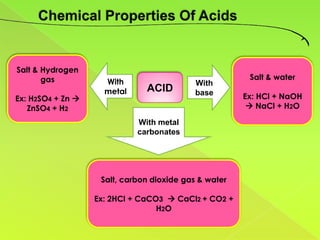
Salt & Hydrogen
       gas                                              Salt & water
                     With                   With
                     metal     ACID         base
Ex: H2SO4 + Zn                                        Ex: HCl + NaOH
   ZnSO4 + H2                                            NaCl + H2O

                             With metal
                             carbonates


                    Salt, carbon dioxide gas & water

                   Ex: 2HCl + CaCO3  CaCl2 + CO2 +
                                  H2O
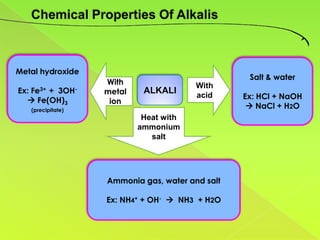
Metal hydroxide
                                                  Salt & water
                   With                 With
Ex: Fe3+ + 3OH-    metal    ALKALI
   Fe(OH)3
                                        acid     Ex: HCl + NaOH
                    ion
   (precipitate)
                                                   NaCl + H2O
                            Heat with
                           ammonium
                              salt


                   Ammonia gas, water and salt

                   Ex: NH4+ + OH-  NH3 + H2O
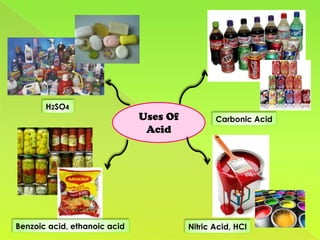
H2SO4
                              Uses Of          Carbonic Acid
                               Acid


Benzoic acid, ethanoic acid             Nitric Acid, HCl
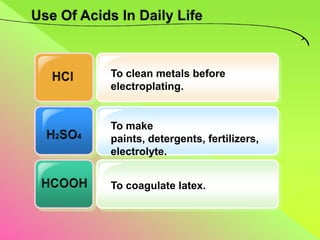
To clean metals before
electroplating.


To make
paints, detergents, fertilizers,
electrolyte.


To coagulate latex.
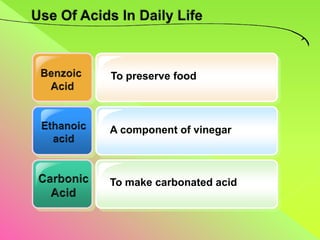
To preserve food


A component of vinegar


To make carbonated acid
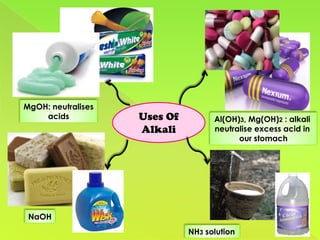
MgOH: neutralises
    acids           Uses Of         Al(OH)3, Mg(OH)2 : alkali
                    Alkali          neutralise excess acid in
                                          our stomach


 NaOH
                              NH3 solution
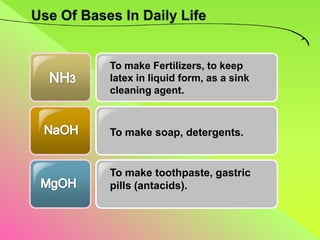
To make Fertilizers, to keep
latex in liquid form, as a sink
cleaning agent.


To make soap, detergents.


To make toothpaste, gastric
pills (antacids).
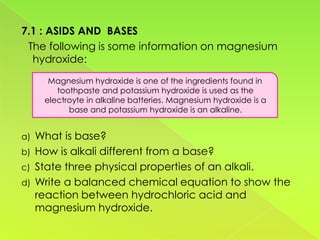
7.1 : ASIDS AND BASES
 The following is some information on magnesium
  hydroxide:
       Magnesium hydroxide is one of the ingredients found in
         toothpaste and potassium hydroxide is used as the
      electroyte in alkaline batteries. Magnesium hydroxide is a
            base and potassium hydroxide is an alkaline.


a)   What is base?
b)   How is alkali different from a base?
c)   State three physical properties of an alkali.
d)   Write a balanced chemical equation to show the
     reaction between hydrochloric acid and
     magnesium hydroxide.
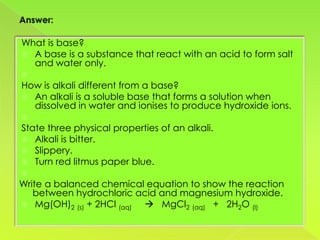
What is base?
 A base is a substance that react with an acid to form salt
  and water only.

How is alkali different from a base?
 An alkali is a soluble base that forms a solution when
  dissolved in water and ionises to produce hydroxide ions.

State three physical properties of an alkali.
 Alkali is bitter.
 Slippery.
 Turn red litmus paper blue.

Write a balanced chemical equation to show the reaction
   between hydrochloric acid and magnesium hydroxide.
 Mg(OH)2 (s) + 2HCl (aq)  MgCl2 (aq) + 2H2O (l)
Chapter 7 Acid & Bases part 1

Chapter 7 Acid & Bases part 1

  • 2.
    At the endof this lesson, students are able to: • State the meaning of acid, base and alkali. • State uses of acids, bases and alkalis in daily life. • Explain the role of water in the formation of hydrogen ions to show the properties of acids. • Explain the role of water in the formation of hydroxide ions to show the properties of alkalis. • Describe chemical properties of acids and alkalis.
  • 5.
    Arrhenius’ definition: ACID BASE ALKALI Chemical Chemical Bases that can dissolve in water to compound that compound that produces ionises to produce can neutralise an hydroxide ion, OH- H+ or H3O+ in acid to form salt water. and water. H2O H2O Ex: HCl H+ + Cl- Base + acidsalt + Ex: NaOH (s) Na+ water + OH- Ex: MgO, ZnO, NaOH, KOH
  • 6.
    The properties ofacid is due to the presence Of hydrogen ions, H+ (aq) H2O Acid H+ Without water, acid will not behave as an acid.
  • 7.
    The properties ofalkali is due to the presence Of hydroxide ions, OH- . H2O Alkali OH- Without water, alkali will not behave as an alkali.
  • 8.
    ACID ALKALI • Sour taste • Bitter taste • pH < 7 • pH > 7 • Turn blue litmus • Turn red litmus paper to red paper to blue • React with bases to • React with bases to form salt & water form salt & water
  • 9.
    Salt & Hydrogen gas Salt & water With With metal ACID base Ex: H2SO4 + Zn  Ex: HCl + NaOH ZnSO4 + H2  NaCl + H2O With metal carbonates Salt, carbon dioxide gas & water Ex: 2HCl + CaCO3  CaCl2 + CO2 + H2O
  • 10.
    Metal hydroxide Salt & water With With Ex: Fe3+ + 3OH- metal ALKALI  Fe(OH)3 acid Ex: HCl + NaOH ion (precipitate)  NaCl + H2O Heat with ammonium salt Ammonia gas, water and salt Ex: NH4+ + OH-  NH3 + H2O
  • 11.
    H2SO4 Uses Of Carbonic Acid Acid Benzoic acid, ethanoic acid Nitric Acid, HCl
  • 12.
    To clean metalsbefore electroplating. To make paints, detergents, fertilizers, electrolyte. To coagulate latex.
  • 13.
    To preserve food Acomponent of vinegar To make carbonated acid
  • 14.
    MgOH: neutralises acids Uses Of Al(OH)3, Mg(OH)2 : alkali Alkali neutralise excess acid in our stomach NaOH NH3 solution
  • 15.
    To make Fertilizers,to keep latex in liquid form, as a sink cleaning agent. To make soap, detergents. To make toothpaste, gastric pills (antacids).
  • 16.
    7.1 : ASIDSAND BASES The following is some information on magnesium hydroxide: Magnesium hydroxide is one of the ingredients found in toothpaste and potassium hydroxide is used as the electroyte in alkaline batteries. Magnesium hydroxide is a base and potassium hydroxide is an alkaline. a) What is base? b) How is alkali different from a base? c) State three physical properties of an alkali. d) Write a balanced chemical equation to show the reaction between hydrochloric acid and magnesium hydroxide.
  • 17.
    What is base? A base is a substance that react with an acid to form salt and water only.  How is alkali different from a base?  An alkali is a soluble base that forms a solution when dissolved in water and ionises to produce hydroxide ions.  State three physical properties of an alkali.  Alkali is bitter.  Slippery.  Turn red litmus paper blue.  Write a balanced chemical equation to show the reaction between hydrochloric acid and magnesium hydroxide.  Mg(OH)2 (s) + 2HCl (aq)  MgCl2 (aq) + 2H2O (l)