Copyright© The McGraw-Hill Companies, Inc. Permission required for reproduction or display.


              Chapter 4
              Calculations and the Chemical
              Equation


Denniston
Topping
Caret
7th Edition
4.1 The Mole Concept and Atoms
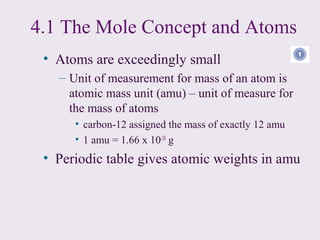
 • Atoms are exceedingly small
   – Unit of measurement for mass of an atom is
     atomic mass unit (amu) – unit of measure for
     the mass of atoms
      • carbon-12 assigned the mass of exactly 12 amu
      • 1 amu = 1.66 x 10⁻²⁴ g
 • Periodic table gives atomic weights in amu
4.1 The Mole Concept and
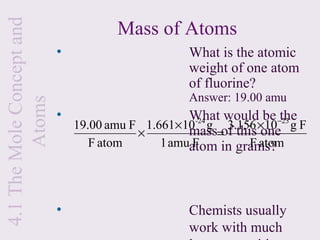
                                       Mass of Atoms
                           •                        What is the atomic
                                                    weight of one atom
                                                    of fluorine?
                                                    Answer: 19.00 amu
         Atoms


                           •                       What would be −the
                               19.00 amu F 1.661× 10 -24 g 3.156 ×10 23 g F
                                          ×        mass= this one
                                                           of
                                  F atom      1 amuatom in grams?
                                                    F          F atom


                           •                        Chemists usually
                                                    work with much
4.1 The Mole Concept and    The Mole and Avogadro’s
                                   Number
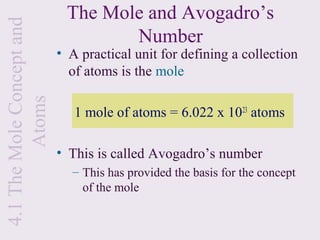
                           • A practical unit for defining a collection
                             of atoms is the mole
         Atoms


                              1 mole of atoms = 6.022 x 10²³ atoms

                           • This is called Avogadro’s number
                             – This has provided the basis for the concept
                               of the mole
The Mole
4.1 The Mole Concept and

                           • To make this connection we must define
                             the mole as a counting unit
                             – The mole is abbreviated mol
         Atoms


                           • A mole is simply a unit that defines an
                             amount of something
                             – Dozen defines 12
                             – Gross defines 144
4.1 The Mole Concept and                Atomic Mass
                           • The atomic mass of one atom of an element
                             corresponds to:
                              – The average mass of a single atom in amu
         Atoms


                              – The mass of a mole of atoms in grams
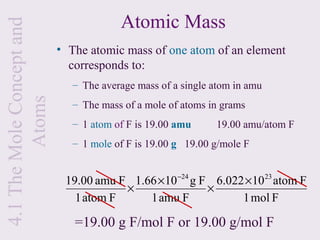
                              – 1 atom of F is 19.00 amu     19.00 amu/atom F
                              – 1 mole of F is 19.00 g 19.00 g/mole F


                            19.00 amu F 1.66 × 10 −24 g F 6.022 × 10 23 atom F
                                       ×                 ×
                              1 atom F     1 amu F             1 mol F

                              =19.00 g F/mol F or 19.00 g/mol F
Molar Mass
4.1 The Mole Concept and
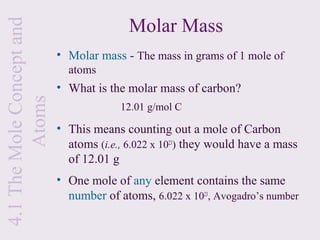
                           • Molar mass - The mass in grams of 1 mole of
                             atoms
                           • What is the molar mass of carbon?
         Atoms


                                        12.01 g/mol C

                           • This means counting out a mole of Carbon
                             atoms (i.e., 6.022 x 10²³) they would have a mass
                             of 12.01 g
                           • One mole of any element contains the same
                             number of atoms, 6.022 x 10²³, Avogadro’s number
Calculating Atoms, Moles, and Mass
4.1 The Mole Concept and

                           • We use the following conversion factors:
                             • Density converts grams – milliliters
         Atoms


                             • Atomic mass unit converts amu –
                               grams
                             • Avogadro’s number converts moles –
                               number of atoms
                             • Molar mass converts grams – moles
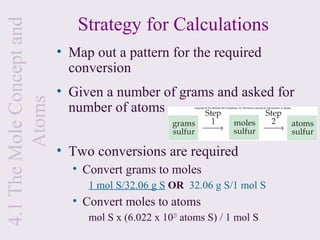
4.1 The Mole Concept and      Strategy for Calculations
                           • Map out a pattern for the required
                             conversion
                           • Given a number of grams and asked for
         Atoms


                             number of atoms


                           • Two conversions are required
                             • Convert grams to moles
                                1 mol S/32.06 g S OR 32.06 g S/1 mol S
                             • Convert moles to atoms
                                mol S x (6.022 x 10²³ atoms S) / 1 mol S
4.1 The Mole Concept and         Practice Calculations
                           1. Calculate the number of atoms in 1.7
                              moles of boron.
                           2. Find the mass in grams of 2.5 mol Na
         Atoms


                              (sodium).
                           3. Calculate the number of atoms in 5.0 g
                              aluminum.
                           4. Calculate the mass of 5,000,000 atoms
                              of Au (gold)
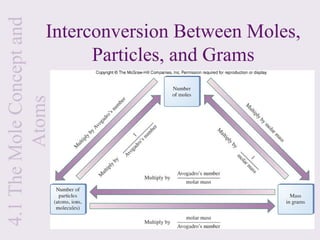
4.1 The Mole Concept and
                      Interconversion Between Moles,
                            Particles, and Grams
         Atoms
4.2 The Chemical Formula,
      Formula Weight, and Molar
                Mass
• Chemical formula - a combination of
  symbols of the various elements that make up
  the compound
• Formula unit - the smallest collection of
  atoms that provide two important pieces of
  information
  – The identity of the atoms
  – The relative number of each type of atom
4.2 The Chemical Formula,
                            Formula Weight and Molar Mass            Chemical Formula
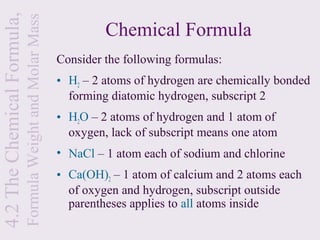
                                                            Consider the following formulas:
                                                            • H2 – 2 atoms of hydrogen are chemically bonded
                                                              forming diatomic hydrogen, subscript 2
                                                            • H2O – 2 atoms of hydrogen and 1 atom of
                                                              oxygen, lack of subscript means one atom
                                                            • NaCl – 1 atom each of sodium and chlorine
                                                            • Ca(OH)2 – 1 atom of calcium and 2 atoms each
                                                              of oxygen and hydrogen, subscript outside
                                                              parentheses applies to all atoms inside
4.2 The Chemical Formula,
                            Formula Weight and Molar Mass              Chemical Formula
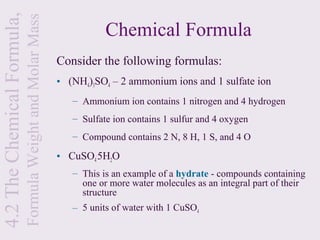
                                                            Consider the following formulas:
                                                            • (NH4)3SO4 – 2 ammonium ions and 1 sulfate ion
                                                               – Ammonium ion contains 1 nitrogen and 4 hydrogen
                                                               – Sulfate ion contains 1 sulfur and 4 oxygen
                                                               – Compound contains 2 N, 8 H, 1 S, and 4 O

                                                            • CuSO4.5H2O
                                                               – This is an example of a hydrate - compounds containing
                                                                 one or more water molecules as an integral part of their
                                                                 structure
                                                               – 5 units of water with 1 CuSO4
4.2 The Chemical Formula,                                   Comparison of Hydrated and
                            Formula Weight and Molar Mass
                                                             Anhydrous Copper Sulfate


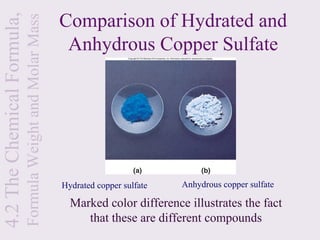
                                                            Hydrated copper sulfate   Anhydrous copper sulfate

                                                              Marked color difference illustrates the fact
                                                                 that these are different compounds
Formula Weight and Molar Mass   Formula Weight and Molar Mass
   4.2 The Chemical Formula,

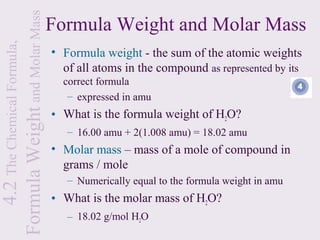
                                • Formula weight - the sum of the atomic weights
                                  of all atoms in the compound as represented by its
                                  correct formula
                                   – expressed in amu
                                • What is the formula weight of H2O?
                                   – 16.00 amu + 2(1.008 amu) = 18.02 amu
                                • Molar mass – mass of a mole of compound in
                                  grams / mole
                                   – Numerically equal to the formula weight in amu
                                • What is the molar mass of H2O?
                                   – 18.02 g/mol H2O
4.2 The Chemical Formula, Formula
                                                    Formula Unit
     Weight and Molar Mass
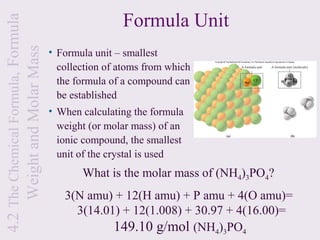
                                    • Formula unit – smallest
                                      collection of atoms from which
                                      the formula of a compound can
                                      be established
                                    • When calculating the formula
                                      weight (or molar mass) of an
                                      ionic compound, the smallest
                                      unit of the crystal is used
                                           What is the molar mass of (NH4)3PO4?
                                       3(N amu) + 12(H amu) + P amu + 4(O amu)=
                                         3(14.01) + 12(1.008) + 30.97 + 4(16.00)=
                                                149.10 g/mol (NH4)3PO4
4.3 The Chemical Equation and the
      Information It Conveys
A Recipe For Chemical Change
• Chemical equation - shorthand notation of a
  chemical reaction
  – Describes all of the substances that react and all
    the products that form, physical states, and
    experimental conditions
  – Reactants – (starting materials) – the substances
    that undergo change in the reaction
  – Products – substances produced by the reaction
and the Information It Conveys
4.3 The Chemical Equation                                    Features of a Chemical Equation
                                                             1. Identity of products and reactants must
                                                                be specified using chemical symbols
                                                             2. Reactants are written to the left of the
                                                                reaction arrow and products are written
                                                                to the right
                                                             3. Physical states of reactants and products
                                                                may be shown in parentheses
                                                             4. Symbol ∆ over the reaction arrow
                                                                means that energy is necessary for the
                                                                reaction to occur
                                                             5. Equation must be balanced
and the Information It Conveys
4.3 The Chemical Equation                                    Features of a Chemical Equation
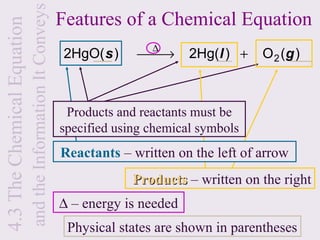
                                                                             ∆
                                                             2HgO( s )    →       2Hg( l ) +   O 2 (g )


                                                              Products and reactants must be
                                                             specified using chemical symbols
                                                             Reactants – written on the left of arrow
                                                                          Products – written on the right
                                                             ∆ – energy is needed
                                                              Physical states are shown in parentheses
and the Information It Conveys
4.3 The Chemical Equation                                     The Experimental Basis of a
                                                                  Chemical Equation

                                                             We know that a chemical equation
                                                             represents a chemical change
                                                                • One or more substances changed into
                                                                  new substances
                                                                • Different chemical and physical
                                                                  properties
and the Information It Conveys   Evidence of a Reaction Occurring
4.3 The Chemical Equation
                                                              The following can be visual evidence of a reaction:
                                                              •Release of a gas
                                                                 – CO2 is released when acid is placed in a solution
                                                                   containing CO32- ions
                                                              •Formation of a solid (precipitate)
                                                                 – A solution containing Ag+ ions mixed with a solution
                                                                   containing Cl- ions
                                                              •Heat is produced or absorbed
                                                                 – Acid and base are mixed together
                                                              •Color changes
and the Information It Conveys
4.3 The Chemical Equation
                                                             Subtle Indications of a Reaction
                                                               • Heat or light is absorbed or emitted
                                                               • Changes in the way the substances
                                                                 behave in an electrical or magnetic
                                                                 field before and after a reaction
                                                               • Changes in electrical properties
and the Information It Conveys
                                                                   Writing Chemical Reactions
4.3 The Chemical Equation

                                                             • We will learn to identify the following
                                                               patterns of chemical reactions:
                                                               –   combination
                                                               –   decomposition
                                                               –   single-replacement
                                                               –   double-replacement
                                                             • Recognizing the pattern will help you
                                                               write and understand reactions
and the Information It Conveys
4.3 The Chemical Equation
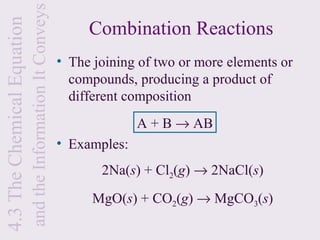
                                                                  Combination Reactions
                                                             • The joining of two or more elements or
                                                               compounds, producing a product of
                                                               different composition
                                                                           A + B → AB
                                                             • Examples:
                                                                    2Na(s) + Cl2(g) → 2NaCl(s)
                                                                   MgO(s) + CO2(g) → MgCO3(s)
and the Information It Conveys
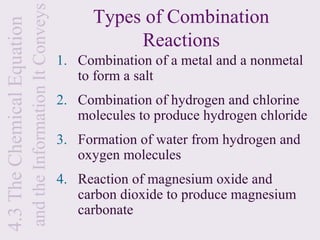
4.3 The Chemical Equation                                         Types of Combination
                                                                       Reactions
                                                             1. Combination of a metal and a nonmetal
                                                                to form a salt
                                                             2. Combination of hydrogen and chlorine
                                                                molecules to produce hydrogen chloride
                                                             3. Formation of water from hydrogen and
                                                                oxygen molecules
                                                             4. Reaction of magnesium oxide and
                                                                carbon dioxide to produce magnesium
                                                                carbonate
and the Information It Conveys
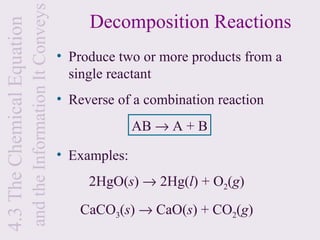
4.3 The Chemical Equation                                         Decomposition Reactions
                                                             • Produce two or more products from a
                                                               single reactant
                                                             • Reverse of a combination reaction
                                                                           AB → A + B

                                                             • Examples:
                                                                  2HgO(s) → 2Hg(l) + O2(g)
                                                                 CaCO3(s) → CaO(s) + CO2(g)
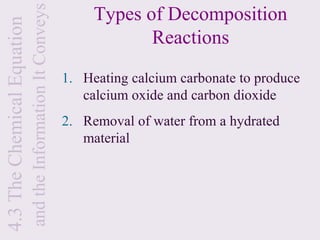
Types of Decomposition
                            and the Information It Conveys
4.3 The Chemical Equation
                                                                         Reactions
                                                             1. Heating calcium carbonate to produce
                                                                calcium oxide and carbon dioxide
                                                             2. Removal of water from a hydrated
                                                                material
and the Information It Conveys
4.3 The Chemical Equation
                                                                   Replacement Reactions
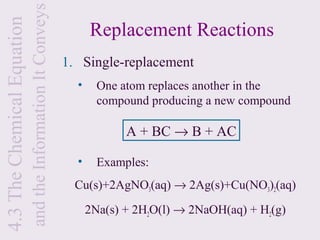
                                                             1. Single-replacement
                                                               •     One atom replaces another in the
                                                                     compound producing a new compound

                                                                          A + BC → B + AC

                                                               •     Examples:
                                                               Cu(s)+2AgNO3(aq) → 2Ag(s)+Cu(NO3)2(aq)
                                                                   2Na(s) + 2H2O(l) → 2NaOH(aq) + H2(g)
and the Information It Conveys
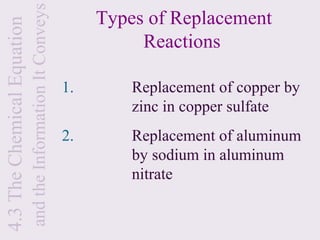
4.3 The Chemical Equation                                         Types of Replacement
                                                                       Reactions

                                                             1.       Replacement of copper by
                                                                      zinc in copper sulfate
                                                             2.       Replacement of aluminum
                                                                      by sodium in aluminum
                                                                      nitrate
and the Information It Conveys
4.3 The Chemical Equation
                                                                Replacement Reactions
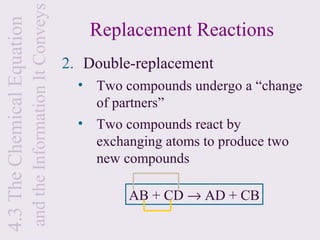
                                                             2. Double-replacement
                                                               • Two compounds undergo a “change
                                                                 of partners”
                                                               • Two compounds react by
                                                                 exchanging atoms to produce two
                                                                 new compounds

                                                                      AB + CD → AD + CB
and the Information It Conveys
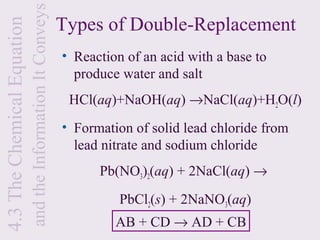
4.3 The Chemical Equation                                    Types of Double-Replacement
                                                             • Reaction of an acid with a base to
                                                               produce water and salt
                                                              HCl(aq)+NaOH(aq) →NaCl(aq)+H2O(l)
                                                             • Formation of solid lead chloride from
                                                               lead nitrate and sodium chloride
                                                                   Pb(NO3)2(aq) + 2NaCl(aq) →
                                                                       PbCl2(s) + 2NaNO3(aq)
                                                                      AB + CD → AD + CB
and the Information It Conveys
4.3 The Chemical Equation
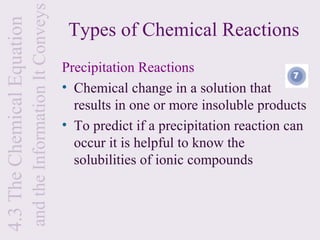
                                                              Types of Chemical Reactions
                                                             Precipitation Reactions
                                                             • Chemical change in a solution that
                                                               results in one or more insoluble products
                                                             • To predict if a precipitation reaction can
                                                               occur it is helpful to know the
                                                               solubilities of ionic compounds
and the Information It Conveys
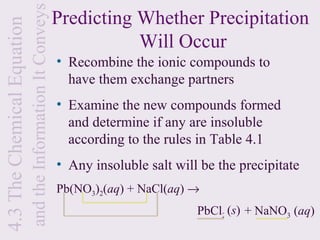
4.3 The Chemical Equation                                    Predicting Whether Precipitation
                                                                        Will Occur
                                                             • Recombine the ionic compounds to
                                                               have them exchange partners
                                                             • Examine the new compounds formed
                                                               and determine if any are insoluble
                                                               according to the rules in Table 4.1
                                                             • Any insoluble salt will be the precipitate
                                                             Pb(NO3)2(aq) + NaCl(aq) →
                                                                                      PbCl2 (s) + NaNO3 ( ?)
                                                                                            (?)         (aq)
and the Information It Conveys
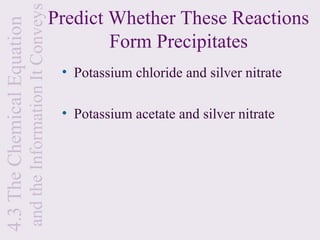
4.3 The Chemical Equation                                    Predict Whether These Reactions
                                                                     Form Precipitates
                                                              • Potassium chloride and silver nitrate

                                                              • Potassium acetate and silver nitrate
and the Information It Conveys
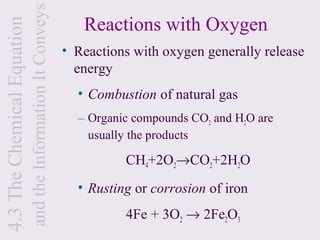
4.3 The Chemical Equation                                       Reactions with Oxygen
                                                             • Reactions with oxygen generally release
                                                               energy
                                                               • Combustion of natural gas
                                                               – Organic compounds CO2 and H2O are
                                                                 usually the products

                                                                       CH4+2O2→CO2+2H2O
                                                               • Rusting or corrosion of iron
                                                                       4Fe + 3O2 → 2Fe2O3
and the Information It Conveys
4.3 The Chemical Equation                                            Acid-Base Reactions
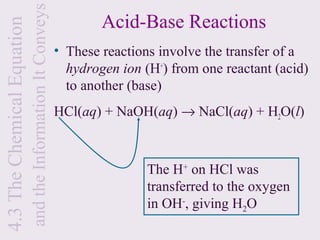
                                                             • These reactions involve the transfer of a
                                                               hydrogen ion (H+) from one reactant (acid)
                                                               to another (base)
                                                             HCl(aq) + NaOH(aq) → NaCl(aq) + H2O(l)


                                                                             The H+ on HCl was
                                                                             transferred to the oxygen
                                                                             in OH-, giving H2O
and the Information It Conveys
4.3 The Chemical Equation                                    Oxidation-Reduction Reactions
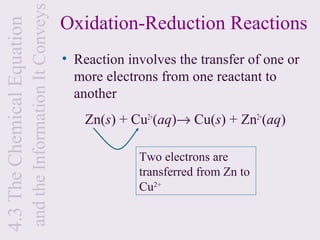
                                                             • Reaction involves the transfer of one or
                                                               more electrons from one reactant to
                                                               another
                                                                 Zn(s) + Cu2+(aq)→ Cu(s) + Zn2+(aq)

                                                                          Two electrons are
                                                                          transferred from Zn to
                                                                          Cu2+
and the Information It Conveys
4.3 The Chemical Equation                                     Writing Chemical Reactions
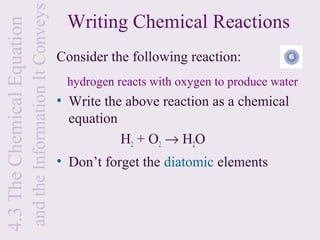
                                                             Consider the following reaction:
                                                              hydrogen reacts with oxygen to produce water
                                                             • Write the above reaction as a chemical
                                                               equation
                                                                        H2 + O2 → H2O
                                                             • Don’t forget the diatomic elements
and the Information It Conveys
4.3 The Chemical Equation
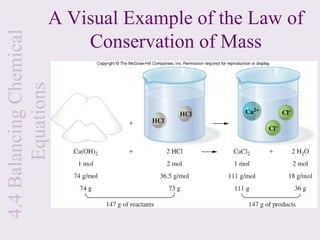
                                                             Law of Conservation of Mass

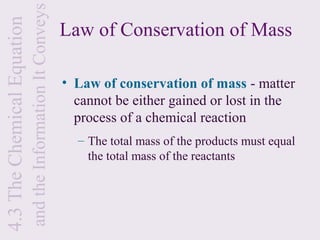
                                                             • Law of conservation of mass - matter
                                                               cannot be either gained or lost in the
                                                               process of a chemical reaction
                                                               – The total mass of the products must equal
                                                                 the total mass of the reactants
A Visual Example of the Law of
4.4 Balancing Chemical
       Equations         Conservation of Mass
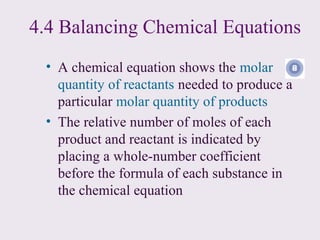
4.4 Balancing Chemical Equations
 • A chemical equation shows the molar
   quantity of reactants needed to produce a
   particular molar quantity of products
 • The relative number of moles of each
   product and reactant is indicated by
   placing a whole-number coefficient
   before the formula of each substance in
   the chemical equation
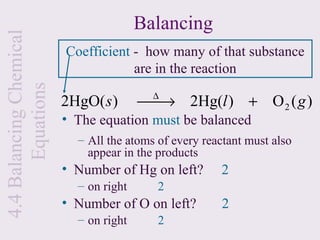
4.4 Balancing Chemical                  Balancing
                         Coefficient - how many of that substance
                                     are in the reaction
       Equations

                                          ∆
                         2HgO( s )      
                                        → 2Hg(l ) + O 2 ( g )
                         • The equation must be balanced
                           – All the atoms of every reactant must also
                             appear in the products
                         • Number of Hg on left?       2
                           – on right      2
                         • Number of O on left?        2
                           – on right      2
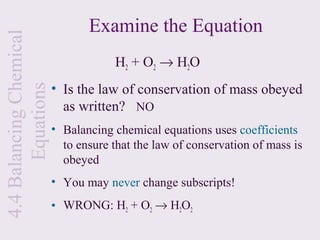
Examine the Equation
4.4 Balancing Chemical

                                     H 2 + O 2 → H 2O
                         • Is the law of conservation of mass obeyed
       Equations


                           as written? NO
                         • Balancing chemical equations uses coefficients
                           to ensure that the law of conservation of mass is
                           obeyed
                         • You may never change subscripts!
                         • WRONG: H2 + O2 → H2O2
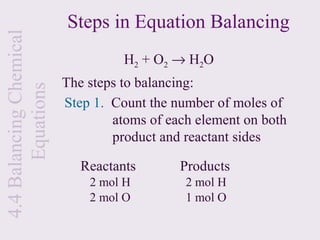
4.4 Balancing Chemical   Steps in Equation Balancing
                                   H2 + O2 → H2O
                         The steps to balancing:
       Equations


                         Step 1. Count the number of moles of
                                 atoms of each element on both
                                 product and reactant sides

                            Reactants       Products
                             2 mol H         2 mol H
                             2 mol O         1 mol O
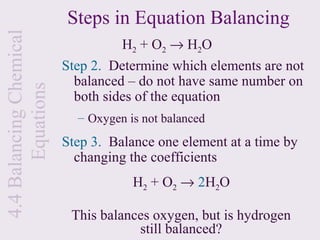
4.4 Balancing Chemical   Steps in Equation Balancing
                                   H2 + O2 → H2O
                         Step 2. Determine which elements are not
                           balanced – do not have same number on
       Equations

                           both sides of the equation
                           – Oxygen is not balanced
                         Step 3. Balance one element at a time by
                           changing the coefficients
                                     H2 + O2 → 2H2O

                          This balances oxygen, but is hydrogen
                                     still balanced?
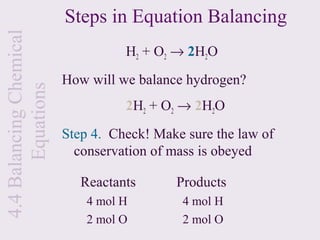
4.4 Balancing Chemical   Steps in Equation Balancing
                                   H2 + O2 → 2H2O
                         How will we balance hydrogen?
       Equations


                                   2H2 + O2 → 2H2O
                         Step 4. Check! Make sure the law of
                           conservation of mass is obeyed

                            Reactants      Products
                             4 mol H        4 mol H
                             2 mol O        2 mol O
4.4 Balancing Chemical
       Equations
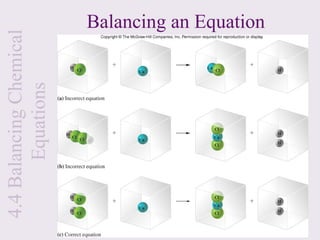
                     Balancing an Equation
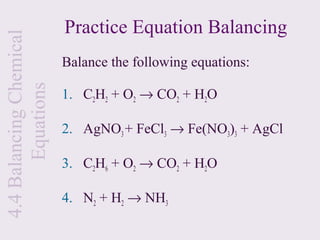
Practice Equation Balancing
4.4 Balancing Chemical

                         Balance the following equations:
       Equations

                         1. C2H2 + O2 → CO2 + H2O

                         2. AgNO3 + FeCl3 → Fe(NO3)3 + AgCl

                         3. C2H6 + O2 → CO2 + H2O

                         4. N2 + H2 → NH3
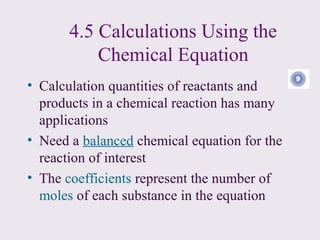
4.5 Calculations Using the
           Chemical Equation
• Calculation quantities of reactants and
  products in a chemical reaction has many
  applications
• Need a balanced chemical equation for the
  reaction of interest
• The coefficients represent the number of
  moles of each substance in the equation
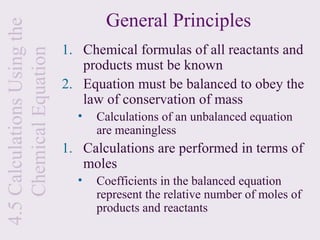
4.5 Calculations Using the          General Principles
                             1. Chemical formulas of all reactants and
    Chemical Equation
                                products must be known
                             2. Equation must be balanced to obey the
                                law of conservation of mass
                               •   Calculations of an unbalanced equation
                                   are meaningless
                             1. Calculations are performed in terms of
                                moles
                               •   Coefficients in the balanced equation
                                   represent the relative number of moles of
                                   products and reactants
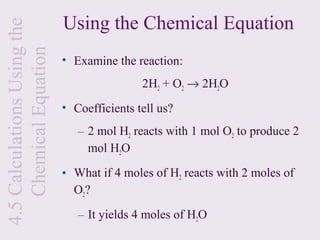
4.5 Calculations Using the   Using the Chemical Equation
    Chemical Equation
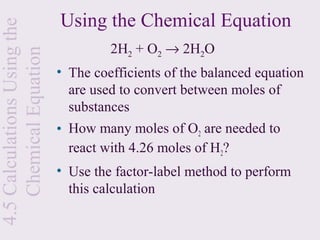
                             • Examine the reaction:
                                             2H2 + O2 → 2H2O
                             • Coefficients tell us?
                                – 2 mol H2 reacts with 1 mol O2 to produce 2
                                  mol H2O

                             • What if 4 moles of H2 reacts with 2 moles of
                               O2?

                                – It yields 4 moles of H2O
Using the Chemical Equation
4.5 Calculations Using the
                                      2H2 + O2 → 2H2O
    Chemical Equation
                             • The coefficients of the balanced equation
                               are used to convert between moles of
                               substances
                             • How many moles of O2 are needed to
                               react with 4.26 moles of H2?
                             • Use the factor-label method to perform
                               this calculation
Use of Conversion Factors
4.5 Calculations Using the
    Chemical Equation
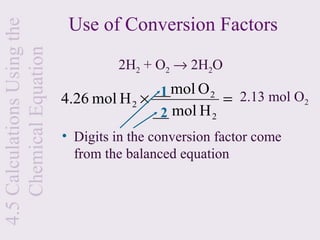
                                      2H2 + O2 → 2H2O
                                            __mol O 2
                                             1
                             4.26 mol H 2 ×            = 2.13 mol O2
                                            __ mol H 2
                                             2
                             • Digits in the conversion factor come
                               from the balanced equation
4.5 Calculations Using the    Conversion Between Moles
    Chemical Equation                 and Grams
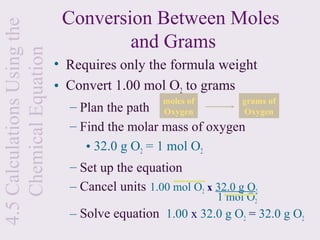
                             • Requires only the formula weight
                             • Convert 1.00 mol O2 to grams
                                                 moles of        grams of
                               – Plan the path   Oxygen          Oxygen
                               – Find the molar mass of oxygen
                                  • 32.0 g O2 = 1 mol O2
                               – Set up the equation
                               – Cancel units 1.00 mol O2 x 32.0 g O2
                                                            1 mol O2
                               – Solve equation 1.00 x 32.0 g O2 = 32.0 g O2
Conversion of Mole Reactants to
4.5 Calculations Using the
    Chemical Equation           Mole Products
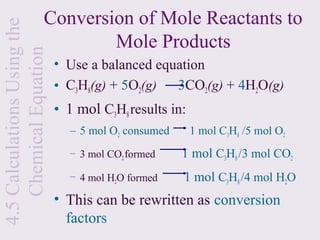
                             • Use a balanced equation
                             • C3H8(g) + 5O2(g)  3CO2(g) + 4H2O(g)
                             • 1 mol C3H8 results in:
                               – 5 mol O2 consumed      1 mol C3H8 /5 mol O2
                               – 3 mol CO2 formed    1 mol C3H8 /3 mol CO2
                               – 4 mol H2O formed    1 mol C3H8 /4 mol H2O
                             • This can be rewritten as conversion
                               factors
4.5 Calculations Using the
    Chemical Equation        Calculating Reacting Quantities
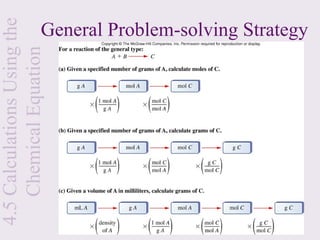
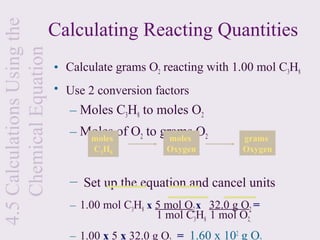
                             • Calculate grams O2 reacting with 1.00 mol C3H8
                             • Use 2 conversion factors
                                – Moles C3H8 to moles O2
                                – Moles of O2 to grams O2
                                   moles           moles            grams
                                     C3 H8          Oxygen          Oxygen


                                – Set up the equation and cancel units
                                – 1.00 mol C3H8 x 5 mol O2 x 32.0 g O2 =
                                                  1 mol C3H8 1 mol O2
                                – 1.00 x 5 x 32.0 g O = 1.60 x 10² g O
4.5 Calculations Using the   Calculating Grams of Product
    Chemical Equation          from Moles of Reactant
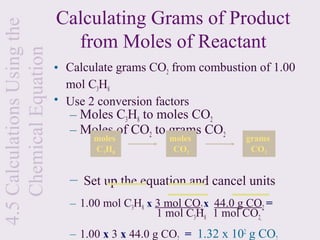
                             • Calculate grams CO2 from combustion of 1.00
                               mol C3H8
                             • Use 2 conversion factors
                               – Moles C3H8 to moles CO2
                               – Moles of CO2 to grams CO2
                                    moles          moles           grams
                                    C3 H8           CO2             CO2


                               – Set up the equation and cancel units
                               – 1.00 mol C3H8 x 3 mol CO2 x 44.0 g CO2 =
                                                 1 mol C3H8 1 mol CO2
                               – 1.00 x 3 x 44.0 g CO = 1.32 x 10² g CO
4.5 Calculations Using the   Relating Masses of Reactants
    Chemical Equation                and Products
                             • Calculate grams C3H8 required to produce
                               36.0 grams of H2O
                             • Use 3 conversion factors
                                – Grams H2O to moles H2O
                                – Moles H2O to moles C3H8
                                – Moles of C3H8 to grams C3H8
                                grams           moles           moles           grams
                                 H2 O            H2 O           C3 H8            C3 H8


                                – Set up the equation and cancel units
                                36.0 g H2O x 1 mol H2O x 1 mol C3H8 x 44.0 g C3H8
                                             18.0 g H2O 4 mol H2O 1 mol C3H8
                                – 36.0 x [1/18.0] x [1/4] x 44.0 g C3H8 = 22.0 g C3H8
Calculating a Quantity of Reactant
4.5 Calculations Using the
                             • Ca(OH)2 neutralizes HCl
    Chemical Equation
                             • Calculate grams HCl neutralized by 0.500 mol
                               Ca(OH)2
                               – Write chemical equation and balance
                             • Ca(OH)2(s) + 2HCl(aq)       CaCl2(s) + 2H2O(l)
                                – Plan the path
                                     moles            moles          grams
                                    Ca(OH)2           HCl             HCl

                                – Set up the equation and cancel units
                                0.500 mol Ca(OH)2 x 2 mol HCl x 36.5 g HCl
                                                    1 mol Ca(OH)2 1 mol HCl
                                Solve equation 0.500 x [2/1] x 36.5 g HCl = 36.5 g HCl
4.5 Calculations Using the
    Chemical Equation  General Problem-solving Strategy
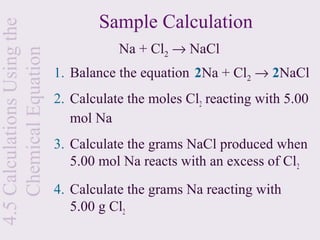
Sample Calculation
4.5 Calculations Using the
                                        Na + Cl2 → NaCl
    Chemical Equation
                             1. Balance the equation 2Na + Cl2 → 2NaCl
                             2. Calculate the moles Cl2 reacting with 5.00
                                mol Na
                             3. Calculate the grams NaCl produced when
                                5.00 mol Na reacts with an excess of Cl2
                             4. Calculate the grams Na reacting with
                                5.00 g Cl2
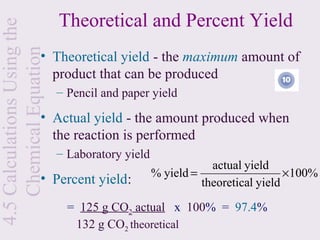
Theoretical and Percent Yield
4.5 Calculations Using the
    Chemical Equation
                        • Theoretical yield - the maximum amount of
                          product that can be produced
                             – Pencil and paper yield

                        • Actual yield - the amount produced when
                          the reaction is performed
                             – Laboratory yield
                                                              actual yield
                        • Percent yield:          % yield =                   × 100%
                                                            theoretical yield

                               = 125 g CO2 actual x 100% = 97.4%
                                132 g CO2 theoretical
Sample Calculation
4.5 Calculations Using the

                             If the theoretical yield of iron was 30.0 g
    Chemical Equation
                             and actual yield was 25.0 g, calculate the
                             percent yield:
                             2 Al(s) + Fe2O3(s) → Al2O3(aq) + 2Fe(aq)
                             • [25.0 g / 30.0 g] x 100% = 83.3%
                             • Calculate the % yield if 26.8 grams iron
                             was collected in the same reaction

Me cchapter 4

  • 1.
    Copyright© The McGraw-HillCompanies, Inc. Permission required for reproduction or display. Chapter 4 Calculations and the Chemical Equation Denniston Topping Caret 7th Edition
  • 2.
    4.1 The MoleConcept and Atoms • Atoms are exceedingly small – Unit of measurement for mass of an atom is atomic mass unit (amu) – unit of measure for the mass of atoms • carbon-12 assigned the mass of exactly 12 amu • 1 amu = 1.66 x 10⁻²⁴ g • Periodic table gives atomic weights in amu
  • 3.
    4.1 The MoleConcept and Mass of Atoms • What is the atomic weight of one atom of fluorine? Answer: 19.00 amu Atoms • What would be −the 19.00 amu F 1.661× 10 -24 g 3.156 ×10 23 g F × mass= this one of F atom 1 amuatom in grams? F F atom • Chemists usually work with much
  • 4.
    4.1 The MoleConcept and The Mole and Avogadro’s Number • A practical unit for defining a collection of atoms is the mole Atoms 1 mole of atoms = 6.022 x 10²³ atoms • This is called Avogadro’s number – This has provided the basis for the concept of the mole
  • 5.
    The Mole 4.1 TheMole Concept and • To make this connection we must define the mole as a counting unit – The mole is abbreviated mol Atoms • A mole is simply a unit that defines an amount of something – Dozen defines 12 – Gross defines 144
  • 6.
    4.1 The MoleConcept and Atomic Mass • The atomic mass of one atom of an element corresponds to: – The average mass of a single atom in amu Atoms – The mass of a mole of atoms in grams – 1 atom of F is 19.00 amu 19.00 amu/atom F – 1 mole of F is 19.00 g 19.00 g/mole F 19.00 amu F 1.66 × 10 −24 g F 6.022 × 10 23 atom F × × 1 atom F 1 amu F 1 mol F =19.00 g F/mol F or 19.00 g/mol F
  • 7.
    Molar Mass 4.1 TheMole Concept and • Molar mass - The mass in grams of 1 mole of atoms • What is the molar mass of carbon? Atoms 12.01 g/mol C • This means counting out a mole of Carbon atoms (i.e., 6.022 x 10²³) they would have a mass of 12.01 g • One mole of any element contains the same number of atoms, 6.022 x 10²³, Avogadro’s number
  • 8.
    Calculating Atoms, Moles,and Mass 4.1 The Mole Concept and • We use the following conversion factors: • Density converts grams – milliliters Atoms • Atomic mass unit converts amu – grams • Avogadro’s number converts moles – number of atoms • Molar mass converts grams – moles
  • 9.
    4.1 The MoleConcept and Strategy for Calculations • Map out a pattern for the required conversion • Given a number of grams and asked for Atoms number of atoms • Two conversions are required • Convert grams to moles 1 mol S/32.06 g S OR 32.06 g S/1 mol S • Convert moles to atoms mol S x (6.022 x 10²³ atoms S) / 1 mol S
  • 10.
    4.1 The MoleConcept and Practice Calculations 1. Calculate the number of atoms in 1.7 moles of boron. 2. Find the mass in grams of 2.5 mol Na Atoms (sodium). 3. Calculate the number of atoms in 5.0 g aluminum. 4. Calculate the mass of 5,000,000 atoms of Au (gold)
  • 11.
    4.1 The MoleConcept and Interconversion Between Moles, Particles, and Grams Atoms
  • 12.
    4.2 The ChemicalFormula, Formula Weight, and Molar Mass • Chemical formula - a combination of symbols of the various elements that make up the compound • Formula unit - the smallest collection of atoms that provide two important pieces of information – The identity of the atoms – The relative number of each type of atom
  • 13.
    4.2 The ChemicalFormula, Formula Weight and Molar Mass Chemical Formula Consider the following formulas: • H2 – 2 atoms of hydrogen are chemically bonded forming diatomic hydrogen, subscript 2 • H2O – 2 atoms of hydrogen and 1 atom of oxygen, lack of subscript means one atom • NaCl – 1 atom each of sodium and chlorine • Ca(OH)2 – 1 atom of calcium and 2 atoms each of oxygen and hydrogen, subscript outside parentheses applies to all atoms inside
  • 14.
    4.2 The ChemicalFormula, Formula Weight and Molar Mass Chemical Formula Consider the following formulas: • (NH4)3SO4 – 2 ammonium ions and 1 sulfate ion – Ammonium ion contains 1 nitrogen and 4 hydrogen – Sulfate ion contains 1 sulfur and 4 oxygen – Compound contains 2 N, 8 H, 1 S, and 4 O • CuSO4.5H2O – This is an example of a hydrate - compounds containing one or more water molecules as an integral part of their structure – 5 units of water with 1 CuSO4
  • 15.
    4.2 The ChemicalFormula, Comparison of Hydrated and Formula Weight and Molar Mass Anhydrous Copper Sulfate Hydrated copper sulfate Anhydrous copper sulfate Marked color difference illustrates the fact that these are different compounds
  • 16.
    Formula Weight andMolar Mass Formula Weight and Molar Mass 4.2 The Chemical Formula, • Formula weight - the sum of the atomic weights of all atoms in the compound as represented by its correct formula – expressed in amu • What is the formula weight of H2O? – 16.00 amu + 2(1.008 amu) = 18.02 amu • Molar mass – mass of a mole of compound in grams / mole – Numerically equal to the formula weight in amu • What is the molar mass of H2O? – 18.02 g/mol H2O
  • 17.
    4.2 The ChemicalFormula, Formula Formula Unit Weight and Molar Mass • Formula unit – smallest collection of atoms from which the formula of a compound can be established • When calculating the formula weight (or molar mass) of an ionic compound, the smallest unit of the crystal is used What is the molar mass of (NH4)3PO4? 3(N amu) + 12(H amu) + P amu + 4(O amu)= 3(14.01) + 12(1.008) + 30.97 + 4(16.00)= 149.10 g/mol (NH4)3PO4
  • 18.
    4.3 The ChemicalEquation and the Information It Conveys A Recipe For Chemical Change • Chemical equation - shorthand notation of a chemical reaction – Describes all of the substances that react and all the products that form, physical states, and experimental conditions – Reactants – (starting materials) – the substances that undergo change in the reaction – Products – substances produced by the reaction
  • 19.
    and the InformationIt Conveys 4.3 The Chemical Equation Features of a Chemical Equation 1. Identity of products and reactants must be specified using chemical symbols 2. Reactants are written to the left of the reaction arrow and products are written to the right 3. Physical states of reactants and products may be shown in parentheses 4. Symbol ∆ over the reaction arrow means that energy is necessary for the reaction to occur 5. Equation must be balanced
  • 20.
    and the InformationIt Conveys 4.3 The Chemical Equation Features of a Chemical Equation ∆ 2HgO( s ) → 2Hg( l ) + O 2 (g ) Products and reactants must be specified using chemical symbols Reactants – written on the left of arrow Products – written on the right ∆ – energy is needed Physical states are shown in parentheses
  • 21.
    and the InformationIt Conveys 4.3 The Chemical Equation The Experimental Basis of a Chemical Equation We know that a chemical equation represents a chemical change • One or more substances changed into new substances • Different chemical and physical properties
  • 22.
    and the InformationIt Conveys Evidence of a Reaction Occurring 4.3 The Chemical Equation The following can be visual evidence of a reaction: •Release of a gas – CO2 is released when acid is placed in a solution containing CO32- ions •Formation of a solid (precipitate) – A solution containing Ag+ ions mixed with a solution containing Cl- ions •Heat is produced or absorbed – Acid and base are mixed together •Color changes
  • 23.
    and the InformationIt Conveys 4.3 The Chemical Equation Subtle Indications of a Reaction • Heat or light is absorbed or emitted • Changes in the way the substances behave in an electrical or magnetic field before and after a reaction • Changes in electrical properties
  • 24.
    and the InformationIt Conveys Writing Chemical Reactions 4.3 The Chemical Equation • We will learn to identify the following patterns of chemical reactions: – combination – decomposition – single-replacement – double-replacement • Recognizing the pattern will help you write and understand reactions
  • 25.
    and the InformationIt Conveys 4.3 The Chemical Equation Combination Reactions • The joining of two or more elements or compounds, producing a product of different composition A + B → AB • Examples: 2Na(s) + Cl2(g) → 2NaCl(s) MgO(s) + CO2(g) → MgCO3(s)
  • 26.
    and the InformationIt Conveys 4.3 The Chemical Equation Types of Combination Reactions 1. Combination of a metal and a nonmetal to form a salt 2. Combination of hydrogen and chlorine molecules to produce hydrogen chloride 3. Formation of water from hydrogen and oxygen molecules 4. Reaction of magnesium oxide and carbon dioxide to produce magnesium carbonate
  • 27.
    and the InformationIt Conveys 4.3 The Chemical Equation Decomposition Reactions • Produce two or more products from a single reactant • Reverse of a combination reaction AB → A + B • Examples: 2HgO(s) → 2Hg(l) + O2(g) CaCO3(s) → CaO(s) + CO2(g)
  • 28.
    Types of Decomposition and the Information It Conveys 4.3 The Chemical Equation Reactions 1. Heating calcium carbonate to produce calcium oxide and carbon dioxide 2. Removal of water from a hydrated material
  • 29.
    and the InformationIt Conveys 4.3 The Chemical Equation Replacement Reactions 1. Single-replacement • One atom replaces another in the compound producing a new compound A + BC → B + AC • Examples: Cu(s)+2AgNO3(aq) → 2Ag(s)+Cu(NO3)2(aq) 2Na(s) + 2H2O(l) → 2NaOH(aq) + H2(g)
  • 30.
    and the InformationIt Conveys 4.3 The Chemical Equation Types of Replacement Reactions 1. Replacement of copper by zinc in copper sulfate 2. Replacement of aluminum by sodium in aluminum nitrate
  • 31.
    and the InformationIt Conveys 4.3 The Chemical Equation Replacement Reactions 2. Double-replacement • Two compounds undergo a “change of partners” • Two compounds react by exchanging atoms to produce two new compounds AB + CD → AD + CB
  • 32.
    and the InformationIt Conveys 4.3 The Chemical Equation Types of Double-Replacement • Reaction of an acid with a base to produce water and salt HCl(aq)+NaOH(aq) →NaCl(aq)+H2O(l) • Formation of solid lead chloride from lead nitrate and sodium chloride Pb(NO3)2(aq) + 2NaCl(aq) → PbCl2(s) + 2NaNO3(aq) AB + CD → AD + CB
  • 33.
    and the InformationIt Conveys 4.3 The Chemical Equation Types of Chemical Reactions Precipitation Reactions • Chemical change in a solution that results in one or more insoluble products • To predict if a precipitation reaction can occur it is helpful to know the solubilities of ionic compounds
  • 34.
    and the InformationIt Conveys 4.3 The Chemical Equation Predicting Whether Precipitation Will Occur • Recombine the ionic compounds to have them exchange partners • Examine the new compounds formed and determine if any are insoluble according to the rules in Table 4.1 • Any insoluble salt will be the precipitate Pb(NO3)2(aq) + NaCl(aq) → PbCl2 (s) + NaNO3 ( ?) (?) (aq)
  • 35.
    and the InformationIt Conveys 4.3 The Chemical Equation Predict Whether These Reactions Form Precipitates • Potassium chloride and silver nitrate • Potassium acetate and silver nitrate
  • 36.
    and the InformationIt Conveys 4.3 The Chemical Equation Reactions with Oxygen • Reactions with oxygen generally release energy • Combustion of natural gas – Organic compounds CO2 and H2O are usually the products CH4+2O2→CO2+2H2O • Rusting or corrosion of iron 4Fe + 3O2 → 2Fe2O3
  • 37.
    and the InformationIt Conveys 4.3 The Chemical Equation Acid-Base Reactions • These reactions involve the transfer of a hydrogen ion (H+) from one reactant (acid) to another (base) HCl(aq) + NaOH(aq) → NaCl(aq) + H2O(l) The H+ on HCl was transferred to the oxygen in OH-, giving H2O
  • 38.
    and the InformationIt Conveys 4.3 The Chemical Equation Oxidation-Reduction Reactions • Reaction involves the transfer of one or more electrons from one reactant to another Zn(s) + Cu2+(aq)→ Cu(s) + Zn2+(aq) Two electrons are transferred from Zn to Cu2+
  • 39.
    and the InformationIt Conveys 4.3 The Chemical Equation Writing Chemical Reactions Consider the following reaction: hydrogen reacts with oxygen to produce water • Write the above reaction as a chemical equation H2 + O2 → H2O • Don’t forget the diatomic elements
  • 40.
    and the InformationIt Conveys 4.3 The Chemical Equation Law of Conservation of Mass • Law of conservation of mass - matter cannot be either gained or lost in the process of a chemical reaction – The total mass of the products must equal the total mass of the reactants
  • 41.
    A Visual Exampleof the Law of 4.4 Balancing Chemical Equations Conservation of Mass
  • 42.
    4.4 Balancing ChemicalEquations • A chemical equation shows the molar quantity of reactants needed to produce a particular molar quantity of products • The relative number of moles of each product and reactant is indicated by placing a whole-number coefficient before the formula of each substance in the chemical equation
  • 43.
    4.4 Balancing Chemical Balancing Coefficient - how many of that substance are in the reaction Equations ∆ 2HgO( s )  → 2Hg(l ) + O 2 ( g ) • The equation must be balanced – All the atoms of every reactant must also appear in the products • Number of Hg on left? 2 – on right 2 • Number of O on left? 2 – on right 2
  • 44.
    Examine the Equation 4.4Balancing Chemical H 2 + O 2 → H 2O • Is the law of conservation of mass obeyed Equations as written? NO • Balancing chemical equations uses coefficients to ensure that the law of conservation of mass is obeyed • You may never change subscripts! • WRONG: H2 + O2 → H2O2
  • 45.
    4.4 Balancing Chemical Steps in Equation Balancing H2 + O2 → H2O The steps to balancing: Equations Step 1. Count the number of moles of atoms of each element on both product and reactant sides Reactants Products 2 mol H 2 mol H 2 mol O 1 mol O
  • 46.
    4.4 Balancing Chemical Steps in Equation Balancing H2 + O2 → H2O Step 2. Determine which elements are not balanced – do not have same number on Equations both sides of the equation – Oxygen is not balanced Step 3. Balance one element at a time by changing the coefficients H2 + O2 → 2H2O This balances oxygen, but is hydrogen still balanced?
  • 47.
    4.4 Balancing Chemical Steps in Equation Balancing H2 + O2 → 2H2O How will we balance hydrogen? Equations 2H2 + O2 → 2H2O Step 4. Check! Make sure the law of conservation of mass is obeyed Reactants Products 4 mol H 4 mol H 2 mol O 2 mol O
  • 48.
    4.4 Balancing Chemical Equations Balancing an Equation
  • 49.
    Practice Equation Balancing 4.4Balancing Chemical Balance the following equations: Equations 1. C2H2 + O2 → CO2 + H2O 2. AgNO3 + FeCl3 → Fe(NO3)3 + AgCl 3. C2H6 + O2 → CO2 + H2O 4. N2 + H2 → NH3
  • 50.
    4.5 Calculations Usingthe Chemical Equation • Calculation quantities of reactants and products in a chemical reaction has many applications • Need a balanced chemical equation for the reaction of interest • The coefficients represent the number of moles of each substance in the equation
  • 51.
    4.5 Calculations Usingthe General Principles 1. Chemical formulas of all reactants and Chemical Equation products must be known 2. Equation must be balanced to obey the law of conservation of mass • Calculations of an unbalanced equation are meaningless 1. Calculations are performed in terms of moles • Coefficients in the balanced equation represent the relative number of moles of products and reactants
  • 52.
    4.5 Calculations Usingthe Using the Chemical Equation Chemical Equation • Examine the reaction: 2H2 + O2 → 2H2O • Coefficients tell us? – 2 mol H2 reacts with 1 mol O2 to produce 2 mol H2O • What if 4 moles of H2 reacts with 2 moles of O2? – It yields 4 moles of H2O
  • 53.
    Using the ChemicalEquation 4.5 Calculations Using the 2H2 + O2 → 2H2O Chemical Equation • The coefficients of the balanced equation are used to convert between moles of substances • How many moles of O2 are needed to react with 4.26 moles of H2? • Use the factor-label method to perform this calculation
  • 54.
    Use of ConversionFactors 4.5 Calculations Using the Chemical Equation 2H2 + O2 → 2H2O __mol O 2 1 4.26 mol H 2 × = 2.13 mol O2 __ mol H 2 2 • Digits in the conversion factor come from the balanced equation
  • 55.
    4.5 Calculations Usingthe Conversion Between Moles Chemical Equation and Grams • Requires only the formula weight • Convert 1.00 mol O2 to grams moles of grams of – Plan the path Oxygen Oxygen – Find the molar mass of oxygen • 32.0 g O2 = 1 mol O2 – Set up the equation – Cancel units 1.00 mol O2 x 32.0 g O2 1 mol O2 – Solve equation 1.00 x 32.0 g O2 = 32.0 g O2
  • 56.
    Conversion of MoleReactants to 4.5 Calculations Using the Chemical Equation Mole Products • Use a balanced equation • C3H8(g) + 5O2(g) 3CO2(g) + 4H2O(g) • 1 mol C3H8 results in: – 5 mol O2 consumed 1 mol C3H8 /5 mol O2 – 3 mol CO2 formed 1 mol C3H8 /3 mol CO2 – 4 mol H2O formed 1 mol C3H8 /4 mol H2O • This can be rewritten as conversion factors
  • 57.
    4.5 Calculations Usingthe Chemical Equation Calculating Reacting Quantities • Calculate grams O2 reacting with 1.00 mol C3H8 • Use 2 conversion factors – Moles C3H8 to moles O2 – Moles of O2 to grams O2 moles moles grams C3 H8 Oxygen Oxygen – Set up the equation and cancel units – 1.00 mol C3H8 x 5 mol O2 x 32.0 g O2 = 1 mol C3H8 1 mol O2 – 1.00 x 5 x 32.0 g O = 1.60 x 10² g O
  • 58.
    4.5 Calculations Usingthe Calculating Grams of Product Chemical Equation from Moles of Reactant • Calculate grams CO2 from combustion of 1.00 mol C3H8 • Use 2 conversion factors – Moles C3H8 to moles CO2 – Moles of CO2 to grams CO2 moles moles grams C3 H8 CO2 CO2 – Set up the equation and cancel units – 1.00 mol C3H8 x 3 mol CO2 x 44.0 g CO2 = 1 mol C3H8 1 mol CO2 – 1.00 x 3 x 44.0 g CO = 1.32 x 10² g CO
  • 59.
    4.5 Calculations Usingthe Relating Masses of Reactants Chemical Equation and Products • Calculate grams C3H8 required to produce 36.0 grams of H2O • Use 3 conversion factors – Grams H2O to moles H2O – Moles H2O to moles C3H8 – Moles of C3H8 to grams C3H8 grams moles moles grams H2 O H2 O C3 H8 C3 H8 – Set up the equation and cancel units 36.0 g H2O x 1 mol H2O x 1 mol C3H8 x 44.0 g C3H8 18.0 g H2O 4 mol H2O 1 mol C3H8 – 36.0 x [1/18.0] x [1/4] x 44.0 g C3H8 = 22.0 g C3H8
  • 60.
    Calculating a Quantityof Reactant 4.5 Calculations Using the • Ca(OH)2 neutralizes HCl Chemical Equation • Calculate grams HCl neutralized by 0.500 mol Ca(OH)2 – Write chemical equation and balance • Ca(OH)2(s) + 2HCl(aq) CaCl2(s) + 2H2O(l) – Plan the path moles moles grams Ca(OH)2 HCl HCl – Set up the equation and cancel units 0.500 mol Ca(OH)2 x 2 mol HCl x 36.5 g HCl 1 mol Ca(OH)2 1 mol HCl Solve equation 0.500 x [2/1] x 36.5 g HCl = 36.5 g HCl
  • 61.
    4.5 Calculations Usingthe Chemical Equation General Problem-solving Strategy
  • 62.
    Sample Calculation 4.5 CalculationsUsing the Na + Cl2 → NaCl Chemical Equation 1. Balance the equation 2Na + Cl2 → 2NaCl 2. Calculate the moles Cl2 reacting with 5.00 mol Na 3. Calculate the grams NaCl produced when 5.00 mol Na reacts with an excess of Cl2 4. Calculate the grams Na reacting with 5.00 g Cl2
  • 63.
    Theoretical and PercentYield 4.5 Calculations Using the Chemical Equation • Theoretical yield - the maximum amount of product that can be produced – Pencil and paper yield • Actual yield - the amount produced when the reaction is performed – Laboratory yield actual yield • Percent yield: % yield = × 100% theoretical yield = 125 g CO2 actual x 100% = 97.4% 132 g CO2 theoretical
  • 64.
    Sample Calculation 4.5 CalculationsUsing the If the theoretical yield of iron was 30.0 g Chemical Equation and actual yield was 25.0 g, calculate the percent yield: 2 Al(s) + Fe2O3(s) → Al2O3(aq) + 2Fe(aq) • [25.0 g / 30.0 g] x 100% = 83.3% • Calculate the % yield if 26.8 grams iron was collected in the same reaction