Introduction to Life on Earth
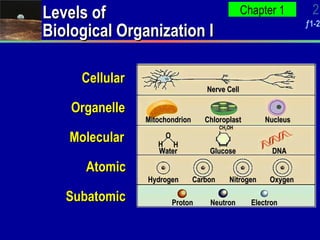
Levels of Biological Organization I Subatomic Electron Neutron Proton Nitrogen Carbon Hydrogen Oxygen DNA Glucose Water Nucleus Chloroplast Mitochondrion Nerve Cell Atomic Molecular Organelle Cellular O H H CH 2 OH
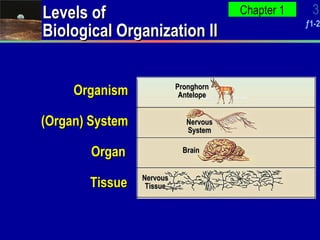
Levels of Biological Organization II Tissue Nervous Tissue Brain Nervous System Pronghorn Antelope Organ (Organ) System Organism
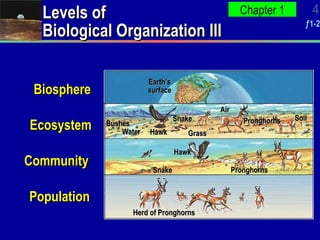
Levels of Biological Organization III Population Herd of Pronghorns Hawk Water Earth’s surface Community Ecosystem Biosphere Pronghorns Hawk Grass Pronghorns Snake Bushes Soil Air Snake
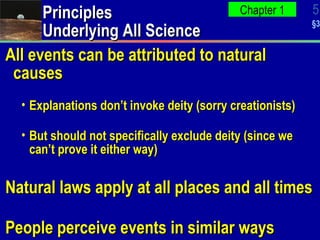
Principles Underlying All Science All events can be attributed to natural causes Explanations don’t invoke deity (sorry creationists) But should not specifically exclude deity (since we can’t prove it either way) Natural laws apply at all places and all times People perceive events in similar ways


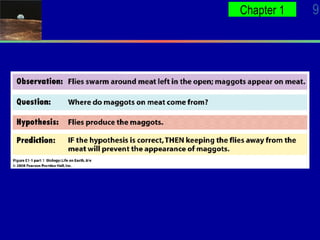
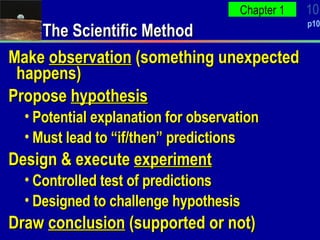
The Scientific Method Make  observation  (something unexpected happens) Propose  hypothesis Potential explanation for observation Must lead to “if/then” predictions Design & execute  experiment Controlled test of predictions Designed to challenge hypothesis Draw  conclusion  (supported or not)
Scientific Theories A general statement about how things operate Derived through  inductive reasoning Has survived thorough challenges Never permanent or final “truth” Always provisional (tentative) Always subject to change or replacement Used to propose hypotheses ( deductive reasoning )
Evolution: Unifying Theories of Biology All species evolved from previous species Theories of origin that emerged from inductive reasoning Evolutionary theory emerges from data (true science) Creationism imposes itself on data (not science but doctrine of faith) Extremely vital web linking all biological information
When environment changes: Species must adapt to new conditions Some can’t and go extinct Dinosaurs Experienced changes 65 mya Were unable to adapt fast enough Globally extinct Changing Conditions
Characteristics of Living Things Complex, organized & made of cells Must get materials & energy Homeostasis maintains internal conditions Growth Respond to stimuli Reproduce themselves Capacity to evolve
Salt; Organized but simple Oceans; Complex but unorganized Water flea; Organized and complex Cells are the basic unit of organization in living things Characteristics: 1.  Complex, Organized, Cells
Characteristics: 2. Respond to Stimuli Changes in internal environment Temperature Water level Blood sugar level Changes in external environment Seek food and water Avoid bitterness Plants grow toward light
Characteristics: 3. Homeostasis Organized systems disintegrate Preventing disintegration requires energy Homeostasis  means “staying the same” Sweating when hot; shivering when cold Thirsting when water is low
Characteristics: 4. Acquire Materials and Energy Homeostasis requires energy Opposes natural trend to disintegration  Obtained from external source Homeostasis requires physical repair Parts break down New materials required for repair Food supplies material and energy
Characteristics: 5. Growth Violates homeostasis Homeostasis “staying the same” Growth = homeostasis plus extra Organism grows in size/mass Must acquire more than needed for homeostasis Genetically programmed Timing Size Shape
Characteristics: 6. Reproduction Reproduce themselves in kind (heredity) Perpetuation of parents’ genetics Genetic info stored in DNA chemical Variation Offspring similar to both parents Offspring different from either parent Simple code with complex error correction system
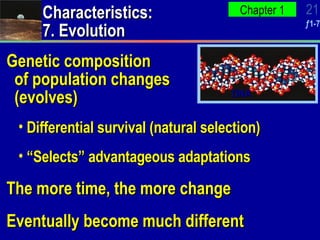
Genetic composition of population changes (evolves) Differential survival (natural selection) “Selects” advantageous adaptations The more time, the more change Eventually become much different Characteristics: 7. Evolution DNA
Made of Cells (well, at least 1) Reproduce Obtain/Use Energy Respond to Environment Grow/Develop Mr. D’s Characteristics of Life
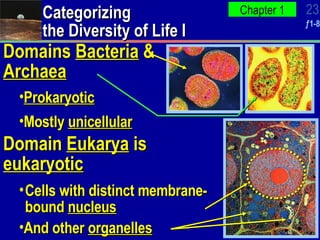
Categorizing the Diversity of Life I Domains  Bacteria  &  Archaea Prokaryotic Mostly  unicellular Domain  Eukarya  is  eukaryotic And other  organelles Cells with distinct membrane-bound  nucleus
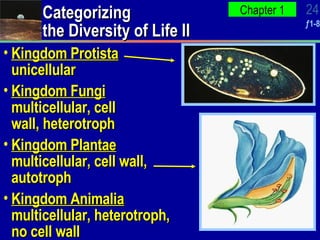
Categorizing the Diversity of Life II Kingdom Protista  unicellular Kingdom Fungi  multicellular, cell wall, heterotroph Kingdom Plantae  multicellular, cell wall, autotroph Kingdom Animalia  multicellular, heterotroph, no cell wall
Variations in Energy Acquisition Plantae Capture light energy Use to make food from carbon dioxide Photosynthetic   autotrophs Most others: Eat other organisms to get food Some absorb particles Others ingest bites Heterotrophs
The End

AP Bio Ch 1 PowerPoint

  • 1.
  • 2.
    Levels of BiologicalOrganization I Subatomic Electron Neutron Proton Nitrogen Carbon Hydrogen Oxygen DNA Glucose Water Nucleus Chloroplast Mitochondrion Nerve Cell Atomic Molecular Organelle Cellular O H H CH 2 OH
  • 3.
    Levels of BiologicalOrganization II Tissue Nervous Tissue Brain Nervous System Pronghorn Antelope Organ (Organ) System Organism
  • 4.
    Levels of BiologicalOrganization III Population Herd of Pronghorns Hawk Water Earth’s surface Community Ecosystem Biosphere Pronghorns Hawk Grass Pronghorns Snake Bushes Soil Air Snake
  • 5.
    Principles Underlying AllScience All events can be attributed to natural causes Explanations don’t invoke deity (sorry creationists) But should not specifically exclude deity (since we can’t prove it either way) Natural laws apply at all places and all times People perceive events in similar ways
  • 6.
  • 7.
  • 8.
  • 9.
  • 10.
    The Scientific MethodMake observation (something unexpected happens) Propose hypothesis Potential explanation for observation Must lead to “if/then” predictions Design & execute experiment Controlled test of predictions Designed to challenge hypothesis Draw conclusion (supported or not)
  • 11.
    Scientific Theories Ageneral statement about how things operate Derived through inductive reasoning Has survived thorough challenges Never permanent or final “truth” Always provisional (tentative) Always subject to change or replacement Used to propose hypotheses ( deductive reasoning )
  • 12.
    Evolution: Unifying Theoriesof Biology All species evolved from previous species Theories of origin that emerged from inductive reasoning Evolutionary theory emerges from data (true science) Creationism imposes itself on data (not science but doctrine of faith) Extremely vital web linking all biological information
  • 13.
    When environment changes:Species must adapt to new conditions Some can’t and go extinct Dinosaurs Experienced changes 65 mya Were unable to adapt fast enough Globally extinct Changing Conditions
  • 14.
    Characteristics of LivingThings Complex, organized & made of cells Must get materials & energy Homeostasis maintains internal conditions Growth Respond to stimuli Reproduce themselves Capacity to evolve
  • 15.
    Salt; Organized butsimple Oceans; Complex but unorganized Water flea; Organized and complex Cells are the basic unit of organization in living things Characteristics: 1. Complex, Organized, Cells
  • 16.
    Characteristics: 2. Respondto Stimuli Changes in internal environment Temperature Water level Blood sugar level Changes in external environment Seek food and water Avoid bitterness Plants grow toward light
  • 17.
    Characteristics: 3. HomeostasisOrganized systems disintegrate Preventing disintegration requires energy Homeostasis means “staying the same” Sweating when hot; shivering when cold Thirsting when water is low
  • 18.
    Characteristics: 4. AcquireMaterials and Energy Homeostasis requires energy Opposes natural trend to disintegration Obtained from external source Homeostasis requires physical repair Parts break down New materials required for repair Food supplies material and energy
  • 19.
    Characteristics: 5. GrowthViolates homeostasis Homeostasis “staying the same” Growth = homeostasis plus extra Organism grows in size/mass Must acquire more than needed for homeostasis Genetically programmed Timing Size Shape
  • 20.
    Characteristics: 6. ReproductionReproduce themselves in kind (heredity) Perpetuation of parents’ genetics Genetic info stored in DNA chemical Variation Offspring similar to both parents Offspring different from either parent Simple code with complex error correction system
  • 21.
    Genetic composition ofpopulation changes (evolves) Differential survival (natural selection) “Selects” advantageous adaptations The more time, the more change Eventually become much different Characteristics: 7. Evolution DNA
  • 22.
    Made of Cells(well, at least 1) Reproduce Obtain/Use Energy Respond to Environment Grow/Develop Mr. D’s Characteristics of Life
  • 23.
    Categorizing the Diversityof Life I Domains Bacteria & Archaea Prokaryotic Mostly unicellular Domain Eukarya is eukaryotic And other organelles Cells with distinct membrane-bound nucleus
  • 24.
    Categorizing the Diversityof Life II Kingdom Protista unicellular Kingdom Fungi multicellular, cell wall, heterotroph Kingdom Plantae multicellular, cell wall, autotroph Kingdom Animalia multicellular, heterotroph, no cell wall
  • 25.
    Variations in EnergyAcquisition Plantae Capture light energy Use to make food from carbon dioxide Photosynthetic autotrophs Most others: Eat other organisms to get food Some absorb particles Others ingest bites Heterotrophs
  • 26.

Editor's Notes

  • #2 Life on Earth is confined to a thin film encompassing Earth's surface: the biosphere. Earth, seen from the Moon, is an oasis of life in our solar system.