HOMEOSTASIS
Dr Nilesh N Kate
Associate Professor
ESIC Medical College.
Gulbarga.
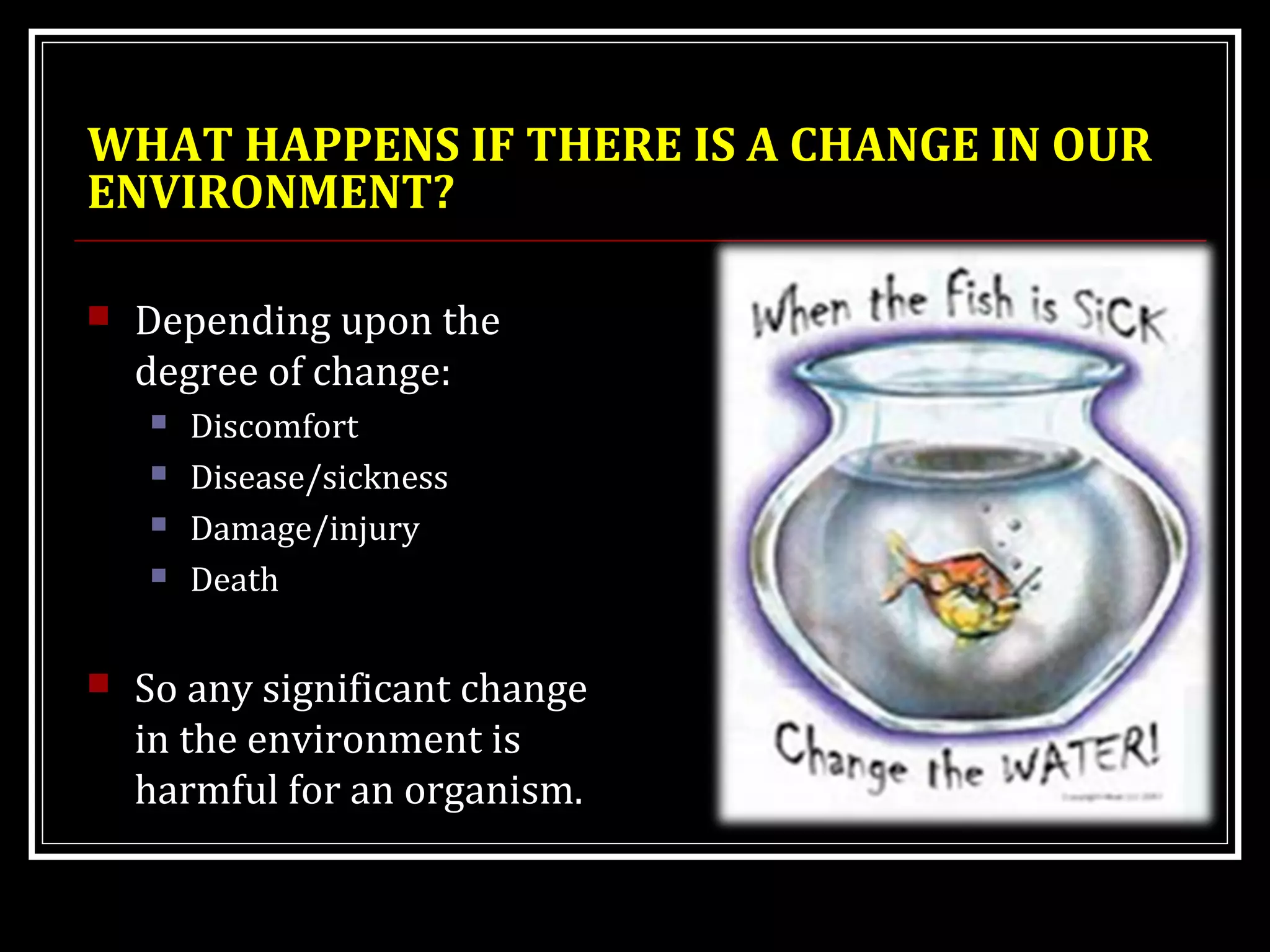
WHAT HAPPENS IF THERE IS A CHANGE IN OUR
ENVIRONMENT?
 Depending upon the
degree of change:
 Discomfort
 Disease/sickness
 Damage/injury
 Death
 So any significant change
in the environment is
harmful for an organism.
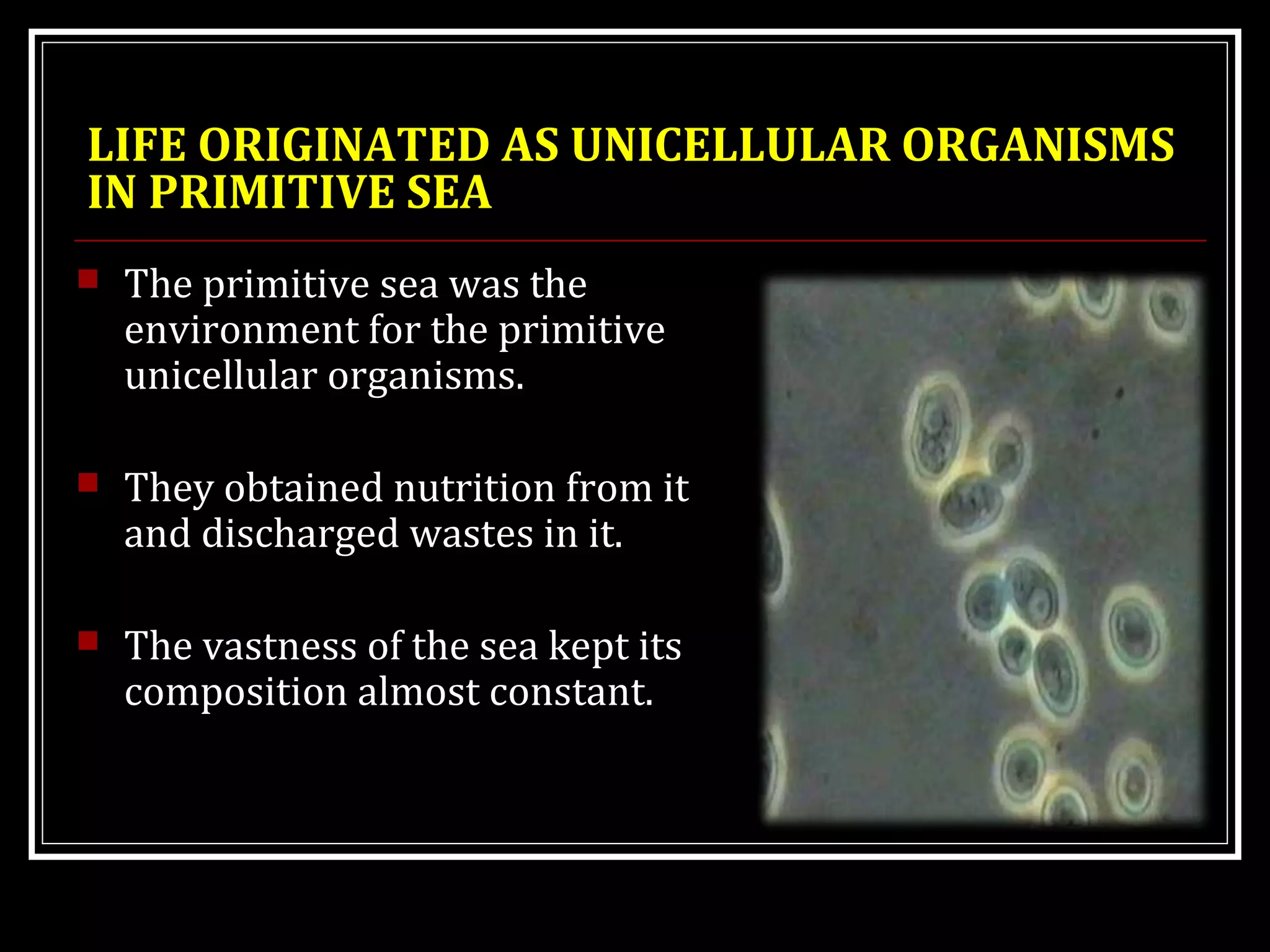
LIFE ORIGINATED AS UNICELLULAR ORGANISMS
IN PRIMITIVE SEA
 The primitive sea was the
environment for the primitive
unicellular organisms.
 They obtained nutrition from it
and discharged wastes in it.
 The vastness of the sea kept its
composition almost constant.
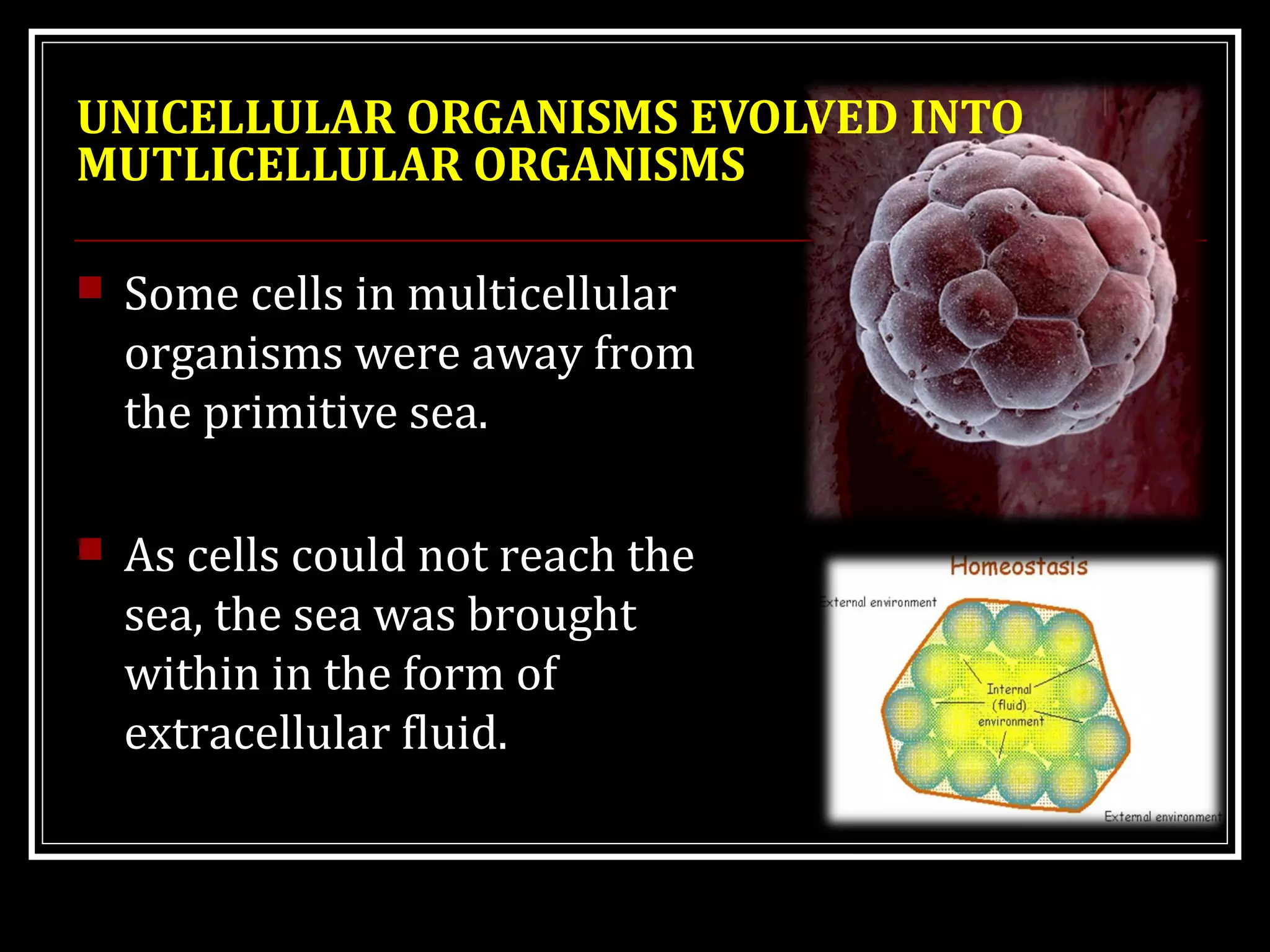
UNICELLULAR ORGANISMS EVOLVED INTO
MUTLICELLULAR ORGANISMS
 Some cells in multicellular
organisms were away from
the primitive sea.
 As cells could not reach the
sea, the sea was brought
within in the form of
extracellular fluid.
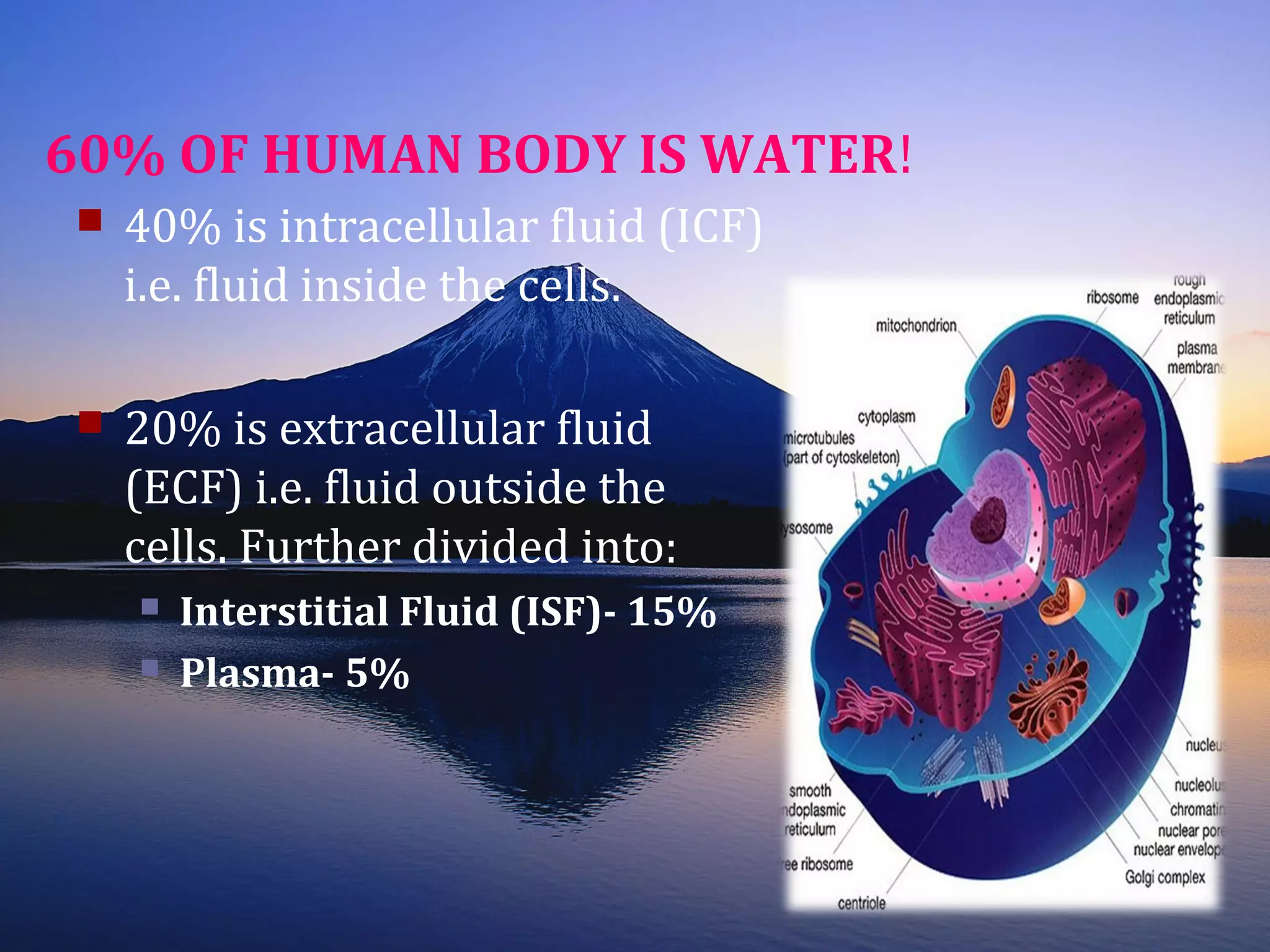
60% OF HUMAN BODY IS WATER!
 40% is intracellular fluid (ICF)
i.e. fluid inside the cells.
 20% is extracellular fluid
(ECF) i.e. fluid outside the
cells. Further divided into:
 Interstitial Fluid (ISF)- 15%
 Plasma- 5%
ECF: THE INTERNAL ENVIRONMENT OF
THE BODY
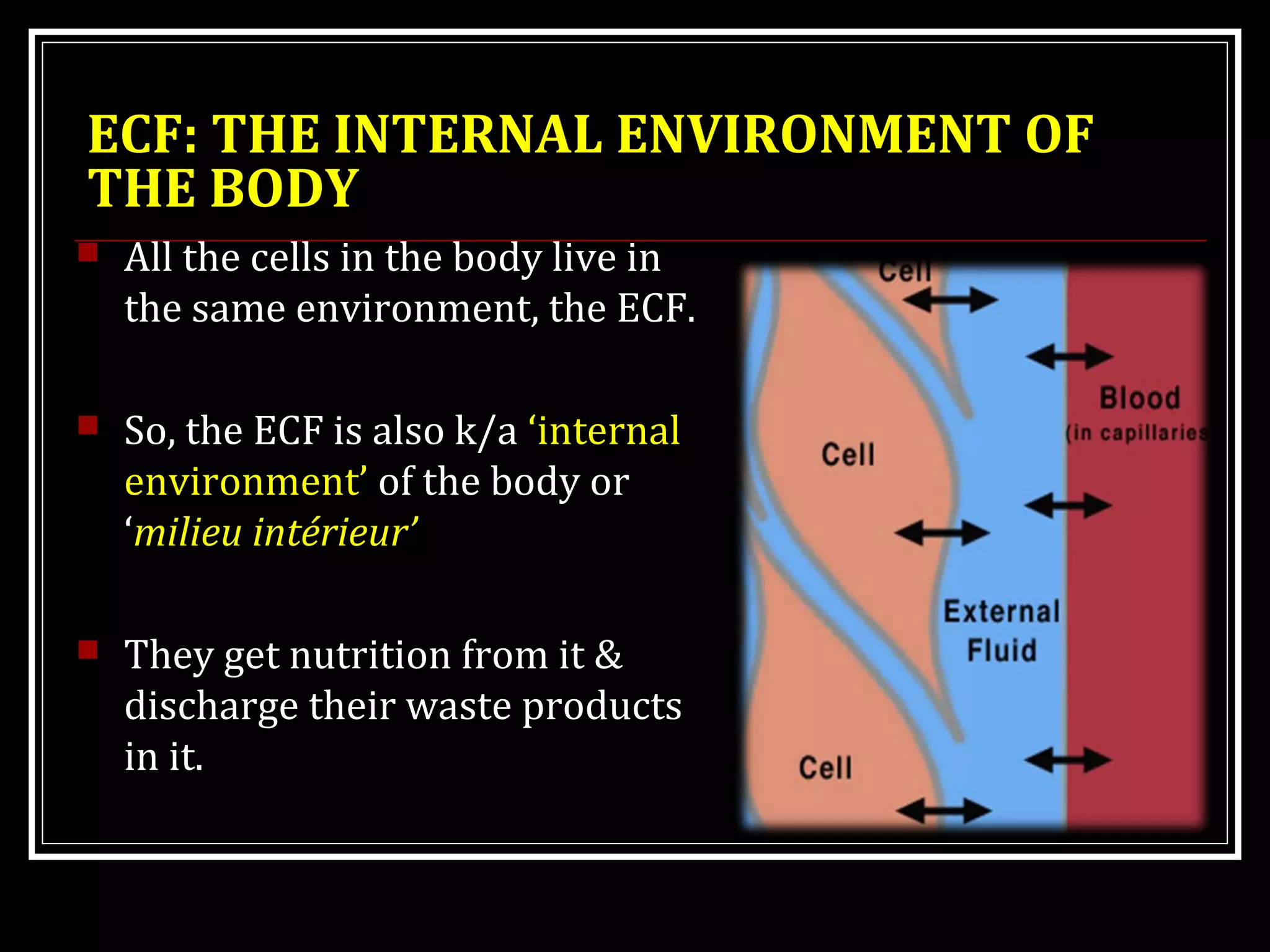
 All the cells in the body live in
the same environment, the ECF.
 So, the ECF is also k/a ‘internal
environment’ of the body or
‘milieu intérieur’
 They get nutrition from it &
discharge their waste products
in it.
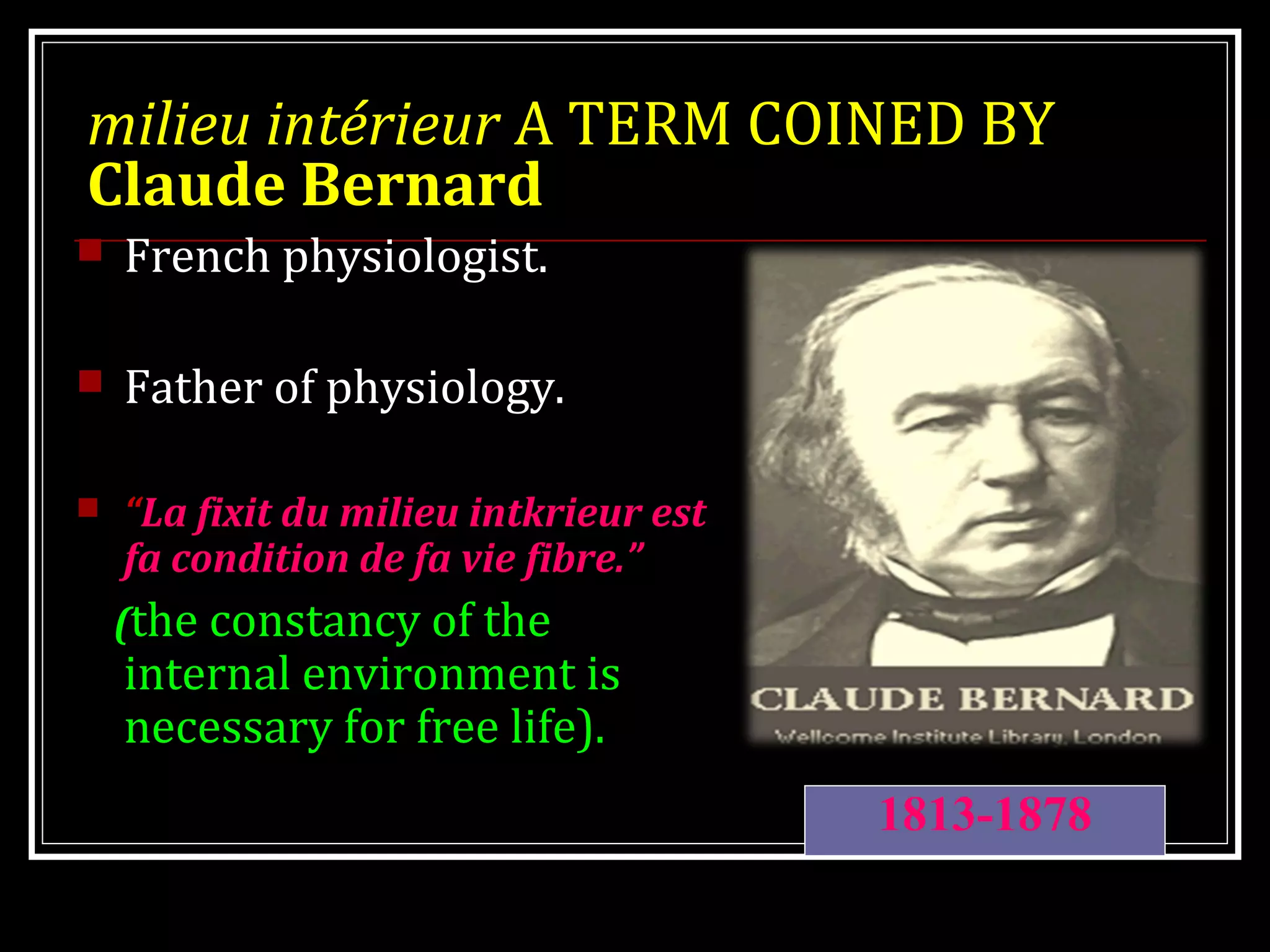
milieu intérieur A TERM COINED BY
Claude Bernard
 French physiologist.
 Father of physiology.
 “La fixit du milieu intkrieur est
fa condition de fa vie fibre.”
(the constancy of the
internal environment is
necessary for free life).
1813-1878
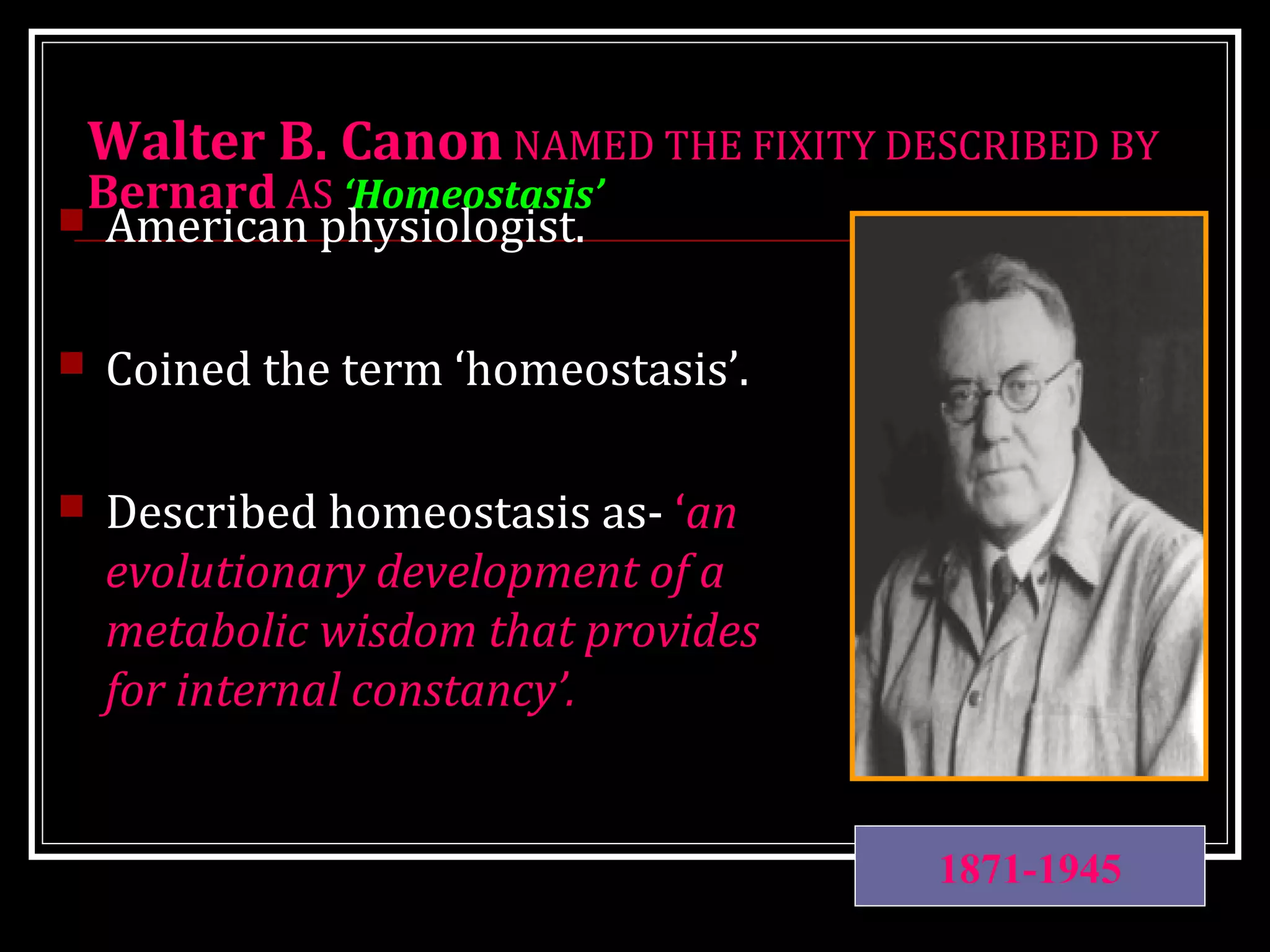
Walter B. Canon NAMED THE FIXITY DESCRIBED BY
Bernard AS ‘Homeostasis’
 American physiologist.
 Coined the term ‘homeostasis’.
 Described homeostasis as- ‘an
evolutionary development of a
metabolic wisdom that provides
for internal constancy’.
1871-1945
HOMEOSTASIS
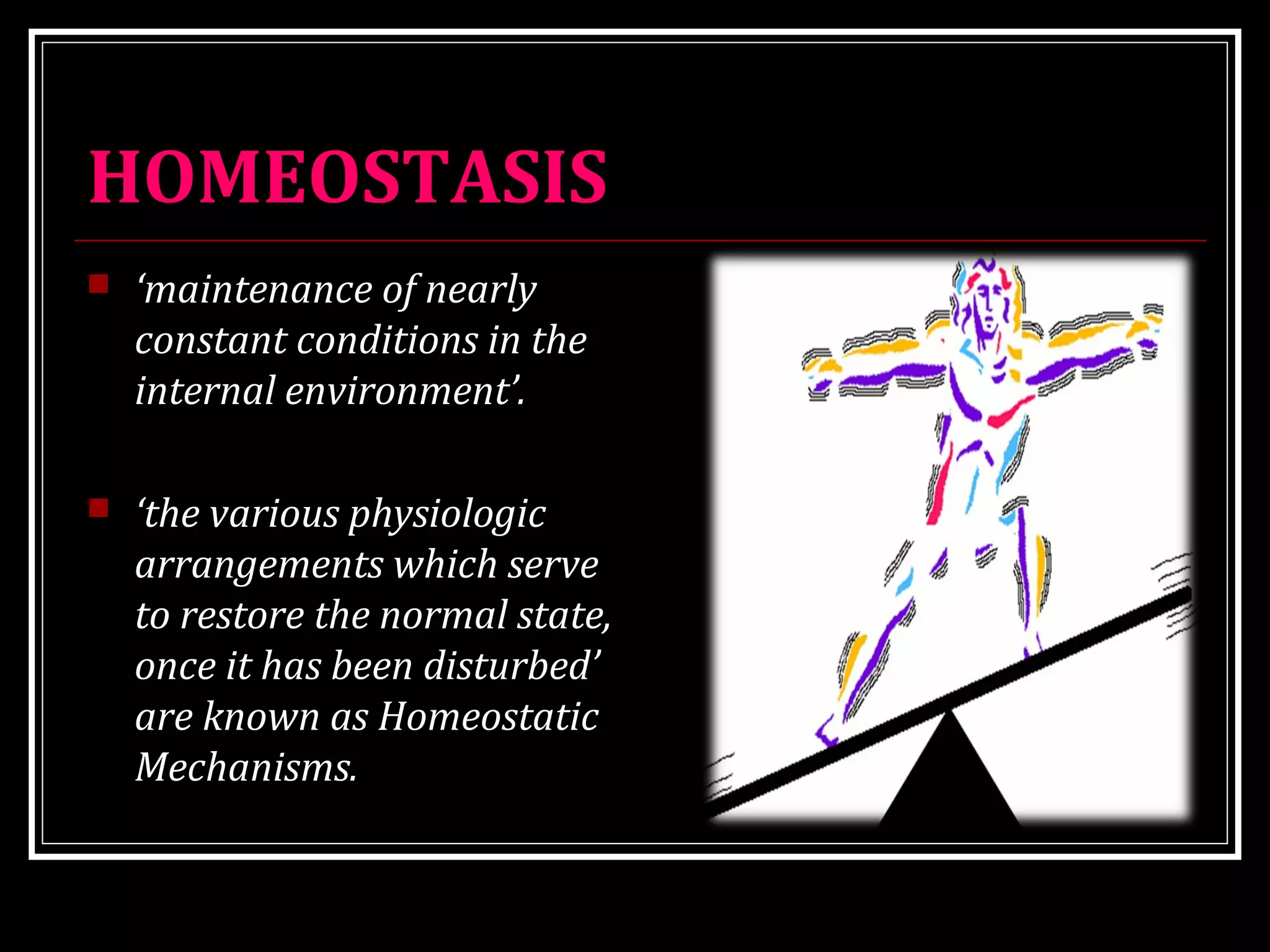
 ‘maintenance of nearly
constant conditions in the
internal environment’.
 ‘the various physiologic
arrangements which serve
to restore the normal state,
once it has been disturbed’
are known as Homeostatic
Mechanisms.
WHAT NEEDS TO BE MAINTAINED CONSTANT IN
INTERNAL ENVIRONMENT?
1. Concentration of oxygen
and carbon dioxide.
2. pH of the internal
environment.
3. Concentration of
nutrients and waste
products.
4. Concentration of salt
and other electrolytes.
5. Volume and pressure of
extracellular fluid.
HOMEOSTASIS: AS DESCRIBED BY CANON
 perturbation in the organism’s steady state may arise from
changes within the organism as well as changes from without.
 homeostasis is not the responsibility of a single system but that
all the organ systems of the body operate cooperatively to effect
internal constancy.
 each cell benefits from homeostasis, and in turn, each cell
contributes its share toward the maintenance of homeostasis.
 the more “advanced” the evolutionary stage of a particular group
or organisms, the more subtle and complex the homeostatic
apparatus.
ALL ORGANS AND ORGAN SYSTEMS OF THE BODY HELP
IN MAINTENANCE OF HOMEOSTASIS
 Cardiovascular system.
 Respiratory system.
 Nervous system.
 Endocrine system.
 Gastrointestinal system.
 Excretory system.
 Skeletal system.
 Integumentry system.
 Reproductive system.
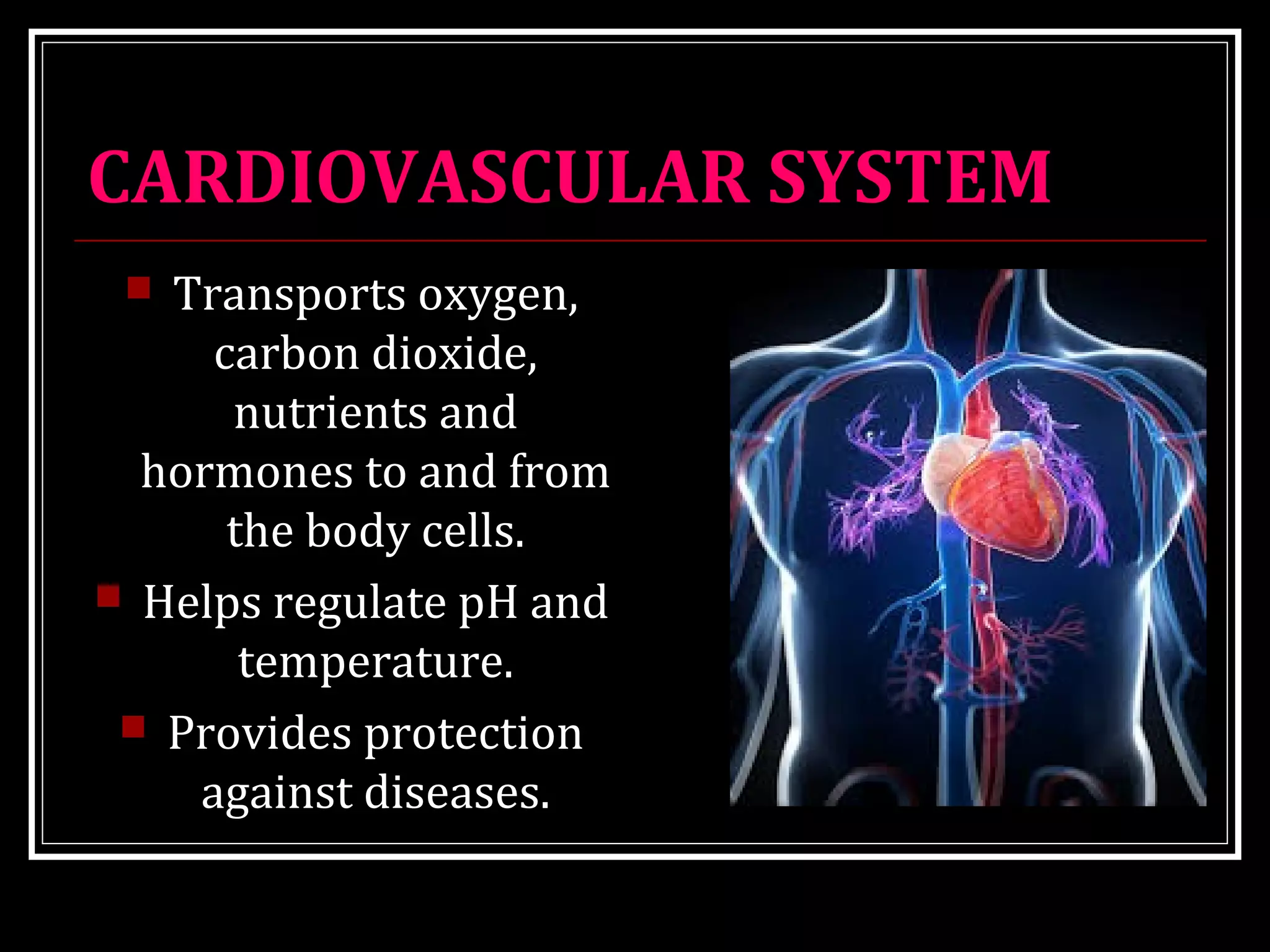
CARDIOVASCULAR SYSTEM
 Transports oxygen,
carbon dioxide,
nutrients and
hormones to and from
the body cells.
 Helps regulate pH and
temperature.
 Provides protection
against diseases.
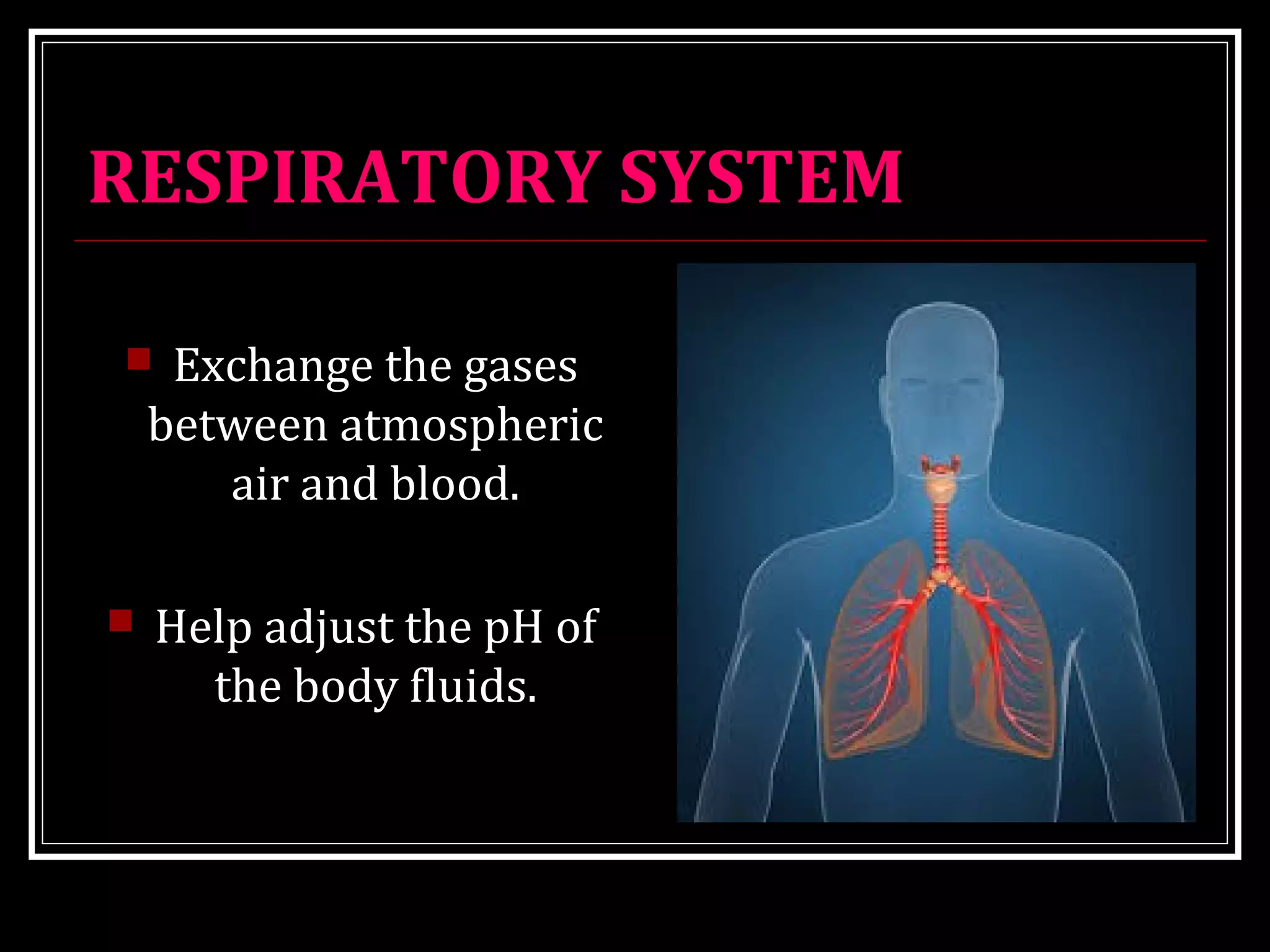
RESPIRATORY SYSTEM
 Exchange the gases
between atmospheric
air and blood.
 Help adjust the pH of
the body fluids.
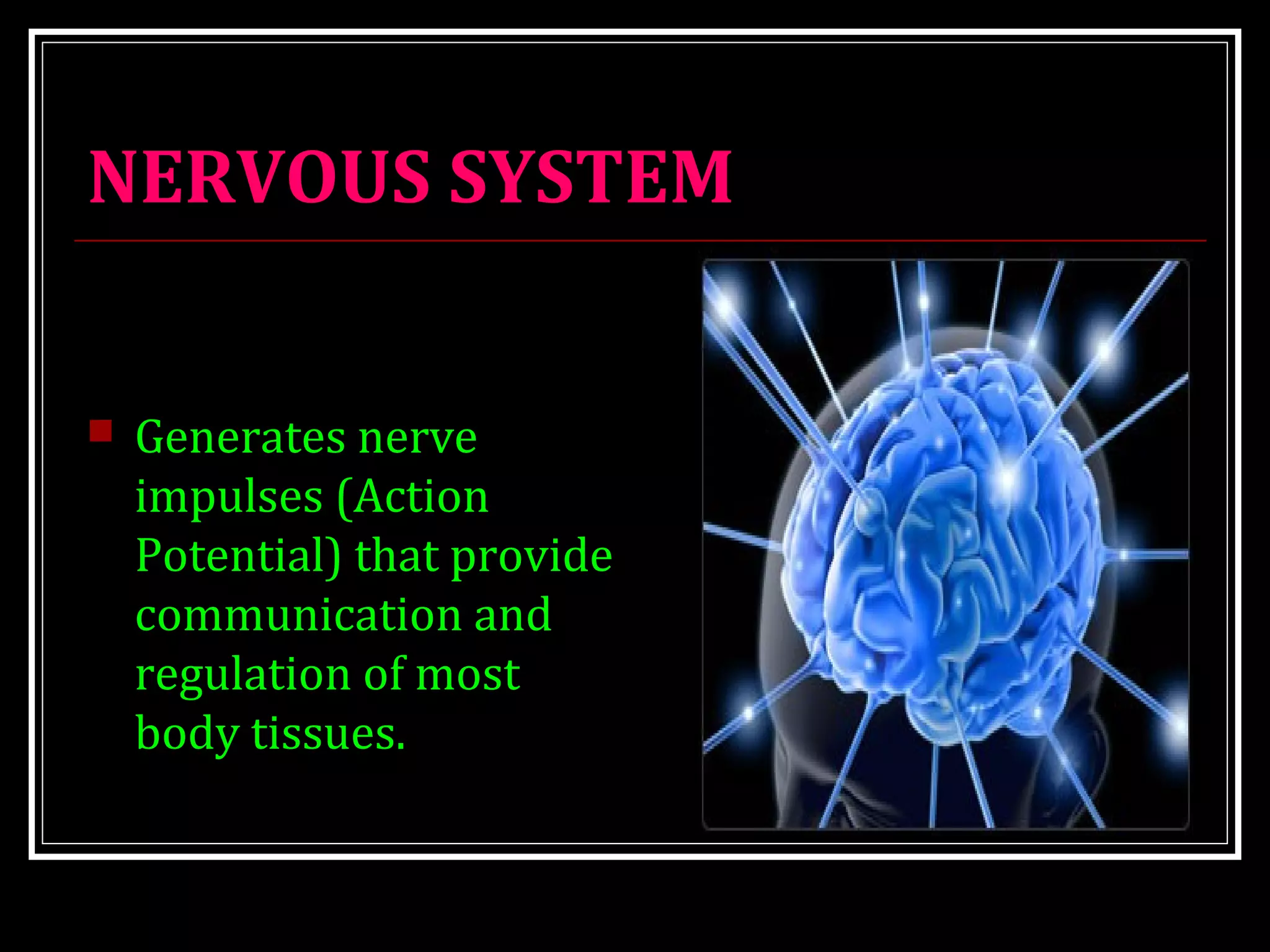
NERVOUS SYSTEM
 Generates nerve
impulses (Action
Potential) that provide
communication and
regulation of most
body tissues.
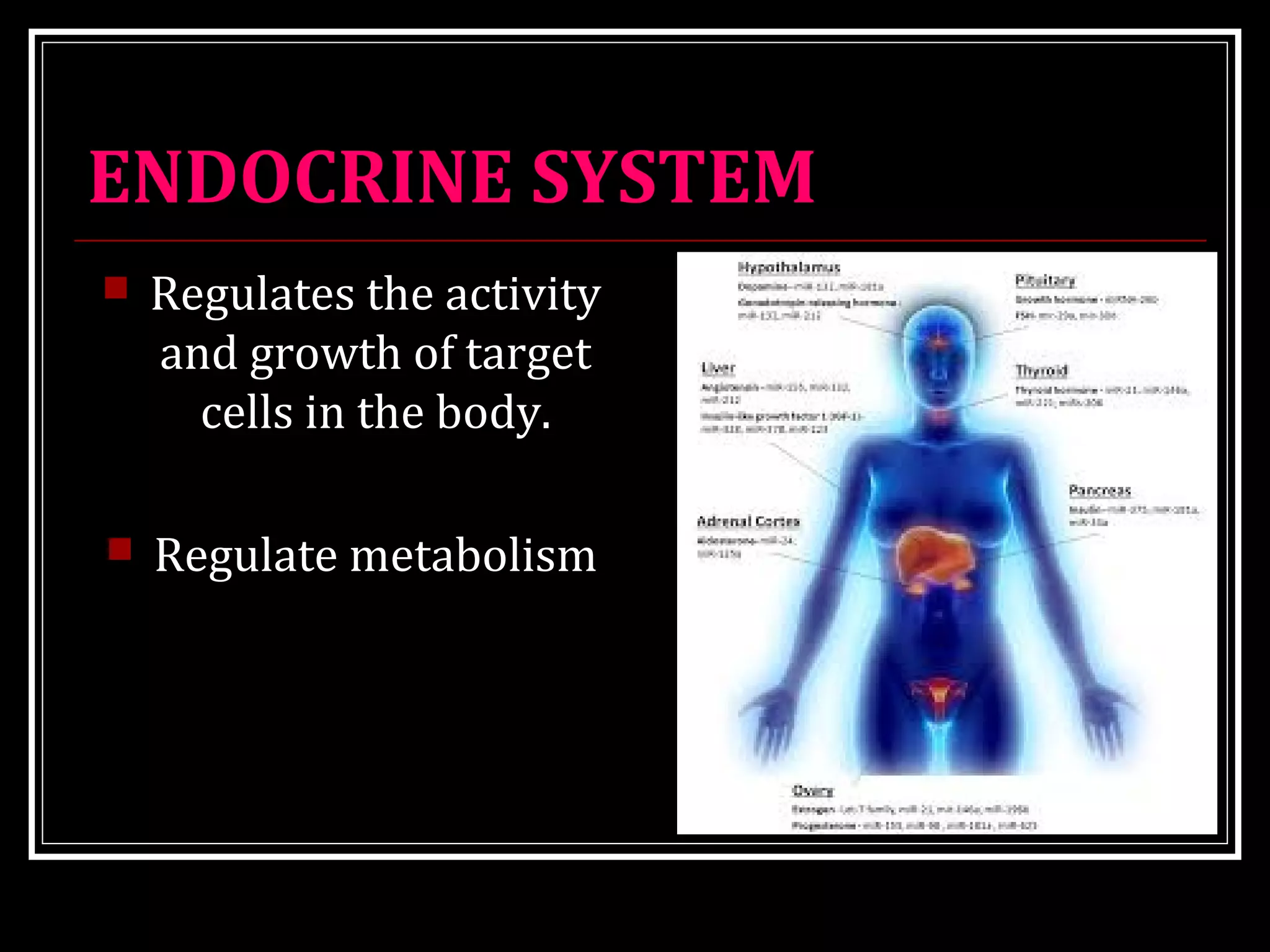
ENDOCRINE SYSTEM
 Regulates the activity
and growth of target
cells in the body.
 Regulate metabolism
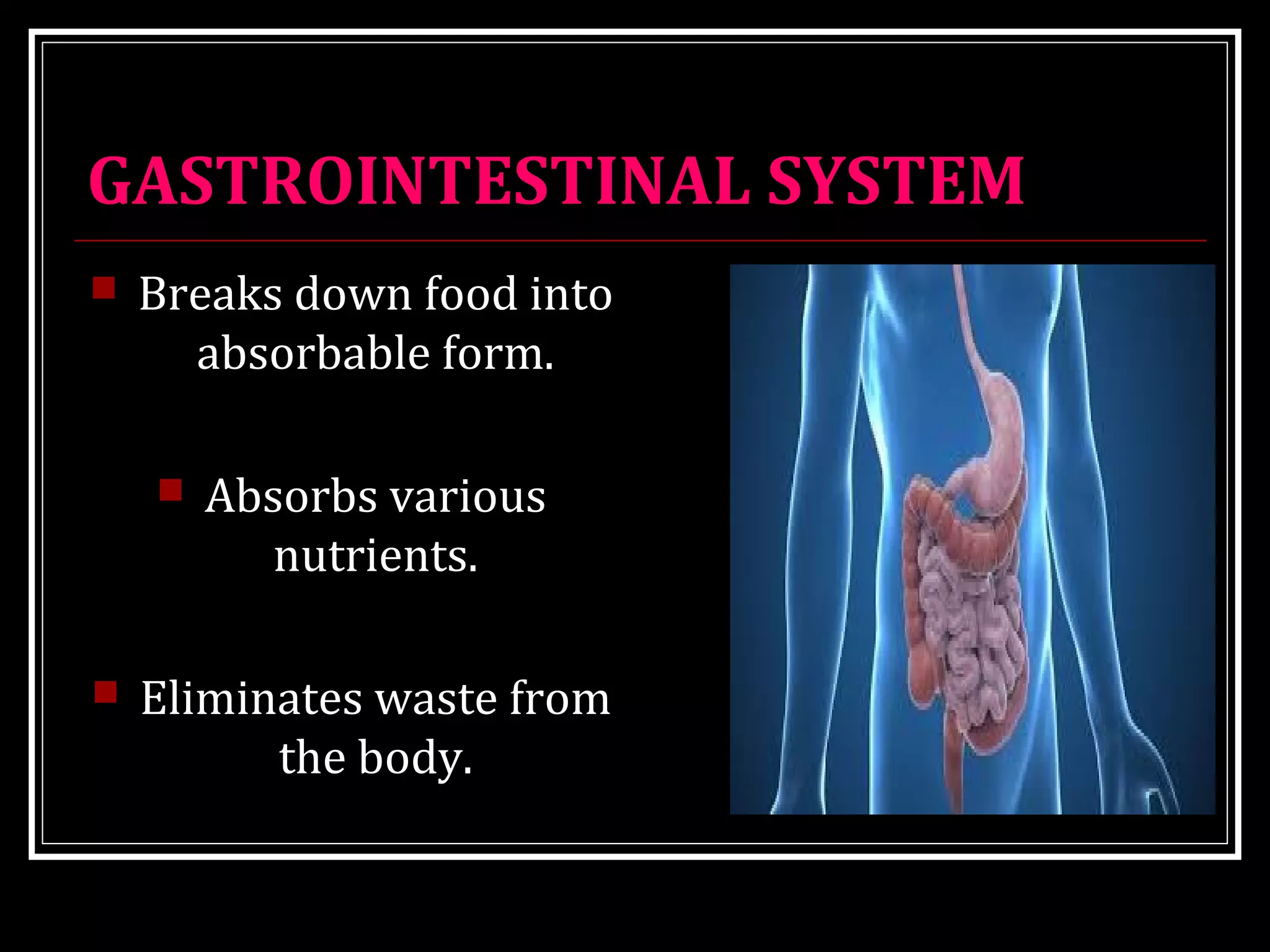
GASTROINTESTINAL SYSTEM
 Breaks down food into
absorbable form.
 Absorbs various
nutrients.
 Eliminates waste from
the body.
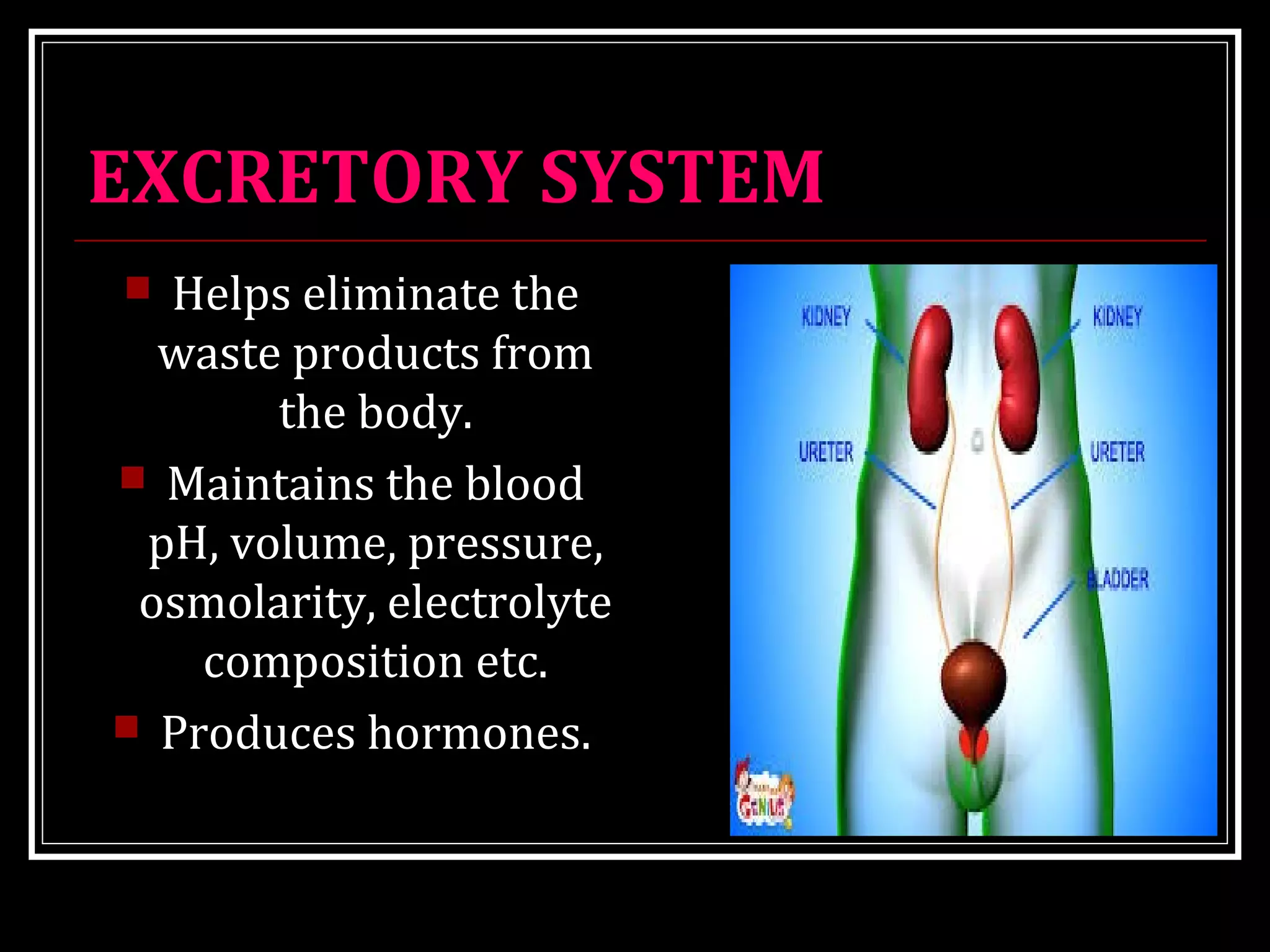
EXCRETORY SYSTEM
 Helps eliminate the
waste products from
the body.
 Maintains the blood
pH, volume, pressure,
osmolarity, electrolyte
composition etc.
 Produces hormones.
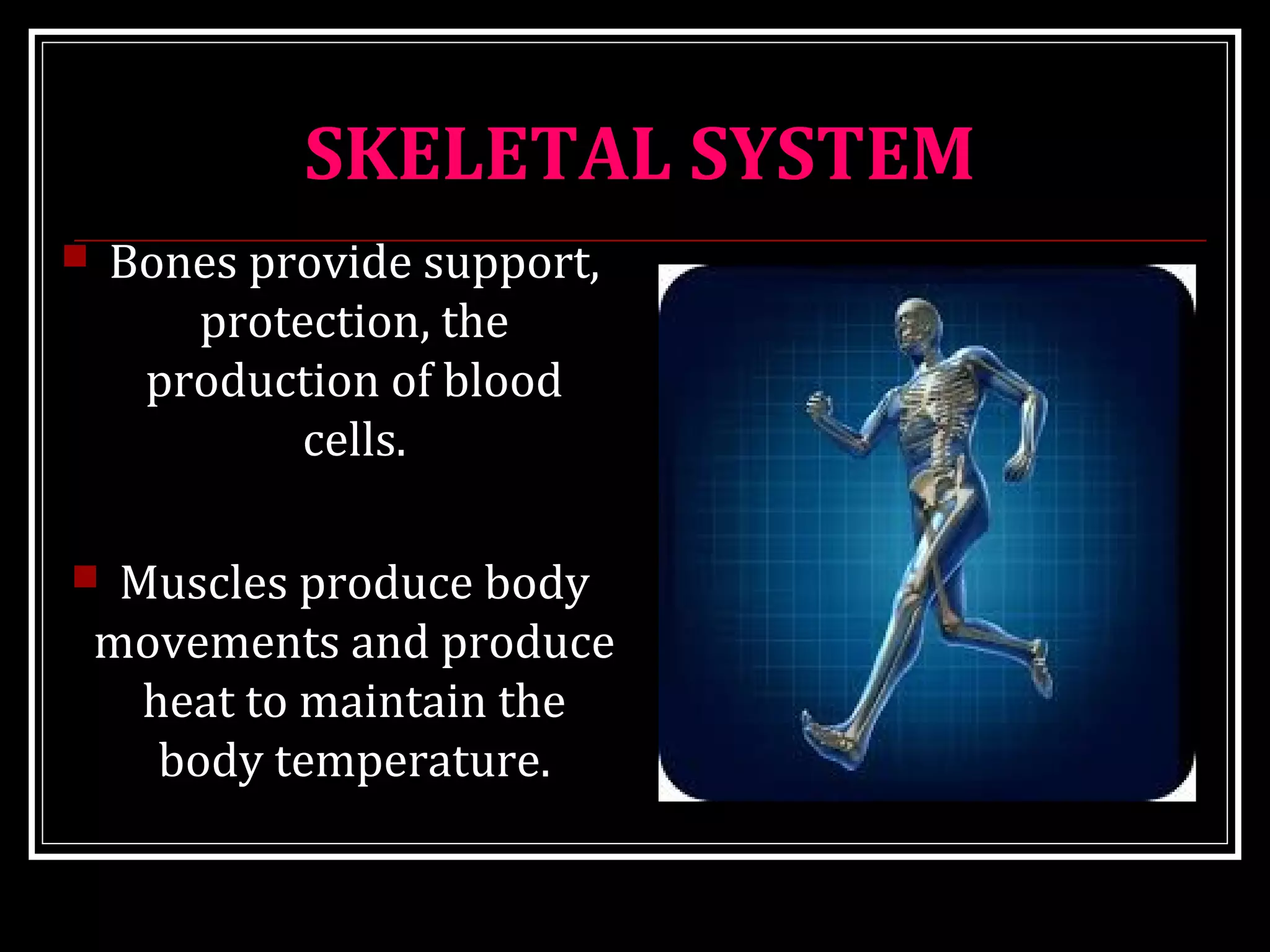
SKELETAL SYSTEM
 Bones provide support,
protection, the
production of blood
cells.
 Muscles produce body
movements and produce
heat to maintain the
body temperature.
INTEGUMENTARY SYSTEM
 Contributes to
homeostasis by
protecting the body
and helping regulate
the body temperature.
It also allows you to
sense pleasurable,
painful and other
stimuli in your
external environment.
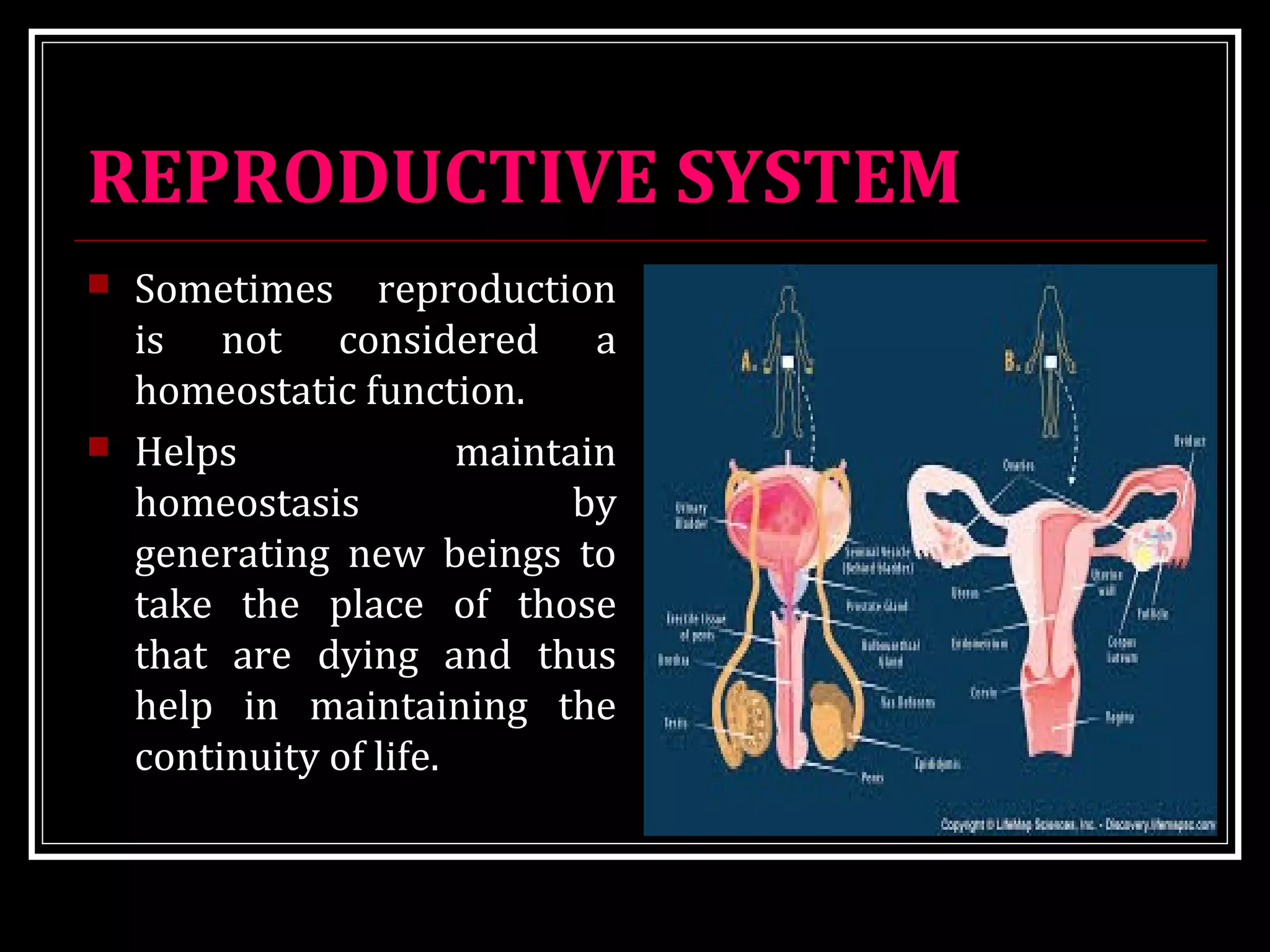
REPRODUCTIVE SYSTEM
 Sometimes reproduction
is not considered a
homeostatic function.
 Helps maintain
homeostasis by
generating new beings to
take the place of those
that are dying and thus
help in maintaining the
continuity of life.
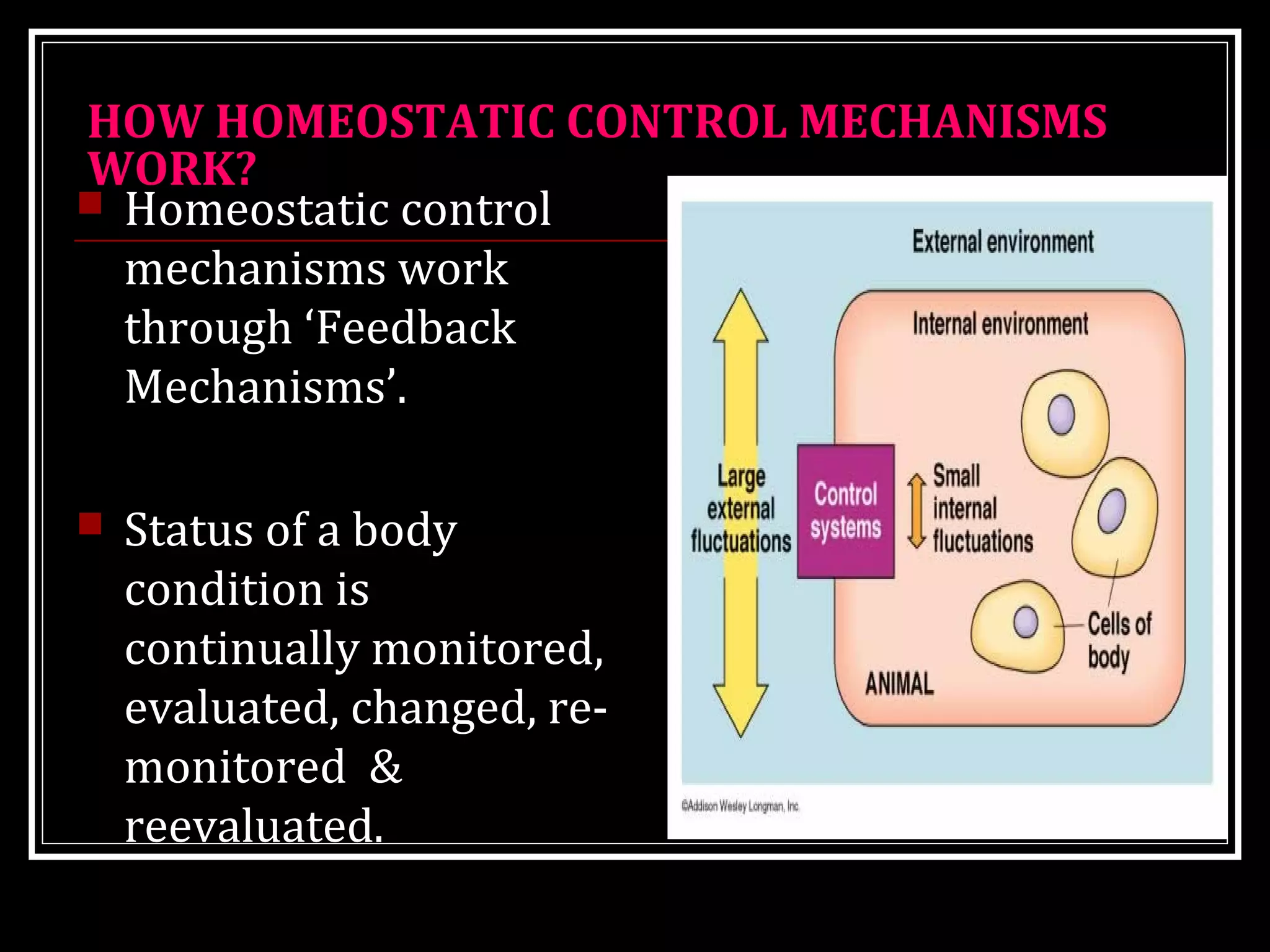
HOW HOMEOSTATIC CONTROL MECHANISMS
WORK?
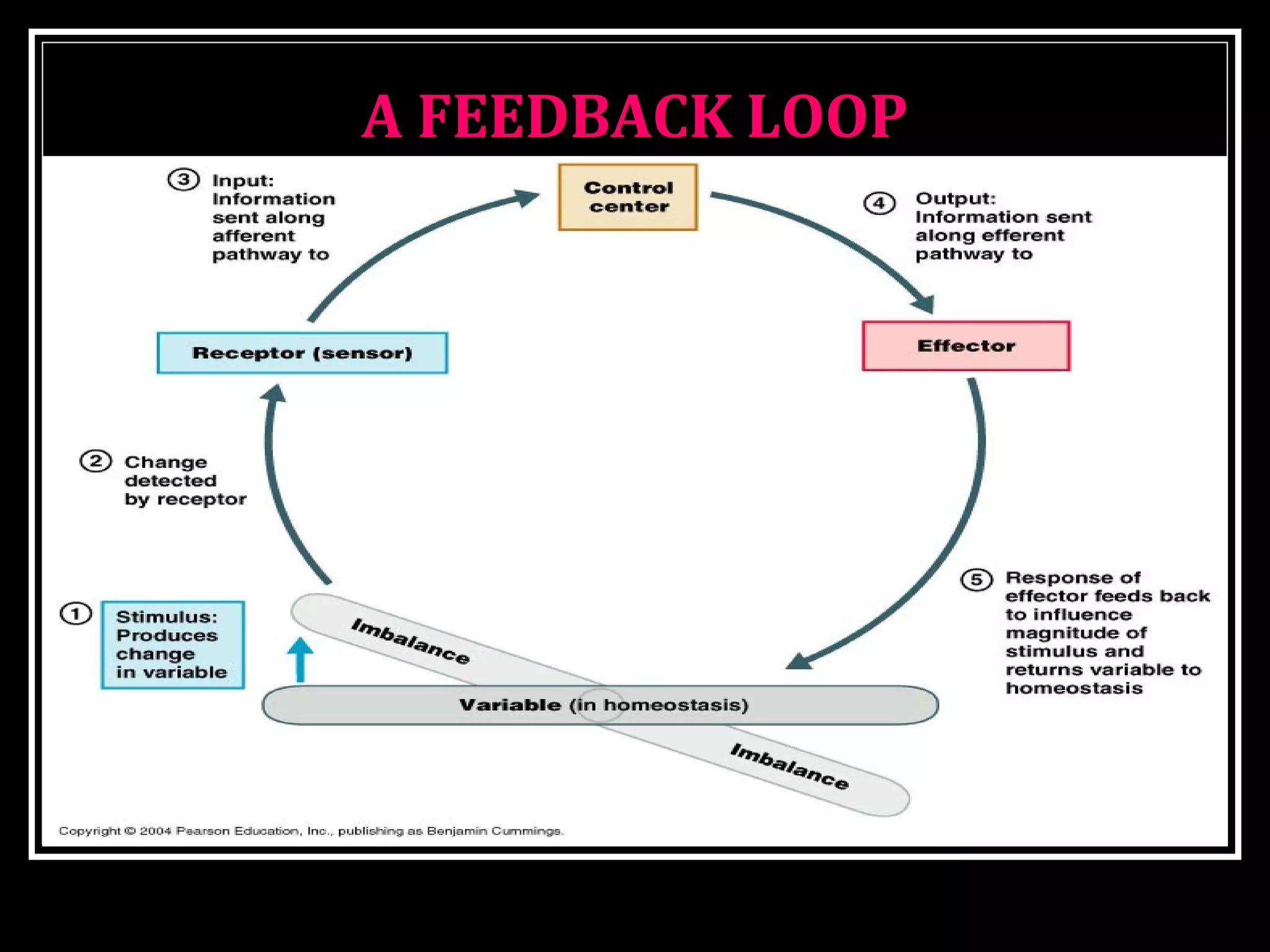
 Homeostatic control
mechanisms work
through ‘Feedback
Mechanisms’.
 Status of a body
condition is
continually monitored,
evaluated, changed, re-
monitored &
reevaluated.
FEEDBACK MECHANISM
 A feedback mechanism is a cycle in which the
output of a system “feeds back” to either modify or
reinforce the action taken by the system.
 A feedback mechanism may operate at:
 Tissue level
 Organ level
 Organ system level
 Body level, integrating with other organ systems.
 Feedback mechanism can be:
 Negative feedback (more common)
 Positive feedback
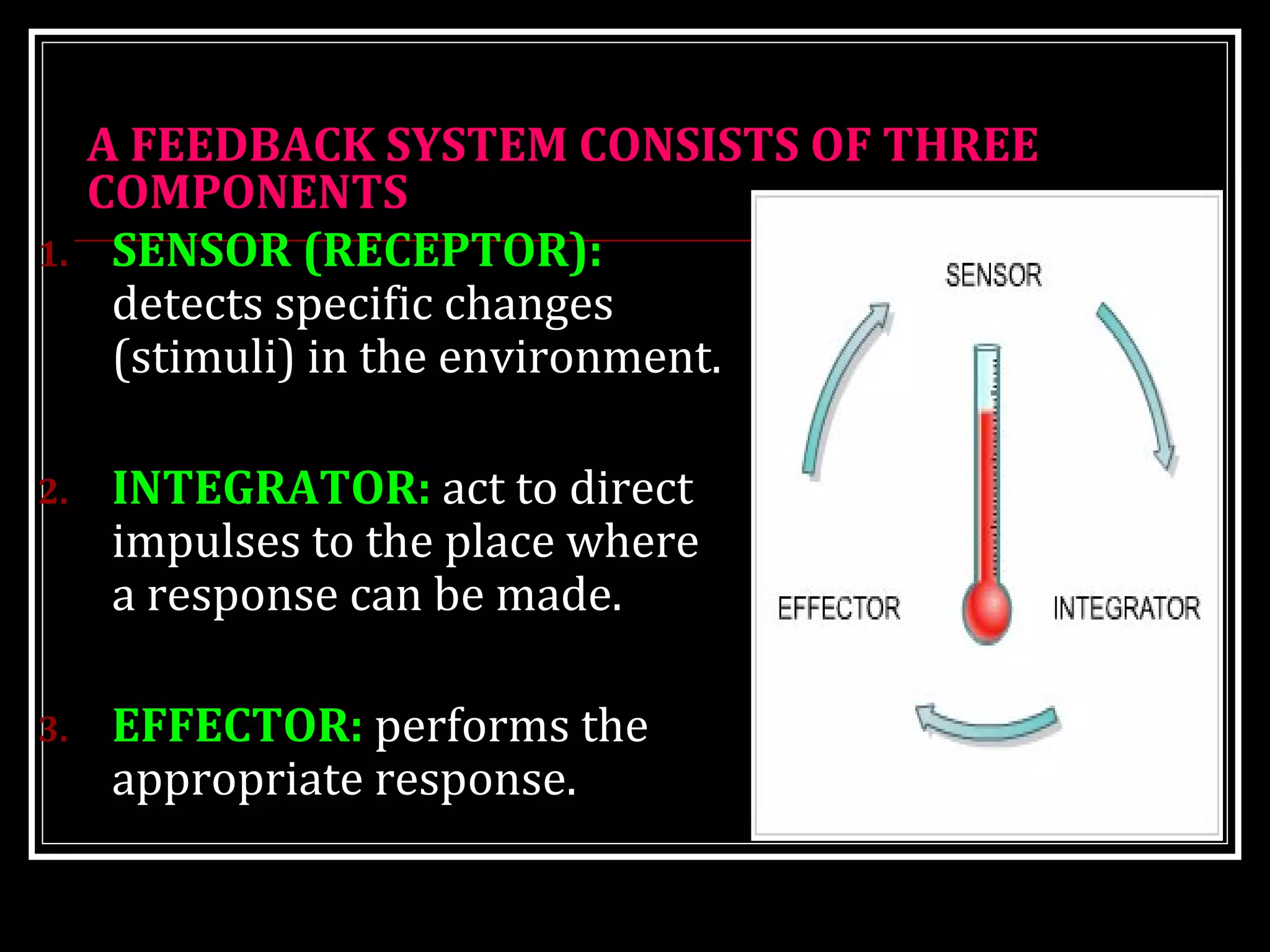
A FEEDBACK SYSTEM CONSISTS OF THREE
COMPONENTS
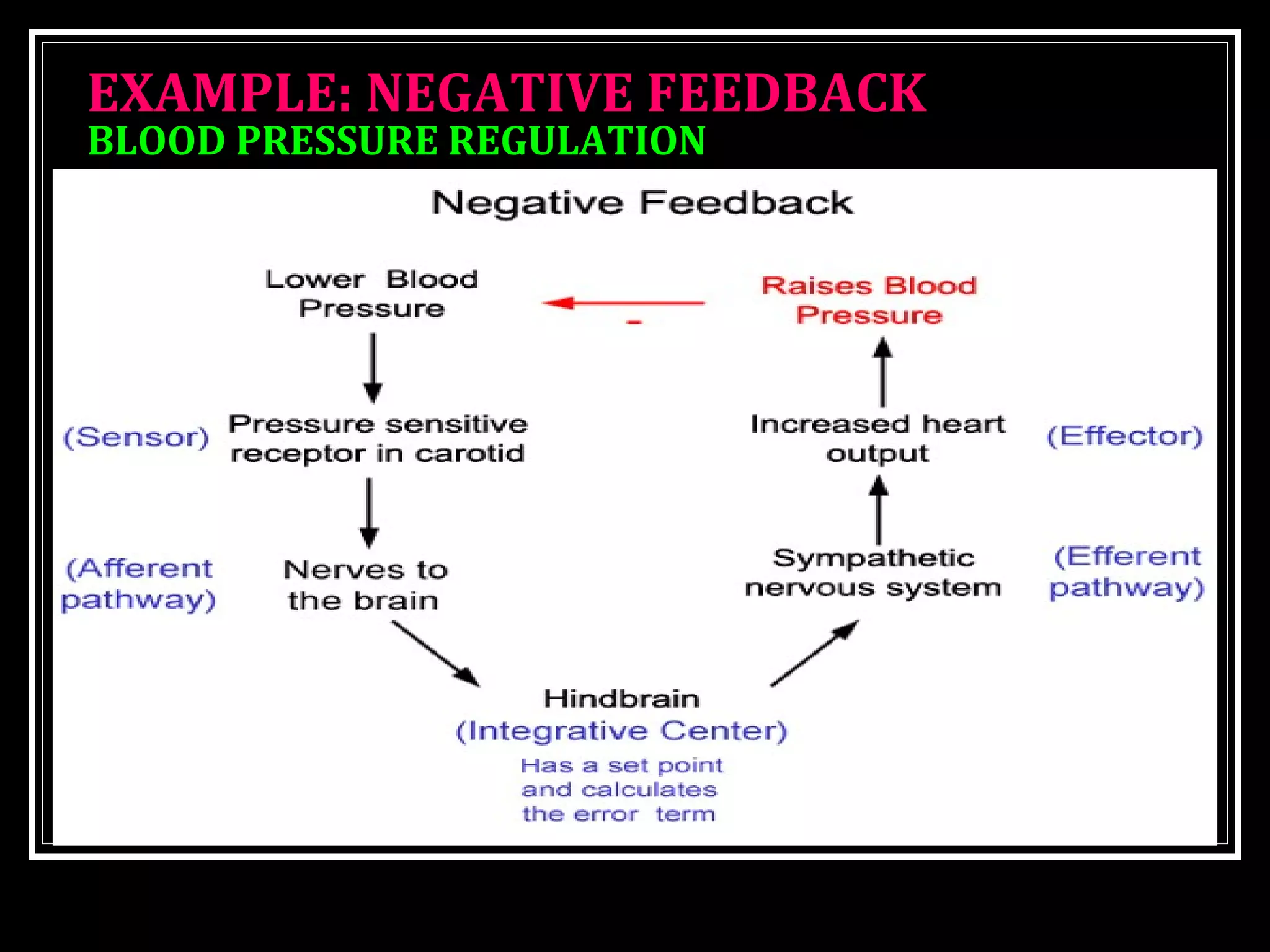
1. SENSOR (RECEPTOR):
detects specific changes
(stimuli) in the environment.
2. INTEGRATOR: act to direct
impulses to the place where
a response can be made.
3. EFFECTOR: performs the
appropriate response.
A FEEDBACK LOOP
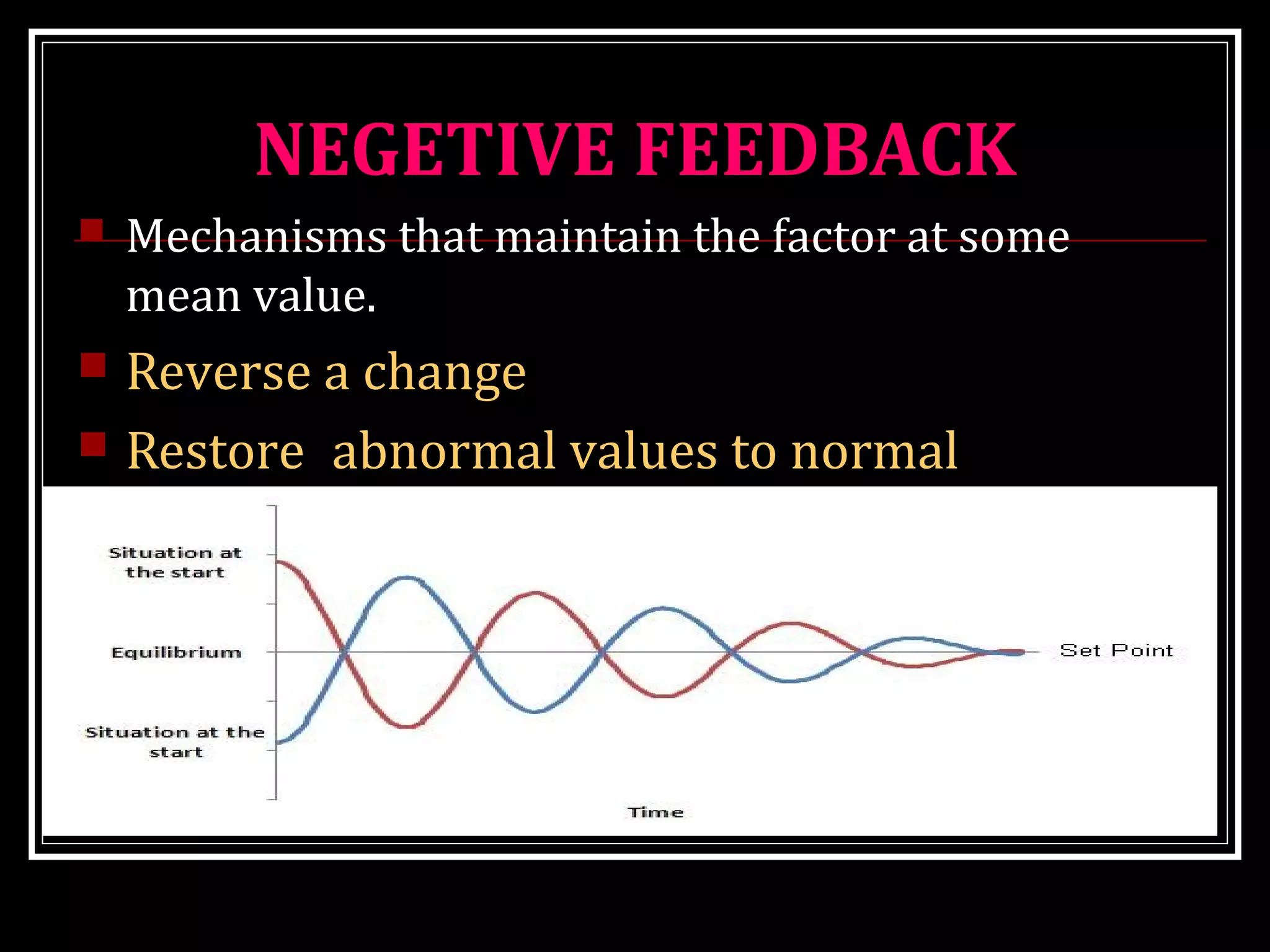
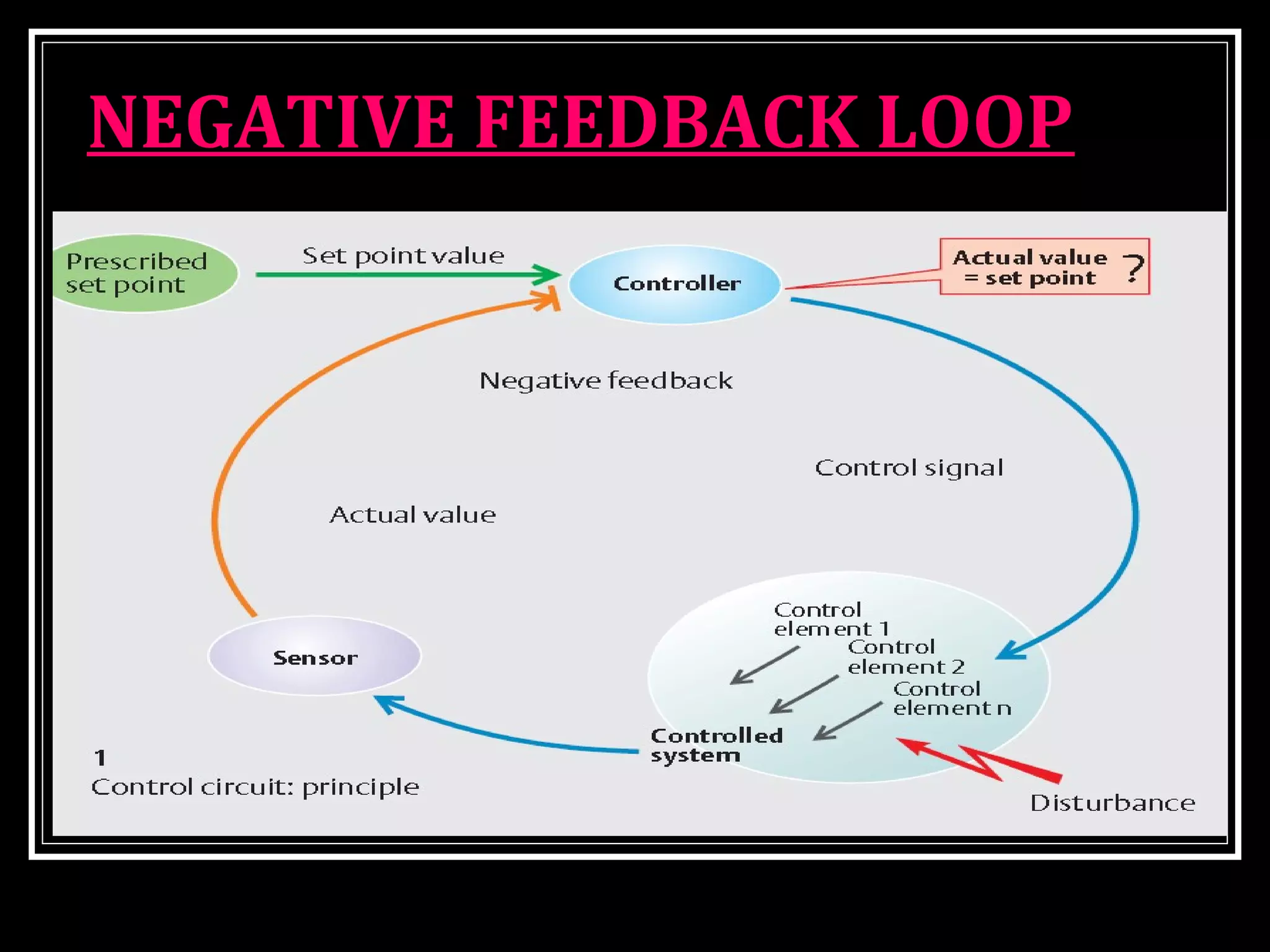
NEGETIVE FEEDBACK
 Mechanisms that maintain the factor at some
mean value.
 Reverse a change
 Restore abnormal values to normal
NEGATIVE FEEDBACK LOOP
EXAMPLE: NEGATIVE FEEDBACKEXAMPLE: NEGATIVE FEEDBACK
BLOOD PRESSURE REGULATIONBLOOD PRESSURE REGULATION
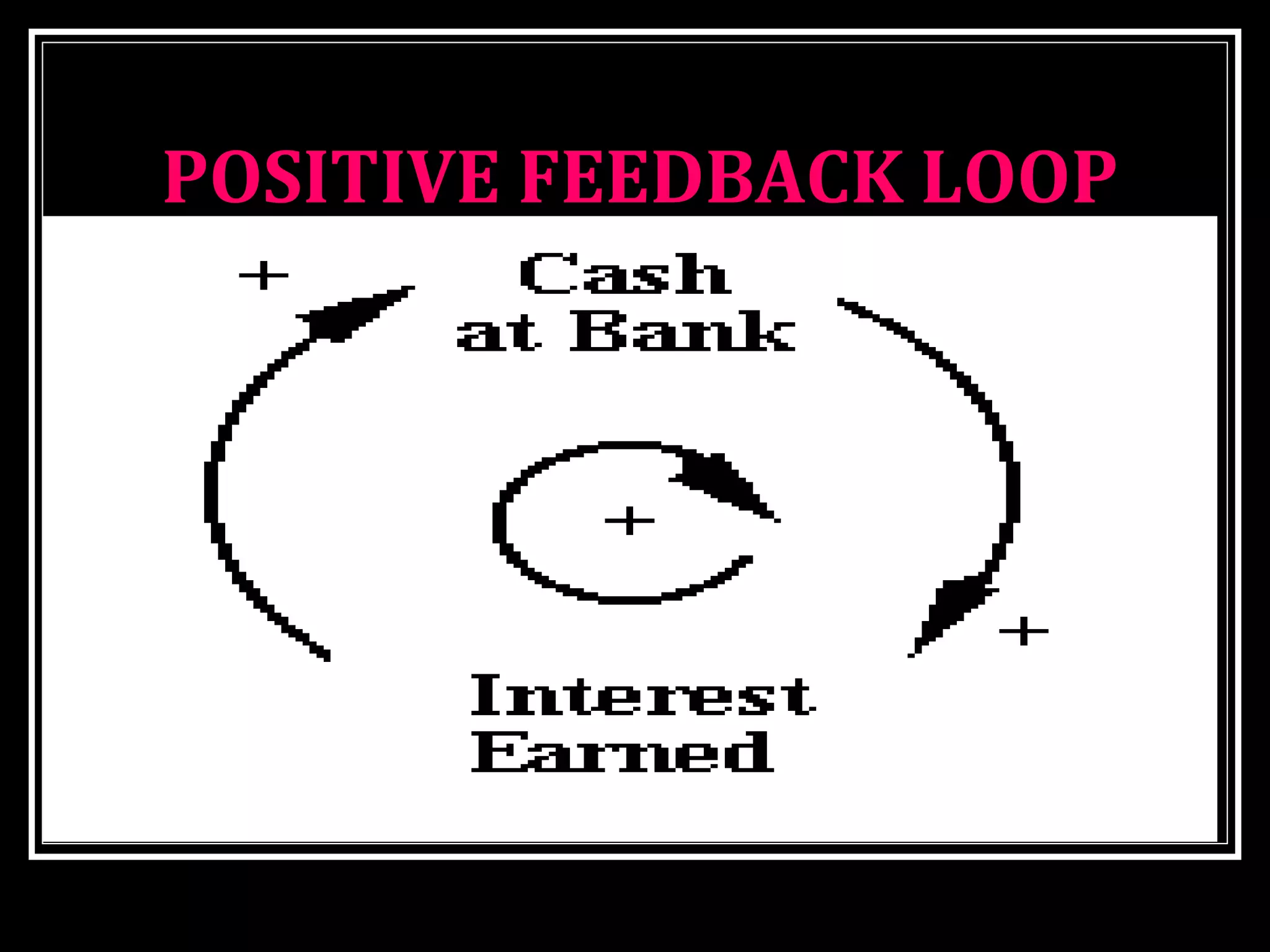
POSITIVE FEEDBACK
 Strengthens or reinforces a change.
 Makes abnormal values more abnormal.
 Produces ‘Vicious Cycle’.
 But in body a mild degree of positive feedback can be
overcome by the negative feedback control
mechanisms of the body, and the vicious cycle fails to
develop.
POSITIVE FEEDBACK LOOP
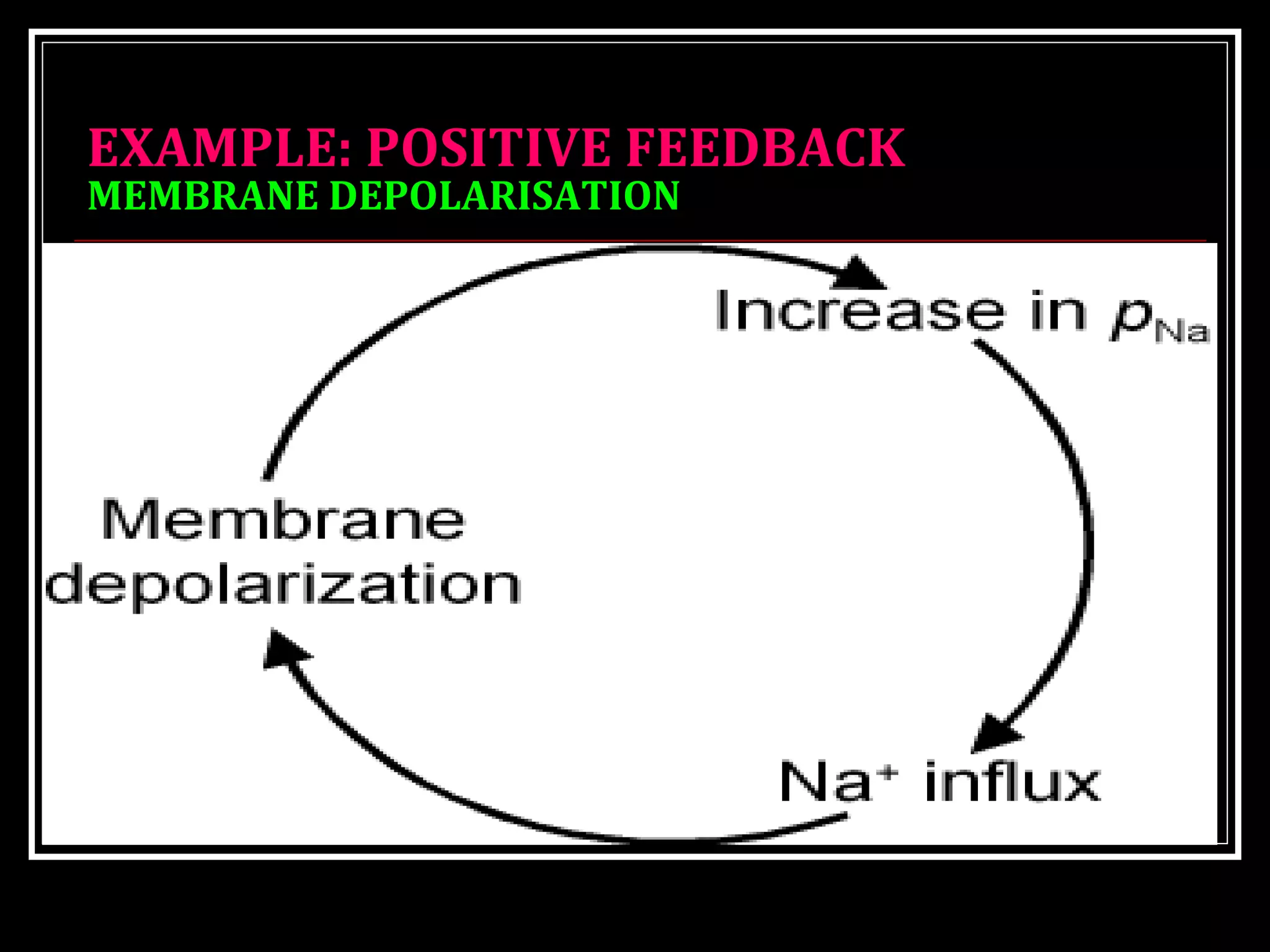
EXAMPLE: POSITIVE FEEDBACKEXAMPLE: POSITIVE FEEDBACK
MEMBRANE DEPOLARISATIONMEMBRANE DEPOLARISATION
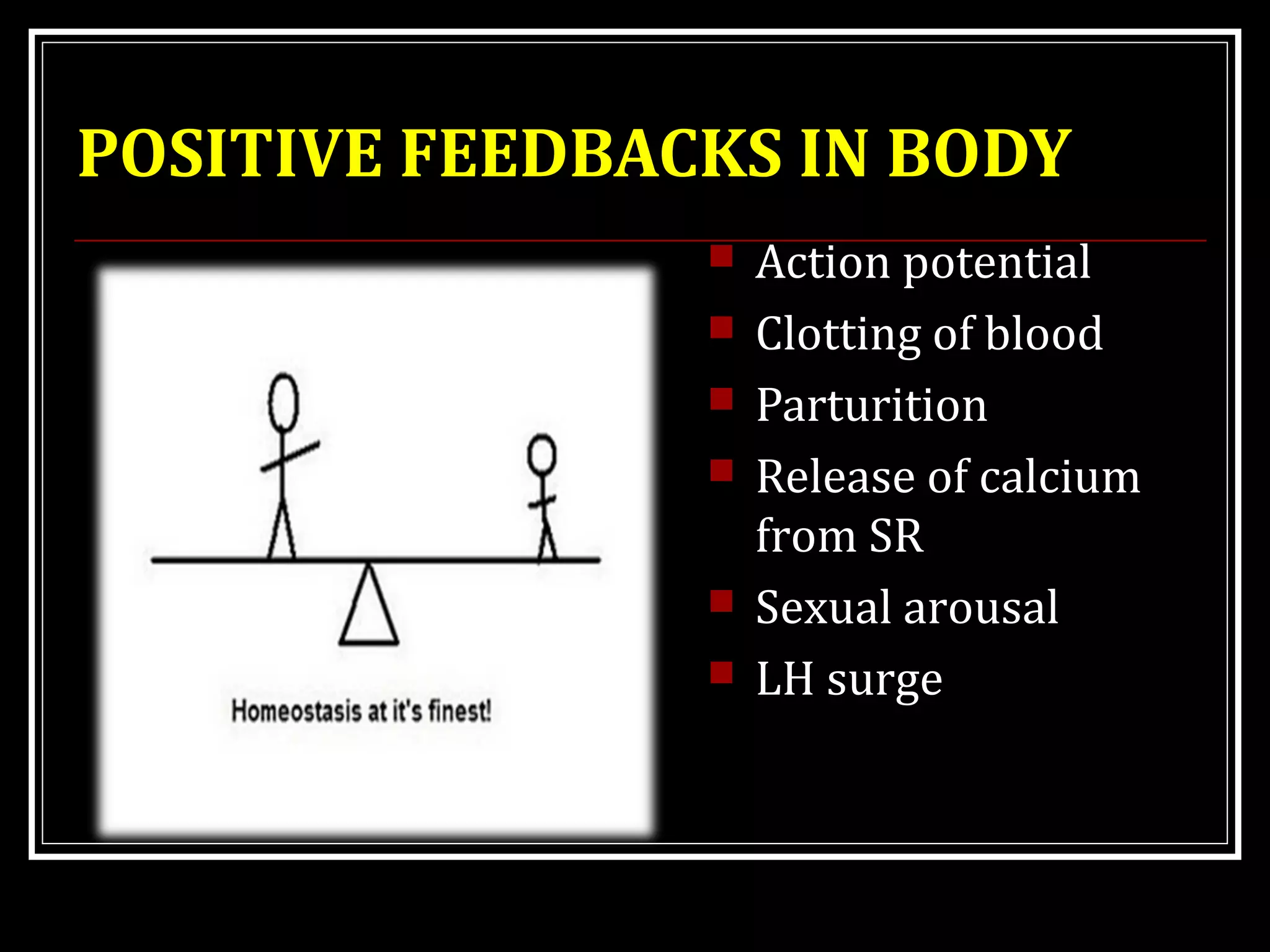
POSITIVE FEEDBACKS IN BODY
 Action potential
 Clotting of blood
 Parturition
 Release of calcium
from SR
 Sexual arousal
 LH surge
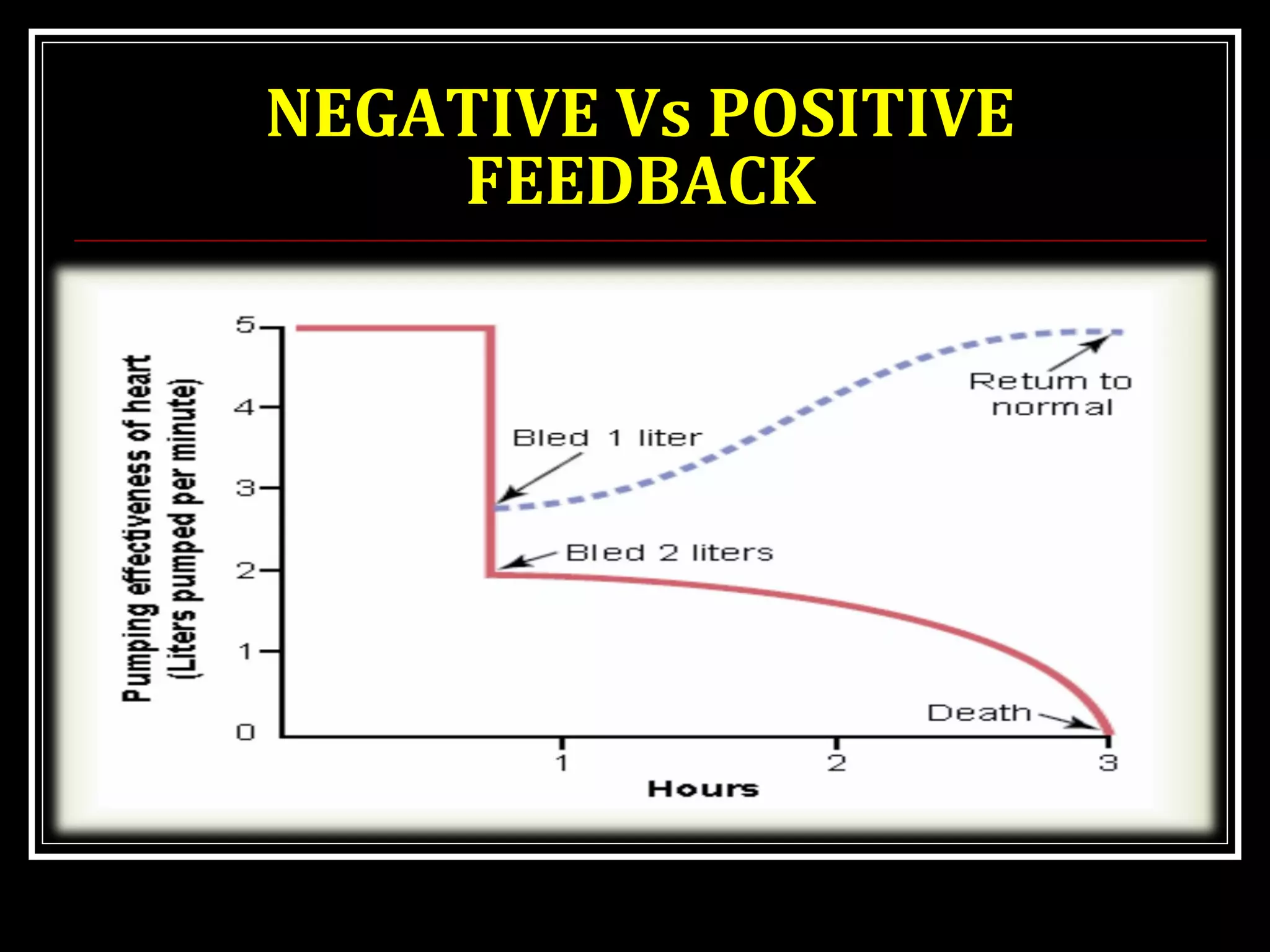
NEGATIVE Vs POSITIVE
FEEDBACK
EFFECTIVENESS OF A FEEDBACK CONTROL
THE PRINCIPLE OF GAIN
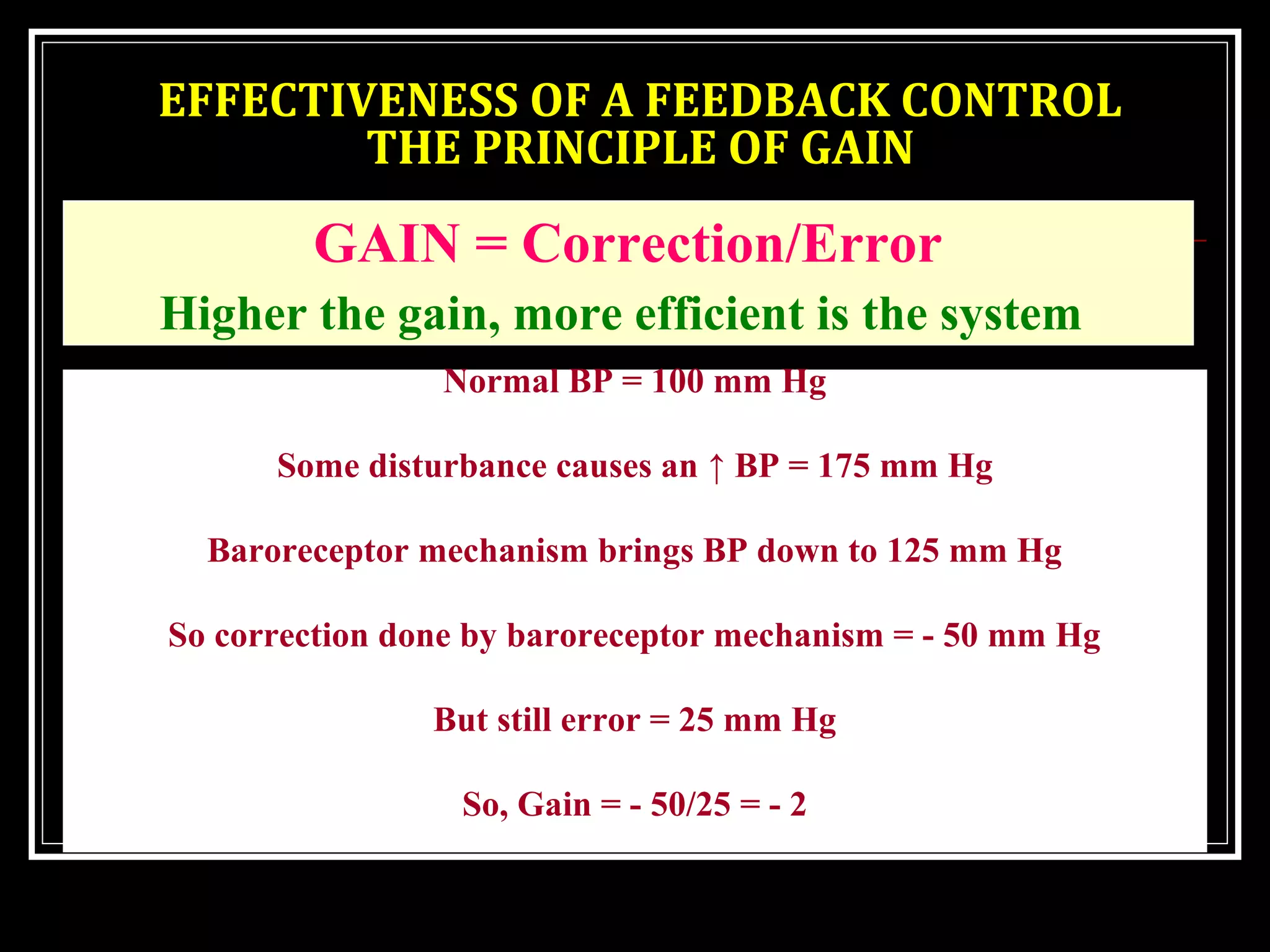
GAIN = Correction/Error
Higher the gain, more efficient is the system
Normal BP = 100 mm Hg
Some disturbance causes an ↑ BP = 175 mm Hg
Baroreceptor mechanism brings BP down to 125 mm Hg
So correction done by baroreceptor mechanism = - 50 mm Hg
But still error = 25 mm Hg
So, Gain = - 50/25 = - 2
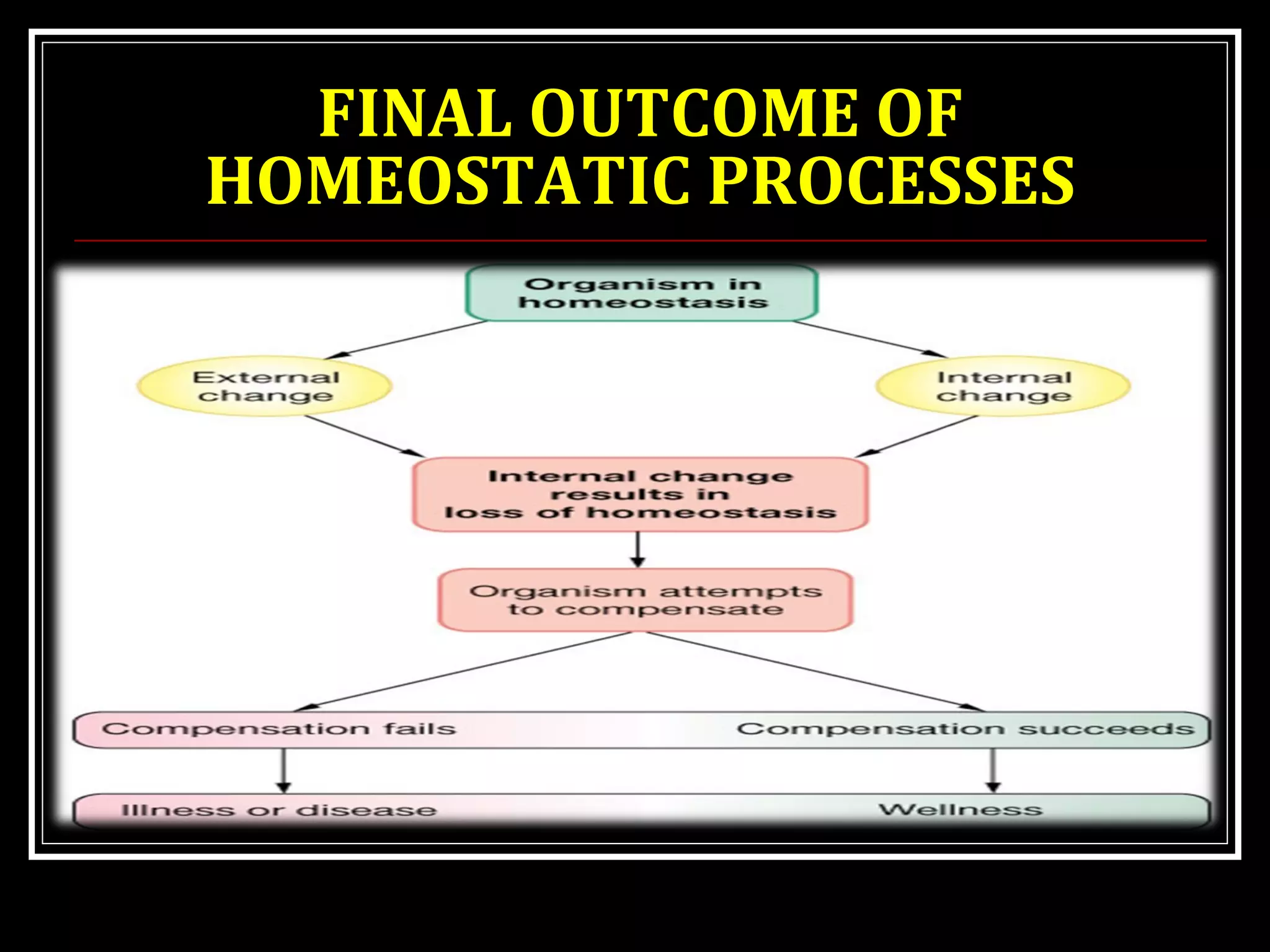
FINAL OUTCOME OF
HOMEOSTATIC PROCESSES
HOMEOSTASIS

HOMEOSTASIS

  • 1.
    HOMEOSTASIS Dr Nilesh NKate Associate Professor ESIC Medical College. Gulbarga.
  • 2.
    WHAT HAPPENS IFTHERE IS A CHANGE IN OUR ENVIRONMENT?  Depending upon the degree of change:  Discomfort  Disease/sickness  Damage/injury  Death  So any significant change in the environment is harmful for an organism.
  • 3.
    LIFE ORIGINATED ASUNICELLULAR ORGANISMS IN PRIMITIVE SEA  The primitive sea was the environment for the primitive unicellular organisms.  They obtained nutrition from it and discharged wastes in it.  The vastness of the sea kept its composition almost constant.
  • 4.
    UNICELLULAR ORGANISMS EVOLVEDINTO MUTLICELLULAR ORGANISMS  Some cells in multicellular organisms were away from the primitive sea.  As cells could not reach the sea, the sea was brought within in the form of extracellular fluid.
  • 5.
    60% OF HUMANBODY IS WATER!  40% is intracellular fluid (ICF) i.e. fluid inside the cells.  20% is extracellular fluid (ECF) i.e. fluid outside the cells. Further divided into:  Interstitial Fluid (ISF)- 15%  Plasma- 5%
  • 6.
    ECF: THE INTERNALENVIRONMENT OF THE BODY  All the cells in the body live in the same environment, the ECF.  So, the ECF is also k/a ‘internal environment’ of the body or ‘milieu intérieur’  They get nutrition from it & discharge their waste products in it.
  • 7.
    milieu intérieur ATERM COINED BY Claude Bernard  French physiologist.  Father of physiology.  “La fixit du milieu intkrieur est fa condition de fa vie fibre.” (the constancy of the internal environment is necessary for free life). 1813-1878
  • 8.
    Walter B. CanonNAMED THE FIXITY DESCRIBED BY Bernard AS ‘Homeostasis’  American physiologist.  Coined the term ‘homeostasis’.  Described homeostasis as- ‘an evolutionary development of a metabolic wisdom that provides for internal constancy’. 1871-1945
  • 9.
    HOMEOSTASIS  ‘maintenance ofnearly constant conditions in the internal environment’.  ‘the various physiologic arrangements which serve to restore the normal state, once it has been disturbed’ are known as Homeostatic Mechanisms.
  • 10.
    WHAT NEEDS TOBE MAINTAINED CONSTANT IN INTERNAL ENVIRONMENT? 1. Concentration of oxygen and carbon dioxide. 2. pH of the internal environment. 3. Concentration of nutrients and waste products. 4. Concentration of salt and other electrolytes. 5. Volume and pressure of extracellular fluid.
  • 11.
    HOMEOSTASIS: AS DESCRIBEDBY CANON  perturbation in the organism’s steady state may arise from changes within the organism as well as changes from without.  homeostasis is not the responsibility of a single system but that all the organ systems of the body operate cooperatively to effect internal constancy.  each cell benefits from homeostasis, and in turn, each cell contributes its share toward the maintenance of homeostasis.  the more “advanced” the evolutionary stage of a particular group or organisms, the more subtle and complex the homeostatic apparatus.
  • 12.
    ALL ORGANS ANDORGAN SYSTEMS OF THE BODY HELP IN MAINTENANCE OF HOMEOSTASIS  Cardiovascular system.  Respiratory system.  Nervous system.  Endocrine system.  Gastrointestinal system.  Excretory system.  Skeletal system.  Integumentry system.  Reproductive system.
  • 13.
    CARDIOVASCULAR SYSTEM  Transportsoxygen, carbon dioxide, nutrients and hormones to and from the body cells.  Helps regulate pH and temperature.  Provides protection against diseases.
  • 14.
    RESPIRATORY SYSTEM  Exchangethe gases between atmospheric air and blood.  Help adjust the pH of the body fluids.
  • 15.
    NERVOUS SYSTEM  Generatesnerve impulses (Action Potential) that provide communication and regulation of most body tissues.
  • 16.
    ENDOCRINE SYSTEM  Regulatesthe activity and growth of target cells in the body.  Regulate metabolism
  • 17.
    GASTROINTESTINAL SYSTEM  Breaksdown food into absorbable form.  Absorbs various nutrients.  Eliminates waste from the body.
  • 18.
    EXCRETORY SYSTEM  Helpseliminate the waste products from the body.  Maintains the blood pH, volume, pressure, osmolarity, electrolyte composition etc.  Produces hormones.
  • 19.
    SKELETAL SYSTEM  Bonesprovide support, protection, the production of blood cells.  Muscles produce body movements and produce heat to maintain the body temperature.
  • 20.
    INTEGUMENTARY SYSTEM  Contributesto homeostasis by protecting the body and helping regulate the body temperature. It also allows you to sense pleasurable, painful and other stimuli in your external environment.
  • 21.
    REPRODUCTIVE SYSTEM  Sometimesreproduction is not considered a homeostatic function.  Helps maintain homeostasis by generating new beings to take the place of those that are dying and thus help in maintaining the continuity of life.
  • 22.
    HOW HOMEOSTATIC CONTROLMECHANISMS WORK?  Homeostatic control mechanisms work through ‘Feedback Mechanisms’.  Status of a body condition is continually monitored, evaluated, changed, re- monitored & reevaluated.
  • 23.
    FEEDBACK MECHANISM  Afeedback mechanism is a cycle in which the output of a system “feeds back” to either modify or reinforce the action taken by the system.  A feedback mechanism may operate at:  Tissue level  Organ level  Organ system level  Body level, integrating with other organ systems.  Feedback mechanism can be:  Negative feedback (more common)  Positive feedback
  • 24.
    A FEEDBACK SYSTEMCONSISTS OF THREE COMPONENTS 1. SENSOR (RECEPTOR): detects specific changes (stimuli) in the environment. 2. INTEGRATOR: act to direct impulses to the place where a response can be made. 3. EFFECTOR: performs the appropriate response.
  • 25.
  • 26.
    NEGETIVE FEEDBACK  Mechanismsthat maintain the factor at some mean value.  Reverse a change  Restore abnormal values to normal
  • 27.
  • 28.
    EXAMPLE: NEGATIVE FEEDBACKEXAMPLE:NEGATIVE FEEDBACK BLOOD PRESSURE REGULATIONBLOOD PRESSURE REGULATION
  • 29.
    POSITIVE FEEDBACK  Strengthensor reinforces a change.  Makes abnormal values more abnormal.  Produces ‘Vicious Cycle’.  But in body a mild degree of positive feedback can be overcome by the negative feedback control mechanisms of the body, and the vicious cycle fails to develop.
  • 30.
  • 31.
    EXAMPLE: POSITIVE FEEDBACKEXAMPLE:POSITIVE FEEDBACK MEMBRANE DEPOLARISATIONMEMBRANE DEPOLARISATION
  • 32.
    POSITIVE FEEDBACKS INBODY  Action potential  Clotting of blood  Parturition  Release of calcium from SR  Sexual arousal  LH surge
  • 33.
  • 34.
    EFFECTIVENESS OF AFEEDBACK CONTROL THE PRINCIPLE OF GAIN GAIN = Correction/Error Higher the gain, more efficient is the system Normal BP = 100 mm Hg Some disturbance causes an ↑ BP = 175 mm Hg Baroreceptor mechanism brings BP down to 125 mm Hg So correction done by baroreceptor mechanism = - 50 mm Hg But still error = 25 mm Hg So, Gain = - 50/25 = - 2
  • 35.