Introduction to
Life Science
Jelo tfagos
Objectives:
At the end of the lesson, the learners will be able to:
1. Explain the evolving concept of life based on
emerging piece of evidence;
2. Describe the classic experiments that model
conditions which may have enabled the first forms to
evolve;
3. Describe seven emergent properties associated with
life;
4. Describe how unifying themes in the study of life
show the connections among living things and how
they interact with each other and with their
environment.
Concept of
Life
Introduction
• The term Biology was derived from bios
(referring to life) and logos (meaning study).
Literally therefore, it means the study of life.
• All living things are made of cells. Some
organisms are unicellular and consist of only
a single cell that carries out all life processes.
• Other organisms are multicellular and are
composed of many cells which perform
specialized and specific functions.
7 Characteristics of Life
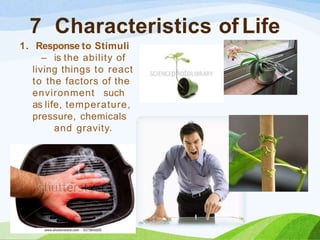
1. Response to Stimuli
– is the ability of
living things to react
to the factors of the
environment such
as life, temperature,
pressure, chemicals
and gravity.
7 Characteristics of Life
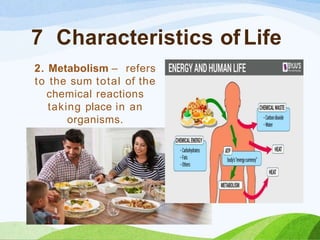
2. Metabolism – refers
to the sum total of the
chemical reactions
taking place in an
organisms.
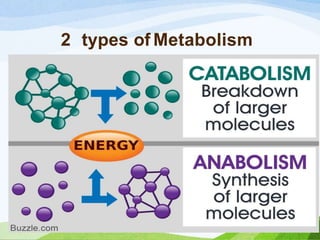
2 types of Metabolism
7 Characteristics of Life
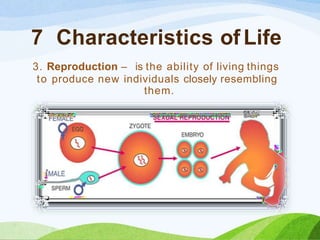
3. Reproduction – is the ability of living things
to produce new individuals closely resembling
them.
7 Characteristics of Life
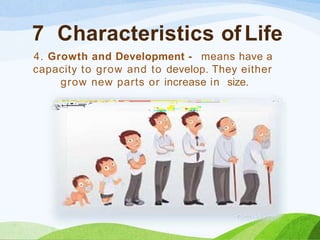
4. Growth and Development - means have a
capacity to grow and to develop. They either
grow new parts or increase in size.
7 Characteristics of Life
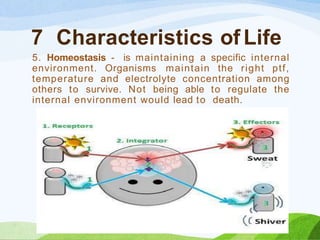
5. Homeostasis - is maintaining a specific internal
environment. Organisms maintain the right ptf,
temperature and electrolyte concentration among
others to survive. Not being able to regulate the
internal environment would lead to death.
7 Characteristics of Life
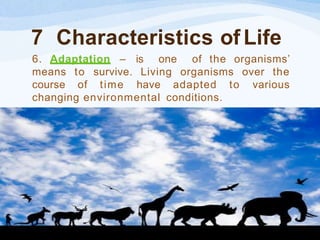
6. Adaptation – is one of the organisms’
means to survive. Living organisms over the
course of time have adapted to various
changing environmental conditions.
7 Characteristics of Life
7. Organization – Living organism is
composed of cells which are also
composed of organelles and their
organelles such as the cell membrane is
again composed of macromolecules and
these macromolecules such as fats is
composed of atoms such as carbon,
hydrogen and other.
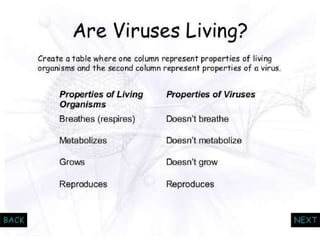
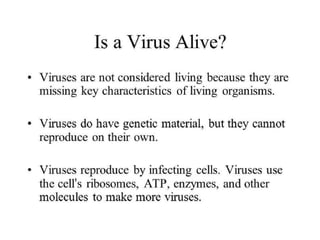
Activity 1:Debate
• Debate about the status of Virus
as living or non-living form.
Origin of
Life
Special Creation Theory
• Many people believe that everything in
this world was created by a Supreme
being and with tfim nothing is
impossible. It was narrated in Genesis
1 : 1 - 2 8 , 2 : 1 - 4 of Bible.
Spontaneous Generation
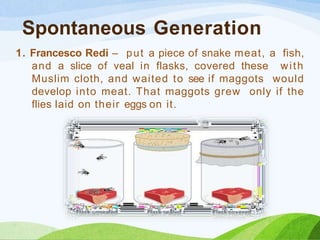
1. Francesco Redi – put a piece of snake meat, a fish,
and a slice of veal in flasks, covered these with
Muslim cloth, and waited to see if maggots would
develop into meat. That maggots grew only if the
flies laid on their eggs on it.
Spontaneous Generation
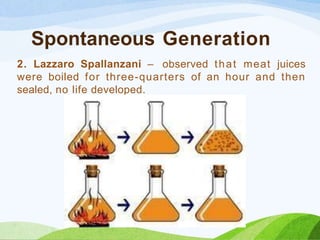
2. Lazzaro Spallanzani – observed that meat juices
were boiled for three-quarters of an hour and then
sealed, no life developed.
Spontaneous Generation
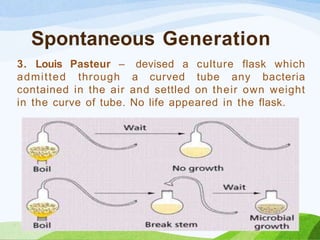
3. Louis Pasteur – devised a culture flask which
admitted through a curved tube any bacteria
contained in the air and settled on their own weight
in the curve of tube. No life appeared in the flask.
Biogenetic Theory
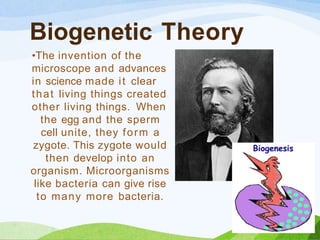
•The invention of the
microscope and advances
in science made it clear
that living things created
other living things. When
the egg and the sperm
cell unite, they form a
zygote. This zygote would
then develop into an
organism. Microorganisms
like bacteria can give rise
to many more bacteria.
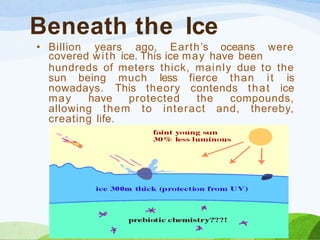
Beneath the Ice
• Billion years ago, Earth’s oceans were
covered with ice. This ice may have been
hundreds of meters thick, mainly due to the
sun being much less fierce than it is
nowadays. This theory contends that ice
may have protected the compounds,
allowing them to interact and, thereby,
creating life.
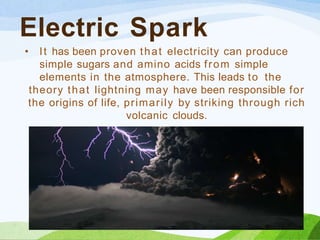
Electric Spark
• It has been proven that electricity can produce
simple sugars and amino acids from simple
elements in the atmosphere. This leads to the
theory that lightning may have been responsible for
the origins of life, primarily by striking through rich
volcanic clouds.
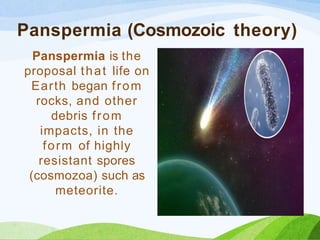
Panspermia (Cosmozoic theory)
Panspermia is the
proposal that life on
Earth began from
rocks, and other
debris from
impacts, in the
form of highly
resistant spores
(cosmozoa) such as
meteorite.
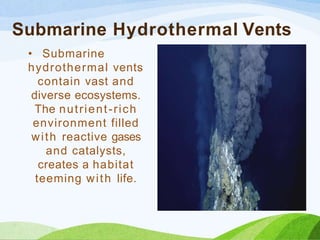
Submarine Hydrothermal Vents
• Submarine
hydrothermal vents
contain vast and
diverse ecosystems.
The nutrient-rich
environment filled
with reactive gases
and catalysts,
creates a habitat
teeming with life.
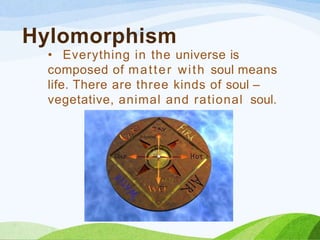
Hylomorphism
• Everything in the universe is
composed of matter with soul means
life. There are three kinds of soul –
vegetative, animal and rational soul.
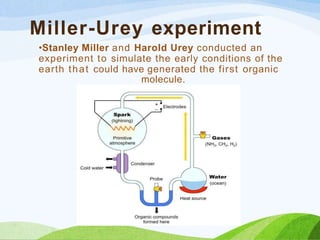
Miller-Urey experiment
•Stanley Miller and Harold Urey conducted an
experiment to simulate the early conditions of the
earth that could have generated the first organic
molecule.
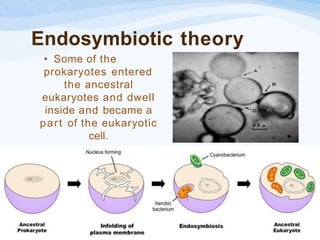
Endosymbiotic theory
• Some of the
prokaryotes entered
the ancestral
eukaryotes and dwell
inside and became a
part of the eukaryotic
cell.
Activity 2: Role Playing
• Group yourselves and make a drama
(role playing) about the early theories
of life and how eukaryotic cells came
into life.
Unifying Themes in
the Study of Life
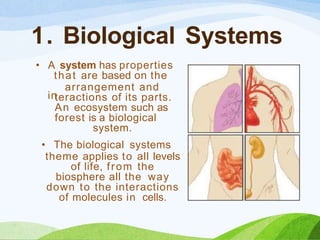
1. Biological Systems
• A system has properties
that are based on the
in
arrangement and
teractions of its parts.
An ecosystem such as
forest is a biological
system.
• The biological systems
theme applies to all levels
of life, from the
biosphere all the way
down to the interactions
of molecules in cells.
2.The Cellular Basis of Life
• In most multicellular organisms, cells are organized
into higher levels of organization. Beginning with the
cellular level, the next is a tissue, which is a group of
similar cells that together perform a specific
function.
• Several types of tissue together may make up a
structure called an organ. The brain is an organ that
consists of nerve tissue and other types of tissues.
• Finally, several organs that together carry out a
major body function make up an organ system. In
this example, the brain, spinal cord, and nerves make
up the organ system called the nervous system.
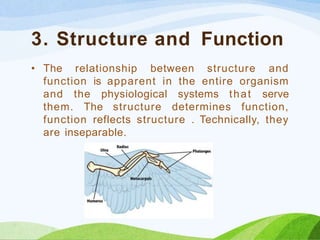
3. Structure and Function
• The relationship between structure and
function is apparent in the entire organism
and the physiological systems that serve
them. The structure determines function,
function reflects structure . Technically, they
are inseparable.
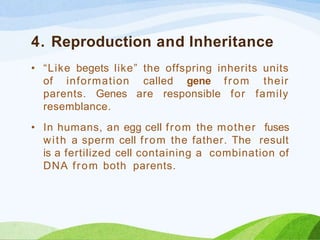
4. Reproduction and Inheritance
• “Like begets like” the offspring inherits units
of information called gene from their
parents. Genes are responsible for family
resemblance.
• In humans, an egg cell from the mother fuses
with a sperm cell from the father. The result
is a fertilized cell containing a combination of
DNA from both parents.
5. Environmental interactions
• No organism is completely isolated from its
surroundings. As part of an ecosystem, each
organism interacts continuously with its
environment. For the example, the plants’
three inputs for photosynthesis process.
6. Energy and Life
• Work depends on a source of energy.
Energy is obtained from chemical
reactions.
• For example, enters energy an
ecosystem as sunlight and exits as
heat.
7. Regulation
• Living organisms have the ability to
regulate their internal conditions.
• The ability of mammals and birds to
regulate body temperature is just one
example of homeostasis. Mechanisms
that enable organisms to regulate
their internal environment, despite
changes in external environment.
8. Evolution and Diversity of life
• It explains changes in organisms over long
periods of time. This includes adaptation,
which allows life forms to acquire new
characteristics in response to their
environment through the process of natural
selection.
• Evolution explains the diversity of life, both
past and present. The transmission of traits
to the next generation with modification
through Natural selection explains the
diversity of life as well as the fossil record.
9. Scientific Inquiry
• Scientific inquiry involves asking questions
about nature and then using observations or
experiments to find possible answers to those
questions.
References
• Acledan, M.Y. et al (2017). Earth and Life
Science for Senior tfigh. Mutya Publishing
tfouse, Inc. pp.86-88
• Bayo-Ang R.B. et al (2016). Earth and Life
Science for Senior tfigh. Mutya Publishing
tfouse, Inc. pp. 1 8 1 - 1 8 7
• All images from Google chrome

introductiontolifescience-180920034752.pptx

  • 1.
  • 2.
    Objectives: At the endof the lesson, the learners will be able to: 1. Explain the evolving concept of life based on emerging piece of evidence; 2. Describe the classic experiments that model conditions which may have enabled the first forms to evolve; 3. Describe seven emergent properties associated with life; 4. Describe how unifying themes in the study of life show the connections among living things and how they interact with each other and with their environment.
  • 3.
  • 4.
    Introduction • The termBiology was derived from bios (referring to life) and logos (meaning study). Literally therefore, it means the study of life. • All living things are made of cells. Some organisms are unicellular and consist of only a single cell that carries out all life processes. • Other organisms are multicellular and are composed of many cells which perform specialized and specific functions.
  • 5.
    7 Characteristics ofLife 1. Response to Stimuli – is the ability of living things to react to the factors of the environment such as life, temperature, pressure, chemicals and gravity.
  • 6.
    7 Characteristics ofLife 2. Metabolism – refers to the sum total of the chemical reactions taking place in an organisms.
  • 7.
    2 types ofMetabolism
  • 8.
    7 Characteristics ofLife 3. Reproduction – is the ability of living things to produce new individuals closely resembling them.
  • 9.
    7 Characteristics ofLife 4. Growth and Development - means have a capacity to grow and to develop. They either grow new parts or increase in size.
  • 10.
    7 Characteristics ofLife 5. Homeostasis - is maintaining a specific internal environment. Organisms maintain the right ptf, temperature and electrolyte concentration among others to survive. Not being able to regulate the internal environment would lead to death.
  • 11.
    7 Characteristics ofLife 6. Adaptation – is one of the organisms’ means to survive. Living organisms over the course of time have adapted to various changing environmental conditions.
  • 12.
    7 Characteristics ofLife 7. Organization – Living organism is composed of cells which are also composed of organelles and their organelles such as the cell membrane is again composed of macromolecules and these macromolecules such as fats is composed of atoms such as carbon, hydrogen and other.
  • 13.
    Activity 1:Debate • Debateabout the status of Virus as living or non-living form.
  • 16.
  • 17.
    Special Creation Theory •Many people believe that everything in this world was created by a Supreme being and with tfim nothing is impossible. It was narrated in Genesis 1 : 1 - 2 8 , 2 : 1 - 4 of Bible.
  • 18.
    Spontaneous Generation 1. FrancescoRedi – put a piece of snake meat, a fish, and a slice of veal in flasks, covered these with Muslim cloth, and waited to see if maggots would develop into meat. That maggots grew only if the flies laid on their eggs on it.
  • 19.
    Spontaneous Generation 2. LazzaroSpallanzani – observed that meat juices were boiled for three-quarters of an hour and then sealed, no life developed.
  • 20.
    Spontaneous Generation 3. LouisPasteur – devised a culture flask which admitted through a curved tube any bacteria contained in the air and settled on their own weight in the curve of tube. No life appeared in the flask.
  • 21.
    Biogenetic Theory •The inventionof the microscope and advances in science made it clear that living things created other living things. When the egg and the sperm cell unite, they form a zygote. This zygote would then develop into an organism. Microorganisms like bacteria can give rise to many more bacteria.
  • 22.
    Beneath the Ice •Billion years ago, Earth’s oceans were covered with ice. This ice may have been hundreds of meters thick, mainly due to the sun being much less fierce than it is nowadays. This theory contends that ice may have protected the compounds, allowing them to interact and, thereby, creating life.
  • 23.
    Electric Spark • Ithas been proven that electricity can produce simple sugars and amino acids from simple elements in the atmosphere. This leads to the theory that lightning may have been responsible for the origins of life, primarily by striking through rich volcanic clouds.
  • 24.
    Panspermia (Cosmozoic theory) Panspermiais the proposal that life on Earth began from rocks, and other debris from impacts, in the form of highly resistant spores (cosmozoa) such as meteorite.
  • 25.
    Submarine Hydrothermal Vents •Submarine hydrothermal vents contain vast and diverse ecosystems. The nutrient-rich environment filled with reactive gases and catalysts, creates a habitat teeming with life.
  • 26.
    Hylomorphism • Everything inthe universe is composed of matter with soul means life. There are three kinds of soul – vegetative, animal and rational soul.
  • 27.
    Miller-Urey experiment •Stanley Millerand Harold Urey conducted an experiment to simulate the early conditions of the earth that could have generated the first organic molecule.
  • 28.
    Endosymbiotic theory • Someof the prokaryotes entered the ancestral eukaryotes and dwell inside and became a part of the eukaryotic cell.
  • 29.
    Activity 2: RolePlaying • Group yourselves and make a drama (role playing) about the early theories of life and how eukaryotic cells came into life.
  • 31.
  • 32.
    1. Biological Systems •A system has properties that are based on the in arrangement and teractions of its parts. An ecosystem such as forest is a biological system. • The biological systems theme applies to all levels of life, from the biosphere all the way down to the interactions of molecules in cells.
  • 33.
    2.The Cellular Basisof Life • In most multicellular organisms, cells are organized into higher levels of organization. Beginning with the cellular level, the next is a tissue, which is a group of similar cells that together perform a specific function. • Several types of tissue together may make up a structure called an organ. The brain is an organ that consists of nerve tissue and other types of tissues. • Finally, several organs that together carry out a major body function make up an organ system. In this example, the brain, spinal cord, and nerves make up the organ system called the nervous system.
  • 34.
    3. Structure andFunction • The relationship between structure and function is apparent in the entire organism and the physiological systems that serve them. The structure determines function, function reflects structure . Technically, they are inseparable.
  • 35.
    4. Reproduction andInheritance • “Like begets like” the offspring inherits units of information called gene from their parents. Genes are responsible for family resemblance. • In humans, an egg cell from the mother fuses with a sperm cell from the father. The result is a fertilized cell containing a combination of DNA from both parents.
  • 36.
    5. Environmental interactions •No organism is completely isolated from its surroundings. As part of an ecosystem, each organism interacts continuously with its environment. For the example, the plants’ three inputs for photosynthesis process.
  • 37.
    6. Energy andLife • Work depends on a source of energy. Energy is obtained from chemical reactions. • For example, enters energy an ecosystem as sunlight and exits as heat.
  • 38.
    7. Regulation • Livingorganisms have the ability to regulate their internal conditions. • The ability of mammals and birds to regulate body temperature is just one example of homeostasis. Mechanisms that enable organisms to regulate their internal environment, despite changes in external environment.
  • 39.
    8. Evolution andDiversity of life • It explains changes in organisms over long periods of time. This includes adaptation, which allows life forms to acquire new characteristics in response to their environment through the process of natural selection. • Evolution explains the diversity of life, both past and present. The transmission of traits to the next generation with modification through Natural selection explains the diversity of life as well as the fossil record.
  • 40.
    9. Scientific Inquiry •Scientific inquiry involves asking questions about nature and then using observations or experiments to find possible answers to those questions.
  • 41.
    References • Acledan, M.Y.et al (2017). Earth and Life Science for Senior tfigh. Mutya Publishing tfouse, Inc. pp.86-88 • Bayo-Ang R.B. et al (2016). Earth and Life Science for Senior tfigh. Mutya Publishing tfouse, Inc. pp. 1 8 1 - 1 8 7 • All images from Google chrome