Biological moleculesBiological molecules
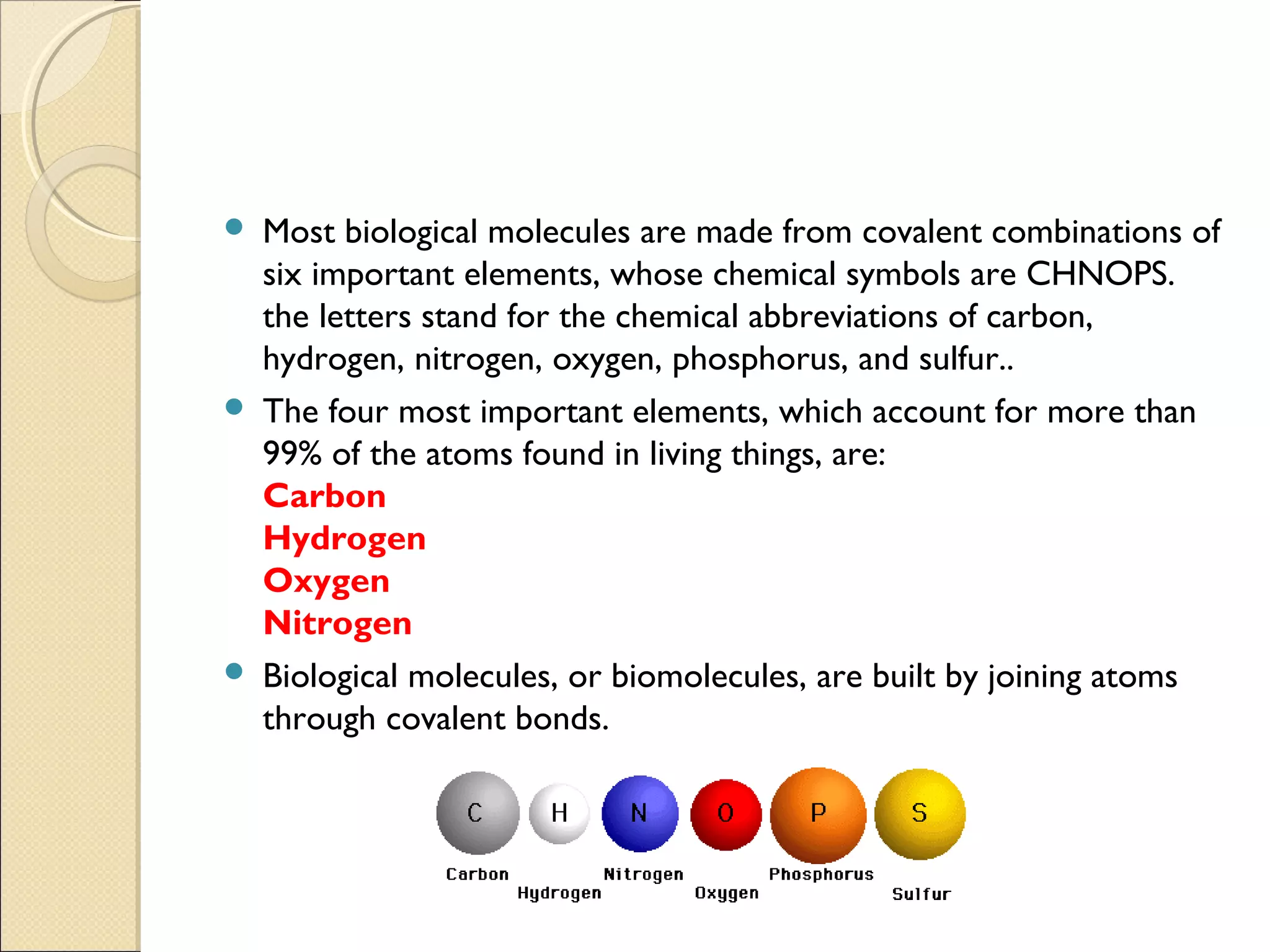
 Most biological molecules are made from covalent combinations of
six important elements, whose chemical symbols are CHNOPS.
the letters stand for the chemical abbreviations of carbon,
hydrogen, nitrogen, oxygen, phosphorus, and sulfur..
 The four most important elements, which account for more than
99% of the atoms found in living things, are:
Carbon
Hydrogen
Oxygen
Nitrogen
 Biological molecules, or biomolecules, are built by joining atoms
through covalent bonds.
Why is carbon so special?Why is carbon so special?
 Carbon has 4 valence electrons.
 Carbon can form up to four bonds with other atoms.
 This allows carbon (C) to form lots of different types of
structures and molecules, all with different functions.
 Carbon can form long chains or ring structures, which
can be thought as the ´basic skeletons´ of organic
molecules to which groups of other atoms attach.
What is a biomolecule or biologicalWhat is a biomolecule or biological
molecule?molecule?
 Biomolecules are organic molecules especially macromolecules like
carbohydrates, proteins in living organisms. All living forms of life are
made of similar macromolecules that are responsible for life.
All forms of life are composed of biomolecules only. 
 Biomolecules are molecules that occur naturally in living organisms.
 Biomolecules consists mainly of carbon and hydrogen with nitrogen,
oxygen, sulphur, and phosphorus.
 Biomolecules include macromolecules like proteins, carbohydrates, lipids
and nucleic acids. But, it also includes small molecules like primary and
secondary metabolites and natural products.
 Biomolecules are very large molecules of many atoms, that are covalently
bound together.
Some definitions to keep in mind…Some definitions to keep in mind…
 Organic molecule: contains at least C (carbon) and H
(hydrogen)
 Macromolecule (“giant molecule”): large biological
molecule, such as a protein or nucleic acid
 Monomer: a relatively simple molecule which is used as
a basic building block for thr synthesis of a polymer.
Many monomers join together make a polymer.
 Polymer: a giant molecule made from many similar
repeating subunits joined together in a chain.
Monomers and polymersMonomers and polymers
CarbohydratesCarbohydrates
Molecular formula: shows the atoms an
its amount
Structural formula: shows the
arrangements of the atoms using a
diagram.
Ring structure: When the chain ´closes´
Formation of the glycosidicFormation of the glycosidic
bond: Condensationbond: Condensation
Monosaccharides have to major functions:
•Commonly used as a source of energy
•Are important as building blocks for larger molecules
•Monosaccharides and disaccharides are sugars.
Polysaccharides.Polysaccharides.
Polysaccharides are polymers of
monosaccharides. They are unsweet, and
complex carbohydrates.They are
insoluble in water and are not in
crystalline form. 
Examples:starch,  glycogen,cellulose.
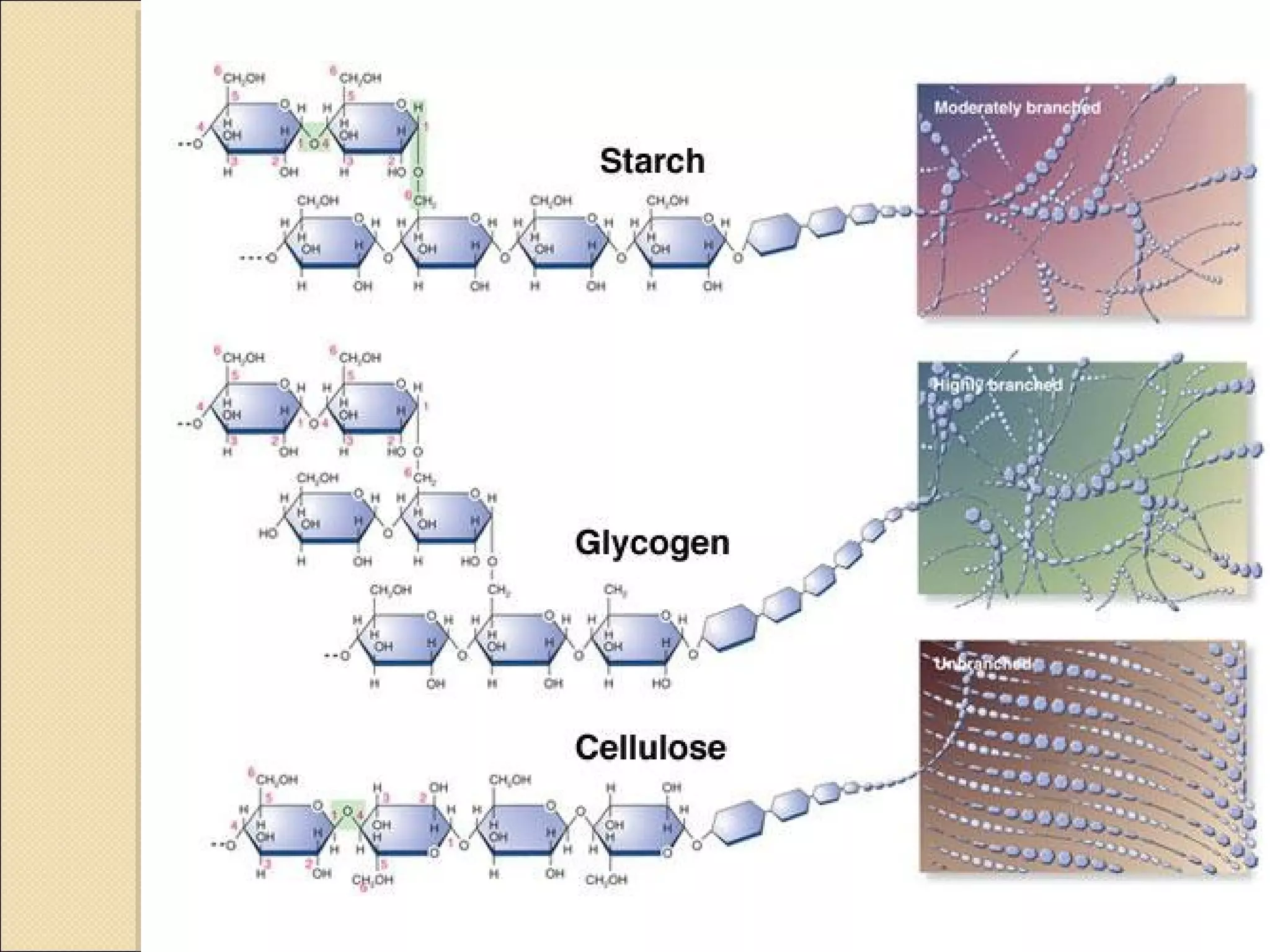
Starch and glycogen
Cellulose
Structure and function
Storage of glucoseStorage of glucose
 Glucose is the main form of energy for cells, which is
why it is important for livinf organisms to store it.
 If glucose was accummulated in cells:
1. It would affect osmotic properties
2. It would interfere with the cell chemistry
 How to solve the problem? Glucose is converted to a
storage polysaccharide form:
Starch in plants
Glycogen in animals
 Glucose can become quickly available again for the
organism, by a quick enzyme-controlled reaction
Starch and glycogenStarch and glycogen
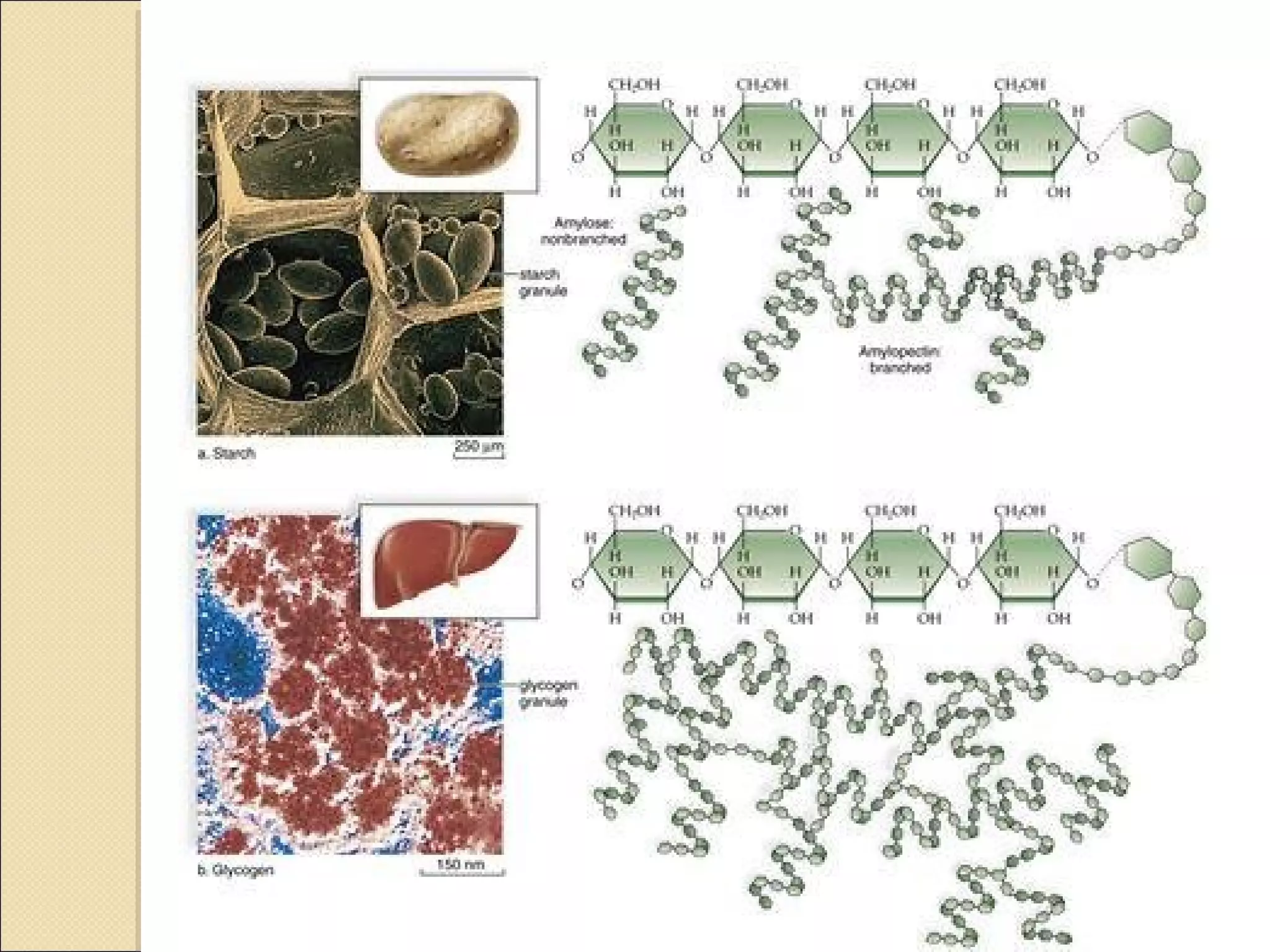
 Starch:
 Mixture of two substances: amylose and amylopectin
 Amylose: 1,4 linked molecules of glucose --- Unbranched
 Amylopectin: 1,4 linked glucose, but with branvhes (1,6 linkages)
 Glycogen:
 Only one type of molecule, similar to amilopectin, but more
branched
CelluloseCellulose
 Most abundant molecule on the planet (due its presence in plant
cell walls and slow rate of breakdown)
 Mechanically strong molecule – form cell walls
 Differs from starch and glycogen, because cellulose is formed by
β-glucose.
 This arrangement allows formation og hydrogen bonds –
STRONG!!!!!
LipidsLipids
 The lipids are a heterogeneous group of naturally
occuring compounds (organic), that are related more
by their physycal than by their chemical properties.
 They have in common the property of being relatively
insoluble in water and soluble in nonpolar
solvents such as ether and chloroform.
 ´True lipids´ are esters formed by fatty acids combinig
with an alcohol.
Classification of lipidsClassification of lipids
Fatty acidsFatty acids
•Fatty acids are important component of lipids in plants,
animals, and microorganisms.
•A fatty acid consists of a straight chain of carbon atoms, with
hydrogen atoms along the length of the chain and at one end of
the chain, and a carboxyl group ( COOH) at the other end. It−
is that carboxyl group that makes it an acid (carboxylic acid).
•Fatty acids are included in the group of derived lipids
•If the carbon-to-carbon bonds are all single, the acid is
saturated; if any of the bonds is double or triple, the acid is
unsaturated and is more reactive.
Fatty acid structureFatty acid structure
 Fatty acids are not found in a free state in nature; commonly
they exist combined with glycerol forming triglycerides.
 Alcohols are a series of organic molecules wich contain a
hydroxil group (-OH) attached to a carbon atom.
 Glycerol is an alcohol with three carbons and three
hydroxyl groups.
 The reaction between an acid and an alcohol, called
condensation, produces a chemical known as ester. The
chemical link established between an alcohol and an acid is
called ester bond. In every condensation reaction water is
formed.
 Tryglicerides are esters formed by one molecule of
glycerol combined with three fatty acids.
Condensation reactionCondensation reaction
Phospholipids: a special type of lipidPhospholipids: a special type of lipid
Roles of lipidsRoles of lipids
Triglycerides
 Energy source
 Energy reserves (storage form of energy – adipose tissue)
 Body insulation and protection around organs
 Sensory qualities (adds flavor and texture to food)
 Contribute to satiety
Phospholipids
 Form structure of membranes, matrix of cell wall, mielin sheath,
among others
 Carriers of ions across membranes
 Perform many vital functions within the body
Phospholipids are constituents ofPhospholipids are constituents of
membranesmembranes
 Phospholipids are composed of a hydrophilic head, which is
attracted to water, and two hydrophobic tails, which repel water.
Because these cells contain molecules that simultaneously attract
and resist water, they are considered amphipathic (both water-
soluble and non-water-soluble).
Different lipids: how do they look?Different lipids: how do they look?
ProteinsProteins
Amino acids
Peptide bond
Primary, secondary, third and cuaternary
structure
ProteinsProteins
Extremely important group of biological
molecules. WHY?
Huge variety, but common basic
monomers: amino acids
Peptide bondPeptide bond
 Two amino acids can join together by a peptide bond
 In this reaction one molecule of water is formed
 Dipeptide: molecule formed by two amino acids
 Polypeptide: molecule formed by many amino acids linked
Polypetides are another example of polymers and macromolecules
 Protein molecule may have just one polypeptide chain, or two or
more chains interacting with each other
Structure of proteinsStructure of proteins
 Primary structure: is the sequence of amino acids in a
polypeptide or protein.
 Secondary structure: is the structure of a protein molecule
resulting from the regular coiling or folding of the chain of amino
acids. E.g. β-pleated sheet α-helix.
 Tertiary structure: is the compact structure of a
proteinmolecule resulting from the three-dimensional coiling of
the already-folded chain of amino acids.
IMPORTANT: different kind of bonds (SEE BOOKLET)
 Quaternary structure: is the three-dimensional arrangement of
two or more polypeptides, or of a polypeptide and a non-protein
component such as haem, in a protein molecule.
Globular and fibrous proteinsGlobular and fibrous proteins
 Globular proteins: folded and ´curled´. Usually soluble in water
(because hydrophilic groups remain on the outside).
Many globular proteins have roles in metabolic reactions. For
example: enzymes and myoglobin
 Fibrous proteins: Do not curl-up, but form long strands.
Usually not soluble in water, and have structural roles. For
example: collagen and keartin.
WaterWater
 Most important biochemical??? Is it? WHY?
Although being a small molecule, it has surprising properties
which make it simply essential for life as we know it
 Water as a solvent: excellent solvent for ions and polar
molecules (this explains its importance for organisms!)
 Water as a transport medium: water is the transport
medium in the blood, lymphatic system, excretory and
digestive system in animals, and in vascular tissue of plants
 Water as a reagent: it takes part as a reagent in some
chemical reactions inside the cell. For example, in
photosynthesis
Properties of waterProperties of water
High specific heat capacity
High latent heat of vapourisation
Density and freezing properties
High surface tension
Useful linksUseful links
 https://www.youtube.com/watch?v=YO244P1e9QM
 https://www.youtube.com/watch?v=7jqsrlsjrIk
 https://www.youtube.com/watch?v=nt9u7CfVoc4
 http://www.slideshare.net/rozeka01/biology-unit-1-life-and-
biochemistry-biomolecules-notes
 http://www.slideshare.net/rozemak1/bio-unit-1-biological-
elements-and-biomolecules-notes
 http://www.slideshare.net/mazz4/proteins-55747399
 http://www.slideshare.net/ssuser86bed3/75-proteins2
 http://www.slideshare.net/mazz4/water205-b20155d
(this last one, start on slide 30)

Biological molecules

  • 1.
  • 2.
     Most biologicalmolecules are made from covalent combinations of six important elements, whose chemical symbols are CHNOPS. the letters stand for the chemical abbreviations of carbon, hydrogen, nitrogen, oxygen, phosphorus, and sulfur..  The four most important elements, which account for more than 99% of the atoms found in living things, are: Carbon Hydrogen Oxygen Nitrogen  Biological molecules, or biomolecules, are built by joining atoms through covalent bonds.
  • 3.
    Why is carbonso special?Why is carbon so special?  Carbon has 4 valence electrons.  Carbon can form up to four bonds with other atoms.  This allows carbon (C) to form lots of different types of structures and molecules, all with different functions.  Carbon can form long chains or ring structures, which can be thought as the ´basic skeletons´ of organic molecules to which groups of other atoms attach.
  • 4.
    What is abiomolecule or biologicalWhat is a biomolecule or biological molecule?molecule?  Biomolecules are organic molecules especially macromolecules like carbohydrates, proteins in living organisms. All living forms of life are made of similar macromolecules that are responsible for life. All forms of life are composed of biomolecules only.   Biomolecules are molecules that occur naturally in living organisms.  Biomolecules consists mainly of carbon and hydrogen with nitrogen, oxygen, sulphur, and phosphorus.  Biomolecules include macromolecules like proteins, carbohydrates, lipids and nucleic acids. But, it also includes small molecules like primary and secondary metabolites and natural products.  Biomolecules are very large molecules of many atoms, that are covalently bound together.
  • 5.
    Some definitions tokeep in mind…Some definitions to keep in mind…  Organic molecule: contains at least C (carbon) and H (hydrogen)  Macromolecule (“giant molecule”): large biological molecule, such as a protein or nucleic acid  Monomer: a relatively simple molecule which is used as a basic building block for thr synthesis of a polymer. Many monomers join together make a polymer.  Polymer: a giant molecule made from many similar repeating subunits joined together in a chain.
  • 6.
  • 8.
    CarbohydratesCarbohydrates Molecular formula: showsthe atoms an its amount Structural formula: shows the arrangements of the atoms using a diagram. Ring structure: When the chain ´closes´
  • 10.
    Formation of theglycosidicFormation of the glycosidic bond: Condensationbond: Condensation Monosaccharides have to major functions: •Commonly used as a source of energy •Are important as building blocks for larger molecules •Monosaccharides and disaccharides are sugars.
  • 11.
    Polysaccharides.Polysaccharides. Polysaccharides are polymersof monosaccharides. They are unsweet, and complex carbohydrates.They are insoluble in water and are not in crystalline form.  Examples:starch,  glycogen,cellulose. Starch and glycogen Cellulose Structure and function
  • 12.
    Storage of glucoseStorageof glucose  Glucose is the main form of energy for cells, which is why it is important for livinf organisms to store it.  If glucose was accummulated in cells: 1. It would affect osmotic properties 2. It would interfere with the cell chemistry  How to solve the problem? Glucose is converted to a storage polysaccharide form: Starch in plants Glycogen in animals  Glucose can become quickly available again for the organism, by a quick enzyme-controlled reaction
  • 13.
    Starch and glycogenStarchand glycogen  Starch:  Mixture of two substances: amylose and amylopectin  Amylose: 1,4 linked molecules of glucose --- Unbranched  Amylopectin: 1,4 linked glucose, but with branvhes (1,6 linkages)  Glycogen:  Only one type of molecule, similar to amilopectin, but more branched
  • 15.
    CelluloseCellulose  Most abundantmolecule on the planet (due its presence in plant cell walls and slow rate of breakdown)  Mechanically strong molecule – form cell walls  Differs from starch and glycogen, because cellulose is formed by β-glucose.  This arrangement allows formation og hydrogen bonds – STRONG!!!!!
  • 17.
    LipidsLipids  The lipidsare a heterogeneous group of naturally occuring compounds (organic), that are related more by their physycal than by their chemical properties.  They have in common the property of being relatively insoluble in water and soluble in nonpolar solvents such as ether and chloroform.  ´True lipids´ are esters formed by fatty acids combinig with an alcohol.
  • 18.
  • 19.
    Fatty acidsFatty acids •Fattyacids are important component of lipids in plants, animals, and microorganisms. •A fatty acid consists of a straight chain of carbon atoms, with hydrogen atoms along the length of the chain and at one end of the chain, and a carboxyl group ( COOH) at the other end. It− is that carboxyl group that makes it an acid (carboxylic acid). •Fatty acids are included in the group of derived lipids •If the carbon-to-carbon bonds are all single, the acid is saturated; if any of the bonds is double or triple, the acid is unsaturated and is more reactive.
  • 20.
  • 22.
     Fatty acidsare not found in a free state in nature; commonly they exist combined with glycerol forming triglycerides.  Alcohols are a series of organic molecules wich contain a hydroxil group (-OH) attached to a carbon atom.  Glycerol is an alcohol with three carbons and three hydroxyl groups.  The reaction between an acid and an alcohol, called condensation, produces a chemical known as ester. The chemical link established between an alcohol and an acid is called ester bond. In every condensation reaction water is formed.  Tryglicerides are esters formed by one molecule of glycerol combined with three fatty acids.
  • 23.
  • 25.
    Phospholipids: a specialtype of lipidPhospholipids: a special type of lipid
  • 26.
    Roles of lipidsRolesof lipids Triglycerides  Energy source  Energy reserves (storage form of energy – adipose tissue)  Body insulation and protection around organs  Sensory qualities (adds flavor and texture to food)  Contribute to satiety Phospholipids  Form structure of membranes, matrix of cell wall, mielin sheath, among others  Carriers of ions across membranes  Perform many vital functions within the body
  • 27.
    Phospholipids are constituentsofPhospholipids are constituents of membranesmembranes  Phospholipids are composed of a hydrophilic head, which is attracted to water, and two hydrophobic tails, which repel water. Because these cells contain molecules that simultaneously attract and resist water, they are considered amphipathic (both water- soluble and non-water-soluble).
  • 29.
    Different lipids: howdo they look?Different lipids: how do they look?
  • 30.
    ProteinsProteins Amino acids Peptide bond Primary,secondary, third and cuaternary structure
  • 31.
    ProteinsProteins Extremely important groupof biological molecules. WHY? Huge variety, but common basic monomers: amino acids
  • 33.
    Peptide bondPeptide bond Two amino acids can join together by a peptide bond  In this reaction one molecule of water is formed  Dipeptide: molecule formed by two amino acids  Polypeptide: molecule formed by many amino acids linked Polypetides are another example of polymers and macromolecules
  • 34.
     Protein moleculemay have just one polypeptide chain, or two or more chains interacting with each other
  • 35.
    Structure of proteinsStructureof proteins  Primary structure: is the sequence of amino acids in a polypeptide or protein.  Secondary structure: is the structure of a protein molecule resulting from the regular coiling or folding of the chain of amino acids. E.g. β-pleated sheet α-helix.  Tertiary structure: is the compact structure of a proteinmolecule resulting from the three-dimensional coiling of the already-folded chain of amino acids. IMPORTANT: different kind of bonds (SEE BOOKLET)  Quaternary structure: is the three-dimensional arrangement of two or more polypeptides, or of a polypeptide and a non-protein component such as haem, in a protein molecule.
  • 39.
    Globular and fibrousproteinsGlobular and fibrous proteins  Globular proteins: folded and ´curled´. Usually soluble in water (because hydrophilic groups remain on the outside). Many globular proteins have roles in metabolic reactions. For example: enzymes and myoglobin  Fibrous proteins: Do not curl-up, but form long strands. Usually not soluble in water, and have structural roles. For example: collagen and keartin.
  • 40.
    WaterWater  Most importantbiochemical??? Is it? WHY? Although being a small molecule, it has surprising properties which make it simply essential for life as we know it  Water as a solvent: excellent solvent for ions and polar molecules (this explains its importance for organisms!)  Water as a transport medium: water is the transport medium in the blood, lymphatic system, excretory and digestive system in animals, and in vascular tissue of plants  Water as a reagent: it takes part as a reagent in some chemical reactions inside the cell. For example, in photosynthesis
  • 41.
    Properties of waterPropertiesof water High specific heat capacity High latent heat of vapourisation Density and freezing properties High surface tension
  • 42.
    Useful linksUseful links https://www.youtube.com/watch?v=YO244P1e9QM  https://www.youtube.com/watch?v=7jqsrlsjrIk  https://www.youtube.com/watch?v=nt9u7CfVoc4  http://www.slideshare.net/rozeka01/biology-unit-1-life-and- biochemistry-biomolecules-notes  http://www.slideshare.net/rozemak1/bio-unit-1-biological- elements-and-biomolecules-notes  http://www.slideshare.net/mazz4/proteins-55747399  http://www.slideshare.net/ssuser86bed3/75-proteins2  http://www.slideshare.net/mazz4/water205-b20155d (this last one, start on slide 30)