Mitotic Mistakes What happens when things go wrong?
What is the big deal? Although errors in mitosis are rare, the process may go wrong, especially during early cellular divisions in the  zygote . Mitotic errors can be especially dangerous to the organism because future offspring from this parent cell will carry the same disorder.
Different types of Errors Non-Disjunction Deletion Translocation Inversion
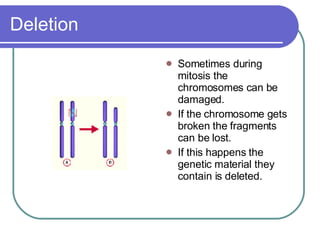
Deletion Sometimes during mitosis the chromosomes can be damaged. If the chromosome gets broken the fragments can be lost. If this happens the genetic material they contain is deleted.
Translocation If the chromosome breaks, it can reattach. Sometimes it reattaches to the wrong chromosome.  This is called translocation
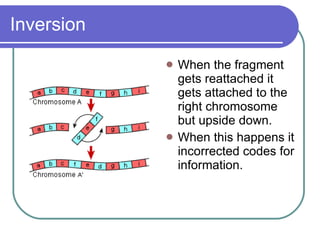
Inversion When the fragment gets reattached it gets attached to the right chromosome but upside down. When this happens it incorrected codes for information.
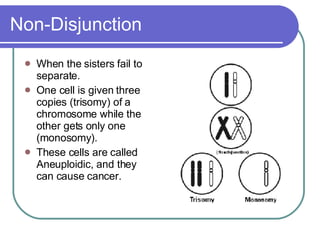
Non-Disjunction When the sisters fail to separate.  One cell is given three copies (trisomy) of a chromosome while the other gets only one (monosomy). These cells are called Aneuploidic, and they can cause cancer.
Aneuploidy Most recognized forms of Aneuploidy are Downs Syndrome (Trisomy 21) and Edwards syndrome (Trisomy 18). Different cells with abnormal amounts of chromosomes is called mosaicism. Some forms of mosaicism can cause cancers of the white blood cells (luekemia).

Mitotic Mistakes

  • 1.
    Mitotic Mistakes Whathappens when things go wrong?
  • 2.
    What is thebig deal? Although errors in mitosis are rare, the process may go wrong, especially during early cellular divisions in the zygote . Mitotic errors can be especially dangerous to the organism because future offspring from this parent cell will carry the same disorder.
  • 3.
    Different types ofErrors Non-Disjunction Deletion Translocation Inversion
  • 4.
    Deletion Sometimes duringmitosis the chromosomes can be damaged. If the chromosome gets broken the fragments can be lost. If this happens the genetic material they contain is deleted.
  • 5.
    Translocation If thechromosome breaks, it can reattach. Sometimes it reattaches to the wrong chromosome. This is called translocation
  • 6.
    Inversion When thefragment gets reattached it gets attached to the right chromosome but upside down. When this happens it incorrected codes for information.
  • 7.
    Non-Disjunction When thesisters fail to separate. One cell is given three copies (trisomy) of a chromosome while the other gets only one (monosomy). These cells are called Aneuploidic, and they can cause cancer.
  • 8.
    Aneuploidy Most recognizedforms of Aneuploidy are Downs Syndrome (Trisomy 21) and Edwards syndrome (Trisomy 18). Different cells with abnormal amounts of chromosomes is called mosaicism. Some forms of mosaicism can cause cancers of the white blood cells (luekemia).