 To reduce the amount of Global Greenhouse Gases
 CO2
 To reduce our dependence on foreign oil supplies
 By lowering our use of petro-fuels
 To increase our Sustainability level
 Use of more Bio-friendly fuels
 We are taking the first steps
 This is NOT going to resolve itself overnight
 It is going to be expensive
 Much of the technology needed does not yet exist!
CO2 – Carbon Dioxide
CO – Carbon Monoxide
Nox – Nitrous Oxides
SO2 – Sulfur Dioxide
HC – Hydro-Carbons
VOC – Volatile Organic Compounds
PM – Particulate Matter
Lead – Many different compounds
CO2 – Carbon Dioxide
CO – Carbon Monoxide
Nox – Nitrous Oxides
HC – Hydro-Carbons
PM – Particulate Matter
 Sustainable energy is the sustainable provision of
energy that meets the needs of the present without
compromising the ability of future generations to meet
their needs (long-term availability).
 Hydroelectricity
 Geothermal
 Solar
 Wind
 Tidal
 is a subset of renewable energy and represents those
renewable energy resources and technologies that
provide the highest environmental benefit.
 Biofuels
Ethanol
Biodiesel
 Hydrogen
Fuel Cell
 Climate Change
 GHG-CO2, CH4, N2O, CFC’s, HFC’s, PFC’s, SF6
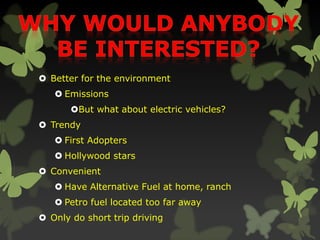
 Better for the environment
 Emissions
But what about electric vehicles?
 Trendy
 First Adopters
 Hollywood stars
 Convenient
 Have Alternative Fuel at home, ranch
 Petro fuel located too far away
 Only do short trip driving
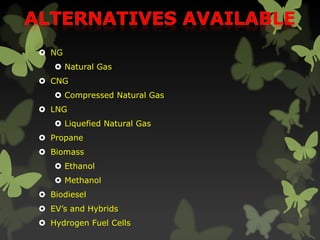
 NG
 Natural Gas
 CNG
 Compressed Natural Gas
 LNG
 Liquefied Natural Gas
 Propane
 Biomass
 Ethanol
 Methanol
 Biodiesel
 EV’s and Hybrids
 Hydrogen Fuel Cells
For this class, AFV means
Alternative Fueled Vehicles, NOT:
America’s Funniest Videos!!!
 Engine wear and cleanliness much better
with certain fuels
 Most have much less GHG impact
 May help obtain energy future
independence
 Lower emissions
 Lower fuel costs
 Renewable/sustainable
 Generally less driving range
 Fuel storage takes up space in vehicle
 Lack of infrastructure to support fueling
 Technician training not widespread
 Dual-fuel systems more complex
 Higher initial costs
 Few OEM models
 Outlook uncertain
Can it survive without subsidy?
 Found deep underground, and in coal beds
 “Landfill gas”: renewable
 Methane hydrate:
 CH4 trapped in ice beneath ocean floor
 Worldwide est. 104 gigatons, not all recoverable
 19th century street-lighting US cities
 Limited number, used cast-iron pipes
 US early 20th century
 First interstate pipelines
 Mid 20th century and WWII
 Strategic national crude pipeline network, later used as natural
gas pipeline
 Pre-1940’s, unwanted by-product of oil drilling-often flared off
 Limited vehicle fuel use during WWII with higher gasoline prices
 Very safe-ignition temperature: >1000oF
 Very high octane rating: 115+
 Energy: ~20,500 Btu/lb.
 Methane is a GHG
 Compressed Natural Gas (CNG) stored under pressure (3600psi)
 Liquefied Natural Gas (LNG) cryogenically stored (-260oF)
 High pressure onboard tank-3600psi
 Requires heavy/bulky tanks
 Lighter composite tanks are expensive
 Less energy per volume than liquid fuel
 Limited range and/or payload
 Extremely low temperature
 -260oF (-162oC). 1/600 the volume of gas
 Pressure equal to or close to atmospheric
 Requires special cryogenic “Dewars” (~72 hrs.)
 Not suitable for vehicle fuel in general
 Shipped via truck where pipeline not available
 LPG first distilled from gasoline in 1910
 Common for heating/cooking in rural areas
 World Propane use ~270 million metric tons 2012
 One of the simplest hydrocarbons
 Non-toxic, odorless and non-caustic
 Spill/leak will not cause environmental hazards
 Lower CO2 emissions, not a Green House Gas
 Octane rating 104-112
 Ethanol = Grain Alcohol CH3CH2OH
 Biomass sources are corn, sugar cane, etc.
 By bacterial fermentation
 Cellulosic sources are Switch grass, etc.
 Blends easily with gasoline
 Lower blend = Oxygenate
 Higher blend = E85 and Flex Fuel Vehicle (2003)
 Methanol = Wood Alcohol CH3OH
 Can be derived from:
 Coal, natural gas, algae, biomass, etc.
 Similar to Ethanol, used as racing fuel
 Highly poisonous
 Corrosive to some metals, rubber, and polymers
 MTBE – Methanol oxygenate-big environmental problems!
 Low-level blends usable in any gasoline vehicle
 Many FFV models available at little or no extra cost
 Biodegradable and less toxic than gasoline
 Cost of fueling stations (new/upgrade) is reasonable
 Renewable, domestic
 Cellulosic ethanol has great potential to reduce GHG
 Corrosive to certain materials
 Water absorption (& phase separation)
 Higher blends may have cold start issues
 Less range due to less heat content per volume
 Costs more than gasoline
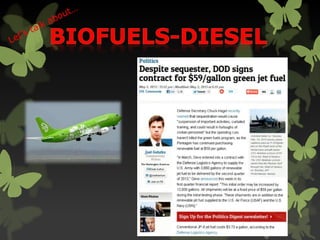
 Biodiesel – Rudolf Diesel used Peanut Oil in 1893
 Feedstock: vegetable oil, animal fat, fatty algae
 Petrodiesel would become affordable, then
dominant!
 Rising oil prices and environmental concerns have
led to reintroduction of biodiesel as alternative fuel
 Modern biodiesel is different from raw vegetable oil
 Biofuels have potential to replace >10 billion
gallons of petroleum in US by 2030
 Domestic, Renewable
 Reduces CO2 emissions
 Little or no engine/fuel
system modification
required
 Tested to ASTM spec
 B5 part of standard diesel
fuel pool
 More OEM’s ok up to B20
 Produces fewer
harmful emissions
(CO2, HC’s, PM)
 New-design engines
meet CARB
standards
 Less environmental
spill damage vs.
petrodiesel
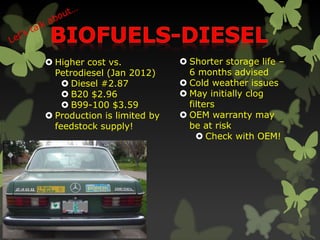
 Higher cost vs.
Petrodiesel (Jan 2012)
 Diesel #2.87
 B20 $2.96
 B99-100 $3.59
 Production is limited by
feedstock supply!
 Shorter storage life –
6 months advised
 Cold weather issues
 May initially clog
filters
 OEM warranty may
be at risk
 Check with OEM!
 In the early 1900’s, EV’s completed with ICE
powered vehicles
 100 years later, EV’s are gaining public interest
 Battery power not a “fuel”, but EV’s and HEV’s are
considered AFV
 In the early 1900’s, EV’s completed with ICE
powered vehicles
 100 years later, EV’s are gaining public interest
 Battery power not a “fuel”, but EV’s and HEV’s are
considered AFV
 HEV: Hybrid Electric Vehicle
 ICE + Battery + Motor
 Toyota Prius, Honda Insight
 PHEV: Plug-in HEV
 HEV + External Charge
 Chevy Volt, Toyota Prius PHV
 EV: All electric Vehicle
 Battery + Motor + external charge
 Nissan Leaf, Mitsubishi iMiEV
 Series Hybrid Electric Vehicle (HEV)
 Low speed efficiency, less at highway speeds
 Parallel HEV
 Higher speed efficiency, less at in-town speeds
 Mild/Micro HEV
 Simple version of Parallel HEV, less power, less costs
 Series/Parallel HEV
 Efficient at both low and high speeds, more complex and expensive
 Plug-in HEV
 Range extended ICE, similar to HEV
 EV-Electric Vehicle
 Classic Battery/Motor, zero emissions, limited range
 Electric Motor Types
 Induction motor
Relatively mature
 Permanent Magnet
 Switched Reluctance motors
 Many other types…
 Battery Types
 Lithium-ion
 Li-ion light weight, high energy density power source
 Nickel-Metal Hydride
 Ni-MH all-electric plug-in vehicles
 Lead-acid
 Very low energy to weight ratio, invented in 1859
 Lithium-Polymer
 LiPO batteries may also power the next generation of
battery electric vehicles
 Ultracapacitor
 Particularly suitable for regenerative braking
applications, possible future replacement for EV and
Plug-in HEV batteries
 HEV
 Can greatly improve fuel
economy in Stop-go
conditions
 Hybrid technology can be
combined with
alternatively-fueled ICE’s
 Many more models will be
offered with a range of
hybrid technologies
 EV
 Niche market now, limited
range, cost, charging
 As battery + charging
technologies/access improve,
so will EV range + acceptance
 ZEV – not zero emissions
 “Well-to-wheel” analysis
 Source of power dirty or
clean?
 Line loss and heat issues
 Securing, expanding clean
power is a daunting,
expensive challenge
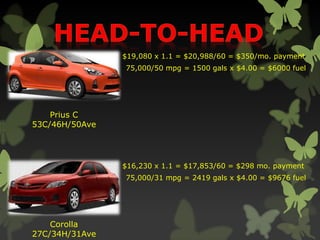
Prius C
53C/46H/50Ave
Corolla
27C/34H/31Ave
Prius C
53C/46H/50Ave
Corolla
27C/34H/31Ave
$19,080 x 1.1 = $20,988/60 = $350/mo. payment
Prius C
53C/46H/50Ave
Corolla
27C/34H/31Ave
$19,080 x 1.1 = $20,988/60 = $350/mo. payment
$16,230 x 1.1 = $17,853/60 = $298 mo. payment
Prius C
53C/46H/50Ave
Corolla
27C/34H/31Ave
$19,080 x 1.1 = $20,988/60 = $350/mo. payment
$16,230 x 1.1 = $17,853/60 = $298 mo. payment
75,000/50 mpg = 1500 gals x $4.00 = $6000 fuel
Prius C
53C/46H/50Ave
Corolla
27C/34H/31Ave
$19,080 x 1.1 = $20,988/60 = $350/mo. payment
$16,230 x 1.1 = $17,853/60 = $298 mo. payment
75,000/50 mpg = 1500 gals x $4.00 = $6000 fuel
75,000/31 mpg = 2419 gals x $4.00 = $9676 fuel
Prius C
53C/46H/50Ave
Corolla
27C/34H/31Ave
$19,080 x 1.1 = $20,988/60 = $350/mo. payment
$16,230 x 1.1 = $17,853/60 = $298 mo. payment
75,000/50 mpg = 1500 gals x $4.00 = $6000 fuel
75,000/31 mpg = 2419 gals x $4.00 = $9676 fuel
$6000/60 = $100/mo. for fuel
Prius C
53C/46H/50Ave
Corolla
27C/34H/31Ave
$19,080 x 1.1 = $20,988/60 = $350/mo. payment
$16,230 x 1.1 = $17,853/60 = $298 mo. payment
75,000/50 mpg = 1500 gals x $4.00 = $6000 fuel
75,000/31 mpg = 2419 gals x $4.00 = $9676 fuel
$6000/60 = $100/mo. for fuel
$9676/60 = $161/mo. for fuel
Prius C
53C/46H/50Ave
Corolla
27C/34H/31Ave
$19,080 x 1.1 = $20,988/60 = $350/mo. payment
$16,230 x 1.1 = $17,853/60 = $298 mo. payment
75,000/50 mpg = 1500 gals x $4.00 = $6000 fuel
75,000/31 mpg = 2419 gals x $4.00 = $9676 fuel
$6000/60 = $100/mo. for fuel
$9676/60 = $161/mo. for fuel
$350 + $100 = $450/month
Prius C
53C/46H/50Ave
Corolla
27C/34H/31Ave
$19,080 x 1.1 = $20,988/60 = $350/mo. payment
$16,230 x 1.1 = $17,853/60 = $298 mo. payment
75,000/50 mpg = 1500 gals x $4.00 = $6000 fuel
75,000/31 mpg = 2419 gals x $4.00 = $9676 fuel
$6000/60 = $100/mo. for fuel
$9676/60 = $161/mo. for fuel
$350 + $100 = $450/month
$298 + $161 = $459/month
Prius C $108 a year
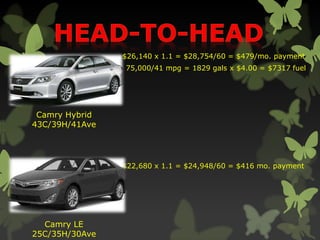
Camry Hybrid
43C/39H/41Ave
Camry LE
25C/35H/30Ave
Camry Hybrid
43C/39H/41Ave
Camry LE
25C/35H/30Ave
$26,140 x 1.1 = $28,754/60 = $479/mo. payment
Camry Hybrid
43C/39H/41Ave
Camry LE
25C/35H/30Ave
$26,140 x 1.1 = $28,754/60 = $479/mo. payment
$22,680 x 1.1 = $24,948/60 = $416 mo. payment
Camry Hybrid
43C/39H/41Ave
Camry LE
25C/35H/30Ave
$26,140 x 1.1 = $28,754/60 = $479/mo. payment
$22,680 x 1.1 = $24,948/60 = $416 mo. payment
75,000/41 mpg = 1829 gals x $4.00 = $7317 fuel
Camry Hybrid
43C/39H/41Ave
Camry LE
25C/35H/30Ave
$26,140 x 1.1 = $28,754/60 = $479/mo. payment
$22,680 x 1.1 = $24,948/60 = $416 mo. payment
75,000/41 mpg = 1829 gals x $4.00 = $7317 fuel
75,000/30 mpg = 2500 gals x $4.00 = $10,000 fuel
Camry Hybrid
43C/39H/41Ave
Camry LE
25C/35H/30Ave
$26,140 x 1.1 = $28,754/60 = $479/mo. payment
$22,680 x 1.1 = $24,948/60 = $416 mo. payment
75,000/41 mpg = 1829 gals x $4.00 = $7317 fuel
75,000/30 mpg = 2500 gals x $4.00 = $10,000 fuel
$7317/60 = $122/mo. for fuel
Camry Hybrid
43C/39H/41Ave
Camry LE
25C/35H/30Ave
$26,140 x 1.1 = $28,754/60 = $479/mo. payment
$22,680 x 1.1 = $24,948/60 = $416 mo. payment
75,000/41 mpg = 1829 gals x $4.00 = $7317 fuel
75,000/30 mpg = 2500 gals x $4.00 = $10,000 fuel
$7317/60 = $122/mo. for fuel
$10,000/60 = $166/mo. for fuel
Camry Hybrid
43C/39H/41Ave
Camry LE
25C/35H/30Ave
$26,140 x 1.1 = $28,754/60 = $479/mo. payment
$22,680 x 1.1 = $24,948/60 = $416 mo. payment
75,000/41 mpg = 1829 gals x $4.00 = $7317 fuel
75,000/30 mpg = 2500 gals x $4.00 = $10,000 fuel
$7317/60 = $122/mo. for fuel
$10,000/60 = $166/mo. for fuel
$479 + $122 = $601/month
Camry Hybrid
43C/39H/41Ave
Camry LE
25C/35H/30Ave
$26,140 x 1.1 = $28,754/60 = $479/mo. payment
$22,680 x 1.1 = $24,948/60 = $416 mo. payment
75,000/41 mpg = 1829 gals x $4.00 = $7317 fuel
75,000/30 mpg = 2500 gals x $4.00 = $10,000 fuel
$7317/60 = $122/mo. for fuel
$10,000/60 = $166/mo. for fuel
$479 + $122 = $601/month
$416 + $166 = $582/month
Camry LE $228 a year
1710 miles free a year
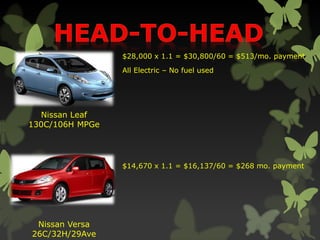
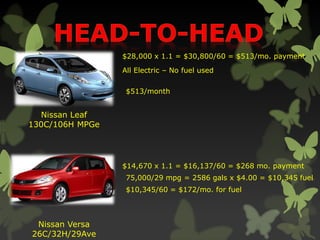
Nissan Leaf
130C/106H MPGe
Nissan Versa
26C/32H/29Ave
Nissan Leaf
130C/106H MPGe
Nissan Versa
26C/32H/29Ave
$28,000 x 1.1 = $30,800/60 = $513/mo. payment
Nissan Leaf
130C/106H MPGe
Nissan Versa
26C/32H/29Ave
$28,000 x 1.1 = $30,800/60 = $513/mo. payment
$14,670 x 1.1 = $16,137/60 = $268 mo. payment
Nissan Leaf
130C/106H MPGe
Nissan Versa
26C/32H/29Ave
$28,000 x 1.1 = $30,800/60 = $513/mo. payment
$14,670 x 1.1 = $16,137/60 = $268 mo. payment
All Electric – No fuel used
Nissan Leaf
130C/106H MPGe
Nissan Versa
26C/32H/29Ave
$28,000 x 1.1 = $30,800/60 = $513/mo. payment
$14,670 x 1.1 = $16,137/60 = $268 mo. payment
75,000/29 mpg = 2586 gals x $4.00 = $10,345 fuel
All Electric – No fuel used
Nissan Leaf
130C/106H MPGe
Nissan Versa
26C/32H/29Ave
$28,000 x 1.1 = $30,800/60 = $513/mo. payment
$14,670 x 1.1 = $16,137/60 = $268 mo. payment
75,000/29 mpg = 2586 gals x $4.00 = $10,345 fuel
$10,345/60 = $172/mo. for fuel
All Electric – No fuel used
Nissan Leaf
130C/106H MPGe
Nissan Versa
26C/32H/29Ave
$28,000 x 1.1 = $30,800/60 = $513/mo. payment
$14,670 x 1.1 = $16,137/60 = $268 mo. payment
75,000/29 mpg = 2586 gals x $4.00 = $10,345 fuel
$10,345/60 = $172/mo. for fuel
$513/month
All Electric – No fuel used
Nissan Leaf
130C/106H MPGe
Nissan Versa
26C/32H/29Ave
$28,000 x 1.1 = $30,800/60 = $513/mo. payment
$14,670 x 1.1 = $16,137/60 = $268 mo. payment
75,000/29 mpg = 2586 gals x $4.00 = $10,345 fuel
$10,345/60 = $172/mo. for fuel
$268 + $172 = $440/month
$513/month
All Electric – No fuel used
Nissan Versa $73/month
6351 miles free a year
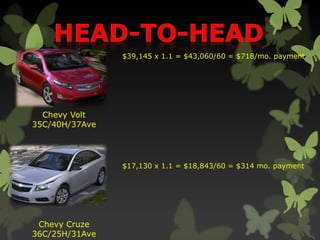
Chevy Volt
35C/40H/37Ave
Chevy Cruze
36C/25H/31Ave
Chevy Volt
35C/40H/37Ave
Chevy Cruze
36C/25H/31Ave
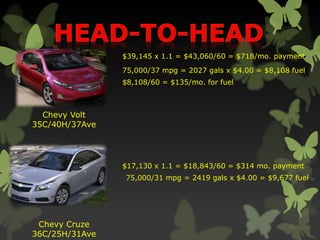
$39,145 x 1.1 = $43,060/60 = $718/mo. payment
Chevy Volt
35C/40H/37Ave
Chevy Cruze
36C/25H/31Ave
$39,145 x 1.1 = $43,060/60 = $718/mo. payment
$17,130 x 1.1 = $18,843/60 = $314 mo. payment
Chevy Volt
35C/40H/37Ave
Chevy Cruze
36C/25H/31Ave
$39,145 x 1.1 = $43,060/60 = $718/mo. payment
$17,130 x 1.1 = $18,843/60 = $314 mo. payment
75,000/37 mpg = 2027 gals x $4.00 = $8,108 fuel
Chevy Volt
35C/40H/37Ave
Chevy Cruze
36C/25H/31Ave
$39,145 x 1.1 = $43,060/60 = $718/mo. payment
$17,130 x 1.1 = $18,843/60 = $314 mo. payment
75,000/31 mpg = 2419 gals x $4.00 = $9,677 fuel
75,000/37 mpg = 2027 gals x $4.00 = $8,108 fuel
Chevy Volt
35C/40H/37Ave
Chevy Cruze
36C/25H/31Ave
$39,145 x 1.1 = $43,060/60 = $718/mo. payment
$17,130 x 1.1 = $18,843/60 = $314 mo. payment
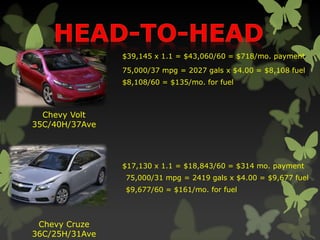
75,000/31 mpg = 2419 gals x $4.00 = $9,677 fuel
75,000/37 mpg = 2027 gals x $4.00 = $8,108 fuel
$8,108/60 = $135/mo. for fuel
Chevy Volt
35C/40H/37Ave
Chevy Cruze
36C/25H/31Ave
$39,145 x 1.1 = $43,060/60 = $718/mo. payment
$17,130 x 1.1 = $18,843/60 = $314 mo. payment
75,000/31 mpg = 2419 gals x $4.00 = $9,677 fuel
$9,677/60 = $161/mo. for fuel
75,000/37 mpg = 2027 gals x $4.00 = $8,108 fuel
$8,108/60 = $135/mo. for fuel
Chevy Volt
35C/40H/37Ave
Chevy Cruze
36C/25H/31Ave
$39,145 x 1.1 = $43,060/60 = $718/mo. payment
$17,130 x 1.1 = $18,843/60 = $314 mo. payment
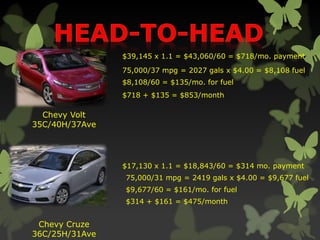
75,000/31 mpg = 2419 gals x $4.00 = $9,677 fuel
$9,677/60 = $161/mo. for fuel
$718 + $135 = $853/month
75,000/37 mpg = 2027 gals x $4.00 = $8,108 fuel
$8,108/60 = $135/mo. for fuel
Chevy Volt
35C/40H/37Ave
Chevy Cruze
36C/25H/31Ave
$39,145 x 1.1 = $43,060/60 = $718/mo. payment
$17,130 x 1.1 = $18,843/60 = $314 mo. payment
75,000/31 mpg = 2419 gals x $4.00 = $9,677 fuel
$9,677/60 = $161/mo. for fuel
$314 + $161 = $475/month
$718 + $135 = $853/month
75,000/37 mpg = 2027 gals x $4.00 = $8,108 fuel
$8,108/60 = $135/mo. for fuel
Chevy Cruze $378/month
35,154 miles free a year
Very special thanks to:
For information content used
William (Bill) S. Gaines, Chairman of the Board, Transfer Flow, Inc.
Dr. Daisuke Aoyagi, PhD, Mechanical and Aerospace Engineering

Alternative fuels

  • 3.
     To reducethe amount of Global Greenhouse Gases  CO2  To reduce our dependence on foreign oil supplies  By lowering our use of petro-fuels  To increase our Sustainability level  Use of more Bio-friendly fuels
  • 4.
     We aretaking the first steps  This is NOT going to resolve itself overnight  It is going to be expensive  Much of the technology needed does not yet exist!
  • 7.
  • 9.
  • 10.
  • 11.
  • 12.
  • 13.
    VOC – VolatileOrganic Compounds
  • 14.
  • 15.
    Lead – Manydifferent compounds
  • 16.
    CO2 – CarbonDioxide CO – Carbon Monoxide Nox – Nitrous Oxides HC – Hydro-Carbons PM – Particulate Matter
  • 22.
     Sustainable energyis the sustainable provision of energy that meets the needs of the present without compromising the ability of future generations to meet their needs (long-term availability).  Hydroelectricity  Geothermal  Solar  Wind  Tidal
  • 23.
     is asubset of renewable energy and represents those renewable energy resources and technologies that provide the highest environmental benefit.  Biofuels Ethanol Biodiesel  Hydrogen Fuel Cell  Climate Change  GHG-CO2, CH4, N2O, CFC’s, HFC’s, PFC’s, SF6
  • 24.
     Better forthe environment  Emissions But what about electric vehicles?  Trendy  First Adopters  Hollywood stars  Convenient  Have Alternative Fuel at home, ranch  Petro fuel located too far away  Only do short trip driving
  • 25.
     NG  NaturalGas  CNG  Compressed Natural Gas  LNG  Liquefied Natural Gas  Propane  Biomass  Ethanol  Methanol  Biodiesel  EV’s and Hybrids  Hydrogen Fuel Cells
  • 26.
    For this class,AFV means Alternative Fueled Vehicles, NOT: America’s Funniest Videos!!!
  • 27.
     Engine wearand cleanliness much better with certain fuels  Most have much less GHG impact  May help obtain energy future independence  Lower emissions  Lower fuel costs  Renewable/sustainable
  • 28.
     Generally lessdriving range  Fuel storage takes up space in vehicle  Lack of infrastructure to support fueling  Technician training not widespread  Dual-fuel systems more complex  Higher initial costs  Few OEM models  Outlook uncertain Can it survive without subsidy?
  • 29.
     Found deepunderground, and in coal beds  “Landfill gas”: renewable  Methane hydrate:  CH4 trapped in ice beneath ocean floor  Worldwide est. 104 gigatons, not all recoverable
  • 30.
     19th centurystreet-lighting US cities  Limited number, used cast-iron pipes  US early 20th century  First interstate pipelines  Mid 20th century and WWII  Strategic national crude pipeline network, later used as natural gas pipeline  Pre-1940’s, unwanted by-product of oil drilling-often flared off  Limited vehicle fuel use during WWII with higher gasoline prices
  • 31.
     Very safe-ignitiontemperature: >1000oF  Very high octane rating: 115+  Energy: ~20,500 Btu/lb.  Methane is a GHG  Compressed Natural Gas (CNG) stored under pressure (3600psi)  Liquefied Natural Gas (LNG) cryogenically stored (-260oF)
  • 32.
     High pressureonboard tank-3600psi  Requires heavy/bulky tanks  Lighter composite tanks are expensive  Less energy per volume than liquid fuel  Limited range and/or payload
  • 33.
     Extremely lowtemperature  -260oF (-162oC). 1/600 the volume of gas  Pressure equal to or close to atmospheric  Requires special cryogenic “Dewars” (~72 hrs.)  Not suitable for vehicle fuel in general  Shipped via truck where pipeline not available
  • 34.
     LPG firstdistilled from gasoline in 1910  Common for heating/cooking in rural areas  World Propane use ~270 million metric tons 2012  One of the simplest hydrocarbons  Non-toxic, odorless and non-caustic  Spill/leak will not cause environmental hazards  Lower CO2 emissions, not a Green House Gas  Octane rating 104-112
  • 35.
     Ethanol =Grain Alcohol CH3CH2OH  Biomass sources are corn, sugar cane, etc.  By bacterial fermentation  Cellulosic sources are Switch grass, etc.  Blends easily with gasoline  Lower blend = Oxygenate  Higher blend = E85 and Flex Fuel Vehicle (2003)
  • 36.
     Methanol =Wood Alcohol CH3OH  Can be derived from:  Coal, natural gas, algae, biomass, etc.  Similar to Ethanol, used as racing fuel  Highly poisonous  Corrosive to some metals, rubber, and polymers  MTBE – Methanol oxygenate-big environmental problems!
  • 37.
     Low-level blendsusable in any gasoline vehicle  Many FFV models available at little or no extra cost  Biodegradable and less toxic than gasoline  Cost of fueling stations (new/upgrade) is reasonable  Renewable, domestic  Cellulosic ethanol has great potential to reduce GHG
  • 38.
     Corrosive tocertain materials  Water absorption (& phase separation)  Higher blends may have cold start issues  Less range due to less heat content per volume  Costs more than gasoline
  • 39.
     Biodiesel –Rudolf Diesel used Peanut Oil in 1893  Feedstock: vegetable oil, animal fat, fatty algae  Petrodiesel would become affordable, then dominant!  Rising oil prices and environmental concerns have led to reintroduction of biodiesel as alternative fuel  Modern biodiesel is different from raw vegetable oil  Biofuels have potential to replace >10 billion gallons of petroleum in US by 2030
  • 44.
     Domestic, Renewable Reduces CO2 emissions  Little or no engine/fuel system modification required  Tested to ASTM spec  B5 part of standard diesel fuel pool  More OEM’s ok up to B20  Produces fewer harmful emissions (CO2, HC’s, PM)  New-design engines meet CARB standards  Less environmental spill damage vs. petrodiesel
  • 45.
     Higher costvs. Petrodiesel (Jan 2012)  Diesel #2.87  B20 $2.96  B99-100 $3.59  Production is limited by feedstock supply!  Shorter storage life – 6 months advised  Cold weather issues  May initially clog filters  OEM warranty may be at risk  Check with OEM!
  • 46.
     In theearly 1900’s, EV’s completed with ICE powered vehicles  100 years later, EV’s are gaining public interest  Battery power not a “fuel”, but EV’s and HEV’s are considered AFV
  • 47.
     In theearly 1900’s, EV’s completed with ICE powered vehicles  100 years later, EV’s are gaining public interest  Battery power not a “fuel”, but EV’s and HEV’s are considered AFV
  • 48.
     HEV: HybridElectric Vehicle  ICE + Battery + Motor  Toyota Prius, Honda Insight  PHEV: Plug-in HEV  HEV + External Charge  Chevy Volt, Toyota Prius PHV  EV: All electric Vehicle  Battery + Motor + external charge  Nissan Leaf, Mitsubishi iMiEV
  • 49.
     Series HybridElectric Vehicle (HEV)  Low speed efficiency, less at highway speeds  Parallel HEV  Higher speed efficiency, less at in-town speeds  Mild/Micro HEV  Simple version of Parallel HEV, less power, less costs  Series/Parallel HEV  Efficient at both low and high speeds, more complex and expensive  Plug-in HEV  Range extended ICE, similar to HEV  EV-Electric Vehicle  Classic Battery/Motor, zero emissions, limited range
  • 50.
     Electric MotorTypes  Induction motor Relatively mature  Permanent Magnet  Switched Reluctance motors  Many other types…
  • 51.
     Battery Types Lithium-ion  Li-ion light weight, high energy density power source  Nickel-Metal Hydride  Ni-MH all-electric plug-in vehicles  Lead-acid  Very low energy to weight ratio, invented in 1859  Lithium-Polymer  LiPO batteries may also power the next generation of battery electric vehicles  Ultracapacitor  Particularly suitable for regenerative braking applications, possible future replacement for EV and Plug-in HEV batteries
  • 53.
     HEV  Cangreatly improve fuel economy in Stop-go conditions  Hybrid technology can be combined with alternatively-fueled ICE’s  Many more models will be offered with a range of hybrid technologies  EV  Niche market now, limited range, cost, charging  As battery + charging technologies/access improve, so will EV range + acceptance  ZEV – not zero emissions  “Well-to-wheel” analysis  Source of power dirty or clean?  Line loss and heat issues  Securing, expanding clean power is a daunting, expensive challenge
  • 55.
  • 56.
    Prius C 53C/46H/50Ave Corolla 27C/34H/31Ave $19,080 x1.1 = $20,988/60 = $350/mo. payment
  • 57.
    Prius C 53C/46H/50Ave Corolla 27C/34H/31Ave $19,080 x1.1 = $20,988/60 = $350/mo. payment $16,230 x 1.1 = $17,853/60 = $298 mo. payment
  • 58.
    Prius C 53C/46H/50Ave Corolla 27C/34H/31Ave $19,080 x1.1 = $20,988/60 = $350/mo. payment $16,230 x 1.1 = $17,853/60 = $298 mo. payment 75,000/50 mpg = 1500 gals x $4.00 = $6000 fuel
  • 59.
    Prius C 53C/46H/50Ave Corolla 27C/34H/31Ave $19,080 x1.1 = $20,988/60 = $350/mo. payment $16,230 x 1.1 = $17,853/60 = $298 mo. payment 75,000/50 mpg = 1500 gals x $4.00 = $6000 fuel 75,000/31 mpg = 2419 gals x $4.00 = $9676 fuel
  • 60.
    Prius C 53C/46H/50Ave Corolla 27C/34H/31Ave $19,080 x1.1 = $20,988/60 = $350/mo. payment $16,230 x 1.1 = $17,853/60 = $298 mo. payment 75,000/50 mpg = 1500 gals x $4.00 = $6000 fuel 75,000/31 mpg = 2419 gals x $4.00 = $9676 fuel $6000/60 = $100/mo. for fuel
  • 61.
    Prius C 53C/46H/50Ave Corolla 27C/34H/31Ave $19,080 x1.1 = $20,988/60 = $350/mo. payment $16,230 x 1.1 = $17,853/60 = $298 mo. payment 75,000/50 mpg = 1500 gals x $4.00 = $6000 fuel 75,000/31 mpg = 2419 gals x $4.00 = $9676 fuel $6000/60 = $100/mo. for fuel $9676/60 = $161/mo. for fuel
  • 62.
    Prius C 53C/46H/50Ave Corolla 27C/34H/31Ave $19,080 x1.1 = $20,988/60 = $350/mo. payment $16,230 x 1.1 = $17,853/60 = $298 mo. payment 75,000/50 mpg = 1500 gals x $4.00 = $6000 fuel 75,000/31 mpg = 2419 gals x $4.00 = $9676 fuel $6000/60 = $100/mo. for fuel $9676/60 = $161/mo. for fuel $350 + $100 = $450/month
  • 63.
    Prius C 53C/46H/50Ave Corolla 27C/34H/31Ave $19,080 x1.1 = $20,988/60 = $350/mo. payment $16,230 x 1.1 = $17,853/60 = $298 mo. payment 75,000/50 mpg = 1500 gals x $4.00 = $6000 fuel 75,000/31 mpg = 2419 gals x $4.00 = $9676 fuel $6000/60 = $100/mo. for fuel $9676/60 = $161/mo. for fuel $350 + $100 = $450/month $298 + $161 = $459/month
  • 65.
  • 74.
  • 75.
    Camry Hybrid 43C/39H/41Ave Camry LE 25C/35H/30Ave $26,140x 1.1 = $28,754/60 = $479/mo. payment
  • 76.
    Camry Hybrid 43C/39H/41Ave Camry LE 25C/35H/30Ave $26,140x 1.1 = $28,754/60 = $479/mo. payment $22,680 x 1.1 = $24,948/60 = $416 mo. payment
  • 77.
    Camry Hybrid 43C/39H/41Ave Camry LE 25C/35H/30Ave $26,140x 1.1 = $28,754/60 = $479/mo. payment $22,680 x 1.1 = $24,948/60 = $416 mo. payment 75,000/41 mpg = 1829 gals x $4.00 = $7317 fuel
  • 78.
    Camry Hybrid 43C/39H/41Ave Camry LE 25C/35H/30Ave $26,140x 1.1 = $28,754/60 = $479/mo. payment $22,680 x 1.1 = $24,948/60 = $416 mo. payment 75,000/41 mpg = 1829 gals x $4.00 = $7317 fuel 75,000/30 mpg = 2500 gals x $4.00 = $10,000 fuel
  • 79.
    Camry Hybrid 43C/39H/41Ave Camry LE 25C/35H/30Ave $26,140x 1.1 = $28,754/60 = $479/mo. payment $22,680 x 1.1 = $24,948/60 = $416 mo. payment 75,000/41 mpg = 1829 gals x $4.00 = $7317 fuel 75,000/30 mpg = 2500 gals x $4.00 = $10,000 fuel $7317/60 = $122/mo. for fuel
  • 80.
    Camry Hybrid 43C/39H/41Ave Camry LE 25C/35H/30Ave $26,140x 1.1 = $28,754/60 = $479/mo. payment $22,680 x 1.1 = $24,948/60 = $416 mo. payment 75,000/41 mpg = 1829 gals x $4.00 = $7317 fuel 75,000/30 mpg = 2500 gals x $4.00 = $10,000 fuel $7317/60 = $122/mo. for fuel $10,000/60 = $166/mo. for fuel
  • 81.
    Camry Hybrid 43C/39H/41Ave Camry LE 25C/35H/30Ave $26,140x 1.1 = $28,754/60 = $479/mo. payment $22,680 x 1.1 = $24,948/60 = $416 mo. payment 75,000/41 mpg = 1829 gals x $4.00 = $7317 fuel 75,000/30 mpg = 2500 gals x $4.00 = $10,000 fuel $7317/60 = $122/mo. for fuel $10,000/60 = $166/mo. for fuel $479 + $122 = $601/month
  • 82.
    Camry Hybrid 43C/39H/41Ave Camry LE 25C/35H/30Ave $26,140x 1.1 = $28,754/60 = $479/mo. payment $22,680 x 1.1 = $24,948/60 = $416 mo. payment 75,000/41 mpg = 1829 gals x $4.00 = $7317 fuel 75,000/30 mpg = 2500 gals x $4.00 = $10,000 fuel $7317/60 = $122/mo. for fuel $10,000/60 = $166/mo. for fuel $479 + $122 = $601/month $416 + $166 = $582/month
  • 84.
    Camry LE $228a year 1710 miles free a year
  • 93.
  • 94.
    Nissan Leaf 130C/106H MPGe NissanVersa 26C/32H/29Ave $28,000 x 1.1 = $30,800/60 = $513/mo. payment
  • 95.
    Nissan Leaf 130C/106H MPGe NissanVersa 26C/32H/29Ave $28,000 x 1.1 = $30,800/60 = $513/mo. payment $14,670 x 1.1 = $16,137/60 = $268 mo. payment
  • 96.
    Nissan Leaf 130C/106H MPGe NissanVersa 26C/32H/29Ave $28,000 x 1.1 = $30,800/60 = $513/mo. payment $14,670 x 1.1 = $16,137/60 = $268 mo. payment All Electric – No fuel used
  • 97.
    Nissan Leaf 130C/106H MPGe NissanVersa 26C/32H/29Ave $28,000 x 1.1 = $30,800/60 = $513/mo. payment $14,670 x 1.1 = $16,137/60 = $268 mo. payment 75,000/29 mpg = 2586 gals x $4.00 = $10,345 fuel All Electric – No fuel used
  • 98.
    Nissan Leaf 130C/106H MPGe NissanVersa 26C/32H/29Ave $28,000 x 1.1 = $30,800/60 = $513/mo. payment $14,670 x 1.1 = $16,137/60 = $268 mo. payment 75,000/29 mpg = 2586 gals x $4.00 = $10,345 fuel $10,345/60 = $172/mo. for fuel All Electric – No fuel used
  • 99.
    Nissan Leaf 130C/106H MPGe NissanVersa 26C/32H/29Ave $28,000 x 1.1 = $30,800/60 = $513/mo. payment $14,670 x 1.1 = $16,137/60 = $268 mo. payment 75,000/29 mpg = 2586 gals x $4.00 = $10,345 fuel $10,345/60 = $172/mo. for fuel $513/month All Electric – No fuel used
  • 100.
    Nissan Leaf 130C/106H MPGe NissanVersa 26C/32H/29Ave $28,000 x 1.1 = $30,800/60 = $513/mo. payment $14,670 x 1.1 = $16,137/60 = $268 mo. payment 75,000/29 mpg = 2586 gals x $4.00 = $10,345 fuel $10,345/60 = $172/mo. for fuel $268 + $172 = $440/month $513/month All Electric – No fuel used
  • 102.
    Nissan Versa $73/month 6351miles free a year
  • 113.
  • 114.
  • 115.
    Chevy Volt 35C/40H/37Ave Chevy Cruze 36C/25H/31Ave $39,145x 1.1 = $43,060/60 = $718/mo. payment $17,130 x 1.1 = $18,843/60 = $314 mo. payment
  • 116.
    Chevy Volt 35C/40H/37Ave Chevy Cruze 36C/25H/31Ave $39,145x 1.1 = $43,060/60 = $718/mo. payment $17,130 x 1.1 = $18,843/60 = $314 mo. payment 75,000/37 mpg = 2027 gals x $4.00 = $8,108 fuel
  • 117.
    Chevy Volt 35C/40H/37Ave Chevy Cruze 36C/25H/31Ave $39,145x 1.1 = $43,060/60 = $718/mo. payment $17,130 x 1.1 = $18,843/60 = $314 mo. payment 75,000/31 mpg = 2419 gals x $4.00 = $9,677 fuel 75,000/37 mpg = 2027 gals x $4.00 = $8,108 fuel
  • 118.
    Chevy Volt 35C/40H/37Ave Chevy Cruze 36C/25H/31Ave $39,145x 1.1 = $43,060/60 = $718/mo. payment $17,130 x 1.1 = $18,843/60 = $314 mo. payment 75,000/31 mpg = 2419 gals x $4.00 = $9,677 fuel 75,000/37 mpg = 2027 gals x $4.00 = $8,108 fuel $8,108/60 = $135/mo. for fuel
  • 119.
    Chevy Volt 35C/40H/37Ave Chevy Cruze 36C/25H/31Ave $39,145x 1.1 = $43,060/60 = $718/mo. payment $17,130 x 1.1 = $18,843/60 = $314 mo. payment 75,000/31 mpg = 2419 gals x $4.00 = $9,677 fuel $9,677/60 = $161/mo. for fuel 75,000/37 mpg = 2027 gals x $4.00 = $8,108 fuel $8,108/60 = $135/mo. for fuel
  • 120.
    Chevy Volt 35C/40H/37Ave Chevy Cruze 36C/25H/31Ave $39,145x 1.1 = $43,060/60 = $718/mo. payment $17,130 x 1.1 = $18,843/60 = $314 mo. payment 75,000/31 mpg = 2419 gals x $4.00 = $9,677 fuel $9,677/60 = $161/mo. for fuel $718 + $135 = $853/month 75,000/37 mpg = 2027 gals x $4.00 = $8,108 fuel $8,108/60 = $135/mo. for fuel
  • 121.
    Chevy Volt 35C/40H/37Ave Chevy Cruze 36C/25H/31Ave $39,145x 1.1 = $43,060/60 = $718/mo. payment $17,130 x 1.1 = $18,843/60 = $314 mo. payment 75,000/31 mpg = 2419 gals x $4.00 = $9,677 fuel $9,677/60 = $161/mo. for fuel $314 + $161 = $475/month $718 + $135 = $853/month 75,000/37 mpg = 2027 gals x $4.00 = $8,108 fuel $8,108/60 = $135/mo. for fuel
  • 123.
  • 152.
    Very special thanksto: For information content used William (Bill) S. Gaines, Chairman of the Board, Transfer Flow, Inc. Dr. Daisuke Aoyagi, PhD, Mechanical and Aerospace Engineering