Unit 1
Introduction to HEV
Hybrid Vehicles
⚫ A hybrid vehicle combines any two power (energy) sources. Possible combinations include
diesel/electric, gasoline/fly wheel, and fuel cell (FC)/battery.
⚫ Typically, one energy source is storage, and the other is conversion of a fuel to energy.
⚫ The combination of two power sources may support two separate propulsion systems. Thus to be a
True hybrid, the vehicle must have at least two modes of propulsion.
Historical development (root) of Automobiles
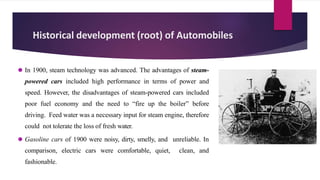
⚫ In 1900, steam technology was advanced. The advantages of steam-
powered cars included high performance in terms of power and
speed. However, the disadvantages of steam-powered cars included
poor fuel economy and the need to “fire up the boiler” before
driving. Feed water was a necessary input for steam engine, therefore
could not tolerate the loss of fresh water.
⚫ Gasoline cars of 1900 were noisy, dirty, smelly, and unreliable. In
comparison, electric cars were comfortable, quiet, clean, and
fashionable.
INVENTION OF HYBRID VEHICLE
⚫ 1890 :Jacob Lohner, a coach builder in Vienna, Austria, foresaw the need for an electric vehicle that
would be less noisy than the new gas- powered cars. He commissioned a design for an electric vehicle
from Austro-Hungarian engineer
⚫ Ferdinand Porsche, who had recently graduated from the Vienna Technical College. Porsche's first version
of the electric car used a pair of electric motors mounted in the front wheel hubs of a conventional car.
EARLY HYBRID VEHICLE
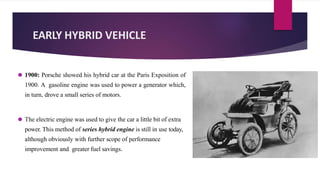
⚫ 1900: Porsche showed his hybrid car at the Paris Exposition of
1900. A gasoline engine was used to power a generator which,
in turn, drove a small series of motors.
⚫ The electric engine was used to give the car a little bit of extra
power. This method of series hybrid engine is still in use today,
although obviously with further scope of performance
improvement and greater fuel savings.
MODERN PERIOD OF HYBRID HISTORY
⚫ 1990s : Automakers took a renewed interest in the hybrid, seeking a solution to dwindling energy supplies and
environmental concerns and created modern history of hybrid car .
⚫ 2000 :Toyota Prius and Honda Insight became the first mass market hybrids to go on sale in the United States, with
dozens of models following in the next decade.
Social and Environmental Importance
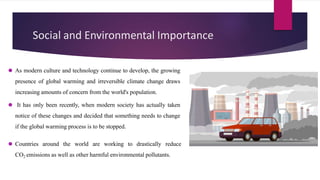
⚫ As modern culture and technology continue to develop, the growing
presence of global warming and irreversible climate change draws
increasing amounts of concern from the world's population.
⚫ It has only been recently, when modern society has actually taken
notice of these changes and decided that something needs to change
if the global warming process is to be stopped.
⚫ Countries around the world are working to drastically reduce
CO2 emissions as well as other harmful environmental pollutants.
Social and Environmental Importance
Two environmental impact elements were accounted for in the:
A) Air pollution (AP):
• At present, all vehicles rely on the combustion of hydrocarbon fuels to derive the energy necessary for their
propulsion. Combustion is a reaction between the fuel and the air that releases heat and combustion products.
• The heat is converted to mechanical power by an engine and the combustion products are released into the
atmosphere. A hydrocarbon is a chemical compound with molecules made up of carbon and hydrogen atoms.
Social and Environmental Importance
B) GLOBALWARMING:
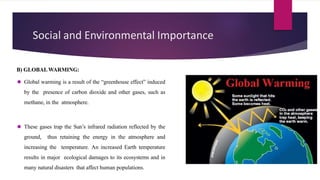
⚫ Global warming is a result of the “greenhouse effect” induced
by the presence of carbon dioxide and other gases, such as
methane, in the atmosphere.
⚫ These gases trap the Sun’s infrared radiation reflected by the
ground, thus retaining the energy in the atmosphere and
increasing the temperature. An increased Earth temperature
results in major ecological damages to its ecosystems and in
many natural disasters that affect human populations.
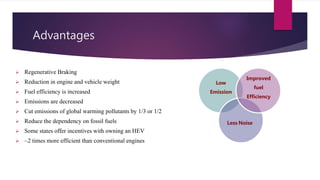
Advantages
 Regenerative Braking
 Reduction in engine and vehicle weight
 Fuel efficiency is increased
 Emissions are decreased
 Cut emissions of global warming pollutants by 1/3 or 1/2
 Reduce the dependency on fossil fuels
 Some states offer incentives with owning an HEV
 ~2 times more efficient than conventional engines
Low
Emission
Less Noise
Improved
fuel
Efficiency
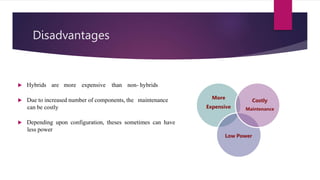
Disadvantages
 Hybrids are more expensive than non- hybrids
 Due to increased number of components, the maintenance
can be costly
 Depending upon configuration, theses sometimes can have
less power
More
Expensive
Low Power
Costly
Maintenance
What is Energy
 Energy is the ability to do work
 Energy Conversion: Transfer and Transform
We know energy can be transferred from one form to another. The movement of energy from one location to another is known as energy
transfer. We notice various energy transformations happening around us.
Following are the four ways through which energy can be transferred:
• Mechanically – By the action of force
• Electrically – Electrically
• By Radiation – By Light waves or Sound waves
• By Heating – By conduction, convection, or radiation
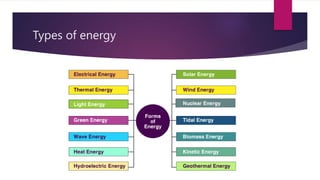
Types of energy
Parts of HEV vehicle
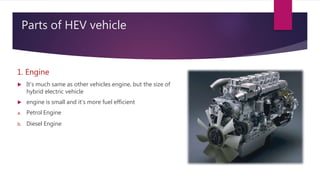
1. Engine
 It’s much same as other vehicles engine, but the size of
hybrid electric vehicle
 engine is small and it’s more fuel efficient
a. Petrol Engine
b. Diesel Engine
Parts of HEV vehicle
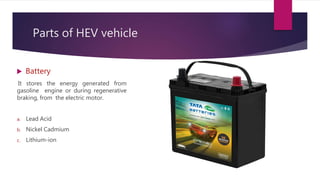
 Battery
It stores the energy generated from
gasoline engine or during regenerative
braking, from the electric motor.
a. Lead Acid
b. Nickel Cadmium
c. Lithium-ion
Parts of HEV vehicle
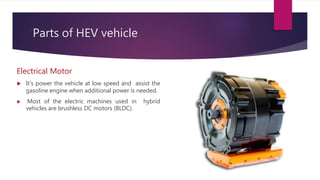
Electrical Motor
 It’s power the vehicle at low speed and assist the
gasoline engine when additional power is needed.
 Most of the electric machines used in hybrid
vehicles are brushless DC motors (BLDC).
Parts of HEV vehicle
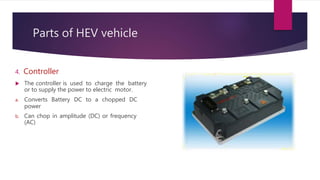
4. Controller
 The controller is used to charge the battery
or to supply the power to electric motor.
a. Converts Battery DC to a chopped DC
power
b. Can chop in amplitude (DC) or frequency
(AC)
Parts of HEV vehicle
5. Generator
It converts mechanical energy from engine
into electrical energy, which can be used by
electric motor stored in the battery. It’s also
used to start the gasoline engine instantly.
Electrical Basics
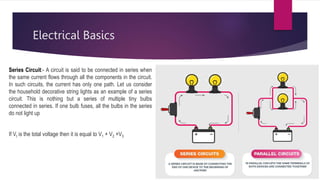
Series Circuit:- A circuit is said to be connected in series when
the same current flows through all the components in the circuit.
In such circuits, the current has only one path. Let us consider
the household decorative string lights as an example of a series
circuit. This is nothing but a series of multiple tiny bulbs
connected in series. If one bulb fuses, all the bulbs in the series
do not light up
If Vt is the total voltage then it is equal to V1 + V2 +V3
Electrical Basics
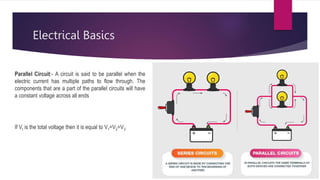
Parallel Circuit:- A circuit is said to be parallel when the
electric current has multiple paths to flow through. The
components that are a part of the parallel circuits will have
a constant voltage across all ends
If Vt is the total voltage then it is equal to V1=V2=V3
Electrical Basics
Faraday’s Law
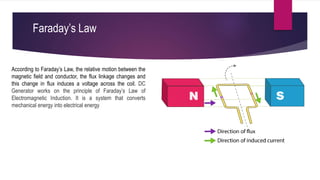
According to Faraday’s Law, the relative motion between the
magnetic field and conductor, the flux linkage changes and
this change in flux induces a voltage across the coil. DC
Generator works on the principle of Faraday’s Law of
Electromagnetic Induction. It is a system that converts
mechanical energy into electrical energy

Unit 1-HEV.pptx

  • 1.
  • 2.
    Hybrid Vehicles ⚫ Ahybrid vehicle combines any two power (energy) sources. Possible combinations include diesel/electric, gasoline/fly wheel, and fuel cell (FC)/battery. ⚫ Typically, one energy source is storage, and the other is conversion of a fuel to energy. ⚫ The combination of two power sources may support two separate propulsion systems. Thus to be a True hybrid, the vehicle must have at least two modes of propulsion.
  • 3.
    Historical development (root)of Automobiles ⚫ In 1900, steam technology was advanced. The advantages of steam- powered cars included high performance in terms of power and speed. However, the disadvantages of steam-powered cars included poor fuel economy and the need to “fire up the boiler” before driving. Feed water was a necessary input for steam engine, therefore could not tolerate the loss of fresh water. ⚫ Gasoline cars of 1900 were noisy, dirty, smelly, and unreliable. In comparison, electric cars were comfortable, quiet, clean, and fashionable.
  • 4.
    INVENTION OF HYBRIDVEHICLE ⚫ 1890 :Jacob Lohner, a coach builder in Vienna, Austria, foresaw the need for an electric vehicle that would be less noisy than the new gas- powered cars. He commissioned a design for an electric vehicle from Austro-Hungarian engineer ⚫ Ferdinand Porsche, who had recently graduated from the Vienna Technical College. Porsche's first version of the electric car used a pair of electric motors mounted in the front wheel hubs of a conventional car.
  • 5.
    EARLY HYBRID VEHICLE ⚫1900: Porsche showed his hybrid car at the Paris Exposition of 1900. A gasoline engine was used to power a generator which, in turn, drove a small series of motors. ⚫ The electric engine was used to give the car a little bit of extra power. This method of series hybrid engine is still in use today, although obviously with further scope of performance improvement and greater fuel savings.
  • 6.
    MODERN PERIOD OFHYBRID HISTORY ⚫ 1990s : Automakers took a renewed interest in the hybrid, seeking a solution to dwindling energy supplies and environmental concerns and created modern history of hybrid car . ⚫ 2000 :Toyota Prius and Honda Insight became the first mass market hybrids to go on sale in the United States, with dozens of models following in the next decade.
  • 7.
    Social and EnvironmentalImportance ⚫ As modern culture and technology continue to develop, the growing presence of global warming and irreversible climate change draws increasing amounts of concern from the world's population. ⚫ It has only been recently, when modern society has actually taken notice of these changes and decided that something needs to change if the global warming process is to be stopped. ⚫ Countries around the world are working to drastically reduce CO2 emissions as well as other harmful environmental pollutants.
  • 8.
    Social and EnvironmentalImportance Two environmental impact elements were accounted for in the: A) Air pollution (AP): • At present, all vehicles rely on the combustion of hydrocarbon fuels to derive the energy necessary for their propulsion. Combustion is a reaction between the fuel and the air that releases heat and combustion products. • The heat is converted to mechanical power by an engine and the combustion products are released into the atmosphere. A hydrocarbon is a chemical compound with molecules made up of carbon and hydrogen atoms.
  • 9.
    Social and EnvironmentalImportance B) GLOBALWARMING: ⚫ Global warming is a result of the “greenhouse effect” induced by the presence of carbon dioxide and other gases, such as methane, in the atmosphere. ⚫ These gases trap the Sun’s infrared radiation reflected by the ground, thus retaining the energy in the atmosphere and increasing the temperature. An increased Earth temperature results in major ecological damages to its ecosystems and in many natural disasters that affect human populations.
  • 10.
    Advantages  Regenerative Braking Reduction in engine and vehicle weight  Fuel efficiency is increased  Emissions are decreased  Cut emissions of global warming pollutants by 1/3 or 1/2  Reduce the dependency on fossil fuels  Some states offer incentives with owning an HEV  ~2 times more efficient than conventional engines Low Emission Less Noise Improved fuel Efficiency
  • 11.
    Disadvantages  Hybrids aremore expensive than non- hybrids  Due to increased number of components, the maintenance can be costly  Depending upon configuration, theses sometimes can have less power More Expensive Low Power Costly Maintenance
  • 12.
    What is Energy Energy is the ability to do work  Energy Conversion: Transfer and Transform We know energy can be transferred from one form to another. The movement of energy from one location to another is known as energy transfer. We notice various energy transformations happening around us. Following are the four ways through which energy can be transferred: • Mechanically – By the action of force • Electrically – Electrically • By Radiation – By Light waves or Sound waves • By Heating – By conduction, convection, or radiation
  • 13.
  • 14.
    Parts of HEVvehicle 1. Engine  It’s much same as other vehicles engine, but the size of hybrid electric vehicle  engine is small and it’s more fuel efficient a. Petrol Engine b. Diesel Engine
  • 15.
    Parts of HEVvehicle  Battery It stores the energy generated from gasoline engine or during regenerative braking, from the electric motor. a. Lead Acid b. Nickel Cadmium c. Lithium-ion
  • 16.
    Parts of HEVvehicle Electrical Motor  It’s power the vehicle at low speed and assist the gasoline engine when additional power is needed.  Most of the electric machines used in hybrid vehicles are brushless DC motors (BLDC).
  • 17.
    Parts of HEVvehicle 4. Controller  The controller is used to charge the battery or to supply the power to electric motor. a. Converts Battery DC to a chopped DC power b. Can chop in amplitude (DC) or frequency (AC)
  • 18.
    Parts of HEVvehicle 5. Generator It converts mechanical energy from engine into electrical energy, which can be used by electric motor stored in the battery. It’s also used to start the gasoline engine instantly.
  • 19.
    Electrical Basics Series Circuit:-A circuit is said to be connected in series when the same current flows through all the components in the circuit. In such circuits, the current has only one path. Let us consider the household decorative string lights as an example of a series circuit. This is nothing but a series of multiple tiny bulbs connected in series. If one bulb fuses, all the bulbs in the series do not light up If Vt is the total voltage then it is equal to V1 + V2 +V3
  • 20.
    Electrical Basics Parallel Circuit:-A circuit is said to be parallel when the electric current has multiple paths to flow through. The components that are a part of the parallel circuits will have a constant voltage across all ends If Vt is the total voltage then it is equal to V1=V2=V3
  • 21.
  • 22.
    Faraday’s Law According toFaraday’s Law, the relative motion between the magnetic field and conductor, the flux linkage changes and this change in flux induces a voltage across the coil. DC Generator works on the principle of Faraday’s Law of Electromagnetic Induction. It is a system that converts mechanical energy into electrical energy