Intro To Hybrids
Introduction to Hybrid Vehicles
• Micro, Mild, Medium, Full (strong), and Power hybrid systems
• Series, Parallel and Series-Parallel powertrain designs
• HEV (Hybrid Electric Vehicles), PHEV (Plug-in Hybrid Electric Vehicles),
and their differences.
What is a Hybrid?
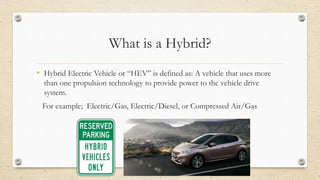
• Hybrid Electric Vehicle or “HEV” is defined as: A vehicle that uses more
than one propulsion technology to provide power to the vehicle drive
system.
For example; Electric/Gas, Electric/Diesel, or Compressed Air/Gas
Hybrid Sub-Categories
• There are Hybrid sub-categories depending on level of assist and voltage
applied. These sub-categories are; Micro, Mild, Medium, Full (Strong), and
Power.
NOTE: There are no industry standard
definition of the following sub-
categories. Hybrid sub-categories are
always changing, depending on
information source (manufacture).
Micro Hybrids
• Micro Hybrids use an electric motor that provides engine stop/start, also
known as “Idle stop”. It also provides auxiliary power and regenerative
braking. This type of hybrid does not provide any extra torque assist to the
ICE.
• Fuel savings for these hybrids are between 5 and 15 percent.
Micro Hybrids
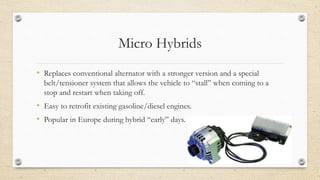
• Replaces conventional alternator with a stronger version and a special
belt/tensioner system that allows the vehicle to “stall” when coming to a
stop and restart when taking off.
• Easy to retrofit existing gasoline/diesel engines.
• Popular in Europe during hybrid “early” days.
Mild Hybrids
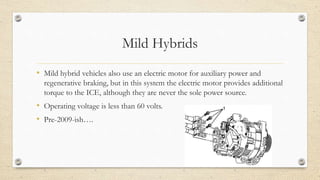
• Mild hybrid vehicles also use an electric motor for auxiliary power and
regenerative braking, but in this system the electric motor provides additional
torque to the ICE, although they are never the sole power source.
• Operating voltage is less than 60 volts.
• Pre-2009-ish….
Mild Hybrids
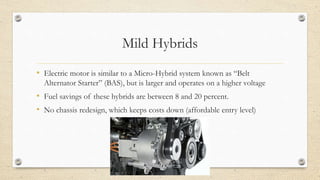
• Electric motor is similar to a Micro-Hybrid system known as “Belt
Alternator Starter” (BAS), but is larger and operates on a higher voltage
• Fuel savings of these hybrids are between 8 and 20 percent.
• No chassis redesign, which keeps costs down (affordable entry level)
Medium Hybrids
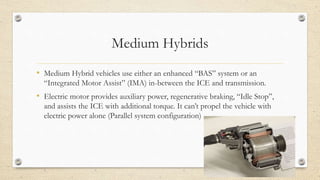
• Medium Hybrid vehicles use either an enhanced “BAS” system or an
“Integrated Motor Assist” (IMA) in-between the ICE and transmission.
• Electric motor provides auxiliary power, regenerative braking, “Idle Stop”,
and assists the ICE with additional torque. It can’t propel the vehicle with

electric power alone (Parallel system configuration)
Medium Hybrids
• Operating volts are between 100 and 200
• Fuel savings of these hybrids are between 20 and 25 percent.
• Examples of medium hybrids include;
-2009 and newer GM e-Assist BAS vehicles.
-Honda “IMA” hybrids (1999 to present)
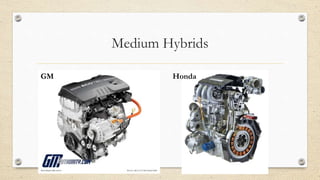
Medium Hybrids
GM Honda
Full (Strong) Hybrids
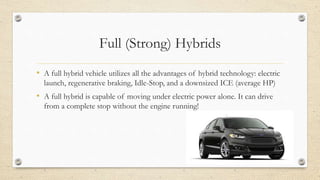
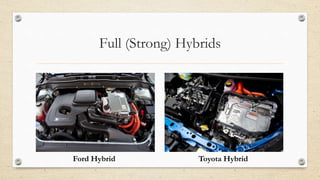
• A full hybrid vehicle utilizes all the advantages of hybrid technology: electric
launch, regenerative braking, Idle-Stop, and a downsized ICE (average HP)
• A full hybrid is capable of moving under electric power alone. It can drive
from a complete stop without the engine running!
Full (Strong) Hybrids
• Operating volts are above 200 (Usually between 300 and 600)
• Fuel savings of these hybrids are between 30 and 50 percent.
• Examples of Full Hybrids include;
-All Ford Hybrids -GM 2 mode trucks
-All Toyota Hybrids -Chevrolet Volt
-2014 and newer Hondas -Newer Nissan Altima and Hyundai Sonata
Full (Strong) Hybrids
Ford Hybrid Toyota Hybrid
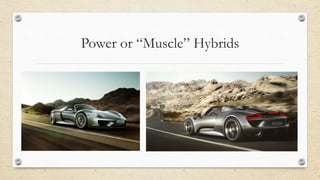
Power or “Muscle” Hybrids
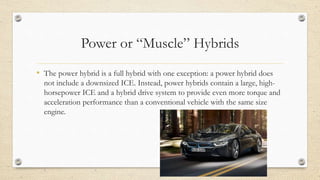
• The power hybrid is a full hybrid with one exception: a power hybrid does
not include a downsized ICE. Instead, power hybrids contain a large, high-
horsepower ICE and a hybrid drive system to provide even more torque and
acceleration performance than a conventional vehicle with the same size
engine.
Power or “Muscle” Hybrid
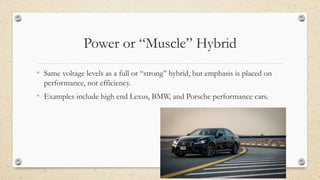
• Same voltage levels as a full or “strong” hybrid, but emphasis is placed on
performance, not efficiency.
• Examples include high end Lexus, BMW, and Porsche performance cars.
Power or “Muscle” Hybrids
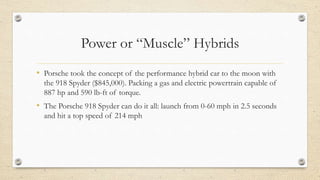
• Porsche took the concept of the performance hybrid car to the moon with
the 918 Spyder ($845,000). Packing a gas and electric powertrain capable of
887 hp and 590 lb-ft of torque.
• The Porsche 918 Spyder can do it all: launch from 0-60 mph in 2.5 seconds
and hit a top speed of 214 mph
Power or “Muscle” Hybrids
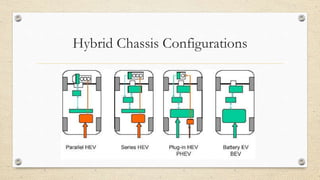
Hybrid Chassis Configurations
NOTE: Due to the complexity of Full (Strong)
hybrids, such as battery size, electrical demand,
and operation, these hybrids utilize several
different chassis and operational configurations.
Such as the following; Series, Parallel, and Series-
Parallel. These definitions are much more
standardized.
Series Design Hybrid
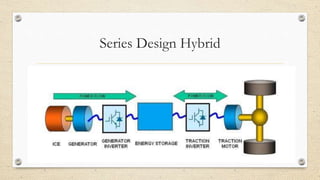
• A series designed hybrid uses the ICE to turn (power) a generator that can
either charge the on board high voltage battery or power the other electric
motor (traction motor) to propel the vehicle.
• There is NO mechanical connection between the ICE and the wheels.
• May become more common as battery technologies improve. (weight)
Series Design Hybrid
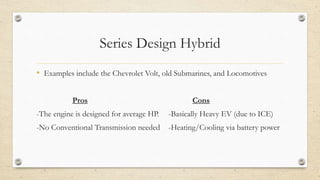
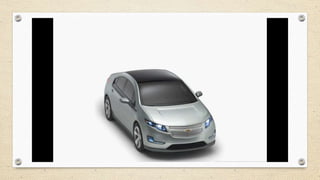
• Examples include the Chevrolet Volt, old Submarines, and Locomotives
Pros Cons
-The engine is designed for average HP. -Basically Heavy EV (due to ICE)
-No Conventional Transmission needed -Heating/Cooling via battery power
Series Design Hybrid
Parallel Design Hybrid
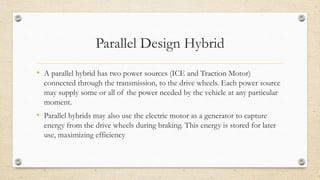
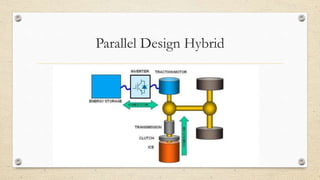
• A parallel hybrid has two power sources (ICE and Traction Motor)
connected through the transmission, to the drive wheels. Each power source
may supply some or all of the power needed by the vehicle at any particular
moment.
• Parallel hybrids may also use the electric motor as a generator to capture
energy from the drive wheels during braking. This energy is stored for later
use, maximizing efficiency
Parallel Design Hybrid
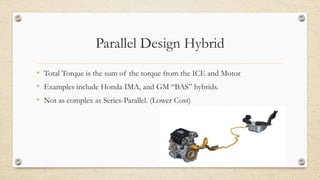
• Total Torque is the sum of the torque from the ICE and Motor
• Examples include Honda IMA, and GM “BAS” hybrids.
• Not as complex as Series-Parallel. (Lower Cost)
Parallel Design Hybrid
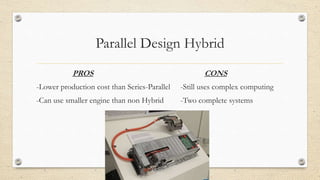
PROS CONS
-Lower production cost than Series-Parallel -Still uses complex computing
-Can use smaller engine than non Hybrid -Two complete systems
Parallel Design Hybrid
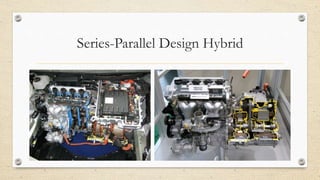
Series-Parallel Design Hybrid
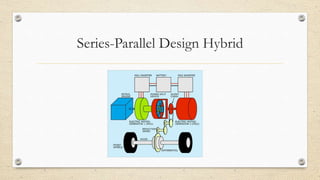
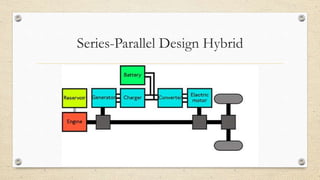
• The ICE and the Traction motor feed into the transmission via separate
paths, enabling fully independent propulsion via the engine or electricity.
• In parallel fashion, the motor-generator can either bolster the engine's output
or provide battery charging via regenerative braking.
• The engine can still power the car, but it can also be reassigned to battery
charging duty while the electric motor drives the vehicle: the classic series
operation.
Series-Parallel Design Hybrid
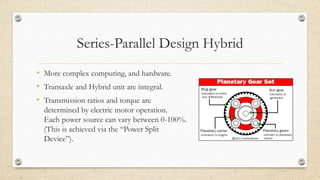
• More complex computing, and hardware.
• Transaxle and Hybrid unit are integral.
• Transmission ratios and torque are
determined by electric motor operation.
Each power source can vary between 0-100%.
(This is achieved via the “Power Split
Device”).
Series-Parallel Design Hybrid
PROS CONS
-Maximum efficiency -Even more complex software
-Extended range vs. EV -Much more parts/subsystems
-Wide range of torque application -Cost and maintenance is high
Lets check out slide 16(operation) of Toyota’s training material for the Prius!
Series-Parallel Design Hybrid
Design Variations
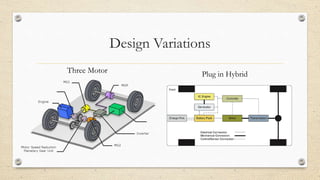
• Plug in Hybrid or “PHEV” can be added to the above configurations. This
adds on a larger, more advanced, more powerful battery, and exterior
charging ports, hardware, and software.
• Three motor hybrids can be achieved by adding an additional (third) electric
motor “MGR”, usually to the rear to create an AWD system. This system
uses an even more complex control software to integrate these systems.
Design Variations
Three Motor Plug in Hybrid
Any Questions?

Intro to hybrids

  • 1.
  • 2.
    Introduction to HybridVehicles • Micro, Mild, Medium, Full (strong), and Power hybrid systems • Series, Parallel and Series-Parallel powertrain designs • HEV (Hybrid Electric Vehicles), PHEV (Plug-in Hybrid Electric Vehicles), and their differences.
  • 3.
    What is aHybrid? • Hybrid Electric Vehicle or “HEV” is defined as: A vehicle that uses more than one propulsion technology to provide power to the vehicle drive system. For example; Electric/Gas, Electric/Diesel, or Compressed Air/Gas
  • 4.
    Hybrid Sub-Categories • Thereare Hybrid sub-categories depending on level of assist and voltage applied. These sub-categories are; Micro, Mild, Medium, Full (Strong), and Power.
  • 5.
    NOTE: There areno industry standard definition of the following sub- categories. Hybrid sub-categories are always changing, depending on information source (manufacture).
  • 6.
    Micro Hybrids • MicroHybrids use an electric motor that provides engine stop/start, also known as “Idle stop”. It also provides auxiliary power and regenerative braking. This type of hybrid does not provide any extra torque assist to the ICE. • Fuel savings for these hybrids are between 5 and 15 percent.
  • 7.
    Micro Hybrids • Replacesconventional alternator with a stronger version and a special belt/tensioner system that allows the vehicle to “stall” when coming to a stop and restart when taking off. • Easy to retrofit existing gasoline/diesel engines. • Popular in Europe during hybrid “early” days.
  • 8.
    Mild Hybrids • Mildhybrid vehicles also use an electric motor for auxiliary power and regenerative braking, but in this system the electric motor provides additional torque to the ICE, although they are never the sole power source. • Operating voltage is less than 60 volts. • Pre-2009-ish….
  • 9.
    Mild Hybrids • Electricmotor is similar to a Micro-Hybrid system known as “Belt Alternator Starter” (BAS), but is larger and operates on a higher voltage • Fuel savings of these hybrids are between 8 and 20 percent. • No chassis redesign, which keeps costs down (affordable entry level)
  • 10.
    Medium Hybrids • MediumHybrid vehicles use either an enhanced “BAS” system or an “Integrated Motor Assist” (IMA) in-between the ICE and transmission. • Electric motor provides auxiliary power, regenerative braking, “Idle Stop”, and assists the ICE with additional torque. It can’t propel the vehicle with electric power alone (Parallel system configuration)
  • 11.
    Medium Hybrids • Operatingvolts are between 100 and 200 • Fuel savings of these hybrids are between 20 and 25 percent. • Examples of medium hybrids include; -2009 and newer GM e-Assist BAS vehicles. -Honda “IMA” hybrids (1999 to present)
  • 12.
  • 13.
    Full (Strong) Hybrids •A full hybrid vehicle utilizes all the advantages of hybrid technology: electric launch, regenerative braking, Idle-Stop, and a downsized ICE (average HP) • A full hybrid is capable of moving under electric power alone. It can drive from a complete stop without the engine running!
  • 14.
    Full (Strong) Hybrids •Operating volts are above 200 (Usually between 300 and 600) • Fuel savings of these hybrids are between 30 and 50 percent. • Examples of Full Hybrids include; -All Ford Hybrids -GM 2 mode trucks -All Toyota Hybrids -Chevrolet Volt -2014 and newer Hondas -Newer Nissan Altima and Hyundai Sonata
  • 15.
    Full (Strong) Hybrids FordHybrid Toyota Hybrid
  • 16.
    Power or “Muscle”Hybrids • The power hybrid is a full hybrid with one exception: a power hybrid does not include a downsized ICE. Instead, power hybrids contain a large, high- horsepower ICE and a hybrid drive system to provide even more torque and acceleration performance than a conventional vehicle with the same size engine.
  • 17.
    Power or “Muscle”Hybrid • Same voltage levels as a full or “strong” hybrid, but emphasis is placed on performance, not efficiency. • Examples include high end Lexus, BMW, and Porsche performance cars.
  • 18.
    Power or “Muscle”Hybrids • Porsche took the concept of the performance hybrid car to the moon with the 918 Spyder ($845,000). Packing a gas and electric powertrain capable of 887 hp and 590 lb-ft of torque. • The Porsche 918 Spyder can do it all: launch from 0-60 mph in 2.5 seconds and hit a top speed of 214 mph
  • 19.
  • 20.
  • 21.
    NOTE: Due tothe complexity of Full (Strong) hybrids, such as battery size, electrical demand, and operation, these hybrids utilize several different chassis and operational configurations. Such as the following; Series, Parallel, and Series- Parallel. These definitions are much more standardized.
  • 22.
    Series Design Hybrid •A series designed hybrid uses the ICE to turn (power) a generator that can either charge the on board high voltage battery or power the other electric motor (traction motor) to propel the vehicle. • There is NO mechanical connection between the ICE and the wheels. • May become more common as battery technologies improve. (weight)
  • 23.
    Series Design Hybrid •Examples include the Chevrolet Volt, old Submarines, and Locomotives Pros Cons -The engine is designed for average HP. -Basically Heavy EV (due to ICE) -No Conventional Transmission needed -Heating/Cooling via battery power
  • 26.
  • 27.
    Parallel Design Hybrid •A parallel hybrid has two power sources (ICE and Traction Motor) connected through the transmission, to the drive wheels. Each power source may supply some or all of the power needed by the vehicle at any particular moment. • Parallel hybrids may also use the electric motor as a generator to capture energy from the drive wheels during braking. This energy is stored for later use, maximizing efficiency
  • 28.
    Parallel Design Hybrid •Total Torque is the sum of the torque from the ICE and Motor • Examples include Honda IMA, and GM “BAS” hybrids. • Not as complex as Series-Parallel. (Lower Cost)
  • 29.
    Parallel Design Hybrid PROSCONS -Lower production cost than Series-Parallel -Still uses complex computing -Can use smaller engine than non Hybrid -Two complete systems
  • 32.
  • 33.
    Series-Parallel Design Hybrid •The ICE and the Traction motor feed into the transmission via separate paths, enabling fully independent propulsion via the engine or electricity. • In parallel fashion, the motor-generator can either bolster the engine's output or provide battery charging via regenerative braking. • The engine can still power the car, but it can also be reassigned to battery charging duty while the electric motor drives the vehicle: the classic series operation.
  • 34.
  • 35.
    Series-Parallel Design Hybrid •More complex computing, and hardware. • Transaxle and Hybrid unit are integral. • Transmission ratios and torque are determined by electric motor operation. Each power source can vary between 0-100%. (This is achieved via the “Power Split Device”).
  • 36.
    Series-Parallel Design Hybrid PROSCONS -Maximum efficiency -Even more complex software -Extended range vs. EV -Much more parts/subsystems -Wide range of torque application -Cost and maintenance is high
  • 37.
    Lets check outslide 16(operation) of Toyota’s training material for the Prius!
  • 39.
  • 40.
  • 41.
    Design Variations • Plugin Hybrid or “PHEV” can be added to the above configurations. This adds on a larger, more advanced, more powerful battery, and exterior charging ports, hardware, and software. • Three motor hybrids can be achieved by adding an additional (third) electric motor “MGR”, usually to the rear to create an AWD system. This system uses an even more complex control software to integrate these systems.
  • 42.
  • 43.