Oil Ratings and ViscosityOil Ratings and Viscosity
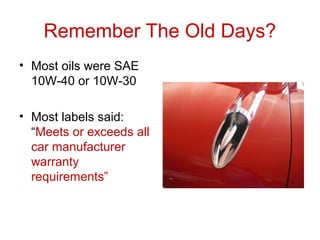
Remember The Old Days?
• Most oils were SAE
10W-40 or 10W-30
• Most labels said:
“Meets or exceeds all
car manufacturer
warranty
requirements”
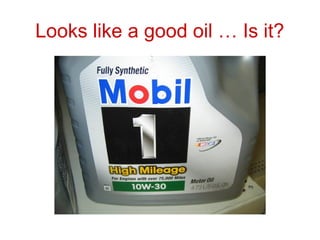
Looks like a good oil … Is it?
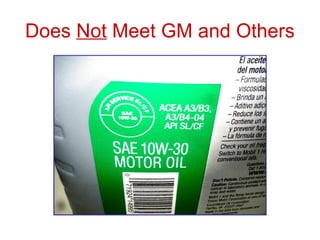
Does Not Meet GM and Others
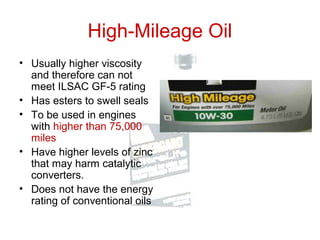
High-Mileage Oil
• Usually higher viscosity
and therefore can not
meet ILSAC GF-5 rating
• Has esters to swell seals
• To be used in engines
with higher than 75,000
miles
• Have higher levels of zinc
that may harm catalytic
converters.
• Does not have the energy
rating of conventional oils
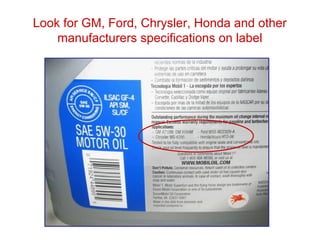
Look for GM, Ford, Chrysler, Honda and other
manufacturers specifications on label
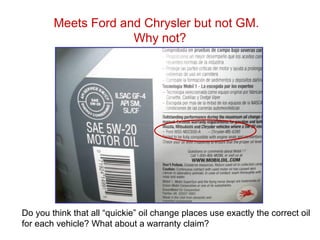
Meets Ford and Chrysler but not GM.
Why not?
Do you think that all “quickie” oil change places use exactly the correct oil
for each vehicle? What about a warranty claim?
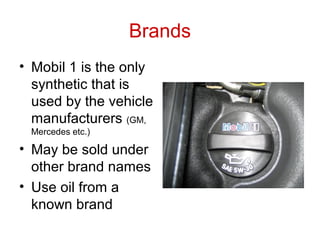
Brands
• Mobil 1 is the only
synthetic that is
used by the vehicle
manufacturers (GM,
Mercedes etc.)
• May be sold under
other brand names
• Use oil from a
known brand
API Service Symbol
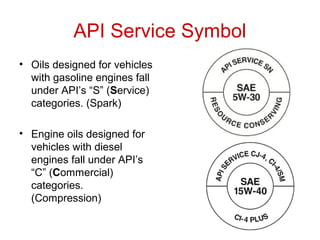
• Oils designed for vehicles
with gasoline engines fall
under API’s “S” (Service)
categories. (Spark)
• Engine oils designed for
vehicles with diesel
engines fall under API’s
“C” (Commercial)
categories.
(Compression)
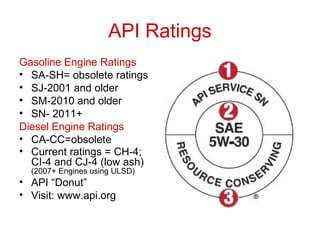
API Ratings
Gasoline Engine Ratings
• SA-SH= obsolete ratings
• SJ-2001 and older
• SM-2010 and older
• SN- 2011+
Diesel Engine Ratings
• CA-CC=obsolete
• Current ratings = CH-4;
CI-4 and CJ-4 (low ash)
(2007+ Engines using ULSD)
• API “Donut”
• Visit: www.api.org
Viscosity
© epc graphics
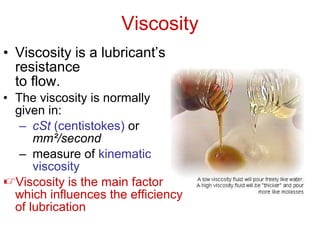
• Viscosity is a lubricant’s
resistance
to flow.
• The viscosity is normally
given in:
– cSt (centistokes) or
mm²/second
– measure of kinematic
viscosity
Viscosity is the main factor
which influences the efficiency
of lubrication
Effect of Temperature on Viscosity
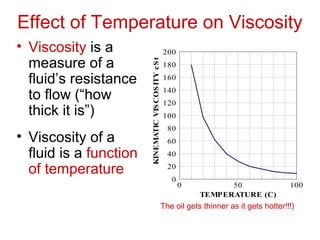
• Viscosity is a
measure of a
fluid’s resistance
to flow (“how
thick it is”)
• Viscosity of a
fluid is a function
of temperature
0 50 100
0
20
40
60
80
100
120
140
160
180
200
TEMPERATURE (C)
KINEMATICVISCOSITYcSt
The oil gets thinner as it gets hotter!!!)
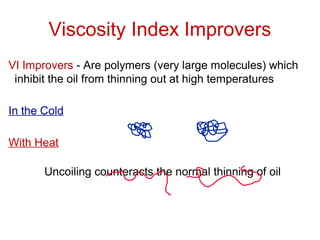
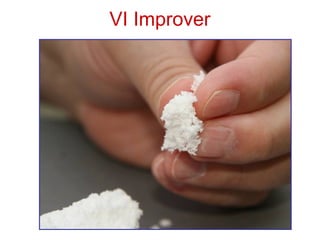
VI Improvers - Are polymers (very large molecules) which
inhibit the oil from thinning out at high temperatures
In the Cold
With Heat
Uncoiling counteracts the normal thinning of oil
Viscosity Index Improvers
VI Improver
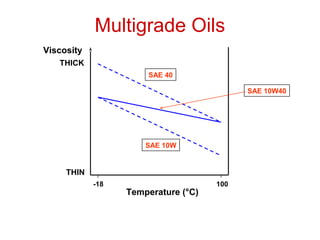
Viscosity
SAE 40
SAE 10W
SAE 10W40
Temperature (°C)
-18 100
Multigrade Oils
THIN
THICK
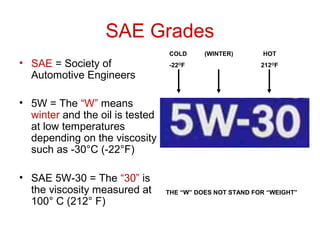
SAE Grades
• SAE = Society of
Automotive Engineers
• 5W = The “W” means
winter and the oil is tested
at low temperatures
depending on the viscosity
such as -30°C (-22°F)
• SAE 5W-30 = The “30” is
the viscosity measured at
100° C (212° F)
COLD (WINTER) HOT
-22O
F 212O
F
THE “W” DOES NOT STAND FOR “WEIGHT”
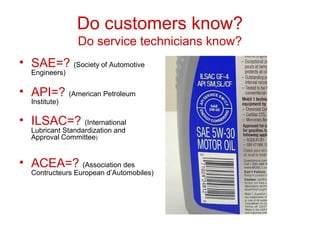
Do customers know?
Do service technicians know?
• SAE=? (Society of Automotive
Engineers)
• API=? (American Petroleum
Institute)
• ILSAC=? (International
Lubricant Standardization and
Approval Committee)
• ACEA=? (Association des
Contructeurs European d’Automobiles)
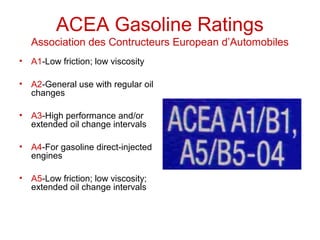
ACEA Gasoline Ratings
Association des Contructeurs European d’Automobiles
• A1-Low friction; low viscosity
• A2-General use with regular oil
changes
• A3-High performance and/or
extended oil change intervals
• A4-For gasoline direct-injected
engines
• A5-Low friction; low viscosity;
extended oil change intervals
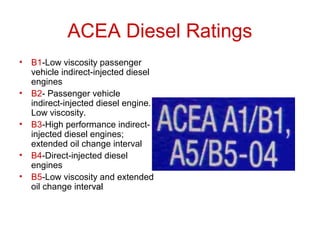
ACEA Diesel Ratings
• B1-Low viscosity passenger
vehicle indirect-injected diesel
engines
• B2- Passenger vehicle
indirect-injected diesel engine.
Low viscosity.
• B3-High performance indirect-
injected diesel engines;
extended oil change interval
• B4-Direct-injected diesel
engines
• B5-Low viscosity and extended
oil change intervalval
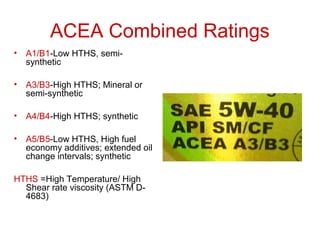
ACEA Combined Ratings
• A1/B1-Low HTHS, semi-
synthetic
• A3/B3-High HTHS; Mineral or
semi-synthetic
• A4/B4-High HTHS; synthetic
• A5/B5-Low HTHS, High fuel
economy additives; extended oil
change intervals; synthetic
HTHS =High Temperature/ High
Shear rate viscosity (ASTM D-
4683)
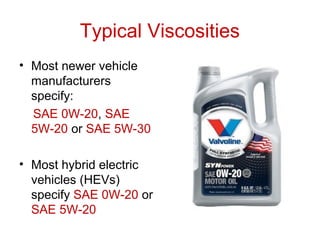
Typical Viscosities
• Most newer vehicle
manufacturers
specify:
SAE 0W-20, SAE
5W-20 or SAE 5W-30
• Most hybrid electric
vehicles (HEVs)
specify SAE 0W-20 or
SAE 5W-20
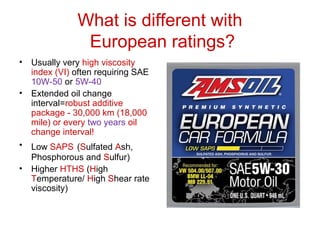
What is different with
European ratings?
• Usually very high viscosity
index (VI) often requiring SAE
10W-50 or 5W-40
• Extended oil change
interval=robust additive
package - 30,000 km (18,000
mile) or every two years oil
change interval!
• Low SAPS (Sulfated Ash,
Phosphorous and Sulfur)
• Higher HTHS (High
Temperature/ High Shear rate
viscosity)
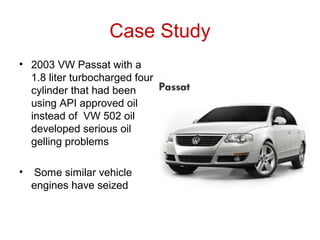
Case Study
• 2003 VW Passat with a
1.8 liter turbocharged four
cylinder that had been
using API approved oil
instead of VW 502 oil
developed serious oil
gelling problems
• Some similar vehicle
engines have seized
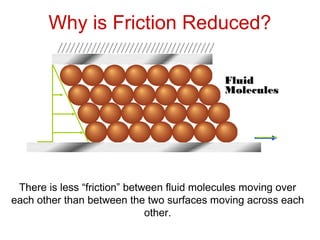
FluidFluid
MoleculesMolecules
Why is Friction Reduced?
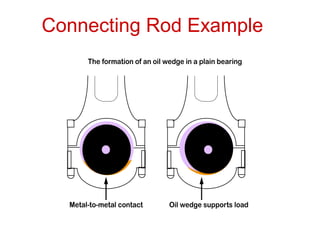
There is less “friction” between fluid molecules moving over
each other than between the two surfaces moving across each
other.
The formation of an oil wedge in a plain bearing
Metal-to-metal contact Oil wedge supports load
Connecting Rod Example
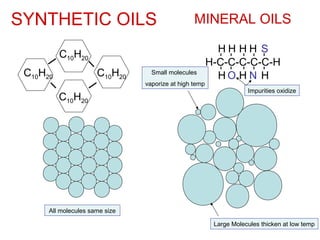
SYNTHETIC OILS MINERAL OILS
Large Molecules thicken at low temp
Small molecules
vaporize at high temp
All molecules same size
H-C-C-C-C-C-H
H H H H S
H HO N H
Impurities oxidize
C10H20
C10H20
C10H20
C10H20
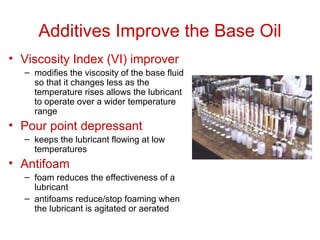
Additives Improve the Base Oil
• Viscosity Index (VI) improver
– modifies the viscosity of the base fluid
so that it changes less as the
temperature rises allows the lubricant
to operate over a wider temperature
range
• Pour point depressant
– keeps the lubricant flowing at low
temperatures
• Antifoam
– foam reduces the effectiveness of a
lubricant
– antifoams reduce/stop foaming when
the lubricant is agitated or aerated
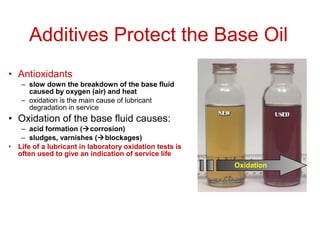
Additives Protect the Base Oil
• Antioxidants
– slow down the breakdown of the base fluid
caused by oxygen (air) and heat
– oxidation is the main cause of lubricant
degradation in service
• Oxidation of the base fluid causes:
– acid formation (corrosion)
– sludges, varnishes (blockages)
• Life of a lubricant in laboratory oxidation tests is
often used to give an indication of service life
Oxidation
Additives Protect the Engine
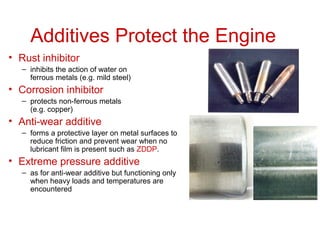
• Rust inhibitor
– inhibits the action of water on
ferrous metals (e.g. mild steel)
• Corrosion inhibitor
– protects non-ferrous metals
(e.g. copper)
• Anti-wear additive
– forms a protective layer on metal surfaces to
reduce friction and prevent wear when no
lubricant film is present such as ZDDP.
• Extreme pressure additive
– as for anti-wear additive but functioning only
when heavy loads and temperatures are
encountered
Roller
bearing
wear
Gear tooth
wear
ZDDP
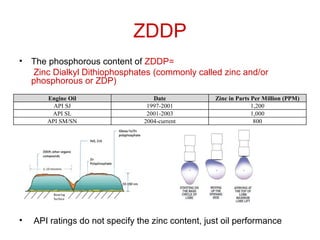
• The phosphorous content of ZDDP=
Zinc Dialkyl Dithiophosphates (commonly called zinc and/or
phosphorous or ZDP)
• API ratings do not specify the zinc content, just oil performance
Engine Oil Date Zinc in Parts Per Million (PPM)
API SJ 1997-2001 1,200
API SL 2001-2003 1,000
API SM/SN 2004-current 800
What About Older Engines?
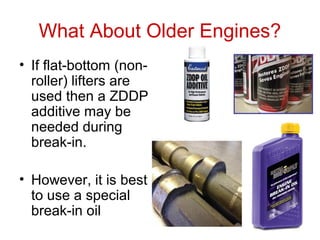
• If flat-bottom (non-
roller) lifters are
used then a ZDDP
additive may be
needed during
break-in.
• However, it is best
to use a special
break-in oil
How Much Zinc is Needed?
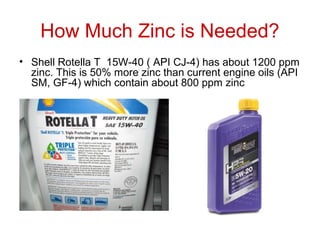
• Shell Rotella T 15W-40 ( API CJ-4) has about 1200 ppm
zinc. This is 50% more zinc than current engine oils (API
SM, GF-4) which contain about 800 ppm zinc
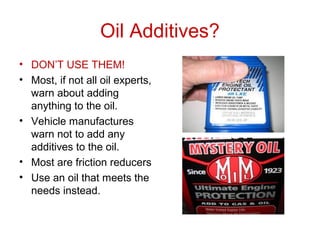
Oil Additives?
• DON’T USE THEM!
• Most, if not all oil experts,
warn about adding
anything to the oil.
• Vehicle manufactures
warn not to add any
additives to the oil.
• Most are friction reducers
• Use an oil that meets the
needs instead.
The “3,000 Mile Myth”
• California’s 3,000 mile
myth program was
started because research
showed that 73% of
California drivers change
their oil more frequently
than recommended by
the vehicle manufacturer
• General Motors has
joined the campaign.
Case Study
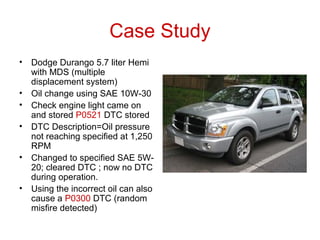
• Dodge Durango 5.7 liter Hemi
with MDS (multiple
displacement system)
• Oil change using SAE 10W-30
• Check engine light came on
and stored P0521 DTC stored
• DTC Description=Oil pressure
not reaching specified at 1,250
RPM
• Changed to specified SAE 5W-
20; cleared DTC ; now no DTC
during operation.
• Using the incorrect oil can also
cause a P0300 DTC (random
misfire detected)
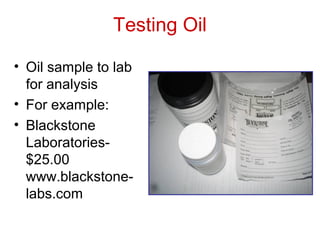
Testing Oil
• Oil sample to lab
for analysis
• For example:
• Blackstone
Laboratories-
$25.00
www.blackstone-
labs.com
Oil Test Results
• Spectral Exam: Establishes the levels of wear metals,
silicon, and additives present in the oil. Also checks for
coolant.
Note: Silicon = dirt; not sealer
• Viscosity: Determines the grade of oil.
• Insolubles: Quantifies the percentage of solids present in
the oil.
• Flash Point: Determines the flash point of the oil to
determine whether any contamination is present in the oil
(such as fuel)
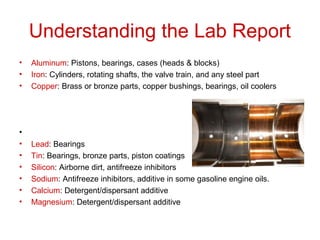
Understanding the Lab Report
• Aluminum: Pistons, bearings, cases (heads & blocks)
• Iron: Cylinders, rotating shafts, the valve train, and any steel part
• Copper: Brass or bronze parts, copper bushings, bearings, oil coolers
•
• Lead: Bearings
• Tin: Bearings, bronze parts, piston coatings
• Silicon: Airborne dirt, antifreeze inhibitors
• Sodium: Antifreeze inhibitors, additive in some gasoline engine oils.
• Calcium: Detergent/dispersant additive
• Magnesium: Detergent/dispersant additive
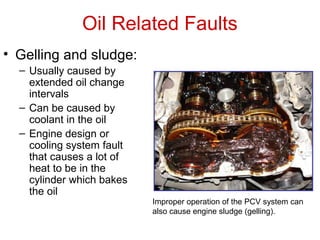
Oil Related Faults
• Gelling and sludge:
– Usually caused by
extended oil change
intervals
– Can be caused by
coolant in the oil
– Engine design or
cooling system fault
that causes a lot of
heat to be in the
cylinder which bakes
the oil
Improper operation of the PCV system can
also cause engine sludge (gelling).
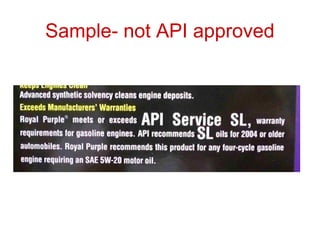
Sample- not API approved
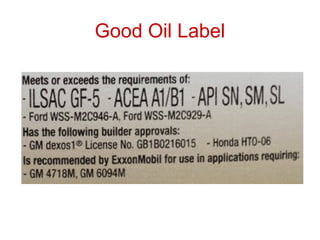
Good Oil Label
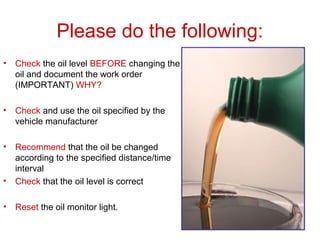
Please do the following:
• Check the oil level BEFORE changing the
oil and document the work order
(IMPORTANT) WHY?
• Check and use the oil specified by the
vehicle manufacturer
• Recommend that the oil be changed
according to the specified distance/time
interval
• Check that the oil level is correct
• Reset the oil monitor light.
Frequently Asked Questionsons
• Question: Can you go back to using
conventional oil after using synthetic?
• Answer: Yes. All oil is mixable.
Frequently Asked Questions
• Question: Do I have to break in a new
engine on mineral oil before switching to
synthetic oil?
• Answer: Synthetic oil (Mobil 1) is used by
many vehicle manufacturers in new
vehicles.
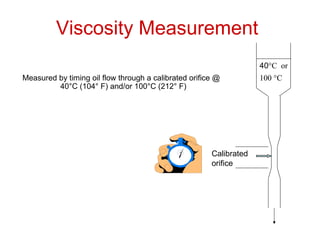
Calibrated
orifice
40°C or
100 °CMeasured by timing oil flow through a calibrated orifice @
40°C (104° F) and/or 100°C (212° F)
Viscosity Measurement
Viscosity MeasurmentViscosity Measurment
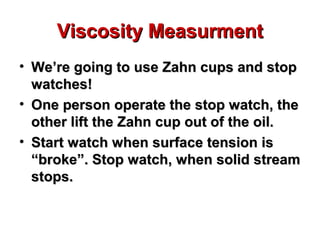
• We’re going to use Zahn cups and stopWe’re going to use Zahn cups and stop
watches!watches!
• One person operate the stop watch, theOne person operate the stop watch, the
other lift the Zahn cup out of the oil.other lift the Zahn cup out of the oil.
• Start watch when surface tension isStart watch when surface tension is
“broke”. Stop watch, when solid stream“broke”. Stop watch, when solid stream
stops.stops.
Viscosity MeasurementViscosity Measurement
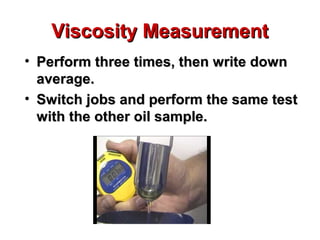
• Perform three times, then write downPerform three times, then write down
average.average.
• Switch jobs and perform the same testSwitch jobs and perform the same test
with the other oil sample.with the other oil sample.
Always wear PPE
FIN!FIN!

Viscosity

  • 1.
    Oil Ratings andViscosityOil Ratings and Viscosity
  • 2.
    Remember The OldDays? • Most oils were SAE 10W-40 or 10W-30 • Most labels said: “Meets or exceeds all car manufacturer warranty requirements”
  • 3.
    Looks like agood oil … Is it?
  • 4.
    Does Not MeetGM and Others
  • 5.
    High-Mileage Oil • Usuallyhigher viscosity and therefore can not meet ILSAC GF-5 rating • Has esters to swell seals • To be used in engines with higher than 75,000 miles • Have higher levels of zinc that may harm catalytic converters. • Does not have the energy rating of conventional oils
  • 6.
    Look for GM,Ford, Chrysler, Honda and other manufacturers specifications on label
  • 7.
    Meets Ford andChrysler but not GM. Why not? Do you think that all “quickie” oil change places use exactly the correct oil for each vehicle? What about a warranty claim?
  • 8.
    Brands • Mobil 1is the only synthetic that is used by the vehicle manufacturers (GM, Mercedes etc.) • May be sold under other brand names • Use oil from a known brand
  • 9.
    API Service Symbol •Oils designed for vehicles with gasoline engines fall under API’s “S” (Service) categories. (Spark) • Engine oils designed for vehicles with diesel engines fall under API’s “C” (Commercial) categories. (Compression)
  • 10.
    API Ratings Gasoline EngineRatings • SA-SH= obsolete ratings • SJ-2001 and older • SM-2010 and older • SN- 2011+ Diesel Engine Ratings • CA-CC=obsolete • Current ratings = CH-4; CI-4 and CJ-4 (low ash) (2007+ Engines using ULSD) • API “Donut” • Visit: www.api.org
  • 11.
    Viscosity © epc graphics •Viscosity is a lubricant’s resistance to flow. • The viscosity is normally given in: – cSt (centistokes) or mm²/second – measure of kinematic viscosity Viscosity is the main factor which influences the efficiency of lubrication
  • 12.
    Effect of Temperatureon Viscosity • Viscosity is a measure of a fluid’s resistance to flow (“how thick it is”) • Viscosity of a fluid is a function of temperature 0 50 100 0 20 40 60 80 100 120 140 160 180 200 TEMPERATURE (C) KINEMATICVISCOSITYcSt The oil gets thinner as it gets hotter!!!)
  • 13.
    VI Improvers -Are polymers (very large molecules) which inhibit the oil from thinning out at high temperatures In the Cold With Heat Uncoiling counteracts the normal thinning of oil Viscosity Index Improvers
  • 14.
  • 15.
    Viscosity SAE 40 SAE 10W SAE10W40 Temperature (°C) -18 100 Multigrade Oils THIN THICK
  • 16.
    SAE Grades • SAE= Society of Automotive Engineers • 5W = The “W” means winter and the oil is tested at low temperatures depending on the viscosity such as -30°C (-22°F) • SAE 5W-30 = The “30” is the viscosity measured at 100° C (212° F) COLD (WINTER) HOT -22O F 212O F THE “W” DOES NOT STAND FOR “WEIGHT”
  • 17.
    Do customers know? Doservice technicians know? • SAE=? (Society of Automotive Engineers) • API=? (American Petroleum Institute) • ILSAC=? (International Lubricant Standardization and Approval Committee) • ACEA=? (Association des Contructeurs European d’Automobiles)
  • 18.
    ACEA Gasoline Ratings Associationdes Contructeurs European d’Automobiles • A1-Low friction; low viscosity • A2-General use with regular oil changes • A3-High performance and/or extended oil change intervals • A4-For gasoline direct-injected engines • A5-Low friction; low viscosity; extended oil change intervals
  • 19.
    ACEA Diesel Ratings •B1-Low viscosity passenger vehicle indirect-injected diesel engines • B2- Passenger vehicle indirect-injected diesel engine. Low viscosity. • B3-High performance indirect- injected diesel engines; extended oil change interval • B4-Direct-injected diesel engines • B5-Low viscosity and extended oil change intervalval
  • 20.
    ACEA Combined Ratings •A1/B1-Low HTHS, semi- synthetic • A3/B3-High HTHS; Mineral or semi-synthetic • A4/B4-High HTHS; synthetic • A5/B5-Low HTHS, High fuel economy additives; extended oil change intervals; synthetic HTHS =High Temperature/ High Shear rate viscosity (ASTM D- 4683)
  • 21.
    Typical Viscosities • Mostnewer vehicle manufacturers specify: SAE 0W-20, SAE 5W-20 or SAE 5W-30 • Most hybrid electric vehicles (HEVs) specify SAE 0W-20 or SAE 5W-20
  • 22.
    What is differentwith European ratings? • Usually very high viscosity index (VI) often requiring SAE 10W-50 or 5W-40 • Extended oil change interval=robust additive package - 30,000 km (18,000 mile) or every two years oil change interval! • Low SAPS (Sulfated Ash, Phosphorous and Sulfur) • Higher HTHS (High Temperature/ High Shear rate viscosity)
  • 23.
    Case Study • 2003VW Passat with a 1.8 liter turbocharged four cylinder that had been using API approved oil instead of VW 502 oil developed serious oil gelling problems • Some similar vehicle engines have seized
  • 24.
    FluidFluid MoleculesMolecules Why is FrictionReduced? There is less “friction” between fluid molecules moving over each other than between the two surfaces moving across each other.
  • 25.
    The formation ofan oil wedge in a plain bearing Metal-to-metal contact Oil wedge supports load Connecting Rod Example
  • 26.
    SYNTHETIC OILS MINERALOILS Large Molecules thicken at low temp Small molecules vaporize at high temp All molecules same size H-C-C-C-C-C-H H H H H S H HO N H Impurities oxidize C10H20 C10H20 C10H20 C10H20
  • 27.
    Additives Improve theBase Oil • Viscosity Index (VI) improver – modifies the viscosity of the base fluid so that it changes less as the temperature rises allows the lubricant to operate over a wider temperature range • Pour point depressant – keeps the lubricant flowing at low temperatures • Antifoam – foam reduces the effectiveness of a lubricant – antifoams reduce/stop foaming when the lubricant is agitated or aerated
  • 28.
    Additives Protect theBase Oil • Antioxidants – slow down the breakdown of the base fluid caused by oxygen (air) and heat – oxidation is the main cause of lubricant degradation in service • Oxidation of the base fluid causes: – acid formation (corrosion) – sludges, varnishes (blockages) • Life of a lubricant in laboratory oxidation tests is often used to give an indication of service life Oxidation
  • 29.
    Additives Protect theEngine • Rust inhibitor – inhibits the action of water on ferrous metals (e.g. mild steel) • Corrosion inhibitor – protects non-ferrous metals (e.g. copper) • Anti-wear additive – forms a protective layer on metal surfaces to reduce friction and prevent wear when no lubricant film is present such as ZDDP. • Extreme pressure additive – as for anti-wear additive but functioning only when heavy loads and temperatures are encountered Roller bearing wear Gear tooth wear
  • 30.
    ZDDP • The phosphorouscontent of ZDDP= Zinc Dialkyl Dithiophosphates (commonly called zinc and/or phosphorous or ZDP) • API ratings do not specify the zinc content, just oil performance Engine Oil Date Zinc in Parts Per Million (PPM) API SJ 1997-2001 1,200 API SL 2001-2003 1,000 API SM/SN 2004-current 800
  • 31.
    What About OlderEngines? • If flat-bottom (non- roller) lifters are used then a ZDDP additive may be needed during break-in. • However, it is best to use a special break-in oil
  • 32.
    How Much Zincis Needed? • Shell Rotella T 15W-40 ( API CJ-4) has about 1200 ppm zinc. This is 50% more zinc than current engine oils (API SM, GF-4) which contain about 800 ppm zinc
  • 33.
    Oil Additives? • DON’TUSE THEM! • Most, if not all oil experts, warn about adding anything to the oil. • Vehicle manufactures warn not to add any additives to the oil. • Most are friction reducers • Use an oil that meets the needs instead.
  • 34.
    The “3,000 MileMyth” • California’s 3,000 mile myth program was started because research showed that 73% of California drivers change their oil more frequently than recommended by the vehicle manufacturer • General Motors has joined the campaign.
  • 35.
    Case Study • DodgeDurango 5.7 liter Hemi with MDS (multiple displacement system) • Oil change using SAE 10W-30 • Check engine light came on and stored P0521 DTC stored • DTC Description=Oil pressure not reaching specified at 1,250 RPM • Changed to specified SAE 5W- 20; cleared DTC ; now no DTC during operation. • Using the incorrect oil can also cause a P0300 DTC (random misfire detected)
  • 36.
    Testing Oil • Oilsample to lab for analysis • For example: • Blackstone Laboratories- $25.00 www.blackstone- labs.com
  • 37.
    Oil Test Results •Spectral Exam: Establishes the levels of wear metals, silicon, and additives present in the oil. Also checks for coolant. Note: Silicon = dirt; not sealer • Viscosity: Determines the grade of oil. • Insolubles: Quantifies the percentage of solids present in the oil. • Flash Point: Determines the flash point of the oil to determine whether any contamination is present in the oil (such as fuel)
  • 38.
    Understanding the LabReport • Aluminum: Pistons, bearings, cases (heads & blocks) • Iron: Cylinders, rotating shafts, the valve train, and any steel part • Copper: Brass or bronze parts, copper bushings, bearings, oil coolers • • Lead: Bearings • Tin: Bearings, bronze parts, piston coatings • Silicon: Airborne dirt, antifreeze inhibitors • Sodium: Antifreeze inhibitors, additive in some gasoline engine oils. • Calcium: Detergent/dispersant additive • Magnesium: Detergent/dispersant additive
  • 39.
    Oil Related Faults •Gelling and sludge: – Usually caused by extended oil change intervals – Can be caused by coolant in the oil – Engine design or cooling system fault that causes a lot of heat to be in the cylinder which bakes the oil Improper operation of the PCV system can also cause engine sludge (gelling).
  • 40.
  • 41.
  • 42.
    Please do thefollowing: • Check the oil level BEFORE changing the oil and document the work order (IMPORTANT) WHY? • Check and use the oil specified by the vehicle manufacturer • Recommend that the oil be changed according to the specified distance/time interval • Check that the oil level is correct • Reset the oil monitor light.
  • 43.
    Frequently Asked Questionsons •Question: Can you go back to using conventional oil after using synthetic? • Answer: Yes. All oil is mixable.
  • 44.
    Frequently Asked Questions •Question: Do I have to break in a new engine on mineral oil before switching to synthetic oil? • Answer: Synthetic oil (Mobil 1) is used by many vehicle manufacturers in new vehicles.
  • 45.
    Calibrated orifice 40°C or 100 °CMeasuredby timing oil flow through a calibrated orifice @ 40°C (104° F) and/or 100°C (212° F) Viscosity Measurement
  • 46.
    Viscosity MeasurmentViscosity Measurment •We’re going to use Zahn cups and stopWe’re going to use Zahn cups and stop watches!watches! • One person operate the stop watch, theOne person operate the stop watch, the other lift the Zahn cup out of the oil.other lift the Zahn cup out of the oil. • Start watch when surface tension isStart watch when surface tension is “broke”. Stop watch, when solid stream“broke”. Stop watch, when solid stream stops.stops.
  • 47.
    Viscosity MeasurementViscosity Measurement •Perform three times, then write downPerform three times, then write down average.average. • Switch jobs and perform the same testSwitch jobs and perform the same test with the other oil sample.with the other oil sample.
  • 48.
  • 49.

Editor's Notes

  • #19 Many factors have to be taken into account when choosing a lubricant. The most important of these is the viscosity of the lubricant. The simplest definition of viscosity is resistance to flow. Under the same conditions of temperature and pressure a liquid with a low viscosity, such as water, will flow more quickly than a liquid with a high viscosity, such as honey. Lubricant manufacturers and users usually use kinematic viscosity. This is the dynamic viscosity divided by the density of the lubricant and is measured in units known as centistokes (cSt). Water at room temperature has a kinematic viscosity of about 1 cSt;the viscosities of most lubricating oils at their operating temperatures lie in the range 10 - 100 cSt.
  • #47 Viscosity Index (VI) improver This additive is added to the base fluid to reduce the extent with which viscosity (‘thickness’) changes with temperature. This is useful where a lubricant has to perform satisfactorily over a wide range of temperatures. For example, a hydraulic fluid used in a cold climate must be ‘thin’ enough to allow the pump to start easily at, say, - 20 oC and yet ‘thick’ enough to lubricate efficiently when the machine is at its operating temperature (80 oC) . Pour point depressant This additive is used to minimise the tendency of the base fluid to congeal and solidify when cooled. A pour point depressant is necessary for most lubricants used in machinery operating at low temperatures. Antifoam This additive prevents the formation of foam in the lubricant. Foam may develop in the presence of certain contaminants - especially in machines in which there is excessive churning and agitation. Foaming increases the exposure of the lubricant to the air and so encourages oxidation (see Slide 11). It may cause oil to be lost from the system through air vents. More seriously, it reduces the efficiency of lubrication - a film of foam is a much less effective lubricant than a continuous film of oil. Foam developing in a hydraulic fluid causes the fluid to become ‘spongy’ and severely reduce its ability to transmit power efficiently.
  • #48 When the base fluid is exposed to oxygen in the air it breaks down to form organic acids, sticky lacquers and sludge (‘oxidation’). The acids can lead to corrosion and lacquers can cause moving surfaces to stick to each other. Sludge thickens the lubricant, and can clog holes, pipe lines, filters and other components of the lubrication system. Oxidation is the main cause of lubricant degradation in service. Oxidation depends on the extent to which oxygen is allowed to come into contact with the lubricant. It takes place more rapidly at high temperatures and is also promoted by moisture and other contaminants present in the oil such as dirt, metal particles, rust and other corrosion products – this is why lubricants in service should be kept clean and dry. Antioxidants block oxidation reactions and slowdown degradation of the lubricant. They have a specific action which continues as long as they are present in the lubricant, even in small concentrations. However, once they are used up, the lubricant starts to oxidise rapidly. It is therefore essential that a lubricant is changed before its antioxidant properties are exhausted. Antioxidants improve the oxidation stability of the lubricant and are particularly important for products that will become hot in use. Most lubricants contain antioxidants.
  • #49 Rust inhibitor This additive inhibits the action of water on iron and steel (‘ferrous’) components. Rust inhibitors are usually found in turbine oils and hydraulic fluids as these products tend to become contaminated with water during use. Corrosion inhibitor Corrosion inhibitors protect non-ferrous metals (e.g. copper, bronze, ‘yellow metals’) from attack by acids formed by oxidation of the lubricant or acidic additives. Anti-wear additive This type of additive adsorbs to metal surfaces and forms a protective layer that prevents direct metal-to-metal contact when the lubricant film is absent (e.g. at start-up). This significantly reduces friction and wear. Extreme pressure (‘EP’) additive An EP additive is required in situations of severe loading where anti-wear additives are ineffective. Such conditions are often encountered on highly loaded steel-on-steel gear teeth. EP additives are stable at normal temperatures but, at the high temperatures which develop, for example, when two gear teeth are squeezed together, they decompose and their breakdown products react with the metal to form a protective lubricant film.