AUT1
Automotive Technology
Week 1
• Goals
– understand how “Horse Power” is measured
– Be able to identify the 3 major systems of the
automobile
– Identify the vehicles sub systems and their purposes
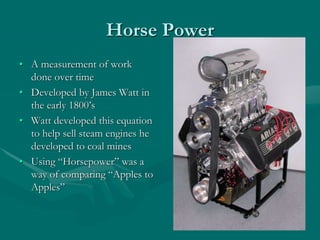
Horse Power
• A measurement of work
done over time
• Developed by James Watt in
the early 1800’s
• Watt developed this equation
to help sell steam engines he
developed to coal mines
• Using “Horsepower” was a
way of comparing “Apples to
Apples”
Horsepower
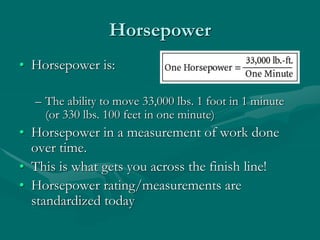
• Horsepower is:
– The ability to move 33,000 lbs. 1 foot in 1 minute
(or 330 lbs. 100 feet in one minute)
• Horsepower in a measurement of work done
over time.
• This is what gets you across the finish line!
• Horsepower rating/measurements are
standardized today
Torque
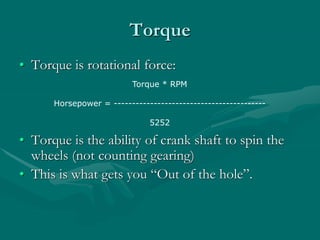
• Torque is rotational force:
• Torque is the ability of crank shaft to spin the
wheels (not counting gearing)
• This is what gets you “Out of the hole”.
Torque * RPM
Horsepower = ------------------------------------------
5252
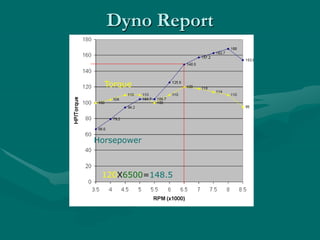
Horsepower
Torque
120X6500=148.5
Dyno Report
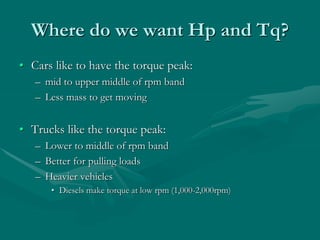
Where do we want Hp and Tq?
• Cars like to have the torque peak:
– mid to upper middle of rpm band
– Less mass to get moving
• Trucks like the torque peak:
– Lower to middle of rpm band
– Better for pulling loads
– Heavier vehicles
• Diesels make torque at low rpm (1,000-2,000rpm)
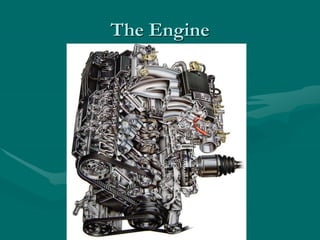
The Engine
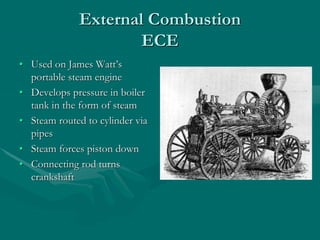
External Combustion
ECE
• Used on James Watt’s
portable steam engine
• Develops pressure in boiler
tank in the form of steam
• Steam routed to cylinder via
pipes
• Steam forces piston down
• Connecting rod turns
crankshaft
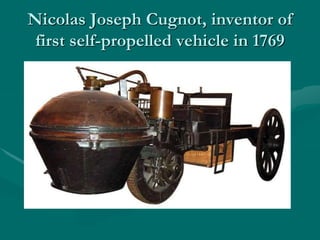
Nicolas Joseph Cugnot, inventor of
first self-propelled vehicle in 1769
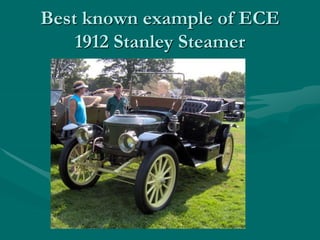
Best known example of ECE
1912 Stanley Steamer
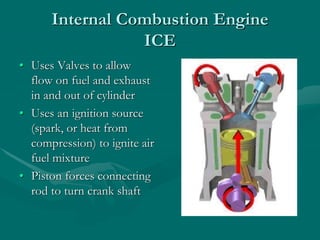
Internal Combustion Engine
ICE
• Uses Valves to allow
flow on fuel and exhaust
in and out of cylinder
• Uses an ignition source
(spark, or heat from
compression) to ignite air
fuel mixture
• Piston forces connecting
rod to turn crank shaft
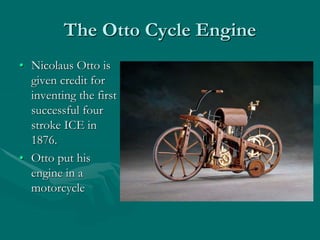
The Otto Cycle Engine
• Nicolaus Otto is
given credit for
inventing the first
successful four
stroke ICE in
1876.
• Otto put his
engine in a
motorcycle
The Basic 4 Stroke Cycle
• The engine needs four things to run.
1. Air
2. Fuel
3. Compression
4. Ignition source (spark plug)
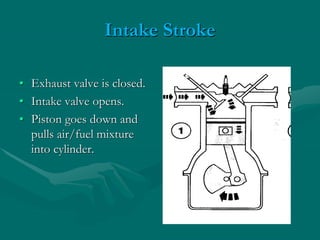
Intake Stroke
• Exhaust valve is closed.
• Intake valve opens.
• Piston goes down and
pulls air/fuel mixture
into cylinder.
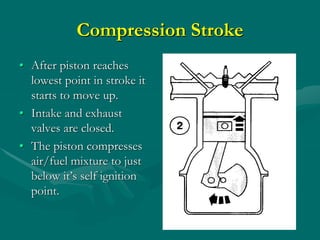
Compression Stroke
• After piston reaches
lowest point in stroke it
starts to move up.
• Intake and exhaust
valves are closed.
• The piston compresses
air/fuel mixture to just
below it’s self ignition
point.
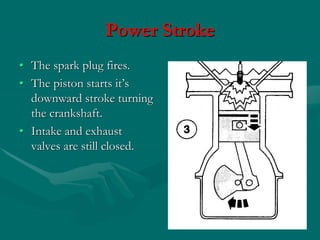
Power Stroke
• The spark plug fires.
• The piston starts it’s
downward stroke turning
the crankshaft.
• Intake and exhaust
valves are still closed.
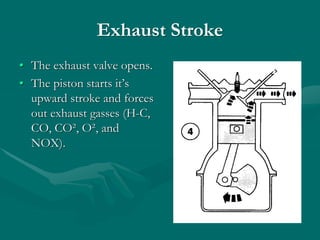
Exhaust Stroke
• The exhaust valve opens.
• The piston starts it’s
upward stroke and forces
out exhaust gasses (H-C,
CO, CO², O², and
NOX).
Engine Sub Systems
• Electrical System
– Battery
– Starter
– Alternator
– Electronic Control Units
• PCM (Powertrain Control Module)
• TCM (Transmission Control Module)
• ECM (Engine Control Module)
Engine Sub Systems
• Fuel System
– Fuel Tank
– Fuel Pump
– Fuel Lines
– Carburetor
– Fuel Injection
– Emission Control
Engine Sub Systems
• Cooling System
– Radiator
– Cooling System Hoses
– Heater Core
– Water Jackets
– Coolant
– Coolant Recovery Bottle
Engine Sub Systems
• Lubrication System
– Oil Pan
– Oil Pump
– Oil Filter
– Oil Galleries
– Oil Cooler (on some cars and trucks)
– Oil
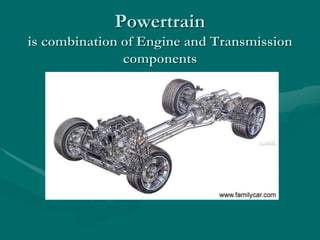
Powertrain
is combination of Engine and Transmission
components
Drivetrain
• Consists of
– Transmission or Transaxle
– Drive Shafts
– Transfer Case
– Differential Housing
– Differential Gears
– Axles
Drivetrain
• Three Different Types
– Front Wheel Drive
• Common on most cars today
– Rear Wheel Drive
• Usually on larger cars
• Common on Trucks
– Four Wheel Drive/All Wheel Drive
• Used by Subaru, Audi, and other auto makers
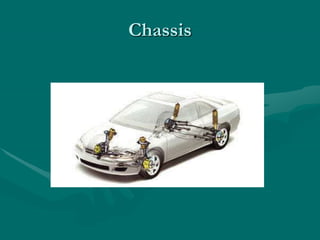
Chassis
Chassis
• Frame Construction
– Full or Ladder frame
– Perimeter frame
• Unit-Body Construction
– Monocoque
– Sub-type frame
• Space-Frame Construction
– Tube construction
– Can use engine and transmission as stressed
components
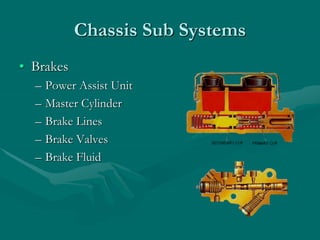
Chassis Sub Systems
• Brakes
– Power Assist Unit
– Master Cylinder
– Brake Lines
– Brake Valves
– Brake Fluid
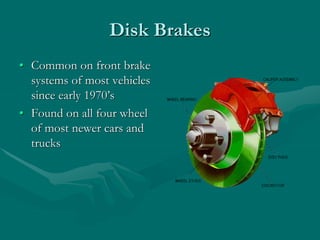
Disk Brakes
• Common on front brake
systems of most vehicles
since early 1970’s
• Found on all four wheel
of most newer cars and
trucks
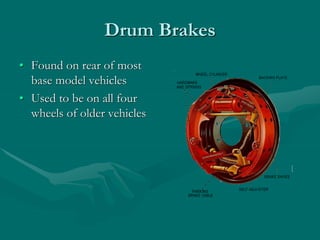
Drum Brakes
• Found on rear of most
base model vehicles
• Used to be on all four
wheels of older vehicles
Suspension and Steering
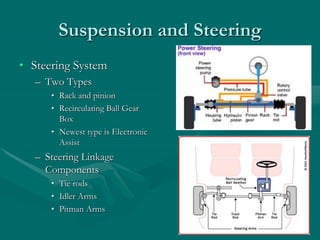
• Steering System
– Two Types
• Rack and pinion
• Recirculating Ball Gear
Box
• Newest type is Electronic
Assist
– Steering Linkage
Components
• Tie rods
• Idler Arms
• Pitman Arms
Suspension and Steering
• Suspension System
– Control Arms
– Steering Knuckles
– Sway Bar
– Coil Springs
– Leaf Springs
– Frame
– Shocks/Struts
– Tires
Summary
Which of the following is most correct.
A. An ICE uses coal to heat up water
B. An ICE uses a spark plug to ignite an air fuel
mixture.
C. An ECE is a new development.
D. An ECE can be used to power an airplane.
Summary
Which of the following is directly linked to the
crank shaft.
A. Valve
B. Piston
C. Cylinder
D. Connecting rod
Summary
What are the three major sections of the
automobile?
A. Brakes, Motor, Driveline
B. Body, Chassis, Electrical
C. Chassis, Powertrain, Drivetrain
D. Chassis, Drivetrain, Engine
Summary
Drum Brakes are typically found on all four
wheels of modern vehicles.
A. True
B. False
End of Systems Overview
Any Questions?
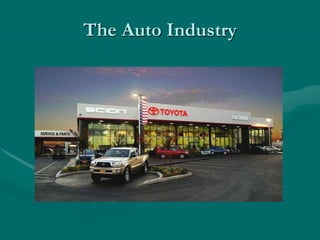
The Auto Industry
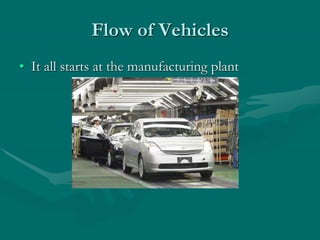
Flow of Vehicles
• It all starts at the manufacturing plant
From the Plant
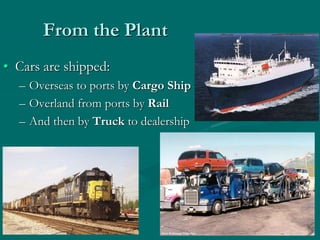
• Cars are shipped:
– Overseas to ports by Cargo Ship
– Overland from ports by Rail
– And then by Truck to dealership
After Delivery to Dealership
• Technicians Perform Pre-Delivery Inspection
(PDI) to check over new car before it goes on
lot for sale.
– Vehicle is checked for fit, finish, performance
– Manufacture Recalls are performed
– Accessories are added
– Final new car cleaning is done
New Car Dealership Operations
• Dealership Principal (Owner)
– General Manager
• Sales Department
• Finance Department
• Business Office
• Parts Department
• Service Department
• Detail Department
Sales
• Sales Mgr.
– Desk Men / Women
– Fleet Sales Personnel
– Sales People
• Finance Mgr.
– F&I (Finance and Insurance) Sales People
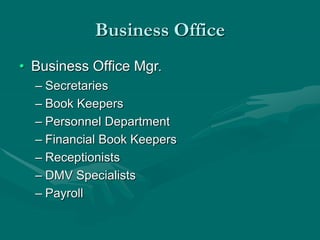
Business Office
• Business Office Mgr.
– Secretaries
– Book Keepers
– Personnel Department
– Financial Book Keepers
– Receptionists
– DMV Specialists
– Payroll
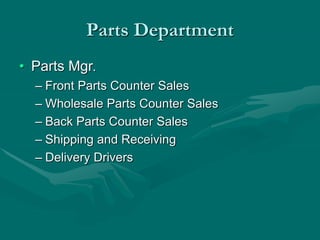
Parts Department
• Parts Mgr.
– Front Parts Counter Sales
– Wholesale Parts Counter Sales
– Back Parts Counter Sales
– Shipping and Receiving
– Delivery Drivers
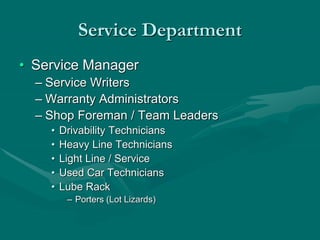
Service Department
• Service Manager
– Service Writers
– Warranty Administrators
– Shop Foreman / Team Leaders
• Drivability Technicians
• Heavy Line Technicians
• Light Line / Service
• Used Car Technicians
• Lube Rack
– Porters (Lot Lizards)
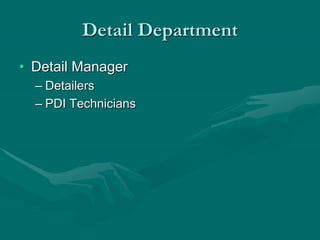
Detail Department
• Detail Manager
– Detailers
– PDI Technicians
How You Get Paid
• Flat Rate or Customer Pay
– Time given by Flat Rate Manual (Mitchell)
• Hourly or Straight Time
– Time spent on job per Punch Time
• Commission
– Combination of hourly + bonus for repair up-sales
• Internal Pay
– Time given by shop for repairs, services, new/used
car preparation
• Warranty
– Time given by Mfg. for individual labor operations
Types of Auto Repair Facilities
• Express Lube Chains
– Minimum wage - $7-10 (usually no benefits)
• Independent-Private shops, Mass Merchandiser
– Minimum wage - $15-20 (usually no benefits)
• Specialty Repair-AAmco Transmission
• $15-20 (usually no benefits)
Types of Auto Repair Facilities
• Fleet Service Facility
– PG&E, CHP
• Minimum wage to $25 with benefits
• Mfg. Dealerships
– Honda, Toyota, Chevrolet, etc.
• Minimum wage (with no tools)
• With tools - $20+ Benefits
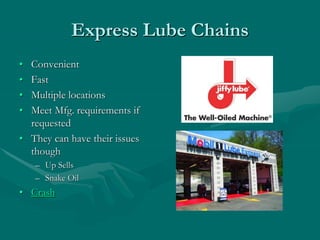
Express Lube Chains
• Convenient
• Fast
• Multiple locations
• Meet Mfg. requirements if
requested
• They can have their issues
though
– Up Sells
– Snake Oil
• Crash
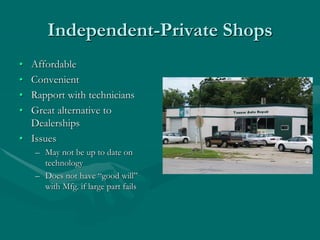
Independent-Private Shops
• Affordable
• Convenient
• Rapport with technicians
• Great alternative to
Dealerships
• Issues
– May not be up to date on
technology
– Does not have “good will”
with Mfg. if large part fails
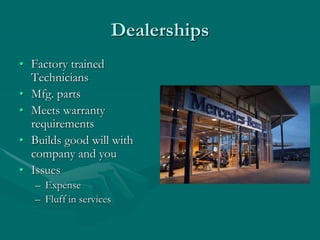
Dealerships
• Factory trained
Technicians
• Mfg. parts
• Meets warranty
requirements
• Builds good will with
company and you
• Issues
– Expense
– Fluff in services
End of Automotive Industry
Any Questions?

Industry

  • 1.
  • 2.
    Week 1 • Goals –understand how “Horse Power” is measured – Be able to identify the 3 major systems of the automobile – Identify the vehicles sub systems and their purposes
  • 3.
    Horse Power • Ameasurement of work done over time • Developed by James Watt in the early 1800’s • Watt developed this equation to help sell steam engines he developed to coal mines • Using “Horsepower” was a way of comparing “Apples to Apples”
  • 4.
    Horsepower • Horsepower is: –The ability to move 33,000 lbs. 1 foot in 1 minute (or 330 lbs. 100 feet in one minute) • Horsepower in a measurement of work done over time. • This is what gets you across the finish line! • Horsepower rating/measurements are standardized today
  • 5.
    Torque • Torque isrotational force: • Torque is the ability of crank shaft to spin the wheels (not counting gearing) • This is what gets you “Out of the hole”. Torque * RPM Horsepower = ------------------------------------------ 5252
  • 6.
  • 7.
    Where do wewant Hp and Tq? • Cars like to have the torque peak: – mid to upper middle of rpm band – Less mass to get moving • Trucks like the torque peak: – Lower to middle of rpm band – Better for pulling loads – Heavier vehicles • Diesels make torque at low rpm (1,000-2,000rpm)
  • 8.
  • 9.
    External Combustion ECE • Usedon James Watt’s portable steam engine • Develops pressure in boiler tank in the form of steam • Steam routed to cylinder via pipes • Steam forces piston down • Connecting rod turns crankshaft
  • 10.
    Nicolas Joseph Cugnot,inventor of first self-propelled vehicle in 1769
  • 11.
    Best known exampleof ECE 1912 Stanley Steamer
  • 12.
    Internal Combustion Engine ICE •Uses Valves to allow flow on fuel and exhaust in and out of cylinder • Uses an ignition source (spark, or heat from compression) to ignite air fuel mixture • Piston forces connecting rod to turn crank shaft
  • 13.
    The Otto CycleEngine • Nicolaus Otto is given credit for inventing the first successful four stroke ICE in 1876. • Otto put his engine in a motorcycle
  • 14.
    The Basic 4Stroke Cycle • The engine needs four things to run. 1. Air 2. Fuel 3. Compression 4. Ignition source (spark plug)
  • 15.
    Intake Stroke • Exhaustvalve is closed. • Intake valve opens. • Piston goes down and pulls air/fuel mixture into cylinder.
  • 16.
    Compression Stroke • Afterpiston reaches lowest point in stroke it starts to move up. • Intake and exhaust valves are closed. • The piston compresses air/fuel mixture to just below it’s self ignition point.
  • 17.
    Power Stroke • Thespark plug fires. • The piston starts it’s downward stroke turning the crankshaft. • Intake and exhaust valves are still closed.
  • 18.
    Exhaust Stroke • Theexhaust valve opens. • The piston starts it’s upward stroke and forces out exhaust gasses (H-C, CO, CO², O², and NOX).
  • 19.
    Engine Sub Systems •Electrical System – Battery – Starter – Alternator – Electronic Control Units • PCM (Powertrain Control Module) • TCM (Transmission Control Module) • ECM (Engine Control Module)
  • 20.
    Engine Sub Systems •Fuel System – Fuel Tank – Fuel Pump – Fuel Lines – Carburetor – Fuel Injection – Emission Control
  • 21.
    Engine Sub Systems •Cooling System – Radiator – Cooling System Hoses – Heater Core – Water Jackets – Coolant – Coolant Recovery Bottle
  • 22.
    Engine Sub Systems •Lubrication System – Oil Pan – Oil Pump – Oil Filter – Oil Galleries – Oil Cooler (on some cars and trucks) – Oil
  • 23.
    Powertrain is combination ofEngine and Transmission components
  • 24.
    Drivetrain • Consists of –Transmission or Transaxle – Drive Shafts – Transfer Case – Differential Housing – Differential Gears – Axles
  • 25.
    Drivetrain • Three DifferentTypes – Front Wheel Drive • Common on most cars today – Rear Wheel Drive • Usually on larger cars • Common on Trucks – Four Wheel Drive/All Wheel Drive • Used by Subaru, Audi, and other auto makers
  • 26.
  • 27.
    Chassis • Frame Construction –Full or Ladder frame – Perimeter frame • Unit-Body Construction – Monocoque – Sub-type frame • Space-Frame Construction – Tube construction – Can use engine and transmission as stressed components
  • 28.
    Chassis Sub Systems •Brakes – Power Assist Unit – Master Cylinder – Brake Lines – Brake Valves – Brake Fluid
  • 29.
    Disk Brakes • Commonon front brake systems of most vehicles since early 1970’s • Found on all four wheel of most newer cars and trucks
  • 30.
    Drum Brakes • Foundon rear of most base model vehicles • Used to be on all four wheels of older vehicles
  • 31.
    Suspension and Steering •Steering System – Two Types • Rack and pinion • Recirculating Ball Gear Box • Newest type is Electronic Assist – Steering Linkage Components • Tie rods • Idler Arms • Pitman Arms
  • 32.
    Suspension and Steering •Suspension System – Control Arms – Steering Knuckles – Sway Bar – Coil Springs – Leaf Springs – Frame – Shocks/Struts – Tires
  • 33.
    Summary Which of thefollowing is most correct. A. An ICE uses coal to heat up water B. An ICE uses a spark plug to ignite an air fuel mixture. C. An ECE is a new development. D. An ECE can be used to power an airplane.
  • 34.
    Summary Which of thefollowing is directly linked to the crank shaft. A. Valve B. Piston C. Cylinder D. Connecting rod
  • 35.
    Summary What are thethree major sections of the automobile? A. Brakes, Motor, Driveline B. Body, Chassis, Electrical C. Chassis, Powertrain, Drivetrain D. Chassis, Drivetrain, Engine
  • 36.
    Summary Drum Brakes aretypically found on all four wheels of modern vehicles. A. True B. False
  • 37.
    End of SystemsOverview Any Questions?
  • 39.
  • 40.
    Flow of Vehicles •It all starts at the manufacturing plant
  • 41.
    From the Plant •Cars are shipped: – Overseas to ports by Cargo Ship – Overland from ports by Rail – And then by Truck to dealership
  • 42.
    After Delivery toDealership • Technicians Perform Pre-Delivery Inspection (PDI) to check over new car before it goes on lot for sale. – Vehicle is checked for fit, finish, performance – Manufacture Recalls are performed – Accessories are added – Final new car cleaning is done
  • 43.

    New Car DealershipOperations • Dealership Principal (Owner) – General Manager • Sales Department • Finance Department • Business Office • Parts Department • Service Department • Detail Department
  • 44.
    Sales • Sales Mgr. –Desk Men / Women – Fleet Sales Personnel – Sales People • Finance Mgr. – F&I (Finance and Insurance) Sales People
  • 45.
    Business Office • BusinessOffice Mgr. – Secretaries – Book Keepers – Personnel Department – Financial Book Keepers – Receptionists – DMV Specialists – Payroll
  • 46.
    Parts Department • PartsMgr. – Front Parts Counter Sales – Wholesale Parts Counter Sales – Back Parts Counter Sales – Shipping and Receiving – Delivery Drivers
  • 47.
    Service Department • ServiceManager – Service Writers – Warranty Administrators – Shop Foreman / Team Leaders • Drivability Technicians • Heavy Line Technicians • Light Line / Service • Used Car Technicians • Lube Rack – Porters (Lot Lizards)
  • 48.
    Detail Department • DetailManager – Detailers – PDI Technicians
  • 49.
    How You GetPaid • Flat Rate or Customer Pay – Time given by Flat Rate Manual (Mitchell) • Hourly or Straight Time – Time spent on job per Punch Time • Commission – Combination of hourly + bonus for repair up-sales • Internal Pay – Time given by shop for repairs, services, new/used car preparation • Warranty – Time given by Mfg. for individual labor operations
  • 50.
    Types of AutoRepair Facilities • Express Lube Chains – Minimum wage - $7-10 (usually no benefits) • Independent-Private shops, Mass Merchandiser – Minimum wage - $15-20 (usually no benefits) • Specialty Repair-AAmco Transmission • $15-20 (usually no benefits)
  • 51.
    Types of AutoRepair Facilities • Fleet Service Facility – PG&E, CHP • Minimum wage to $25 with benefits • Mfg. Dealerships – Honda, Toyota, Chevrolet, etc. • Minimum wage (with no tools) • With tools - $20+ Benefits
  • 52.
    Express Lube Chains •Convenient • Fast • Multiple locations • Meet Mfg. requirements if requested • They can have their issues though – Up Sells – Snake Oil • Crash
  • 53.
    Independent-Private Shops • Affordable •Convenient • Rapport with technicians • Great alternative to Dealerships • Issues – May not be up to date on technology – Does not have “good will” with Mfg. if large part fails
  • 54.
    Dealerships • Factory trained Technicians •Mfg. parts • Meets warranty requirements • Builds good will with company and you • Issues – Expense – Fluff in services
  • 55.
    End of AutomotiveIndustry Any Questions?