ABSTRACT
• Generally the fuels which are sourced from plants or waste
products and are known as alternative or bio-fuels.
• Pure Plant Oil (PPO) is also known as SVO – straight
vegetable oil. It is not a bio diesel.
• Bio methanol is the product of the trans esterification of
vegetable/waste oil or animal fats.
• Bio ethanol is mainly used in petrol engines to deliver higher
performance and reduced emissions.
• Natural gas, a fossil fuel comprised mostly of methane, is
one of the cleanest burning alternative fuels.
.
The U.S. Department of
Energy (DOE) defines an
alternative fuel as a product
that is substantially
nonpetroleum which yields
energy security and
environmental benefits.
TOPICS TO BE DISCUSSED
• Introduction
• Fuels
• Alternative fuels
• Bio ethanol
• methanol
• Natural GAS
• Hydrogen
• Conclusion
INTRODUCTION
• Alternative fuels are the liquids used instead of the fossil
fuels in the vehicles to run motors.
• Alternative fuels are also called as bio-fuels.
• The main use of the alternative fuel is to reduce the
dependent on the fossil fuels and to reduce the
concentration of carbon dioxide in the atmosphere.
• Let us see how it can be done in our world
FUELS
• Fuels are the materials or substances which gives
power or energy when it is burned. EX: diesel
• Diesel is the most common fuel used by
commercial vehicles. Diesel engines are up to 50%
more energy efficient than petrol engines.
ALTERNATIVE FUELS
• Generally the fuels which are sourced from plants or
waste products and are known as alternative or bio-
fuels.
• Replacing fossil fuels with bio fuels in an existing
vehicles reduces co2 emissions.
• All diesel engines can run on a 7% biodiesel in diesel
mix.
BIO ETHANOL
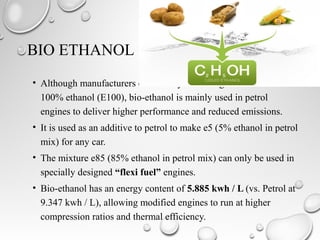
• Although manufacturers can modify diesel engines to run on
100% ethanol (E100), bio-ethanol is mainly used in petrol
engines to deliver higher performance and reduced emissions.
• It is used as an additive to petrol to make e5 (5% ethanol in petrol
mix) for any car.
• The mixture e85 (85% ethanol in petrol mix) can only be used in
specially designed “flexi fuel” engines.
• Bio-ethanol has an energy content of 5.885 kwh / L (vs. Petrol at
9.347 kwh / L), allowing modified engines to run at higher
compression ratios and thermal efficiency.
APPLICATION OF BIO ETHANOL
• Over 80% of the world's ethanol production is used in
the fuel sector.
• E5 may contain a maximum of 5 vol.-% Bioethanol. It
is currently the standard petrol in Europe.
• The increasing direct blending of bioethanol to petrol
has led to ETBE (ethyl tertiary butyl ether) becoming
less important.
• ETBE is composed of around 47% ethanol and 53%
isobutylene and is used as a petrol additive to enhance
its anti-knock properties.
• Petrol in Europe is permitted to contain up to 15 vol.-%
Of ETBE.
• For technical reasons, it is not advisable to use 100%
bioethanol as fuel in our temperate climatic regions.
• That is why e85 is used in Europe. The addition of
petrol improves cold-starting characteristics in the
winter.
• Owing to its high bioethanol content the use of e85 on a
nationwide basis offers the greatest potential for
reducing the dependence on fossil fuels.
Methanol is
produced from natural
gas in production plants
with 60% total energy
efficiency. Methanol can
be made with any
renewable resource
containing carbon such
as seaweed, waste wood
and garbage.
Methanol
Methanol offers the greatest hope
for early and broad introduction of
fuel cells that will make Electric
Vehicles practical within the next
few years.
Whether reformed to provide
hydrogen for conventional fuel
cells or used directly in the latest
liquid fed cells, methanol will
overcome the greatest remaining
obstacle to commercialization, by
offering the only economical way
to transport and store the hydrogen
needed for fuel cells.
Methanol fuel cells will greatly reduce
carbon dioxide emissions for vehicles
and virtually eliminate smog and
particulate pollution.
ADVANTAGES OF METHANOL
OTHER SOME ALTERNATIVE
FUELS
NATURAL GAS
• Natural gas, a fossil fuel comprised mostly of methane,
is one of the cleanest burning alternative fuels.
• Dedicated natural gas vehicles are designed to run on
natural gas only, while bi-fuel vehicles can also run on
gasoline or diesel.
• Since natural gas is stored in high-pressure fuel tanks,
bi-fuel vehicles require two separate fuelling systems,
which take up passenger/cargo space.
• Natural gas vehicles are not available on a large scale.
Only a few models are currently offered for sale.
APPLICATIONS OF NATURAL GAS
RESIDENTIAL SECTOR:
•FUEL IT CAN REPLACE: Gasoil; propane/butane;
electricity; coal; fuel oil; biomass.
•APPLICATIONS: Hot water; heating; cooking; dryers;
gas fires; barbecues; dishwashers; preheating.
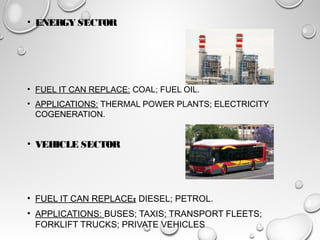
• ENERGY SECTOR
• FUEL IT CAN REPLACE: COAL; FUEL OIL.
• APPLICATIONS: THERMAL POWER PLANTS; ELECTRICITY
COGENERATION.
• VEHICLE SECTOR
• FUEL IT CAN REPLACE: DIESEL; PETROL.
• APPLICATIONS: BUSES; TAXIS; TRANSPORT FLEETS;
FORKLIFT TRUCKS; PRIVATE VEHICLES
HYDROGEN
• Hydrogen (H2) is being explored as a fuel for passenger vehicles.
• It can be used in fuel cells to power electric motors.
• It is an environmentally friendly fuel that has the potential to
dramatically reduce our dependence on imported oil.
BENEFITS
• Produced domestically: hydrogen can be produced domestically
from several sources, reducing our dependence on petroleum
imports.
• Environmentally friendly: hydrogen produces no air pollutants or
greenhouse gases when used in fuel cells; it produces only
nitrogen oxides (nox) when burned in ices.
HYDROGEN-POWERED CARS:
• Companies are involved in numerous industry partnerships to
advance automotive electrification and reduce carbon emissions by
using hydrogen as fuel.
HYDROGEN-POWERED BUSES:
• In various cities in foreign including San Francisco companies are
delivering the fuelling infrastructure to support h2-powered public
bus services.
APPLICATIONS OF HYDROGEN
HYDROGEN-POWERED SUBMARINES:
• Hydrogen-powered submarines can remain under water much
longer than conventional submarines and are much quieter.
• We have already supplied hydrogen fuelling stations and
hydrogen gas for submarines operated by various navies
HYDROGEN-POWERED SHIPS:
• Emissions are a key issue in ports around the world,
compounded by the heavy oils burned by conventional
engines.
• We have already supplied fuelling stations for hydrogen-
powered ferry boats in Germany and etc...
TRANSPORTATION:
• While personal vehicles can be converted for
propane use, vehicles are currently the most
common application for propane as a
transportation fuel.
• Propane is the most common alternative fuel
used for vehicles in canada.
• Propane-powered vehicles include taxis,
delivery and service trucks, and school buses.
BIODIESEL
• Bio diesel is the product of the trans esterification of
vegetable/waste oil or animal fats.
• It benefits the environment by using up waste, for example used
cooking oil (uco).
• But it needs a chemical process and energy for production.
• It's safe, biodegradable, and produces less air pollutants than
petroleum-based diesel.
• Biodiesel can be used in its pure form (b100) or blended with
petroleum diesel. Common blends include B2 (2% biodiesel), B5,
and B20.
CONCLUSION
• Now a days, the availability and utilisation of the bio fuels is very much
less.
• The only reason is the less production and high cost of the bio fuels.
• The usage of bio fuels can be increased in future to reduce the air
pollution and the global warming caused by the emission of the carbon
dioxide (co2) which is emitted on using in the fossil fuels.
• We can also utilise the bio fuels and reduce the effects caused by the
emission of carbon dioxide which may be very useful to reduce the
concentration of the carbon dioxide present in the air.
Thank you

ALTERNATIVE FUELS ETHAOL &AND METHANOL

  • 2.
    ABSTRACT • Generally thefuels which are sourced from plants or waste products and are known as alternative or bio-fuels. • Pure Plant Oil (PPO) is also known as SVO – straight vegetable oil. It is not a bio diesel. • Bio methanol is the product of the trans esterification of vegetable/waste oil or animal fats. • Bio ethanol is mainly used in petrol engines to deliver higher performance and reduced emissions. • Natural gas, a fossil fuel comprised mostly of methane, is one of the cleanest burning alternative fuels. .
  • 3.
    The U.S. Departmentof Energy (DOE) defines an alternative fuel as a product that is substantially nonpetroleum which yields energy security and environmental benefits.
  • 4.
    TOPICS TO BEDISCUSSED • Introduction • Fuels • Alternative fuels • Bio ethanol • methanol • Natural GAS • Hydrogen • Conclusion
  • 5.
    INTRODUCTION • Alternative fuelsare the liquids used instead of the fossil fuels in the vehicles to run motors. • Alternative fuels are also called as bio-fuels. • The main use of the alternative fuel is to reduce the dependent on the fossil fuels and to reduce the concentration of carbon dioxide in the atmosphere. • Let us see how it can be done in our world
  • 6.
    FUELS • Fuels arethe materials or substances which gives power or energy when it is burned. EX: diesel • Diesel is the most common fuel used by commercial vehicles. Diesel engines are up to 50% more energy efficient than petrol engines.
  • 7.
    ALTERNATIVE FUELS • Generallythe fuels which are sourced from plants or waste products and are known as alternative or bio- fuels. • Replacing fossil fuels with bio fuels in an existing vehicles reduces co2 emissions. • All diesel engines can run on a 7% biodiesel in diesel mix.
  • 8.
    BIO ETHANOL • Althoughmanufacturers can modify diesel engines to run on 100% ethanol (E100), bio-ethanol is mainly used in petrol engines to deliver higher performance and reduced emissions. • It is used as an additive to petrol to make e5 (5% ethanol in petrol mix) for any car. • The mixture e85 (85% ethanol in petrol mix) can only be used in specially designed “flexi fuel” engines. • Bio-ethanol has an energy content of 5.885 kwh / L (vs. Petrol at 9.347 kwh / L), allowing modified engines to run at higher compression ratios and thermal efficiency.
  • 9.
    APPLICATION OF BIOETHANOL • Over 80% of the world's ethanol production is used in the fuel sector. • E5 may contain a maximum of 5 vol.-% Bioethanol. It is currently the standard petrol in Europe. • The increasing direct blending of bioethanol to petrol has led to ETBE (ethyl tertiary butyl ether) becoming less important. • ETBE is composed of around 47% ethanol and 53% isobutylene and is used as a petrol additive to enhance its anti-knock properties.
  • 10.
    • Petrol inEurope is permitted to contain up to 15 vol.-% Of ETBE. • For technical reasons, it is not advisable to use 100% bioethanol as fuel in our temperate climatic regions. • That is why e85 is used in Europe. The addition of petrol improves cold-starting characteristics in the winter. • Owing to its high bioethanol content the use of e85 on a nationwide basis offers the greatest potential for reducing the dependence on fossil fuels.
  • 11.
    Methanol is produced fromnatural gas in production plants with 60% total energy efficiency. Methanol can be made with any renewable resource containing carbon such as seaweed, waste wood and garbage. Methanol
  • 12.
    Methanol offers thegreatest hope for early and broad introduction of fuel cells that will make Electric Vehicles practical within the next few years. Whether reformed to provide hydrogen for conventional fuel cells or used directly in the latest liquid fed cells, methanol will overcome the greatest remaining obstacle to commercialization, by offering the only economical way to transport and store the hydrogen needed for fuel cells.
  • 13.
    Methanol fuel cellswill greatly reduce carbon dioxide emissions for vehicles and virtually eliminate smog and particulate pollution. ADVANTAGES OF METHANOL
  • 14.
  • 15.
    NATURAL GAS • Naturalgas, a fossil fuel comprised mostly of methane, is one of the cleanest burning alternative fuels. • Dedicated natural gas vehicles are designed to run on natural gas only, while bi-fuel vehicles can also run on gasoline or diesel. • Since natural gas is stored in high-pressure fuel tanks, bi-fuel vehicles require two separate fuelling systems, which take up passenger/cargo space. • Natural gas vehicles are not available on a large scale. Only a few models are currently offered for sale.
  • 16.
    APPLICATIONS OF NATURALGAS RESIDENTIAL SECTOR: •FUEL IT CAN REPLACE: Gasoil; propane/butane; electricity; coal; fuel oil; biomass. •APPLICATIONS: Hot water; heating; cooking; dryers; gas fires; barbecues; dishwashers; preheating.
  • 17.
    • ENERGY SECTOR •FUEL IT CAN REPLACE: COAL; FUEL OIL. • APPLICATIONS: THERMAL POWER PLANTS; ELECTRICITY COGENERATION. • VEHICLE SECTOR • FUEL IT CAN REPLACE: DIESEL; PETROL. • APPLICATIONS: BUSES; TAXIS; TRANSPORT FLEETS; FORKLIFT TRUCKS; PRIVATE VEHICLES
  • 18.
    HYDROGEN • Hydrogen (H2)is being explored as a fuel for passenger vehicles. • It can be used in fuel cells to power electric motors. • It is an environmentally friendly fuel that has the potential to dramatically reduce our dependence on imported oil. BENEFITS • Produced domestically: hydrogen can be produced domestically from several sources, reducing our dependence on petroleum imports. • Environmentally friendly: hydrogen produces no air pollutants or greenhouse gases when used in fuel cells; it produces only nitrogen oxides (nox) when burned in ices.
  • 19.
    HYDROGEN-POWERED CARS: • Companiesare involved in numerous industry partnerships to advance automotive electrification and reduce carbon emissions by using hydrogen as fuel. HYDROGEN-POWERED BUSES: • In various cities in foreign including San Francisco companies are delivering the fuelling infrastructure to support h2-powered public bus services. APPLICATIONS OF HYDROGEN
  • 20.
    HYDROGEN-POWERED SUBMARINES: • Hydrogen-poweredsubmarines can remain under water much longer than conventional submarines and are much quieter. • We have already supplied hydrogen fuelling stations and hydrogen gas for submarines operated by various navies HYDROGEN-POWERED SHIPS: • Emissions are a key issue in ports around the world, compounded by the heavy oils burned by conventional engines. • We have already supplied fuelling stations for hydrogen- powered ferry boats in Germany and etc...
  • 21.
    TRANSPORTATION: • While personalvehicles can be converted for propane use, vehicles are currently the most common application for propane as a transportation fuel. • Propane is the most common alternative fuel used for vehicles in canada. • Propane-powered vehicles include taxis, delivery and service trucks, and school buses.
  • 22.
    BIODIESEL • Bio dieselis the product of the trans esterification of vegetable/waste oil or animal fats. • It benefits the environment by using up waste, for example used cooking oil (uco). • But it needs a chemical process and energy for production. • It's safe, biodegradable, and produces less air pollutants than petroleum-based diesel. • Biodiesel can be used in its pure form (b100) or blended with petroleum diesel. Common blends include B2 (2% biodiesel), B5, and B20.
  • 23.
    CONCLUSION • Now adays, the availability and utilisation of the bio fuels is very much less. • The only reason is the less production and high cost of the bio fuels. • The usage of bio fuels can be increased in future to reduce the air pollution and the global warming caused by the emission of the carbon dioxide (co2) which is emitted on using in the fossil fuels. • We can also utilise the bio fuels and reduce the effects caused by the emission of carbon dioxide which may be very useful to reduce the concentration of the carbon dioxide present in the air.
  • 24.