Engineering Responses to Changing Climate Klaus S. Lackner Columbia University
FRAMING THE DEBATE Defensive Strategy – Avoid Losses Prevent climate catastrophe Proactive Strategy – Create Gains Provide clean, cheap energy for ten billion
Challenges Greenhouse Gas Emissions Overdependence on Oil Affordability Rethink the World Energy Infrastructure
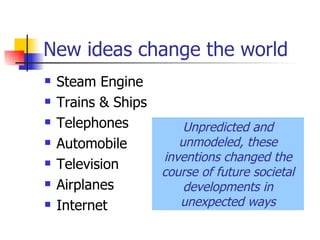
New ideas change the world Steam Engine Trains & Ships Telephones Automobile Television Airplanes Internet Unpredicted and unmodeled, these inventions changed the course of future societal developments in unexpected ways
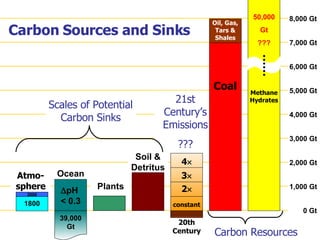
21st Century’s Emissions ??? Atmo-sphere 2000 Ocean Plants Coal Oil, Gas, Tars & Shales Methane Hydrates                  pH  <  0.3 39,000 Gt 50,000 Gt ??? Soil & Detritus 1800 constant Scales of Potential Carbon Sinks Carbon Resources Carbon Sources and Sinks 0 Gt 8,000 Gt 7,000 Gt 6,000 Gt 5,000 Gt 4,000 Gt 3,000 Gt 2,000 Gt 1,000 Gt 20th Century 2  3  4 
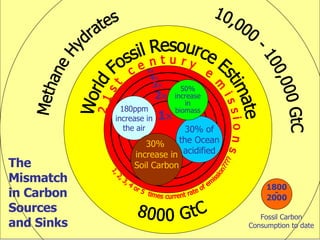
180ppm increase in the air 30% of the Ocean acidified 30%  increase in Soil Carbon 50% increase in biomass Methane Hydrates  10,000 - 100,000 GtC The Mismatch in Carbon Sources and Sinks World Fossil Resource Estimate 21st century emissions  8000 GtC 4  3  1  2  5  1, 2, 3, 4 or 5  times current rate of emission???? 1800 - 2000 Fossil Carbon Consumption to date
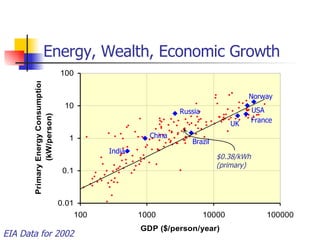
Energy, Wealth, Economic Growth EIA Data for 2002 Norway   USA   France   UK   Brazil   Russia   India   China   $0.38/kWh (primary)
Today’s Energy Infrastructure All fossil energy plus a little hydro and nuclear energy plus a very little renewable energy
Mega-scale Projects Dominate Low Cost tied to Large Scale Power plants are 200 to 2000 MW (400 to 4000 large wind mills) Refineries are billion dollar investments Large scale provides obstacle to entry For developing nations For innovation For flexible response to shortages For eliminating political dependencies
Today’s Technology Fails To Deliver Sufficient Energy … … for 10 billion at US per capita rates Environmental Problems Pollution, CO 2 Oil and Gas Shortages Concentration in the Middle East How much time do we have to make the change?
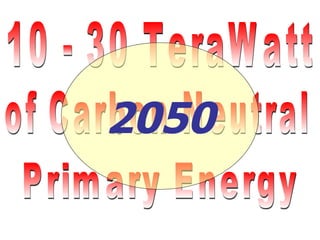
10 - 30 TeraWatt Primary Energy of Carbon Neutral 2050
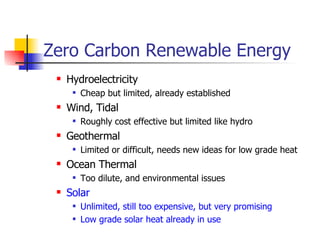
Zero Carbon Renewable Energy  Hydroelectricity Cheap but limited, already established Wind, Tidal Roughly cost effective but limited like hydro Geothermal Limited or difficult, needs new ideas for low grade heat Ocean Thermal Too dilute, and environmental issues Solar Unlimited, still too expensive, but very promising Low grade solar heat already in use
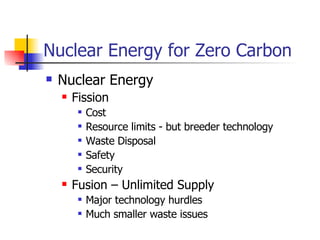
Nuclear Energy for Zero Carbon Nuclear Energy Fission Cost Resource limits - but breeder technology Waste Disposal Safety Security Fusion – Unlimited Supply Major technology hurdles Much smaller waste issues
Fossil Fuels Energy in 2100 need not be more expensive than today Environment Rather Than Resource Limit Carbon Capture and Storage - Untested Technology
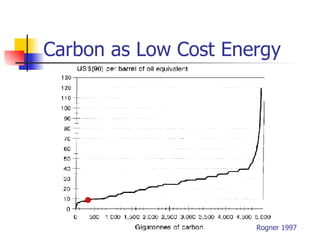
Carbon as Low Cost Energy Rogner 1997
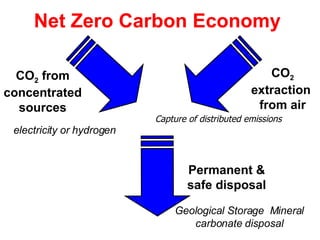
Net Zero Carbon Economy Capture of distributed emissions CO 2  extraction  from air Permanent & safe disposal CO 2  from concentrated sources electricity or hydrogen Geological Storage  Mineral carbonate disposal
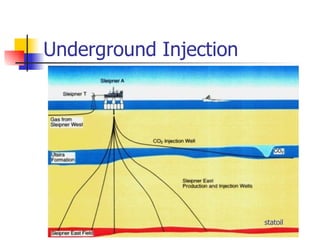
Underground Injection statoil
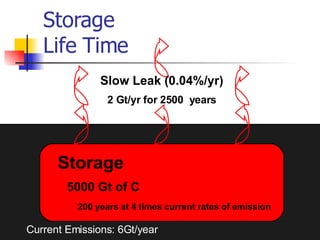
Storage Life Time 5000 Gt of C 200 years at 4 times current rates of emission Storage Slow Leak (0.04%/yr) 2 Gt/yr for 2500  years Current Emissions: 6Gt/year
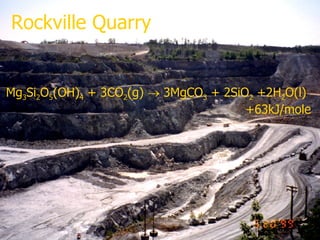
Rockville Quarry Mg 3 Si 2 O 5 (OH) 4  + 3CO 2 (g)    3MgCO 3  + 2SiO 2  +2H 2 O(l)   +63kJ/mole
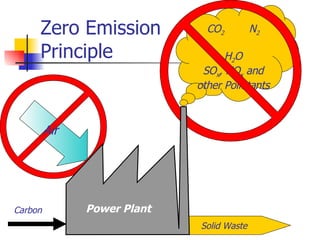
CO 2  N 2 H 2 O SO x , NO x  and other Pollutants Carbon  Air Zero Emission Principle Solid Waste Power Plant
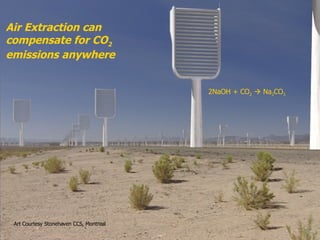
Air Extraction can compensate for CO 2  emissions anywhere Art Courtesy Stonehaven CCS, Montreal 2NaOH + CO 2     Na 2 CO 3
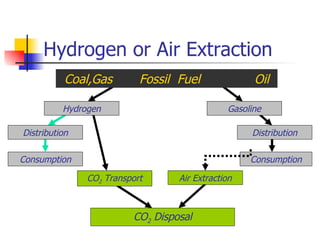
Hydrogen or Air Extraction  Coal,Gas  Fossil  Fuel  Oil Hydrogen Gasoline Consumption Consumption Distribution Distribution CO 2  Transport Air Extraction CO 2  Disposal
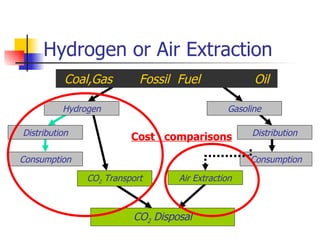
Hydrogen or Air Extraction  Coal,Gas  Fossil  Fuel  Oil Hydrogen Gasoline Consumption Consumption Distribution Distribution CO 2  Transport Air Extraction CO 2  Disposal Cost  comparisons
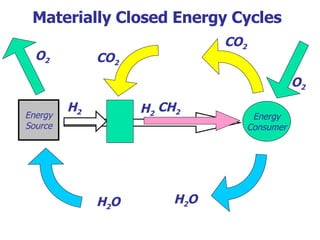
Energy Source Energy Consumer H 2 O H 2 O O 2 O 2 Materially Closed Energy Cycles H 2 CO 2 CO 2 H 2 CH 2
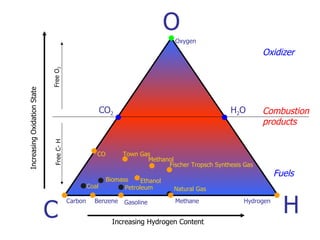
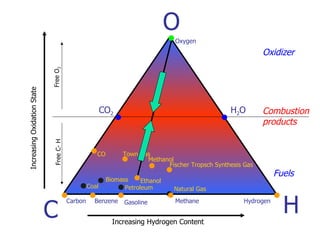
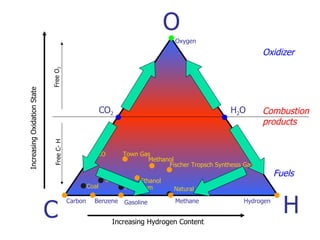
C H O Fuels Oxidizer Combustion products Biomass CO Fischer Tropsch Synthesis Gas Methanol Ethanol Natural Gas Town Gas Petroleum Coal Gasoline Benzene Carbon Hydrogen CO 2 H 2 O Oxygen Increasing Hydrogen Content  Increasing Oxidation State  Methane Free O 2 Free C- H
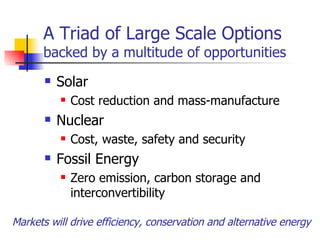
A Triad of Large Scale Options backed by a multitude of opportunities Solar Cost reduction and mass-manufacture Nuclear Cost, waste, safety and security Fossil Energy Zero emission, carbon storage and interconvertibility Markets will drive efficiency, conservation and alternative energy

05_Day_1_Lackner

  • 1.
    Engineering Responses toChanging Climate Klaus S. Lackner Columbia University
  • 2.
    FRAMING THE DEBATEDefensive Strategy – Avoid Losses Prevent climate catastrophe Proactive Strategy – Create Gains Provide clean, cheap energy for ten billion
  • 3.
    Challenges Greenhouse GasEmissions Overdependence on Oil Affordability Rethink the World Energy Infrastructure
  • 4.
    New ideas changethe world Steam Engine Trains & Ships Telephones Automobile Television Airplanes Internet Unpredicted and unmodeled, these inventions changed the course of future societal developments in unexpected ways
  • 5.
    21st Century’s Emissions??? Atmo-sphere 2000 Ocean Plants Coal Oil, Gas, Tars & Shales Methane Hydrates        pH < 0.3 39,000 Gt 50,000 Gt ??? Soil & Detritus 1800 constant Scales of Potential Carbon Sinks Carbon Resources Carbon Sources and Sinks 0 Gt 8,000 Gt 7,000 Gt 6,000 Gt 5,000 Gt 4,000 Gt 3,000 Gt 2,000 Gt 1,000 Gt 20th Century 2  3  4 
  • 6.
    180ppm increase inthe air 30% of the Ocean acidified 30% increase in Soil Carbon 50% increase in biomass Methane Hydrates 10,000 - 100,000 GtC The Mismatch in Carbon Sources and Sinks World Fossil Resource Estimate 21st century emissions 8000 GtC 4  3  1  2  5  1, 2, 3, 4 or 5 times current rate of emission???? 1800 - 2000 Fossil Carbon Consumption to date
  • 7.
    Energy, Wealth, EconomicGrowth EIA Data for 2002 Norway USA France UK Brazil Russia India China $0.38/kWh (primary)
  • 8.
    Today’s Energy InfrastructureAll fossil energy plus a little hydro and nuclear energy plus a very little renewable energy
  • 9.
    Mega-scale Projects DominateLow Cost tied to Large Scale Power plants are 200 to 2000 MW (400 to 4000 large wind mills) Refineries are billion dollar investments Large scale provides obstacle to entry For developing nations For innovation For flexible response to shortages For eliminating political dependencies
  • 10.
    Today’s Technology FailsTo Deliver Sufficient Energy … … for 10 billion at US per capita rates Environmental Problems Pollution, CO 2 Oil and Gas Shortages Concentration in the Middle East How much time do we have to make the change?
  • 11.
    10 - 30TeraWatt Primary Energy of Carbon Neutral 2050
  • 12.
    Zero Carbon RenewableEnergy Hydroelectricity Cheap but limited, already established Wind, Tidal Roughly cost effective but limited like hydro Geothermal Limited or difficult, needs new ideas for low grade heat Ocean Thermal Too dilute, and environmental issues Solar Unlimited, still too expensive, but very promising Low grade solar heat already in use
  • 13.
    Nuclear Energy forZero Carbon Nuclear Energy Fission Cost Resource limits - but breeder technology Waste Disposal Safety Security Fusion – Unlimited Supply Major technology hurdles Much smaller waste issues
  • 14.
    Fossil Fuels Energyin 2100 need not be more expensive than today Environment Rather Than Resource Limit Carbon Capture and Storage - Untested Technology
  • 15.
    Carbon as LowCost Energy Rogner 1997
  • 16.
    Net Zero CarbonEconomy Capture of distributed emissions CO 2 extraction from air Permanent & safe disposal CO 2 from concentrated sources electricity or hydrogen Geological Storage Mineral carbonate disposal
  • 17.
  • 18.
    Storage Life Time5000 Gt of C 200 years at 4 times current rates of emission Storage Slow Leak (0.04%/yr) 2 Gt/yr for 2500 years Current Emissions: 6Gt/year
  • 19.
    Rockville Quarry Mg3 Si 2 O 5 (OH) 4 + 3CO 2 (g)  3MgCO 3 + 2SiO 2 +2H 2 O(l) +63kJ/mole
  • 20.
    CO 2 N 2 H 2 O SO x , NO x and other Pollutants Carbon Air Zero Emission Principle Solid Waste Power Plant
  • 21.
    Air Extraction cancompensate for CO 2 emissions anywhere Art Courtesy Stonehaven CCS, Montreal 2NaOH + CO 2  Na 2 CO 3
  • 22.
    Hydrogen or AirExtraction Coal,Gas Fossil Fuel Oil Hydrogen Gasoline Consumption Consumption Distribution Distribution CO 2 Transport Air Extraction CO 2 Disposal
  • 23.
    Hydrogen or AirExtraction Coal,Gas Fossil Fuel Oil Hydrogen Gasoline Consumption Consumption Distribution Distribution CO 2 Transport Air Extraction CO 2 Disposal Cost comparisons
  • 24.
    Energy Source EnergyConsumer H 2 O H 2 O O 2 O 2 Materially Closed Energy Cycles H 2 CO 2 CO 2 H 2 CH 2
  • 25.
    C H OFuels Oxidizer Combustion products Biomass CO Fischer Tropsch Synthesis Gas Methanol Ethanol Natural Gas Town Gas Petroleum Coal Gasoline Benzene Carbon Hydrogen CO 2 H 2 O Oxygen Increasing Hydrogen Content Increasing Oxidation State Methane Free O 2 Free C- H
  • 26.
    C H OFuels Oxidizer Combustion products Biomass CO Fischer Tropsch Synthesis Gas Methanol Ethanol Natural Gas Town Gas Petroleum Coal Gasoline Benzene Carbon Hydrogen CO 2 H 2 O Oxygen Increasing Hydrogen Content Increasing Oxidation State Methane Free O 2 Free C- H
  • 27.
    C H OFuels Oxidizer Combustion products Biomass CO Fischer Tropsch Synthesis Gas Methanol Ethanol Natural Gas Town Gas Petroleum Coal Gasoline Benzene Carbon Hydrogen CO 2 H 2 O Oxygen Increasing Hydrogen Content Increasing Oxidation State Methane Free O 2 Free C- H
  • 28.
    A Triad ofLarge Scale Options backed by a multitude of opportunities Solar Cost reduction and mass-manufacture Nuclear Cost, waste, safety and security Fossil Energy Zero emission, carbon storage and interconvertibility Markets will drive efficiency, conservation and alternative energy