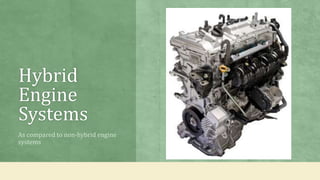
Hybrid
Engine
Systems
As compared to non-hybrid engine
systems
Hybrid Engine Systems
Due to the purpose of the hybrid automobiles, a different engine cycle
was utilized and designed for average horsepower demand and peak
efficiency instead of peak horsepower.
Otto Cycle
• The four-stroke engine was first patented by Alphonse Beau de Rochas
in 1861.
• It is described as what is commonly known as the four cycle process;
Intake, Compression, Power, Exhaust.
• The first person to build a working four-stroke engine, was a German
engineer named Nikolaus Otto.
Atkinson Cycle
• The Atkinson-Cycle engine is designed to provide efficient operation of
a vehicle when overall power is decreased.
• It is a four-stroke engine in which the compression ratio is smaller
than the expansion ratio.
Atkinson Cycle
• This leads to higher efficiency due to less heat loss into the
atmosphere, and longer power stroke. (But less power)
Question?
Why would we sacrifice power for efficiency?
Answer!
If we use an Atkinson-cycle engine in an hybrid we can use
the electric motor to make up for the lower power output.
Use an Atkinson in a Hybrid?
Here’s How!
• We apply this theory with modern design and technology!
BUT HOW?
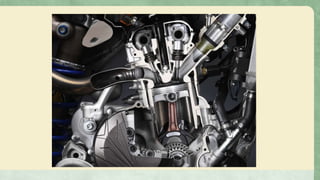
-We offset the crankshaft and piston pin to minimize noise and side load.
And…….
We use variable valve timing (VVT) to control when the intake valve
closes and opens.
WHY WOULD WE DO THAT?
To lower noise and create a difference in the compression and expansion
ratios, so we can take advantage of the Atkinson cycle without major
engine modifications.
Otto vs. Atkinson Cycle comparison
Variable Valve Timing (VVT)
• Used to provide peak efficiency over the entire engine speed range.
• Conventional cams are fixed and must be designed per application.
• Can determine best timing for fuel economy, power, or emissions and
change it dynamically.
• VVT on intake cam controls fuel economy/power, and VVT on exhaust
cam can control emissions by replacing the EGR.
Variable Valve Timing (VVT)
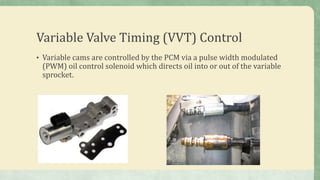
Variable Valve Timing (VVT) Control
• Variable cams are controlled by the PCM via a pulse width modulated
(PWM) oil control solenoid which directs oil into or out of the variable
sprocket.
Variable Valve Timing (VVT)
NOTE: Due to difference in intake valve timing, modern day
Atkinson-cycle variations push some intake air back out of the
cylinder into the intake manifold. Specially designed intake
systems (baffles) and air filters accommodate pressure
differences. You may also notice engine oil puddling on the
bottom of the intake manifold due to late intake valve closing,
and low tension piston rings. (notice design changes).
Engine Inspection and Cleaning
If Atkinson-cycle engines push intake charge back into the intake, what
effect can this have on the engine?
• Air/Fuel charge goes back into intake and “puddles”.
What effect does this have on Fuel mixture?
• Carbon can build up (deposits).
• Oil can puddle at the bottom of the special designed intake reservoir.
(visible through throttle body, requires special cleaning if severe)
Prius Intake manifold design change.
Other Hybrid Engine Design Features
Some other Hybrid engine design features are worth noting. These
design changes or alterations allow the ICE to perform at optimal
efficiency across a wider spectrum.
CAN YOU THINK OF ANY?
Cylinder Deactivation
• Just like Honda used a variable cam lift system to change cam profile
between one that is highly efficient to one that produces more power
on demand
• Modern manufactures can deactivate cylinders all together when
power demand is low. (Variable Displacement)
Technology allows us to
vary engine displacement
and timing dynamically!
Cylinder Deactivation
• This can be accomplished by either changing cam profile or “turning
off” lifters.
Honda Valve Timing Electronic Control
“VTEC” Variable valve timing….YO!
Doesn’t that create vibration and noise?
YES!!!!!
But there is ways to counter act this. Manufactures disable cylinders in
calculated sets to keep power contributions equal through out the 720
degree rotation……
They can also………
• Use Active Control Mounts (ACM) that counteract the vibrations. These
are controlled via the PCM to match engine RPM.
• Use Active Noise Control (ANC) that counteract the noises via an out of
phase sound through the interior speakers. ….CRAZY!
NOTE: Does knowing about these systems affect
our diagnosis? And how? Complaints?
Variable Valve Timing
Active Cylinder Management or
Active Fuel Management.
General Motors Active Fuel Management
More Engine Designs…..Indexed Plugs
• Honda is one company that uses indexed spark plugs, meaning they
can change the position of the side electrode creating a stronger
ignition source to the air/fuel mixture.
Electronic Throttle Control
• All modern vehicles use an electronic connection between the
accelerator pedal and the throttle body that is controlled via the PCM.
There are several advantages to this;
-Reduce pumping loss by opening throttle valve and increasing
EGR.
-Traction control
-Idle stability
-Cruise Control
-Etc, etc…..
Oxygen Sensors
• Due to strict federal emission standards, conventional oxygen sensors
had to be updated to be more accurate.
• Conventional zirconia oxygen sensors can only indicate whether the
exhaust is richer or leaner than stoichiometric (14.7:1 for Gasoline).
• Wide band oxygen sensors were introduced around 1992 and used on
early Hondas, they were capable of detecting air/fuel ratios over a
wide spectrum (10:1 to 23:1).
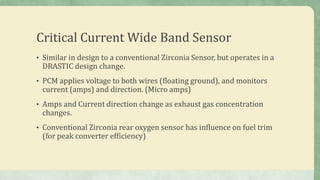
Critical Current Wide Band Sensor
• Similar in design to a conventional Zirconia Sensor, but operates in a
DRASTIC design change.
• PCM applies voltage to both wires (floating ground), and monitors
current (amps) and direction. (Micro amps)
• Amps and Current direction change as exhaust gas concentration
changes.
• Conventional Zirconia rear oxygen sensor has influence on fuel trim
(for peak converter efficiency)
Critical Current Wide Band Sensor
• PCM uses values like;
• AF Sensor (current measurement)
• AF Lambda (actual air/fuel ratio)
• Air Fuel Ratio (like above, but different format)
• AF Feedback command (Target air/fuel ratio)
• AF Feedback (Short Term Fuel Trim)
• AF Feedback Average (Long Term Fuel Trim)
• AF Heater (pulse width modulated heater output)
Critical Current Wide Band Sensor
• Negative current indicates Lean
• Lambda above 1.00 Indicates Lean
Wide Band Dual Planar Nernst Cell
• PCM monitors reference chamber to diffusion chamber signal
(stoichiometric is .45v) and pumps exhaust air in or out of the
diffusion chamber to keep voltage at .45v.
• The PCM monitors the current it takes to achieve this. Either positive
or negative and how much to determine air/fuel ratio. (Small Current)
• PCM uses similar PIDS as the Critical Current sensor, but values
change.
Wide Band Dual Planar Nernst Cell
• Positive Current indicates Lean (instead of rich as in critical current)
• Lambda value above 1.00 is still lean
Narrow Band vs Wide Band o2 sensors
Question?
Are there any different scenarios or special diagnostic
procedures when working on a hybrid?
YES!!!!!!
Compression Tests?
How do we perform these?
• On an IMA system we disable the High Voltage system to use the Aux.
battery and 12v starter
• On a Full or Strong Hybrid, there is no starter? This requires the use of
factory or factory equivalent scanners. We use the scanners or special
procedures to place the vehicle in a special diagnostic cranking mode.
NOTE: On Electronic Throttle equipped vehicles, placing both feet on
the brake and accelerator will keep the throttle closed. Make sure
vehicle is secure, chalked, and in park before performing tests.
Idle Stop?
What problems can “Idle-Stop” feature create during diagnosis?
(Remember the engine stalls when not needed, and it restarts quickly
when needed again.)
• Vacuum readings. How would you perform it?
• ICE diagnostics (drivability and noises). How would you perform it?
• Cranking compression test. How would you perform it?
• Relative compression test. How would you perform it?
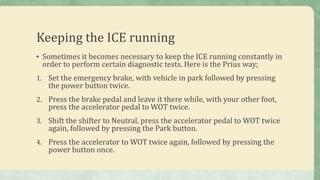
Keeping the ICE running
• Sometimes it becomes necessary to keep the ICE running constantly in
order to perform certain diagnostic tests. Here is the Prius way;
1. Set the emergency brake, with vehicle in park followed by pressing
the power button twice.
2. Press the brake pedal and leave it there while, with your other foot,
press the accelerator pedal to WOT twice.
3. Shift the shifter to Neutral, press the accelerator pedal to WOT twice
again, followed by pressing the Park button.
4. Press the accelerator to WOT twice again, followed by pressing the
power button once.
Engine Vacuum Readings
Do you think the vacuum readings would be the same as an Otto-cycle
engine? If not, what do you think they would be?
• Remember how hybrids utilize the Atkinson cycle? Readings that
would indicate trouble in an Otto-cycle are completely normal for an
Atkinson. Such as;
-Bouncing Needle/Inconsistent Reading
-Lower Vacuum
-Different MAF/MAP readings
Is it ICE or electric drive?
• The ICE will start and run at 1000 rpms, but the electric motor cranks
the ICE at 1000 rpms anyway. So how do you know it started?
1. Check DTC’s
2. Does it stall after putting it into “Running mode”
3. Check PIDS (Motor Torque)
Diagnosing ICE no start complaints
You’re more than likely used to diagnosing No Start complaints and if so,
you know they fall into two categories;
-No Crank, No Start
-Cranks, No Start
All of the conventional causes still apply, but since there are additional
systems we need to add some steps.
No Crank, No Start
• Determine how the vehicle starts (12V starter or High Voltage Motor)
• Manually turn the ICE over (Check for obstruction)
• Check for DTC’s (Disable codes)
• Check PID’s (Battery Voltages (High and Low))
• Gear?
• Oil level?
• Inertia Switch?
Cranks, No Start
Customer complaints of “Cranks, No Start” are typically caused by a fault
related to the ICE. Use conventional testing procedures such as;
-Compression tests (cranking and relative)
-Vacuum (remember its Atkinson-cycle)
-Fuel systems
-Ignition Systems
-DTC’s
-PID’s (Motor torque)
My engine starts then stalls?
• Remember customer complaints are helpful, but shouldn’t be used as
the best starting point for diagnosis.
• Remember the electric motor turns the ICE at 1000 rpms for several
seconds…customers can perceive this as a start and stall, but in reality
the ICE never started at all.
• Check DTC’s, PID’s, and conventional diagnostic methods for no start.
My car feels like it lacks power?
• Another customer complaint that you have to approach differently
than a conventional vehicle.
• Ask yourself is it a Series, Parallel, or Series-Parallel configuration and
when do they experience lack of power, to determine the power source
for diagnosis.
Special Notes
Note: Cranks, No Start may sound like a start and stall due to
the Electric Motor turning the ICE at 1000 rpms.
Note: The OEM service information is ALWAYS the final authority on
testing procedures and test specifications. Be sure to first READ the
entire procedures applicable to the vehicle you are servicing.
THE END!

Hybrid engine

  • 1.
    Hybrid Engine Systems As compared tonon-hybrid engine systems
  • 2.
    Hybrid Engine Systems Dueto the purpose of the hybrid automobiles, a different engine cycle was utilized and designed for average horsepower demand and peak efficiency instead of peak horsepower.
  • 3.
    Otto Cycle • Thefour-stroke engine was first patented by Alphonse Beau de Rochas in 1861. • It is described as what is commonly known as the four cycle process; Intake, Compression, Power, Exhaust. • The first person to build a working four-stroke engine, was a German engineer named Nikolaus Otto.
  • 4.
    Atkinson Cycle • TheAtkinson-Cycle engine is designed to provide efficient operation of a vehicle when overall power is decreased. • It is a four-stroke engine in which the compression ratio is smaller than the expansion ratio.
  • 5.
    Atkinson Cycle • Thisleads to higher efficiency due to less heat loss into the atmosphere, and longer power stroke. (But less power) Question? Why would we sacrifice power for efficiency? Answer! If we use an Atkinson-cycle engine in an hybrid we can use the electric motor to make up for the lower power output.
  • 6.
    Use an Atkinsonin a Hybrid?
  • 7.
    Here’s How! • Weapply this theory with modern design and technology! BUT HOW? -We offset the crankshaft and piston pin to minimize noise and side load.
  • 9.
    And……. We use variablevalve timing (VVT) to control when the intake valve closes and opens. WHY WOULD WE DO THAT? To lower noise and create a difference in the compression and expansion ratios, so we can take advantage of the Atkinson cycle without major engine modifications.
  • 10.
    Otto vs. AtkinsonCycle comparison
  • 11.
    Variable Valve Timing(VVT) • Used to provide peak efficiency over the entire engine speed range. • Conventional cams are fixed and must be designed per application. • Can determine best timing for fuel economy, power, or emissions and change it dynamically. • VVT on intake cam controls fuel economy/power, and VVT on exhaust cam can control emissions by replacing the EGR.
  • 12.
  • 13.
  • 14.
    Variable Valve Timing(VVT) Control • Variable cams are controlled by the PCM via a pulse width modulated (PWM) oil control solenoid which directs oil into or out of the variable sprocket.
  • 15.
    Variable Valve Timing(VVT) NOTE: Due to difference in intake valve timing, modern day Atkinson-cycle variations push some intake air back out of the cylinder into the intake manifold. Specially designed intake systems (baffles) and air filters accommodate pressure differences. You may also notice engine oil puddling on the bottom of the intake manifold due to late intake valve closing, and low tension piston rings. (notice design changes).
  • 16.
    Engine Inspection andCleaning If Atkinson-cycle engines push intake charge back into the intake, what effect can this have on the engine? • Air/Fuel charge goes back into intake and “puddles”. What effect does this have on Fuel mixture? • Carbon can build up (deposits). • Oil can puddle at the bottom of the special designed intake reservoir. (visible through throttle body, requires special cleaning if severe)
  • 17.
    Prius Intake manifolddesign change.
  • 18.
    Other Hybrid EngineDesign Features Some other Hybrid engine design features are worth noting. These design changes or alterations allow the ICE to perform at optimal efficiency across a wider spectrum. CAN YOU THINK OF ANY?
  • 19.
    Cylinder Deactivation • Justlike Honda used a variable cam lift system to change cam profile between one that is highly efficient to one that produces more power on demand • Modern manufactures can deactivate cylinders all together when power demand is low. (Variable Displacement) Technology allows us to vary engine displacement and timing dynamically!
  • 20.
    Cylinder Deactivation • Thiscan be accomplished by either changing cam profile or “turning off” lifters.
  • 21.
    Honda Valve TimingElectronic Control “VTEC” Variable valve timing….YO!
  • 22.
    Doesn’t that createvibration and noise? YES!!!!! But there is ways to counter act this. Manufactures disable cylinders in calculated sets to keep power contributions equal through out the 720 degree rotation……
  • 23.
    They can also……… •Use Active Control Mounts (ACM) that counteract the vibrations. These are controlled via the PCM to match engine RPM. • Use Active Noise Control (ANC) that counteract the noises via an out of phase sound through the interior speakers. ….CRAZY! NOTE: Does knowing about these systems affect our diagnosis? And how? Complaints?
  • 24.
  • 25.
    Active Cylinder Managementor Active Fuel Management.
  • 26.
    General Motors ActiveFuel Management
  • 27.
    More Engine Designs…..IndexedPlugs • Honda is one company that uses indexed spark plugs, meaning they can change the position of the side electrode creating a stronger ignition source to the air/fuel mixture.
  • 28.
    Electronic Throttle Control •All modern vehicles use an electronic connection between the accelerator pedal and the throttle body that is controlled via the PCM. There are several advantages to this; -Reduce pumping loss by opening throttle valve and increasing EGR. -Traction control -Idle stability -Cruise Control -Etc, etc…..
  • 29.
    Oxygen Sensors • Dueto strict federal emission standards, conventional oxygen sensors had to be updated to be more accurate. • Conventional zirconia oxygen sensors can only indicate whether the exhaust is richer or leaner than stoichiometric (14.7:1 for Gasoline). • Wide band oxygen sensors were introduced around 1992 and used on early Hondas, they were capable of detecting air/fuel ratios over a wide spectrum (10:1 to 23:1).
  • 30.
    Critical Current WideBand Sensor • Similar in design to a conventional Zirconia Sensor, but operates in a DRASTIC design change. • PCM applies voltage to both wires (floating ground), and monitors current (amps) and direction. (Micro amps) • Amps and Current direction change as exhaust gas concentration changes. • Conventional Zirconia rear oxygen sensor has influence on fuel trim (for peak converter efficiency)
  • 31.
    Critical Current WideBand Sensor • PCM uses values like; • AF Sensor (current measurement) • AF Lambda (actual air/fuel ratio) • Air Fuel Ratio (like above, but different format) • AF Feedback command (Target air/fuel ratio) • AF Feedback (Short Term Fuel Trim) • AF Feedback Average (Long Term Fuel Trim) • AF Heater (pulse width modulated heater output)
  • 32.
    Critical Current WideBand Sensor • Negative current indicates Lean • Lambda above 1.00 Indicates Lean
  • 33.
    Wide Band DualPlanar Nernst Cell • PCM monitors reference chamber to diffusion chamber signal (stoichiometric is .45v) and pumps exhaust air in or out of the diffusion chamber to keep voltage at .45v. • The PCM monitors the current it takes to achieve this. Either positive or negative and how much to determine air/fuel ratio. (Small Current) • PCM uses similar PIDS as the Critical Current sensor, but values change.
  • 34.
    Wide Band DualPlanar Nernst Cell • Positive Current indicates Lean (instead of rich as in critical current) • Lambda value above 1.00 is still lean
  • 35.
    Narrow Band vsWide Band o2 sensors
  • 36.
    Question? Are there anydifferent scenarios or special diagnostic procedures when working on a hybrid? YES!!!!!!
  • 37.
    Compression Tests? How dowe perform these? • On an IMA system we disable the High Voltage system to use the Aux. battery and 12v starter • On a Full or Strong Hybrid, there is no starter? This requires the use of factory or factory equivalent scanners. We use the scanners or special procedures to place the vehicle in a special diagnostic cranking mode. NOTE: On Electronic Throttle equipped vehicles, placing both feet on the brake and accelerator will keep the throttle closed. Make sure vehicle is secure, chalked, and in park before performing tests.
  • 38.
    Idle Stop? What problemscan “Idle-Stop” feature create during diagnosis? (Remember the engine stalls when not needed, and it restarts quickly when needed again.) • Vacuum readings. How would you perform it? • ICE diagnostics (drivability and noises). How would you perform it? • Cranking compression test. How would you perform it? • Relative compression test. How would you perform it?
  • 39.
    Keeping the ICErunning • Sometimes it becomes necessary to keep the ICE running constantly in order to perform certain diagnostic tests. Here is the Prius way; 1. Set the emergency brake, with vehicle in park followed by pressing the power button twice. 2. Press the brake pedal and leave it there while, with your other foot, press the accelerator pedal to WOT twice. 3. Shift the shifter to Neutral, press the accelerator pedal to WOT twice again, followed by pressing the Park button. 4. Press the accelerator to WOT twice again, followed by pressing the power button once.
  • 40.
    Engine Vacuum Readings Doyou think the vacuum readings would be the same as an Otto-cycle engine? If not, what do you think they would be? • Remember how hybrids utilize the Atkinson cycle? Readings that would indicate trouble in an Otto-cycle are completely normal for an Atkinson. Such as; -Bouncing Needle/Inconsistent Reading -Lower Vacuum -Different MAF/MAP readings
  • 41.
    Is it ICEor electric drive? • The ICE will start and run at 1000 rpms, but the electric motor cranks the ICE at 1000 rpms anyway. So how do you know it started? 1. Check DTC’s 2. Does it stall after putting it into “Running mode” 3. Check PIDS (Motor Torque)
  • 42.
    Diagnosing ICE nostart complaints You’re more than likely used to diagnosing No Start complaints and if so, you know they fall into two categories; -No Crank, No Start -Cranks, No Start All of the conventional causes still apply, but since there are additional systems we need to add some steps.
  • 43.
    No Crank, NoStart • Determine how the vehicle starts (12V starter or High Voltage Motor) • Manually turn the ICE over (Check for obstruction) • Check for DTC’s (Disable codes) • Check PID’s (Battery Voltages (High and Low)) • Gear? • Oil level? • Inertia Switch?
  • 44.
    Cranks, No Start Customercomplaints of “Cranks, No Start” are typically caused by a fault related to the ICE. Use conventional testing procedures such as; -Compression tests (cranking and relative) -Vacuum (remember its Atkinson-cycle) -Fuel systems -Ignition Systems -DTC’s -PID’s (Motor torque)
  • 45.
    My engine startsthen stalls? • Remember customer complaints are helpful, but shouldn’t be used as the best starting point for diagnosis. • Remember the electric motor turns the ICE at 1000 rpms for several seconds…customers can perceive this as a start and stall, but in reality the ICE never started at all. • Check DTC’s, PID’s, and conventional diagnostic methods for no start.
  • 46.
    My car feelslike it lacks power? • Another customer complaint that you have to approach differently than a conventional vehicle. • Ask yourself is it a Series, Parallel, or Series-Parallel configuration and when do they experience lack of power, to determine the power source for diagnosis.
  • 47.
    Special Notes Note: Cranks,No Start may sound like a start and stall due to the Electric Motor turning the ICE at 1000 rpms. Note: The OEM service information is ALWAYS the final authority on testing procedures and test specifications. Be sure to first READ the entire procedures applicable to the vehicle you are servicing.
  • 48.