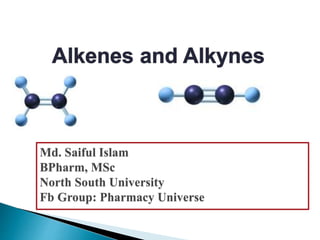
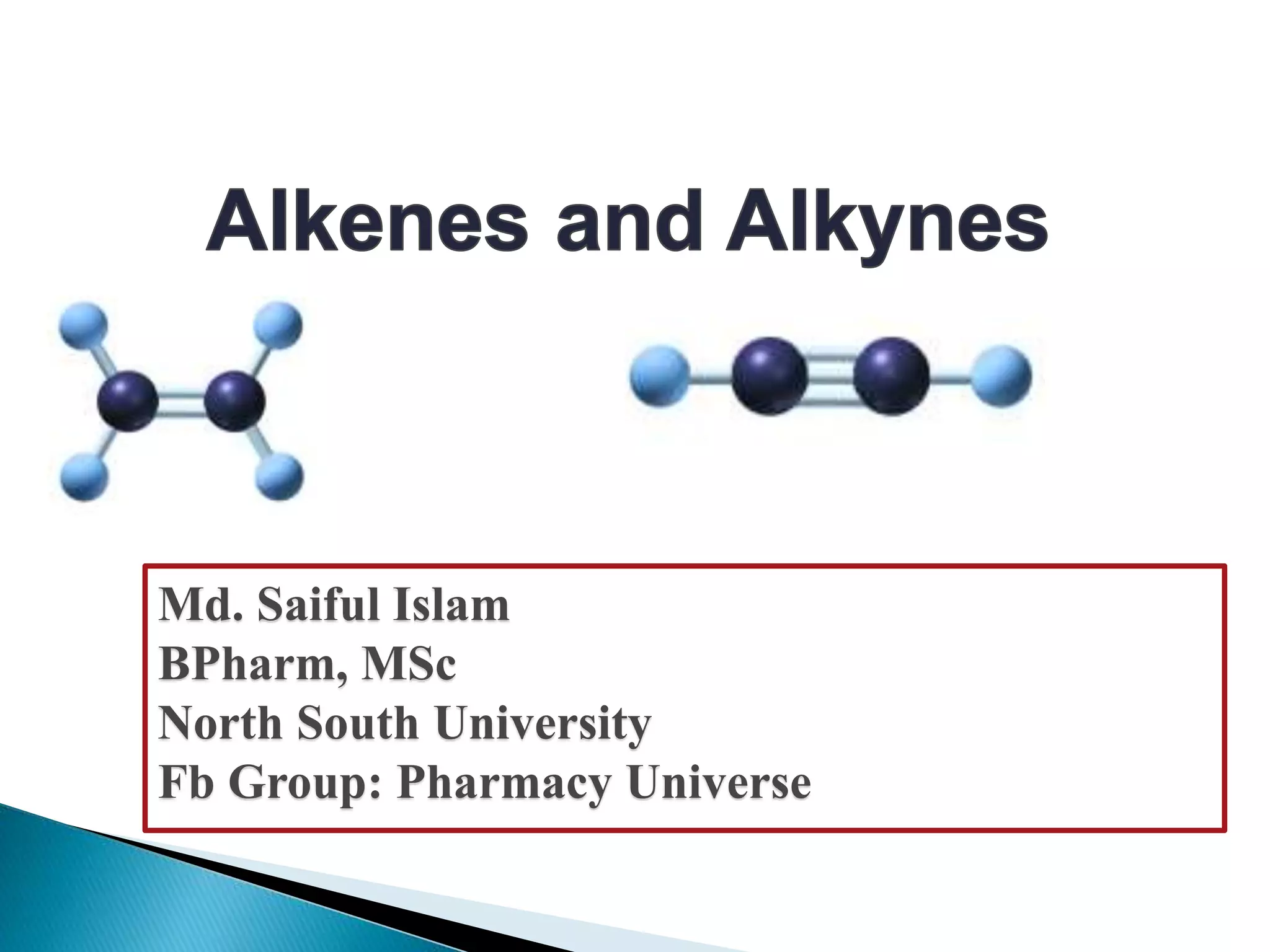
Md. Saiful Islam
BPharm, MSc
North South University
Fb Group: Pharmacy Universe
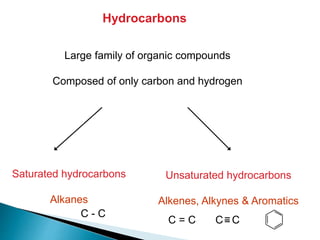
Hydrocarbons
Large family of organic compounds
Composed of only carbon and hydrogen
Saturated hydrocarbons
Alkanes
Unsaturated hydrocarbons
Alkenes, Alkynes & Aromatics
C - C
C = C C C
C
C
C
C
C
C
H
H
H
H
H
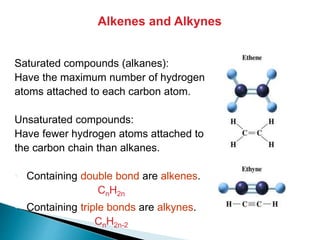
Saturated compounds (alkanes):
Have the maximum number of hydrogen
atoms attached to each carbon atom.
Unsaturated compounds:
Have fewer hydrogen atoms attached to
the carbon chain than alkanes.
• Containing double bond are alkenes.
CnH2n
• Containing triple bonds are alkynes.
CnH2n-2
Alkenes and Alkynes
•Un-branched alkenes containing 2-4 carbons are gaseous, 5-
18 are liquids and over 18 are solids.
•Insoluble in water but soluble in organic solvents.
•Lighter than water with limiting density less than 0.8
•Alkenes have higher MP than that of same length of alkanes
which is attributed by the presence of extra pi bond that
makes the double bond polar and also forms induced dipole
moments within the molecules
Physical properties
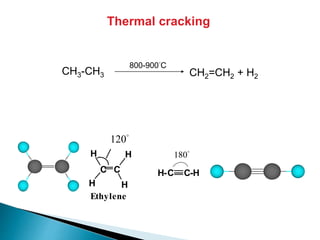
Thermal cracking
CH3-CH3
800-900°C
CH2=CH2 + H2
H
C C
H
H H
121.7°
H3 C
C C
H
H H
124.7°
Ethylene Propene
120°
H
C C
H
H H
H-C C-H
Acetylene
(an alkyne)
Ethylene
(an alkene)
180°
Preparation of Alkynes: Elimination
Reactions of Dihalides
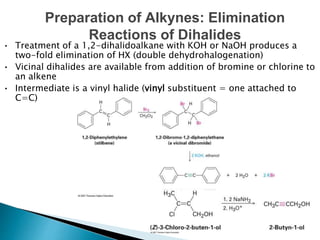
• Treatment of a 1,2-dihalidoalkane with KOH or NaOH produces a
two-fold elimination of HX (double dehydrohalogenation)
• Vicinal dihalides are available from addition of bromine or chlorine to
an alkene
• Intermediate is a vinyl halide (vinyl substituent = one attached to
C=C)
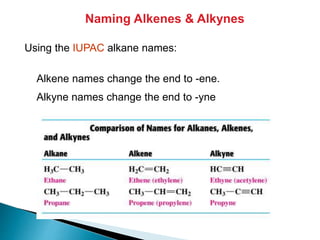
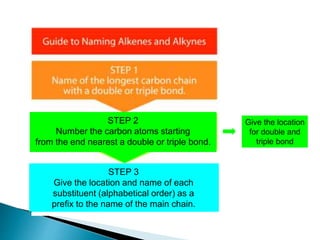
Using the IUPAC alkane names:
Alkene names change the end to -ene.
Alkyne names change the end to -yne
Naming Alkenes & Alkynes
Give the location
for double and
triple bond
STEP 3
Give the location and name of each
substituent (alphabetical order) as a
prefix to the name of the main chain.
STEP 2
Number the carbon atoms starting
from the end nearest a double or triple bond.
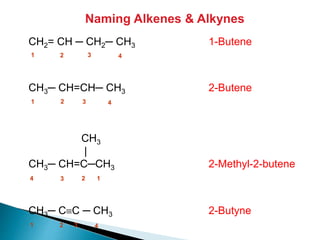
CH2= CH ─ CH2─ CH3 1-Butene
CH3─ CH=CH─ CH3 2-Butene
CH3
|
CH3─ CH=C─CH3 2-Methyl-2-butene
CH3─ CC ─ CH3 2-Butyne
Naming Alkenes & Alkynes
1 2 3 4
1 2 3 4
4 3 2 1
1 2 3 4
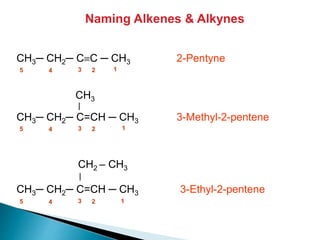
CH3─ CH2─ CC ─ CH3 2-Pentyne
CH3
CH3─ CH2─ C=CH ─ CH3 3-Methyl-2-pentene
CH2 – CH3
CH3─ CH2─ C=CH ─ CH3 3-Ethyl-2-pentene
Naming Alkenes & Alkynes
5 4 3 2 1
5 4 3 2 1
5 4 3 2 1
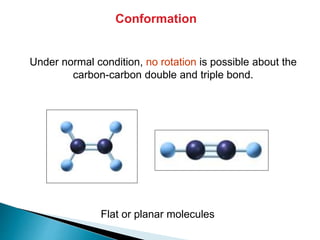
Conformation
Under normal condition, no rotation is possible about the
carbon-carbon double and triple bond.
Flat or planar molecules
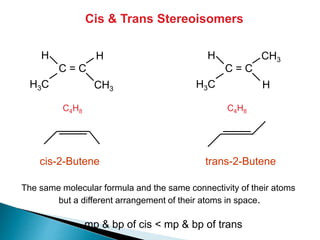
Cis & Trans Stereoisomers
C = C
HH
CH3H3C
C = C
H
H CH3
H3C
cis-2-Butene trans-2-Butene
The same molecular formula and the same connectivity of their atoms
but a different arrangement of their atoms in space.
mp & bp of cis < mp & bp of trans
C4H8 C4H8
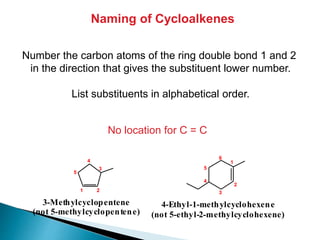
Naming of Cycloalkenes
Number the carbon atoms of the ring double bond 1 and 2
in the direction that gives the substituent lower number.
List substituents in alphabetical order.
No location for C = C
1 2
3
4
5
1
2
3
4
5
6
3-Methylcyclopentene
(not 5-methylcyclopentene)
4-Ethyl-1-methylcyclohexene
(not 5-ethyl-2-methylcyclohexene)
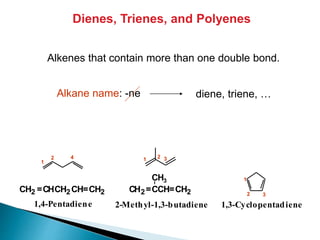
Dienes, Trienes, and Polyenes
Alkenes that contain more than one double bond.
Alkane name: -ne diene, triene, …
CH2=CCH=CH2
CH3
CH2 =CHCH2CH=CH2
1,4-Pentadiene 2-Methyl-1,3-butadiene
(Isoprene)
1,3-Cyclopentadiene
1
2 4 1 2 3
1
2 3
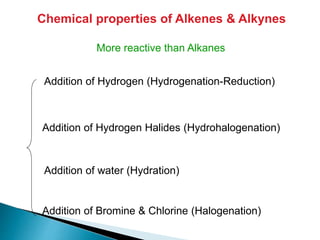
Chemical properties of Alkenes & Alkynes
More reactive than Alkanes
Addition of Hydrogen (Hydrogenation-Reduction)
Addition of Hydrogen Halides (Hydrohalogenation)
Addition of water (Hydration)
Addition of Bromine & Chlorine (Halogenation)
Chemical properties of Alkenes & Alkynes
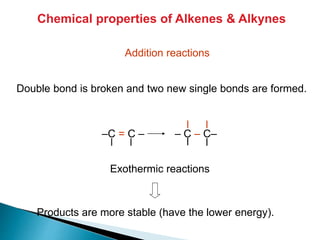
Addition reactions
Double bond is broken and two new single bonds are formed.
Exothermic reactions
–C = C – – C – C–
Products are more stable (have the lower energy).
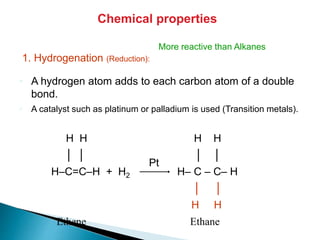
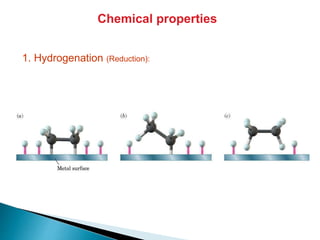
• A hydrogen atom adds to each carbon atom of a double
bond.
• A catalyst such as platinum or palladium is used (Transition metals).
H H H H
│ │ Pt │ │
H–C=C–H + H2 H– C – C– H
│ │
H H
Ethene Ethane
Chemical properties
1. Hydrogenation (Reduction):
Pt
More reactive than Alkanes
Chemical properties
1. Hydrogenation (Reduction):
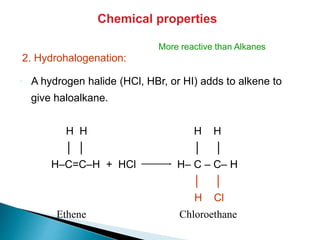
• A hydrogen halide (HCl, HBr, or HI) adds to alkene to
give haloalkane.
H H H H
│ │ │ │
H–C=C–H + HCl H– C – C– H
│ │
H Cl
Ethene Chloroethane
Chemical properties
2. Hydrohalogenation:
More reactive than Alkanes
Chemical properties
2. Hydrohalogenation:
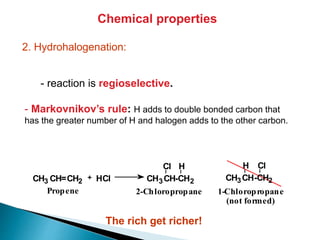
- reaction is regioselective.
- Markovnikov’s rule: H adds to double bonded carbon that
has the greater number of H and halogen adds to the other carbon.
CH3 CH=CH2 HCl CH3CH-CH2
HCl
CH3CH-CH2
ClH
1-Chloropropane
(not formed)
2-ChloropropanePropene
+
The rich get richer!
Chemical properties
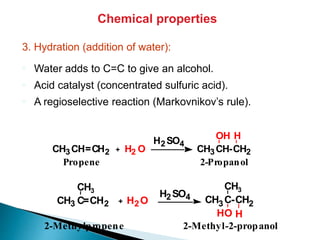
3. Hydration (addition of water):
• Water adds to C=C to give an alcohol.
• Acid catalyst (concentrated sulfuric acid).
• A regioselective reaction (Markovnikov’s rule).
CH3CH=CH2 H2 O
H2SO4
CH3CH-CH2
HOH
Propene 2-Propanol
+
CH3 C=CH2
CH3
H2O
H2SO4 CH3C-CH2
CH3
HO H
2-Methyl-2-propanol2-Methylpropene
+
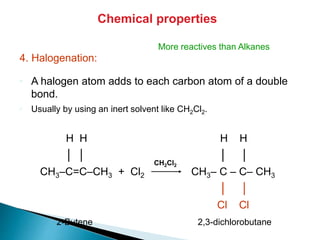
• A halogen atom adds to each carbon atom of a double
bond.
• Usually by using an inert solvent like CH2Cl2.
H H H H
│ │ │ │
CH3–C=C–CH3 + Cl2 CH3– C – C– CH3
│ │
Cl Cl
2-Butene 2,3-dichlorobutane
Chemical properties
4. Halogenation:
CH2Cl2
More reactives than Alkanes
Polymerization
Polymer: a long-chain molecule produced by bonding together
many single parts called monomers.
nCH2 =CH2 CH2 CH2
initiator
Ethylene Polyethylene
n(polymerization)
The most important reactions of alkenes in industry.
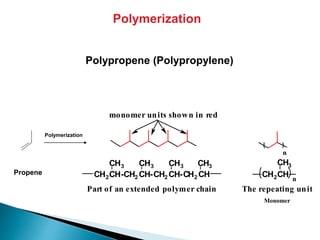
CH2CH-CH2 CH-CH2 CH-CH2 CH
CH3 CH3 CH3 CH3
CH2CH
CH3
The repeating unitPart of an extended polymer chain
n
monomer units shown in red
n
Polymerization
Propene
Monomer
Polymerization
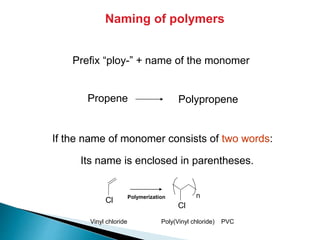
Polypropene (Polypropylene)
Naming of polymers
Prefix “ploy-” + name of the monomer
Propene Polypropene
If the name of monomer consists of two words:
Its name is enclosed in parentheses.
Cl
Cl
nPolymerization
Vinyl chloride Poly(Vinyl chloride) PVC
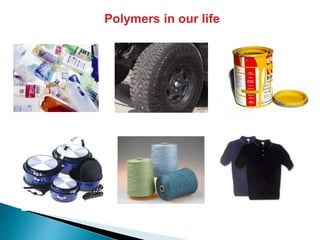
Polymers in our life
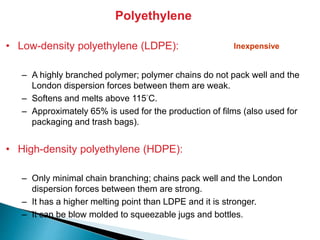
• Low-density polyethylene (LDPE):
– A highly branched polymer; polymer chains do not pack well and the
London dispersion forces between them are weak.
– Softens and melts above 115°C.
– Approximately 65% is used for the production of films (also used for
packaging and trash bags).
• High-density polyethylene (HDPE):
– Only minimal chain branching; chains pack well and the London
dispersion forces between them are strong.
– It has a higher melting point than LDPE and it is stronger.
– It can be blow molded to squeezable jugs and bottles.
Polyethylene
Inexpensive
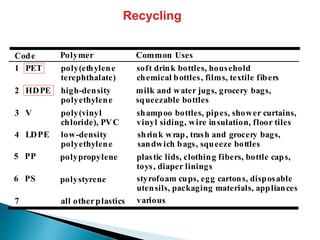
3 V
5 PP
6 PS
Code Polymer Common Uses
1 PET poly(ethylene
terephthalate)
soft drink bottles, household
chemical bottles, films, textile fibers
2 HDPE high-density
polyethylene
milk and water jugs, grocery bags,
squeezable bottles
poly(vinyl
chloride), PVC
shampoo bottles, pipes, shower curtains,
vinyl siding, wire insulation, floor tiles
4 LDPE low-density
polyethylene
shrink wrap, trash and grocery bags,
sandwich bags, squeeze bottles
polypropylene plastic lids, clothing fibers, bottle caps,
toys, diaper linings
polystyrene styrofoam cups, egg cartons, disposable
utensils, packaging materials, appliances
7 all otherplastics various
Recycling
The END

alkene and alkyne

  • 1.
    Md. Saiful Islam BPharm,MSc North South University Fb Group: Pharmacy Universe
  • 2.
    Hydrocarbons Large family oforganic compounds Composed of only carbon and hydrogen Saturated hydrocarbons Alkanes Unsaturated hydrocarbons Alkenes, Alkynes & Aromatics C - C C = C C C C C C C C C H H H H H
  • 3.
    Saturated compounds (alkanes): Havethe maximum number of hydrogen atoms attached to each carbon atom. Unsaturated compounds: Have fewer hydrogen atoms attached to the carbon chain than alkanes. • Containing double bond are alkenes. CnH2n • Containing triple bonds are alkynes. CnH2n-2 Alkenes and Alkynes
  • 4.
    •Un-branched alkenes containing2-4 carbons are gaseous, 5- 18 are liquids and over 18 are solids. •Insoluble in water but soluble in organic solvents. •Lighter than water with limiting density less than 0.8 •Alkenes have higher MP than that of same length of alkanes which is attributed by the presence of extra pi bond that makes the double bond polar and also forms induced dipole moments within the molecules Physical properties
  • 5.
    Thermal cracking CH3-CH3 800-900°C CH2=CH2 +H2 H C C H H H 121.7° H3 C C C H H H 124.7° Ethylene Propene 120° H C C H H H H-C C-H Acetylene (an alkyne) Ethylene (an alkene) 180°
  • 6.
    Preparation of Alkynes:Elimination Reactions of Dihalides • Treatment of a 1,2-dihalidoalkane with KOH or NaOH produces a two-fold elimination of HX (double dehydrohalogenation) • Vicinal dihalides are available from addition of bromine or chlorine to an alkene • Intermediate is a vinyl halide (vinyl substituent = one attached to C=C)
  • 7.
    Using the IUPACalkane names: Alkene names change the end to -ene. Alkyne names change the end to -yne Naming Alkenes & Alkynes
  • 8.
    Give the location fordouble and triple bond STEP 3 Give the location and name of each substituent (alphabetical order) as a prefix to the name of the main chain. STEP 2 Number the carbon atoms starting from the end nearest a double or triple bond.
  • 9.
    CH2= CH ─CH2─ CH3 1-Butene CH3─ CH=CH─ CH3 2-Butene CH3 | CH3─ CH=C─CH3 2-Methyl-2-butene CH3─ CC ─ CH3 2-Butyne Naming Alkenes & Alkynes 1 2 3 4 1 2 3 4 4 3 2 1 1 2 3 4
  • 10.
    CH3─ CH2─ CC─ CH3 2-Pentyne CH3 CH3─ CH2─ C=CH ─ CH3 3-Methyl-2-pentene CH2 – CH3 CH3─ CH2─ C=CH ─ CH3 3-Ethyl-2-pentene Naming Alkenes & Alkynes 5 4 3 2 1 5 4 3 2 1 5 4 3 2 1
  • 11.
    Conformation Under normal condition,no rotation is possible about the carbon-carbon double and triple bond. Flat or planar molecules
  • 12.
    Cis & TransStereoisomers C = C HH CH3H3C C = C H H CH3 H3C cis-2-Butene trans-2-Butene The same molecular formula and the same connectivity of their atoms but a different arrangement of their atoms in space. mp & bp of cis < mp & bp of trans C4H8 C4H8
  • 13.
    Naming of Cycloalkenes Numberthe carbon atoms of the ring double bond 1 and 2 in the direction that gives the substituent lower number. List substituents in alphabetical order. No location for C = C 1 2 3 4 5 1 2 3 4 5 6 3-Methylcyclopentene (not 5-methylcyclopentene) 4-Ethyl-1-methylcyclohexene (not 5-ethyl-2-methylcyclohexene)
  • 14.
    Dienes, Trienes, andPolyenes Alkenes that contain more than one double bond. Alkane name: -ne diene, triene, … CH2=CCH=CH2 CH3 CH2 =CHCH2CH=CH2 1,4-Pentadiene 2-Methyl-1,3-butadiene (Isoprene) 1,3-Cyclopentadiene 1 2 4 1 2 3 1 2 3
  • 15.
    Chemical properties ofAlkenes & Alkynes More reactive than Alkanes Addition of Hydrogen (Hydrogenation-Reduction) Addition of Hydrogen Halides (Hydrohalogenation) Addition of water (Hydration) Addition of Bromine & Chlorine (Halogenation)
  • 16.
    Chemical properties ofAlkenes & Alkynes Addition reactions Double bond is broken and two new single bonds are formed. Exothermic reactions –C = C – – C – C– Products are more stable (have the lower energy).
  • 17.
    • A hydrogenatom adds to each carbon atom of a double bond. • A catalyst such as platinum or palladium is used (Transition metals). H H H H │ │ Pt │ │ H–C=C–H + H2 H– C – C– H │ │ H H Ethene Ethane Chemical properties 1. Hydrogenation (Reduction): Pt More reactive than Alkanes
  • 18.
  • 19.
    • A hydrogenhalide (HCl, HBr, or HI) adds to alkene to give haloalkane. H H H H │ │ │ │ H–C=C–H + HCl H– C – C– H │ │ H Cl Ethene Chloroethane Chemical properties 2. Hydrohalogenation: More reactive than Alkanes
  • 20.
    Chemical properties 2. Hydrohalogenation: -reaction is regioselective. - Markovnikov’s rule: H adds to double bonded carbon that has the greater number of H and halogen adds to the other carbon. CH3 CH=CH2 HCl CH3CH-CH2 HCl CH3CH-CH2 ClH 1-Chloropropane (not formed) 2-ChloropropanePropene + The rich get richer!
  • 21.
    Chemical properties 3. Hydration(addition of water): • Water adds to C=C to give an alcohol. • Acid catalyst (concentrated sulfuric acid). • A regioselective reaction (Markovnikov’s rule). CH3CH=CH2 H2 O H2SO4 CH3CH-CH2 HOH Propene 2-Propanol + CH3 C=CH2 CH3 H2O H2SO4 CH3C-CH2 CH3 HO H 2-Methyl-2-propanol2-Methylpropene +
  • 22.
    • A halogenatom adds to each carbon atom of a double bond. • Usually by using an inert solvent like CH2Cl2. H H H H │ │ │ │ CH3–C=C–CH3 + Cl2 CH3– C – C– CH3 │ │ Cl Cl 2-Butene 2,3-dichlorobutane Chemical properties 4. Halogenation: CH2Cl2 More reactives than Alkanes
  • 23.
    Polymerization Polymer: a long-chainmolecule produced by bonding together many single parts called monomers. nCH2 =CH2 CH2 CH2 initiator Ethylene Polyethylene n(polymerization) The most important reactions of alkenes in industry.
  • 24.
    CH2CH-CH2 CH-CH2 CH-CH2CH CH3 CH3 CH3 CH3 CH2CH CH3 The repeating unitPart of an extended polymer chain n monomer units shown in red n Polymerization Propene Monomer Polymerization Polypropene (Polypropylene)
  • 25.
    Naming of polymers Prefix“ploy-” + name of the monomer Propene Polypropene If the name of monomer consists of two words: Its name is enclosed in parentheses. Cl Cl nPolymerization Vinyl chloride Poly(Vinyl chloride) PVC
  • 26.
  • 27.
    • Low-density polyethylene(LDPE): – A highly branched polymer; polymer chains do not pack well and the London dispersion forces between them are weak. – Softens and melts above 115°C. – Approximately 65% is used for the production of films (also used for packaging and trash bags). • High-density polyethylene (HDPE): – Only minimal chain branching; chains pack well and the London dispersion forces between them are strong. – It has a higher melting point than LDPE and it is stronger. – It can be blow molded to squeezable jugs and bottles. Polyethylene Inexpensive
  • 28.
    3 V 5 PP 6PS Code Polymer Common Uses 1 PET poly(ethylene terephthalate) soft drink bottles, household chemical bottles, films, textile fibers 2 HDPE high-density polyethylene milk and water jugs, grocery bags, squeezable bottles poly(vinyl chloride), PVC shampoo bottles, pipes, shower curtains, vinyl siding, wire insulation, floor tiles 4 LDPE low-density polyethylene shrink wrap, trash and grocery bags, sandwich bags, squeeze bottles polypropylene plastic lids, clothing fibers, bottle caps, toys, diaper linings polystyrene styrofoam cups, egg cartons, disposable utensils, packaging materials, appliances 7 all otherplastics various Recycling
  • 29.