ORGANIC CHEMISTRY I 
Alkenes & Alkynes: Introduction 
Dra. Sri Sutji Susilowati, M.Si., Apt 
M. Salman Fareza, M.Si. 
Pharmacy Departement 
Jenderal Soedirman University
Alkenes 
Introduction: Structure and Bonding 
• Alkenes are also called olefins. 
• Alkenes contain a carbon—carbon double bond. 
• Terminal alkenes have the double bond at the end of 
the carbon chain. 
• Internal alkenes have at least one carbon atom bonded 
to each end of the double bond. 
• Cycloalkenes contain a double bond in a ring.
Alkenes 
Introduction: Structure and Bonding 
• Recall that the double bond consists of a  bond and a 
 bond. The  bond is stronger than the  bond. 
• Each carbon is sp2 hybridized and trigonal planar, with 
bond angles of approximately 120°.
Alkenes 
Introduction: Structure and Bonding 
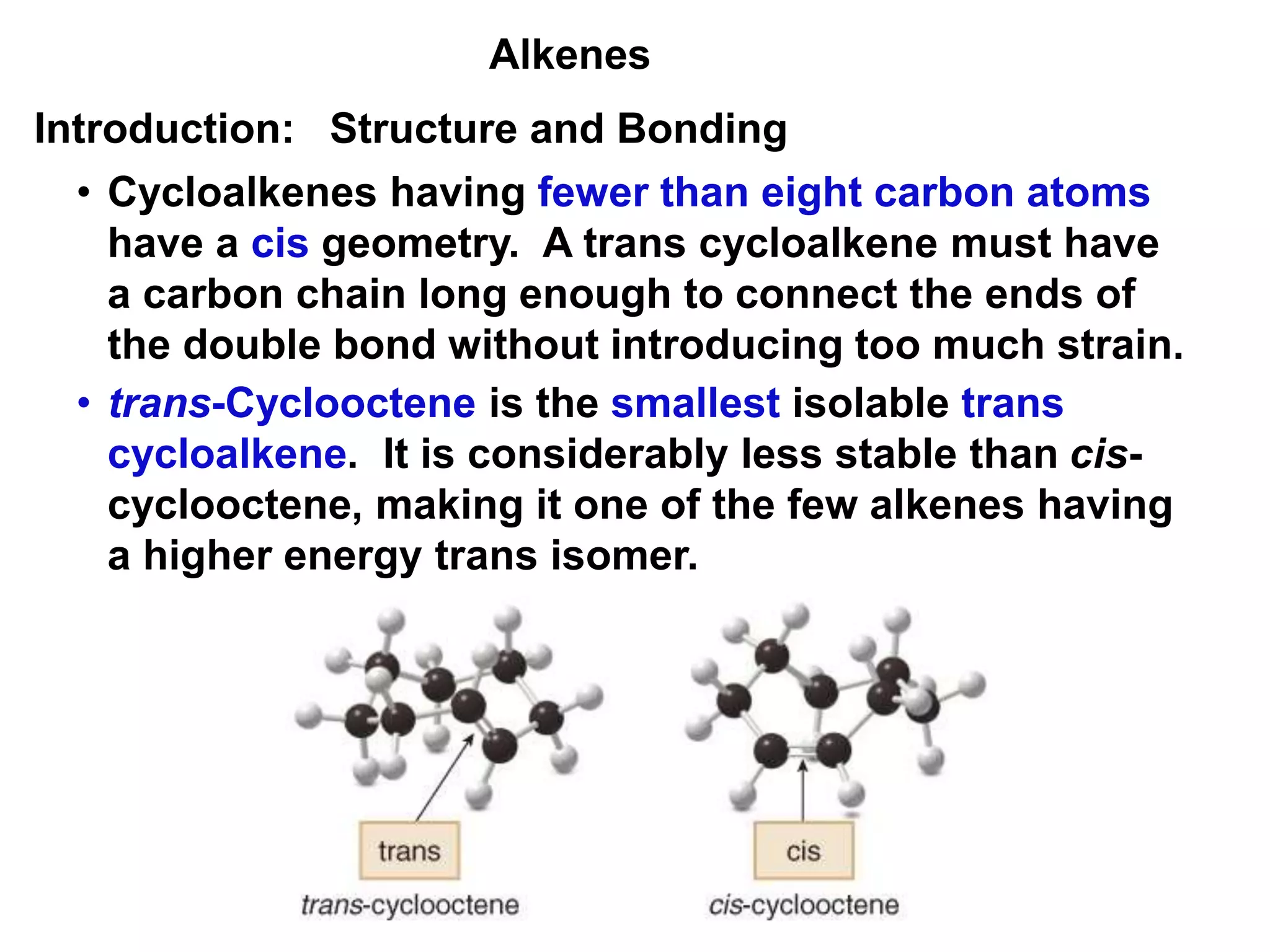
• Cycloalkenes having fewer than eight carbon atoms 
have a cis geometry. A trans cycloalkene must have 
a carbon chain long enough to connect the ends of 
the double bond without introducing too much strain. 
• trans-Cyclooctene is the smallest isolable trans 
cycloalkene. It is considerably less stable than cis-cyclooctene, 
making it one of the few alkenes having 
a higher energy trans isomer.
5 
Alkenes 
Introduction: Structure and Bonding
Alkenes 
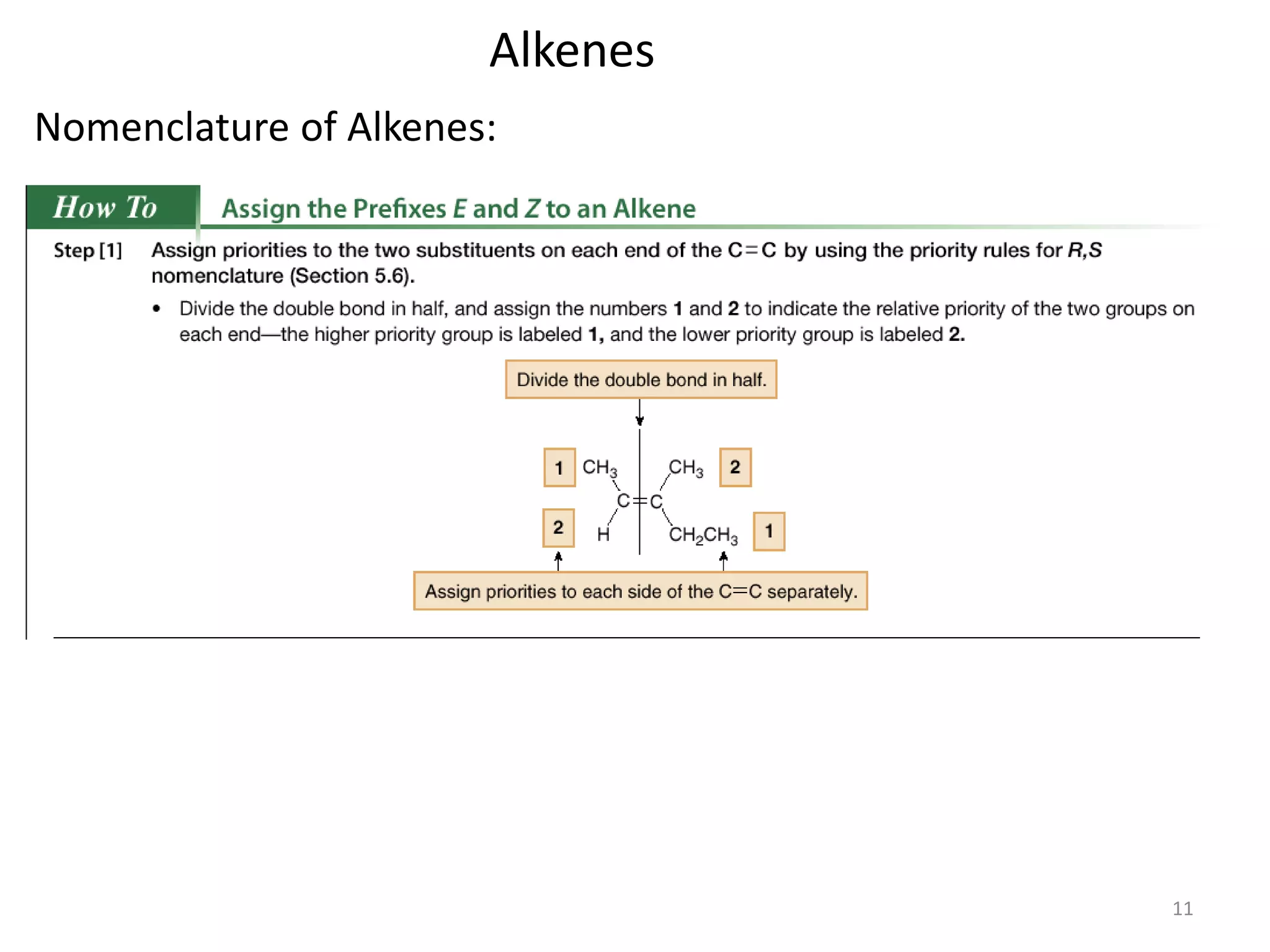
Nomenclature of Alkenes:
Alkenes 
Nomenclature of Alkenes:
Alkenes 
Nomenclature of Alkenes: 
• Always choose the longest chain that contains both 
atoms of the double bond. 
• Compounds with two double bonds are named as 
dienes by changing the “-ane” ending of the parent 
alkane to the suffix “–adiene”. Compounds with 
three double bonds are named as trienes, and so 
forth. 
CH2=CH-CH=CH2 CH2=CH-CH=CH-CH=CH2 
1,3-butadiene 1,3,5-hexatriene
9 
Alkenes 
Nomenclature of Alkenes: 
• In naming cycloalkenes, the double bond is located between C1 and C2, and the 
“1” is usually omitted in the name. The ring is numbered clockwise or 
counterclockwise to give the first substituent the lower number. 
• Compounds that contain both a double bond and a hydroxy group are named as 
alkenols and the chain (or ring) is numbered to give the OH group the lower 
number.
10 
Figure 10.1 Naming an 
alkene in which the 
longest carbon chain 
does not contain both 
atoms of the double bond 
Figure 10.2 
Examples of 
cycloalkene 
nomenclature 
Alkenes 
Nomenclature of Alkenes:
11 
Alkenes 
Nomenclature of Alkenes:
12 
Alkenes 
Nomenclature of Alkenes:
13 
Alkenes 
Nomenclature of Alkenes: 
• Some alkene or alkenyl substituents have common names. 
• The simplest alkene, CH2=CH2, named in the IUPAC system as ethene, 
is often called ethylene. 
Figure 10.3 Naming alkenes with common substituent names
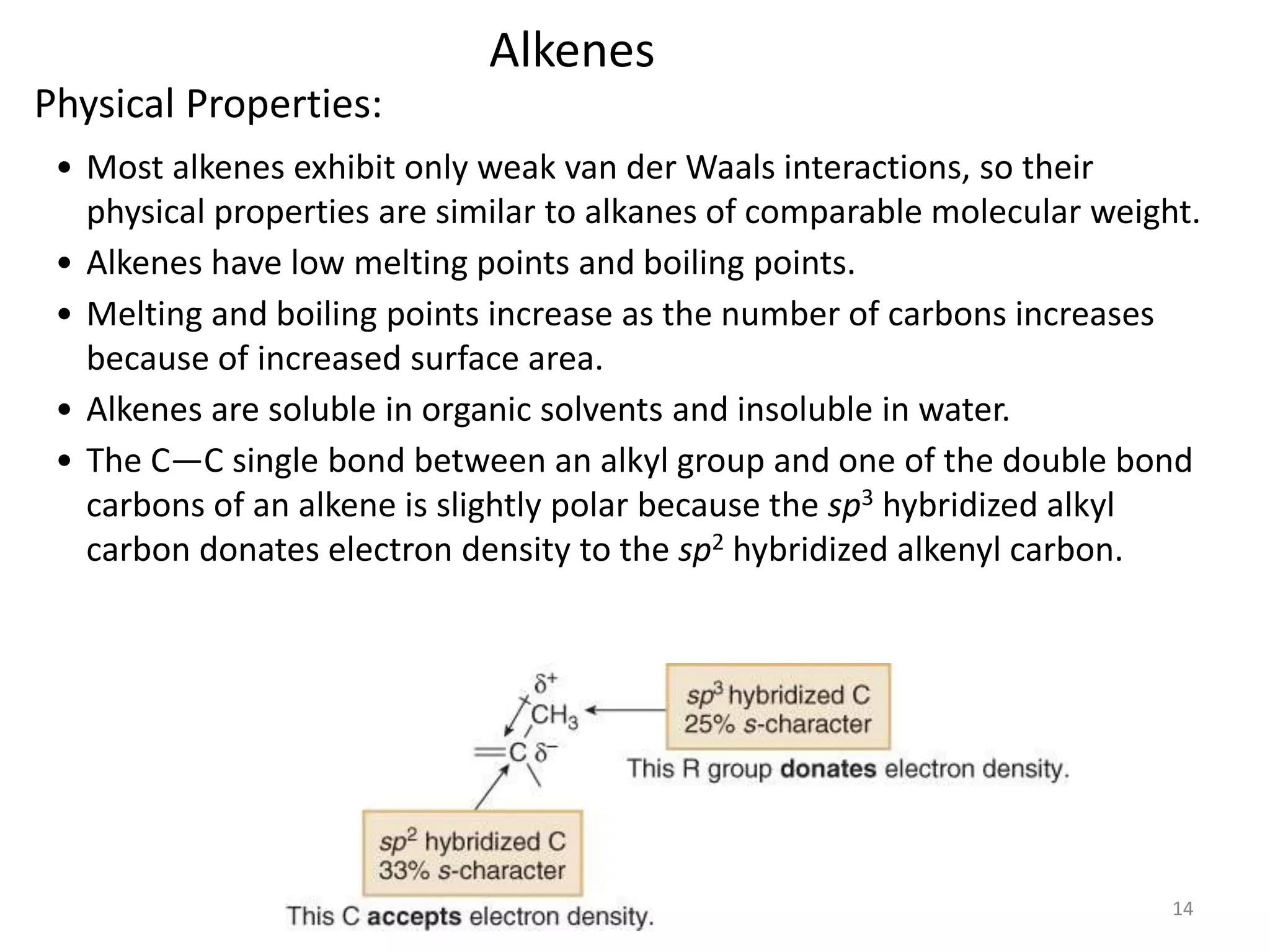
• Most alkenes exhibit only weak van der Waals interactions, so their 
physical properties are similar to alkanes of comparable molecular weight. 
• Alkenes have low melting points and boiling points. 
• Melting and boiling points increase as the number of carbons increases 
because of increased surface area. 
• Alkenes are soluble in organic solvents and insoluble in water. 
• The C—C single bond between an alkyl group and one of the double bond 
carbons of an alkene is slightly polar because the sp3 hybridized alkyl 
carbon donates electron density to the sp2 hybridized alkenyl carbon. 
14 
Physical Properties: 
Alkenes
15 
Alkenes 
Physical Properties: 
• A consequence of this dipole is that cis and trans isomeric alkenes often 
have somewhat different physical properties. 
• cis-2-Butene has a higher boiling point (4°C) than trans-2-butene (1°C). 
• In the cis isomer, the two Csp 
3—Csp 
2 bond dipoles reinforce each other, 
yielding a small net molecular dipole. In the trans isomer, the two bond 
dipoles cancel.
16 
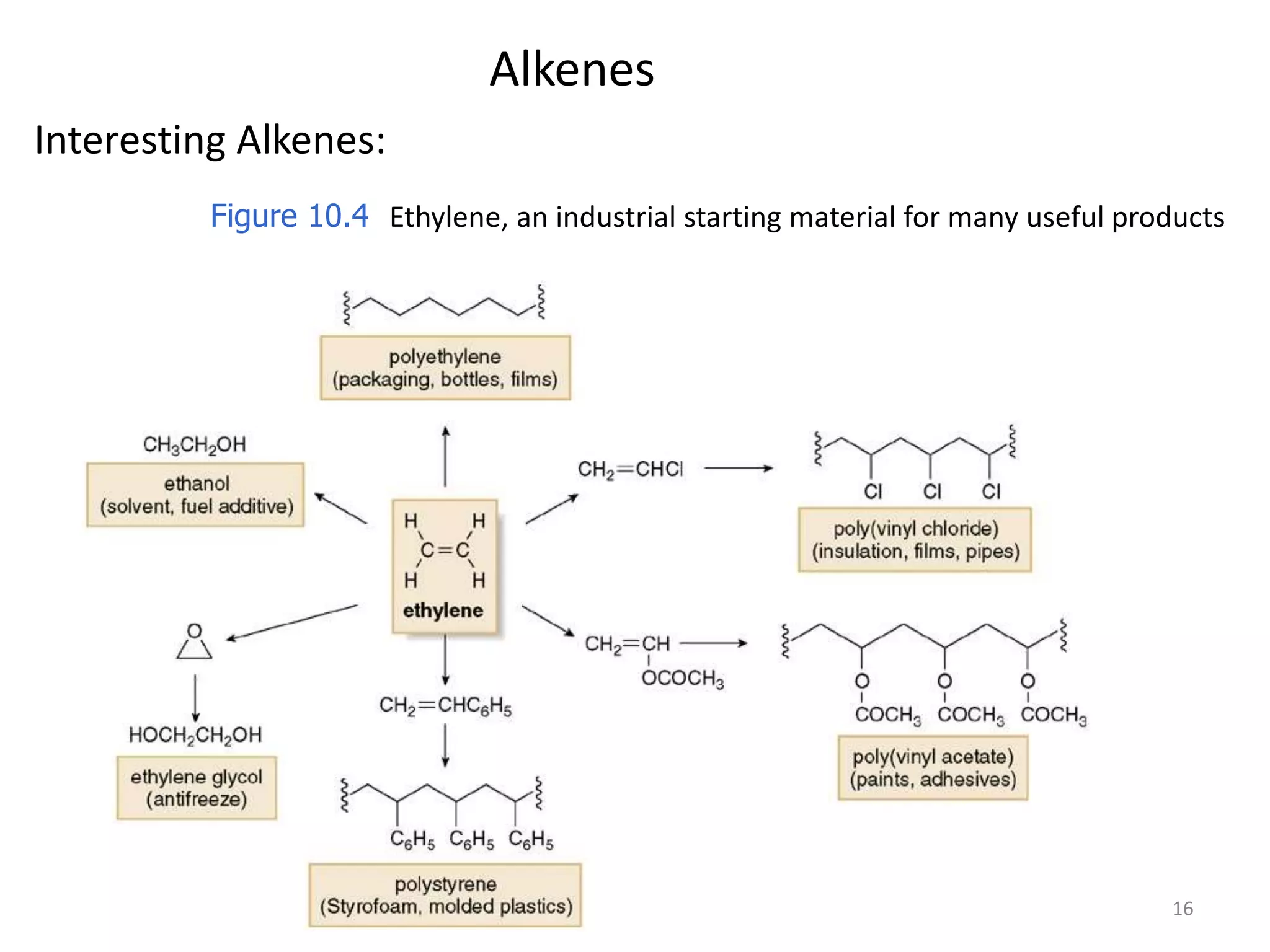
Interesting Alkenes: 
Alkenes 
Figure 10.4 Ethylene, an industrial starting material for many useful products
17 
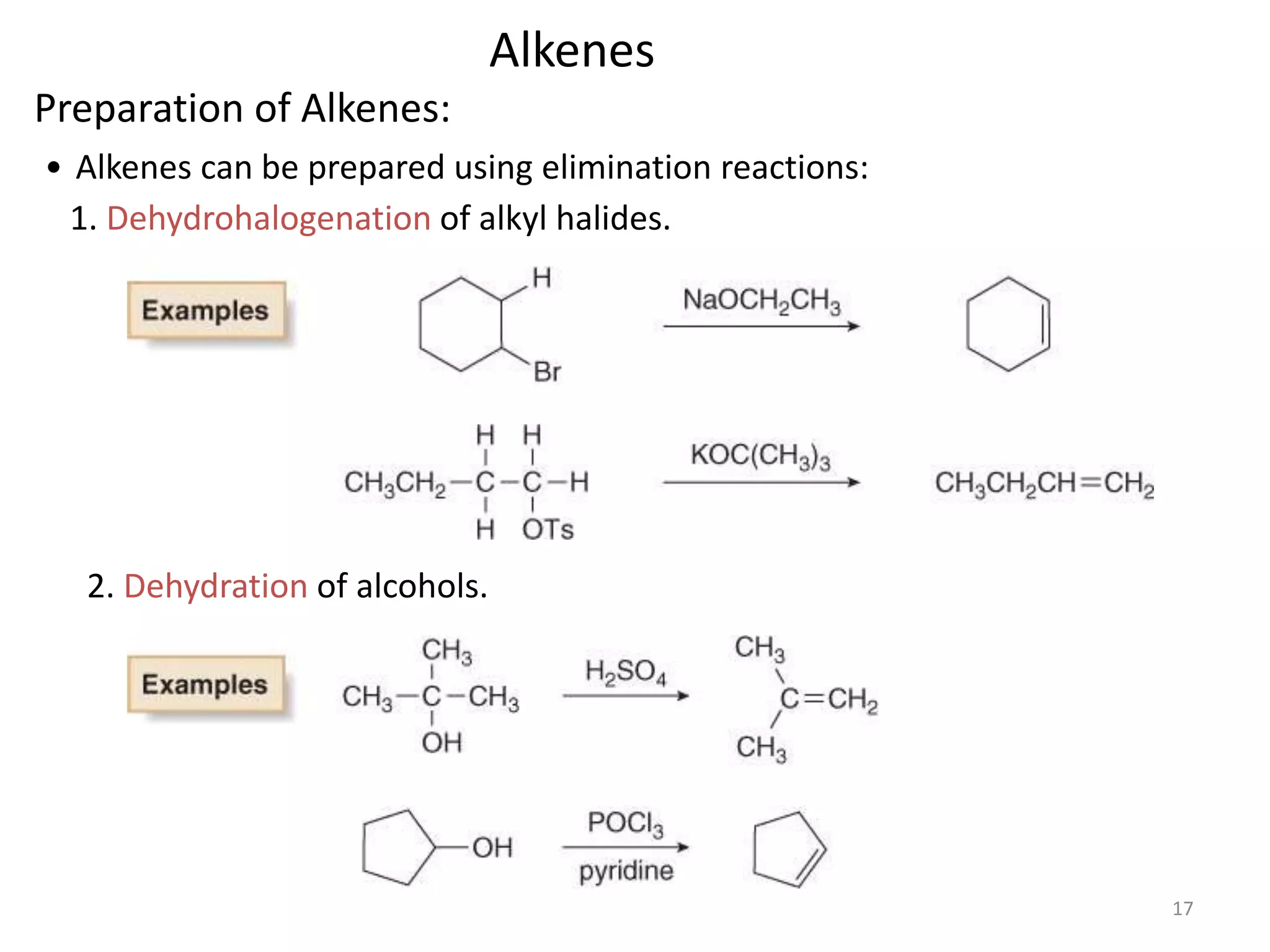
Preparation of Alkenes: 
Alkenes 
• Alkenes can be prepared using elimination reactions: 
1. Dehydrohalogenation of alkyl halides. 
2. Dehydration of alcohols.
• Remember, these elimination reactions are regioselective and stereoselective, so the 
most stable alkene is usually formed as the major product. 
18 
Alkenes 
Preparation of Alkenes:
19 
Alkenes 
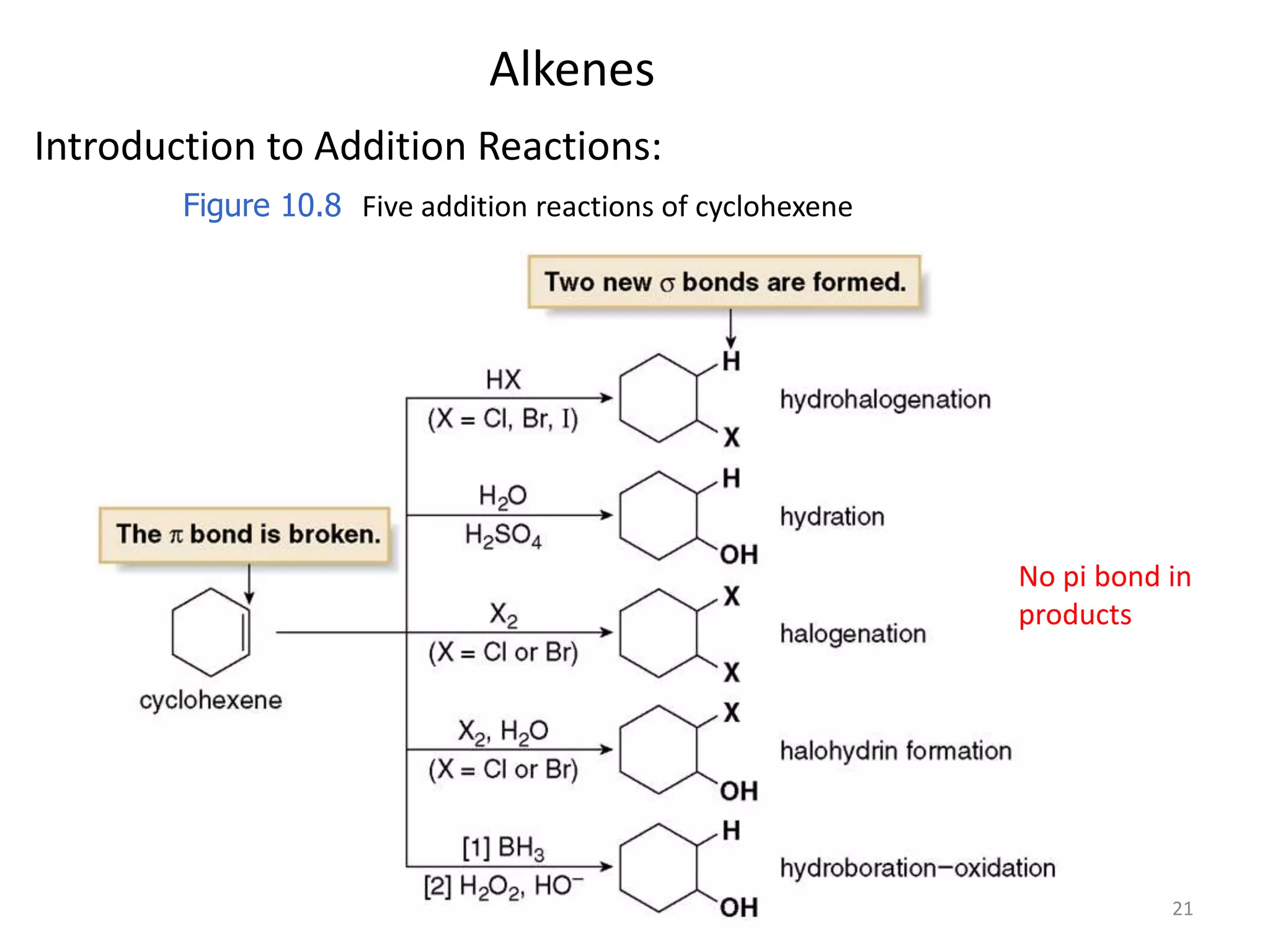
Introduction to Addition Reactions (see also Chapt. 6): 
• The characteristic reaction of alkenes is addition: the  bond is broken 
and two new  bonds are formed. 
No pi bond 
• Alkenes have exposed electrons, with the electron density of the  bond 
above and below the plane of the molecule. 
• Because alkenes are electron rich, simple alkenes do not react with 
nucleophiles or bases, reagents that are themselves electron rich. Alkenes 
react with electrophiles.
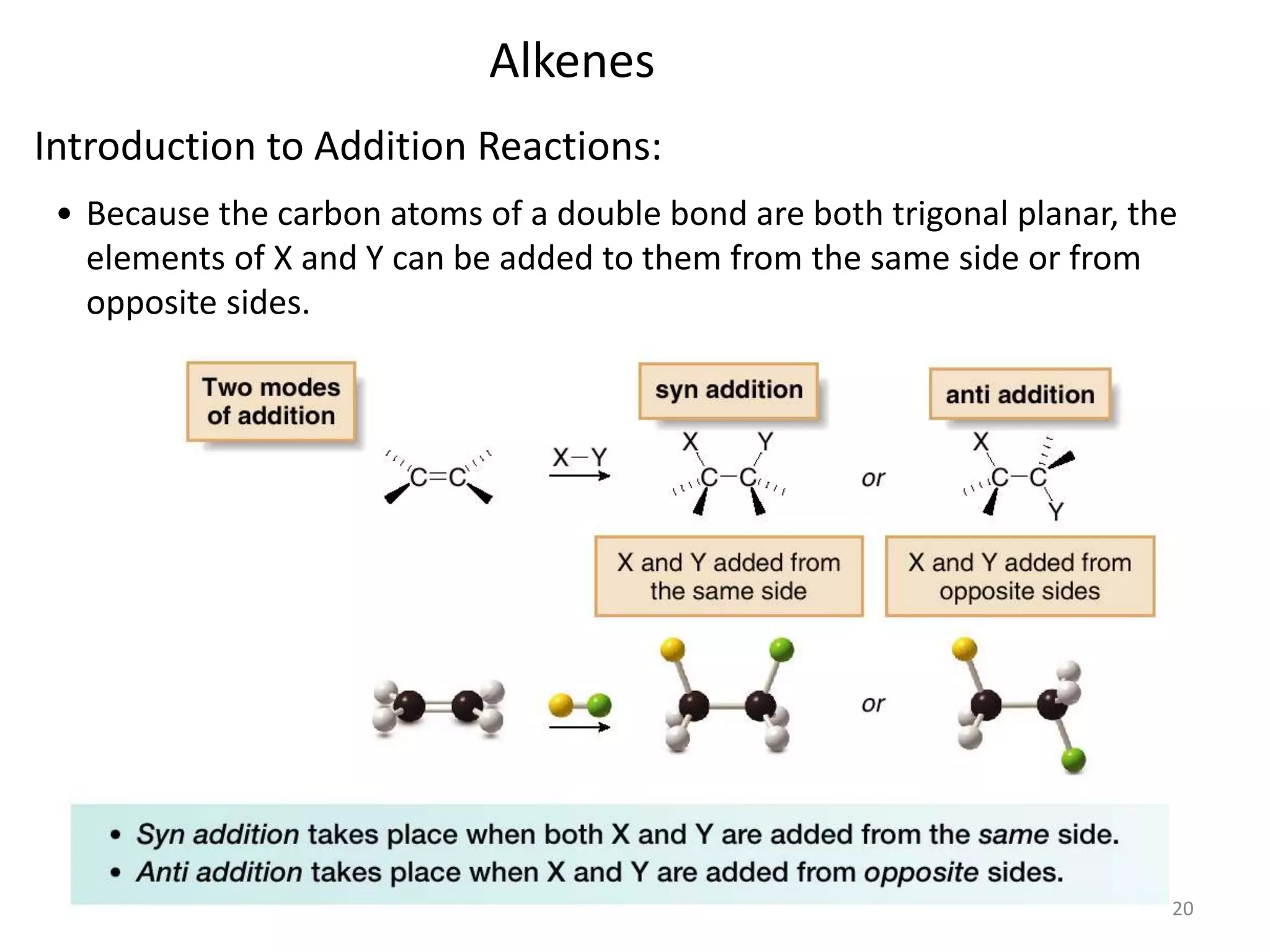
• Because the carbon atoms of a double bond are both trigonal planar, the 
elements of X and Y can be added to them from the same side or from 
opposite sides. 
20 
Alkenes 
Introduction to Addition Reactions:
21 
Alkenes 
Introduction to Addition Reactions: 
Figure 10.8 Five addition reactions of cyclohexene 
No pi bond in 
products
22 
Alkynes 
Introduction—Structure and Bonding: 
• Recall that the triple bond consists of 2  bonds and 1  bond. 
• Each carbon is sp hybridized with a linear geometry and bond angles of 
1800.
23 
Alkynes 
Introduction—Structure and Bonding: 
• Estimation of the energy of pi bonds in ethylene (one  and one  bonds) and 
acetylene (one  and two  bonds).
24 
Alkynes 
Introduction—Structure and Bonding: 
• Alkynes contain a carbon—carbon triple bond. 
• Terminal alkynes have the triple bond at the end of the carbon chain so that a 
hydrogen atom is directly bonded to a carbon atom of the triple bond. 
• Internal alkynes have a carbon atom bonded to each carbon atom of the triple bond. 
• An alkyne has the general molecular formula CnH2n-2, giving it four fewer hydrogens 
than the maximum possible for the number of carbons present. Thus, the triple bond 
introduces two degrees of unsaturation.
25 
Physical Properties: 
Alkynes 
• The physical properties of alkynes resemble those of hydrocarbons of similar shape 
and molecular weight. 
• Alkynes have low melting points and boiling points. 
• Melting point and boiling point increase as the number of carbons increases. 
• Alkynes are soluble in organic solvents and insoluble in water.
26 
Alkynes 
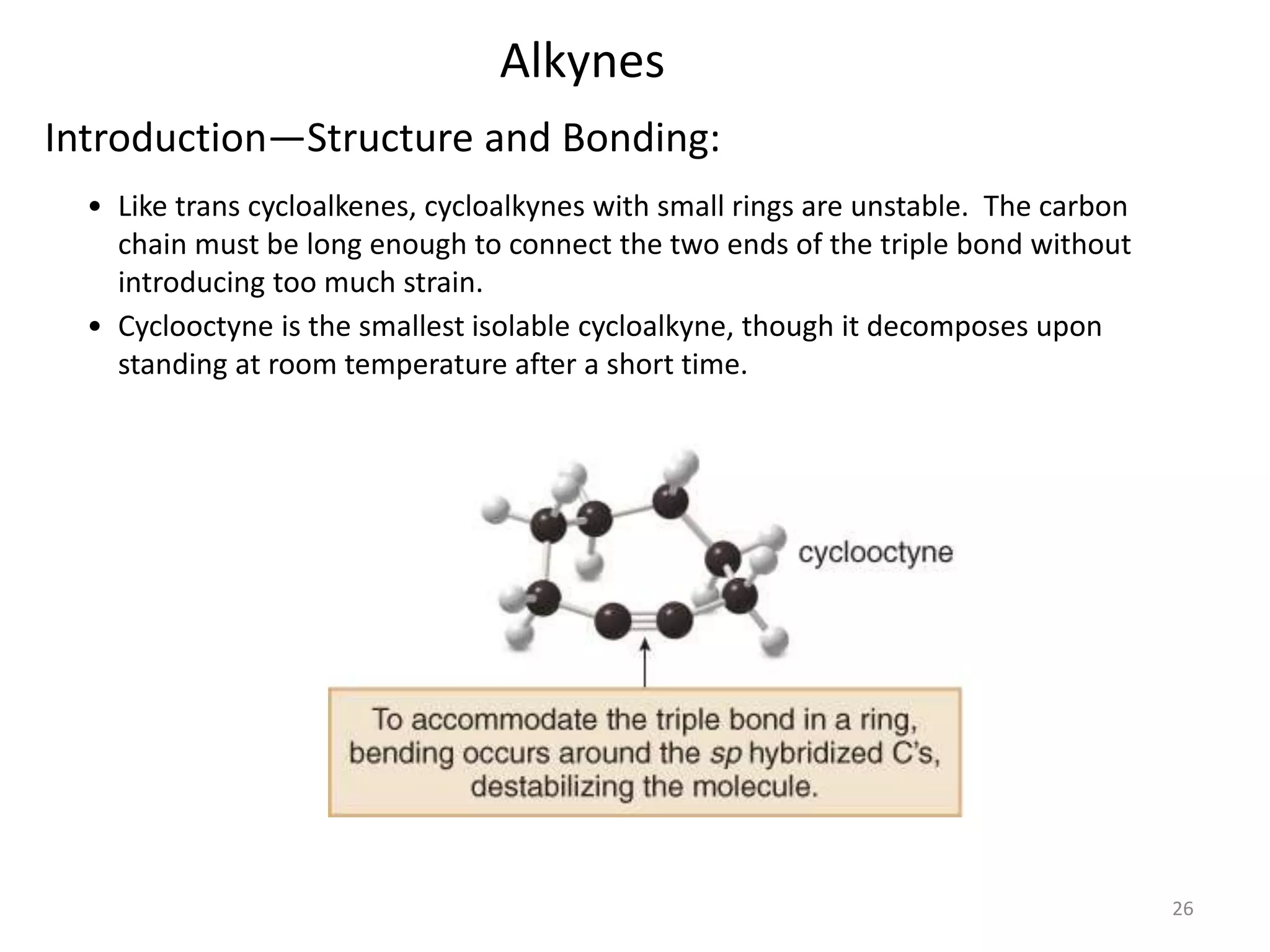
Introduction—Structure and Bonding: 
• Like trans cycloalkenes, cycloalkynes with small rings are unstable. The carbon 
chain must be long enough to connect the two ends of the triple bond without 
introducing too much strain. 
• Cyclooctyne is the smallest isolable cycloalkyne, though it decomposes upon 
standing at room temperature after a short time.
27 
Nomenclature: 
Alkynes 
• Alkynes are named in the same general way that alkenes are named. 
• In the IUPAC system, change the –ane ending of the parent alkane name to 
the suffix –yne. 
• Choose the longest continuous chain that contains both atoms of the triple 
bond and number the chain to give the triple bond the lower number. 
• Compounds with two triple bonds are named as diynes, those with three are 
named as triynes and so forth.
28 
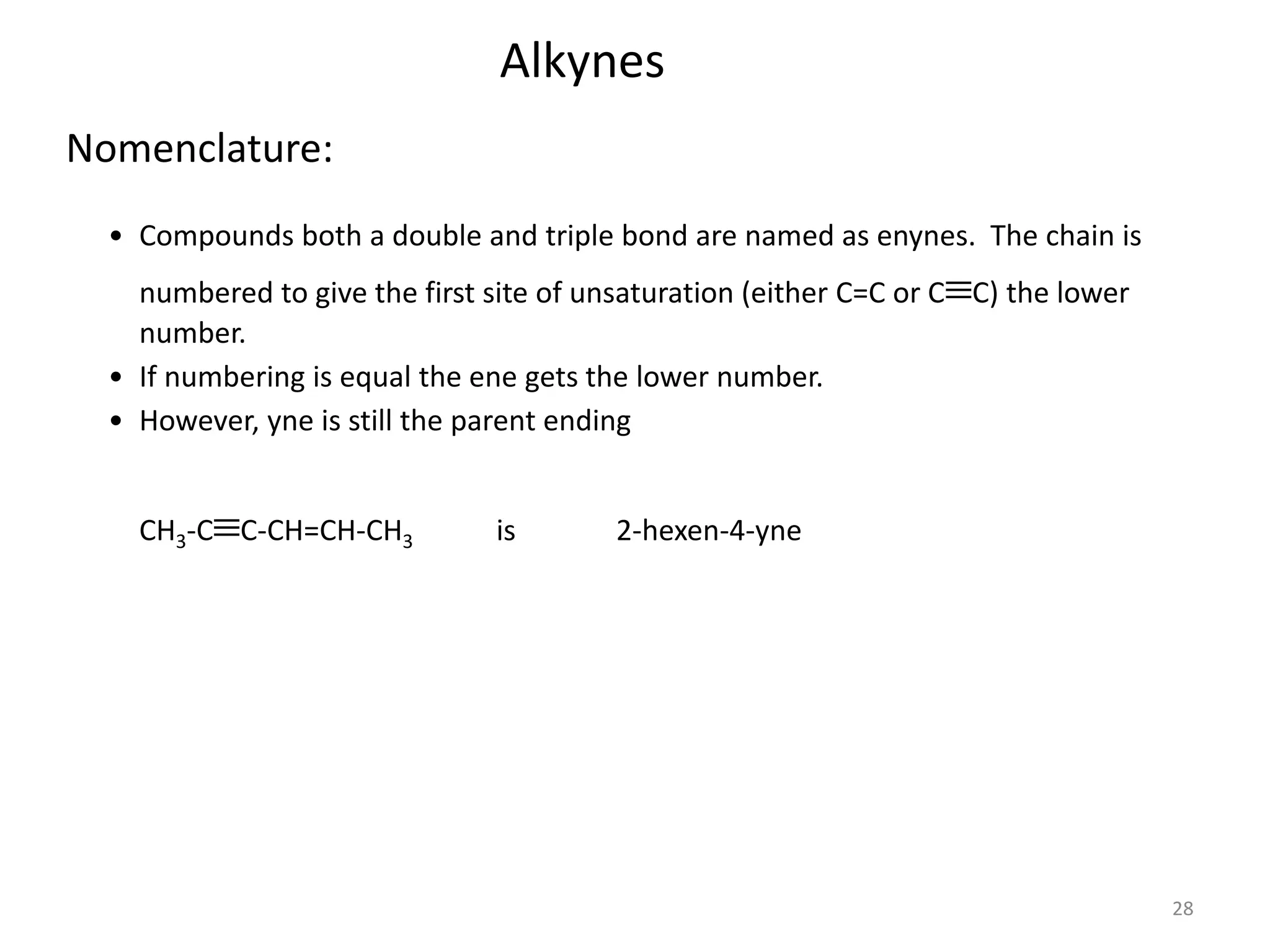
Nomenclature: 
Alkynes 
• Compounds both a double and triple bond are named as enynes. The chain is 
numbered to give the first site of unsaturation (either C=C or CC) the lower 
number. 
• If numbering is equal the ene gets the lower number. 
• However, yne is still the parent ending 
CH3-CC-CH=CH-CH3 is 2-hexen-4-yne
29 
Alkynes 
Preparation of Alkyne: Acetylene 
• Acetylene can be prepared from calcium carbide and water. 
CaC2 + HOH  H-CC-H 
• Calcium carbide is prepared by heating coke and calcium oxide in an electric furnace 
(~2500o). 
C + CaO  CaC2
Alkynes 
• Recall that alkynes are prepared by elimination 
reactions. A strong base removes two equivalents of 
HX from a vicinal or geminal dihalide to yield an alkyne 
through two successive E2 elimination reactions. 
30 
Preparation of Alkynes: Dehydrohalogenation 
Note: NH3 
 NH2 
- + H+ ; pKa = ~38 and tBuOH  tBuO + H+ ; pKa = ~19

Pertemuan ke 7 alkene & alkyne i

  • 1.
    ORGANIC CHEMISTRY I Alkenes & Alkynes: Introduction Dra. Sri Sutji Susilowati, M.Si., Apt M. Salman Fareza, M.Si. Pharmacy Departement Jenderal Soedirman University
  • 2.
    Alkenes Introduction: Structureand Bonding • Alkenes are also called olefins. • Alkenes contain a carbon—carbon double bond. • Terminal alkenes have the double bond at the end of the carbon chain. • Internal alkenes have at least one carbon atom bonded to each end of the double bond. • Cycloalkenes contain a double bond in a ring.
  • 3.
    Alkenes Introduction: Structureand Bonding • Recall that the double bond consists of a  bond and a  bond. The  bond is stronger than the  bond. • Each carbon is sp2 hybridized and trigonal planar, with bond angles of approximately 120°.
  • 4.
    Alkenes Introduction: Structureand Bonding • Cycloalkenes having fewer than eight carbon atoms have a cis geometry. A trans cycloalkene must have a carbon chain long enough to connect the ends of the double bond without introducing too much strain. • trans-Cyclooctene is the smallest isolable trans cycloalkene. It is considerably less stable than cis-cyclooctene, making it one of the few alkenes having a higher energy trans isomer.
  • 5.
    5 Alkenes Introduction:Structure and Bonding
  • 6.
  • 7.
  • 8.
    Alkenes Nomenclature ofAlkenes: • Always choose the longest chain that contains both atoms of the double bond. • Compounds with two double bonds are named as dienes by changing the “-ane” ending of the parent alkane to the suffix “–adiene”. Compounds with three double bonds are named as trienes, and so forth. CH2=CH-CH=CH2 CH2=CH-CH=CH-CH=CH2 1,3-butadiene 1,3,5-hexatriene
  • 9.
    9 Alkenes Nomenclatureof Alkenes: • In naming cycloalkenes, the double bond is located between C1 and C2, and the “1” is usually omitted in the name. The ring is numbered clockwise or counterclockwise to give the first substituent the lower number. • Compounds that contain both a double bond and a hydroxy group are named as alkenols and the chain (or ring) is numbered to give the OH group the lower number.
  • 10.
    10 Figure 10.1Naming an alkene in which the longest carbon chain does not contain both atoms of the double bond Figure 10.2 Examples of cycloalkene nomenclature Alkenes Nomenclature of Alkenes:
  • 11.
  • 12.
  • 13.
    13 Alkenes Nomenclatureof Alkenes: • Some alkene or alkenyl substituents have common names. • The simplest alkene, CH2=CH2, named in the IUPAC system as ethene, is often called ethylene. Figure 10.3 Naming alkenes with common substituent names
  • 14.
    • Most alkenesexhibit only weak van der Waals interactions, so their physical properties are similar to alkanes of comparable molecular weight. • Alkenes have low melting points and boiling points. • Melting and boiling points increase as the number of carbons increases because of increased surface area. • Alkenes are soluble in organic solvents and insoluble in water. • The C—C single bond between an alkyl group and one of the double bond carbons of an alkene is slightly polar because the sp3 hybridized alkyl carbon donates electron density to the sp2 hybridized alkenyl carbon. 14 Physical Properties: Alkenes
  • 15.
    15 Alkenes PhysicalProperties: • A consequence of this dipole is that cis and trans isomeric alkenes often have somewhat different physical properties. • cis-2-Butene has a higher boiling point (4°C) than trans-2-butene (1°C). • In the cis isomer, the two Csp 3—Csp 2 bond dipoles reinforce each other, yielding a small net molecular dipole. In the trans isomer, the two bond dipoles cancel.
  • 16.
    16 Interesting Alkenes: Alkenes Figure 10.4 Ethylene, an industrial starting material for many useful products
  • 17.
    17 Preparation ofAlkenes: Alkenes • Alkenes can be prepared using elimination reactions: 1. Dehydrohalogenation of alkyl halides. 2. Dehydration of alcohols.
  • 18.
    • Remember, theseelimination reactions are regioselective and stereoselective, so the most stable alkene is usually formed as the major product. 18 Alkenes Preparation of Alkenes:
  • 19.
    19 Alkenes Introductionto Addition Reactions (see also Chapt. 6): • The characteristic reaction of alkenes is addition: the  bond is broken and two new  bonds are formed. No pi bond • Alkenes have exposed electrons, with the electron density of the  bond above and below the plane of the molecule. • Because alkenes are electron rich, simple alkenes do not react with nucleophiles or bases, reagents that are themselves electron rich. Alkenes react with electrophiles.
  • 20.
    • Because thecarbon atoms of a double bond are both trigonal planar, the elements of X and Y can be added to them from the same side or from opposite sides. 20 Alkenes Introduction to Addition Reactions:
  • 21.
    21 Alkenes Introductionto Addition Reactions: Figure 10.8 Five addition reactions of cyclohexene No pi bond in products
  • 22.
    22 Alkynes Introduction—Structureand Bonding: • Recall that the triple bond consists of 2  bonds and 1  bond. • Each carbon is sp hybridized with a linear geometry and bond angles of 1800.
  • 23.
    23 Alkynes Introduction—Structureand Bonding: • Estimation of the energy of pi bonds in ethylene (one  and one  bonds) and acetylene (one  and two  bonds).
  • 24.
    24 Alkynes Introduction—Structureand Bonding: • Alkynes contain a carbon—carbon triple bond. • Terminal alkynes have the triple bond at the end of the carbon chain so that a hydrogen atom is directly bonded to a carbon atom of the triple bond. • Internal alkynes have a carbon atom bonded to each carbon atom of the triple bond. • An alkyne has the general molecular formula CnH2n-2, giving it four fewer hydrogens than the maximum possible for the number of carbons present. Thus, the triple bond introduces two degrees of unsaturation.
  • 25.
    25 Physical Properties: Alkynes • The physical properties of alkynes resemble those of hydrocarbons of similar shape and molecular weight. • Alkynes have low melting points and boiling points. • Melting point and boiling point increase as the number of carbons increases. • Alkynes are soluble in organic solvents and insoluble in water.
  • 26.
    26 Alkynes Introduction—Structureand Bonding: • Like trans cycloalkenes, cycloalkynes with small rings are unstable. The carbon chain must be long enough to connect the two ends of the triple bond without introducing too much strain. • Cyclooctyne is the smallest isolable cycloalkyne, though it decomposes upon standing at room temperature after a short time.
  • 27.
    27 Nomenclature: Alkynes • Alkynes are named in the same general way that alkenes are named. • In the IUPAC system, change the –ane ending of the parent alkane name to the suffix –yne. • Choose the longest continuous chain that contains both atoms of the triple bond and number the chain to give the triple bond the lower number. • Compounds with two triple bonds are named as diynes, those with three are named as triynes and so forth.
  • 28.
    28 Nomenclature: Alkynes • Compounds both a double and triple bond are named as enynes. The chain is numbered to give the first site of unsaturation (either C=C or CC) the lower number. • If numbering is equal the ene gets the lower number. • However, yne is still the parent ending CH3-CC-CH=CH-CH3 is 2-hexen-4-yne
  • 29.
    29 Alkynes Preparationof Alkyne: Acetylene • Acetylene can be prepared from calcium carbide and water. CaC2 + HOH  H-CC-H • Calcium carbide is prepared by heating coke and calcium oxide in an electric furnace (~2500o). C + CaO  CaC2
  • 30.
    Alkynes • Recallthat alkynes are prepared by elimination reactions. A strong base removes two equivalents of HX from a vicinal or geminal dihalide to yield an alkyne through two successive E2 elimination reactions. 30 Preparation of Alkynes: Dehydrohalogenation Note: NH3  NH2 - + H+ ; pKa = ~38 and tBuOH  tBuO + H+ ; pKa = ~19