Alkenes: Reactions and
Synthesis
Md. Saiful Islam
Dept. of Pharmaceutical Sciences
North South University
Facebook Group: Pharmacy Universe
Md. Saiful Islam
Dept. of Pharmaceutical Sciences
North South University
Facebook Group: Pharmacy Universe
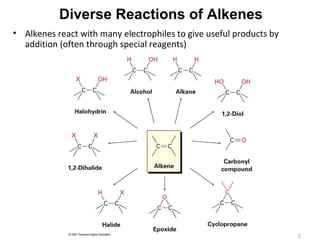
Diverse Reactions of Alkenes
• Alkenes react with many electrophiles to give useful products by
addition (often through special reagents)
2
Preparation of Alkenes: A Preview of
Elimination Reactions
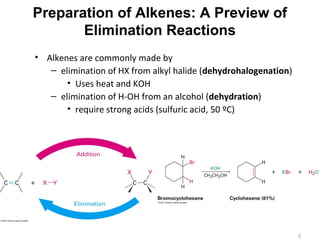
• Alkenes are commonly made by
– elimination of HX from alkyl halide (dehydrohalogenation)
• Uses heat and KOH
– elimination of H-OH from an alcohol (dehydration)
• require strong acids (sulfuric acid, 50 ºC)
3
Addition of Halogens to Alkenes
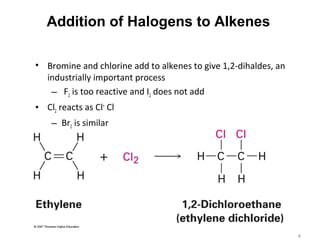
• Bromine and chlorine add to alkenes to give 1,2-dihaldes, an
industrially important process
– F2 is too reactive and I2 does not add
• Cl2 reacts as Cl+
Cl-
– Br2 is similar
4
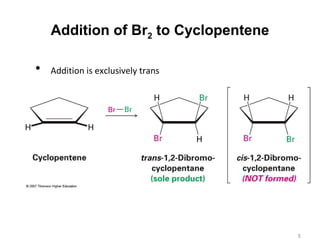
Addition of Br2 to Cyclopentene
• Addition is exclusively trans
5
Mechanism of Bromine Addition
• Br+
adds to an alkene producing a cyclic ion
• Bromonium ion, bromine shares charge with carbon
– Gives trans addition
6
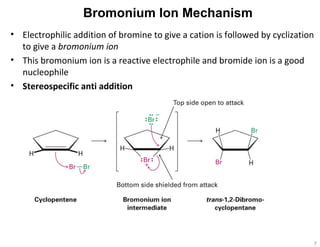
Bromonium Ion Mechanism
• Electrophilic addition of bromine to give a cation is followed by cyclization
to give a bromonium ion
• This bromonium ion is a reactive electrophile and bromide ion is a good
nucleophile
• Stereospecific anti addition
7
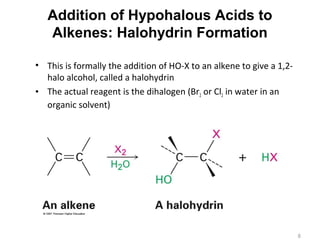
Addition of Hypohalous Acids to
Alkenes: Halohydrin Formation
• This is formally the addition of HO-X to an alkene to give a 1,2-
halo alcohol, called a halohydrin
• The actual reagent is the dihalogen (Br2 or Cl2 in water in an
organic solvent)
8
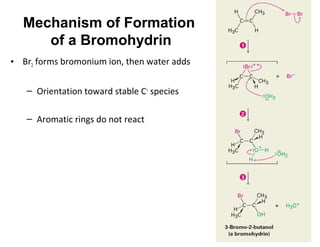
Mechanism of Formation
of a Bromohydrin
• Br2 forms bromonium ion, then water adds
– Orientation toward stable C+
species
– Aromatic rings do not react
9
Addition of Water to Alkenes:
Oxymercuration
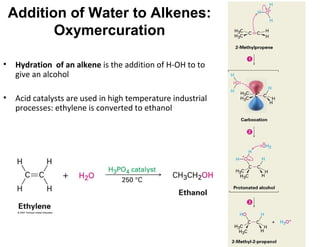
• Hydration of an alkene is the addition of H-OH to to
give an alcohol
• Acid catalysts are used in high temperature industrial
processes: ethylene is converted to ethanol
10
Oxymercuration Intermediates
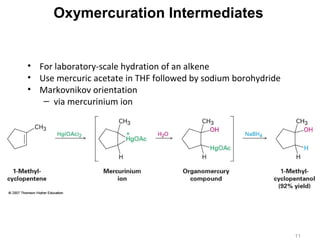
• For laboratory-scale hydration of an alkene
• Use mercuric acetate in THF followed by sodium borohydride
• Markovnikov orientation
– via mercurinium ion
11
Reduction of Alkenes: Hydrogenation
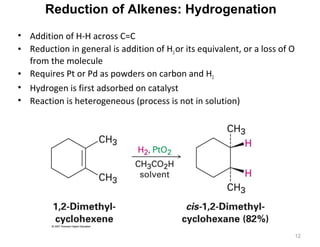
• Addition of H-H across C=C
• Reduction in general is addition of H2or its equivalent, or a loss of O
from the molecule
• Requires Pt or Pd as powders on carbon and H2
• Hydrogen is first adsorbed on catalyst
• Reaction is heterogeneous (process is not in solution)
12
Catalytic
Hydrogenation
Mechanism
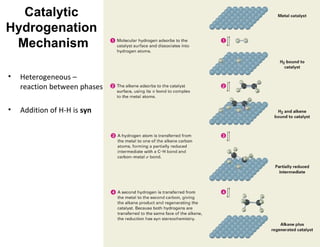
• Heterogeneous –
reaction between phases
• Addition of H-H is syn
13
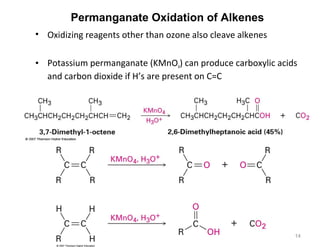
Permanganate Oxidation of Alkenes
• Oxidizing reagents other than ozone also cleave alkenes
• Potassium permanganate (KMnO4) can produce carboxylic acids
and carbon dioxide if H’s are present on C=C
14
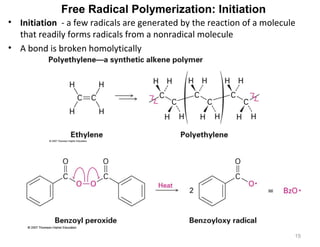
Free Radical Polymerization: Initiation
• Initiation - a few radicals are generated by the reaction of a molecule
that readily forms radicals from a nonradical molecule
• A bond is broken homolytically
15
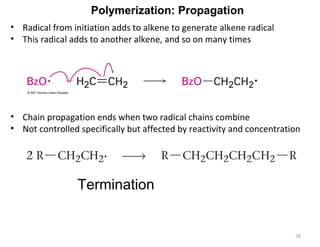
Polymerization: Propagation
• Radical from initiation adds to alkene to generate alkene radical
• This radical adds to another alkene, and so on many times
• Chain propagation ends when two radical chains combine
• Not controlled specifically but affected by reactivity and concentration
16
Termination
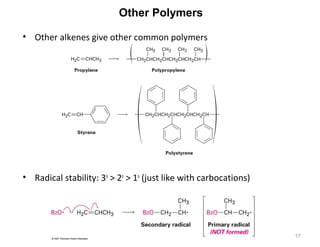
Other Polymers
• Other alkenes give other common polymers
• Radical stability: 3o
> 2o
> 1o
(just like with carbocations)
17

Alkenes: Reactions and Synthesis

  • 1.
    Alkenes: Reactions and Synthesis Md.Saiful Islam Dept. of Pharmaceutical Sciences North South University Facebook Group: Pharmacy Universe Md. Saiful Islam Dept. of Pharmaceutical Sciences North South University Facebook Group: Pharmacy Universe
  • 2.
    Diverse Reactions ofAlkenes • Alkenes react with many electrophiles to give useful products by addition (often through special reagents) 2
  • 3.
    Preparation of Alkenes:A Preview of Elimination Reactions • Alkenes are commonly made by – elimination of HX from alkyl halide (dehydrohalogenation) • Uses heat and KOH – elimination of H-OH from an alcohol (dehydration) • require strong acids (sulfuric acid, 50 ºC) 3
  • 4.
    Addition of Halogensto Alkenes • Bromine and chlorine add to alkenes to give 1,2-dihaldes, an industrially important process – F2 is too reactive and I2 does not add • Cl2 reacts as Cl+ Cl- – Br2 is similar 4
  • 5.
    Addition of Br2to Cyclopentene • Addition is exclusively trans 5
  • 6.
    Mechanism of BromineAddition • Br+ adds to an alkene producing a cyclic ion • Bromonium ion, bromine shares charge with carbon – Gives trans addition 6
  • 7.
    Bromonium Ion Mechanism •Electrophilic addition of bromine to give a cation is followed by cyclization to give a bromonium ion • This bromonium ion is a reactive electrophile and bromide ion is a good nucleophile • Stereospecific anti addition 7
  • 8.
    Addition of HypohalousAcids to Alkenes: Halohydrin Formation • This is formally the addition of HO-X to an alkene to give a 1,2- halo alcohol, called a halohydrin • The actual reagent is the dihalogen (Br2 or Cl2 in water in an organic solvent) 8
  • 9.
    Mechanism of Formation ofa Bromohydrin • Br2 forms bromonium ion, then water adds – Orientation toward stable C+ species – Aromatic rings do not react 9
  • 10.
    Addition of Waterto Alkenes: Oxymercuration • Hydration of an alkene is the addition of H-OH to to give an alcohol • Acid catalysts are used in high temperature industrial processes: ethylene is converted to ethanol 10
  • 11.
    Oxymercuration Intermediates • Forlaboratory-scale hydration of an alkene • Use mercuric acetate in THF followed by sodium borohydride • Markovnikov orientation – via mercurinium ion 11
  • 12.
    Reduction of Alkenes:Hydrogenation • Addition of H-H across C=C • Reduction in general is addition of H2or its equivalent, or a loss of O from the molecule • Requires Pt or Pd as powders on carbon and H2 • Hydrogen is first adsorbed on catalyst • Reaction is heterogeneous (process is not in solution) 12
  • 13.
    Catalytic Hydrogenation Mechanism • Heterogeneous – reactionbetween phases • Addition of H-H is syn 13
  • 14.
    Permanganate Oxidation ofAlkenes • Oxidizing reagents other than ozone also cleave alkenes • Potassium permanganate (KMnO4) can produce carboxylic acids and carbon dioxide if H’s are present on C=C 14
  • 15.
    Free Radical Polymerization:Initiation • Initiation - a few radicals are generated by the reaction of a molecule that readily forms radicals from a nonradical molecule • A bond is broken homolytically 15
  • 16.
    Polymerization: Propagation • Radicalfrom initiation adds to alkene to generate alkene radical • This radical adds to another alkene, and so on many times • Chain propagation ends when two radical chains combine • Not controlled specifically but affected by reactivity and concentration 16 Termination
  • 17.
    Other Polymers • Otheralkenes give other common polymers • Radical stability: 3o > 2o > 1o (just like with carbocations) 17