Renal Pharmacology ( Diuretics)
Md. Saiful Islam
B.Pharm, M.Pharm (PCP)
North South University
Join Facebook : Pharmacy Universe
BIMM118
Renal
Pharmacology
Diuretics:
• Carbonic Anhydrase Inhibitors
• Thiazides
• Loop Diuretics
• Potassium-sparing Diuretics
BIMM118
Renal
Pharmacology
Kidneys:
• Represent 0.5% of total body weight, but
receive ~25% of the total arterial blood
pumped by the heart
• Each contains from one to two million
nephrons:
– The glomerulus
– The proximal convoluted tubule
– The loop of Henle
– The distal convoluted tubule
BIMM118
Renal
Pharmacology
Functions
• Clean extracellular fluid and maintain ECF volume
and composition
• Acid-base balance
• Excretion of wastes and toxic substances
• Renal processes
• Filtration - glomerulus
• Reabsorption
• Tubular secretion
In 24 hours the kidneys reclaim:
– ~ 1,300 g of NaCl
– ~ 400 g NaHCO3
– ~ 180 g glucose
– almost all of the 180 L of water that entered the tubules
BIMM118
Renal Pharmacology
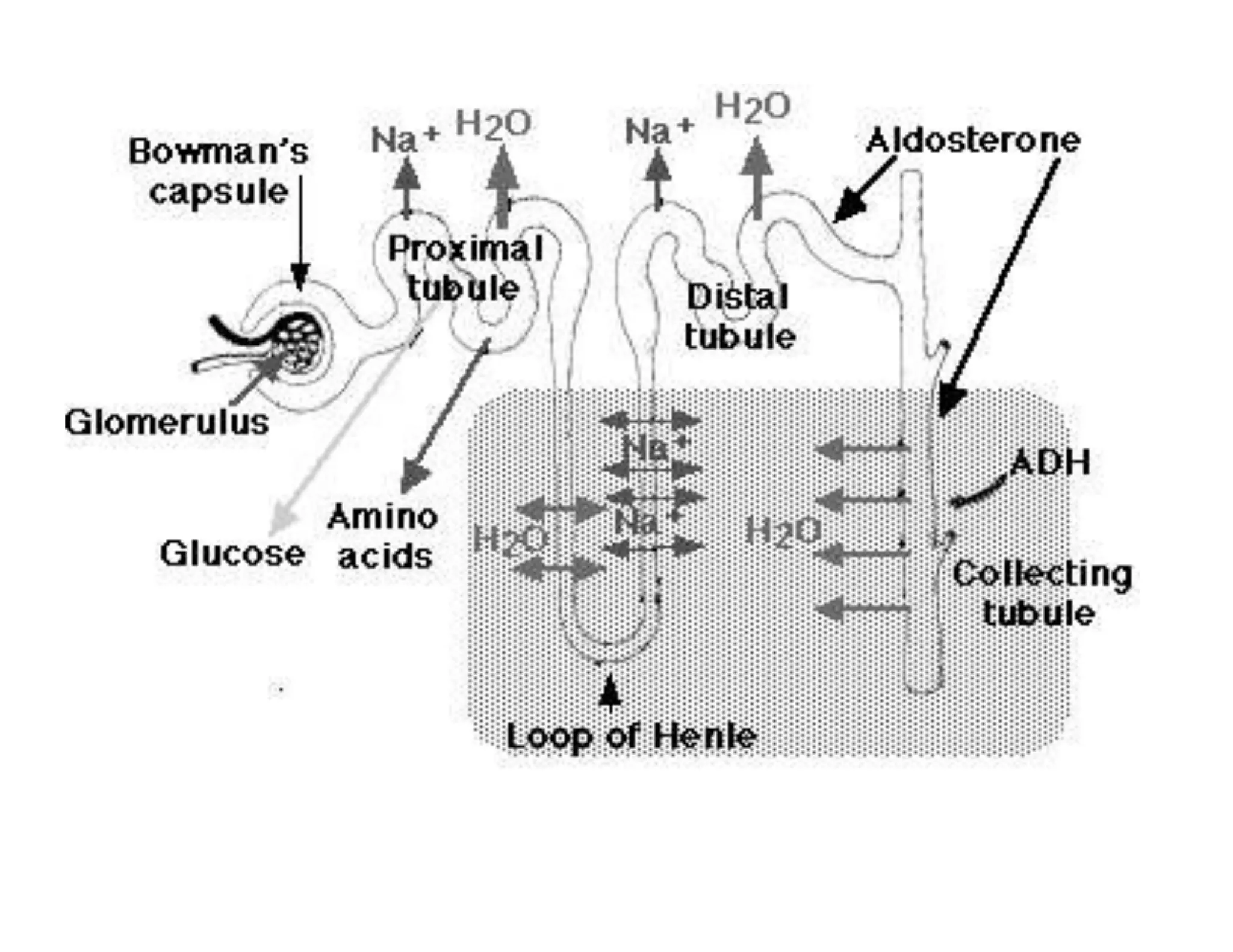
• Blood enters the glomerulus under pressure
• This causes water, small molecules (but not
macromolecules like proteins) and ions to filter through the
capillary walls into the Bowman's capsule
• This fluid is called nephric filtrate
– Not much different from interstitial fluid
• Nephric filtrate collects within the Bowman's capsule and
flows into the proximal tubule:
• Here all of the glucose and amino acids, >90% of the
uric acid, and ~60% of inorganic salts are reabsorbed by active transport
– The active transport of Na+ out of the proximal tubule is controlled by angiotensin II.
– The active transport of phosphate (PO4)3- is regulated (suppressed by) the parathyroid hormone.
• As these solutes are removed from the nephric filtrate, a large volume of the
water follows them by osmosis:
– 80–85% of the 180 liters deposited in the Bowman's capsules in 24 hours
• As the fluid flows into the descending segment of the loop of Henle, water
continues to leave by osmosis because the interstitial fluid is very hypertonic:
– This is caused by the active transport of Na+ out of the tubular fluid as it moves up the
ascending segment of the loop of Henle
• In the distal tubules, more sodium is reclaimed by active transport, and still more
water follows by osmosis.
BIMM118
Renal Pharmacology
Diuretics:
• Increase output of urine
• Primary indications are hypertension and mobilization of
edematous fluid (e.g. kidney problems, heart failure,
cirrhosis,…)
Basic mechanism:
• Block reabsorption of sodium and chloride => water will
also stay in the nephron
• Diuretics that work on the earlier nephron have greatest
effect, since they are able to block more sodium and
chloride reabsorption
BIMM118
Renal Pharmacology
Diuretics:
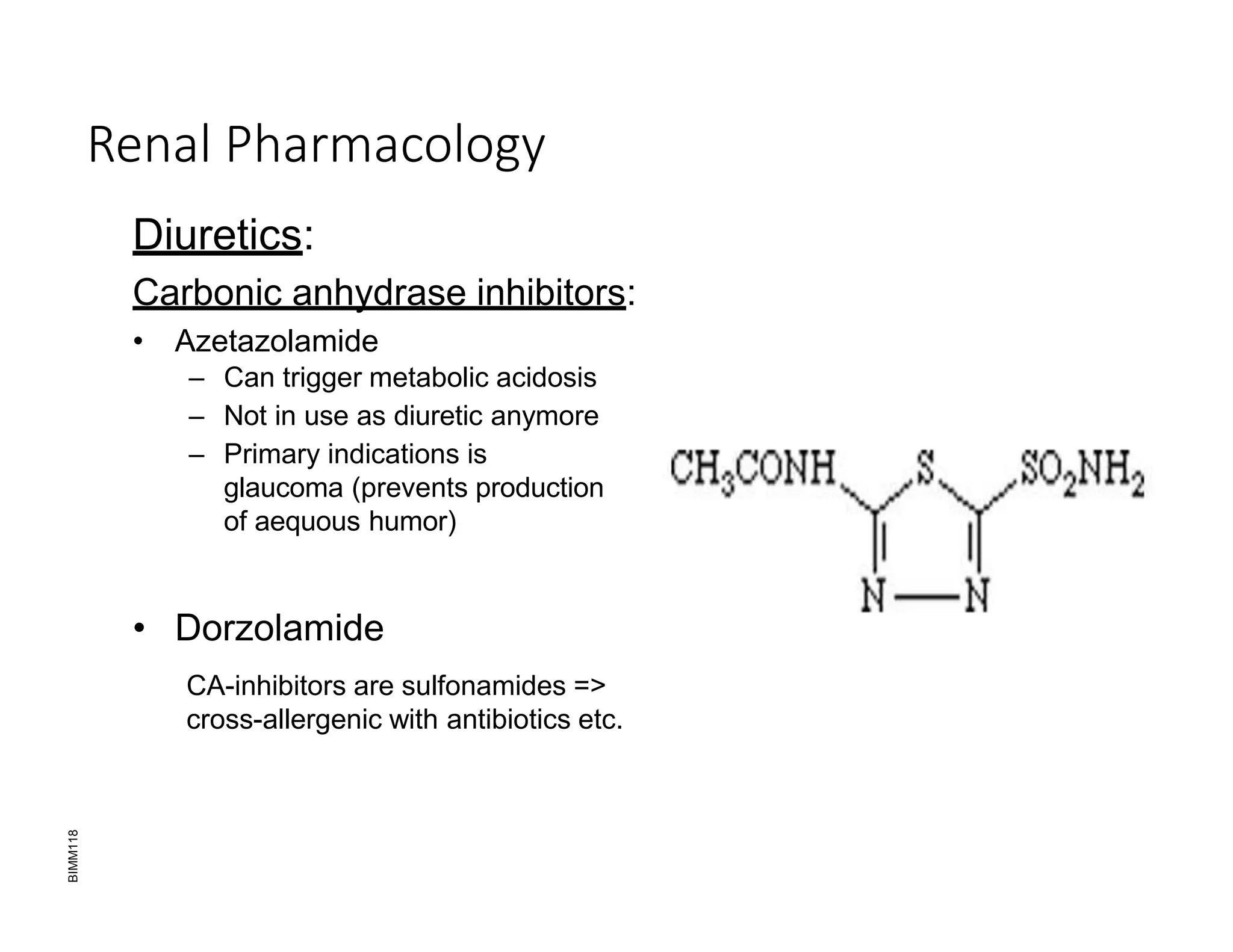
Carbonic anhydrase inhibitors:
• Azetazolamide
– Can trigger metabolic acidosis
– Not in use as diuretic anymore
– Primary indications is
glaucoma (prevents production
of aequous humor)
• Dorzolamide
CA-inhibitors are sulfonamides =>
cross-allergenic with antibiotics etc.
BIMM118
Renal Pharmacology
Diuretics:
Loop diuretics (= high ceiling diuretics):
– Strong, but brief diuresis (within 1 hr, lasts ~ 4hrs)
– Used for moderate to severe fluid retention and hypertension
– Most potent diuretics available
– Act by inhibiting the Na+/K+/2Cl- symporter in the ascending limb
in the loop of Henle
– Major side effects: loss of K+ (and Ca++ and Mg++)
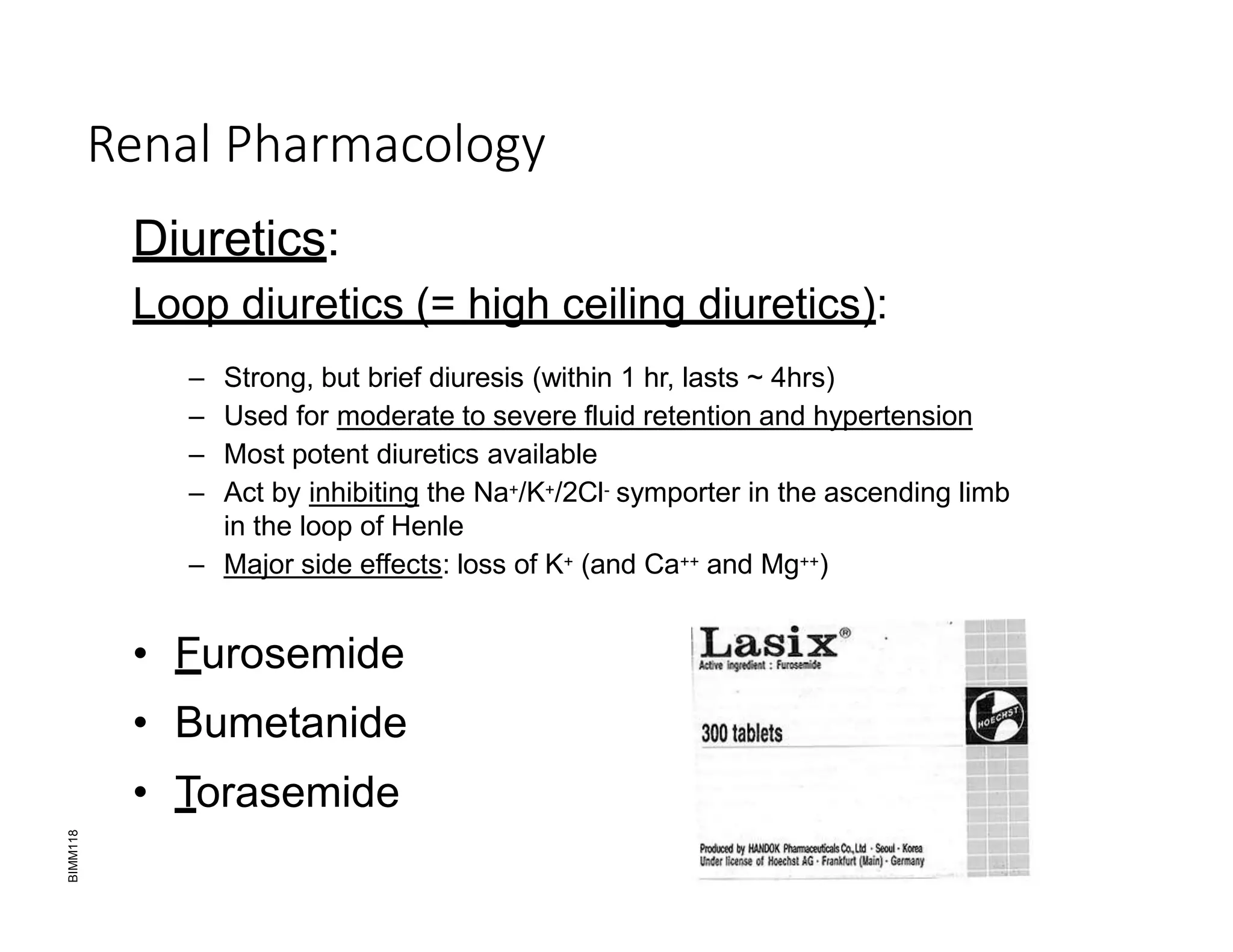
• Furosemide
• Bumetanide
• Torasemide
BIMM118
Renal Pharmacology
Diuretics:
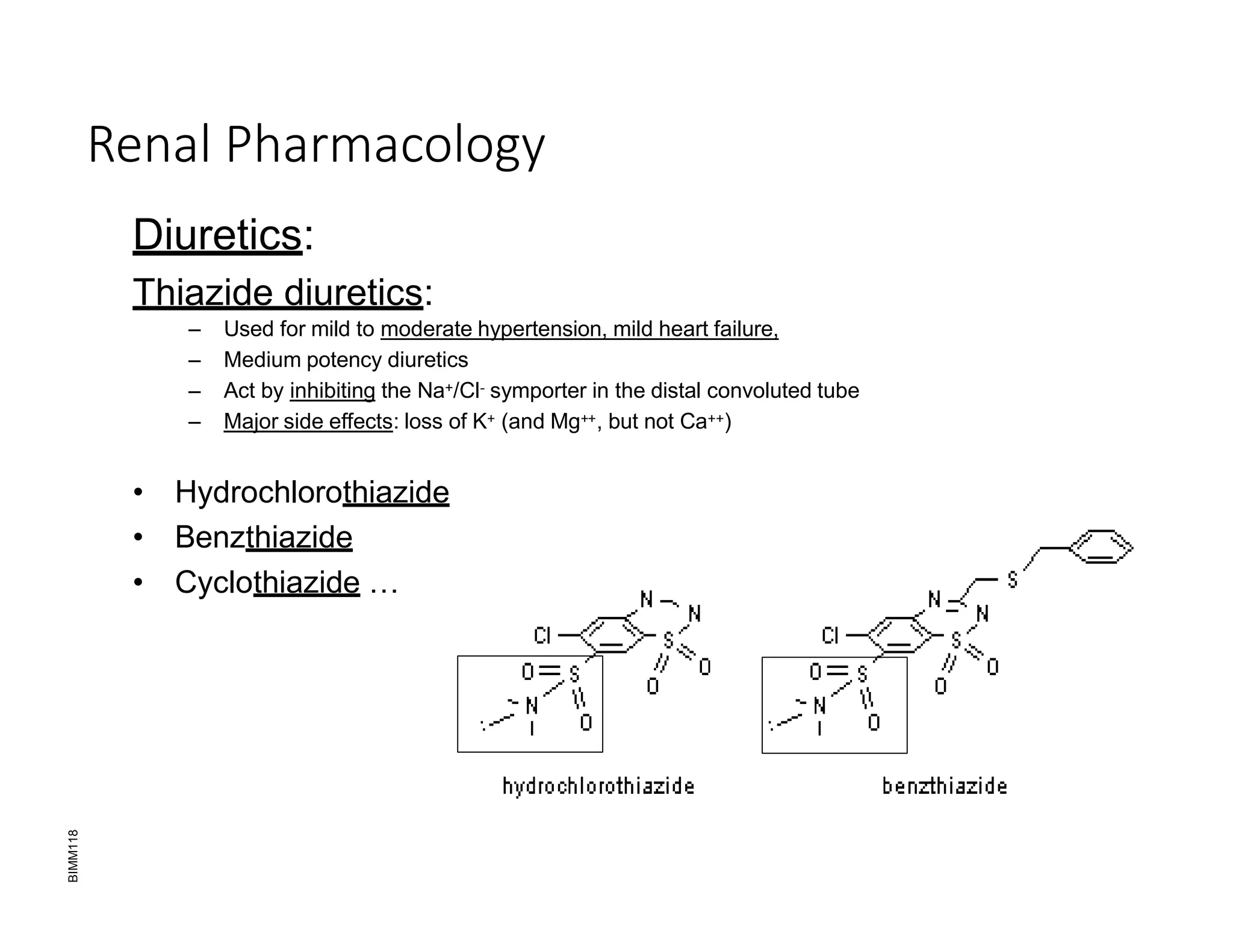
Thiazide diuretics:
– Used for mild to moderate hypertension, mild heart failure,
– Medium potency diuretics
– Act by inhibiting the Na+/Cl- symporter in the distal convoluted tube
– Major side effects: loss of K+ (and Mg++, but not Ca++)
• Hydrochlorothiazide
• Benzthiazide
• Cyclothiazide …
BIMM118
Renal Pharmacology
Major side effects of these diuretics:
• Hypokalemia, hyponatremia, hypochloremia
• Hypotension and dehydration
• Interaction with Cardiac Glycosides
=> Potassium can be given orally or IV
or
Potassium-sparing diuretics:
• Often used in combination with high-ceiling diuretics or
thiazides due to potassium-sparing effects
• Produce little diuresis on their own
BIMM118
Renal Pharmacology
Diuretics:
Potassium-sparing diuretics:
– Act on the distal portion of the distal tube (where Na+ is exchanged for K+)
– Aldosterone promotes reabsorption of Na+ in exchange for K+
(transcriptionally upregulates the Na+/K+ pump and sodium channels)
• Spironolactone
– Aldosterone receptor antagonist
– Onset of action requires several days
• Amiloride; Trimterene
– Block sodium channels
– Quick onset
Aldosterone Spironolactone
BIMM118
Renal Pharmacology
– Small, non-reabsorbable molecules that inhibit passive
reabsorption of water
– Predominantly increase water excretion without significantly
increasing Na+ excretion => limited use
– Used to prevent renal failure, reduction of intracranial pressure
• (does not cross blood-brain barrier => water is pulled out of the
brain into the blood)
• Mannitol
• – Only given IV – can crystallize (=> given with filter needle or in-line
filter)
Diuretics:
Osmotic diuretics:
BIMM118
Renal Pharmacology
BIMM118
Renal
Pharmacology
Uric acid
• only slightly soluble in water and easily precipitates out of solution forming needle-
like crystals of sodium urate
– sodium urate crystals contribute to the formation of kidney stones and
– produce the excruciating pain of gout when deposited in the joints.
• Curiously, our kidneys reclaim most of the uric acid filtered at the glomeruli. Why, if it
can cause problems?
– Uric acid is a potent antioxidant and thus can protect cells from damage by reactive oxygen
species (ROS).
– The concentration of uric acid is 100-times greater in the cytosol than in the extracellular
fluid. So when lethally-damaged cells release their contents, crystals of uric acid form in the
vicinity. These enhance the ability of nearby dendritic cells to "present" any antigens
released at the same time to T cells leading to a stronger immune response.
=> risk of kidney stones and gout may be the price we pay for these protections.
• Most mammals have an enzyme — uricase — for breaking down uric acid into a
soluble product. However, during the evolution of great apes and humans, the gene
encoding uricase became inactive.
– Uric acid is the chief nitrogenous waste of insects, lizards, snakes and birds
(the whitish material that birds leave on statues)
BIMM118
Renal Pharmacology
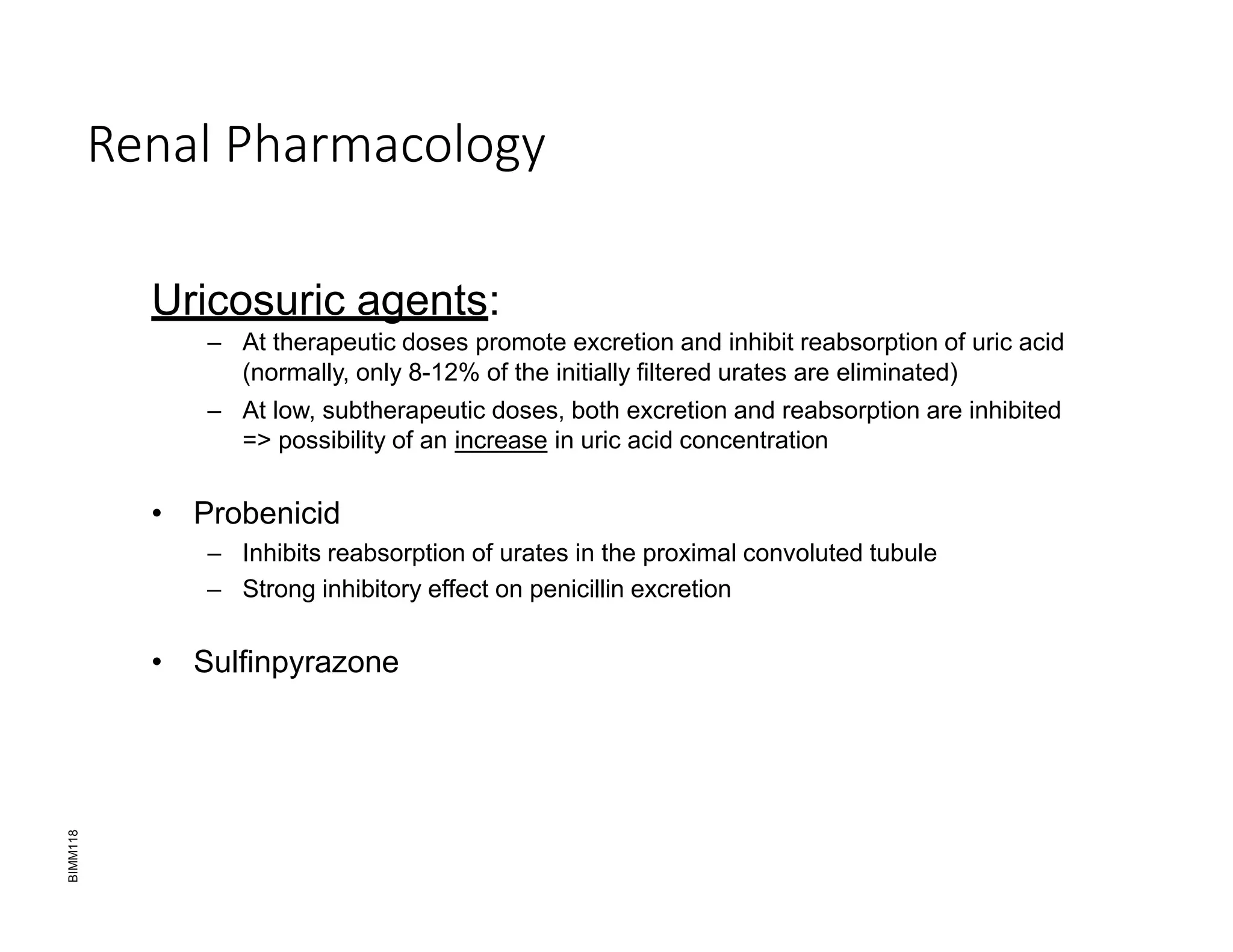
Uricosuric agents:
– At therapeutic doses promote excretion and inhibit reabsorption of uric acid
(normally, only 8-12% of the initially filtered urates are eliminated)
– At low, subtherapeutic doses, both excretion and reabsorption are inhibited
=> possibility of an increase in uric acid concentration
• Probenicid
– Inhibits reabsorption of urates in the proximal convoluted tubule
– Strong inhibitory effect on penicillin excretion
• Sulfinpyrazone

Renal Pharmacology ( Diuretics)

  • 1.
    Renal Pharmacology (Diuretics) Md. Saiful Islam B.Pharm, M.Pharm (PCP) North South University Join Facebook : Pharmacy Universe
  • 2.
    BIMM118 Renal Pharmacology Diuretics: • Carbonic AnhydraseInhibitors • Thiazides • Loop Diuretics • Potassium-sparing Diuretics
  • 3.
    BIMM118 Renal Pharmacology Kidneys: • Represent 0.5%of total body weight, but receive ~25% of the total arterial blood pumped by the heart • Each contains from one to two million nephrons: – The glomerulus – The proximal convoluted tubule – The loop of Henle – The distal convoluted tubule
  • 5.
    BIMM118 Renal Pharmacology Functions • Clean extracellularfluid and maintain ECF volume and composition • Acid-base balance • Excretion of wastes and toxic substances • Renal processes • Filtration - glomerulus • Reabsorption • Tubular secretion In 24 hours the kidneys reclaim: – ~ 1,300 g of NaCl – ~ 400 g NaHCO3 – ~ 180 g glucose – almost all of the 180 L of water that entered the tubules
  • 6.
    BIMM118 Renal Pharmacology • Bloodenters the glomerulus under pressure • This causes water, small molecules (but not macromolecules like proteins) and ions to filter through the capillary walls into the Bowman's capsule • This fluid is called nephric filtrate – Not much different from interstitial fluid • Nephric filtrate collects within the Bowman's capsule and flows into the proximal tubule: • Here all of the glucose and amino acids, >90% of the uric acid, and ~60% of inorganic salts are reabsorbed by active transport – The active transport of Na+ out of the proximal tubule is controlled by angiotensin II. – The active transport of phosphate (PO4)3- is regulated (suppressed by) the parathyroid hormone. • As these solutes are removed from the nephric filtrate, a large volume of the water follows them by osmosis: – 80–85% of the 180 liters deposited in the Bowman's capsules in 24 hours • As the fluid flows into the descending segment of the loop of Henle, water continues to leave by osmosis because the interstitial fluid is very hypertonic: – This is caused by the active transport of Na+ out of the tubular fluid as it moves up the ascending segment of the loop of Henle • In the distal tubules, more sodium is reclaimed by active transport, and still more water follows by osmosis.
  • 8.
    BIMM118 Renal Pharmacology Diuretics: • Increaseoutput of urine • Primary indications are hypertension and mobilization of edematous fluid (e.g. kidney problems, heart failure, cirrhosis,…) Basic mechanism: • Block reabsorption of sodium and chloride => water will also stay in the nephron • Diuretics that work on the earlier nephron have greatest effect, since they are able to block more sodium and chloride reabsorption
  • 9.
    BIMM118 Renal Pharmacology Diuretics: Carbonic anhydraseinhibitors: • Azetazolamide – Can trigger metabolic acidosis – Not in use as diuretic anymore – Primary indications is glaucoma (prevents production of aequous humor) • Dorzolamide CA-inhibitors are sulfonamides => cross-allergenic with antibiotics etc.
  • 11.
    BIMM118 Renal Pharmacology Diuretics: Loop diuretics(= high ceiling diuretics): – Strong, but brief diuresis (within 1 hr, lasts ~ 4hrs) – Used for moderate to severe fluid retention and hypertension – Most potent diuretics available – Act by inhibiting the Na+/K+/2Cl- symporter in the ascending limb in the loop of Henle – Major side effects: loss of K+ (and Ca++ and Mg++) • Furosemide • Bumetanide • Torasemide
  • 14.
    BIMM118 Renal Pharmacology Diuretics: Thiazide diuretics: –Used for mild to moderate hypertension, mild heart failure, – Medium potency diuretics – Act by inhibiting the Na+/Cl- symporter in the distal convoluted tube – Major side effects: loss of K+ (and Mg++, but not Ca++) • Hydrochlorothiazide • Benzthiazide • Cyclothiazide …
  • 16.
    BIMM118 Renal Pharmacology Major sideeffects of these diuretics: • Hypokalemia, hyponatremia, hypochloremia • Hypotension and dehydration • Interaction with Cardiac Glycosides => Potassium can be given orally or IV or Potassium-sparing diuretics: • Often used in combination with high-ceiling diuretics or thiazides due to potassium-sparing effects • Produce little diuresis on their own
  • 17.
    BIMM118 Renal Pharmacology Diuretics: Potassium-sparing diuretics: –Act on the distal portion of the distal tube (where Na+ is exchanged for K+) – Aldosterone promotes reabsorption of Na+ in exchange for K+ (transcriptionally upregulates the Na+/K+ pump and sodium channels) • Spironolactone – Aldosterone receptor antagonist – Onset of action requires several days • Amiloride; Trimterene – Block sodium channels – Quick onset Aldosterone Spironolactone
  • 19.
    BIMM118 Renal Pharmacology – Small,non-reabsorbable molecules that inhibit passive reabsorption of water – Predominantly increase water excretion without significantly increasing Na+ excretion => limited use – Used to prevent renal failure, reduction of intracranial pressure • (does not cross blood-brain barrier => water is pulled out of the brain into the blood) • Mannitol • – Only given IV – can crystallize (=> given with filter needle or in-line filter) Diuretics: Osmotic diuretics:
  • 20.
  • 21.
    BIMM118 Renal Pharmacology Uric acid • onlyslightly soluble in water and easily precipitates out of solution forming needle- like crystals of sodium urate – sodium urate crystals contribute to the formation of kidney stones and – produce the excruciating pain of gout when deposited in the joints. • Curiously, our kidneys reclaim most of the uric acid filtered at the glomeruli. Why, if it can cause problems? – Uric acid is a potent antioxidant and thus can protect cells from damage by reactive oxygen species (ROS). – The concentration of uric acid is 100-times greater in the cytosol than in the extracellular fluid. So when lethally-damaged cells release their contents, crystals of uric acid form in the vicinity. These enhance the ability of nearby dendritic cells to "present" any antigens released at the same time to T cells leading to a stronger immune response. => risk of kidney stones and gout may be the price we pay for these protections. • Most mammals have an enzyme — uricase — for breaking down uric acid into a soluble product. However, during the evolution of great apes and humans, the gene encoding uricase became inactive. – Uric acid is the chief nitrogenous waste of insects, lizards, snakes and birds (the whitish material that birds leave on statues)
  • 22.
    BIMM118 Renal Pharmacology Uricosuric agents: –At therapeutic doses promote excretion and inhibit reabsorption of uric acid (normally, only 8-12% of the initially filtered urates are eliminated) – At low, subtherapeutic doses, both excretion and reabsorption are inhibited => possibility of an increase in uric acid concentration • Probenicid – Inhibits reabsorption of urates in the proximal convoluted tubule – Strong inhibitory effect on penicillin excretion • Sulfinpyrazone