Chapter 10 – 13
Organic Chemistry
Alkanes, Alkenes, Alkynes & Benzene
Chemistry b11
Organic Compounds
Organic Compounds
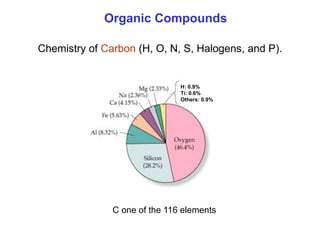
Chemistry of Carbon (H, O, N, S, Halogens, and P).
H: 0.9%
Ti: 0.6%
Others: 0.9%
C one of the 116 elements
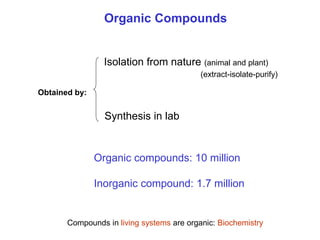
Obtained by:
Isolation from nature (animal and plant)
Synthesis in lab
Organic compounds: 10 million
Inorganic compound: 1.7 million
Compounds in living systems are organic: Biochemistry
Organic Compounds
(extract-isolate-purify)
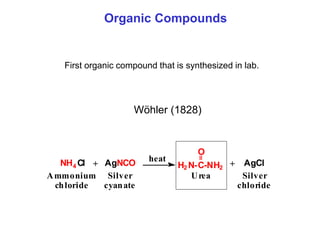
NH4 Cl AgNCO H2 N-C-NH2
O
AgCl
+
heat
+
Ammonium
chloride
Silver
cyanate
Urea Silver
chloride
Organic Compounds
First organic compound that is synthesized in lab.
Wöhler (1828)
Organic Compounds
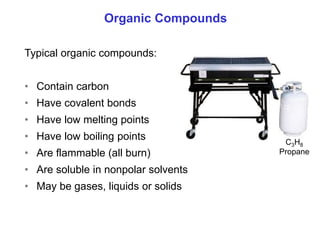
Typical organic compounds:
• Contain carbon
• Have covalent bonds
• Have low melting points
• Have low boiling points
• Are flammable (all burn)
• Are soluble in nonpolar solvents
• May be gases, liquids or solids
C3H8
Propane
Carbon
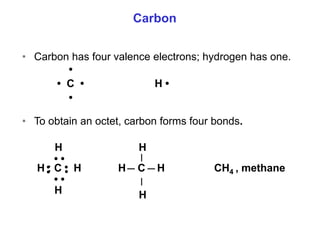
• Carbon has four valence electrons; hydrogen has one.
•
• C • H •
•
• To obtain an octet, carbon forms four bonds.
H H
• •
H  C  H H C H CH4 , methane
• •
H H
H
8
Classification of Hydrocarbons
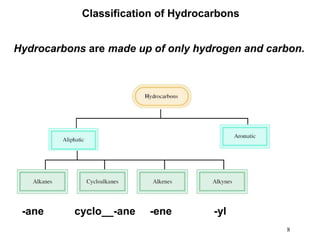
Hydrocarbons are made up of only hydrogen and carbon.
-ane cyclo__-ane -ene -yl
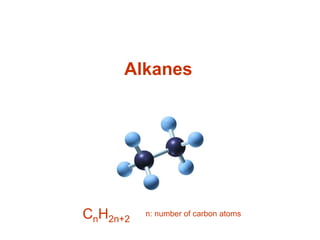
Alkanes
CnH2n+2
n: number of carbon atoms
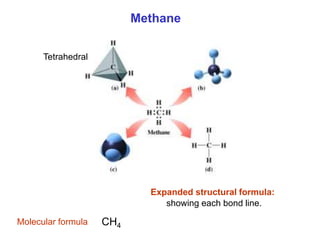
Methane
Tetrahedral
Expanded structural formula:
showing each bond line.
CH4
Molecular formula
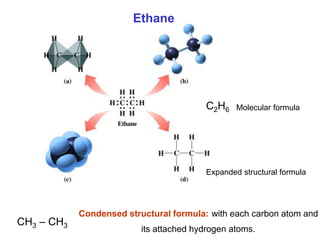
Ethane
C2H6 Molecular formula
Expanded structural formula
CH3 – CH3
Condensed structural formula: with each carbon atom and
its attached hydrogen atoms.
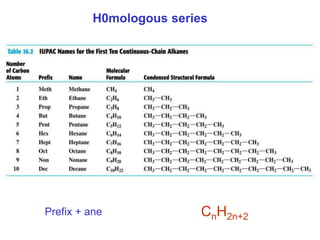
H0mologous series
CnH2n+2
Prefix + ane
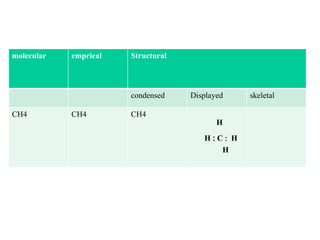
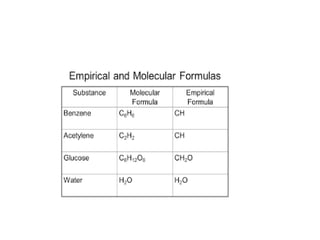
molecular emprical Structural
condensed Displayed skeletal
CH4 CH4 CH4
H
H  C  H
H
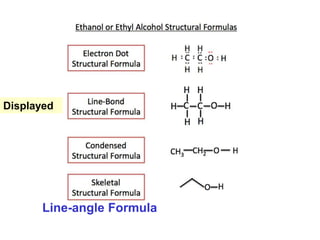
Displayed
Line-angle Formula
http://www.ivyroses.com/Chemistry/
Organic/How-to-draw-skeletal-
formulae-of-organic-molecules.php
skeletal
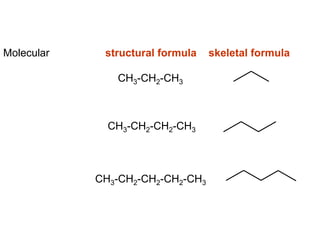
CH3-CH2-CH2-CH2-CH3
CH3-CH2-CH2-CH3
CH3-CH2-CH3
Molecular structural formula skeletal formula
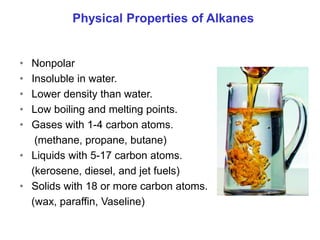
• Nonpolar
• Insoluble in water.
• Lower density than water.
• Low boiling and melting points.
• Gases with 1-4 carbon atoms.
(methane, propane, butane)
• Liquids with 5-17 carbon atoms.
(kerosene, diesel, and jet fuels)
• Solids with 18 or more carbon atoms.
(wax, paraffin, Vaseline)
Physical Properties of Alkanes
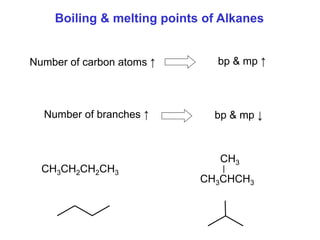
Boiling & melting points of Alkanes
Number of carbon atoms ↑ bp & mp ↑
Number of branches ↑ bp & mp ↓
CH3CH2CH2CH3
CH3CHCH3
CH3
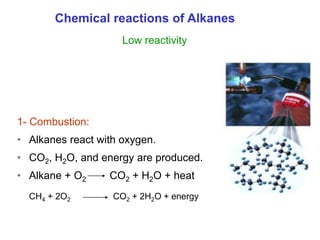
Chemical reactions of Alkanes
Low reactivity
1- Combustion:
• Alkanes react with oxygen.
• CO2, H2O, and energy are produced.
• Alkane + O2 CO2 + H2O + heat
CH4 + 2O2 CO2 + 2H2O + energy
Combustion
• Combustion means burning or
to burn.
• Combustion can be either
complete or incomplete
• Incomplete combustion can be
very dangerous!
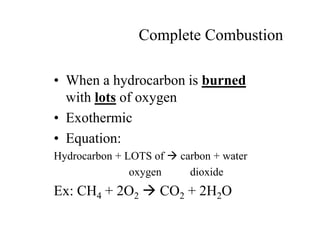
Complete Combustion
• When a hydrocarbon is burned
with lots of oxygen
• Exothermic
• Equation:
Hydrocarbon + LOTS of  carbon + water
oxygen dioxide
Ex: CH4 + 2O2  CO2 + 2H2O
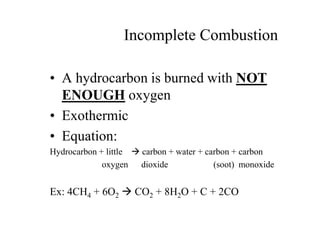
Incomplete Combustion
• A hydrocarbon is burned with NOT
ENOUGH oxygen
• Exothermic
• Equation:
Hydrocarbon + little  carbon + water + carbon + carbon
oxygen dioxide (soot) monoxide
Ex: 4CH4 + 6O2  CO2 + 8H2O + C + 2CO
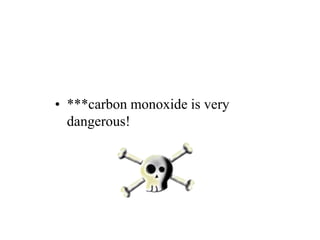
• ***carbon monoxide is very
dangerous!
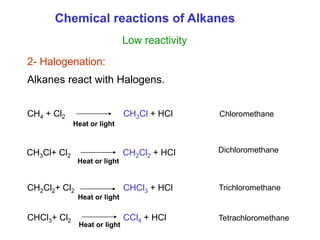
2- Halogenation:
Alkanes react with Halogens.
CH4 + Cl2 CH3Cl + HCl
Heat or light
Chemical reactions of Alkanes
Low reactivity
CH3Cl+ Cl2 CH2Cl2 + HCl
CH2Cl2+ Cl2 CHCl3 + HCl
CHCl3+ Cl2 CCl4 + HCl
Heat or light
Heat or light
Heat or light
Chloromethane
Dichloromethane
Trichloromethane
Tetrachloromethane
Chlorination and Bromination of
Alkanes
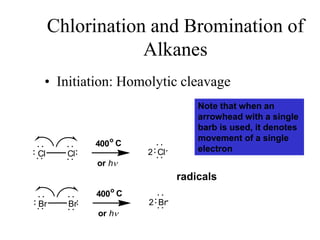
• Initiation: Homolytic cleavage
Cl Cl
400o
C
or h
2 Cl
Br Br
400o
C
or h
2 Br
radicals
Note that when an
arrowhead with a single
barb is used, it denotes
movement of a single
electron
Chlorination and Bromination of
Alkanes
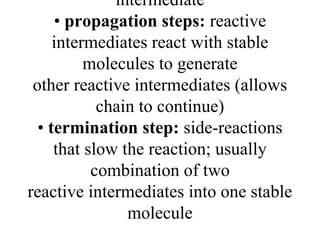
intermediate
• propagation steps: reactive
intermediates react with stable
molecules to generate
other reactive intermediates (allows
chain to continue)
• termination step: side-reactions
that slow the reaction; usually
combination of two
reactive intermediates into one stable
molecule
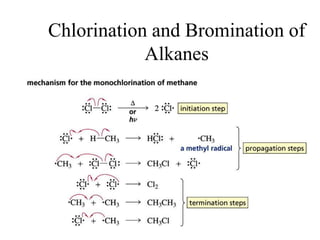
• Initiation Step: Cl2 absorbs energy and the
bond is homolytically cleaved.
• • The first-formed reactive intermediate is a
chlorine radical.
• reactive intermediate: short-lived species
that reacts quickly as it is formed
• radical: species with an unpaired electron
(usually just draw the unpaired electron)
• Propagation Steps: The Meat of the
Reaction
• a) Chlorine radical abstracts a hydrogen
from methane to form a methyl radical.
• b) Methyl radical abstracts a chlorine from
Cl2 to form product and another chlorine
radical
• Consumption of reactive intermediates
(radicals) without generation of new ones.
• • Termination steps slow down and
eventually stop the chain reaction.
• • Termination reactions become most
important at the end of a reaction, when
• there are very few reactant molecules left.
• Before we investigate the energetics
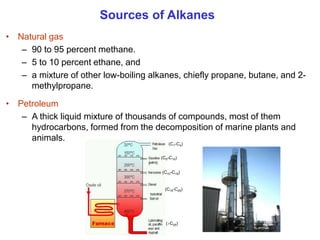
• Natural gas
– 90 to 95 percent methane.
– 5 to 10 percent ethane, and
– a mixture of other low-boiling alkanes, chiefly propane, butane, and 2-
methylpropane.
• Petroleum
– A thick liquid mixture of thousands of compounds, most of them
hydrocarbons, formed from the decomposition of marine plants and
animals.
Sources of Alkanes
(C5-C10)
(C10-C18)
(C1-C4)
(C15-C25)
(C25)
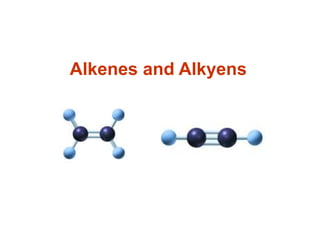
Alkenes and Alkyens
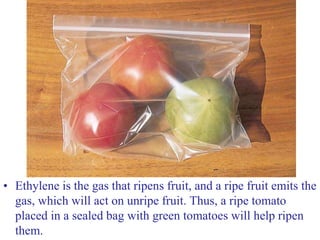
• Ethylene is the gas that ripens fruit, and a ripe fruit emits the
gas, which will act on unripe fruit. Thus, a ripe tomato
placed in a sealed bag with green tomatoes will help ripen
them.
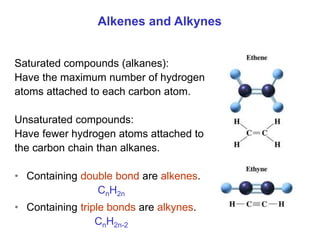
Saturated compounds (alkanes):
Have the maximum number of hydrogen
atoms attached to each carbon atom.
Unsaturated compounds:
Have fewer hydrogen atoms attached to
the carbon chain than alkanes.
• Containing double bond are alkenes.
CnH2n
• Containing triple bonds are alkynes.
CnH2n-2
Alkenes and Alkynes
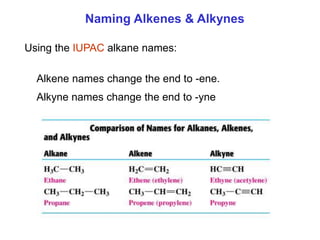
Using the IUPAC alkane names:
Alkene names change the end to -ene.
Alkyne names change the end to -yne
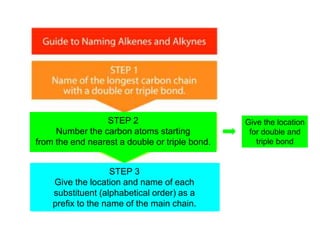
Naming Alkenes & Alkynes
Give the location
for double and
triple bond
STEP 3
Give the location and name of each
substituent (alphabetical order) as a
prefix to the name of the main chain.
STEP 2
Number the carbon atoms starting
from the end nearest a double or triple bond.
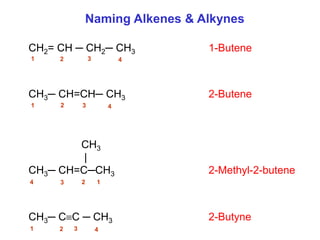
CH2= CH ─ CH2─ CH3 1-Butene
CH3─ CH=CH─ CH3 2-Butene
CH3
|
CH3─ CH=C─CH3 2-Methyl-2-butene
CH3─ CC ─ CH3 2-Butyne
Naming Alkenes & Alkynes
1 2 3 4
1 2 3 4
4 3 2 1
1 2 3 4
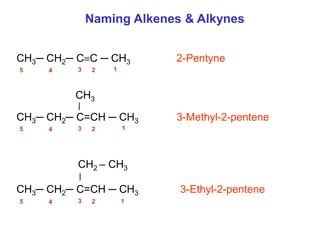
CH3─ CH2─ CC ─ CH3 2-Pentyne
CH3
CH3─ CH2─ C=CH ─ CH3 3-Methyl-2-pentene
CH2 – CH3
CH3─ CH2─ C=CH ─ CH3 3-Ethyl-2-pentene
Naming Alkenes & Alkynes
5 4 3 2 1
5 4 3 2 1
5 4 3 2 1
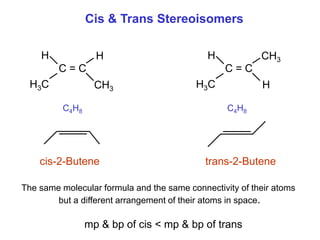
Cis & Trans Stereoisomers
C = C
H
H
CH3
H3C
C = C
H
H CH3
H3C
cis-2-Butene trans-2-Butene
The same molecular formula and the same connectivity of their atoms
but a different arrangement of their atoms in space.
mp & bp of cis < mp & bp of trans
C4H8 C4H8
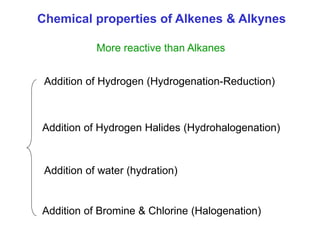
Chemical properties of Alkenes & Alkynes
More reactive than Alkanes
Addition of Hydrogen (Hydrogenation-Reduction)
Addition of Hydrogen Halides (Hydrohalogenation)
Addition of water (hydration)
Addition of Bromine & Chlorine (Halogenation)
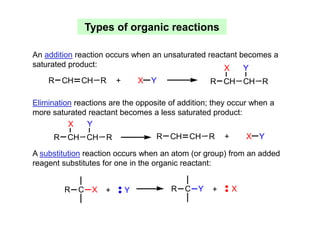
Types of organic reactions
An addition reaction occurs when an unsaturated reactant becomes a
saturated product:
Elimination reactions are the opposite of addition; they occur when a
more saturated reactant becomes a less saturated product:
R CH CH R + X Y R CH CH R
X Y
R CH CH R + X Y
R CH CH R
X Y
A substitution reaction occurs when an atom (or group) from an added
reagent substitutes for one in the organic reactant:
R C X + Y R C Y + X
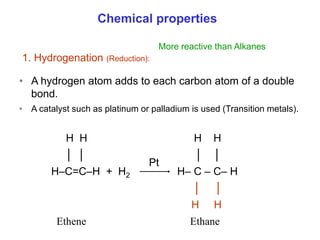
• A hydrogen atom adds to each carbon atom of a double
bond.
• A catalyst such as platinum or palladium is used (Transition metals).
H H H H
│ │ Pt │ │
H–C=C–H + H2 H– C – C– H
│ │
H H
Ethene Ethane
Chemical properties
1. Hydrogenation (Reduction):
Pt
More reactive than Alkanes
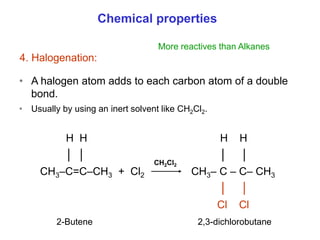
• A halogen atom adds to each carbon atom of a double
bond.
• Usually by using an inert solvent like CH2Cl2.
H H H H
│ │ │ │
CH3–C=C–CH3 + Cl2 CH3– C – C– CH3
│ │
Cl Cl
2-Butene 2,3-dichlorobutane
Chemical properties
4. Halogenation:
CH2Cl2
More reactives than Alkanes
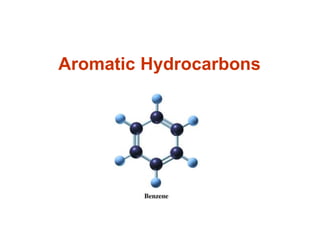
Aromatic Hydrocarbons
• A cyclic compound containing several degrees
of unsaturation (double bonds).
• Aromatic compounds have resonance hybrids
and thus are more stable than normal
unsaturated compounds. E.g. Cl2 does not
readily add to an aromatic double bond, but
reacts quite rapidly with normal unsaturated
compounds.
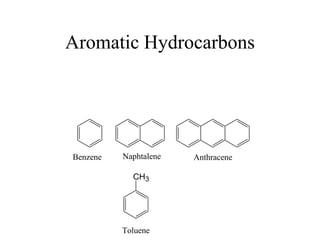
Aromatic Hydrocarbons
CH3
Benzene Naphtalene Anthracene
Toluene
Naming of Aromatic Compounds
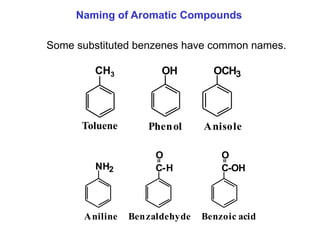
Some substituted benzenes have common names.
OCH3 C-OH
O
NH2
OH C-H
O
enol Aniline Benzoic acid
Anisole Benzaldehyde
OCH3 NH2
OH
Phenol Aniline
Anisole Ben
OCH3 NH2
OH C-H
O
Phenol Aniline
Anisole Benzaldehyde
CH3
Toluene
Naming of Aromatic Compounds
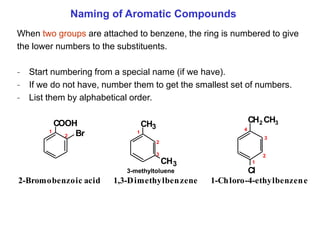
When two groups are attached to benzene, the ring is numbered to give
the lower numbers to the substituents.
- Start numbering from a special name (if we have).
- If we do not have, number them to get the smallest set of numbers.
- List them by alphabetical order.
Ortho Meta Para
COOH
Br
CH3
CH3
Cl
CH2 CH3
1
2-Bromobenzoic acid
(o-Bromobenzoic acid)
1,3-Dimethylbenzene
(m-Xylene)
1-Chloro-4-ethylbenzene
(p-Chloroethylbenzene)
1
2
2
2
3
3
4
1
3-methyltoluene
Naming of Aromatic Compounds
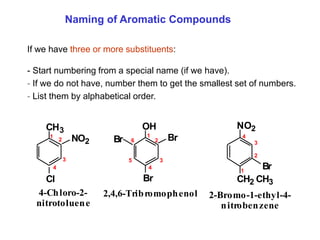
CH3
NO2
Cl
OH
Br
Br
Br
NO2
CH2 CH3
Br
4
3
2
1
5
6
4
3
2
1
4
3
1
2
4-Chloro-2-
nitrotoluene
2,4,6-Tribromophenol 2-Bromo-1-ethyl-4-
nitrobenzene
If we have three or more substituents:
- Start numbering from a special name (if we have).
- If we do not have, number them to get the smallest set of numbers.
- List them by alphabetical order.
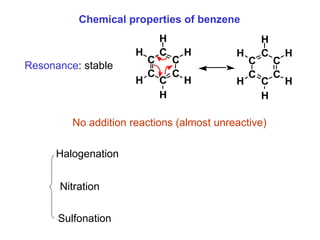
Chemical properties of benzene
Halogenation
Nitration
Sulfonation
Resonance: stable
C
C
C
C
C
C C
C
C
C
C
C
H
H
H
H
H
H H
H
H
H
H
H
No addition reactions (almost unreactive)
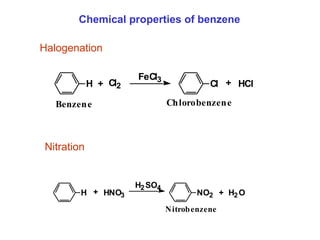
Chemical properties of benzene
Halogenation
H Cl2
FeCl3
Cl HCl
+ +
Chlorobenzene
Benzene
Nitration
H HNO3
H2SO4
NO2 H2O
+
+
Nitrobenzene

Alkanes, Alkenes, Alkynes & Benzeene.ppt

  • 1.
    Chapter 10 –13 Organic Chemistry Alkanes, Alkenes, Alkynes & Benzene Chemistry b11
  • 2.
  • 3.
    Organic Compounds Chemistry ofCarbon (H, O, N, S, Halogens, and P). H: 0.9% Ti: 0.6% Others: 0.9% C one of the 116 elements
  • 4.
    Obtained by: Isolation fromnature (animal and plant) Synthesis in lab Organic compounds: 10 million Inorganic compound: 1.7 million Compounds in living systems are organic: Biochemistry Organic Compounds (extract-isolate-purify)
  • 5.
    NH4 Cl AgNCOH2 N-C-NH2 O AgCl + heat + Ammonium chloride Silver cyanate Urea Silver chloride Organic Compounds First organic compound that is synthesized in lab. Wöhler (1828)
  • 6.
    Organic Compounds Typical organiccompounds: • Contain carbon • Have covalent bonds • Have low melting points • Have low boiling points • Are flammable (all burn) • Are soluble in nonpolar solvents • May be gases, liquids or solids C3H8 Propane
  • 7.
    Carbon • Carbon hasfour valence electrons; hydrogen has one. • • C • H • • • To obtain an octet, carbon forms four bonds. H H • • H  C  H H C H CH4 , methane • • H H H
  • 8.
    8 Classification of Hydrocarbons Hydrocarbonsare made up of only hydrogen and carbon. -ane cyclo__-ane -ene -yl
  • 9.
  • 10.
    Methane Tetrahedral Expanded structural formula: showingeach bond line. CH4 Molecular formula
  • 11.
    Ethane C2H6 Molecular formula Expandedstructural formula CH3 – CH3 Condensed structural formula: with each carbon atom and its attached hydrogen atoms.
  • 12.
  • 13.
    molecular emprical Structural condensedDisplayed skeletal CH4 CH4 CH4 H H  C  H H
  • 15.
  • 16.
  • 17.
  • 18.
    • Nonpolar • Insolublein water. • Lower density than water. • Low boiling and melting points. • Gases with 1-4 carbon atoms. (methane, propane, butane) • Liquids with 5-17 carbon atoms. (kerosene, diesel, and jet fuels) • Solids with 18 or more carbon atoms. (wax, paraffin, Vaseline) Physical Properties of Alkanes
  • 19.
    Boiling & meltingpoints of Alkanes Number of carbon atoms ↑ bp & mp ↑ Number of branches ↑ bp & mp ↓ CH3CH2CH2CH3 CH3CHCH3 CH3
  • 20.
    Chemical reactions ofAlkanes Low reactivity 1- Combustion: • Alkanes react with oxygen. • CO2, H2O, and energy are produced. • Alkane + O2 CO2 + H2O + heat CH4 + 2O2 CO2 + 2H2O + energy
  • 21.
    Combustion • Combustion meansburning or to burn. • Combustion can be either complete or incomplete • Incomplete combustion can be very dangerous!
  • 22.
    Complete Combustion • Whena hydrocarbon is burned with lots of oxygen • Exothermic • Equation: Hydrocarbon + LOTS of  carbon + water oxygen dioxide Ex: CH4 + 2O2  CO2 + 2H2O
  • 23.
    Incomplete Combustion • Ahydrocarbon is burned with NOT ENOUGH oxygen • Exothermic • Equation: Hydrocarbon + little  carbon + water + carbon + carbon oxygen dioxide (soot) monoxide Ex: 4CH4 + 6O2  CO2 + 8H2O + C + 2CO
  • 24.
    • ***carbon monoxideis very dangerous!
  • 25.
    2- Halogenation: Alkanes reactwith Halogens. CH4 + Cl2 CH3Cl + HCl Heat or light Chemical reactions of Alkanes Low reactivity CH3Cl+ Cl2 CH2Cl2 + HCl CH2Cl2+ Cl2 CHCl3 + HCl CHCl3+ Cl2 CCl4 + HCl Heat or light Heat or light Heat or light Chloromethane Dichloromethane Trichloromethane Tetrachloromethane
  • 26.
    Chlorination and Brominationof Alkanes • Initiation: Homolytic cleavage Cl Cl 400o C or h 2 Cl Br Br 400o C or h 2 Br radicals Note that when an arrowhead with a single barb is used, it denotes movement of a single electron
  • 27.
  • 28.
    intermediate • propagation steps:reactive intermediates react with stable molecules to generate other reactive intermediates (allows chain to continue) • termination step: side-reactions that slow the reaction; usually combination of two reactive intermediates into one stable molecule
  • 29.
    • Initiation Step:Cl2 absorbs energy and the bond is homolytically cleaved. • • The first-formed reactive intermediate is a chlorine radical. • reactive intermediate: short-lived species that reacts quickly as it is formed • radical: species with an unpaired electron (usually just draw the unpaired electron)
  • 30.
    • Propagation Steps:The Meat of the Reaction • a) Chlorine radical abstracts a hydrogen from methane to form a methyl radical. • b) Methyl radical abstracts a chlorine from Cl2 to form product and another chlorine radical
  • 31.
    • Consumption ofreactive intermediates (radicals) without generation of new ones. • • Termination steps slow down and eventually stop the chain reaction. • • Termination reactions become most important at the end of a reaction, when • there are very few reactant molecules left. • Before we investigate the energetics
  • 32.
    • Natural gas –90 to 95 percent methane. – 5 to 10 percent ethane, and – a mixture of other low-boiling alkanes, chiefly propane, butane, and 2- methylpropane. • Petroleum – A thick liquid mixture of thousands of compounds, most of them hydrocarbons, formed from the decomposition of marine plants and animals. Sources of Alkanes (C5-C10) (C10-C18) (C1-C4) (C15-C25) (C25)
  • 33.
  • 34.
    • Ethylene isthe gas that ripens fruit, and a ripe fruit emits the gas, which will act on unripe fruit. Thus, a ripe tomato placed in a sealed bag with green tomatoes will help ripen them.
  • 35.
    Saturated compounds (alkanes): Havethe maximum number of hydrogen atoms attached to each carbon atom. Unsaturated compounds: Have fewer hydrogen atoms attached to the carbon chain than alkanes. • Containing double bond are alkenes. CnH2n • Containing triple bonds are alkynes. CnH2n-2 Alkenes and Alkynes
  • 36.
    Using the IUPACalkane names: Alkene names change the end to -ene. Alkyne names change the end to -yne Naming Alkenes & Alkynes
  • 37.
    Give the location fordouble and triple bond STEP 3 Give the location and name of each substituent (alphabetical order) as a prefix to the name of the main chain. STEP 2 Number the carbon atoms starting from the end nearest a double or triple bond.
  • 38.
    CH2= CH ─CH2─ CH3 1-Butene CH3─ CH=CH─ CH3 2-Butene CH3 | CH3─ CH=C─CH3 2-Methyl-2-butene CH3─ CC ─ CH3 2-Butyne Naming Alkenes & Alkynes 1 2 3 4 1 2 3 4 4 3 2 1 1 2 3 4
  • 39.
    CH3─ CH2─ CC─ CH3 2-Pentyne CH3 CH3─ CH2─ C=CH ─ CH3 3-Methyl-2-pentene CH2 – CH3 CH3─ CH2─ C=CH ─ CH3 3-Ethyl-2-pentene Naming Alkenes & Alkynes 5 4 3 2 1 5 4 3 2 1 5 4 3 2 1
  • 40.
    Cis & TransStereoisomers C = C H H CH3 H3C C = C H H CH3 H3C cis-2-Butene trans-2-Butene The same molecular formula and the same connectivity of their atoms but a different arrangement of their atoms in space. mp & bp of cis < mp & bp of trans C4H8 C4H8
  • 41.
    Chemical properties ofAlkenes & Alkynes More reactive than Alkanes Addition of Hydrogen (Hydrogenation-Reduction) Addition of Hydrogen Halides (Hydrohalogenation) Addition of water (hydration) Addition of Bromine & Chlorine (Halogenation)
  • 42.
    Types of organicreactions An addition reaction occurs when an unsaturated reactant becomes a saturated product: Elimination reactions are the opposite of addition; they occur when a more saturated reactant becomes a less saturated product: R CH CH R + X Y R CH CH R X Y R CH CH R + X Y R CH CH R X Y A substitution reaction occurs when an atom (or group) from an added reagent substitutes for one in the organic reactant: R C X + Y R C Y + X
  • 43.
    • A hydrogenatom adds to each carbon atom of a double bond. • A catalyst such as platinum or palladium is used (Transition metals). H H H H │ │ Pt │ │ H–C=C–H + H2 H– C – C– H │ │ H H Ethene Ethane Chemical properties 1. Hydrogenation (Reduction): Pt More reactive than Alkanes
  • 44.
    • A halogenatom adds to each carbon atom of a double bond. • Usually by using an inert solvent like CH2Cl2. H H H H │ │ │ │ CH3–C=C–CH3 + Cl2 CH3– C – C– CH3 │ │ Cl Cl 2-Butene 2,3-dichlorobutane Chemical properties 4. Halogenation: CH2Cl2 More reactives than Alkanes
  • 45.
  • 46.
    • A cycliccompound containing several degrees of unsaturation (double bonds). • Aromatic compounds have resonance hybrids and thus are more stable than normal unsaturated compounds. E.g. Cl2 does not readily add to an aromatic double bond, but reacts quite rapidly with normal unsaturated compounds.
  • 47.
  • 48.
    Naming of AromaticCompounds Some substituted benzenes have common names. OCH3 C-OH O NH2 OH C-H O enol Aniline Benzoic acid Anisole Benzaldehyde OCH3 NH2 OH Phenol Aniline Anisole Ben OCH3 NH2 OH C-H O Phenol Aniline Anisole Benzaldehyde CH3 Toluene
  • 49.
    Naming of AromaticCompounds When two groups are attached to benzene, the ring is numbered to give the lower numbers to the substituents. - Start numbering from a special name (if we have). - If we do not have, number them to get the smallest set of numbers. - List them by alphabetical order. Ortho Meta Para COOH Br CH3 CH3 Cl CH2 CH3 1 2-Bromobenzoic acid (o-Bromobenzoic acid) 1,3-Dimethylbenzene (m-Xylene) 1-Chloro-4-ethylbenzene (p-Chloroethylbenzene) 1 2 2 2 3 3 4 1 3-methyltoluene
  • 50.
    Naming of AromaticCompounds CH3 NO2 Cl OH Br Br Br NO2 CH2 CH3 Br 4 3 2 1 5 6 4 3 2 1 4 3 1 2 4-Chloro-2- nitrotoluene 2,4,6-Tribromophenol 2-Bromo-1-ethyl-4- nitrobenzene If we have three or more substituents: - Start numbering from a special name (if we have). - If we do not have, number them to get the smallest set of numbers. - List them by alphabetical order.
  • 51.
    Chemical properties ofbenzene Halogenation Nitration Sulfonation Resonance: stable C C C C C C C C C C C C H H H H H H H H H H H H No addition reactions (almost unreactive)
  • 52.
    Chemical properties ofbenzene Halogenation H Cl2 FeCl3 Cl HCl + + Chlorobenzene Benzene Nitration H HNO3 H2SO4 NO2 H2O + + Nitrobenzene