CARBANION
DEPARTMENT OF PHARMACEUTICAL SCIENCES,
DR. H. S GOUR VISHWAVIDYALAYA, SAGAR, M.P
PRESENTED TO
Prof. Asmita Gajbhiye
PRESENTED BY
Mr. Sushanta Bhattacharya
M.Pharm (II Sem)
Contents
 INTRODUCTION
 DEVELOPMENT OF CARBANION CHEMISTRY
 CHARACTERISTICS OF CARBANIONS
 STABILIZATION OF CARBANIONS
 GENERATION OF CARBANIONS
 REACTIONS INVOLVING CARBANIONS AS NUCLEOPHILES
 REFERENCES
Introduction
Development Of Carbanion
Chemistry
Carbanion
Negatively charged Organic species in which carbon carries three
bond pairs and one lone pair, is known as cabanion.It is represented
as
Characteristics Of Carbanions
• Hybridisation and geometry : Alkyl carbanion has three bond pairs
and one lone pair. Thus hybridisation is sp3 and geometry is
pryamidal.
• There are eight electrons in the outermost orbit of carbanionic carbon hence
its octet is complete.
• It behaves as charged nucleophile.
• It is diamagnetic in character because all eight electrons are paired.
• It is formed by heterolytic bond fission.
• It reacts with electrophiles.
• A very important way of generating carbon nucleophiles
involves removal of a proton from a carbon by a base. The
anions produced are carbanions.
• The negative charge gives good nucleophilic properties and
it can be used in the formation of new carbon-carbon
bond.
• The C-C bonds of a molecule
under construction constitute its
scaffolding.
• Reactions which form new C-C
bonds are exceptionally useful
synthetically.
Stabilisation Of Carbanion
Conjugation Of Unshared Pair With An
Unsaturated Bond
• In cases where a double or triple bond is located α the
carbanionic C
• The ion is stabilized by resonance in which the unshared
pair overlaps with the ∏ electrons of the double bond
• This factor is responsible for the stability of the allylic and
benzylic types of carbanions
• Diphenylmethyl and triphenylmethyl anions are still more stable and can be
kept in solution indefinitely if water is rigidly excluded
• Carbanionic carbon is conjugated with a C–O or C–N multiple bond (Y=O or N),
the stability of the ion is greater than that of the triarylmethyl anions, since
these electronegative atoms are better capable of bearing a negative charge
than carbon.
Stabilization By >C=O Group Present On Carbanionic
Carbon
Carbanion Enolate ion
(I) (II)
Contribution of structure (II) will be more than (I) because in (II) negative
charge present on electronegative oxygen.
Carbanions Increase In Stability With An Increase In The
Amount Of S Character At The Carbanionic C
Stability directly proportional to electronegativity of carbanionic carbon
which is directly proportional to % s-character of carbanionic carbon
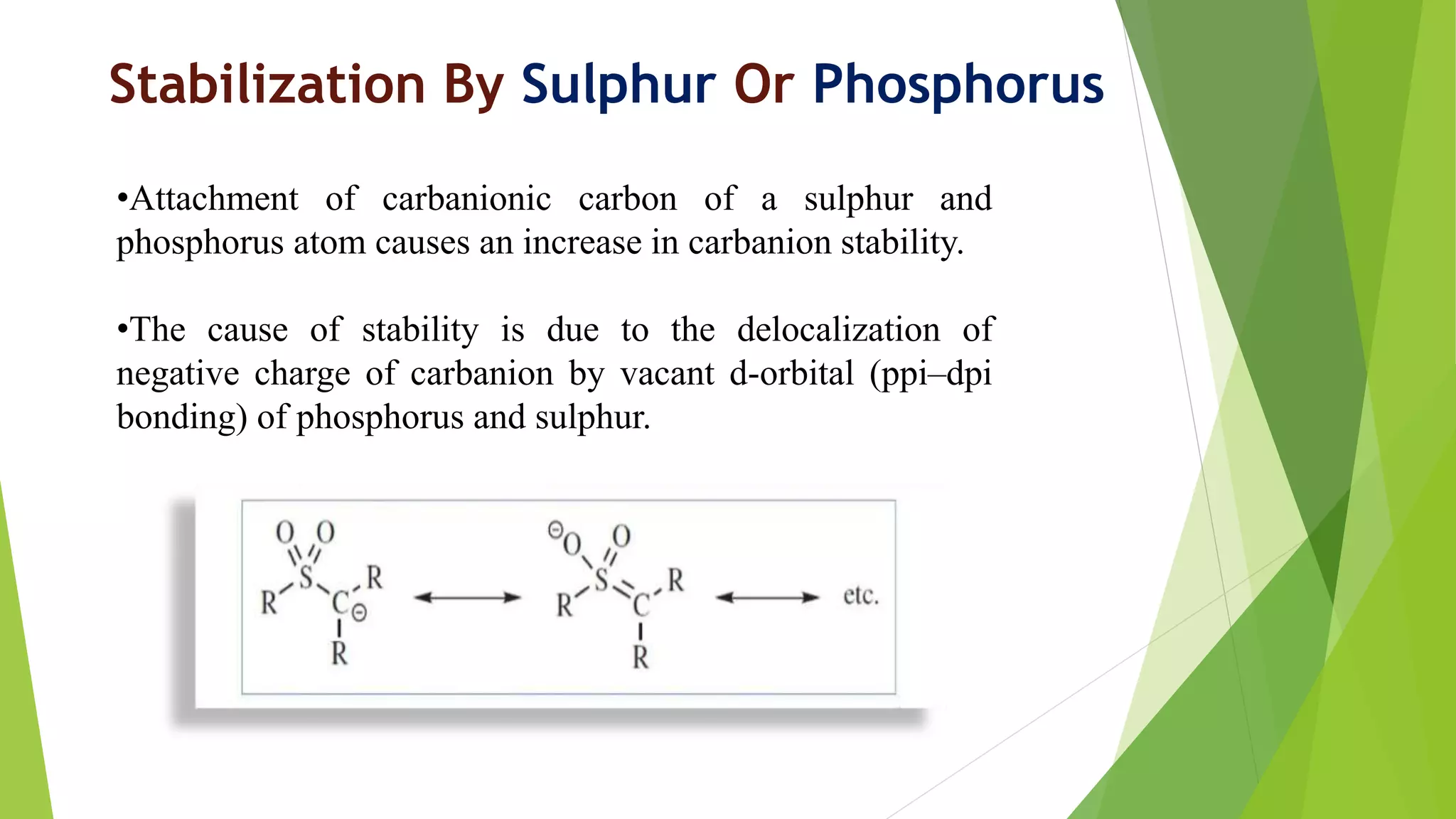
Stabilization By Sulphur Or Phosphorus
•Attachment of carbanionic carbon of a sulphur and
phosphorus atom causes an increase in carbanion stability.
•The cause of stability is due to the delocalization of
negative charge of carbanion by vacant d-orbital (ppi–dpi
bonding) of phosphorus and sulphur.
Field Effect
• Most of the groups that stabilize carbanions by resonance effects have electron-
withdrawing field effects and thereby stabilize the carbanion further by spreading
the negative charge.
• Nitrogen ylid, where a positive nitrogen is adjacent to the negatively charged
carbon, only the field effect operates.Ylids are more stable than the corresponding
simple carbanions.
• Carbanions are stabilized by a field effect if
there is any heteroatom (O, N, or S) connected to the carbanionic carbon,
provided that the heteroatom bears a positive charge in at least one important
canonical form.
Certain Carbanions Are Stable Because They
Are Aromatic
• Anions in which negative charge is present on carbon of aromatic system is
known as aromatic carbanions.
• Aromatic carbanions are most stable carbanions.
• Anions obeying Huckel rule are stable because they are aromatic and there is
complete delocalization of negative charge.
Stabilization By A Non-adjecent p Bond
Generation Of Carbanions
1. A group attached to a carbon leaves without its electron pair
2. A negative ion adds to a carbon–carbon double or triple bond
Reactions Involving Carbanions As
Nucleophiles
1. Alpha-halogenation of ketones
2. Nucleophilic addition to aldehydes/ketones
a) Aldol and Crossed aldol
b) Aldol related reactions
c) Grignard synthesis of alcohols
d) Wittig synthesis of alkenes
3. Nucleophilic acyl substitution with esters and acid chlorides
a) Claisen and crossed Claisen
b) R2CuLi + RCOCl
Cont.
4. SN2 with alkyl halides
a) Corey-House
b) metal acetylide
c) Malonate synthesis
d) Acetoacetate synthesis
5. Michael Addition to α,β-unsaturated carbonyl
compounds
Alpha-halogenation Of Ketones
 The enolate anion is a strong base and a good nucleophile
H3C
C
CH3
O
H3C
C
CH2
O
+ OH + H2O
R
C
CH2
O
R
C
CH2
O
"enolate" anion
Hydrogens that are alpha to a carbonyl are weakly
acidic due to resonance stabilization of the carbanion.
The enolate anion is a strong base and a good nucleophile
Mechanism for base promoted alpha-bromination
of acetone
H3C
C
CH3
O
H3C
C
CH2
O
+ OH + H2O
RDS
H3C
C
CH2
O
+ Br Br
H3C
C
CH2Br
O
+ Br
REFERENCES
• Smith M.B & March J,”MARCH’S ADVANCED ORGANIC CHEMISTRY”, Sixth edition,
John Wiley & Sons , New Delhi, 2007, 249-65.
• Morrison R.T, Boyd & Bhattacharjee S.K, “Organic Chemistry”, Seventh edition,
Dorling Kindersley(India) Pvt. Ltd., South Asia, 1992, 69-72.
• https://www.slideshare.net/shazi5250/carbanions-i-1
• https://slideplayer.com/slide/12672704/
Carbanion organic ppt

Carbanion organic ppt

  • 1.
    CARBANION DEPARTMENT OF PHARMACEUTICALSCIENCES, DR. H. S GOUR VISHWAVIDYALAYA, SAGAR, M.P PRESENTED TO Prof. Asmita Gajbhiye PRESENTED BY Mr. Sushanta Bhattacharya M.Pharm (II Sem)
  • 2.
    Contents  INTRODUCTION  DEVELOPMENTOF CARBANION CHEMISTRY  CHARACTERISTICS OF CARBANIONS  STABILIZATION OF CARBANIONS  GENERATION OF CARBANIONS  REACTIONS INVOLVING CARBANIONS AS NUCLEOPHILES  REFERENCES
  • 3.
  • 4.
  • 5.
    Carbanion Negatively charged Organicspecies in which carbon carries three bond pairs and one lone pair, is known as cabanion.It is represented as
  • 6.
    Characteristics Of Carbanions •Hybridisation and geometry : Alkyl carbanion has three bond pairs and one lone pair. Thus hybridisation is sp3 and geometry is pryamidal. • There are eight electrons in the outermost orbit of carbanionic carbon hence its octet is complete. • It behaves as charged nucleophile. • It is diamagnetic in character because all eight electrons are paired. • It is formed by heterolytic bond fission. • It reacts with electrophiles.
  • 7.
    • A veryimportant way of generating carbon nucleophiles involves removal of a proton from a carbon by a base. The anions produced are carbanions. • The negative charge gives good nucleophilic properties and it can be used in the formation of new carbon-carbon bond.
  • 8.
    • The C-Cbonds of a molecule under construction constitute its scaffolding. • Reactions which form new C-C bonds are exceptionally useful synthetically.
  • 9.
  • 10.
    Conjugation Of UnsharedPair With An Unsaturated Bond • In cases where a double or triple bond is located α the carbanionic C • The ion is stabilized by resonance in which the unshared pair overlaps with the ∏ electrons of the double bond • This factor is responsible for the stability of the allylic and benzylic types of carbanions
  • 11.
    • Diphenylmethyl andtriphenylmethyl anions are still more stable and can be kept in solution indefinitely if water is rigidly excluded • Carbanionic carbon is conjugated with a C–O or C–N multiple bond (Y=O or N), the stability of the ion is greater than that of the triarylmethyl anions, since these electronegative atoms are better capable of bearing a negative charge than carbon.
  • 12.
    Stabilization By >C=OGroup Present On Carbanionic Carbon Carbanion Enolate ion (I) (II) Contribution of structure (II) will be more than (I) because in (II) negative charge present on electronegative oxygen.
  • 13.
    Carbanions Increase InStability With An Increase In The Amount Of S Character At The Carbanionic C Stability directly proportional to electronegativity of carbanionic carbon which is directly proportional to % s-character of carbanionic carbon
  • 14.
    Stabilization By SulphurOr Phosphorus •Attachment of carbanionic carbon of a sulphur and phosphorus atom causes an increase in carbanion stability. •The cause of stability is due to the delocalization of negative charge of carbanion by vacant d-orbital (ppi–dpi bonding) of phosphorus and sulphur.
  • 15.
    Field Effect • Mostof the groups that stabilize carbanions by resonance effects have electron- withdrawing field effects and thereby stabilize the carbanion further by spreading the negative charge. • Nitrogen ylid, where a positive nitrogen is adjacent to the negatively charged carbon, only the field effect operates.Ylids are more stable than the corresponding simple carbanions. • Carbanions are stabilized by a field effect if there is any heteroatom (O, N, or S) connected to the carbanionic carbon, provided that the heteroatom bears a positive charge in at least one important canonical form.
  • 16.
    Certain Carbanions AreStable Because They Are Aromatic • Anions in which negative charge is present on carbon of aromatic system is known as aromatic carbanions. • Aromatic carbanions are most stable carbanions. • Anions obeying Huckel rule are stable because they are aromatic and there is complete delocalization of negative charge.
  • 17.
    Stabilization By ANon-adjecent p Bond
  • 18.
    Generation Of Carbanions 1.A group attached to a carbon leaves without its electron pair 2. A negative ion adds to a carbon–carbon double or triple bond
  • 19.
    Reactions Involving CarbanionsAs Nucleophiles 1. Alpha-halogenation of ketones 2. Nucleophilic addition to aldehydes/ketones a) Aldol and Crossed aldol b) Aldol related reactions c) Grignard synthesis of alcohols d) Wittig synthesis of alkenes 3. Nucleophilic acyl substitution with esters and acid chlorides a) Claisen and crossed Claisen b) R2CuLi + RCOCl
  • 20.
    Cont. 4. SN2 withalkyl halides a) Corey-House b) metal acetylide c) Malonate synthesis d) Acetoacetate synthesis 5. Michael Addition to α,β-unsaturated carbonyl compounds
  • 21.
  • 22.
     The enolateanion is a strong base and a good nucleophile H3C C CH3 O H3C C CH2 O + OH + H2O R C CH2 O R C CH2 O "enolate" anion Hydrogens that are alpha to a carbonyl are weakly acidic due to resonance stabilization of the carbanion. The enolate anion is a strong base and a good nucleophile
  • 23.
    Mechanism for basepromoted alpha-bromination of acetone H3C C CH3 O H3C C CH2 O + OH + H2O RDS H3C C CH2 O + Br Br H3C C CH2Br O + Br
  • 24.
    REFERENCES • Smith M.B& March J,”MARCH’S ADVANCED ORGANIC CHEMISTRY”, Sixth edition, John Wiley & Sons , New Delhi, 2007, 249-65. • Morrison R.T, Boyd & Bhattacharjee S.K, “Organic Chemistry”, Seventh edition, Dorling Kindersley(India) Pvt. Ltd., South Asia, 1992, 69-72. • https://www.slideshare.net/shazi5250/carbanions-i-1 • https://slideplayer.com/slide/12672704/