Pharmaceutical Microbiology
History
Md. Saiful Islam
BPharm, MPharm (PCP)
North South University
Fb Group: Pharmacy Universe
Louis Pasteur 1859 –
• used swan-necked flask
• flask allowed in air, but
trapped dust (and
microbes)
• boiled infusion
• showed that NO growth
occurred, even after many
days
(French chemist) entered a contest
sponsored by French Academy of Sciences
to prove or disprove Spontaneous
generation.
Microbiology – Vaccine
Edward Jenner is credited with first vaccine - in
epidemics of smallpox during the late 1700’s he
observed that milk maids didn’t get the disease, cattle
had a similar disease - cowpox, milk maids had cow
pox lesions, but not small pox, he purposefully took
scrapings from cowpox blister and scraped a 8 year
old volunteer. With the material - child got mild illness
but not small pox.
Vaccination comes from Latin word “vacca” meaning
cow. Jenner laid the foundation for Pasteur’s later
work with other vaccinations.
Jenner and vaccination
Microbiology – TMV
Iwanowski 1892 - Discovered that plant disease can be
caused by small organisms that were so small they
passed through filters , Tobacco mosaic virus (TMV) was
later identified as the cause
That’s the beginning of virology .
Microbiology – Aseptic Technique
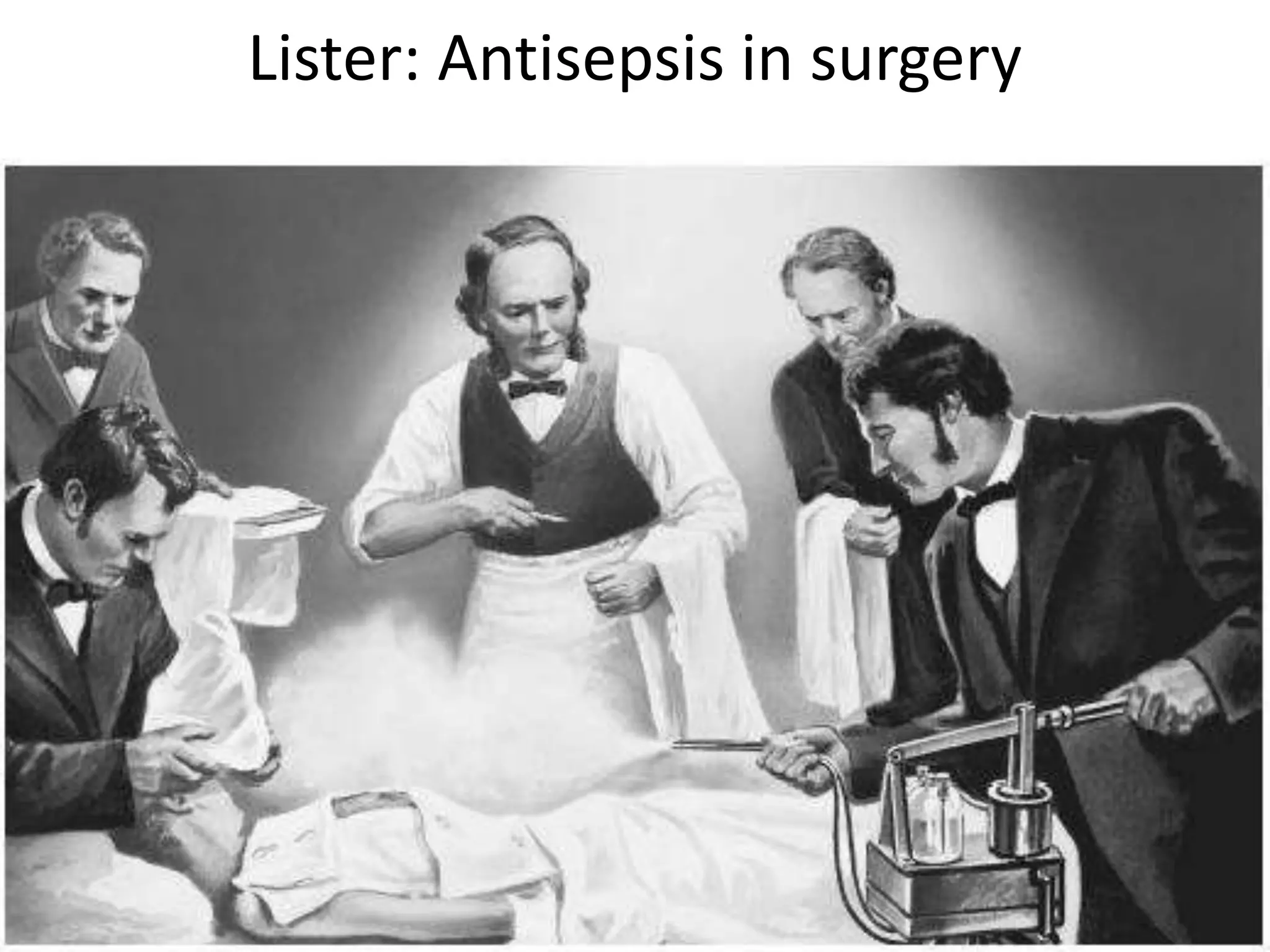
Joseph Lister – 1860’s, English surgeon that applied
ideas of the germ theory to surgery, remembered the
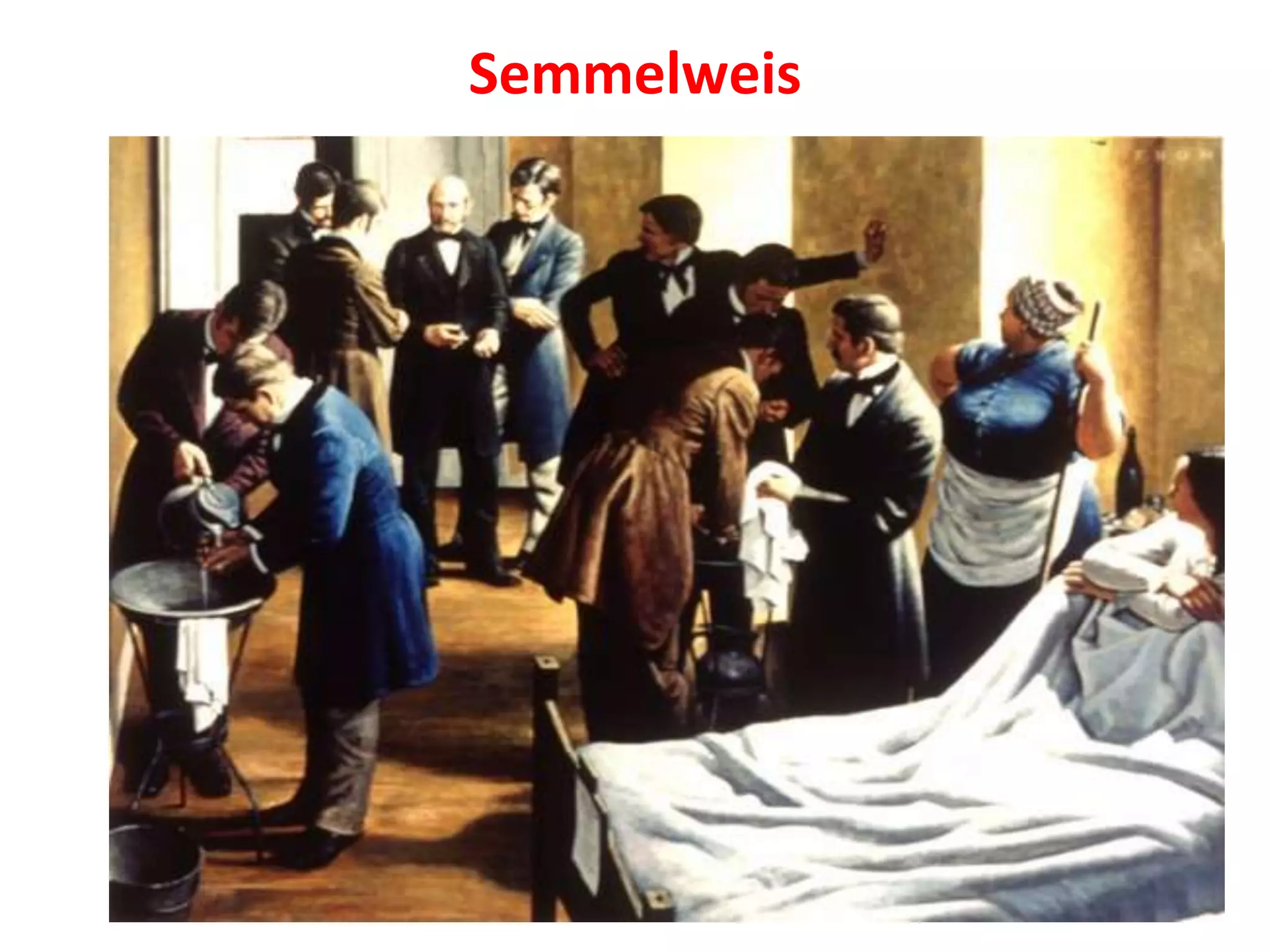
work of Semmelweis in Hungary in the 1840’s, if a Dr.
would wash their hands childbed fever was prevented.
He knew that phenol would kill bacteria; put 2 and 2
together and treated wounds with phenol - and no
infection (phenol is the basic agent of today’s – Lysol)
1. First antiseptic use in surgery, chemicals used as
agents on tissue before surgery
2. Also proved that microbes cause surgical infections
Semmelweis
Lister: Antisepsis in surgery
Microbiology – Penicillin
Alexander Fleming - Scottish physician and bacteriologist
- 1928
Observed mold growing on a bacteria culture, there was
a ring of clearing around the mold where the bacteria
didn’t grow, the mold was later found to be a Penicillium
species and the naturally secreted chemical was called
penicillin, an antibiotic.
Fleming’s work - shelved until early WWII, sulfas were
failing, needed penicillin to cure battle field
wounds.
Now have thousands of antibiotics and synthetics (and a
significant problem – resistance)
Microbiology – Polio vaccine
Salk - Polio vaccine, 1950’s polio was a scary
epidemic, Salk developed a vaccine by
treating the virus with formalin (IPV) inactivated
polio virus
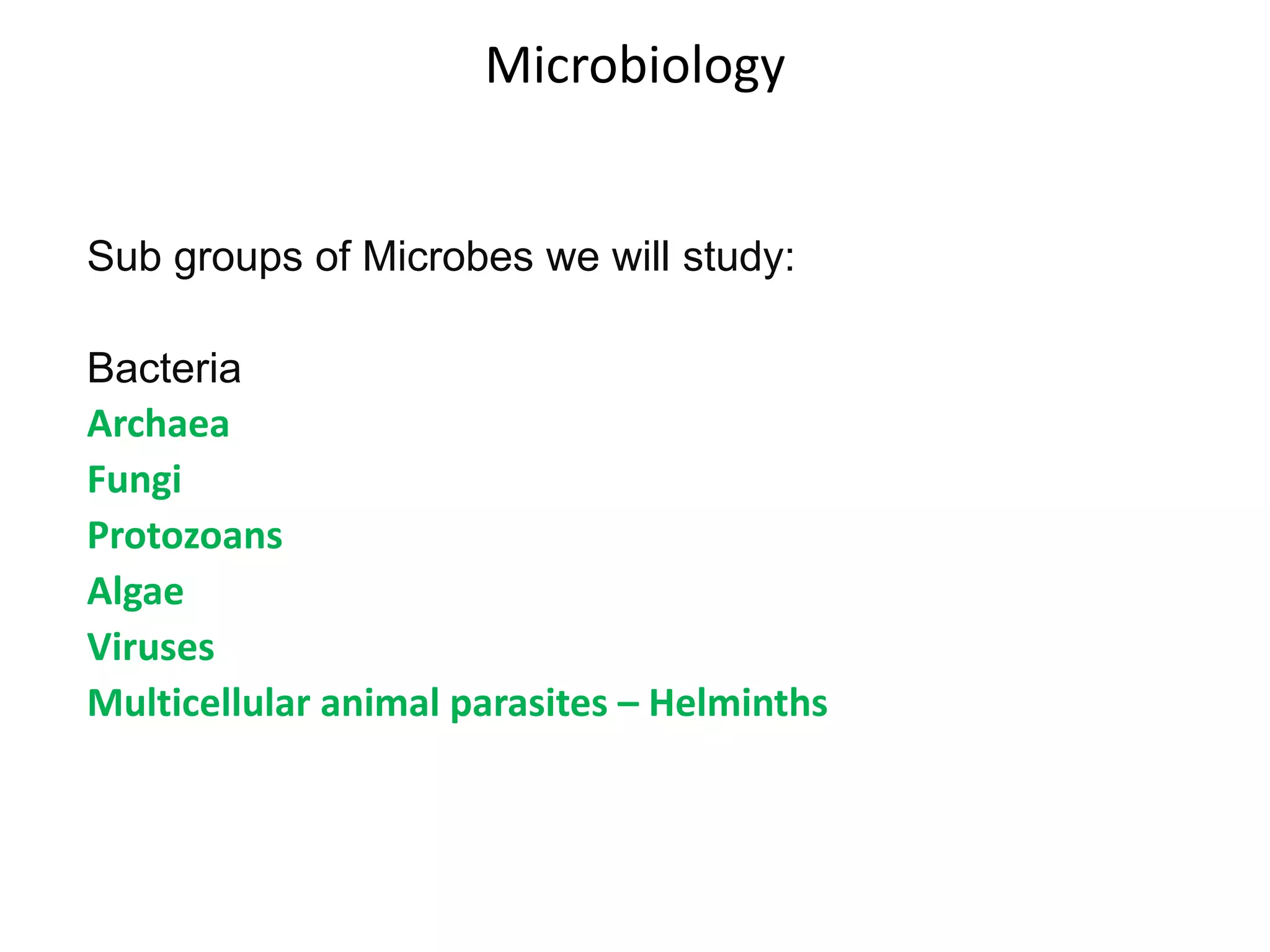
Sabin 1963 live Polio virus vaccine, attenuated –
altered virus, OPV-oral polio vaccine
The work done on polio revolutionized the science
of virology and we are seeing the results today in
advances with Hepatitis and HIV viral infections –
tissue culture and other techniques.
Salk; IPV
Sabin, OPV
Microbiology
Sub groups of Microbes we will study:
Bacteria
Archaea
Fungi
Protozoans
Algae
Viruses
Multicellular animal parasites – Helminths
Domains
• 3 domains
1. Archaea : ancient “bacteria”, unicellular like bacteria,
also simple cell structure (prokaryote – no nucleus)
but have distinct metabolism (chemistry) allowing
them to exist in “extreme” environments
2. Bacteria : unicellular, prokaryote, found everywhere
3. Eukarya : unicellular to multicellular, complex and
organized cells with nuclei and organelles
(mitochondria)
Domain Archaea
• Archaea are single-
celled organisms that
lack a membrane-
bound nucleus. -
Prokaryote
• Archaea can be found in
environments that are
too hostile for other life
forms.
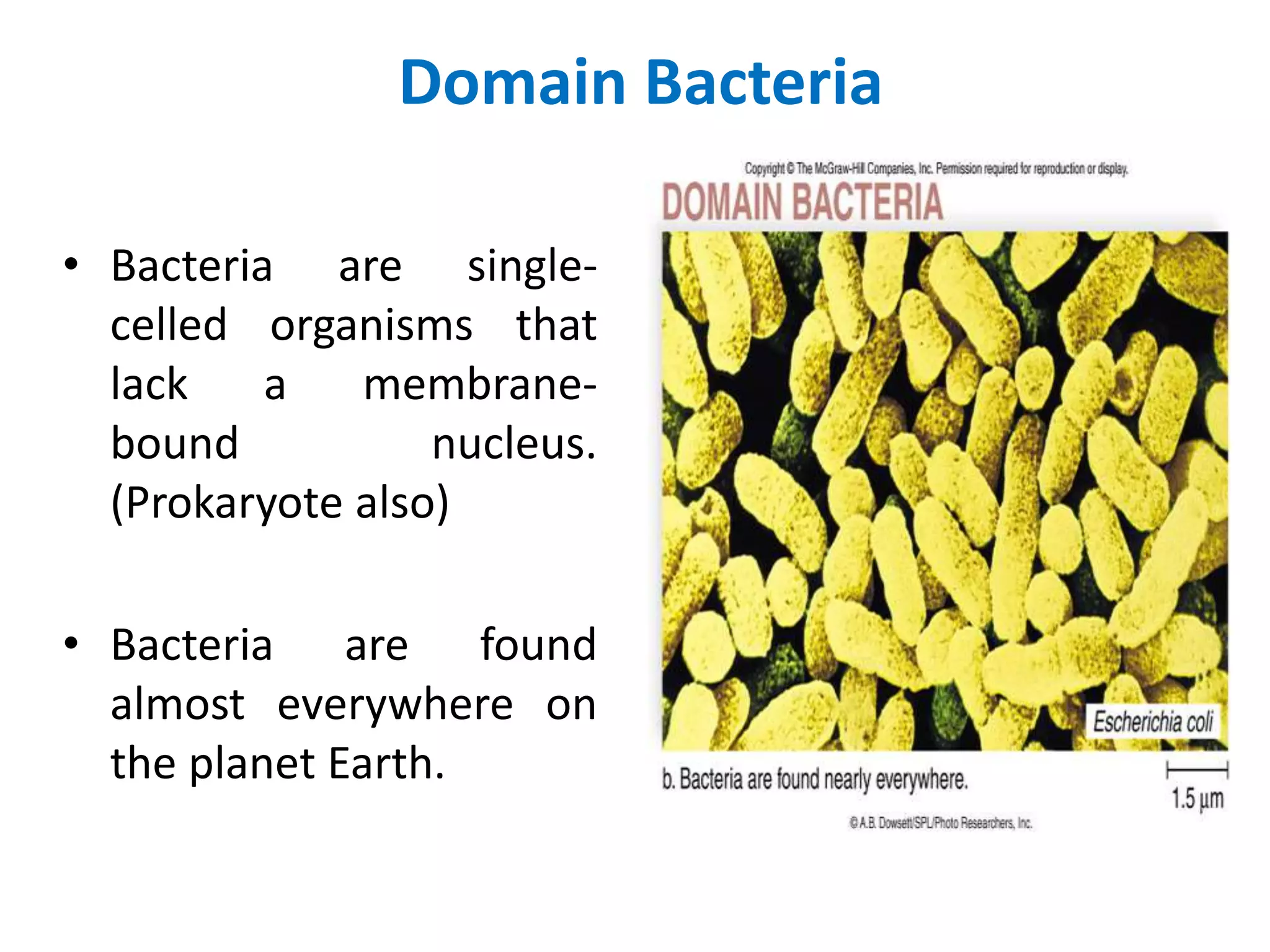
Domain Bacteria
• Bacteria are single-
celled organisms that
lack a membrane-
bound nucleus.
(Prokaryote also)
• Bacteria are found
almost everywhere on
the planet Earth.
Domain Eukarya
• The cells of all
eukaryotes have a
membrane-bound
nucleus.
• Members of the
Domain Eukarya are
further categorized
into one of four
Kingdoms.

History of Bacteria

  • 1.
    Pharmaceutical Microbiology History Md. SaifulIslam BPharm, MPharm (PCP) North South University Fb Group: Pharmacy Universe
  • 2.
    Louis Pasteur 1859– • used swan-necked flask • flask allowed in air, but trapped dust (and microbes) • boiled infusion • showed that NO growth occurred, even after many days (French chemist) entered a contest sponsored by French Academy of Sciences to prove or disprove Spontaneous generation.
  • 3.
    Microbiology – Vaccine EdwardJenner is credited with first vaccine - in epidemics of smallpox during the late 1700’s he observed that milk maids didn’t get the disease, cattle had a similar disease - cowpox, milk maids had cow pox lesions, but not small pox, he purposefully took scrapings from cowpox blister and scraped a 8 year old volunteer. With the material - child got mild illness but not small pox. Vaccination comes from Latin word “vacca” meaning cow. Jenner laid the foundation for Pasteur’s later work with other vaccinations.
  • 4.
  • 5.
    Microbiology – TMV Iwanowski1892 - Discovered that plant disease can be caused by small organisms that were so small they passed through filters , Tobacco mosaic virus (TMV) was later identified as the cause That’s the beginning of virology .
  • 6.
    Microbiology – AsepticTechnique Joseph Lister – 1860’s, English surgeon that applied ideas of the germ theory to surgery, remembered the work of Semmelweis in Hungary in the 1840’s, if a Dr. would wash their hands childbed fever was prevented. He knew that phenol would kill bacteria; put 2 and 2 together and treated wounds with phenol - and no infection (phenol is the basic agent of today’s – Lysol) 1. First antiseptic use in surgery, chemicals used as agents on tissue before surgery 2. Also proved that microbes cause surgical infections
  • 7.
  • 8.
  • 9.
    Microbiology – Penicillin AlexanderFleming - Scottish physician and bacteriologist - 1928 Observed mold growing on a bacteria culture, there was a ring of clearing around the mold where the bacteria didn’t grow, the mold was later found to be a Penicillium species and the naturally secreted chemical was called penicillin, an antibiotic. Fleming’s work - shelved until early WWII, sulfas were failing, needed penicillin to cure battle field wounds. Now have thousands of antibiotics and synthetics (and a significant problem – resistance)
  • 10.
    Microbiology – Poliovaccine Salk - Polio vaccine, 1950’s polio was a scary epidemic, Salk developed a vaccine by treating the virus with formalin (IPV) inactivated polio virus Sabin 1963 live Polio virus vaccine, attenuated – altered virus, OPV-oral polio vaccine The work done on polio revolutionized the science of virology and we are seeing the results today in advances with Hepatitis and HIV viral infections – tissue culture and other techniques.
  • 11.
  • 12.
  • 13.
    Microbiology Sub groups ofMicrobes we will study: Bacteria Archaea Fungi Protozoans Algae Viruses Multicellular animal parasites – Helminths
  • 14.
    Domains • 3 domains 1.Archaea : ancient “bacteria”, unicellular like bacteria, also simple cell structure (prokaryote – no nucleus) but have distinct metabolism (chemistry) allowing them to exist in “extreme” environments 2. Bacteria : unicellular, prokaryote, found everywhere 3. Eukarya : unicellular to multicellular, complex and organized cells with nuclei and organelles (mitochondria)
  • 15.
    Domain Archaea • Archaeaare single- celled organisms that lack a membrane- bound nucleus. - Prokaryote • Archaea can be found in environments that are too hostile for other life forms.
  • 16.
    Domain Bacteria • Bacteriaare single- celled organisms that lack a membrane- bound nucleus. (Prokaryote also) • Bacteria are found almost everywhere on the planet Earth.
  • 17.
    Domain Eukarya • Thecells of all eukaryotes have a membrane-bound nucleus. • Members of the Domain Eukarya are further categorized into one of four Kingdoms.