
1
BY
VANA JAGAN MOHAN RAO M.S.Pharm, MED.CHEM
NIPER-KOLKATA
Asst.Professor, MIPER-KURNOOL
Email: jaganvana6@gmail.com
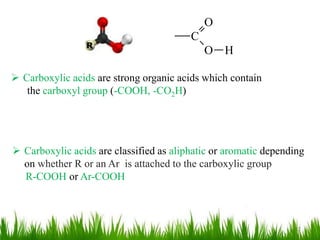
 Carboxylic acids are strong organic acids which contain
the carboxyl group (-COOH, -CO2H)
 Carboxylic acids are classified as aliphatic or aromatic depending
on whether R or an Ar is attached to the carboxylic group
R-COOH or Ar-COOH
C
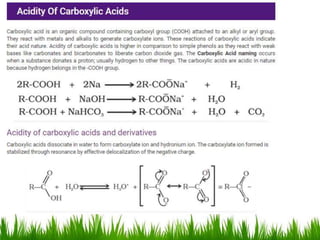
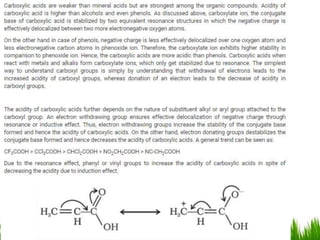
O
O H
2
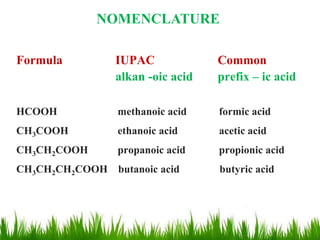
Formula IUPAC Common
alkan -oic acid prefix – ic acid
HCOOH methanoic acid formic acid
CH3COOH ethanoic acid acetic acid
CH3CH2COOH propanoic acid propionic acid
CH3CH2CH2COOH butanoic acid butyric acid
NOMENCLATURE
3
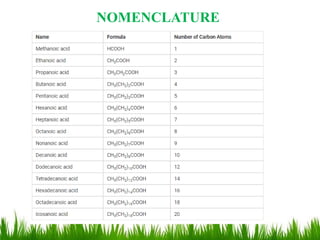
NOMENCLATURE
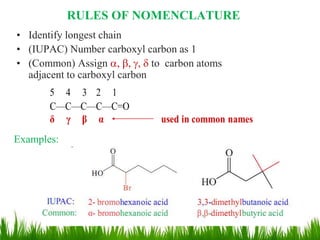
• Identify longest chain
• (IUPAC) Number carboxyl carbon as 1
• (Common) Assign , , ,  to carbon atoms
adjacent to carboxyl carbon
RULES OF NOMENCLATURE
Examples:
5
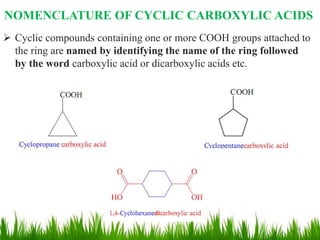
 Cyclic compounds containing one or more COOH groups attached to
the ring are named by identifying the name of the ring followed
by the word carboxylic acid or dicarboxylic acids etc.
NOMENCLATURE OF CYCLIC CARBOXYLIC ACIDS
6
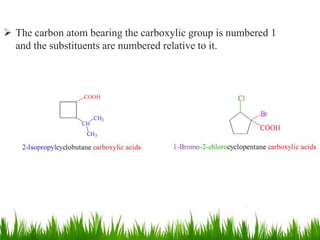
 The carbon atom bearing the carboxylic group is numbered 1
and the substituents are numbered relative to it.
7
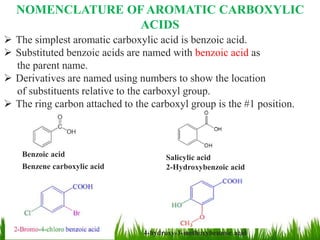
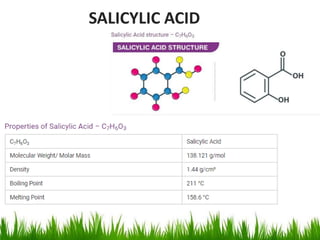
Salicylic acid
2-Hydroxybenzoic acid
NOMENCLATURE OF AROMATIC CARBOXYLIC
ACIDS
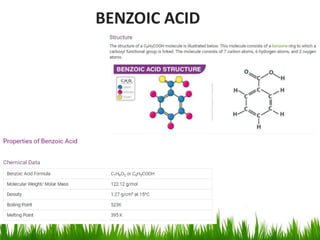
 The simplest aromatic carboxylic acid is benzoic acid.
 Substituted benzoic acids are named with benzoic acid as
the parent name.
 Derivatives are named using numbers to show the location
of substituents relative to the carboxyl group.
 The ring carbon attached to the carboxyl group is the #1 position.
Benzoic acid
Benzene carboxylic acid
8
4-hydroxy-3-methoxybenzoic acid
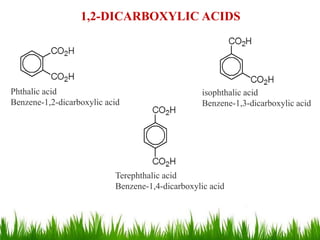
1,2-DICARBOXYLIC ACIDS
Phthalic acid
Benzene-1,2-dicarboxylic acid
isophthalic acid
Benzene-1,3-dicarboxylic acid
Terephthalic acid
Benzene-1,4-dicarboxylic acid
9
PHYSICAL PROPERTIES OF CARBOXYLIC ACIDS
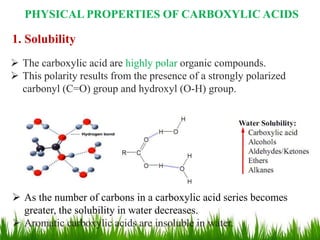
1. Solubility
 The carboxylic acid are highly polar organic compounds.
 This polarity results from the presence of a strongly polarized
carbonyl (C=O) group and hydroxyl (O-H) group.
 As the number of carbons in a carboxylic acid series becomes
greater, the solubility in water decreases.
 Aromatic carboxylic acids are insoluble in water. 10
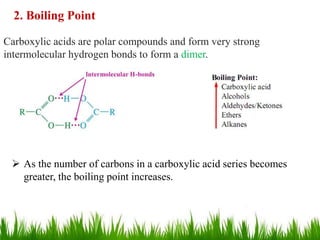
2. Boiling Point
Carboxylic acids are polar compounds and form very strong
intermolecular hydrogen bonds to form a dimer.
 As the number of carbons in a carboxylic acid series becomes
greater, the boiling point increases.
11
ACIDITY AND ACID STRENGTH
 The most important chemical property of carboxylic acids
chemistry is their acidic nature.
 The mineral acids (HCl, HBr, HI, H2SO4, H3PO4 ) are defined as
"strong acids" because they undergo complete dissociation.
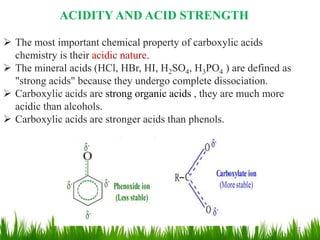
 Carboxylic acids are strong organic acids , they are much more
acidic than alcohols.
 Carboxylic acids are stronger acids than phenols.
12
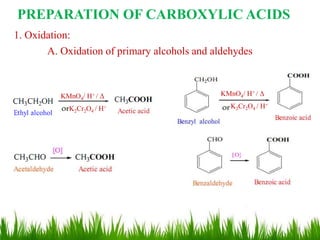
PREPARATION OF CARBOXYLIC ACIDS
1. Oxidation:
A. Oxidation of primary alcohols and aldehydes
KMnO4/ H+ / Δ
K2Cr2O4 / H+
KMnO4/ H+ / Δ
K2Cr2O4 / H+
15
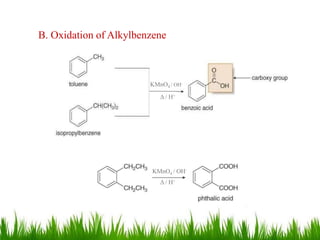
B. Oxidation of Alkylbenzene
KMnO4 / OH-
Δ / H+
Δ / H+
KMnO4 / OH-
16
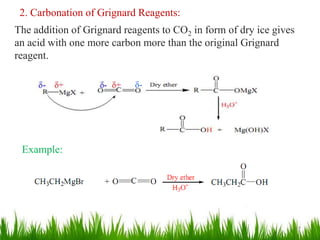
2. Carbonation of Grignard Reagents:
The addition of Grignard reagents to CO2 in form of dry ice gives
an acid with one more carbon more than the original Grignard
reagent.
Example:
δ-
17
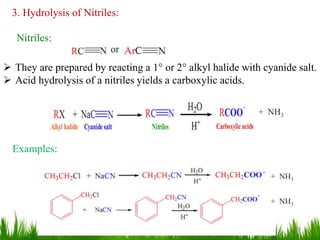
3. Hydrolysis of Nitriles:
Nitriles:
 They are prepared by reacting a 1° or 2° alkyl halide with cyanide salt.
 Acid hydrolysis of a nitriles yields a carboxylic acids.
Examples:
+ NH3
+ NH3
+ NH3
18
REACTIONS OF CARBOXYLIC ACIDS
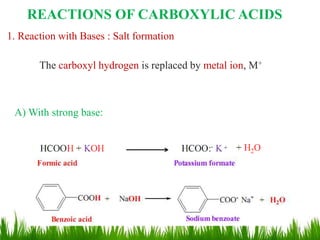
1. Reaction with Bases : Salt formation
The carboxyl hydrogen is replaced by metal ion, M+
A) With strong base:
+
19
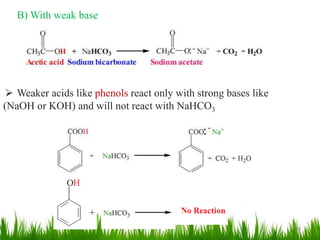
B) With weak base
 Weaker acids like phenols react only with strong bases like
(NaOH or KOH) and will not react with NaHCO3
20
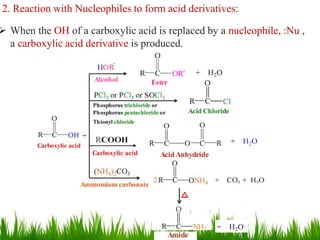
2. Reaction with Nucleophiles to form acid derivatives:
 When the OH of a carboxylic acid is replaced by a nucleophile, :Nu ,
a carboxylic acid derivative is produced.
21
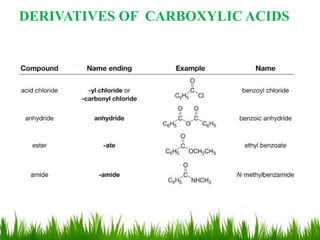
DERIVATIVES OF CARBOXYLIC ACIDS
22
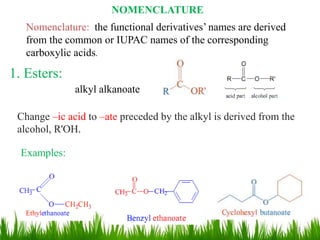
NOMENCLATURE
Nomenclature: the functional derivatives’ names are derived
from the common or IUPAC names of the corresponding
carboxylic acids.
1. Esters:
Change –ic acid to –ate preceded by the alkyl is derived from the
alcohol, R'OH.
alkyl alkanoate
Examples:
23
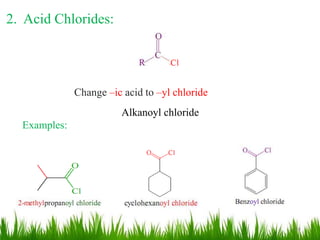
2. Acid Chlorides:
Change –ic acid to –yl chloride
Examples:
Alkanoyl chloride
24
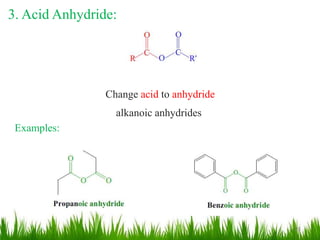
3. Acid Anhydride:
Change acid to anhydride
Examples:
alkanoic anhydrides
25
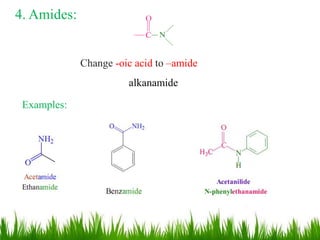
4. Amides:
Change -oic acid to –amide
alkanamide
Examples:
26
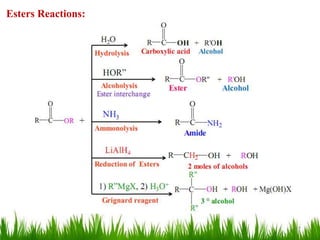
Esters Reactions:
27
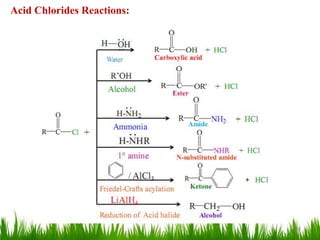
Acid Chlorides Reactions:
28
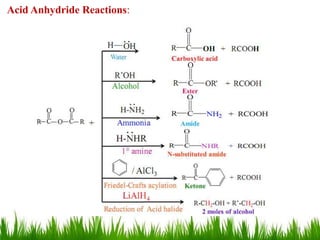
Acid Anhydride Reactions:
29
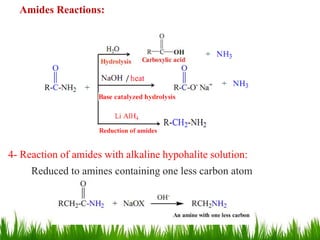
Amides Reactions:
/
Reduced to amines containing one less carbon atom
4- Reaction of amides with alkaline hypohalite solution:
30
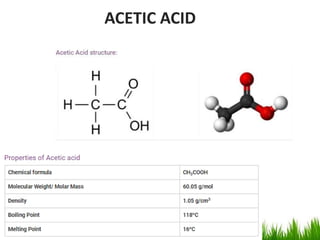
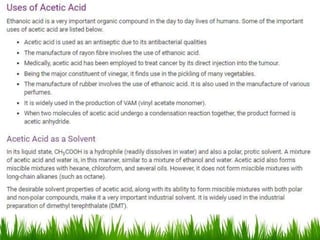
ACETIC ACID
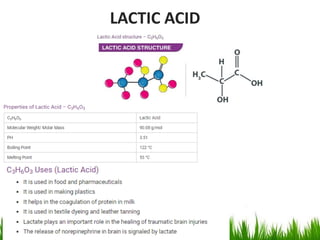
LACTIC ACID
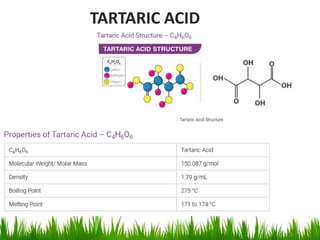
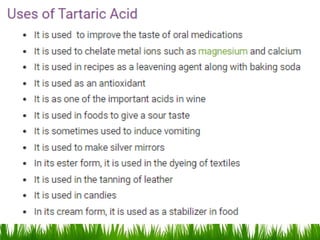
TARTARIC ACID
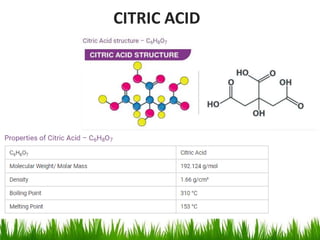
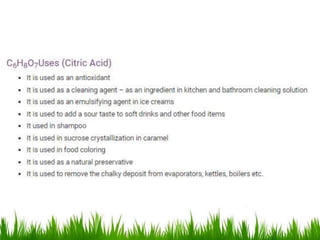
CITRIC ACID
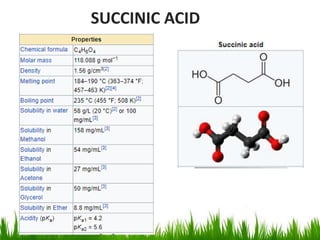
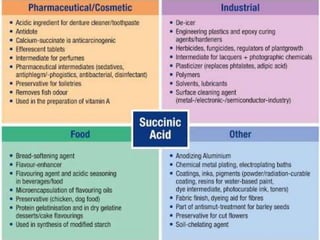
SUCCINIC ACID
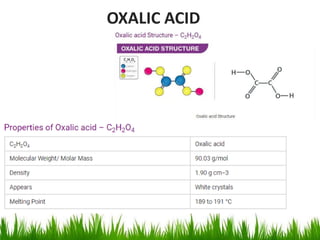
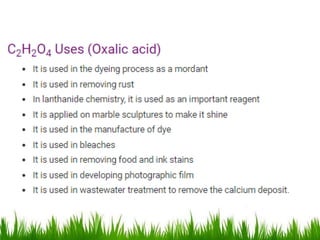
OXALIC ACID
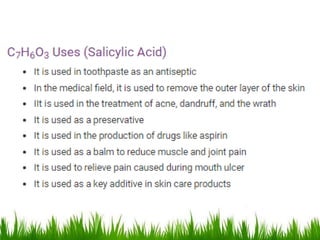
SALICYLIC ACID
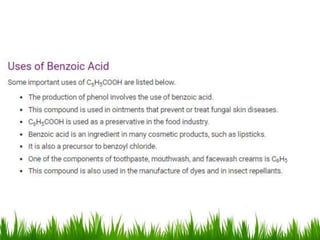
BENZOIC ACID
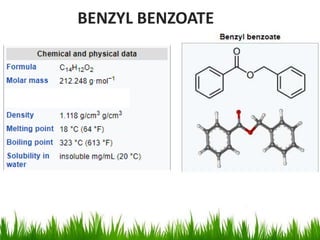
BENZYL BENZOATE
USES:
1. It is an effective and inexpensive topical agent to treat
human scabies.
2. It has vasodilating and spasmolytic effect in case of asthma
and whooping cough
3. It is also used an excipient in some testosterone replacement
drugs
4. It acts as Scabicide, Pediculicide and Acaricide
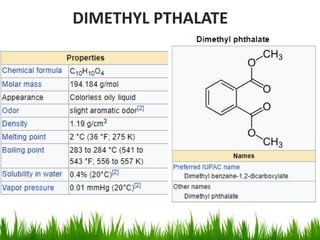
DIMETHYL PTHALATE
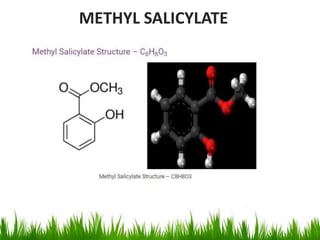
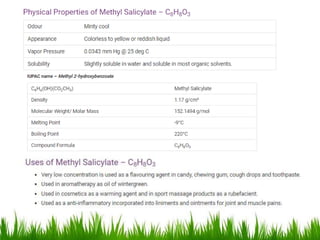
METHYL SALICYLATE
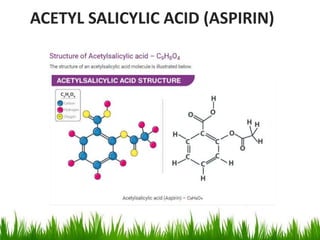
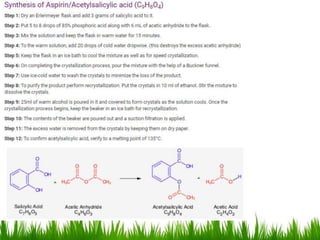
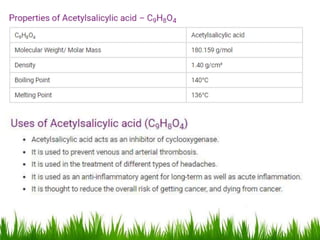
ACETYL SALICYLIC ACID (ASPIRIN)
Carboxylic acid  derivatives

Carboxylic acid derivatives

  • 1.
    1 BY VANA JAGAN MOHANRAO M.S.Pharm, MED.CHEM NIPER-KOLKATA Asst.Professor, MIPER-KURNOOL Email: jaganvana6@gmail.com
  • 2.
     Carboxylic acidsare strong organic acids which contain the carboxyl group (-COOH, -CO2H)  Carboxylic acids are classified as aliphatic or aromatic depending on whether R or an Ar is attached to the carboxylic group R-COOH or Ar-COOH C O O H 2
  • 3.
    Formula IUPAC Common alkan-oic acid prefix – ic acid HCOOH methanoic acid formic acid CH3COOH ethanoic acid acetic acid CH3CH2COOH propanoic acid propionic acid CH3CH2CH2COOH butanoic acid butyric acid NOMENCLATURE 3
  • 4.
  • 5.
    • Identify longestchain • (IUPAC) Number carboxyl carbon as 1 • (Common) Assign , , ,  to carbon atoms adjacent to carboxyl carbon RULES OF NOMENCLATURE Examples: 5
  • 6.
     Cyclic compoundscontaining one or more COOH groups attached to the ring are named by identifying the name of the ring followed by the word carboxylic acid or dicarboxylic acids etc. NOMENCLATURE OF CYCLIC CARBOXYLIC ACIDS 6
  • 7.
     The carbonatom bearing the carboxylic group is numbered 1 and the substituents are numbered relative to it. 7
  • 8.
    Salicylic acid 2-Hydroxybenzoic acid NOMENCLATUREOF AROMATIC CARBOXYLIC ACIDS  The simplest aromatic carboxylic acid is benzoic acid.  Substituted benzoic acids are named with benzoic acid as the parent name.  Derivatives are named using numbers to show the location of substituents relative to the carboxyl group.  The ring carbon attached to the carboxyl group is the #1 position. Benzoic acid Benzene carboxylic acid 8 4-hydroxy-3-methoxybenzoic acid
  • 9.
    1,2-DICARBOXYLIC ACIDS Phthalic acid Benzene-1,2-dicarboxylicacid isophthalic acid Benzene-1,3-dicarboxylic acid Terephthalic acid Benzene-1,4-dicarboxylic acid 9
  • 10.
    PHYSICAL PROPERTIES OFCARBOXYLIC ACIDS 1. Solubility  The carboxylic acid are highly polar organic compounds.  This polarity results from the presence of a strongly polarized carbonyl (C=O) group and hydroxyl (O-H) group.  As the number of carbons in a carboxylic acid series becomes greater, the solubility in water decreases.  Aromatic carboxylic acids are insoluble in water. 10
  • 11.
    2. Boiling Point Carboxylicacids are polar compounds and form very strong intermolecular hydrogen bonds to form a dimer.  As the number of carbons in a carboxylic acid series becomes greater, the boiling point increases. 11
  • 12.
    ACIDITY AND ACIDSTRENGTH  The most important chemical property of carboxylic acids chemistry is their acidic nature.  The mineral acids (HCl, HBr, HI, H2SO4, H3PO4 ) are defined as "strong acids" because they undergo complete dissociation.  Carboxylic acids are strong organic acids , they are much more acidic than alcohols.  Carboxylic acids are stronger acids than phenols. 12
  • 15.
    PREPARATION OF CARBOXYLICACIDS 1. Oxidation: A. Oxidation of primary alcohols and aldehydes KMnO4/ H+ / Δ K2Cr2O4 / H+ KMnO4/ H+ / Δ K2Cr2O4 / H+ 15
  • 16.
    B. Oxidation ofAlkylbenzene KMnO4 / OH- Δ / H+ Δ / H+ KMnO4 / OH- 16
  • 17.
    2. Carbonation ofGrignard Reagents: The addition of Grignard reagents to CO2 in form of dry ice gives an acid with one more carbon more than the original Grignard reagent. Example: δ- 17
  • 18.
    3. Hydrolysis ofNitriles: Nitriles:  They are prepared by reacting a 1° or 2° alkyl halide with cyanide salt.  Acid hydrolysis of a nitriles yields a carboxylic acids. Examples: + NH3 + NH3 + NH3 18
  • 19.
    REACTIONS OF CARBOXYLICACIDS 1. Reaction with Bases : Salt formation The carboxyl hydrogen is replaced by metal ion, M+ A) With strong base: + 19
  • 20.
    B) With weakbase  Weaker acids like phenols react only with strong bases like (NaOH or KOH) and will not react with NaHCO3 20
  • 21.
    2. Reaction withNucleophiles to form acid derivatives:  When the OH of a carboxylic acid is replaced by a nucleophile, :Nu , a carboxylic acid derivative is produced. 21
  • 22.
  • 23.
    NOMENCLATURE Nomenclature: the functionalderivatives’ names are derived from the common or IUPAC names of the corresponding carboxylic acids. 1. Esters: Change –ic acid to –ate preceded by the alkyl is derived from the alcohol, R'OH. alkyl alkanoate Examples: 23
  • 24.
    2. Acid Chlorides: Change–ic acid to –yl chloride Examples: Alkanoyl chloride 24
  • 25.
    3. Acid Anhydride: Changeacid to anhydride Examples: alkanoic anhydrides 25
  • 26.
    4. Amides: Change -oicacid to –amide alkanamide Examples: 26
  • 27.
  • 28.
  • 29.
  • 30.
    Amides Reactions: / Reduced toamines containing one less carbon atom 4- Reaction of amides with alkaline hypohalite solution: 30
  • 38.
  • 40.
  • 41.
  • 43.
  • 45.
  • 47.
  • 49.
  • 51.
  • 53.
  • 54.
    USES: 1. It isan effective and inexpensive topical agent to treat human scabies. 2. It has vasodilating and spasmolytic effect in case of asthma and whooping cough 3. It is also used an excipient in some testosterone replacement drugs 4. It acts as Scabicide, Pediculicide and Acaricide
  • 55.
  • 56.
  • 58.