Microbiological Spoilage and
Preservation of
Pharmaceutical Products
Md. Saiful Islam
B.Pharm, M.Pharm (PCP)
North South University
Fb Group: Pharmacy Universe
• Three categories based on likelihood of spoilage
– Perishable
» Nutrient rich, moist, and unprotected by
coverings
– Semi-perishable
» Can store sealed for months without
spoiling
» Many fermented foods are semi-perishable
– Nonperishable
» Dry or canned foods that can be stored
indefinitely
» Often nutrient poor, dried, fermented, or
preserved
Classifying foods in terms of potential for
spoilage
• Food-processing methods
– Industrial canning
» Eliminates mesophilic bacteria and
endospores
– Pasteurization
» Lowers microbe numbers, but some microbes
survive
– Lyophilization
» A vacuum draws off ice crystals from frozen
foods
– Gamma radiation
» Can achieve complete sterilization
The prevention of food spoilage
Microorganisms found in Food
• Food safety is a global issue
• Soil microbes can spoil food
• Contamination by unsanitary handling of food
• Improper storage and preparation procedures
can lead to contamination by pathogens
• Imports of fruits and vegetables from 3rd World
countries can bring in diseases and parasites
• Hands washed properly?
FRUITS AND VEGETABLES
• Pseudomonas fluorescens are found on surface
of fruits and vegetables
• Pathogens: Salmonella, Shigella and Entameoba
can be transmitted on surfaces
• Now using GMO to make plants resistant
MEATS AND POULTRY
• 20 bacteria found on Poultry- 1/2 of all infections
caused by Salmonella, ¼ by Clostridium perfringens and
¼ Staphylococcus aureus.
• Pseudomonas cause slime and odors.
• Chickens laying eggs can have Salmonella,1/10000 eggs
has this bacteria in side shell.
MILK
• Mostly Staphylococcus, Micrococcus, Pseudomonas
• Hand milking- E. coli, Acinetobacter
• Milk is Soured by Streptococcus lactis, Lactobacillus
Industrial Food Canning
CANNING
• Some thermophiles (Bacillus
stearothermophilus) may remain alive even after
canning, spores can germinate and grow, can will
bulge in heat (thermophilic anaerobic spoilage)
• Flat sour spoilage
• Mesophilic spoilage- improper canning at room
temp
• Sugars
DRYING AND LYOPHILIZATION
• Drying- desication or dehydration is oldest method
• Remove 90% of water
• Stops growth but does not kill microbes
• Can be sun dried, heated in ovens etc
• Addition of slat, sugar or chemicals also used
• Lyophilization- freeze drying is used for instant
coffee and dry yeast for bread making
Food Preservation- Irradiation
• Aseptic packaging: Pre-sterilized materials assembled
into packages and aseptically filled.
• Gamma radiation kills bacteria, insects, and parasitic
worms.
FOOD IRRADIATION- Ionizing Radiation
•2 types of Irradiation- UV and Ionizing
•Microwaves do not kill, but the heat is microbicidal,
but food must be rotated Ionizing-Gamma Rays can
penetrate and are microbicidal
•Can be done, before or after packaging
•Cobalt 60 gamma and Cs 137 used in Japan and
Europe, FDA has declared safe in the US
PASTUERIZATION OF MILK - STANDARDS
• 2 methods : High temp short time and Low temp long
time
• Ultra high temperature- UHT treatment
• Some chemical additives
• Milk and Food in US carefully regulated by FDA
• Animals inspected and soon stricter methods by
microscope
• Quality control has many tests for purity and guarantees
high quality milk to consumers
Thecheese-makingprocess
Pasteurization kills
unwanted microorganisms
Addition of starter
bacterial culture
Coagulation of milk
proteins (curd formation)
Disposal of
liquid whey as
waste product
Production of
unprocessed
cheeses
Cutting
of curds
Production of processed
cheeses through pressing,
addition of secondary
microbial cultures, and
aging (ripening)
Yeast Fermentations
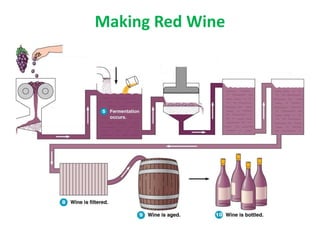
Making Red Wine
Sugar Ethyl alcohol + CO2
Saccharomyces cerevisiae
Malic acid Lactic acid
Lactic acid bacteria
Ethyl alcohol Acetic acid
Acetobacter or Gluconobacter
Microbial Metabolism
Fermentation Technology
Biomass Methane or ethyl alcohol
Bioconversion
Alternative Energy Sources Using Microorganisms

Microbiological spoilage

  • 1.
    Microbiological Spoilage and Preservationof Pharmaceutical Products Md. Saiful Islam B.Pharm, M.Pharm (PCP) North South University Fb Group: Pharmacy Universe
  • 2.
    • Three categoriesbased on likelihood of spoilage – Perishable » Nutrient rich, moist, and unprotected by coverings – Semi-perishable » Can store sealed for months without spoiling » Many fermented foods are semi-perishable – Nonperishable » Dry or canned foods that can be stored indefinitely » Often nutrient poor, dried, fermented, or preserved Classifying foods in terms of potential for spoilage
  • 3.
    • Food-processing methods –Industrial canning » Eliminates mesophilic bacteria and endospores – Pasteurization » Lowers microbe numbers, but some microbes survive – Lyophilization » A vacuum draws off ice crystals from frozen foods – Gamma radiation » Can achieve complete sterilization The prevention of food spoilage
  • 4.
    Microorganisms found inFood • Food safety is a global issue • Soil microbes can spoil food • Contamination by unsanitary handling of food • Improper storage and preparation procedures can lead to contamination by pathogens • Imports of fruits and vegetables from 3rd World countries can bring in diseases and parasites • Hands washed properly?
  • 5.
    FRUITS AND VEGETABLES •Pseudomonas fluorescens are found on surface of fruits and vegetables • Pathogens: Salmonella, Shigella and Entameoba can be transmitted on surfaces • Now using GMO to make plants resistant
  • 6.
    MEATS AND POULTRY •20 bacteria found on Poultry- 1/2 of all infections caused by Salmonella, ¼ by Clostridium perfringens and ¼ Staphylococcus aureus. • Pseudomonas cause slime and odors. • Chickens laying eggs can have Salmonella,1/10000 eggs has this bacteria in side shell.
  • 7.
    MILK • Mostly Staphylococcus,Micrococcus, Pseudomonas • Hand milking- E. coli, Acinetobacter • Milk is Soured by Streptococcus lactis, Lactobacillus
  • 8.
  • 9.
    CANNING • Some thermophiles(Bacillus stearothermophilus) may remain alive even after canning, spores can germinate and grow, can will bulge in heat (thermophilic anaerobic spoilage) • Flat sour spoilage • Mesophilic spoilage- improper canning at room temp • Sugars
  • 10.
    DRYING AND LYOPHILIZATION •Drying- desication or dehydration is oldest method • Remove 90% of water • Stops growth but does not kill microbes • Can be sun dried, heated in ovens etc • Addition of slat, sugar or chemicals also used • Lyophilization- freeze drying is used for instant coffee and dry yeast for bread making
  • 11.
    Food Preservation- Irradiation •Aseptic packaging: Pre-sterilized materials assembled into packages and aseptically filled. • Gamma radiation kills bacteria, insects, and parasitic worms.
  • 12.
    FOOD IRRADIATION- IonizingRadiation •2 types of Irradiation- UV and Ionizing •Microwaves do not kill, but the heat is microbicidal, but food must be rotated Ionizing-Gamma Rays can penetrate and are microbicidal •Can be done, before or after packaging •Cobalt 60 gamma and Cs 137 used in Japan and Europe, FDA has declared safe in the US
  • 14.
    PASTUERIZATION OF MILK- STANDARDS • 2 methods : High temp short time and Low temp long time • Ultra high temperature- UHT treatment • Some chemical additives • Milk and Food in US carefully regulated by FDA • Animals inspected and soon stricter methods by microscope • Quality control has many tests for purity and guarantees high quality milk to consumers
  • 15.
    Thecheese-makingprocess Pasteurization kills unwanted microorganisms Additionof starter bacterial culture Coagulation of milk proteins (curd formation) Disposal of liquid whey as waste product Production of unprocessed cheeses Cutting of curds Production of processed cheeses through pressing, addition of secondary microbial cultures, and aging (ripening)
  • 16.
  • 17.
  • 18.
    Sugar Ethyl alcohol+ CO2 Saccharomyces cerevisiae Malic acid Lactic acid Lactic acid bacteria Ethyl alcohol Acetic acid Acetobacter or Gluconobacter Microbial Metabolism
  • 19.
  • 20.
    Biomass Methane orethyl alcohol Bioconversion Alternative Energy Sources Using Microorganisms