Organic Chemistry
What is Organic chemistry?



The study of carbon and its compounds.
First we will concentrate on compounds just
containing carbon and hydrogen, these
compounds are called hydrocarbons.
Hydrocarbons are compounds that are
composed entirely of carbon and hydrogen
atoms bonded to each other by covalent bonds
Hydrocarbons are classified into two major
categories aliphatic and aromatic.



The term aromatic refers to compounds
contain benzene rings.
All hydrocarbons that are not aromatic are
often described as aliphatic
The aliphatic hydrocarbons include the alkane,
alkene, alkyne, and cyclo alkane .
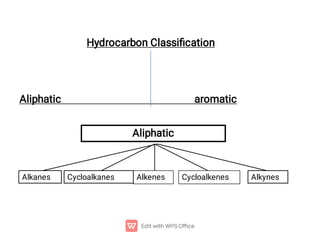
Hydrocarbon Classification
Aliphatic aromatic
Aliphatic
Alkanes Alkenes
Cycloalkanes Alkynes
Cycloalkenes
Saturated Hydrocarbons;Alkanes


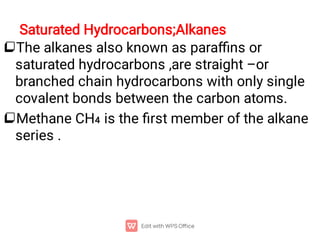
The alkanes also known as paraffins or
saturated hydrocarbons ,are straight –or
branched chain hydrocarbons with only single
covalent bonds between the carbon atoms.
Methane CH4 is the first member of the alkane
series .
1.
A.
B.
a.
C.
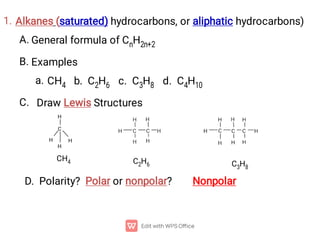
Alkanes (saturated) hydrocarbons, or aliphatic hydrocarbons)
General formula of CnH2n+2
Examples
CH4 b. C2H6 c. C3H8 d. C4H10
Draw Lewis Structures
CH4 C2H6 C3H8
D. Polarity? Polar or nonpolar? Nonpolar
C
H
H
H
H
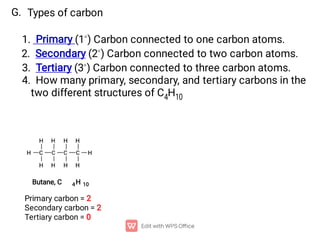
G. Types of carbon
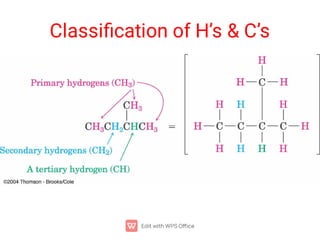
1. Primary (1◦) Carbon connected to one carbon atoms.
2. Secondary (2◦) Carbon connected to two carbon atoms.
3. Tertiary (3◦) Carbon connected to three carbon atoms.
4. How many primary, secondary, and tertiary carbons in the
two different structures of C4H10
Butane, C 4H 10
Primary carbon = 2
Secondary carbon = 2
Tertiary carbon = 0
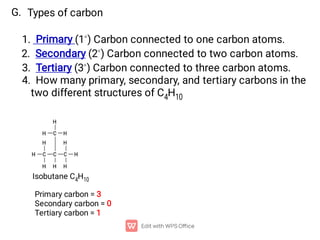
G. Types of carbon
1. Primary (1◦) Carbon connected to one carbon atoms.
2. Secondary (2◦) Carbon connected to two carbon atoms.
3. Tertiary (3◦) Carbon connected to three carbon atoms.
4. How many primary, secondary, and tertiary carbons in the
two different structures of C4H10
Primary carbon = 3
Secondary carbon = 0
Tertiary carbon = 1
Isobutane C4H10
Carbon Bonding in Alkanes




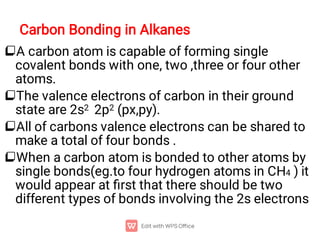
A carbon atom is capable of forming single
covalent bonds with one, two ,three or four other
atoms.
The valence electrons of carbon in their ground
state are 2s2 2p2 (px,py).
All of carbons valence electrons can be shared to
make a total of four bonds .
When a carbon atom is bonded to other atoms by
single bonds(eg.to four hydrogen atoms in CH4 ) it
would appear at first that there should be two
different types of bonds involving the 2s electrons



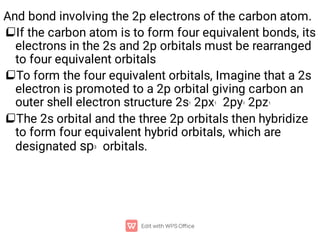
And bond involving the 2p electrons of the carbon atom.
If the carbon atom is to form four equivalent bonds, its
electrons in the 2s and 2p orbitals must be rearranged
to four equivalent orbitals
To form the four equivalent orbitals, Imagine that a 2s
electron is promoted to a 2p orbital giving carbon an
outer shell electron structure 2s1 2px1 2py1 2pz1
The 2s orbital and the three 2p orbitals then hybridize
to form four equivalent hybrid orbitals, which are
designated sp3 orbitals.
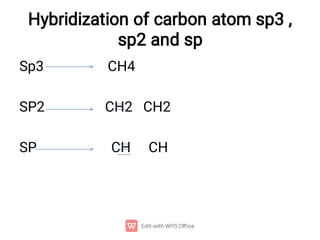
Hybridization of carbon atom sp3 ,
sp2 and sp
Sp3 CH4
SP2 CH2 CH2
SP CH CH
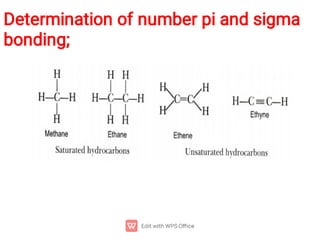
Determination of number pi and sigma
bonding;
14
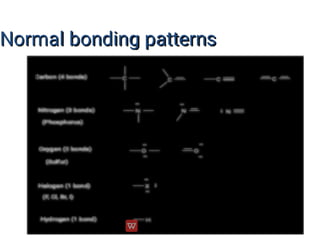
Normal bonding patterns
15
Hydrocarbons




Alkanes contain only single ( ) bonds and have the generic
molecular formula: [CnH2n+2]
Alkenes also contain double ( + ) bonds and have the generic
molecular formula: [CnH2n]
Alkynes contain triple ( + 2) bonds and have the generic
molecular formula: [CnH2n-2]
Aromatics are planar, ring structures with alternating single and
double bonds: eg. C6H6
16
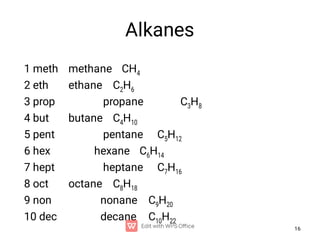
Alkanes
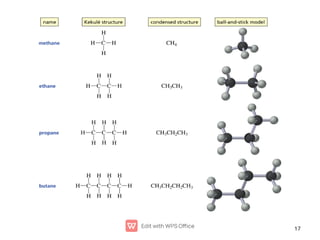
1 meth methane CH4
2 eth ethane C2H6
3 prop propane C3H8
4 but butane C4H10
5 pent pentane C5H12
6 hex hexane C6H14
7 hept heptane C7H16
8 oct octane C8H18
9 non nonane C9H20
10 dec decane C10H22
17
Classification of H’s & C’s
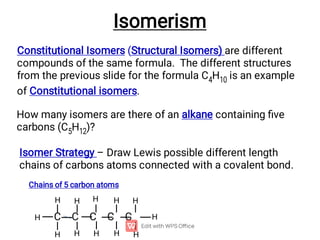
Constitutional Isomers (Structural Isomers) are different
compounds of the same formula. The different structures
from the previous slide for the formula C4H10 is an example
of Constitutional isomers.
How many isomers are there of an alkane containing five
carbons (C5H12)?
Isomerism
Isomer Strategy – Draw Lewis possible different length
chains of carbons atoms connected with a covalent bond.
C C C C C
Chains of 5 carbon atoms
H
H
H
H
H H
H
H
H
H
H H
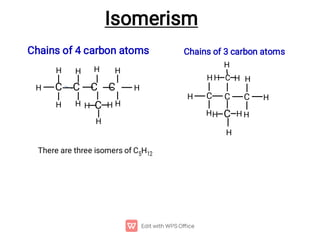
Isomerism
Chains of 4 carbon atoms
C C C C
H
H
H H
C
H
H
H
H H
H
H
H
Chains of 3 carbon atoms
There are three isomers of C5H12
C
C C C
H
H
H
H
H
H
C
H
H
H
H H
H
navedmalek@yahoo.co.in 21
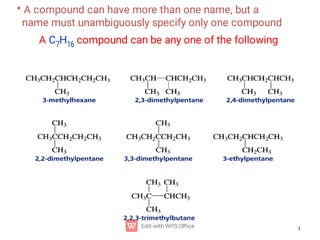
• A compound can have more than one name, but a
name must unambiguously specify only one compound
A C7H16 compound can be any one of the following:
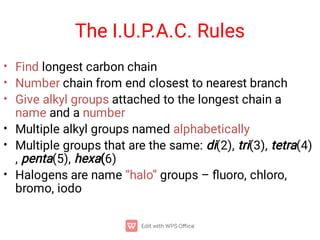
The I.U.P.A.C. Rules
•
•
•
•
•
•
Find longest carbon chain
Number chain from end closest to nearest branch
Give alkyl groups attached to the longest chain a
name and a number
Multiple alkyl groups named alphabetically
Multiple groups that are the same: di(2), tri(3), tetra(4)
, penta(5), hexa(6)
Halogens are name “halo” groups – fluoro, chloro,
bromo, iodo
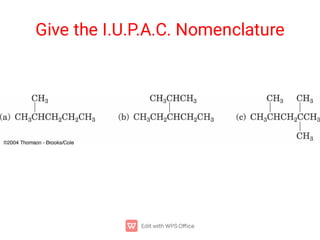
Give the I.U.P.A.C. Nomenclature
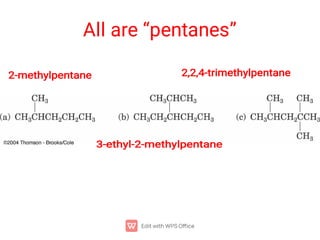
2-methylpentane
3-ethyl-2-methylpentane
2,2,4-trimethylpentane
All are “pentanes”
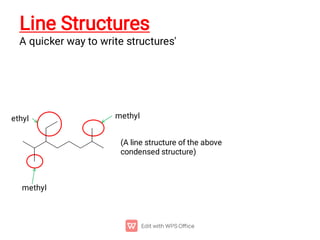
Line Structures
A quicker way to write structures'
(A line structure of the above
condensed structure)
ethyl
methyl
methyl
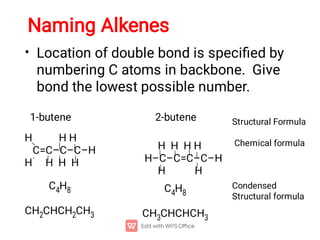
Naming Alkenes
• Location of double bond is specified by
numbering C atoms in backbone. Give
bond the lowest possible number.
H H H
C=C–C–C–H
H H H H
C4H8
CH2CHCH2CH3
H H H H
H–C–C=C–C–H
H H
C4H8
CH3CHCHCH3
1-butene 2-butene Structural Formula
Chemical formula
Condensed
Structural formula
Naming Alkynes
•
•
Use the corresponding name from the alkane
series and change the –ane to –yne.
Use the same naming process you used for
naming Alkenes
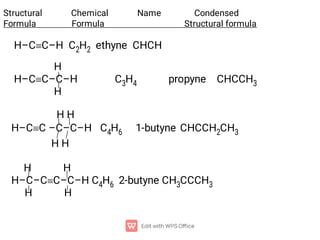
H–CC–H C2H2 ethyne CHCH
H
H–CC–C–H C3H4 propyne CHCCH3
H
H H
H–CC –C–C–H C4H6 1-butyne CHCCH2CH3
H H
H H
H–C–CC–C–H C4H6 2-butyne CH3CCCH3
H H
Structural Chemical Name Condensed
Formula Formula Structural formula
Alkanes – saturated hydrocarbons
(CnH2n+2)






physical properties:
not soluble in water (= hydrophobic)
non polar bonds (similar electronegativity of C and H)
densities between 0.6 and 0.8 g/cm3 (= less than water)
colorless, tasteless, nearly odorless
boiling points increase with increasing MW, and decrease
with branching (C1-C4 are gases)
volatility decreases with molar weight (MW)
Alkanes – saturated hydrocarbons
(CnH2n+2)



alkanes and the human body:
inhalation of alkane vapors (e.g. gasoline)
causes severe damage to the lung tissue
(it dissolves cellular membranes)
liquid alkanes can also harm the skin: long-term contact
between low MW alkanes and skin remove skin oils and
can cause soreness (headache)
high MW alkanes can be used to protect the skin: mixtures
of C20-C30 alkanes are used in skin and hair lotions to
replace natural oils
Alkanes – saturated hydrocarbons
(CnH2n+2)


reactivity:
not very reactive („paraffins“ ~ parum affinis = little activity)
simple (sigma, ) bonds:
C-Cbonding electrons tightly held between carbons,
not readily available to other substances
Alkanes – saturated hydrocarbons
(CnH2n+2)
1.


2.


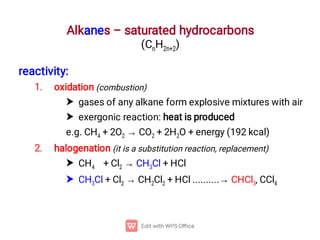
reactivity:
oxidation (combustion)
gases of any alkane form explosive mixtures with air
exergonic reaction: heat is produced
e.g. CH4 + 2O2 → CO2 + 2H2O + energy (192 kcal)
halogenation (it is a substitution reaction, replacement)
CH4 + Cl2 → CH3Cl + HCl
CH3Cl + Cl2 → CH2Cl2 + HCl ..........→ CHCl3, CCl4
Alkenes – unsaturated hydrocarbons
(CnH2n)





physical properties:
not soluble in water (= hydrophobic)
nonpolar bonds (similar electronegativity of C and H)
low boiling points – lower than alkanes of the same
length (C1-C4 are gases)
double bond consist of 1 and 1 bond
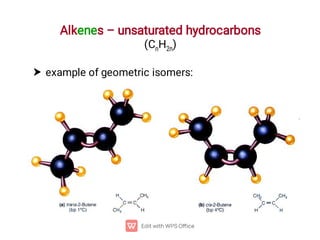
the double bond does not permit free rotation
geometric isomerism
Alkenes – unsaturated hydrocarbons
(CnH2n)
 example of geometric isomers:
Alkenes – unsaturated hydrocarbons
(CnH2n)



alkenes have higher biological efect than alkanes
their narcotic efect and toxicity increase with MW and
with other unsaturated bonds
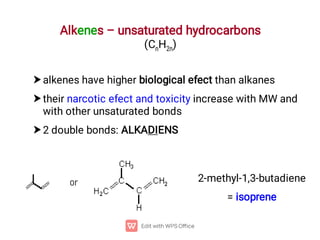
2 double bonds: ALKADIENS
2-methyl-1,3-butadiene
= isoprene
Alkenes – unsaturated hydrocarbons
(CnH2n)

1.
2.
reactivity:
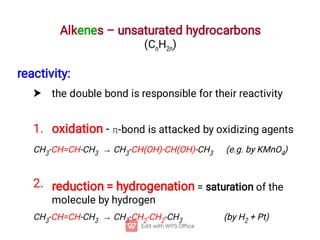
the double bond is responsible for their reactivity
oxidation - -bond is attacked by oxidizing agents
CH3-CH=CH-CH3 → CH3-CH(OH)-CH(OH)-CH3 (e.g. by KMnO4)
reduction = hydrogenation = saturation of the
molecule by hydrogen
CH3-CH=CH-CH3 → CH3-CH2-CH2-CH3 (by H2 + Pt)
Alkenes – unsaturated hydrocarbons
(CnH2n)
3.

reactivity:
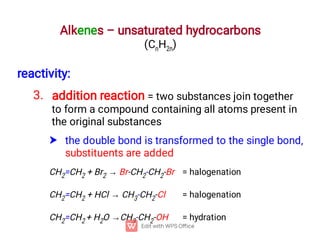
addition reaction = two substances join together
to form a compound containing all atoms present in
the original substances
the double bond is transformed to the single bond,
substituents are added
CH2=CH2 + Br2 → Br-CH2-CH2-Br = halogenation
CH2=CH2 + HCl → CH3-CH2-Cl = halogenation
CH2=CH2 + H2O →CH3-CH2-OH = hydration
Alkenes – unsaturated hydrocarbons
(CnH2n)


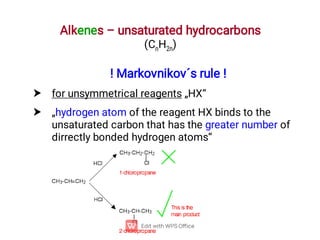
! Markovnikov´s rule !
for unsymmetrical reagents „HX“
„hydrogen atom of the reagent HX binds to the
unsaturated carbon that has the greater number of
dirrectly bonded hydrogen atoms“
Alkynes – unsaturated hydrocarbons
(CnH2n-2)






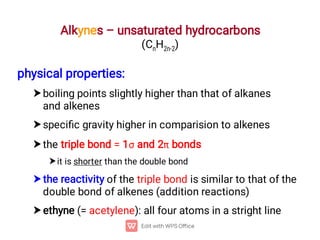
physical properties:
boiling points slightly higher than that of alkanes
and alkenes
specific gravity higher in comparision to alkenes
the triple bond = 1 and 2 bonds
it is shorter than the double bond
the reactivity of the triple bond is similar to that of the
double bond of alkenes (addition reactions)
ethyne (= acetylene): all four atoms in a stright line

theory organic 1.pdf

  • 1.
  • 2.
    What is Organicchemistry?    The study of carbon and its compounds. First we will concentrate on compounds just containing carbon and hydrogen, these compounds are called hydrocarbons. Hydrocarbons are compounds that are composed entirely of carbon and hydrogen atoms bonded to each other by covalent bonds Hydrocarbons are classified into two major categories aliphatic and aromatic.
  • 3.
       The term aromaticrefers to compounds contain benzene rings. All hydrocarbons that are not aromatic are often described as aliphatic The aliphatic hydrocarbons include the alkane, alkene, alkyne, and cyclo alkane .
  • 4.
  • 5.
    Saturated Hydrocarbons;Alkanes   The alkanesalso known as paraffins or saturated hydrocarbons ,are straight –or branched chain hydrocarbons with only single covalent bonds between the carbon atoms. Methane CH4 is the first member of the alkane series .
  • 6.
    1. A. B. a. C. Alkanes (saturated) hydrocarbons,or aliphatic hydrocarbons) General formula of CnH2n+2 Examples CH4 b. C2H6 c. C3H8 d. C4H10 Draw Lewis Structures CH4 C2H6 C3H8 D. Polarity? Polar or nonpolar? Nonpolar C H H H H
  • 7.
    G. Types ofcarbon 1. Primary (1◦) Carbon connected to one carbon atoms. 2. Secondary (2◦) Carbon connected to two carbon atoms. 3. Tertiary (3◦) Carbon connected to three carbon atoms. 4. How many primary, secondary, and tertiary carbons in the two different structures of C4H10 Butane, C 4H 10 Primary carbon = 2 Secondary carbon = 2 Tertiary carbon = 0
  • 8.
    G. Types ofcarbon 1. Primary (1◦) Carbon connected to one carbon atoms. 2. Secondary (2◦) Carbon connected to two carbon atoms. 3. Tertiary (3◦) Carbon connected to three carbon atoms. 4. How many primary, secondary, and tertiary carbons in the two different structures of C4H10 Primary carbon = 3 Secondary carbon = 0 Tertiary carbon = 1 Isobutane C4H10
  • 9.
    Carbon Bonding inAlkanes     A carbon atom is capable of forming single covalent bonds with one, two ,three or four other atoms. The valence electrons of carbon in their ground state are 2s2 2p2 (px,py). All of carbons valence electrons can be shared to make a total of four bonds . When a carbon atom is bonded to other atoms by single bonds(eg.to four hydrogen atoms in CH4 ) it would appear at first that there should be two different types of bonds involving the 2s electrons
  • 10.
       And bond involvingthe 2p electrons of the carbon atom. If the carbon atom is to form four equivalent bonds, its electrons in the 2s and 2p orbitals must be rearranged to four equivalent orbitals To form the four equivalent orbitals, Imagine that a 2s electron is promoted to a 2p orbital giving carbon an outer shell electron structure 2s1 2px1 2py1 2pz1 The 2s orbital and the three 2p orbitals then hybridize to form four equivalent hybrid orbitals, which are designated sp3 orbitals.
  • 11.
    Hybridization of carbonatom sp3 , sp2 and sp Sp3 CH4 SP2 CH2 CH2 SP CH CH
  • 12.
    Determination of numberpi and sigma bonding;
  • 14.
  • 15.
    15 Hydrocarbons     Alkanes contain onlysingle ( ) bonds and have the generic molecular formula: [CnH2n+2] Alkenes also contain double ( + ) bonds and have the generic molecular formula: [CnH2n] Alkynes contain triple ( + 2) bonds and have the generic molecular formula: [CnH2n-2] Aromatics are planar, ring structures with alternating single and double bonds: eg. C6H6
  • 16.
    16 Alkanes 1 meth methaneCH4 2 eth ethane C2H6 3 prop propane C3H8 4 but butane C4H10 5 pent pentane C5H12 6 hex hexane C6H14 7 hept heptane C7H16 8 oct octane C8H18 9 non nonane C9H20 10 dec decane C10H22
  • 17.
  • 18.
  • 19.
    Constitutional Isomers (StructuralIsomers) are different compounds of the same formula. The different structures from the previous slide for the formula C4H10 is an example of Constitutional isomers. How many isomers are there of an alkane containing five carbons (C5H12)? Isomerism Isomer Strategy – Draw Lewis possible different length chains of carbons atoms connected with a covalent bond. C C C C C Chains of 5 carbon atoms H H H H H H H H H H H H
  • 20.
    Isomerism Chains of 4carbon atoms C C C C H H H H C H H H H H H H H Chains of 3 carbon atoms There are three isomers of C5H12 C C C C H H H H H H C H H H H H H
  • 21.
    navedmalek@yahoo.co.in 21 • Acompound can have more than one name, but a name must unambiguously specify only one compound A C7H16 compound can be any one of the following:
  • 22.
    The I.U.P.A.C. Rules • • • • • • Findlongest carbon chain Number chain from end closest to nearest branch Give alkyl groups attached to the longest chain a name and a number Multiple alkyl groups named alphabetically Multiple groups that are the same: di(2), tri(3), tetra(4) , penta(5), hexa(6) Halogens are name “halo” groups – fluoro, chloro, bromo, iodo
  • 23.
    Give the I.U.P.A.C.Nomenclature
  • 24.
  • 25.
    Line Structures A quickerway to write structures' (A line structure of the above condensed structure) ethyl methyl methyl
  • 26.
    Naming Alkenes • Locationof double bond is specified by numbering C atoms in backbone. Give bond the lowest possible number. H H H C=C–C–C–H H H H H C4H8 CH2CHCH2CH3 H H H H H–C–C=C–C–H H H C4H8 CH3CHCHCH3 1-butene 2-butene Structural Formula Chemical formula Condensed Structural formula
  • 27.
    Naming Alkynes • • Use thecorresponding name from the alkane series and change the –ane to –yne. Use the same naming process you used for naming Alkenes
  • 28.
    H–CC–H C2H2 ethyneCHCH H H–CC–C–H C3H4 propyne CHCCH3 H H H H–CC –C–C–H C4H6 1-butyne CHCCH2CH3 H H H H H–C–CC–C–H C4H6 2-butyne CH3CCCH3 H H Structural Chemical Name Condensed Formula Formula Structural formula
  • 29.
    Alkanes – saturatedhydrocarbons (CnH2n+2)       physical properties: not soluble in water (= hydrophobic) non polar bonds (similar electronegativity of C and H) densities between 0.6 and 0.8 g/cm3 (= less than water) colorless, tasteless, nearly odorless boiling points increase with increasing MW, and decrease with branching (C1-C4 are gases) volatility decreases with molar weight (MW)
  • 30.
    Alkanes – saturatedhydrocarbons (CnH2n+2)    alkanes and the human body: inhalation of alkane vapors (e.g. gasoline) causes severe damage to the lung tissue (it dissolves cellular membranes) liquid alkanes can also harm the skin: long-term contact between low MW alkanes and skin remove skin oils and can cause soreness (headache) high MW alkanes can be used to protect the skin: mixtures of C20-C30 alkanes are used in skin and hair lotions to replace natural oils
  • 31.
    Alkanes – saturatedhydrocarbons (CnH2n+2)   reactivity: not very reactive („paraffins“ ~ parum affinis = little activity) simple (sigma, ) bonds: C-Cbonding electrons tightly held between carbons, not readily available to other substances
  • 32.
    Alkanes – saturatedhydrocarbons (CnH2n+2) 1.   2.   reactivity: oxidation (combustion) gases of any alkane form explosive mixtures with air exergonic reaction: heat is produced e.g. CH4 + 2O2 → CO2 + 2H2O + energy (192 kcal) halogenation (it is a substitution reaction, replacement) CH4 + Cl2 → CH3Cl + HCl CH3Cl + Cl2 → CH2Cl2 + HCl ..........→ CHCl3, CCl4
  • 33.
    Alkenes – unsaturatedhydrocarbons (CnH2n)      physical properties: not soluble in water (= hydrophobic) nonpolar bonds (similar electronegativity of C and H) low boiling points – lower than alkanes of the same length (C1-C4 are gases) double bond consist of 1 and 1 bond the double bond does not permit free rotation geometric isomerism
  • 34.
    Alkenes – unsaturatedhydrocarbons (CnH2n)  example of geometric isomers:
  • 35.
    Alkenes – unsaturatedhydrocarbons (CnH2n)    alkenes have higher biological efect than alkanes their narcotic efect and toxicity increase with MW and with other unsaturated bonds 2 double bonds: ALKADIENS 2-methyl-1,3-butadiene = isoprene
  • 36.
    Alkenes – unsaturatedhydrocarbons (CnH2n)  1. 2. reactivity: the double bond is responsible for their reactivity oxidation - -bond is attacked by oxidizing agents CH3-CH=CH-CH3 → CH3-CH(OH)-CH(OH)-CH3 (e.g. by KMnO4) reduction = hydrogenation = saturation of the molecule by hydrogen CH3-CH=CH-CH3 → CH3-CH2-CH2-CH3 (by H2 + Pt)
  • 37.
    Alkenes – unsaturatedhydrocarbons (CnH2n) 3.  reactivity: addition reaction = two substances join together to form a compound containing all atoms present in the original substances the double bond is transformed to the single bond, substituents are added CH2=CH2 + Br2 → Br-CH2-CH2-Br = halogenation CH2=CH2 + HCl → CH3-CH2-Cl = halogenation CH2=CH2 + H2O →CH3-CH2-OH = hydration
  • 38.
    Alkenes – unsaturatedhydrocarbons (CnH2n)   ! Markovnikov´s rule ! for unsymmetrical reagents „HX“ „hydrogen atom of the reagent HX binds to the unsaturated carbon that has the greater number of dirrectly bonded hydrogen atoms“
  • 39.
    Alkynes – unsaturatedhydrocarbons (CnH2n-2)       physical properties: boiling points slightly higher than that of alkanes and alkenes specific gravity higher in comparision to alkenes the triple bond = 1 and 2 bonds it is shorter than the double bond the reactivity of the triple bond is similar to that of the double bond of alkenes (addition reactions) ethyne (= acetylene): all four atoms in a stright line