
Bacteria-III
Pharmaceutical Microbiology
Md. Saiful Islam
BPharm, MPharm (PCP)
North South University
Fb Group: Pharmacy Universe
Bacteria: Activities
(a) Enzyme Production: Bacteria invariably give rise to the
production of enzymes that act on complex food
molecules, breaking them down into much simpler
components ; they are the principal agents responsible for
causing decay (gradual decomposition of organic matter
exposed to air by bacteria) and putrefaction (decomposition
of nitrogenous and other organic materials in the absence of
air thereby producing foul odours).
(b) Toxin Production : Special molecules called adhesins bind
bacteria to the host cells. Once the attachment gets materialized,
the bacteria may produce poisonous substances usually known as
toxins. Toxins are commonly of two kinds, such as :
(i) Exotoxins- enzymes that virtually disrupt the cell’s
function or kill it,and
(ii) Endotoxins- stimulate production of cytokines which
may produce widespread vasodilation and shock.
• The soil bacteria play a vital and important
role in different phases of the nitrogen cycle
viz.mnitrification, nitrogen fixation, and
denitrification.
Significance of Teichoic Acids
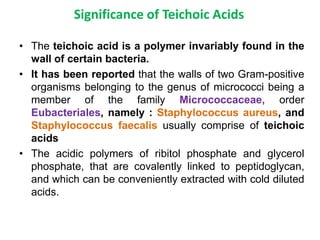
• The teichoic acid is a polymer invariably found in the
wall of certain bacteria.
• It has been reported that the walls of two Gram-positive
organisms belonging to the genus of micrococci being a
member of the family Micrococcaceae, order
Eubacteriales, namely : Staphylococcus aureus, and
Staphylococcus faecalis usually comprise of teichoic
acids
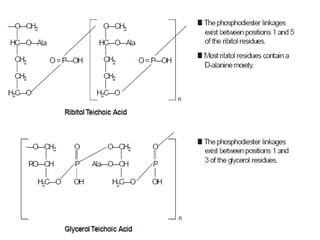
• The acidic polymers of ribitol phosphate and glycerol
phosphate, that are covalently linked to peptidoglycan,
and which can be conveniently extracted with cold diluted
acids.
Characteristic Features
They usually get bound to Mg2+ ions specifically, and
there is quite a bit of evidence to suggest that they do aid
in the protection of bacteria from the thermal injury by
way of providing an adequate accessible pool of such
cations for the stabilization of the cytoplasmic
membrane exclusively.
Measurement of bacterial growth
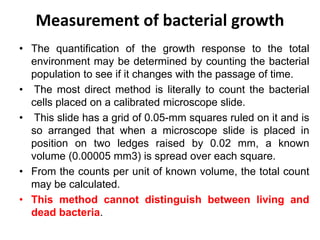
• The quantification of the growth response to the total
environment may be determined by counting the bacterial
population to see if it changes with the passage of time.
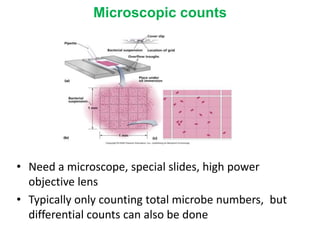
• The most direct method is literally to count the bacterial
cells placed on a calibrated microscope slide.
• This slide has a grid of 0.05-mm squares ruled on it and is
so arranged that when a microscope slide is placed in
position on two ledges raised by 0.02 mm, a known
volume (0.00005 mm3) is spread over each square.
• From the counts per unit of known volume, the total count
may be calculated.
• This method cannot distinguish between living and
dead bacteria.
Measuring Growth (Direct Measurement)
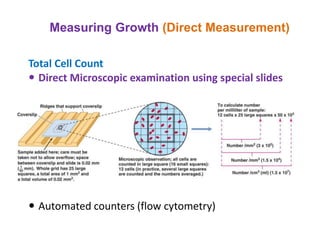
Total Cell Count
 Direct Microscopic examination using special slides
 Automated counters (flow cytometry)
Microscopic counts
• Need a microscope, special slides, high power
objective lens
• Typically only counting total microbe numbers, but
differential counts can also be done
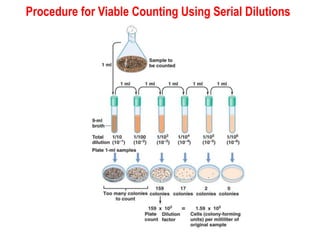
• Viable count is a necessary process to determine the
number of living bacteria in a culture.
• In this method, an aliquot ( a portion of the larger whole)
of the culture, suitably diluted, is mixed with, or placed on
the surface of, a suitable solid culture medium and the
mixture incubated.
• Viable colonies appear in or on the medium and are
counted.
• A single bacterium in the original culture being plated is
assumed to give rise to a single viable colony—this may
not always be true and aggregates of two or more cells
may give rise to a single colony.
• Ideally, this situation should be avoided, but in order to
present some notion of scientific correctness, the viable
count may be referred to as the number of colony-forming
units (cfu) rather than as 'number of bacteria‘.
Measuring Growth (Direct Measurement)
Viable Count
 Measurement of living, reproducing population
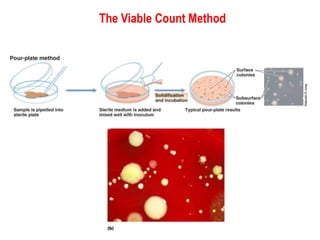
 Two main ways to perform plate counts
 Spread-plate method
 Pour-plate method
 To obtain the appropriate colony number, the
sample to be counted may need to be diluted
(serial dilutions)
The Viable Count Method
Spread-Plate Method for the Viable Count
Procedure for Viable Counting Using Serial Dilutions
• A third method of determining the changes in a viable
population is to take advantage of the fact that bacteria in
suspension scatter or absorb light.
• By shining a light beam through a bacterial suspension
and calculating changes in light intensity by allowing the
emergent beam to fall on a photoelectric cell connected to
a galvanometer, the bacterial population observed as light-
scattering or light-absorbing units may be determined.
• This method is rapid but it counts both living and dead
bacteria and, for that matter, non-bacterial particles.
• A calibration curve relating bacterial numbers to
galvanometer reading must be produced for each
experimental circumstance.
Turbidity
Growth of Bacterial Populations
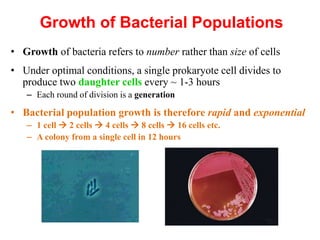
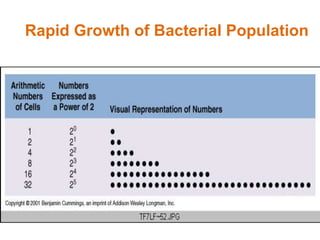
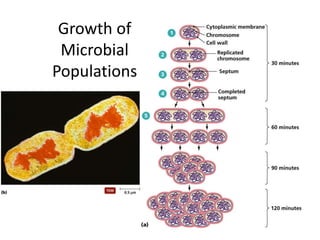
• Growth of bacteria refers to number rather than size of cells
• Under optimal conditions, a single prokaryote cell divides to
produce two daughter cells every ~ 1-3 hours
– Each round of division is a generation
• Bacterial population growth is therefore rapid and exponential
– 1 cell  2 cells  4 cells  8 cells  16 cells etc.
– A colony from a single cell in 12 hours
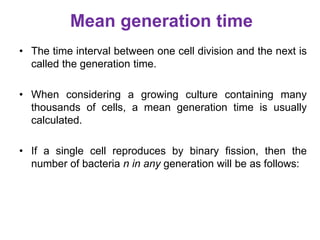
Mean generation time
• The time interval between one cell division and the next is
called the generation time.
• When considering a growing culture containing many
thousands of cells, a mean generation time is usually
calculated.
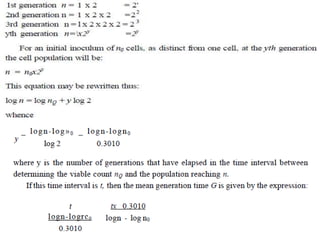
• If a single cell reproduces by binary fission, then the
number of bacteria n in any generation will be as follows:
Rapid Growth of Bacterial Population
Generation Time
 Generation Time – time required to complete fission
cycle from parent cell to 2 daughter cells. (Doubling
time). In terms of a population it is the amount of time
needed to double the population.
 The length of the generation time is a measure of the
Growth Rate of the microbe.
 It varies depending on environmental conditions.
 Different microbes have different generation times.
 Mycobacterium leprae  10-30 days
 Staphylococcus aureus  20-30 minutes
Growth of
Microbial
Populations
Microbial Growth Cycle
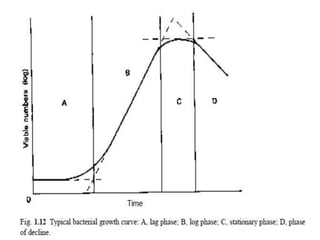
• Typical growth curve for population of cells grown in a closed
system is characterized by four phases
– Lag phase
– Exponential phase
– Stationary phase
– Death phase
# When a sample of living bacteria is inoculated into a
medium adequate for growth, the change in viable
population with time follows this- characteristic pattern
The Growth Curve
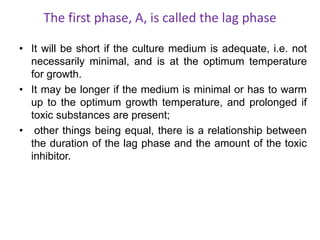
The first phase, A, is called the lag phase
• It will be short if the culture medium is adequate, i.e. not
necessarily minimal, and is at the optimum temperature
for growth.
• It may be longer if the medium is minimal or has to warm
up to the optimum growth temperature, and prolonged if
toxic substances are present;
• other things being equal, there is a relationship between
the duration of the lag phase and the amount of the toxic
inhibitor.
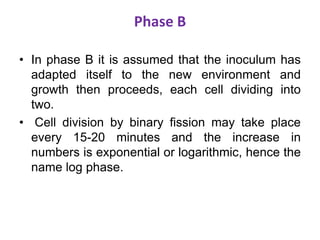
Phase B
• In phase B it is assumed that the inoculum has
adapted itself to the new environment and
growth then proceeds, each cell dividing into
two.
• Cell division by binary fission may take place
every 15-20 minutes and the increase in
numbers is exponential or logarithmic, hence the
name log phase.
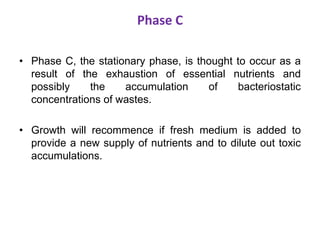
• Phase C, the stationary phase, is thought to occur as a
result of the exhaustion of essential nutrients and
possibly the accumulation of bacteriostatic
concentrations of wastes.
• Growth will recommence if fresh medium is added to
provide a new supply of nutrients and to dilute out toxic
accumulations.
Phase C
Phase D
• In phase D, the phase of decline, bacteria are actually
dying due to the combined pressures of food exhaustion
and toxic waste accumulation.

Bacteria iii

  • 1.
    Bacteria-III Pharmaceutical Microbiology Md. SaifulIslam BPharm, MPharm (PCP) North South University Fb Group: Pharmacy Universe
  • 2.
    Bacteria: Activities (a) EnzymeProduction: Bacteria invariably give rise to the production of enzymes that act on complex food molecules, breaking them down into much simpler components ; they are the principal agents responsible for causing decay (gradual decomposition of organic matter exposed to air by bacteria) and putrefaction (decomposition of nitrogenous and other organic materials in the absence of air thereby producing foul odours). (b) Toxin Production : Special molecules called adhesins bind bacteria to the host cells. Once the attachment gets materialized, the bacteria may produce poisonous substances usually known as toxins. Toxins are commonly of two kinds, such as : (i) Exotoxins- enzymes that virtually disrupt the cell’s function or kill it,and (ii) Endotoxins- stimulate production of cytokines which may produce widespread vasodilation and shock.
  • 3.
    • The soilbacteria play a vital and important role in different phases of the nitrogen cycle viz.mnitrification, nitrogen fixation, and denitrification.
  • 4.
    Significance of TeichoicAcids • The teichoic acid is a polymer invariably found in the wall of certain bacteria. • It has been reported that the walls of two Gram-positive organisms belonging to the genus of micrococci being a member of the family Micrococcaceae, order Eubacteriales, namely : Staphylococcus aureus, and Staphylococcus faecalis usually comprise of teichoic acids • The acidic polymers of ribitol phosphate and glycerol phosphate, that are covalently linked to peptidoglycan, and which can be conveniently extracted with cold diluted acids.
  • 6.
    Characteristic Features They usuallyget bound to Mg2+ ions specifically, and there is quite a bit of evidence to suggest that they do aid in the protection of bacteria from the thermal injury by way of providing an adequate accessible pool of such cations for the stabilization of the cytoplasmic membrane exclusively.
  • 7.
    Measurement of bacterialgrowth • The quantification of the growth response to the total environment may be determined by counting the bacterial population to see if it changes with the passage of time. • The most direct method is literally to count the bacterial cells placed on a calibrated microscope slide. • This slide has a grid of 0.05-mm squares ruled on it and is so arranged that when a microscope slide is placed in position on two ledges raised by 0.02 mm, a known volume (0.00005 mm3) is spread over each square. • From the counts per unit of known volume, the total count may be calculated. • This method cannot distinguish between living and dead bacteria.
  • 8.
    Measuring Growth (DirectMeasurement) Total Cell Count  Direct Microscopic examination using special slides  Automated counters (flow cytometry)
  • 9.
    Microscopic counts • Needa microscope, special slides, high power objective lens • Typically only counting total microbe numbers, but differential counts can also be done
  • 10.
    • Viable countis a necessary process to determine the number of living bacteria in a culture. • In this method, an aliquot ( a portion of the larger whole) of the culture, suitably diluted, is mixed with, or placed on the surface of, a suitable solid culture medium and the mixture incubated. • Viable colonies appear in or on the medium and are counted. • A single bacterium in the original culture being plated is assumed to give rise to a single viable colony—this may not always be true and aggregates of two or more cells may give rise to a single colony. • Ideally, this situation should be avoided, but in order to present some notion of scientific correctness, the viable count may be referred to as the number of colony-forming units (cfu) rather than as 'number of bacteria‘.
  • 11.
    Measuring Growth (DirectMeasurement) Viable Count  Measurement of living, reproducing population  Two main ways to perform plate counts  Spread-plate method  Pour-plate method  To obtain the appropriate colony number, the sample to be counted may need to be diluted (serial dilutions)
  • 12.
  • 13.
    Spread-Plate Method forthe Viable Count
  • 14.
    Procedure for ViableCounting Using Serial Dilutions
  • 15.
    • A thirdmethod of determining the changes in a viable population is to take advantage of the fact that bacteria in suspension scatter or absorb light. • By shining a light beam through a bacterial suspension and calculating changes in light intensity by allowing the emergent beam to fall on a photoelectric cell connected to a galvanometer, the bacterial population observed as light- scattering or light-absorbing units may be determined. • This method is rapid but it counts both living and dead bacteria and, for that matter, non-bacterial particles. • A calibration curve relating bacterial numbers to galvanometer reading must be produced for each experimental circumstance.
  • 16.
  • 17.
    Growth of BacterialPopulations • Growth of bacteria refers to number rather than size of cells • Under optimal conditions, a single prokaryote cell divides to produce two daughter cells every ~ 1-3 hours – Each round of division is a generation • Bacterial population growth is therefore rapid and exponential – 1 cell  2 cells  4 cells  8 cells  16 cells etc. – A colony from a single cell in 12 hours
  • 18.
    Mean generation time •The time interval between one cell division and the next is called the generation time. • When considering a growing culture containing many thousands of cells, a mean generation time is usually calculated. • If a single cell reproduces by binary fission, then the number of bacteria n in any generation will be as follows:
  • 20.
    Rapid Growth ofBacterial Population
  • 21.
    Generation Time  GenerationTime – time required to complete fission cycle from parent cell to 2 daughter cells. (Doubling time). In terms of a population it is the amount of time needed to double the population.  The length of the generation time is a measure of the Growth Rate of the microbe.  It varies depending on environmental conditions.  Different microbes have different generation times.  Mycobacterium leprae  10-30 days  Staphylococcus aureus  20-30 minutes
  • 22.
  • 23.
    Microbial Growth Cycle •Typical growth curve for population of cells grown in a closed system is characterized by four phases – Lag phase – Exponential phase – Stationary phase – Death phase # When a sample of living bacteria is inoculated into a medium adequate for growth, the change in viable population with time follows this- characteristic pattern
  • 25.
  • 26.
    The first phase,A, is called the lag phase • It will be short if the culture medium is adequate, i.e. not necessarily minimal, and is at the optimum temperature for growth. • It may be longer if the medium is minimal or has to warm up to the optimum growth temperature, and prolonged if toxic substances are present; • other things being equal, there is a relationship between the duration of the lag phase and the amount of the toxic inhibitor.
  • 27.
    Phase B • Inphase B it is assumed that the inoculum has adapted itself to the new environment and growth then proceeds, each cell dividing into two. • Cell division by binary fission may take place every 15-20 minutes and the increase in numbers is exponential or logarithmic, hence the name log phase.
  • 28.
    • Phase C,the stationary phase, is thought to occur as a result of the exhaustion of essential nutrients and possibly the accumulation of bacteriostatic concentrations of wastes. • Growth will recommence if fresh medium is added to provide a new supply of nutrients and to dilute out toxic accumulations. Phase C
  • 29.
    Phase D • Inphase D, the phase of decline, bacteria are actually dying due to the combined pressures of food exhaustion and toxic waste accumulation.