Agnosias
Introduction
• Gnosis essentially means “ to know ”.
• Agnosia means “ without knowledge ”
• Unable to recognize or appreciate the identity or nature of
sensory stimuli
• The term Agnosia was coined by Sigmund Freud in 1891.
• Lissaeuer (1890) made a distinction between a deficit in the
ability to perceive stimuli consciously and a deficit reflecting an
inability to ascribe meaning to what is perceived, a disorder he
referred to as Seelenblindheit, or “soul blindness”
Introduction
• An example of agnosia is Oliver Sacks’ patient, who not only
failed to recognize his wife’s face but also mistook it for a hat.
• Milner and Teuber in 1968, referred to agnosia as a “normal
percept stripped of its meaning.”
• Criteria for the diagnosis of agnosia include: (1) failure to
recognize an object (2) normal perception of the object,
excluding an elementary sensory disorder (3) ability to name
the object once it is recognized, excluding anomia as the principal
Deficit and (4) absence of a generalized dementia
Introduction
• Agnosia results from lesions that disconnect and isolate visual,
auditory and somatosensory input from higher level processing.
• Defined as profound, modality-specific recognition impairment in the
presence of normal primary sensory function that cannot be fully
explained by:
• - mental deterioration,
• - attentional disturbances,
• - unfamiliarity with the stimuli used to assess recognition abilities
Classification
• Agnosia can be classified according to the modality as
• Visual
• Auditory
• Tactile
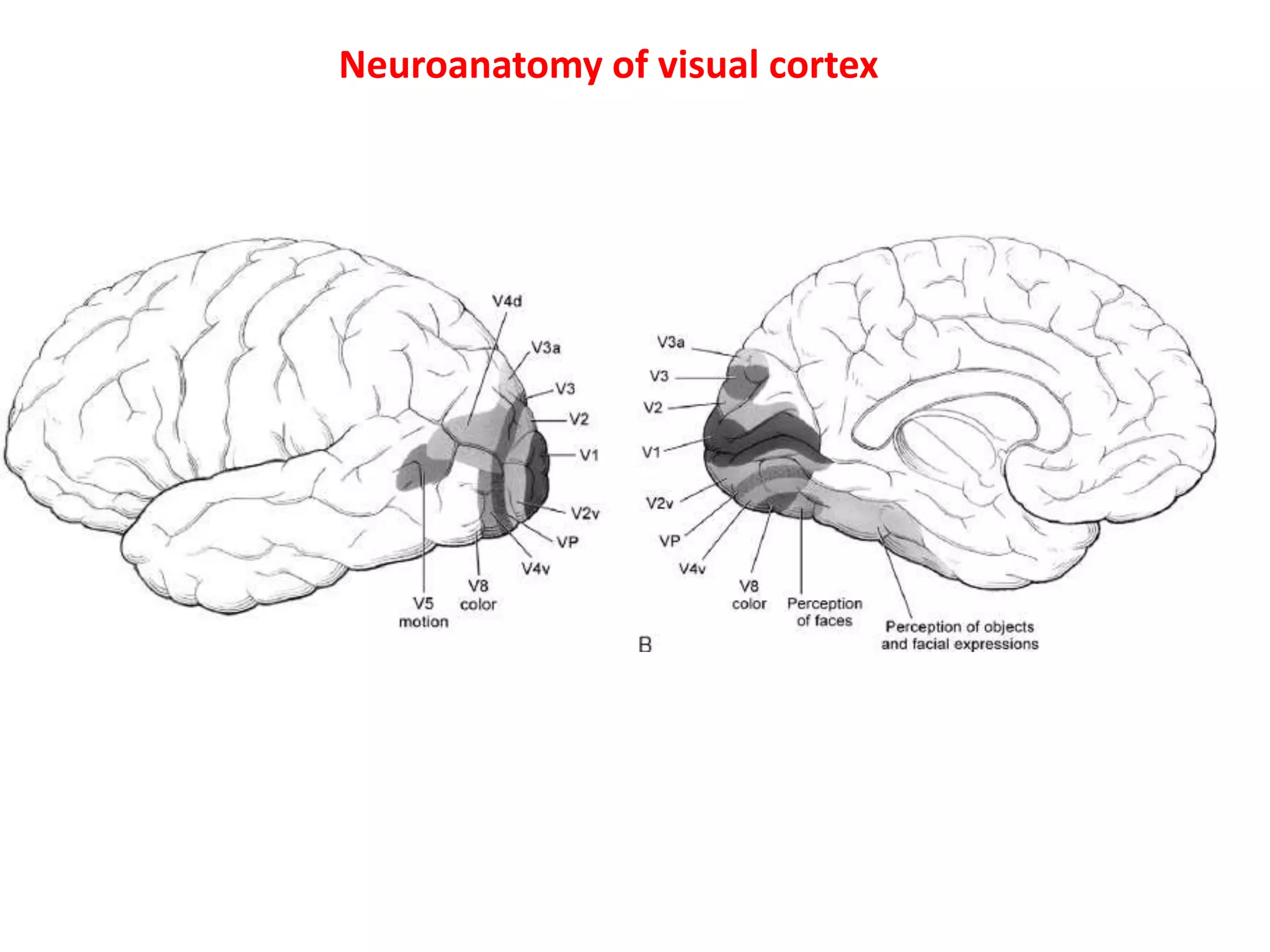
Neuroanatomy of visual cortex
Visual processing
• Extrastriate regions group into two streams:
1. Ventral occipitotemporal ‘‘what’’ stream is involved in object
recognition
2. Dorsal occipitoparietal ‘‘where’’ stream is involved in spatial
processing.
• Integration of ventral and dorsal stream information occurs at
the level of the inferior parietal lobule
• Aids in object recognition and provides information regarding its
location in space (functional knowledge)
Disorders of ventral stream
• Agnosias
• Alexia
• Disorders of face perception
• Disorders of color
- Achromatopsia
- Color agnosia
- Color anomia
Deficits of dorsal stream
Disorders of motion perception
-associated with damage to areas of extrastriate visualcortex
analogous to V5.[“OPTIC ATAXIA”]
Disorders of spatial perception
-Balint syndrome
-Dressing apraxia and constructional ‘‘apraxia’’
• Confusingly, these are not apraxias as such, but are rather
visuospatial deficits .
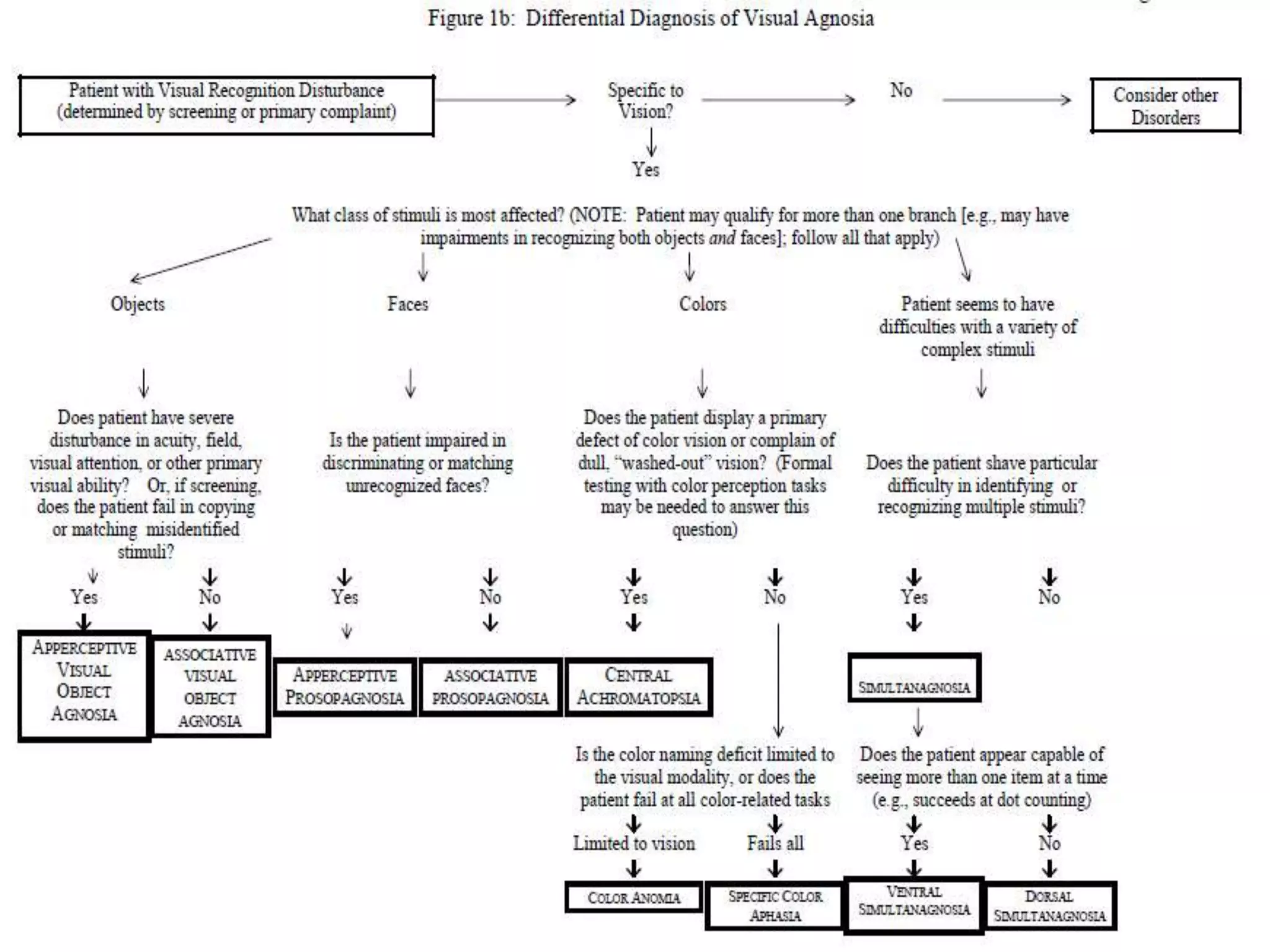
Visual agnosias
1) Visual Object Agnosia.
- associative
- apperceptive
2) Simultanagnosia.
- dorsal
- ventral
3) Prosopagnosia.
4) Color Agnosia.
- central achromatopsia
- color anomia
- specific color aphasia
- color agnosia
5) Optic Aphasia.
Apperceptive visual agnosia
• Visual ability on a basic sensory level – INTACT
• Defect in early stage visual processing prevents a correct percept
of the stimulus being formed.
• Structure or spatial properties of a visual stimuli – IMPAIRED
• Object is not seen as a whole or in a meaningful way.
• Visual matching
• Discriminating shapes
IMPAIRED
• Comparing similar figures
• Copying drawings
Apperceptive agnosia
features
Complete visual percept Not formed
VA
Brightness discrimination
Color vision & texture
INTACT
-MATCHING
-COPYING
-DISCRIMINATION of simple from
complex shapes
IMPAIRED
Recognize objects in motion /
actions depicted in line drawings
INTACT
• Stroke, anoxia and carbon monoxide poisoning are
common causes and it is often associated with diffuse,
posterior lesions.
• Useful tests are incomplete letters, object decision and
silhouettes sub-tests from the Visual Orientation and
Space Perception Battery (VOSP), the Gollin Figures.
Gollin Incomplete Figures Test
Associative visual agnosia
• Primary sensory and early visual processing systems are
preserved.
• CANNOT interpret, understand or assign meaning to the object,
face or word
• Bilateral damage to the inferior temporo-occipital junction and
subjacent white matter.
• It is more common than apperceptive visual agnosia.
• Able to copy objects and pictures, often with great accuracy,
• Assessed by presenting the patient with pictures of objects and
asking them to name, describe functions and sort according to
use or category to which they belong.
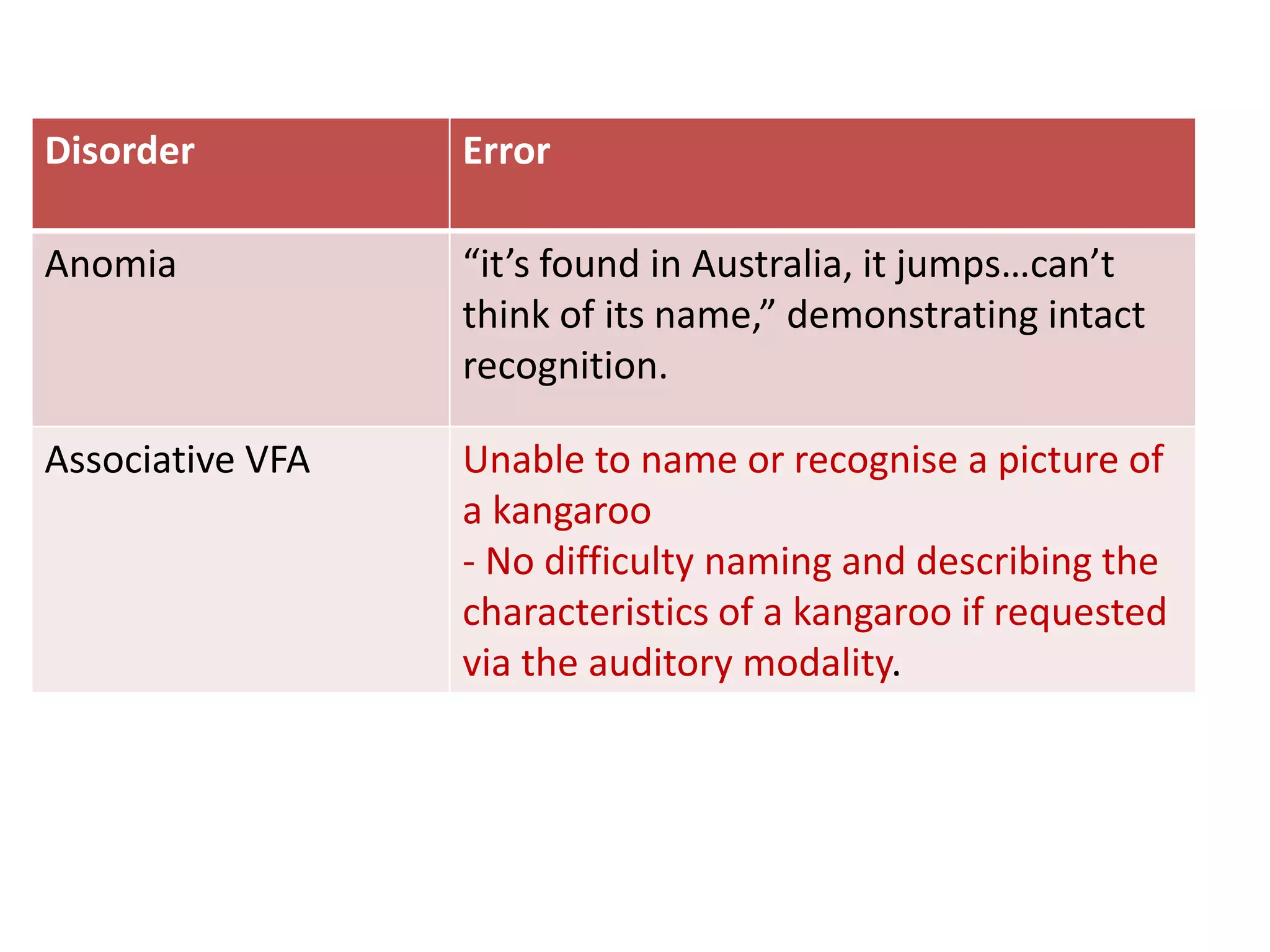
Disorder Error
Anomia “it’s found in Australia, it jumps…can’t
think of its name,” demonstrating intact
recognition.
Associative VFA Unable to name or recognise a picture of
a kangaroo
- No difficulty naming and describing the
characteristics of a kangaroo if requested
via the auditory modality.
Integrative agnosia
• ASSOCIATIVE AGNOSIA SUBTYPE – basic ,local visual elements are
processed in a normal way but the integration of these elements
into a unitary whole is impaired
• Problem with shape-matching tasks requiring semantic
information;
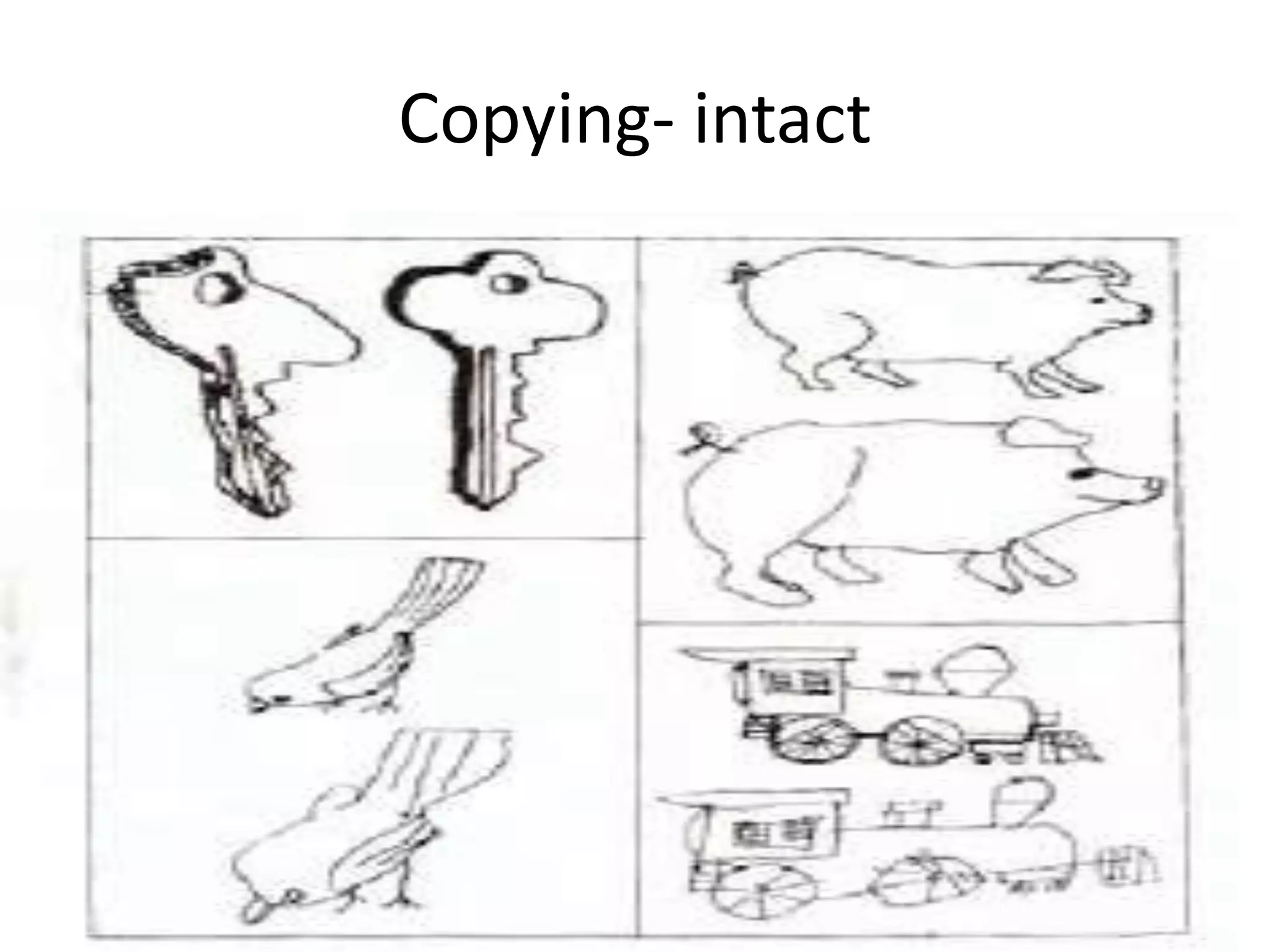
• No trouble copying objects;
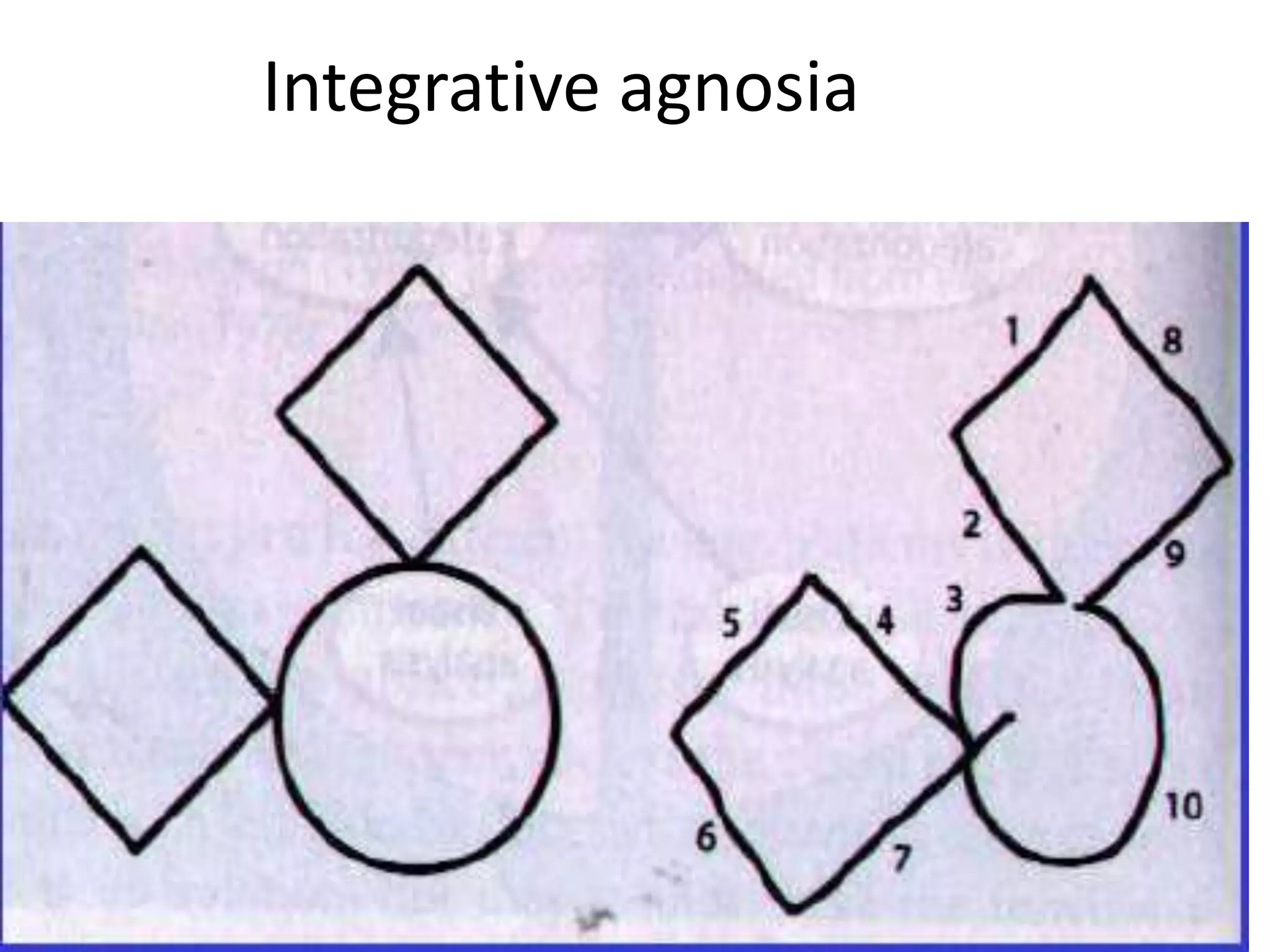
• Recognized objects in isolation, but had great difficulty when the
contours of 2 objects overlapped
• Integrative agnosia deficits in the recognition of objects due to
the failure to group and integrate the component parts into a
coherent whole;
• Patients with this deficit can faithfully reproduce drawings of
objects, however their percept is of isolated, unconnected parts
or contours
Copying- intact
Integrative agnosia
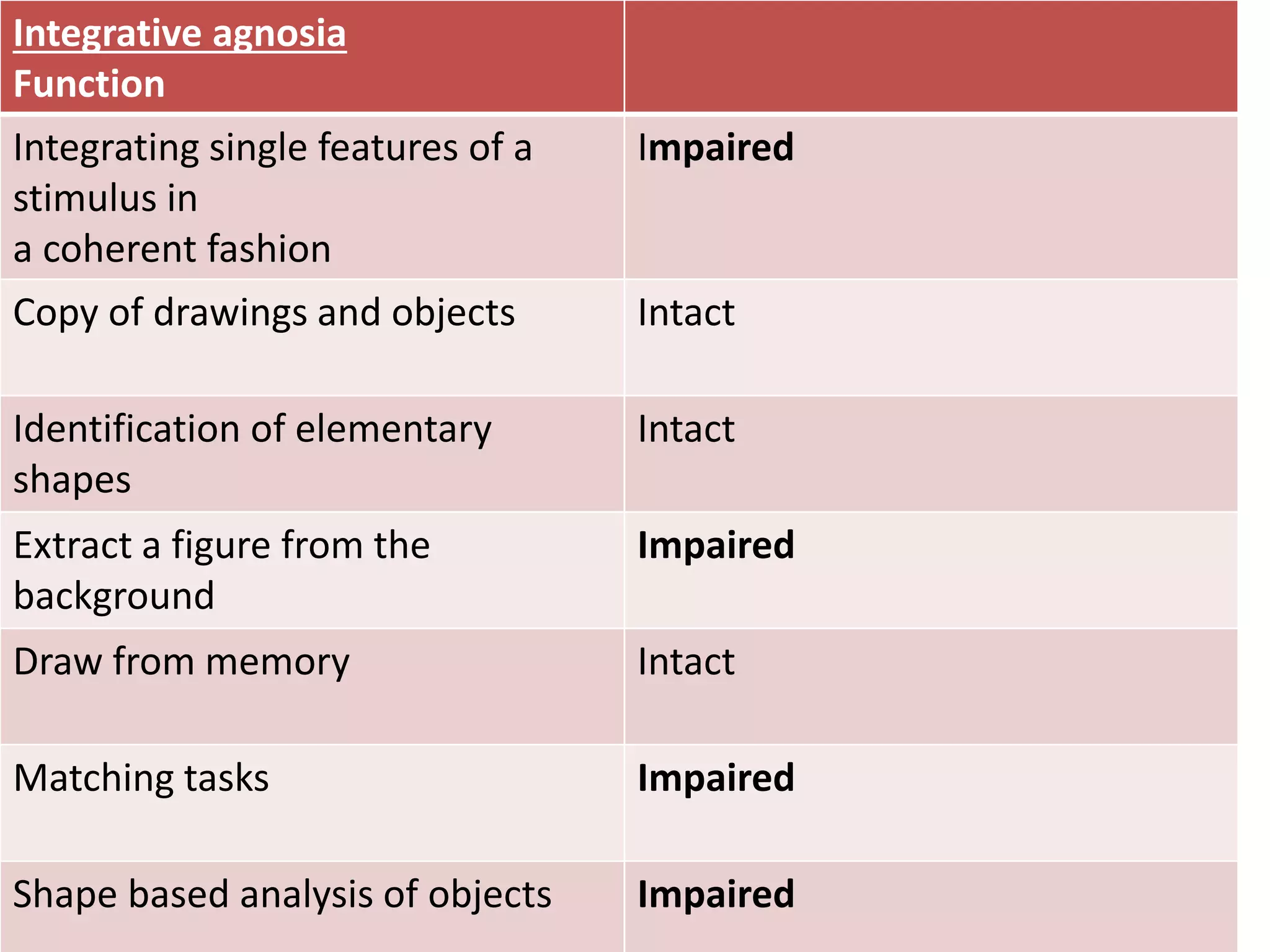
Integrative agnosia
Function
Integrating single features of a
stimulus in
a coherent fashion
Impaired
Copy of drawings and objects Intact
Identification of elementary
shapes
Intact
Extract a figure from the
background
Impaired
Draw from memory Intact
Matching tasks Impaired
Shape based analysis of objects Impaired
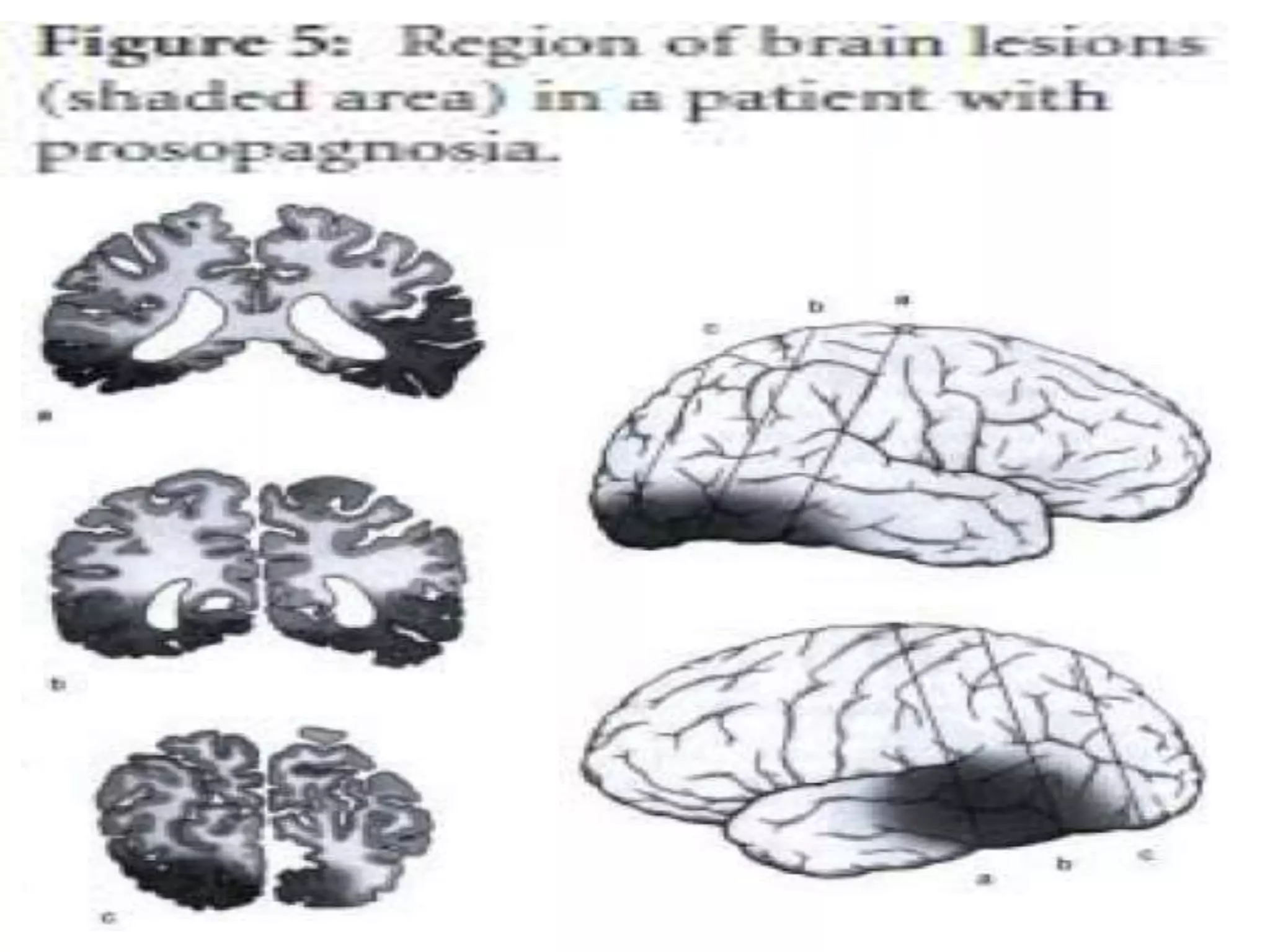
Prosopagnosia
Prosopagnosia is a disorder of face recognition.
 Can identify facial parts
 Can recognize a face as a face
……..No recognition of the person.
• In severe cases, patients cannot recognise their
own face.
• Affected people can use cues such as hairstyle,
glasses and clothing and will recognise the
person as soon as they speak.
Function Anatomical site
Face recognition Right Fusiform gyrus
Object recognition Left occipito-temporal
region
Familiarity matters !
Propasoagnosia
• The Warrington Recognition Memory for Faces (RMF)
• Benton Facial Recognition Test (BFRT) - commercially
available tests that are commonly used
BENTON facial recognition
Simultanagnosia
• Key Features
• Patient cannot apprehend the overall meaning of a picture or
stimulus
• May be able to appreciate and describe isolated elements &
can utilize shape information
• Failure to integrate visual detail into a coherent whole.
• Types
• 1. “dorsal” simultanagnosia (bilateral occipitoparietal lesions);
• - cannot see more than one object at a time
• 2. “ventral” simultanagnosia (left inferior occipital lesions);
• - may be able to “see” more than one object at a time
Dorsal simultagnosia
- may appear blind( bumping into walls and furniture) making
haphazard and uncoordinated movements in attempting to reach
for objects.
- If asked to focus on a small visual area, the patient may describe
this accurately and in great detail.
- Impaired spatial attentional mechanisms (spatial coding defecits)
Dorsal simultagnosia Ventral simultagnosia
Cannot percieve more than 1
stimulus at a time
Reduced ability to recognize
multiple stimuli rapidly
Generalised inability to percieve
multiple stimuli
More impaired while
reading(identify each word letter
by letter)
B/L posterior parietal
oroccipitoparietal lesions
Left posterior temporal or
occipitotemporal regions
Balint’s syndrome
• Balint’s syndrome is a rare disorder consisting of the triad of
dorsal simultanagnosia, gaze apraxia, and optic ataxia.
• It is caused by bilateral occipitoparietal lesions.
• Inability to disengage attention from a specific object or region
in space
Finger agnosia
 Loss of ability to identify, recognize ,differentiate , name select &
orient the individual fingers
 A selective impairment of the body image “ as though the optic-
tactile-kinesthetic image pertaining to the fingers were split off
from the total body image”
Finger agnosia
• Some commit more errors without visual control
• Most evident errors are observed in the index, middle
and ring fingers.
• A mild form of autotopagnosia
• Finger agnosia and acalculia sites were found in the
supramarginal gyrus or close to the intraparietal
sulcus.
Finger agnosia
• Gerstmann called the agraphia and finger agnosia
“Kardinalsymptome” (cardinal symptoms)
• Symptoms of Gerstmann syndrome had some localizing
value related to the left side of the lesion and to the
posterior parasylvian area, but the lesions were spread
“widely over the parietal, temporal and occipital lobes”.
• Accompanied by “numerous other neurological deficits,
notably dysphasia” and all patients were aphasic
Color agnosia
• Because colors can only appreciated visually, the status of ‘color
agnosia’ as a true agnosic deficit has been difficult to establish.
• Nonetheless, four classes of patients have been identified with
disproportional impairment in recognizing, naming, or otherwise
utilizing color information
• Color Agnosia
- central achromatopsia
- color anomia
- specific color aphasia
- color agnosia
Central achromatopsia
• Acquired deficit in color vision due to CNS disease.
• Cannot match, discriminate, or name colors.
• Bilateral occipital-temporal or right non-dominant lesions,
involving lingual or fusiform gyri ; sparing of the calcarine cortex
• Cone system and fibres carrying color information remain intact.
This indicates that the mechanism used to construct colors is
defective.
• Isihara color plates
Central achromatopsia
• Color perception area – lateral aspect of the collateral sulcus
on the fusiform gyrus
Isihara color plate reading Impaired
Sorting colors according to
HUE
Impaired
Color anomia
• Specific difficulty in naming colors
• Usually found in the context of right homonymous hemianopia
and pure alexia
• Posterior left hemisphere lesion- inferior medial aspect of
Occipitotemporal lobe(left mesialsubsplenial area)
Color anomia features
Read isihara color plates Yes
Sort colors according to HUE Yes
Point to a named color No
Naming a color No
• Specific color aphasia: seen in the context of aphasia, represents
a disproportionate difficulty in naming colors; suspect left
(dominant) parietal lobe damage
• Color agnosia: this is a residual category of patients who have
difficulty appreciating the nature or name of color they see, but
who do not fall within the categories above
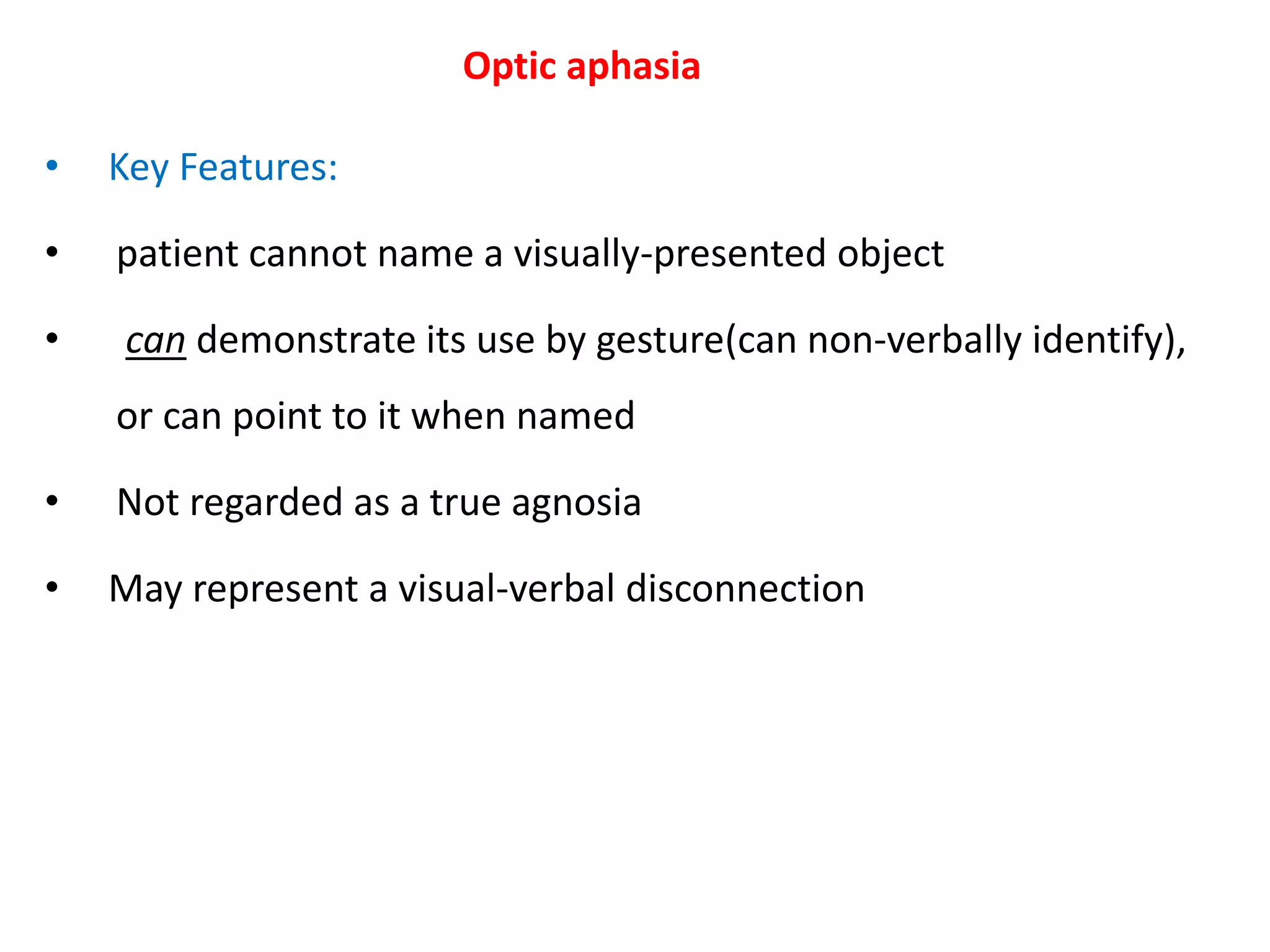
Optic aphasia
• Key Features:
• patient cannot name a visually-presented object
• can demonstrate its use by gesture(can non-verbally identify),
or can point to it when named
• Not regarded as a true agnosia
• May represent a visual-verbal disconnection
CLINICAL APPROACH TO AGNOSIAS
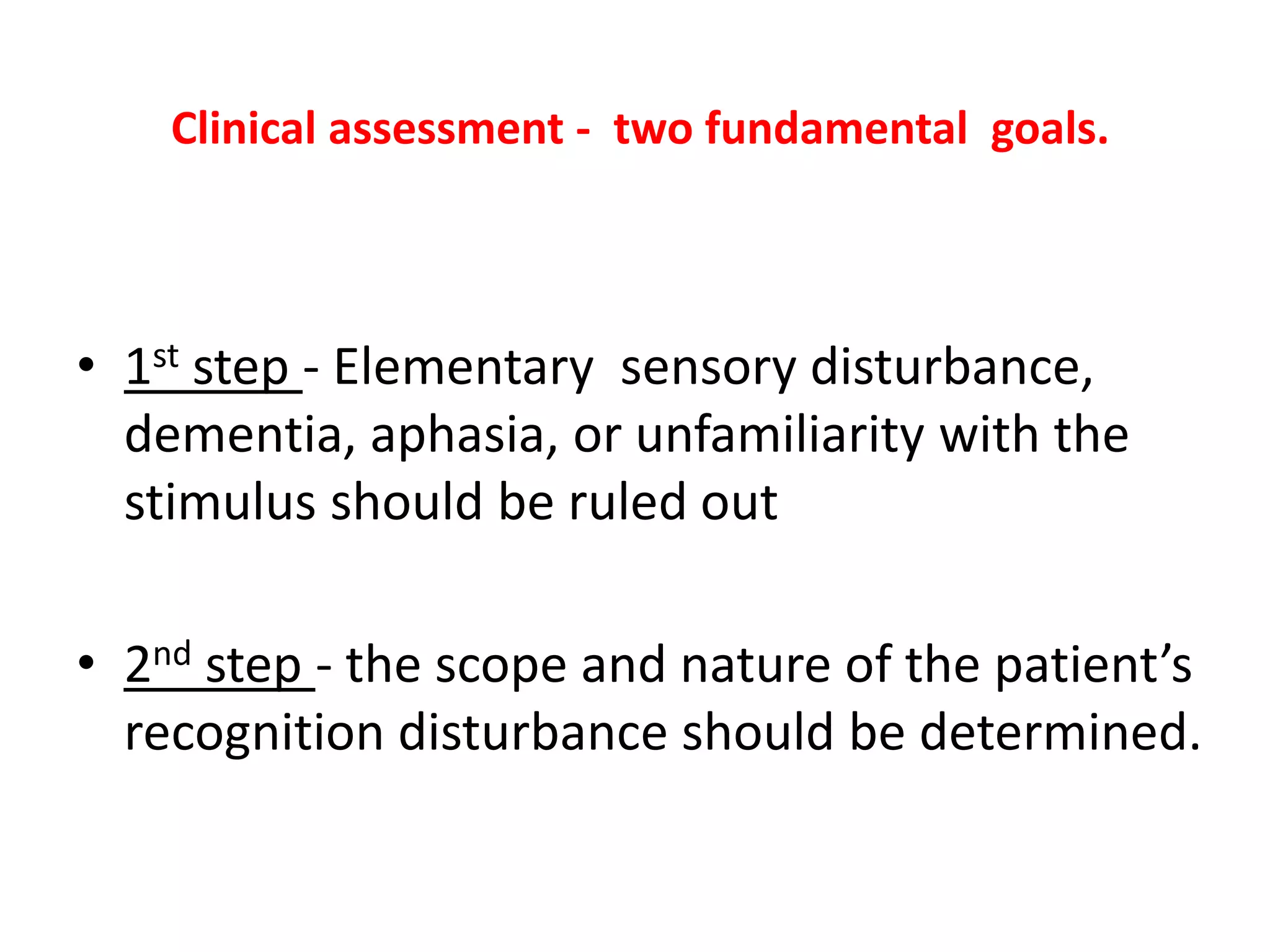
Clinical assessment - two fundamental goals.
• 1st step - Elementary sensory disturbance,
dementia, aphasia, or unfamiliarity with the
stimulus should be ruled out
• 2nd step - the scope and nature of the patient’s
recognition disturbance should be determined.
• Does the recognition disturbance exist only for
certain stimuli or classes of stimuli?
• Is it restricted to a particular sensory
modality?
• Under what conditions (if any) can the patient
recognize stimuli?
• “Pure” forms of these disorders are quite rare
• the etiology of the patient’s disorder and/or
the stage of recovery (if acute onset) will
determine the observed pattern of deficits.
Auditory agnosias
1. Cortical Auditory Disorder and Cortical Deafness
2. Pure Word Deafness
3. Auditory Sound Agnosia (Auditory Agnosia for Nonspeech
Sounds)
4. Sensory (Receptive) Amusia.
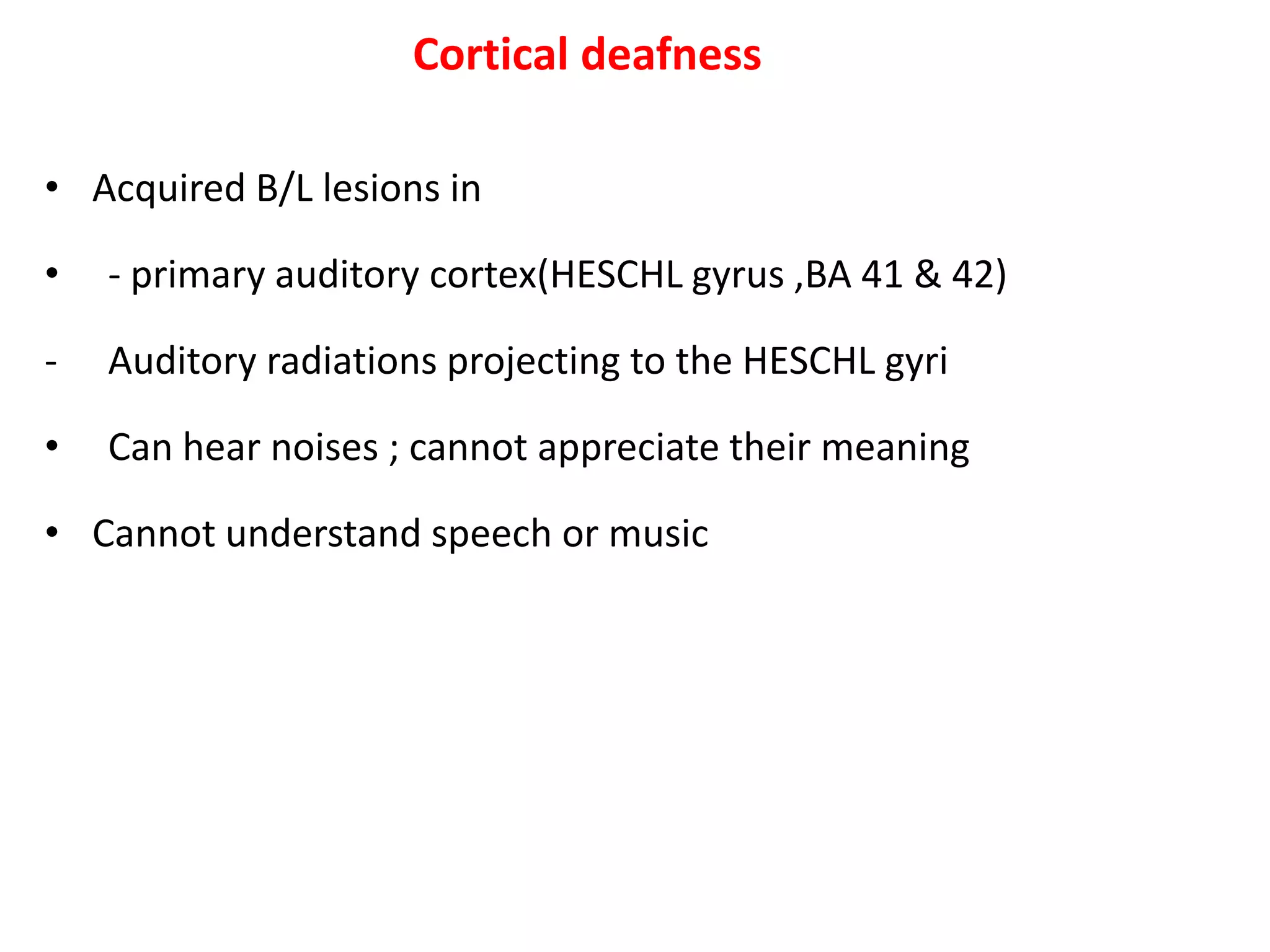
Cortical deafness
• Acquired B/L lesions in
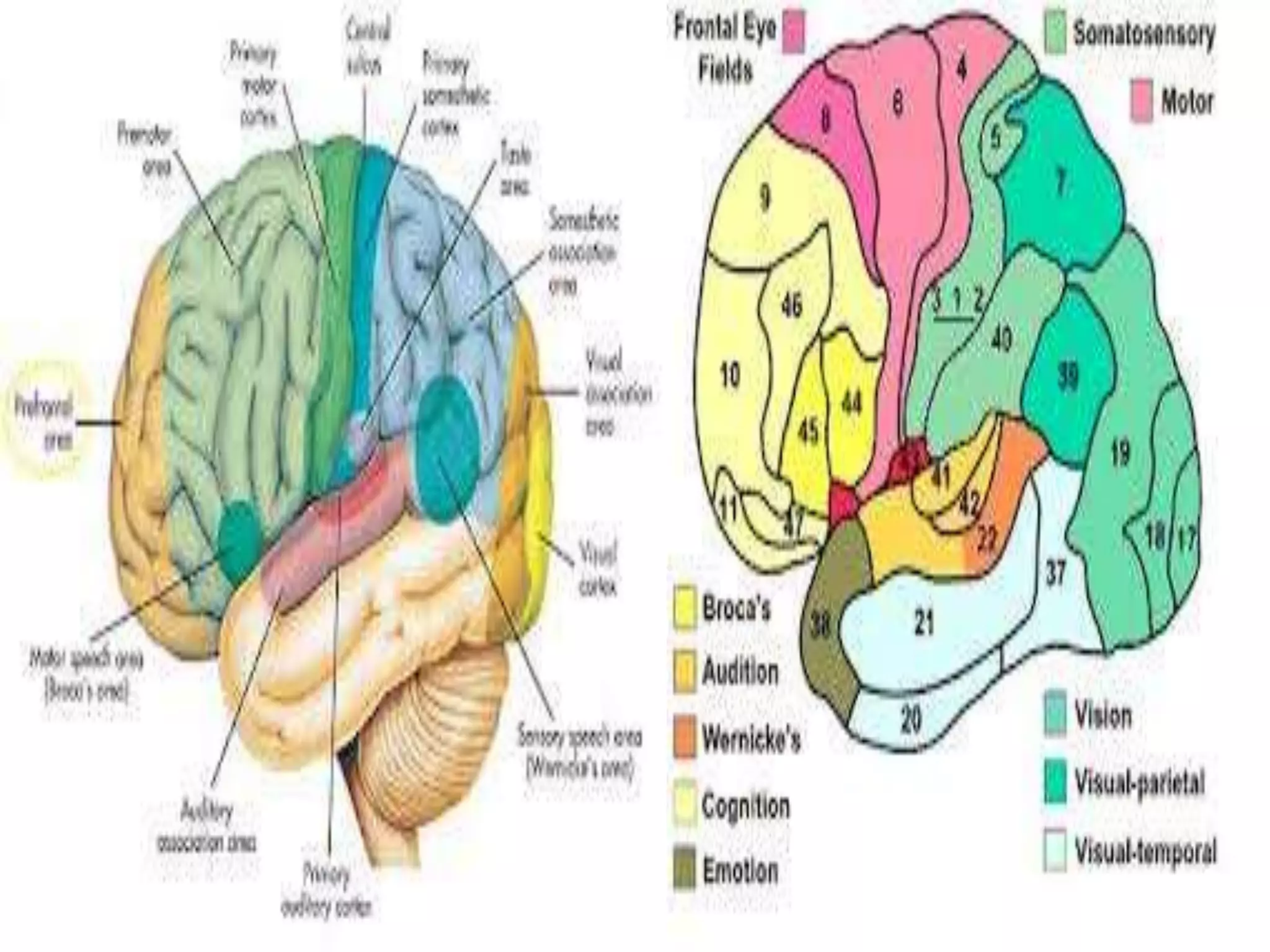
• - primary auditory cortex(HESCHL gyrus ,BA 41 & 42)
- Auditory radiations projecting to the HESCHL gyri
• Can hear noises ; cannot appreciate their meaning
• Cannot understand speech or music
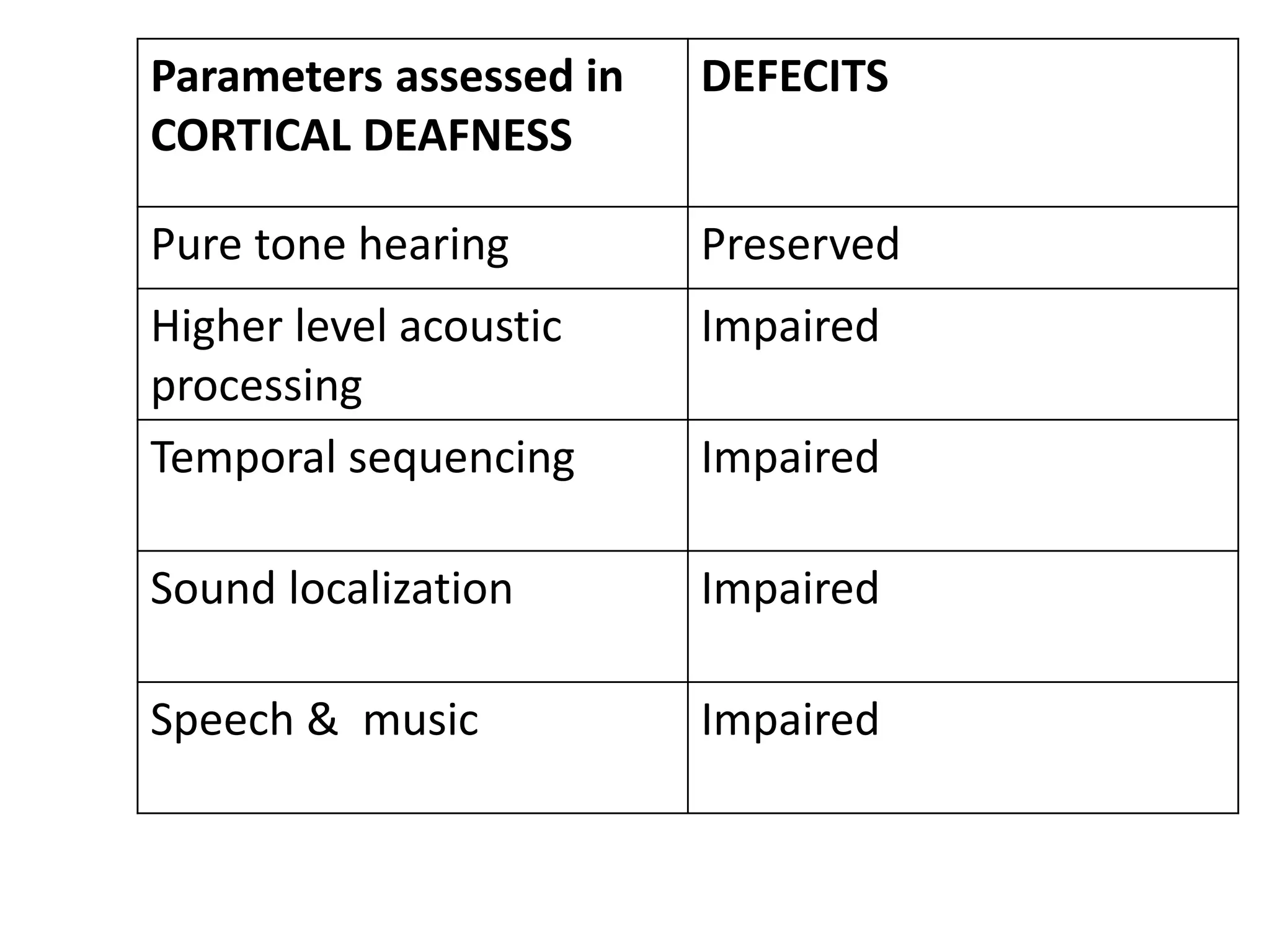
Parameters assessed in
CORTICAL DEAFNESS
DEFECITS
Pure tone hearing Preserved
Higher level acoustic
processing
Impaired
Temporal sequencing Impaired
Sound localization Impaired
Speech & music Impaired
Pure word deafness
• Primary auditory cortex
Wernicke’s
area
Comprehension of
spoken words
Impaired
Non-verbal sounds Can recognize
Reading , writing ,
spoken speech
Intact
AUDITORY NONVERBAL AGNOSIA Meaningful non-verbal sounds
– cannot identify
Pure –tone hearing - preserved
Language comprehension –
preserved
B/L temporal lobe lesions
PHONOSOGNOSIA Recognition of familiar voices –
impaired
Emotional intonation of speech
– cannot percieve [auditory
affective agnosia]
Right parietal lesion
Auditory nonverbal agnosia
• Varieties of Auditory Sound Agnosia
• 1. perceptual-discriminative form: makes predominantly
acoustic errors (e.g., “whistling” for birdsong)
• 2. semantic-associative form: makes predominantly semantic
errors (e.g., “train” for automobile engine)
Music agnosia
• A 2 stage process
1) Failure to encode melodic information (defined by
sequential variations in pitch)
• - Lesion site = > Right STG
o Familiar music passage
• stored representations
Music agnosia
Long-term memory representations are intact .
Can sing from memory
A perceptual melodic impairment
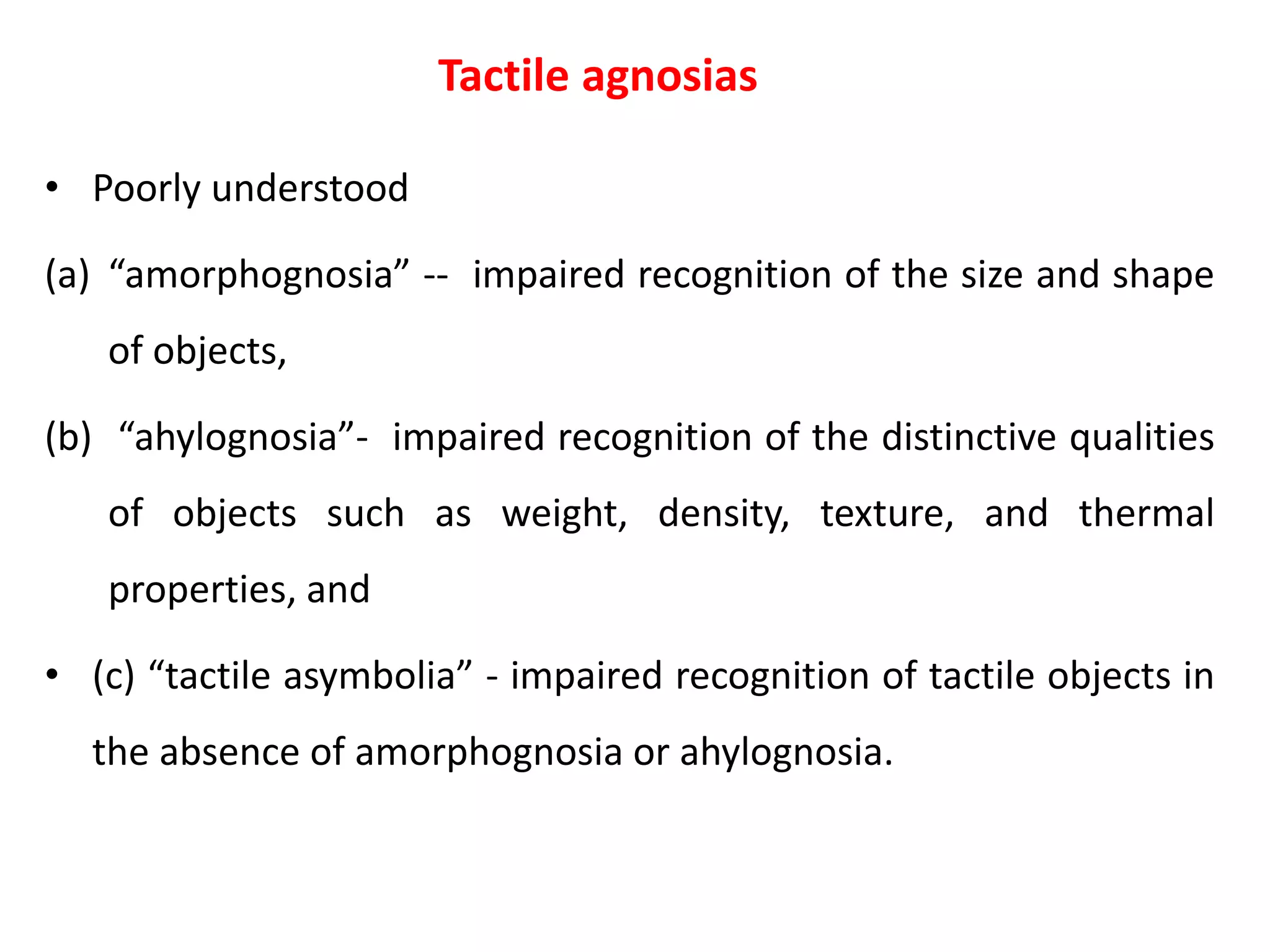
Tactile agnosias
• Poorly understood
(a) “amorphognosia” -- impaired recognition of the size and shape
of objects,
(b) “ahylognosia”- impaired recognition of the distinctive qualities
of objects such as weight, density, texture, and thermal
properties, and
• (c) “tactile asymbolia” - impaired recognition of tactile objects in
the absence of amorphognosia or ahylognosia.
Cortical tactile disorders
• Key Features - size, shape, weight, or spatial configuration of
tactually presented objects : failure of appreciation
• No hemispheric specialization exists in elementary
somatosensory function, but patients with right hemisphere
disease may have difficulty in performing the spatial component
of many tactile discrimination tasks.
Test for TACTILE agnosia Type of defecit
Identification of objects placed in
the hand – key common feature
Impaired
Deficit exists in both hands Agnostic deficit - a central
defect in processing the nature of
a stimulus); cannot demonstrate
use of object through gesture
Deficit exists in one (usually left)
hand
a “visual-verbal
disconnection”; can demonstrate
use of the object, and can
name the object if placed in the
other hand
Anton’s syndrome
• Denial of blindness
• B/L diffuse lesions of medial occipital lobes
• Confabulation +
Anosognosia
• Mechanisms of anosognosia
• Thalamic involvement or secondary to disruption of thalamic
connections to right parietal asssociation cortex
• Extension of lesion beyond calcarine cortex to involve visual
association cortices
Thank you

Agnosia ppt

  • 1.
  • 2.
    Introduction • Gnosis essentiallymeans “ to know ”. • Agnosia means “ without knowledge ” • Unable to recognize or appreciate the identity or nature of sensory stimuli • The term Agnosia was coined by Sigmund Freud in 1891. • Lissaeuer (1890) made a distinction between a deficit in the ability to perceive stimuli consciously and a deficit reflecting an inability to ascribe meaning to what is perceived, a disorder he referred to as Seelenblindheit, or “soul blindness”
  • 3.
    Introduction • An exampleof agnosia is Oliver Sacks’ patient, who not only failed to recognize his wife’s face but also mistook it for a hat. • Milner and Teuber in 1968, referred to agnosia as a “normal percept stripped of its meaning.” • Criteria for the diagnosis of agnosia include: (1) failure to recognize an object (2) normal perception of the object, excluding an elementary sensory disorder (3) ability to name the object once it is recognized, excluding anomia as the principal Deficit and (4) absence of a generalized dementia
  • 4.
    Introduction • Agnosia resultsfrom lesions that disconnect and isolate visual, auditory and somatosensory input from higher level processing. • Defined as profound, modality-specific recognition impairment in the presence of normal primary sensory function that cannot be fully explained by: • - mental deterioration, • - attentional disturbances, • - unfamiliarity with the stimuli used to assess recognition abilities
  • 7.
    Classification • Agnosia canbe classified according to the modality as • Visual • Auditory • Tactile
  • 8.
  • 10.
    Visual processing • Extrastriateregions group into two streams: 1. Ventral occipitotemporal ‘‘what’’ stream is involved in object recognition 2. Dorsal occipitoparietal ‘‘where’’ stream is involved in spatial processing. • Integration of ventral and dorsal stream information occurs at the level of the inferior parietal lobule • Aids in object recognition and provides information regarding its location in space (functional knowledge)
  • 12.
    Disorders of ventralstream • Agnosias • Alexia • Disorders of face perception • Disorders of color - Achromatopsia - Color agnosia - Color anomia
  • 13.
    Deficits of dorsalstream Disorders of motion perception -associated with damage to areas of extrastriate visualcortex analogous to V5.[“OPTIC ATAXIA”] Disorders of spatial perception -Balint syndrome -Dressing apraxia and constructional ‘‘apraxia’’ • Confusingly, these are not apraxias as such, but are rather visuospatial deficits .
  • 14.
    Visual agnosias 1) VisualObject Agnosia. - associative - apperceptive 2) Simultanagnosia. - dorsal - ventral 3) Prosopagnosia.
  • 15.
    4) Color Agnosia. -central achromatopsia - color anomia - specific color aphasia - color agnosia 5) Optic Aphasia.
  • 16.
    Apperceptive visual agnosia •Visual ability on a basic sensory level – INTACT • Defect in early stage visual processing prevents a correct percept of the stimulus being formed. • Structure or spatial properties of a visual stimuli – IMPAIRED • Object is not seen as a whole or in a meaningful way.
  • 17.
    • Visual matching •Discriminating shapes IMPAIRED • Comparing similar figures • Copying drawings
  • 18.
    Apperceptive agnosia features Complete visualpercept Not formed VA Brightness discrimination Color vision & texture INTACT -MATCHING -COPYING -DISCRIMINATION of simple from complex shapes IMPAIRED Recognize objects in motion / actions depicted in line drawings INTACT
  • 19.
    • Stroke, anoxiaand carbon monoxide poisoning are common causes and it is often associated with diffuse, posterior lesions. • Useful tests are incomplete letters, object decision and silhouettes sub-tests from the Visual Orientation and Space Perception Battery (VOSP), the Gollin Figures.
  • 21.
  • 23.
    Associative visual agnosia •Primary sensory and early visual processing systems are preserved. • CANNOT interpret, understand or assign meaning to the object, face or word • Bilateral damage to the inferior temporo-occipital junction and subjacent white matter. • It is more common than apperceptive visual agnosia.
  • 24.
    • Able tocopy objects and pictures, often with great accuracy, • Assessed by presenting the patient with pictures of objects and asking them to name, describe functions and sort according to use or category to which they belong.
  • 28.
    Disorder Error Anomia “it’sfound in Australia, it jumps…can’t think of its name,” demonstrating intact recognition. Associative VFA Unable to name or recognise a picture of a kangaroo - No difficulty naming and describing the characteristics of a kangaroo if requested via the auditory modality.
  • 29.
    Integrative agnosia • ASSOCIATIVEAGNOSIA SUBTYPE – basic ,local visual elements are processed in a normal way but the integration of these elements into a unitary whole is impaired • Problem with shape-matching tasks requiring semantic information; • No trouble copying objects; • Recognized objects in isolation, but had great difficulty when the contours of 2 objects overlapped
  • 30.
    • Integrative agnosiadeficits in the recognition of objects due to the failure to group and integrate the component parts into a coherent whole; • Patients with this deficit can faithfully reproduce drawings of objects, however their percept is of isolated, unconnected parts or contours
  • 31.
  • 32.
  • 33.
    Integrative agnosia Function Integrating singlefeatures of a stimulus in a coherent fashion Impaired Copy of drawings and objects Intact Identification of elementary shapes Intact Extract a figure from the background Impaired Draw from memory Intact Matching tasks Impaired Shape based analysis of objects Impaired
  • 34.
    Prosopagnosia Prosopagnosia is adisorder of face recognition.  Can identify facial parts  Can recognize a face as a face ……..No recognition of the person.
  • 35.
    • In severecases, patients cannot recognise their own face. • Affected people can use cues such as hairstyle, glasses and clothing and will recognise the person as soon as they speak.
  • 36.
    Function Anatomical site Facerecognition Right Fusiform gyrus Object recognition Left occipito-temporal region
  • 39.
  • 40.
    Propasoagnosia • The WarringtonRecognition Memory for Faces (RMF) • Benton Facial Recognition Test (BFRT) - commercially available tests that are commonly used
  • 41.
  • 42.
    Simultanagnosia • Key Features •Patient cannot apprehend the overall meaning of a picture or stimulus • May be able to appreciate and describe isolated elements & can utilize shape information • Failure to integrate visual detail into a coherent whole.
  • 43.
    • Types • 1.“dorsal” simultanagnosia (bilateral occipitoparietal lesions); • - cannot see more than one object at a time • 2. “ventral” simultanagnosia (left inferior occipital lesions); • - may be able to “see” more than one object at a time
  • 44.
    Dorsal simultagnosia - mayappear blind( bumping into walls and furniture) making haphazard and uncoordinated movements in attempting to reach for objects. - If asked to focus on a small visual area, the patient may describe this accurately and in great detail. - Impaired spatial attentional mechanisms (spatial coding defecits)
  • 45.
    Dorsal simultagnosia Ventralsimultagnosia Cannot percieve more than 1 stimulus at a time Reduced ability to recognize multiple stimuli rapidly Generalised inability to percieve multiple stimuli More impaired while reading(identify each word letter by letter) B/L posterior parietal oroccipitoparietal lesions Left posterior temporal or occipitotemporal regions
  • 46.
    Balint’s syndrome • Balint’ssyndrome is a rare disorder consisting of the triad of dorsal simultanagnosia, gaze apraxia, and optic ataxia. • It is caused by bilateral occipitoparietal lesions. • Inability to disengage attention from a specific object or region in space
  • 47.
    Finger agnosia  Lossof ability to identify, recognize ,differentiate , name select & orient the individual fingers  A selective impairment of the body image “ as though the optic- tactile-kinesthetic image pertaining to the fingers were split off from the total body image”
  • 48.
    Finger agnosia • Somecommit more errors without visual control • Most evident errors are observed in the index, middle and ring fingers. • A mild form of autotopagnosia • Finger agnosia and acalculia sites were found in the supramarginal gyrus or close to the intraparietal sulcus.
  • 49.
    Finger agnosia • Gerstmanncalled the agraphia and finger agnosia “Kardinalsymptome” (cardinal symptoms) • Symptoms of Gerstmann syndrome had some localizing value related to the left side of the lesion and to the posterior parasylvian area, but the lesions were spread “widely over the parietal, temporal and occipital lobes”. • Accompanied by “numerous other neurological deficits, notably dysphasia” and all patients were aphasic
  • 50.
    Color agnosia • Becausecolors can only appreciated visually, the status of ‘color agnosia’ as a true agnosic deficit has been difficult to establish. • Nonetheless, four classes of patients have been identified with disproportional impairment in recognizing, naming, or otherwise utilizing color information
  • 51.
    • Color Agnosia -central achromatopsia - color anomia - specific color aphasia - color agnosia
  • 52.
    Central achromatopsia • Acquireddeficit in color vision due to CNS disease. • Cannot match, discriminate, or name colors. • Bilateral occipital-temporal or right non-dominant lesions, involving lingual or fusiform gyri ; sparing of the calcarine cortex
  • 53.
    • Cone systemand fibres carrying color information remain intact. This indicates that the mechanism used to construct colors is defective. • Isihara color plates
  • 54.
    Central achromatopsia • Colorperception area – lateral aspect of the collateral sulcus on the fusiform gyrus Isihara color plate reading Impaired Sorting colors according to HUE Impaired
  • 55.
    Color anomia • Specificdifficulty in naming colors • Usually found in the context of right homonymous hemianopia and pure alexia • Posterior left hemisphere lesion- inferior medial aspect of Occipitotemporal lobe(left mesialsubsplenial area)
  • 56.
    Color anomia features Readisihara color plates Yes Sort colors according to HUE Yes Point to a named color No Naming a color No
  • 57.
    • Specific coloraphasia: seen in the context of aphasia, represents a disproportionate difficulty in naming colors; suspect left (dominant) parietal lobe damage • Color agnosia: this is a residual category of patients who have difficulty appreciating the nature or name of color they see, but who do not fall within the categories above
  • 58.
    Optic aphasia • KeyFeatures: • patient cannot name a visually-presented object • can demonstrate its use by gesture(can non-verbally identify), or can point to it when named • Not regarded as a true agnosia • May represent a visual-verbal disconnection
  • 60.
  • 61.
    Clinical assessment -two fundamental goals. • 1st step - Elementary sensory disturbance, dementia, aphasia, or unfamiliarity with the stimulus should be ruled out • 2nd step - the scope and nature of the patient’s recognition disturbance should be determined.
  • 62.
    • Does therecognition disturbance exist only for certain stimuli or classes of stimuli? • Is it restricted to a particular sensory modality? • Under what conditions (if any) can the patient recognize stimuli?
  • 63.
    • “Pure” formsof these disorders are quite rare • the etiology of the patient’s disorder and/or the stage of recovery (if acute onset) will determine the observed pattern of deficits.
  • 66.
    Auditory agnosias 1. CorticalAuditory Disorder and Cortical Deafness 2. Pure Word Deafness 3. Auditory Sound Agnosia (Auditory Agnosia for Nonspeech Sounds) 4. Sensory (Receptive) Amusia.
  • 67.
    Cortical deafness • AcquiredB/L lesions in • - primary auditory cortex(HESCHL gyrus ,BA 41 & 42) - Auditory radiations projecting to the HESCHL gyri • Can hear noises ; cannot appreciate their meaning • Cannot understand speech or music
  • 68.
    Parameters assessed in CORTICALDEAFNESS DEFECITS Pure tone hearing Preserved Higher level acoustic processing Impaired Temporal sequencing Impaired Sound localization Impaired Speech & music Impaired
  • 69.
    Pure word deafness •Primary auditory cortex Wernicke’s area Comprehension of spoken words Impaired Non-verbal sounds Can recognize Reading , writing , spoken speech Intact
  • 70.
    AUDITORY NONVERBAL AGNOSIAMeaningful non-verbal sounds – cannot identify Pure –tone hearing - preserved Language comprehension – preserved B/L temporal lobe lesions PHONOSOGNOSIA Recognition of familiar voices – impaired Emotional intonation of speech – cannot percieve [auditory affective agnosia] Right parietal lesion
  • 71.
    Auditory nonverbal agnosia •Varieties of Auditory Sound Agnosia • 1. perceptual-discriminative form: makes predominantly acoustic errors (e.g., “whistling” for birdsong) • 2. semantic-associative form: makes predominantly semantic errors (e.g., “train” for automobile engine)
  • 72.
    Music agnosia • A2 stage process 1) Failure to encode melodic information (defined by sequential variations in pitch) • - Lesion site = > Right STG o Familiar music passage • stored representations
  • 73.
    Music agnosia Long-term memoryrepresentations are intact . Can sing from memory A perceptual melodic impairment
  • 74.
    Tactile agnosias • Poorlyunderstood (a) “amorphognosia” -- impaired recognition of the size and shape of objects, (b) “ahylognosia”- impaired recognition of the distinctive qualities of objects such as weight, density, texture, and thermal properties, and • (c) “tactile asymbolia” - impaired recognition of tactile objects in the absence of amorphognosia or ahylognosia.
  • 75.
    Cortical tactile disorders •Key Features - size, shape, weight, or spatial configuration of tactually presented objects : failure of appreciation • No hemispheric specialization exists in elementary somatosensory function, but patients with right hemisphere disease may have difficulty in performing the spatial component of many tactile discrimination tasks.
  • 76.
    Test for TACTILEagnosia Type of defecit Identification of objects placed in the hand – key common feature Impaired Deficit exists in both hands Agnostic deficit - a central defect in processing the nature of a stimulus); cannot demonstrate use of object through gesture Deficit exists in one (usually left) hand a “visual-verbal disconnection”; can demonstrate use of the object, and can name the object if placed in the other hand
  • 77.
    Anton’s syndrome • Denialof blindness • B/L diffuse lesions of medial occipital lobes • Confabulation +
  • 78.
    Anosognosia • Mechanisms ofanosognosia • Thalamic involvement or secondary to disruption of thalamic connections to right parietal asssociation cortex • Extension of lesion beyond calcarine cortex to involve visual association cortices
  • 80.