Blink Reflex


BY: SYED IRSHAD MURTAZA
      TECHNOLOGIST
    NEUROPHYSIOLOGY
          AKUH
         KARACHI

     Date: 18-07-2012
IM 18-07-
  2012.
• Definition:-
Reflex is an efferent response to an afferent
  stimulation.
• Its also known as reflex arc response because
  there is an afferent segment, synapses with
  inter-neurons and then there is an efferent
  limb, all these making an arc of activity hence
  called Reflex Arc Response.


                                            IM 18-07-
                                              2012.
INTRODUCTION :
Blink reflex is essentially the electrical
correlate of the clinically evoked corneal
reflex.
Blink reflex is capable of evaluating the cranial
nerves and their proximal segments.
The afferent limb of blink reflex is ophthalmic
division of trigeminal (V) nerve (which can be
stimulated mechanically or electrically) and
the facial (VII) nerve mediates the efferent
arc.
                                              IM 18-07-
                                                2012.
Advantages
• The blink reflex study is          a useful
  electrophysiological technique     for the
  evaluation of patients with:

• ● Involvement of trigeminal or facial nerve.
• ● Variety of demyelinating polyneuropathies
• ● Central Lesion in the Brainstem


                                            IM 18-07-
                                              2012.
Anatomy
• The afferent limb of the blink reflex is
  mediated by sensory fibers of the supraorbital
  branch of the ophthalmic division of the
  trigiminal nerve (V) and the efferent limb by
  motor fibers of the facial nerve (VII).
• Just as with the corneal reflex, ipsilateral
  electrical stimulation of the supraorbital
  branch of the trigiminal nerve elicits a facial
  nerve (eye blink) response bilaterally.

                                             IM 18-07-
                                               2012.
Application Methods
Position of Patient:
Lying on the couch with eyes closed.
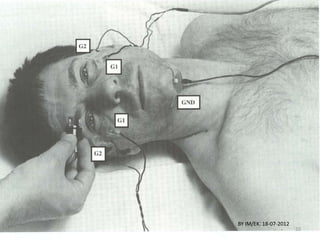
Recording Electrodes :
Active electrode placed laterally over the
  orbicularis occuli muscles
Reference placed on the side of the nose, OR
  Chin.
 Ground Electrode : Placed submentally on the
  neck or forehead.
                                         IM 18-07-
                                           2012.
Stimulating Site

Supraorbital nerve is stimulated which is the
  branch of Trigeminal Nerve (Cranial Nerve V)
  with cathode placed over the supra-orbital
  foramen/notch on one side and anode placed
  on the forehead.


                                          IM 18-07-
                                            2012.
PARAMETERS
SWEEP TIMEVE/LOCITY: 5-10 (msec/div)
• SENSITIVITY: 200 (µv/div)
• FILTERS: (HFF:20Hz, LFF: 10KHz)
• STIMULATION DURATION/RATE: 0.01msec/2 Hz
• INTERVAL : Between successive stimuli is set at
  atleast 30 sec to minimize interactions between
  them.
• (If R1 is not recorded easily, reduce the
  interstimulus interval to 5msec so that facilitation
  resulting from first stimulus permits R1 to be
  elicited.)

                                                  IM 18-07-
                                                    2012.
BY IM/EK. 18-07-2012
                       10
Response to Electrical Stimulus
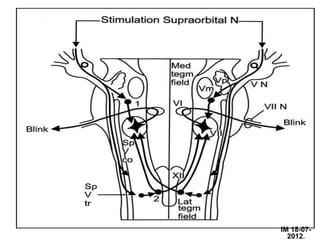
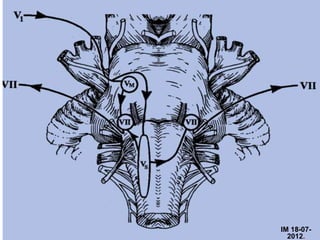
• Stimulation of the ipsilateral supraorbital
  nerve results in an afferent response along the
  trigiminal nerve to both the main sensory
  nucleus of V (mid Pons) and the nucleus of the
  spinal tract of V (lower Pons and medulla) in
  the brain stem.
• Through a series of interneuron’s in the Pons
  and lateral medulla, the nerve impulse next
  reaches the ipsilateral and contralateral facial
  nuclei, from which the efferent signal travels
  along the facial nerve bilaterally.
                                              IM 18-07-
                                                2012.
IM 18-07-
    12
  2012.
REFLEX RESPONSE
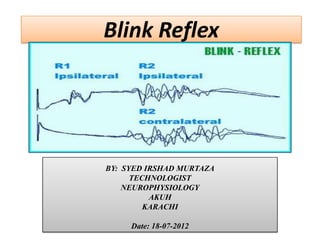
• Two distinct components are there, which as following

1. EARLY R1
2. LATER R2

• 1. EARLY R1 COMPONENT:

• Elicited only on the side that is stimulated. Relatively
  stable. Short lasting and of low amplitude. A disynaptic
  pathway between the main sensory nucleus of the
  trigeminal nerve and the ipsilateral facial nucleus.
                                                     IM 18-07-
                                                       2012.
Cont,
2. LATER R2 COMPONENT

Present on both sides following unilateral
stimulation.
More variable.
Long lasting and of higher amplitude.
A polysynaptic connections between the spinal
nucleus of the trigeminal nerve and bilateral
facial nucleus.
                                         IM 18-07-
                                           2012.
REFLEX RESPONSE
• EARLY R1 COMPONENT:
•  If latency > 13ms, then its abnormal
• Interside difference in latency < 1.2ms.
• LATER R2 COMPONENT:
•  If ipsilateral latency > 41ms and contralateral
  latency > 44ms, then its abnormal.
• The latency difference between ipsilateral and
  contralateral response recorded simultaneously
  following unilateral stimulation is < 5ms.
• The latency difference between R2 evoked by
  stimulation on each side in turn should be < 7ms.
                                              IM 18-07-
                                                2012.
REFLEX RESPONSE
• EARLY R1 COMPONENT:
• Delay or absence indicates a disturbance of
  trigeminal or facial nerve or both on that side.
• LATER R2 COMPONENT:
• Involvement of R2 indicates the site of lesion
  when R1 is abnormal.
• Trigeminal nerve lesions is characterized by
  bilateral delay or attenuation of R2 when the
  affected side of the face is stimulated.
• Facial nerve lesions is characterized by delay of R2
  on the affected side, whichever side is stimulated.
                                                 IM 18-07-
                                                   2012.
BLINK REFLEX INDICATION
• Facial /Bells palsy (facial paralysis resulting from a dysfunction of the cranial nerve
  VII (the facial nerve)

• Polyneuropathy
• Lesions of the V nerve
• Synkinesis of facial muscles (involuntary movements due to miswiring of
   nerves after trauma)
• Hemi facial spasm (frequent involuntary contractions)
• Acoustic neuroma (slow-growing tumor of the nerve that connects the ear to
  the brain (cochlear nerve))

• Lesions in brain stem and spinal cord
• Multiple Sclerosis (a chronic autoimmune disorder affecting movement,
   sensation, and bodily functions, caused by destruction of the myelin insulation covering
   nerve fibers (neurons) in the CNS )
• Wallenberg syndrome                    (difficulty in swallowing and hoarseness due
   to paralysis of the ipsilateral vocal cord.)
                                                                                 IM 18-07-
                                                                                   2012.
CLINICAL APPLICATION
In Bell’s Palsy, the response is initially nearly
normal becoming abnormal after few days. R1 -
delayed or abnormal during the first few weeks
suggesting demyelination.
In certain polyneuropathies - Direct response
and R1 component delayed.
In comatose patients and acute phase of CVA -
R2 delayed.


                                             IM 18-07-
                                               2012.
CLINICAL APPLICATION
• In hemifacial spasm or facial synkinesis following
  aberrant reinnervation there is spread of blink
  reflex into muscles other than orbicularis oris.
• In multiple sclerosis, the R1- delayed on one or
  both the sides and alterations in the R2
  component is less specific. And if R2 is abnormal
  (with normal R1), it is suggestive of lateral
  medullary lesion.
• In Wallenberg’s syndrome, the R1 - normal and
  R2 - delayed or absent bilaterally with the
  stimulation of the affected side of the face
                                                 IM 18-07-
                                                   2012.
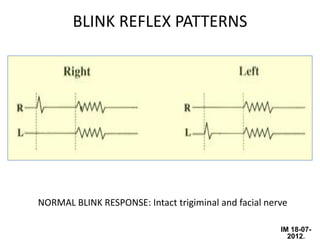
BLINK REFLEX PATTERNS


NORMAL BLINK RESPONSE: Intact trigiminal and facial nerve

                                                       IM 18-07-
                                                         2012.
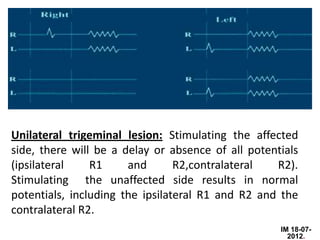
Unilateral trigeminal lesion: Stimulating the affected
side, there will be a delay or absence of all potentials
(ipsilateral    R1     and       R2,contralateral  R2).
Stimulating the unaffected side results in normal
potentials, including the ipsilateral R1 and R2 and the
contralateral R2.
                                                    IM 18-07-
                                                      2012.
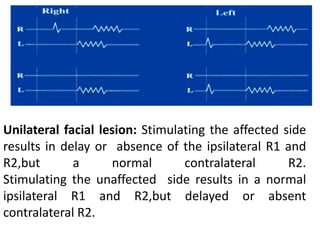
Unilateral facial lesion: Stimulating the affected side
results in delay or absence of the ipsilateral R1 and
R2,but       a      normal       contralateral      R2.
Stimulating the unaffected side results in a normal
ipsilateral R1 and R2,but delayed or absent
contralateral R2.
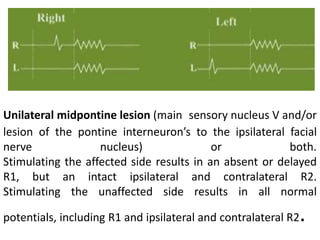
Unilateral midpontine lesion (main sensory nucleus V and/or
lesion of the pontine interneuron’s to the ipsilateral facial
nerve              nucleus)               or            both.
Stimulating the affected side results in an absent or delayed
R1, but an intact ipsilateral and contralateral R2.
Stimulating the unaffected side results in all normal

                                                            .
potentials, including R1 and ipsilateral and contralateral R2
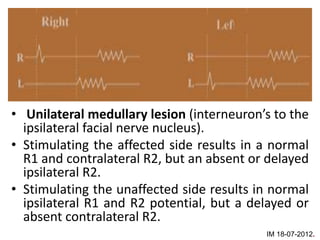
• Unilateral medullary lesion (interneuron’s to the
  ipsilateral facial nerve nucleus).
• Stimulating the affected side results in a normal
  R1 and contralateral R2, but an absent or delayed
  ipsilateral R2.
• Stimulating the unaffected side results in normal
  ipsilateral R1 and R2 potential, but a delayed or
  absent contralateral R2.
                                           IM 18-07-2012.
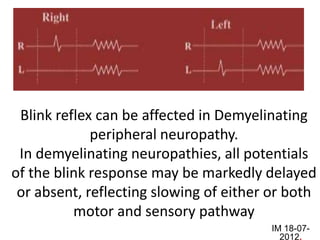
Blink reflex can be affected in Demyelinating
             peripheral neuropathy.
 In demyelinating neuropathies, all potentials
of the blink response may be markedly delayed
 or absent, reflecting slowing of either or both
          motor and sensory pathway
                                        IM 18-07-
                                          2012.
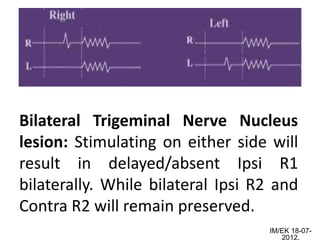
Bilateral Trigeminal Nerve Nucleus
lesion: Stimulating on either side will
result in delayed/absent Ipsi R1
bilaterally. While bilateral Ipsi R2 and
Contra R2 will remain preserved.
                                   IM/EK 18-07-
                                      2012.
REFERENCES
• EMG AND NEUROMUSCULAR DISORDER BY
  David C. Preston
• Snell’s Human anatomy
• Kimura J. Electodiagnosis in diseases of
  Nerve& Muscles


  Diligence is the mother of good fortune.
                                      IM/EK 18-07-
                                         2012.

Blink reflex

  • 1.
    Blink Reflex BY: SYEDIRSHAD MURTAZA TECHNOLOGIST NEUROPHYSIOLOGY AKUH KARACHI Date: 18-07-2012
  • 2.
  • 3.
    • Definition:- Reflex isan efferent response to an afferent stimulation. • Its also known as reflex arc response because there is an afferent segment, synapses with inter-neurons and then there is an efferent limb, all these making an arc of activity hence called Reflex Arc Response. IM 18-07- 2012.
  • 4.
    INTRODUCTION : Blink reflexis essentially the electrical correlate of the clinically evoked corneal reflex. Blink reflex is capable of evaluating the cranial nerves and their proximal segments. The afferent limb of blink reflex is ophthalmic division of trigeminal (V) nerve (which can be stimulated mechanically or electrically) and the facial (VII) nerve mediates the efferent arc. IM 18-07- 2012.
  • 5.
    Advantages • The blinkreflex study is a useful electrophysiological technique for the evaluation of patients with: • ● Involvement of trigeminal or facial nerve. • ● Variety of demyelinating polyneuropathies • ● Central Lesion in the Brainstem IM 18-07- 2012.
  • 6.
    Anatomy • The afferentlimb of the blink reflex is mediated by sensory fibers of the supraorbital branch of the ophthalmic division of the trigiminal nerve (V) and the efferent limb by motor fibers of the facial nerve (VII). • Just as with the corneal reflex, ipsilateral electrical stimulation of the supraorbital branch of the trigiminal nerve elicits a facial nerve (eye blink) response bilaterally. IM 18-07- 2012.
  • 7.
    Application Methods Position ofPatient: Lying on the couch with eyes closed. Recording Electrodes : Active electrode placed laterally over the orbicularis occuli muscles Reference placed on the side of the nose, OR Chin. Ground Electrode : Placed submentally on the neck or forehead. IM 18-07- 2012.
  • 8.
    Stimulating Site Supraorbital nerveis stimulated which is the branch of Trigeminal Nerve (Cranial Nerve V) with cathode placed over the supra-orbital foramen/notch on one side and anode placed on the forehead. IM 18-07- 2012.
  • 9.
    PARAMETERS SWEEP TIMEVE/LOCITY: 5-10(msec/div) • SENSITIVITY: 200 (µv/div) • FILTERS: (HFF:20Hz, LFF: 10KHz) • STIMULATION DURATION/RATE: 0.01msec/2 Hz • INTERVAL : Between successive stimuli is set at atleast 30 sec to minimize interactions between them. • (If R1 is not recorded easily, reduce the interstimulus interval to 5msec so that facilitation resulting from first stimulus permits R1 to be elicited.) IM 18-07- 2012.
  • 10.
  • 11.
    Response to ElectricalStimulus • Stimulation of the ipsilateral supraorbital nerve results in an afferent response along the trigiminal nerve to both the main sensory nucleus of V (mid Pons) and the nucleus of the spinal tract of V (lower Pons and medulla) in the brain stem. • Through a series of interneuron’s in the Pons and lateral medulla, the nerve impulse next reaches the ipsilateral and contralateral facial nuclei, from which the efferent signal travels along the facial nerve bilaterally. IM 18-07- 2012.
  • 12.
    IM 18-07- 12 2012.
  • 13.
    REFLEX RESPONSE • Twodistinct components are there, which as following 1. EARLY R1 2. LATER R2 • 1. EARLY R1 COMPONENT: • Elicited only on the side that is stimulated. Relatively stable. Short lasting and of low amplitude. A disynaptic pathway between the main sensory nucleus of the trigeminal nerve and the ipsilateral facial nucleus. IM 18-07- 2012.
  • 14.
    Cont, 2. LATER R2COMPONENT Present on both sides following unilateral stimulation. More variable. Long lasting and of higher amplitude. A polysynaptic connections between the spinal nucleus of the trigeminal nerve and bilateral facial nucleus. IM 18-07- 2012.
  • 15.
    REFLEX RESPONSE • EARLYR1 COMPONENT: • If latency > 13ms, then its abnormal • Interside difference in latency < 1.2ms. • LATER R2 COMPONENT: • If ipsilateral latency > 41ms and contralateral latency > 44ms, then its abnormal. • The latency difference between ipsilateral and contralateral response recorded simultaneously following unilateral stimulation is < 5ms. • The latency difference between R2 evoked by stimulation on each side in turn should be < 7ms. IM 18-07- 2012.
  • 16.
    REFLEX RESPONSE • EARLYR1 COMPONENT: • Delay or absence indicates a disturbance of trigeminal or facial nerve or both on that side. • LATER R2 COMPONENT: • Involvement of R2 indicates the site of lesion when R1 is abnormal. • Trigeminal nerve lesions is characterized by bilateral delay or attenuation of R2 when the affected side of the face is stimulated. • Facial nerve lesions is characterized by delay of R2 on the affected side, whichever side is stimulated. IM 18-07- 2012.
  • 17.
    BLINK REFLEX INDICATION •Facial /Bells palsy (facial paralysis resulting from a dysfunction of the cranial nerve VII (the facial nerve) • Polyneuropathy • Lesions of the V nerve • Synkinesis of facial muscles (involuntary movements due to miswiring of nerves after trauma) • Hemi facial spasm (frequent involuntary contractions) • Acoustic neuroma (slow-growing tumor of the nerve that connects the ear to the brain (cochlear nerve)) • Lesions in brain stem and spinal cord • Multiple Sclerosis (a chronic autoimmune disorder affecting movement, sensation, and bodily functions, caused by destruction of the myelin insulation covering nerve fibers (neurons) in the CNS ) • Wallenberg syndrome (difficulty in swallowing and hoarseness due to paralysis of the ipsilateral vocal cord.) IM 18-07- 2012.
  • 18.
    CLINICAL APPLICATION In Bell’sPalsy, the response is initially nearly normal becoming abnormal after few days. R1 - delayed or abnormal during the first few weeks suggesting demyelination. In certain polyneuropathies - Direct response and R1 component delayed. In comatose patients and acute phase of CVA - R2 delayed. IM 18-07- 2012.
  • 19.
    CLINICAL APPLICATION • Inhemifacial spasm or facial synkinesis following aberrant reinnervation there is spread of blink reflex into muscles other than orbicularis oris. • In multiple sclerosis, the R1- delayed on one or both the sides and alterations in the R2 component is less specific. And if R2 is abnormal (with normal R1), it is suggestive of lateral medullary lesion. • In Wallenberg’s syndrome, the R1 - normal and R2 - delayed or absent bilaterally with the stimulation of the affected side of the face IM 18-07- 2012.
  • 20.
    BLINK REFLEX PATTERNS NORMALBLINK RESPONSE: Intact trigiminal and facial nerve IM 18-07- 2012.
  • 21.
    Unilateral trigeminal lesion:Stimulating the affected side, there will be a delay or absence of all potentials (ipsilateral R1 and R2,contralateral R2). Stimulating the unaffected side results in normal potentials, including the ipsilateral R1 and R2 and the contralateral R2. IM 18-07- 2012.
  • 22.
    Unilateral facial lesion:Stimulating the affected side results in delay or absence of the ipsilateral R1 and R2,but a normal contralateral R2. Stimulating the unaffected side results in a normal ipsilateral R1 and R2,but delayed or absent contralateral R2.
  • 23.
    Unilateral midpontine lesion(main sensory nucleus V and/or lesion of the pontine interneuron’s to the ipsilateral facial nerve nucleus) or both. Stimulating the affected side results in an absent or delayed R1, but an intact ipsilateral and contralateral R2. Stimulating the unaffected side results in all normal . potentials, including R1 and ipsilateral and contralateral R2
  • 24.
    • Unilateral medullarylesion (interneuron’s to the ipsilateral facial nerve nucleus). • Stimulating the affected side results in a normal R1 and contralateral R2, but an absent or delayed ipsilateral R2. • Stimulating the unaffected side results in normal ipsilateral R1 and R2 potential, but a delayed or absent contralateral R2. IM 18-07-2012.
  • 25.
    Blink reflex canbe affected in Demyelinating peripheral neuropathy. In demyelinating neuropathies, all potentials of the blink response may be markedly delayed or absent, reflecting slowing of either or both motor and sensory pathway IM 18-07- 2012.
  • 26.
    Bilateral Trigeminal NerveNucleus lesion: Stimulating on either side will result in delayed/absent Ipsi R1 bilaterally. While bilateral Ipsi R2 and Contra R2 will remain preserved. IM/EK 18-07- 2012.
  • 27.
    REFERENCES • EMG ANDNEUROMUSCULAR DISORDER BY David C. Preston • Snell’s Human anatomy • Kimura J. Electodiagnosis in diseases of Nerve& Muscles Diligence is the mother of good fortune. IM/EK 18-07- 2012.