Apraxia
Introduction
• Two major goals of humans’ brain - maintain
body homeostasis and to allow us to
successfully interact with the environment
• Upper limbs / forelimbs - perform most of the
interactions with objects in the environment,
as well as a person’s own body
• Goal-oriented movements made by the
forelimb - guided by instructions or programs
from the brain
Introduction
• Heymann Steinthal – coined the term
• essentially a cognitive deficit in motor
programming
• inability to correctly perform learned skilled
movements
• results in errors - either of the spatiotemporal
processing of the movements or in the
content of the actions
• occurs in about 50% to 80% of patients with
left hemisphere lesions and can persist as a
chronic deficit in 40% to 50%
• results in major functional impairment as it
affects critical movements of the arms, hands,
and fingers
• correlates with greater caregiver dependence
and need for help with ADLs
• interferes with rehabilitation therapy and the
use of gestural communication
• Two major forms of forelimb apraxia: task
specific and general
• Task-specific apraxias - disorders that are
limited primarily to one form of activity (eg,
dressing apraxia, constructional apraxia, and
apraxic agraphia)
MODELS FOR PRAXIS
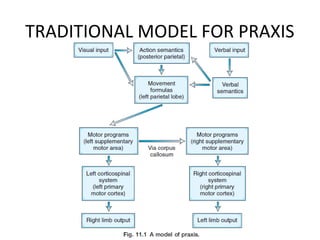
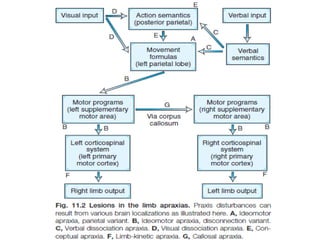
• Hugo Karl Liepmann - seminal model of the
limb apraxias
• proposed that the execution of purposeful
movements could be divided into three steps
• First - retrieval of “movement formulas/
praxicons” (memories of the spatial-temporal
patterns required to make purposeful skilled
movements of the intended action) from the
left hemisphere
• Second - transfer and association of these
movement formulas via cortical connections
with the motor programs located in the left
“sensomotorium (premotor and
supplementary motor areas )
• Third - transmission of the information to the
left primary motor cortex for performance of
the intended actions in the right limb
• Finally - information traverses the corpus
callosum to the right sensomotorium to
activate the right primary motor cortex - left
limb to perform the movements
• classified disturbances in these connections as
“ideational, ideo-kinetic (melokinetic), and
limb-kinetic apraxia”
TRADITIONAL MODEL FOR PRAXIS
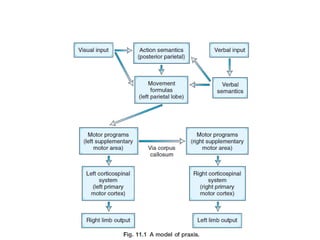
• Most models of praxis - left parietal hub -
with connections to anterior motor areas
• Inferior parietal lobule contains the
movement formulas needed to carry out
learned skilled movements
• Multiple input modalities - visual, verbal-
auditory, and tactile can activate these
movement formulas
• Left parietal region also contain
• Action semantics & Conceptual knowledge
• If a movement involves the use of a tool or
object, action semantics specify knowledge of
tool action (turning of keys, pounding of
hammer, etc.) and the knowledge of which
tool or object to use for a task
• Premotor region - SMA – involved in
sequential movements and bimanual
coordination of the upper extremities
• receives projections from parietal neurons
• projects axons to motor neurons in the
primary motor cortex
• SMA - translates the parietal time-space
movement formulas to specific motor
programs
• activate the motor neurons such that the
contralateral extremity moves in the
proscribed spatial trajectory and timing
• For movements in the ipsilateral extremity,
the brain further conveys these programs
across the corpus callosum to the opposite
premotor cortex
Newer Models Of Praxis
• Focus on network activation - as opposed to
isolated regional activation
• Posterior left parietal and temporal cortices
and dorsolateral prefrontal cortex - activated
when hand gestures are planned and
executed
• This left parieto-fronto-temporal network has
been termed the praxis representation
network
CLASSIFICATION OF LIMB
APRAXIAS
• Heilman and associates
• Ideomotor Apraxia, Parietal Variant
• Ideomotor Apraxia, Disconnection Variant
• Dissociation Apraxia
• Ideational Apraxia
• Conceptual Apraxia
• Limb-Kinetic Apraxia
• Callosal Apraxia
TESTING FOR LIMB APRAXIAS
• Prior to testing of praxis - a neurological
examination to exclude the presence of
significant motor, sensory, or cognitive
disorders
• 1. PANTOMIME TO VERBAL COMMAND
• Transitive - associated with tool or
instrument use - demonstrate how to comb
their hair, brush their teeth, or use a pair of
scissors
• Intransitive - associated with communicative
gestures - demonstrate how to wave
goodbye, beckon somebody to come, say
Namaste, Salute, victory sign
• testing involves the right and left limbs
independently
• observes the patient’s responses for the
presence of temporal-spatial or content
errors
• if the patient has difficulty pantomiming
movements - tests their ability to imitate
gestures
• 2. IMITATION OF GESTURES
• performs both transitive and intransitive movements
and asks the patient to copy the movements
• Also include meaningless/nonrepresentational,
gestures such as linking pinkies or interlocking circles
made with the thumb and index finger on each hand
• Disturbed meaningless gestures
• either an inability to apprehend spatial
relationships involving the hands and arms in
parietal-variant ideomotor apraxia
• basic disturbances in idiokinetic movements
• 3. GESTURE KNOWLEDGE
• perform the same transitive and intransitive
gestures and asks the patient to identify the
gesture
• patient must identify the gesture and
discriminate between those that are well and
poorly performed
• 4. SEQUENTIAL ACTIONS
• patient must perform tasks that require several
motor acts in sequence, such as making a sandwich
or preparing a letter for mailing
• 5. CONCEPTUAL KNOWLEDGE
• Patient is shown pictures of tools or objects or the
actual tools or objects themselves.
• The examiner then requests the patient to
pantomime the action associated with the tool or
object
• 6. LIMB-KINETIC MOVEMENTS
• examiner checks for fine finger movements by asking
the patient to do repetitive tapping, picking up a coin
with a pincer grasp, and twirling the coin
• 7. REAL OBJECT USE
• If limb apraxia is present, test with real object use
• Most limb apraxias improve when using real objects
for transitive actions and when gesturing
spontaneously with intransitive actions
• Any impairment in the patient’s ability to use real
objects indicates marked severity of the limb apraxia
Ideomotor Apraxia, Parietal
Variant
• most common and prototypical limb apraxia
• Disruption of the movement formulas in the
inferior parietal lobule
• impairs skilled movements on command and
to imitation, as well as the recognition of
gestures
• spatial and temporal errors while producing
movements, hesitant, stuttered movements
rather than smooth, effortless ones
• Pantomime to verbal command - Abnormal
• Imitation of gestures - Abnormal
• Spatiotemporal errors in the positioning and
orientation of the arm, hand, and fingers to
the target and in the timing of the movements
• but the goal of the action is still recognizable
• three types of spatial errors
(1)postural errors or internal configuration
errors
(2) egocentric movement errors - use of
incorrect joints or incorrect coordination
between joints
(3) allocentric movement errors - actions are not
correctly targeted to the real or imaginary
object upon which the tool works
• Spatial errors- patients will often fail to place
their hand, forearm, and arm in the position
that would enable them to correctly hold a
tool or implement
• patients may substitute a body part for the
tool or object – body part as tool errors
(BPTEs)
• Eg.- when attempting to pantomime combing
their hair or brushing their teeth, they
substitute their fingers for the comb or
toothbrush
• Normal subjects - may make the same errors
• examiner should ask patients not to substitute
their fingers or other body parts
• to pantomime using a “pretend tool.”
• Patients with ideomotor apraxia - may not
improve with these instructions and continue
to make BPTEs
• Gesture knowledge - Abnormal - major
distinguishing feature of the parietal variant
• Sequential actions, Conceptual knowledge,
• Limb-kinetic movement – Normal
Ideomotor Apraxia, Disconnection
Variant
• disconnection of an intact parietal region from
the pathways to primary motor cortices
• disruptions of motor programs in the SMA or
in their intra-and inter hemispheric
connections
• lesions lie along the route from the left
inferior parietal cortex to primary motor
cortices
• Pantomime to verbal command - Abnormal
• Imitation of gestures - Abnormal
• The movement formulas themselves are
preserved
• Gesture knowledge - Normal
• Patients can recognize and identify gestures,
can comprehend gestures and pantomimes
and discriminate between correctly and
incorrectly performed pantomimes
Case vignette
• A 55-year-old dentist returned to work after a
3-month break
• His first patient had a cavity that was not
deep. His assistant inserted a drill bit into the
drill and handed him the drill so that he could
clean out the decay
• He asked the patient to open her mouth and
pressed on the pedal that made the drill
rotate
• Then he realized that he was not sure how to
correctly move the drill in the patient’s
mouth
• He told the patient he could not work on her
teeth and apologized
• When examined in the clinic and asked to
pantomime transitive movements, he made
postural and movement errors, could not
imitate transitive movements, and even had
trouble using actual tools
• His deficit was much worse in his right than
left hand
• This man’s spatial errors were typical of IMA
Dissociation Apraxia
• Patients exhibit errors when the movement is
evoked by stimuli in one specific modality -
usually the verbal or language modality
• Verbal disconnection apraxia - disconnection
between language areas and movement
formulas in the inferior parietal lobule
• Information, however, can reach the inferior
parietal lobe via other input modalities
• Pantomime to verbal command – Abnormal -
absence of recognizable movements - patients
may look at their hands but fail to perform
any pertinent actions
• Unlike patients with ideomotor apraxia,
Imitation of gestures & Gesture knowledge –
Normal ( Normal visual input)
• There can be visual and tactile dissociation
apraxias as well
Case vignette
• A 43-year-old school teacher developed an
anomic aphasia (comprehension intact)
• When she was tested for IMA, she was asked
to pantomime how she would put a key into a
door lock and open the door lock
• After hearing the command, she looked at her
open hand with all her fingers fully extended
and repeatedly said, ‘‘Unlock the door.’’
• When, however, the examiner took out a key
and she saw the key, she immediately
performed the pantomime correctly.
• The inability to correctly pantomime when the
command is presented in one modality but is
correctly performed in another modality is
called dissociation apraxia
Ideational Apraxia
• inability to correctly order or sequence a
series of movements to achieve a goal -
disturbance in an overall ideational action
plan
• patients are given components necessary to
complete a multistep task - they have trouble
carrying out the steps in the proper order -
such as preparing, addressing, and then
mailing a letter
• The individual steps, however, are performed
accurately
• lesion responsible is not clear
• usually occur in patients with diffuse cerebral
processes such as dementia, delirium, or
extensive lesions in the left hemisphere that
involve the frontal lobe and SMA
• Pantomime to verbal command, Imitation of
gestures & Gesture knowledge – Normal
• Sequential actions – Abnormal
• Eg. Patient is asked to demonstrate how to
prepare a letter for mailing or a sandwich for
eating
• The examiner instructs the patient that the
imaginary elements needed for the task are
laid out in front of them
• patient is then observed to see whether the
correct sequence of events is performed
• Ideational apraxia - manifests as a failure to
perform each step in the correct order
• If disturbed, the examiner can repeat this
testing with a real object, such as providing
the patient with a letter and stamp
Case vignette
• A 69-year-old woman had been an excellent
cook her entire life.
• In the past few months, her husband noticed
that she appeared to have some problems
controlling her temper and was not keeping
the house as clean as she used to keep it, but
thought these changes were just part of aging.
• One morning, wanting to make a cheese
omelet for her husband, she took out the
liquid eggs, slices of cheese and butter.
• After putting the frying pan on the gas, she
turned on the gas and waited until the pan got
hot.
• She then dropped the cheese onto the hot
pan and after a few minutes poured the eggs
on top of the cheese.
• The cheese melted and after the eggs
hardened, she tried to slide the cheese omelet
onto the plate but found it was stuck to the
frying pan.
• By the time she got the eggs and cheese out
of the pan she had made scrambled cheese
eggs.
• The patient’s inability to correctly order her
acts to make a final product is characteristic
ideational apraxia
Conceptual Apraxia
• defects in the Action semantics / Conceptual
knowledge needed to successfully select tools
and objects
• results in errors in the content of the action,
such as in tool-selection errors or in tool–
object knowledge
• most common in Alzheimer disease, in other
dementias, diffuse posterior cerebral lesions,
particularly involving the left hemisphere
• Tools - provide the user with mechanical
advantages.
• Several steps are necessary in correctly using
a tool to alter the environment or one’s own
self
• First step - recognition that something needs
to be altered
• Some patients cannot identify that an
alteration action is required - problem
unawareness
• Some patients cannot recognize the tool that
is needed to perform or complete the
required action or the tool that works on
specific objects (eg, hammers are used with
nails)
• This impairment is called a tool-selection
deficit
• Tool-action–association deficit - Some
patients might cannot recall the type of
actions associated with specific tools (eg,
hammers are used to pound)
• Mechanical advantage knowledge - knowing
the characteristics of a tool that allow it to
perform a given action
• Eg, when attempting to drive a nail into a
piece of wood and no hammer is available in
the tool chest, the patient with impaired
mechanical knowledge might select a
screwdriver rather than a wrench
• Conceptual apraxia is the loss of mechanical
knowledge
• There are several subtypes
• Problem unawareness
• tool-selection deficit
• Tool action– association deficit
• Impaired mechanical advantage knowledge
• Pantomime to verbal command – Abnormal
• Content errors - demonstrate the actions of
tools or objects other than the one they were
asked to pantomime
• Imitation of gestures & Gestural Knowledge –
Normal
• Conceptual knowledge - Abnormal
• Unable to name or point to a tool when its
function is discussed
• Unable to recall the type of actions associated
with specific tools, utensils, or objects
• Eg- when asked to demonstrate the use of a
hammer or a saw either by pantomiming or
using the tool, the patient may pantomime a
screwing twisting movement as if using a
screwdriver
Case vignette
• A 76-year-old retired carpenter was working
on building a house. He had retired because
he was having some memory problems
• While hammering a nail into a board, the nail
bent
• He wanted to take this nail out, but his
hammer did not have a claw
• In his tool chest he found a knife, and with the
knife he tried to cut the wood around the nail
so he could remove it from the board but
found this was not working
• His friend seeing him do this said, ‘‘Use the
pliers!’’
• The loss of mechanical knowledge exhibited
by this man is called conceptual apraxia
Limb-Kinetic Apraxia
• inability to make finely graded, precise,
coordinated individual finger movements –
leading to loss of dexterity or deftness
• results from lesions in the primary motor
cortex or corticospinal system
• not a real apraxia in the traditional definition
• but is considered in the differential diagnosis
of the limb apraxias
• usually confined to the limb contralateral to a
hemispheric lesion
• when it occurs in the dominant hand, it may
also be present in the nondominant hand
• Should be distinguished from right parietal
functions such as
• nonsymbolic gestures (e.g., copying
meaningless fine finger movements)
• optic ataxia, or decreased coordination of the
hands under visual guidance
• For limb-kinetic apraxia testing - ask the
patient to perform fine finger movements
-look for evidence of incoordination
• Eg. examiner asks the patient to pick up a
small coin from the table with the thumb and
the index finger only
• Normally - pincer grasp to pick up a coin - by
putting a forefinger on one edge of the coin
and the thumb on the opposite edge
• Patients with limb-kinetic apraxia - will have
trouble doing this without sliding the coin to
the edge of the table or using multiple fingers
• Coin-rotation task - one of the simplest and
sensitive bedside tests - patients are given a
coin in their palm and are asked to rotate it
between their thumb, index, and middle
fingers as rapidly as possible for 20
revolutions
• Patients with limb-kinetic apraxia are slow and
clumsy at these tasks, they may also have
disproportionate problems with meaningless
gestures
Case
• A 78-year-old man with a history of
hypertension had the sudden onset of a right
hemiparesis and trouble speaking (a nonfluent
aphasia with intact comprehension and
impaired repetition and naming)
• Over a period of several days the weakness in
his arm and hand abated, and when examined
1 month after this stroke, the strength in his
right forelimb, including his fingers was
normal
• However, he had trouble buttoning his shirt
and performing other activities that required
fine precise movements
• His brain imaging revealed that he had a
stroke that injured his motor cortex and Broca
area of his left hemisphere.
• The loss of deftness, including the ability to
make precise independent but coordinated
finger movements, is called limb-kinetic
apraxia
Callosal Apraxia
• Limb apraxia syndromes can result from
callosal lesions
• confined to the nondominant limb - usually
the left arm or hand in right-handed
individuals.
PATHOPHYSIOLOGY OF LIMB
APRAXIAS
• IMA - associated with lesions in a variety of
structures including the inferior parietal lobe,
the frontal lobe, and the premotor areas,
particularly the SMA
• due to subcortical lesions in the basal ganglia
(caudate-putamen), thalamus (pulvinar),
associatedated white-matter tracts including
the corpus callosum
• can be caused by any CNS disorder that
affects these regions
• CVA, especially left MCA strokes with right
hemiparesis and apraxia evident in the left
upper extremity
• Right ACA strokes and paramedian lesions –
IMA, disconnection variant
• initial or presenting manifestation of disorders
such as CBD,PPA, or parietal-variant Alzheimer
disease
REHABILITATION FOR LIMB
APRAXIAS
• Many instrumental and routine ADLs depend
on learned skilled movements - patients with
limb apraxia usually have impaired functional
abilities
• Presence of limb apraxia correlates with the
level of caregiver assistance required six
months after a stroke
• Absence of apraxia is a significant predictor of
return to work after a stroke
• treatment - therefore important for improving
the quality of life of the patient
• Many apraxia treatments have been studied,
none has emerged as the standard
• No effective pharmacotherapies
• Treatments primarily involve rehabilitation
strategies
Treatment Strategies
• multiple cues
• error type reduction
• six-stage task hierarchy
• conductive education
• strategy training
• transitive/intransitive gesture training
• error completion, exploration training, and
combined error completion and exploration
training
• Most of these approaches emphasize cueing
with multiple modalities, with verbal, visual,
and tactile inputs, repetitive learning, and
feedback and correction of errors
• Novel Approach - use of sensors embedded in
household tools and objects - detect apraxic
errors and guide rehabilitation
Practical interventions
• Making environmental changes
• removing unsafe tools or implements
• providing a limited number of tools to select
from
• replacing complex tasks with simpler ones
that require few or no tools and fewer steps

Apraxia

  • 1.
  • 2.
    Introduction • Two majorgoals of humans’ brain - maintain body homeostasis and to allow us to successfully interact with the environment • Upper limbs / forelimbs - perform most of the interactions with objects in the environment, as well as a person’s own body • Goal-oriented movements made by the forelimb - guided by instructions or programs from the brain
  • 3.
    Introduction • Heymann Steinthal– coined the term • essentially a cognitive deficit in motor programming • inability to correctly perform learned skilled movements • results in errors - either of the spatiotemporal processing of the movements or in the content of the actions
  • 4.
    • occurs inabout 50% to 80% of patients with left hemisphere lesions and can persist as a chronic deficit in 40% to 50% • results in major functional impairment as it affects critical movements of the arms, hands, and fingers • correlates with greater caregiver dependence and need for help with ADLs • interferes with rehabilitation therapy and the use of gestural communication
  • 5.
    • Two majorforms of forelimb apraxia: task specific and general • Task-specific apraxias - disorders that are limited primarily to one form of activity (eg, dressing apraxia, constructional apraxia, and apraxic agraphia)
  • 6.
    MODELS FOR PRAXIS •Hugo Karl Liepmann - seminal model of the limb apraxias • proposed that the execution of purposeful movements could be divided into three steps • First - retrieval of “movement formulas/ praxicons” (memories of the spatial-temporal patterns required to make purposeful skilled movements of the intended action) from the left hemisphere
  • 7.
    • Second -transfer and association of these movement formulas via cortical connections with the motor programs located in the left “sensomotorium (premotor and supplementary motor areas ) • Third - transmission of the information to the left primary motor cortex for performance of the intended actions in the right limb
  • 8.
    • Finally -information traverses the corpus callosum to the right sensomotorium to activate the right primary motor cortex - left limb to perform the movements • classified disturbances in these connections as “ideational, ideo-kinetic (melokinetic), and limb-kinetic apraxia”
  • 9.
  • 10.
    • Most modelsof praxis - left parietal hub - with connections to anterior motor areas • Inferior parietal lobule contains the movement formulas needed to carry out learned skilled movements • Multiple input modalities - visual, verbal- auditory, and tactile can activate these movement formulas
  • 11.
    • Left parietalregion also contain • Action semantics & Conceptual knowledge • If a movement involves the use of a tool or object, action semantics specify knowledge of tool action (turning of keys, pounding of hammer, etc.) and the knowledge of which tool or object to use for a task
  • 12.
    • Premotor region- SMA – involved in sequential movements and bimanual coordination of the upper extremities • receives projections from parietal neurons • projects axons to motor neurons in the primary motor cortex
  • 13.
    • SMA -translates the parietal time-space movement formulas to specific motor programs • activate the motor neurons such that the contralateral extremity moves in the proscribed spatial trajectory and timing • For movements in the ipsilateral extremity, the brain further conveys these programs across the corpus callosum to the opposite premotor cortex
  • 15.
    Newer Models OfPraxis • Focus on network activation - as opposed to isolated regional activation • Posterior left parietal and temporal cortices and dorsolateral prefrontal cortex - activated when hand gestures are planned and executed • This left parieto-fronto-temporal network has been termed the praxis representation network
  • 16.
    CLASSIFICATION OF LIMB APRAXIAS •Heilman and associates • Ideomotor Apraxia, Parietal Variant • Ideomotor Apraxia, Disconnection Variant • Dissociation Apraxia • Ideational Apraxia • Conceptual Apraxia • Limb-Kinetic Apraxia • Callosal Apraxia
  • 18.
    TESTING FOR LIMBAPRAXIAS • Prior to testing of praxis - a neurological examination to exclude the presence of significant motor, sensory, or cognitive disorders • 1. PANTOMIME TO VERBAL COMMAND • Transitive - associated with tool or instrument use - demonstrate how to comb their hair, brush their teeth, or use a pair of scissors
  • 19.
    • Intransitive -associated with communicative gestures - demonstrate how to wave goodbye, beckon somebody to come, say Namaste, Salute, victory sign • testing involves the right and left limbs independently • observes the patient’s responses for the presence of temporal-spatial or content errors
  • 20.
    • if thepatient has difficulty pantomiming movements - tests their ability to imitate gestures • 2. IMITATION OF GESTURES • performs both transitive and intransitive movements and asks the patient to copy the movements • Also include meaningless/nonrepresentational, gestures such as linking pinkies or interlocking circles made with the thumb and index finger on each hand
  • 21.
    • Disturbed meaninglessgestures • either an inability to apprehend spatial relationships involving the hands and arms in parietal-variant ideomotor apraxia • basic disturbances in idiokinetic movements
  • 22.
    • 3. GESTUREKNOWLEDGE • perform the same transitive and intransitive gestures and asks the patient to identify the gesture • patient must identify the gesture and discriminate between those that are well and poorly performed
  • 23.
    • 4. SEQUENTIALACTIONS • patient must perform tasks that require several motor acts in sequence, such as making a sandwich or preparing a letter for mailing • 5. CONCEPTUAL KNOWLEDGE • Patient is shown pictures of tools or objects or the actual tools or objects themselves. • The examiner then requests the patient to pantomime the action associated with the tool or object
  • 24.
    • 6. LIMB-KINETICMOVEMENTS • examiner checks for fine finger movements by asking the patient to do repetitive tapping, picking up a coin with a pincer grasp, and twirling the coin • 7. REAL OBJECT USE • If limb apraxia is present, test with real object use • Most limb apraxias improve when using real objects for transitive actions and when gesturing spontaneously with intransitive actions • Any impairment in the patient’s ability to use real objects indicates marked severity of the limb apraxia
  • 25.
    Ideomotor Apraxia, Parietal Variant •most common and prototypical limb apraxia • Disruption of the movement formulas in the inferior parietal lobule • impairs skilled movements on command and to imitation, as well as the recognition of gestures • spatial and temporal errors while producing movements, hesitant, stuttered movements rather than smooth, effortless ones
  • 26.
    • Pantomime toverbal command - Abnormal • Imitation of gestures - Abnormal • Spatiotemporal errors in the positioning and orientation of the arm, hand, and fingers to the target and in the timing of the movements • but the goal of the action is still recognizable
  • 27.
    • three typesof spatial errors (1)postural errors or internal configuration errors (2) egocentric movement errors - use of incorrect joints or incorrect coordination between joints (3) allocentric movement errors - actions are not correctly targeted to the real or imaginary object upon which the tool works
  • 28.
    • Spatial errors-patients will often fail to place their hand, forearm, and arm in the position that would enable them to correctly hold a tool or implement • patients may substitute a body part for the tool or object – body part as tool errors (BPTEs)
  • 29.
    • Eg.- whenattempting to pantomime combing their hair or brushing their teeth, they substitute their fingers for the comb or toothbrush • Normal subjects - may make the same errors • examiner should ask patients not to substitute their fingers or other body parts • to pantomime using a “pretend tool.”
  • 30.
    • Patients withideomotor apraxia - may not improve with these instructions and continue to make BPTEs • Gesture knowledge - Abnormal - major distinguishing feature of the parietal variant • Sequential actions, Conceptual knowledge, • Limb-kinetic movement – Normal
  • 31.
    Ideomotor Apraxia, Disconnection Variant •disconnection of an intact parietal region from the pathways to primary motor cortices • disruptions of motor programs in the SMA or in their intra-and inter hemispheric connections • lesions lie along the route from the left inferior parietal cortex to primary motor cortices
  • 32.
    • Pantomime toverbal command - Abnormal • Imitation of gestures - Abnormal • The movement formulas themselves are preserved • Gesture knowledge - Normal • Patients can recognize and identify gestures, can comprehend gestures and pantomimes and discriminate between correctly and incorrectly performed pantomimes
  • 33.
    Case vignette • A55-year-old dentist returned to work after a 3-month break • His first patient had a cavity that was not deep. His assistant inserted a drill bit into the drill and handed him the drill so that he could clean out the decay • He asked the patient to open her mouth and pressed on the pedal that made the drill rotate
  • 34.
    • Then herealized that he was not sure how to correctly move the drill in the patient’s mouth • He told the patient he could not work on her teeth and apologized • When examined in the clinic and asked to pantomime transitive movements, he made postural and movement errors, could not imitate transitive movements, and even had trouble using actual tools
  • 35.
    • His deficitwas much worse in his right than left hand • This man’s spatial errors were typical of IMA
  • 36.
    Dissociation Apraxia • Patientsexhibit errors when the movement is evoked by stimuli in one specific modality - usually the verbal or language modality • Verbal disconnection apraxia - disconnection between language areas and movement formulas in the inferior parietal lobule • Information, however, can reach the inferior parietal lobe via other input modalities
  • 37.
    • Pantomime toverbal command – Abnormal - absence of recognizable movements - patients may look at their hands but fail to perform any pertinent actions • Unlike patients with ideomotor apraxia, Imitation of gestures & Gesture knowledge – Normal ( Normal visual input) • There can be visual and tactile dissociation apraxias as well
  • 38.
    Case vignette • A43-year-old school teacher developed an anomic aphasia (comprehension intact) • When she was tested for IMA, she was asked to pantomime how she would put a key into a door lock and open the door lock • After hearing the command, she looked at her open hand with all her fingers fully extended and repeatedly said, ‘‘Unlock the door.’’
  • 39.
    • When, however,the examiner took out a key and she saw the key, she immediately performed the pantomime correctly. • The inability to correctly pantomime when the command is presented in one modality but is correctly performed in another modality is called dissociation apraxia
  • 40.
    Ideational Apraxia • inabilityto correctly order or sequence a series of movements to achieve a goal - disturbance in an overall ideational action plan • patients are given components necessary to complete a multistep task - they have trouble carrying out the steps in the proper order - such as preparing, addressing, and then mailing a letter
  • 41.
    • The individualsteps, however, are performed accurately • lesion responsible is not clear • usually occur in patients with diffuse cerebral processes such as dementia, delirium, or extensive lesions in the left hemisphere that involve the frontal lobe and SMA
  • 42.
    • Pantomime toverbal command, Imitation of gestures & Gesture knowledge – Normal • Sequential actions – Abnormal • Eg. Patient is asked to demonstrate how to prepare a letter for mailing or a sandwich for eating • The examiner instructs the patient that the imaginary elements needed for the task are laid out in front of them
  • 43.
    • patient isthen observed to see whether the correct sequence of events is performed • Ideational apraxia - manifests as a failure to perform each step in the correct order • If disturbed, the examiner can repeat this testing with a real object, such as providing the patient with a letter and stamp
  • 44.
    Case vignette • A69-year-old woman had been an excellent cook her entire life. • In the past few months, her husband noticed that she appeared to have some problems controlling her temper and was not keeping the house as clean as she used to keep it, but thought these changes were just part of aging.
  • 45.
    • One morning,wanting to make a cheese omelet for her husband, she took out the liquid eggs, slices of cheese and butter. • After putting the frying pan on the gas, she turned on the gas and waited until the pan got hot. • She then dropped the cheese onto the hot pan and after a few minutes poured the eggs on top of the cheese.
  • 46.
    • The cheesemelted and after the eggs hardened, she tried to slide the cheese omelet onto the plate but found it was stuck to the frying pan. • By the time she got the eggs and cheese out of the pan she had made scrambled cheese eggs. • The patient’s inability to correctly order her acts to make a final product is characteristic ideational apraxia
  • 47.
    Conceptual Apraxia • defectsin the Action semantics / Conceptual knowledge needed to successfully select tools and objects • results in errors in the content of the action, such as in tool-selection errors or in tool– object knowledge • most common in Alzheimer disease, in other dementias, diffuse posterior cerebral lesions, particularly involving the left hemisphere
  • 48.
    • Tools -provide the user with mechanical advantages. • Several steps are necessary in correctly using a tool to alter the environment or one’s own self • First step - recognition that something needs to be altered • Some patients cannot identify that an alteration action is required - problem unawareness
  • 49.
    • Some patientscannot recognize the tool that is needed to perform or complete the required action or the tool that works on specific objects (eg, hammers are used with nails) • This impairment is called a tool-selection deficit
  • 50.
    • Tool-action–association deficit- Some patients might cannot recall the type of actions associated with specific tools (eg, hammers are used to pound)
  • 51.
    • Mechanical advantageknowledge - knowing the characteristics of a tool that allow it to perform a given action • Eg, when attempting to drive a nail into a piece of wood and no hammer is available in the tool chest, the patient with impaired mechanical knowledge might select a screwdriver rather than a wrench
  • 52.
    • Conceptual apraxiais the loss of mechanical knowledge • There are several subtypes • Problem unawareness • tool-selection deficit • Tool action– association deficit • Impaired mechanical advantage knowledge
  • 53.
    • Pantomime toverbal command – Abnormal • Content errors - demonstrate the actions of tools or objects other than the one they were asked to pantomime • Imitation of gestures & Gestural Knowledge – Normal
  • 54.
    • Conceptual knowledge- Abnormal • Unable to name or point to a tool when its function is discussed • Unable to recall the type of actions associated with specific tools, utensils, or objects • Eg- when asked to demonstrate the use of a hammer or a saw either by pantomiming or using the tool, the patient may pantomime a screwing twisting movement as if using a screwdriver
  • 55.
    Case vignette • A76-year-old retired carpenter was working on building a house. He had retired because he was having some memory problems • While hammering a nail into a board, the nail bent • He wanted to take this nail out, but his hammer did not have a claw
  • 56.
    • In histool chest he found a knife, and with the knife he tried to cut the wood around the nail so he could remove it from the board but found this was not working • His friend seeing him do this said, ‘‘Use the pliers!’’ • The loss of mechanical knowledge exhibited by this man is called conceptual apraxia
  • 57.
    Limb-Kinetic Apraxia • inabilityto make finely graded, precise, coordinated individual finger movements – leading to loss of dexterity or deftness • results from lesions in the primary motor cortex or corticospinal system • not a real apraxia in the traditional definition • but is considered in the differential diagnosis of the limb apraxias
  • 58.
    • usually confinedto the limb contralateral to a hemispheric lesion • when it occurs in the dominant hand, it may also be present in the nondominant hand • Should be distinguished from right parietal functions such as • nonsymbolic gestures (e.g., copying meaningless fine finger movements) • optic ataxia, or decreased coordination of the hands under visual guidance
  • 59.
    • For limb-kineticapraxia testing - ask the patient to perform fine finger movements -look for evidence of incoordination • Eg. examiner asks the patient to pick up a small coin from the table with the thumb and the index finger only • Normally - pincer grasp to pick up a coin - by putting a forefinger on one edge of the coin and the thumb on the opposite edge
  • 60.
    • Patients withlimb-kinetic apraxia - will have trouble doing this without sliding the coin to the edge of the table or using multiple fingers • Coin-rotation task - one of the simplest and sensitive bedside tests - patients are given a coin in their palm and are asked to rotate it between their thumb, index, and middle fingers as rapidly as possible for 20 revolutions
  • 61.
    • Patients withlimb-kinetic apraxia are slow and clumsy at these tasks, they may also have disproportionate problems with meaningless gestures
  • 62.
    Case • A 78-year-oldman with a history of hypertension had the sudden onset of a right hemiparesis and trouble speaking (a nonfluent aphasia with intact comprehension and impaired repetition and naming) • Over a period of several days the weakness in his arm and hand abated, and when examined 1 month after this stroke, the strength in his right forelimb, including his fingers was normal
  • 63.
    • However, hehad trouble buttoning his shirt and performing other activities that required fine precise movements • His brain imaging revealed that he had a stroke that injured his motor cortex and Broca area of his left hemisphere. • The loss of deftness, including the ability to make precise independent but coordinated finger movements, is called limb-kinetic apraxia
  • 64.
    Callosal Apraxia • Limbapraxia syndromes can result from callosal lesions • confined to the nondominant limb - usually the left arm or hand in right-handed individuals.
  • 65.
    PATHOPHYSIOLOGY OF LIMB APRAXIAS •IMA - associated with lesions in a variety of structures including the inferior parietal lobe, the frontal lobe, and the premotor areas, particularly the SMA • due to subcortical lesions in the basal ganglia (caudate-putamen), thalamus (pulvinar), associatedated white-matter tracts including the corpus callosum
  • 66.
    • can becaused by any CNS disorder that affects these regions • CVA, especially left MCA strokes with right hemiparesis and apraxia evident in the left upper extremity • Right ACA strokes and paramedian lesions – IMA, disconnection variant • initial or presenting manifestation of disorders such as CBD,PPA, or parietal-variant Alzheimer disease
  • 67.
    REHABILITATION FOR LIMB APRAXIAS •Many instrumental and routine ADLs depend on learned skilled movements - patients with limb apraxia usually have impaired functional abilities • Presence of limb apraxia correlates with the level of caregiver assistance required six months after a stroke • Absence of apraxia is a significant predictor of return to work after a stroke
  • 68.
    • treatment -therefore important for improving the quality of life of the patient • Many apraxia treatments have been studied, none has emerged as the standard • No effective pharmacotherapies • Treatments primarily involve rehabilitation strategies
  • 69.
    Treatment Strategies • multiplecues • error type reduction • six-stage task hierarchy • conductive education • strategy training • transitive/intransitive gesture training • error completion, exploration training, and combined error completion and exploration training
  • 70.
    • Most ofthese approaches emphasize cueing with multiple modalities, with verbal, visual, and tactile inputs, repetitive learning, and feedback and correction of errors • Novel Approach - use of sensors embedded in household tools and objects - detect apraxic errors and guide rehabilitation
  • 71.
    Practical interventions • Makingenvironmental changes • removing unsafe tools or implements • providing a limited number of tools to select from • replacing complex tasks with simpler ones that require few or no tools and fewer steps