Frontal Lobe
-Dr. Sachin A Adukia
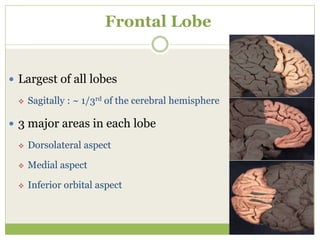
Frontal Lobe
 Largest of all lobes
 Sagitally : ~ 1/3rd of the cerebral hemisphere
 3 major areas in each lobe
 Dorsolateral aspect
 Medial aspect
 Inferior orbital aspect
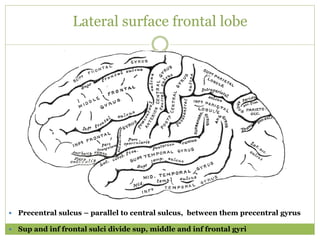
Lateral surface frontal lobe
 Precentral sulcus – parallel to central sulcus, between them precentral gyrus
 Sup and inf frontal sulci divide sup, middle and inf frontal gyri
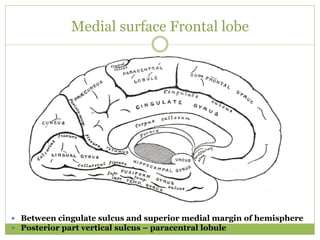
Medial surface Frontal lobe
 Between cingulate sulcus and superior medial margin of hemisphere
 Posterior part vertical sulcus – paracentral lobule
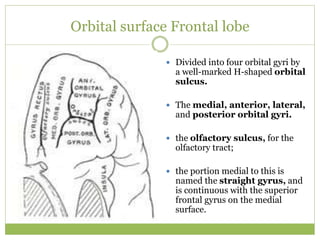
Orbital surface Frontal lobe
 Divided into four orbital gyri by
a well-marked H-shaped orbital
sulcus.
 The medial, anterior, lateral,
and posterior orbital gyri.
 the olfactory sulcus, for the
olfactory tract;
 the portion medial to this is
named the straight gyrus, and
is continuous with the superior
frontal gyrus on the medial
surface.
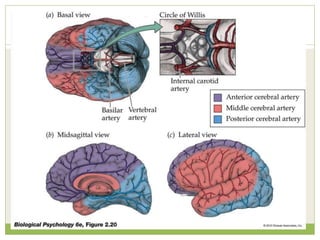
Vascular supply
Medial parts of frontal lobe: Anterior cerebral
artery
Convexity : Superior (rolandic) division of MCA
 Inferior surface: ACA and MCA
 Underlying deep white matter: penetrating arteries
(lenticulostriate) from stem of MCA
Primary Motor Cortex
Precentral gyrus; Brodmann’s Area 4
 Input
 thalamus, BG, sensory, premotor
 Output
 motor fibers to brainstem and spinal cord
 Function
 executes design into movement
 Lesions
 / tone;  power;  fine motor function on contralateral
side
Bedside tests
 1. Motor strength of hand grip.
 The patient is asked to grip the examiners fingers.
 Strength should be roughly equal, with greater strength on the
dominant side. It should be difficult for the examiner to free her/his
fingers.
 2. Motor speed as in finger tapping;
 but does not discriminate from the premotor cortex.
 poor performances suggest
 local lesions - vascular or neoplastic
 generalized lesion - degenerative disease
Pre Motor Cortex
Sup. Frontal gyrus Lat. Surface; Brodmann Area 6,8
 Input
 thalamus, BG, sensory cortex
 Output
 primary motor cortex
 Function
 Planning complex movements; controls coarse postural
movements
 Lesions
 moderate weakness in proximal muscles on contralateral side
 1. Sensorimotor abilities
 asking the patient touch each finger to the thumb in succession
as rapidly as possible. Watch for speed and dexterity.
 2. Apraxia
 to demonstrate the use of a shovel.
Supplementary Motor Cortex
Sup. Frontal gyrus Med. Surface; Brodmann’s area 6,8
 Input
 cingulate gyrus, thalamus, sensory & prefrontal cortex
 Output
 premotor, primary motor
 Function
 intentional preparation for movement; procedural memory
 Lesions
 mutism, akinesia
Frontal eye fields
Middle Frontal Gyrus; Broadman’s area 8
 Input
 parietal / temporal (ventral = what is target)
 posterior parietal cortex (dorsal = where is target)
 Output
 caudate; superior colliculus; PPRF
 Function
 executive: selects target and commands movement (saccades)
 Lesion
 eyes deviate ipsilaterally with destructive lesion
 contralaterally with irritating lesions
 Voluntary eye movements are of two types.
 Pursuit.
 Saccades.
 Bedside test:
 1. Ask the patient to follow the movement of a finger from left
to right and up and down.
 2. Ask the patient to look from left to right, up and down (with
no finger to follow).
 Note inability to move or jerky movement.
Broca’s speech area
Inf. Frontal Gyrus (Pars Triangularis &Pars Opercularis)
Brodman’s area 44,45
 Input
 Wernicke’s
 Output
 primary motor cortex
 Function
 speech production (dominant hemisphere); emotional,
melodic component of speech (non-dominant)
 Lesions
 motor aphasia; monotonous speech
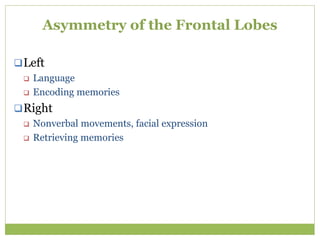
Asymmetry of the Frontal Lobes
Left
 Language
 Encoding memories
Right
 Nonverbal movements, facial expression
 Retrieving memories
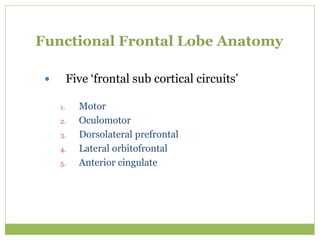
Functional Frontal Lobe Anatomy
 Five ‘frontal sub cortical circuits’
1. Motor
2. Oculomotor
3. Dorsolateral prefrontal
4. Lateral orbitofrontal
5. Anterior cingulate
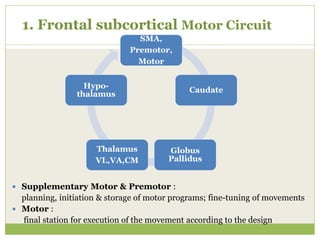
1. Frontal subcortical Motor Circuit
 Supplementary Motor & Premotor :
planning, initiation & storage of motor programs; fine-tuning of movements
 Motor :
final station for execution of the movement according to the design
SMA,
Premotor,
Motor
Caudate
Globus
Pallidus
Thalamus
VL,VA,CM
Hypo-
thalamus
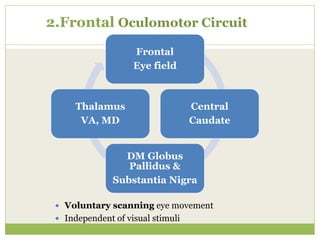
2.Frontal Oculomotor Circuit
 Voluntary scanning eye movement
 Independent of visual stimuli
Frontal
Eye field
Central
Caudate
DM Globus
Pallidus &
Substantia Nigra
Thalamus
VA, MD
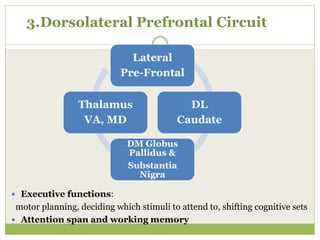
3.Dorsolateral Prefrontal Circuit
 Executive functions:
motor planning, deciding which stimuli to attend to, shifting cognitive sets
 Attention span and working memory
Lateral
Pre-Frontal
DL
Caudate
DM Globus
Pallidus &
Substantia
Nigra
Thalamus
VA, MD
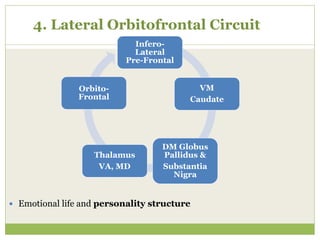
4. Lateral Orbitofrontal Circuit
 Emotional life and personality structure
Infero-
Lateral
Pre-Frontal
VM
Caudate
DM Globus
Pallidus &
Substantia
Nigra
Thalamus
VA, MD
Orbito-
Frontal
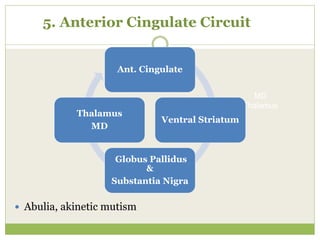
5. Anterior Cingulate Circuit
 Abulia, akinetic mutism
MD
Thalamus
Ant. Cingulate
Ventral Striatum
Globus Pallidus
&
Substantia Nigra
Thalamus
MD
Symptoms of Frontal Lobe Lesions
Disturbances of Motor Function
 Loss of fine movements, speed, and strength
 Typically appears after damage to the primary motor
cortex
 Changes in voluntary gaze
 Damage to frontal eye field
 Change in speech
 Motor aphasia; dysprosody (monotonous speech)
 Speech is sparse, slow, hesitant, disturbance of rhythm
and articulation, difficulty in word finding, wrong
words are chosen & often mispronounced,
perseveration, agrammatism
 telegraphic language
Dorsolateral prefrontal lobe syndrome
 Executive dysfunction.
 Inability to organize & plan.
 Inability to initiate, stop and modify behavior in
response to changing stimuli.
 Impaired problem solving
 Inability to inhibit responses
 Perseveration & inability to shift thought process
 Impaired fluency
 Memory problems:
 Defective working memory.
 Defective retrieval.
 Impaired attention.
 Lack of initiative & spontaneity.
 Impaired abstract thinking
 Impaired problem solving, creativity
 Impaired language & verbal fluency
Orbit frontal syndrome
 Disinhibition and impulsivity of thought,
affection and action
 Failure to appreciate consequences of one’s
action.
 A flat affect, blunted emotional response.
 Imitation and utilization behavior
 Euphoria, hypomania, Grandiosity
Anterior cingulate syndrome
 Akinetic mutism
 Represents a wakeful state of profound apathy, with indifference to
pain, thirst & hunger and absence of motor & psychic initiative.
 Manifested by lack of spontaneous movement, absent verbalization
and failure to respond to questions & commands
 Abulia -- similar but less severe , lack of spontaneity, apathy, and
paucity of speech and movement
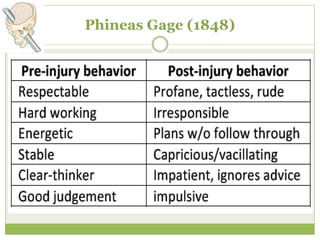
Phineas Gage (1848)
Bilateral Frontal lobe lesion
1. Apathy, Abulia, akinetic mutism,
2. Impulsiveness and irritability
3. Inability to sustain attention
4. gait disturbances
5. Sphincter disturbance
6. Active learning, problem solving, judgment:- impaired
7. Frontal release sign
a. Snout
b. Suck
c. Palmomental
d. Grasp
e. Brow tapping
Frontal Assessment Battery
1. Similarities (conceptualization)
2. Lexical fluency (mental flexibility)
3. Motor series “Luria” test (programming)
4. Conflicting instructions (sensitivity to interference)
5. Go–No Go (inhibitory control)
6. Prehension behavior (environmental autonomy)
Interpreting results
A cut off score of 12 out of 18 on the FAB has a sensitivity of 77% and
specificity of 87% in differentiating between frontal dysexecutive type
dementias and DAT
Similarities (conceptualization)
 “In what way are they alike?” A banana and a orange
 (In the event of total failure: “they are not alike” or partial failure “both
have a peel”, help the patient by saying “both a banana and an orange
are….”; but credit 0 for the item; do not help the patient for the two
following items)
 A table and a chair
 A tulip, a rose, and a daisy
Score: only category responses (fruits, furniture, flowers) are considered
correct.
 Three correct: 3
 Two correct: 2
 One correct: 1
 None correct: 0
Lexical fluency (mental flexibility)
 Say as many words as you can beginning with the letter ‘S,’
any words except surnames or proper nouns.”
 If the patient gives no response during the first 5 seconds, say:" for
instance, snake.” If the patient pauses 10 seconds, stimulate him by
saying: “any word beginning with the letter ‘S.’ The time allowed is 60
seconds.
 Score (word repetitions or variations [shoe, shoemaker], surnames, or
proper nouns are not counted as correct responses)
 More than nine words: 3
 Six to nine words: 2
 Three to five words: 1
 Less than three words: 0
 Controlled oral word association test (COWAT)
Motor series (programming)
 “Look carefully at what I’m doing.”
 The examiner performs alone three times with his left hand the series of
Luria “fist–edge–palm.” “Now, with your right hand do the same series,
first with me, then alone.” The examiner performs the series three times
with the patient, then says to him/her: “Now, do it on your own.”
 Score
 six correct consecutive series alone: 3
 at least three correct consecutive series alone: 2
 fails alone, but performs 3 correct consecutive series with examiner: 1
 cannot perform 3 correct consecutive series even with the examiner: 0
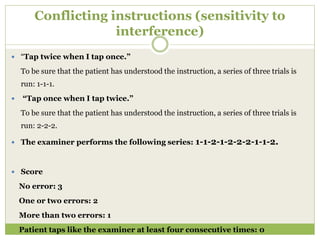
Conflicting instructions (sensitivity to
interference)
 “Tap twice when I tap once.”
To be sure that the patient has understood the instruction, a series of three trials is
run: 1-1-1.
 “Tap once when I tap twice.”
To be sure that the patient has understood the instruction, a series of three trials is
run: 2-2-2.
 The examiner performs the following series: 1-1-2-1-2-2-2-1-1-2.
 Score
No error: 3
One or two errors: 2
More than two errors: 1
Patient taps like the examiner at least four consecutive times: 0
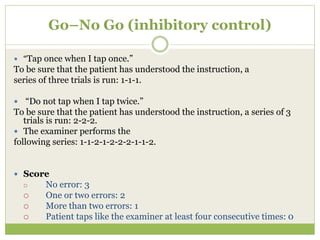
Go–No Go (inhibitory control)
 “Tap once when I tap once.”
To be sure that the patient has understood the instruction, a
series of three trials is run: 1-1-1.
 “Do not tap when I tap twice.”
To be sure that the patient has understood the instruction, a series of 3
trials is run: 2-2-2.
 The examiner performs the
following series: 1-1-2-1-2-2-2-1-1-2.
 Score
 No error: 3
 One or two errors: 2
 More than two errors: 1
 Patient taps like the examiner at least four consecutive times: 0
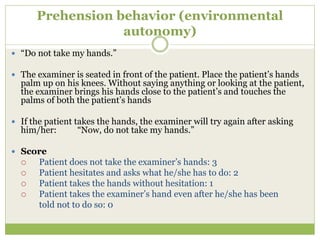
Prehension behavior (environmental
autonomy)
 “Do not take my hands.”
 The examiner is seated in front of the patient. Place the patient’s hands
palm up on his knees. Without saying anything or looking at the patient,
the examiner brings his hands close to the patient’s and touches the
palms of both the patient’s hands
 If the patient takes the hands, the examiner will try again after asking
him/her: “Now, do not take my hands.”
 Score
 Patient does not take the examiner’s hands: 3
 Patient hesitates and asks what he/she has to do: 2
 Patient takes the hands without hesitation: 1
 Patient takes the examiner’s hand even after he/she has been
told not to do so: 0
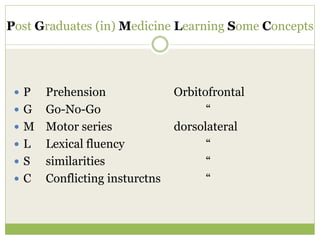
Post Graduates (in) Medicine Learning Some Concepts
 P Prehension Orbitofrontal
 G Go-No-Go “
 M Motor series dorsolateral
 L Lexical fluency “
 S similarities “
 C Conflicting insturctns “
History in frontal lobe pathology
 Personality changes (over familiar, tactless and
sexual indiscretions)
 Hyperorality
 Distractibility
 Poor motivation
 Inability to adapt to new situations
 Poor problem solving skills
Tests at bedside
 Abstract thinking: Proverb interpretation
 FAB
 Cognitive estimates
 “What is the height of an average woman”?
 Primitive reflexes
 Neurological test
 Check for anosmia (olfactory nerve involvement)
 Motor aphasia (Broca’s area involvement)
Formal Tests
• Wisconsin Card Sorting Test
• Trail Making
• Stroop Color & Word Test
• Tower of London Test
• Block design
• Maze lest
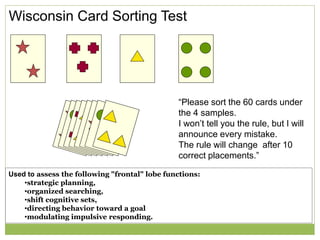
Wisconsin Card Sorting Test
“Please sort the 60 cards under
the 4 samples.
I won’t tell you the rule, but I will
announce every mistake.
The rule will change after 10
correct placements.”
Used to assess the following "frontal" lobe functions:
•strategic planning,
•organized searching,
•shift cognitive sets,
•directing behavior toward a goal
•modulating impulsive responding.
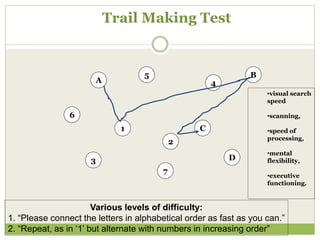
Trail Making Test
A
C1
2
7
3 D
5 B
4
6
Various levels of difficulty:
1. “Please connect the letters in alphabetical order as fast as you can.”
2. “Repeat, as in ‘1’ but alternate with numbers in increasing order”
•visual search
speed
•scanning,
•speed of
processing,
•mental
flexibility,
•executive
functioning.
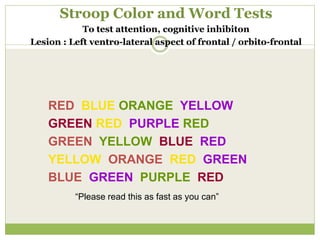
Stroop Color and Word Tests
To test attention, cognitive inhibiton
Lesion : Left ventro-lateral aspect of frontal / orbito-frontal
RED BLUE ORANGE YELLOW
GREEN RED PURPLE RED
GREEN YELLOW BLUE RED
YELLOW ORANGE RED GREEN
BLUE GREEN PURPLE RED
“Please read this as fast as you can”
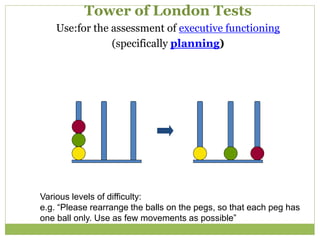
Tower of London Tests
Use:for the assessment of executive functioning
(specifically planning)
Various levels of difficulty:
e.g. “Please rearrange the balls on the pegs, so that each peg has
one ball only. Use as few movements as possible”
Frontal lobe epilepsy
 Clinical Features
 Frequent seizure with clustering
 Brief stereotyped
 Nocturnal
 Sudden onset and cessation
 No psychic aura or postictal confusion
 Rapid evolution with awareness lost at onset
 Prominent complex bilateral motor automatism involving lower limbs
 Prominent ictal posturing and tonic spasm
 Versive head and eye turning
 Bizarre automatism
 Frequent secondary generalization
 Status epilepticus common
Frontal lobe epilepsy
 EEG
 May show no ictal or interictal abnormality
 May show bilateral spike waves
 May show focal changes often widespread
 Imaging/ pathology
 Hemartoma
 Benign tumors
 Gliomas
 Angioma
 Dysplasia
 Post traumatic
 Atrophy
 Tuberculoma
 Cysticercosis
Frontal Lobe Syndrome Mimics
 Bilateral Caudate nucleus lesion
 Globus pallidus lesion – Apathy and abulia
 Bilateral thalamic infarction
 MS – Apathy and disinhibition
 Subcortical stroke
 Adrenoleukodystrophy
 Parkinson’s disease
 Huntington’s disease
 Depression
 Schizophrenia
 OCD
Thank You

Frontal lobe

  • 1.
  • 2.
    Frontal Lobe  Largestof all lobes  Sagitally : ~ 1/3rd of the cerebral hemisphere  3 major areas in each lobe  Dorsolateral aspect  Medial aspect  Inferior orbital aspect
  • 3.
    Lateral surface frontallobe  Precentral sulcus – parallel to central sulcus, between them precentral gyrus  Sup and inf frontal sulci divide sup, middle and inf frontal gyri
  • 4.
    Medial surface Frontallobe  Between cingulate sulcus and superior medial margin of hemisphere  Posterior part vertical sulcus – paracentral lobule
  • 5.
    Orbital surface Frontallobe  Divided into four orbital gyri by a well-marked H-shaped orbital sulcus.  The medial, anterior, lateral, and posterior orbital gyri.  the olfactory sulcus, for the olfactory tract;  the portion medial to this is named the straight gyrus, and is continuous with the superior frontal gyrus on the medial surface.
  • 6.
    Vascular supply Medial partsof frontal lobe: Anterior cerebral artery Convexity : Superior (rolandic) division of MCA  Inferior surface: ACA and MCA  Underlying deep white matter: penetrating arteries (lenticulostriate) from stem of MCA
  • 8.
    Primary Motor Cortex Precentralgyrus; Brodmann’s Area 4  Input  thalamus, BG, sensory, premotor  Output  motor fibers to brainstem and spinal cord  Function  executes design into movement  Lesions  / tone;  power;  fine motor function on contralateral side
  • 9.
    Bedside tests  1.Motor strength of hand grip.  The patient is asked to grip the examiners fingers.  Strength should be roughly equal, with greater strength on the dominant side. It should be difficult for the examiner to free her/his fingers.  2. Motor speed as in finger tapping;  but does not discriminate from the premotor cortex.  poor performances suggest  local lesions - vascular or neoplastic  generalized lesion - degenerative disease
  • 10.
    Pre Motor Cortex Sup.Frontal gyrus Lat. Surface; Brodmann Area 6,8  Input  thalamus, BG, sensory cortex  Output  primary motor cortex  Function  Planning complex movements; controls coarse postural movements  Lesions  moderate weakness in proximal muscles on contralateral side
  • 11.
     1. Sensorimotorabilities  asking the patient touch each finger to the thumb in succession as rapidly as possible. Watch for speed and dexterity.  2. Apraxia  to demonstrate the use of a shovel.
  • 12.
    Supplementary Motor Cortex Sup.Frontal gyrus Med. Surface; Brodmann’s area 6,8  Input  cingulate gyrus, thalamus, sensory & prefrontal cortex  Output  premotor, primary motor  Function  intentional preparation for movement; procedural memory  Lesions  mutism, akinesia
  • 13.
    Frontal eye fields MiddleFrontal Gyrus; Broadman’s area 8  Input  parietal / temporal (ventral = what is target)  posterior parietal cortex (dorsal = where is target)  Output  caudate; superior colliculus; PPRF  Function  executive: selects target and commands movement (saccades)  Lesion  eyes deviate ipsilaterally with destructive lesion  contralaterally with irritating lesions
  • 14.
     Voluntary eyemovements are of two types.  Pursuit.  Saccades.  Bedside test:  1. Ask the patient to follow the movement of a finger from left to right and up and down.  2. Ask the patient to look from left to right, up and down (with no finger to follow).  Note inability to move or jerky movement.
  • 15.
    Broca’s speech area Inf.Frontal Gyrus (Pars Triangularis &Pars Opercularis) Brodman’s area 44,45  Input  Wernicke’s  Output  primary motor cortex  Function  speech production (dominant hemisphere); emotional, melodic component of speech (non-dominant)  Lesions  motor aphasia; monotonous speech
  • 16.
    Asymmetry of theFrontal Lobes Left  Language  Encoding memories Right  Nonverbal movements, facial expression  Retrieving memories
  • 17.
    Functional Frontal LobeAnatomy  Five ‘frontal sub cortical circuits’ 1. Motor 2. Oculomotor 3. Dorsolateral prefrontal 4. Lateral orbitofrontal 5. Anterior cingulate
  • 18.
    1. Frontal subcorticalMotor Circuit  Supplementary Motor & Premotor : planning, initiation & storage of motor programs; fine-tuning of movements  Motor : final station for execution of the movement according to the design SMA, Premotor, Motor Caudate Globus Pallidus Thalamus VL,VA,CM Hypo- thalamus
  • 19.
    2.Frontal Oculomotor Circuit Voluntary scanning eye movement  Independent of visual stimuli Frontal Eye field Central Caudate DM Globus Pallidus & Substantia Nigra Thalamus VA, MD
  • 20.
    3.Dorsolateral Prefrontal Circuit Executive functions: motor planning, deciding which stimuli to attend to, shifting cognitive sets  Attention span and working memory Lateral Pre-Frontal DL Caudate DM Globus Pallidus & Substantia Nigra Thalamus VA, MD
  • 21.
    4. Lateral OrbitofrontalCircuit  Emotional life and personality structure Infero- Lateral Pre-Frontal VM Caudate DM Globus Pallidus & Substantia Nigra Thalamus VA, MD Orbito- Frontal
  • 22.
    5. Anterior CingulateCircuit  Abulia, akinetic mutism MD Thalamus Ant. Cingulate Ventral Striatum Globus Pallidus & Substantia Nigra Thalamus MD
  • 23.
    Symptoms of FrontalLobe Lesions Disturbances of Motor Function  Loss of fine movements, speed, and strength  Typically appears after damage to the primary motor cortex  Changes in voluntary gaze  Damage to frontal eye field  Change in speech  Motor aphasia; dysprosody (monotonous speech)  Speech is sparse, slow, hesitant, disturbance of rhythm and articulation, difficulty in word finding, wrong words are chosen & often mispronounced, perseveration, agrammatism  telegraphic language
  • 24.
    Dorsolateral prefrontal lobesyndrome  Executive dysfunction.  Inability to organize & plan.  Inability to initiate, stop and modify behavior in response to changing stimuli.  Impaired problem solving  Inability to inhibit responses  Perseveration & inability to shift thought process  Impaired fluency  Memory problems:  Defective working memory.  Defective retrieval.  Impaired attention.  Lack of initiative & spontaneity.  Impaired abstract thinking  Impaired problem solving, creativity  Impaired language & verbal fluency
  • 25.
    Orbit frontal syndrome Disinhibition and impulsivity of thought, affection and action  Failure to appreciate consequences of one’s action.  A flat affect, blunted emotional response.  Imitation and utilization behavior  Euphoria, hypomania, Grandiosity
  • 26.
    Anterior cingulate syndrome Akinetic mutism  Represents a wakeful state of profound apathy, with indifference to pain, thirst & hunger and absence of motor & psychic initiative.  Manifested by lack of spontaneous movement, absent verbalization and failure to respond to questions & commands  Abulia -- similar but less severe , lack of spontaneity, apathy, and paucity of speech and movement
  • 27.
  • 28.
    Bilateral Frontal lobelesion 1. Apathy, Abulia, akinetic mutism, 2. Impulsiveness and irritability 3. Inability to sustain attention 4. gait disturbances 5. Sphincter disturbance 6. Active learning, problem solving, judgment:- impaired 7. Frontal release sign a. Snout b. Suck c. Palmomental d. Grasp e. Brow tapping
  • 29.
    Frontal Assessment Battery 1.Similarities (conceptualization) 2. Lexical fluency (mental flexibility) 3. Motor series “Luria” test (programming) 4. Conflicting instructions (sensitivity to interference) 5. Go–No Go (inhibitory control) 6. Prehension behavior (environmental autonomy) Interpreting results A cut off score of 12 out of 18 on the FAB has a sensitivity of 77% and specificity of 87% in differentiating between frontal dysexecutive type dementias and DAT
  • 30.
    Similarities (conceptualization)  “Inwhat way are they alike?” A banana and a orange  (In the event of total failure: “they are not alike” or partial failure “both have a peel”, help the patient by saying “both a banana and an orange are….”; but credit 0 for the item; do not help the patient for the two following items)  A table and a chair  A tulip, a rose, and a daisy Score: only category responses (fruits, furniture, flowers) are considered correct.  Three correct: 3  Two correct: 2  One correct: 1  None correct: 0
  • 31.
    Lexical fluency (mentalflexibility)  Say as many words as you can beginning with the letter ‘S,’ any words except surnames or proper nouns.”  If the patient gives no response during the first 5 seconds, say:" for instance, snake.” If the patient pauses 10 seconds, stimulate him by saying: “any word beginning with the letter ‘S.’ The time allowed is 60 seconds.  Score (word repetitions or variations [shoe, shoemaker], surnames, or proper nouns are not counted as correct responses)  More than nine words: 3  Six to nine words: 2  Three to five words: 1  Less than three words: 0  Controlled oral word association test (COWAT)
  • 32.
    Motor series (programming) “Look carefully at what I’m doing.”  The examiner performs alone three times with his left hand the series of Luria “fist–edge–palm.” “Now, with your right hand do the same series, first with me, then alone.” The examiner performs the series three times with the patient, then says to him/her: “Now, do it on your own.”  Score  six correct consecutive series alone: 3  at least three correct consecutive series alone: 2  fails alone, but performs 3 correct consecutive series with examiner: 1  cannot perform 3 correct consecutive series even with the examiner: 0
  • 33.
    Conflicting instructions (sensitivityto interference)  “Tap twice when I tap once.” To be sure that the patient has understood the instruction, a series of three trials is run: 1-1-1.  “Tap once when I tap twice.” To be sure that the patient has understood the instruction, a series of three trials is run: 2-2-2.  The examiner performs the following series: 1-1-2-1-2-2-2-1-1-2.  Score No error: 3 One or two errors: 2 More than two errors: 1 Patient taps like the examiner at least four consecutive times: 0
  • 34.
    Go–No Go (inhibitorycontrol)  “Tap once when I tap once.” To be sure that the patient has understood the instruction, a series of three trials is run: 1-1-1.  “Do not tap when I tap twice.” To be sure that the patient has understood the instruction, a series of 3 trials is run: 2-2-2.  The examiner performs the following series: 1-1-2-1-2-2-2-1-1-2.  Score  No error: 3  One or two errors: 2  More than two errors: 1  Patient taps like the examiner at least four consecutive times: 0
  • 35.
    Prehension behavior (environmental autonomy) “Do not take my hands.”  The examiner is seated in front of the patient. Place the patient’s hands palm up on his knees. Without saying anything or looking at the patient, the examiner brings his hands close to the patient’s and touches the palms of both the patient’s hands  If the patient takes the hands, the examiner will try again after asking him/her: “Now, do not take my hands.”  Score  Patient does not take the examiner’s hands: 3  Patient hesitates and asks what he/she has to do: 2  Patient takes the hands without hesitation: 1  Patient takes the examiner’s hand even after he/she has been told not to do so: 0
  • 36.
    Post Graduates (in)Medicine Learning Some Concepts  P Prehension Orbitofrontal  G Go-No-Go “  M Motor series dorsolateral  L Lexical fluency “  S similarities “  C Conflicting insturctns “
  • 37.
    History in frontallobe pathology  Personality changes (over familiar, tactless and sexual indiscretions)  Hyperorality  Distractibility  Poor motivation  Inability to adapt to new situations  Poor problem solving skills
  • 38.
    Tests at bedside Abstract thinking: Proverb interpretation  FAB  Cognitive estimates  “What is the height of an average woman”?  Primitive reflexes  Neurological test  Check for anosmia (olfactory nerve involvement)  Motor aphasia (Broca’s area involvement)
  • 39.
    Formal Tests • WisconsinCard Sorting Test • Trail Making • Stroop Color & Word Test • Tower of London Test • Block design • Maze lest
  • 40.
    Wisconsin Card SortingTest “Please sort the 60 cards under the 4 samples. I won’t tell you the rule, but I will announce every mistake. The rule will change after 10 correct placements.” Used to assess the following "frontal" lobe functions: •strategic planning, •organized searching, •shift cognitive sets, •directing behavior toward a goal •modulating impulsive responding.
  • 41.
    Trail Making Test A C1 2 7 3D 5 B 4 6 Various levels of difficulty: 1. “Please connect the letters in alphabetical order as fast as you can.” 2. “Repeat, as in ‘1’ but alternate with numbers in increasing order” •visual search speed •scanning, •speed of processing, •mental flexibility, •executive functioning.
  • 42.
    Stroop Color andWord Tests To test attention, cognitive inhibiton Lesion : Left ventro-lateral aspect of frontal / orbito-frontal RED BLUE ORANGE YELLOW GREEN RED PURPLE RED GREEN YELLOW BLUE RED YELLOW ORANGE RED GREEN BLUE GREEN PURPLE RED “Please read this as fast as you can”
  • 43.
    Tower of LondonTests Use:for the assessment of executive functioning (specifically planning) Various levels of difficulty: e.g. “Please rearrange the balls on the pegs, so that each peg has one ball only. Use as few movements as possible”
  • 44.
    Frontal lobe epilepsy Clinical Features  Frequent seizure with clustering  Brief stereotyped  Nocturnal  Sudden onset and cessation  No psychic aura or postictal confusion  Rapid evolution with awareness lost at onset  Prominent complex bilateral motor automatism involving lower limbs  Prominent ictal posturing and tonic spasm  Versive head and eye turning  Bizarre automatism  Frequent secondary generalization  Status epilepticus common
  • 45.
    Frontal lobe epilepsy EEG  May show no ictal or interictal abnormality  May show bilateral spike waves  May show focal changes often widespread  Imaging/ pathology  Hemartoma  Benign tumors  Gliomas  Angioma  Dysplasia  Post traumatic  Atrophy  Tuberculoma  Cysticercosis
  • 46.
    Frontal Lobe SyndromeMimics  Bilateral Caudate nucleus lesion  Globus pallidus lesion – Apathy and abulia  Bilateral thalamic infarction  MS – Apathy and disinhibition  Subcortical stroke  Adrenoleukodystrophy  Parkinson’s disease  Huntington’s disease  Depression  Schizophrenia  OCD
  • 47.