Perceptual disorders
CHRISTY JOSE
AJITH BENNY
ALBERT VARGHESE
Categories of perceptual disorders
1. Body scheme/ Body image disorders
2. Spacial relation disorders
3. Agnosia
4. Apraxia
Body scheme/Body image disorders
1. Unilateral neglect
2. Anosognosia
3. Somatoagnosia
4. Finger agnosia
5. Rt-Lt discrimination
Disorders of Spatial relations
It includes specific impairments in
1. figure ground discrimination.
2. Spatial relations,
3. position in space,
4. topographical disorientation.
5. Form discrimination.
6. Depth and distance perception
7. vertical disorientation.
Agnosia’s
1. Visual object Agnosia
2. Auditory Agnosia
3. Tactile Agnosia
Apraxia’s
1. Ideomotor Apraxia
2. Ideational Apraxia
3. Buccofacial Apraxia
1. Unilateral neglect
 Unilateral neglect is characterized by the failure to
report or respond to people or objects present at the
side opposite to brain lesion
Sensory neglect
 Defined as being unaware of sensory stimuli on the side of the body or
space opposite to the body lession.
 This can be further classified into
1. Visual neglect
2. Auditory neglect
3. Tactile neglect
Motor neglect
 Failure to generate a movement response to a stimulus
eventhough the person is aware of the stimulus
 The movement failure cannot be explained by a primary
motor deficit or weakness.
Representational neglect
 Where a person ignores the contraesional of internally
generated images
 Internally generated images are mental representations
or visualizations of a task, action or environment.
Personal neglect
 A lack of exploration or awareness of the side of the body opposite the
brain lesion.
 (E.g.)Failure to dress one half of the body or combing only one side of the
head.
Spatial neglect
A failure to acknowledge stimuli on the contralesional side
of space
1. Peri personal neglect
2. Extra personal neglect
Testing Unilateral Neglect
 Line bisection tests
 Cancellation tests
 Copying and drawing tests
 Behavioral Inattention Test (BIT)
Cancellation test
Copying and drawing test
Clock face
Behaviour inattention test
 The Behavioral Inattention Test (BIT) is a 15 item
standardized test battery for assessing visual neglect,
consisting of
 6 of the most commonly used pen-and paper tests as
well as
 9 behavioral tasks.
Pen & Paper tests
1. Line crossing,
2. Letter cancellation,
3. Star cancellation,
4. Figure copying,
5. Line bisection, and
6. Free drawing.
Behavioral Tasks
1. Picture scanning,
2. Telephone dialing,
3. Menu reading,
4. Article reading,
5. Telling and setting the time,
6. Coin sorting,
7. Address and sentence copying,
8. Map navigation, and
9.Card sorting.
2. Somato Agnosia
 Impairment in body scheme, is a lack of awareness of body
structure and the relationship of body parts to oneself or to others
Evaluation
Draw Man Test:
Ask the patient to draw the diagram of a man
Note for
A.Absence of a specific body part
B.Abnormality in relation between the body parts
3. Finger Agnosia
■ Inability to identify the fingers of one’s own hands or of the hands of the
examiner.
■ This includes difficulty in naming the fingers on command
4. Anosognosia
 Anosognosia is a lack of ability to perceive the realities of one’s own
condition. It’s a person’s inability to accept that they have a condition that
matches up with their symptoms or a formal diagnosis.
5. Right-left discrimination
 Right–left discrimination is a complex neuropsychologic process that calls
upon several higher functions, including visuospatial processing, memory,
language and integration of sensory information, and cerebral
hemispherical asymmetry appears to be a contributing factor.
Disorders of Spatial relations
 Indications that someone may have a deficit in spatial awareness include:
difficulties pinpointing the location of something they see, hear, or feel.
Issues navigating through their environment when walking or driving.
Problems gauging distance from an object, such as when walking, driving,
or reaching for things.
Types
1. Figure-ground discrimination
2. Form Constancy
3. Spatial Relation
4. Position in spac
5. Topographic disorientation
6. Depth & distance Perception
7. Vertical Disorientation
1.Figure – Ground Discrimination
Inability to Visually distinguish a figure from the background in which it’s
embeded
2.Form discrimination
 Inability to perceive or attend subtle difference in form and shape.
3.Spatial relations
 Inability to Perceive the relationship of one object in space to another
object or to oneself
4.Position in space
Inability to perceive and interpret spatial concept such as Up, Down, Under,
Over, in Out, Infront of, Behind
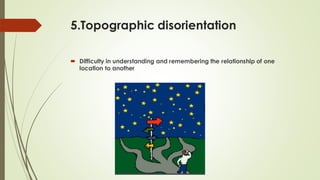
5.Topographic disorientation
 Difficulty in understanding and remembering the relationship of one
location to another
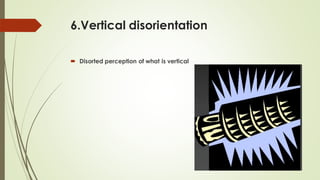
6.Vertical disorientation
 Disorted perception of what is vertical
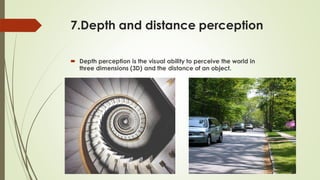
7.Depth and distance perception
 Depth perception is the visual ability to perceive the world in
three dimensions (3D) and the distance of an object.
AGNOSIA
Agnosia is a rare disorder whereby a patient is unable to recognize and
identify objects, persons, or sounds using one or more of their senses despite
otherwise normally functioning senses
For example, a patient with agnosia may not be able to identify a cup by
sight, although they may be able to tell its color and identify it by touch by its
shape and texture
Types:. -Visual agnosia
-Auditory agnosia
VISUAL AGNOSIA
 Visual object agnosia Is the most common form of agnosia.
 Visual agnosia refers to an impairment in recognizing visually presented
objects, despite otherwise normal visual field, acuity, color vision, brightness
discrimination, language, and memory. Patients can recognize objects using
other sensory modalities.
 Lesion area : occipito-temporo-parietal areas of either hemisphere.
 For example: One remarkable aspect of this disorder is the readiness with
which the patient can identify an object once it is handled . The patient may
not recognize people, possessions and common objects.
 Testing :To test for this deficit, Several common objects are placed in front
the patient. The patient is asked to name the objects, to point to an object
named by the therapist, or to demonstrate its use.
AUDITORY AGNOSIA
 Auditory agnosia refer to the inability to recognize nonspeech sounds or to
discriminate between them. This occurs In the absence of other
communication disorders.
 Lesion area : The lesion is located in the dominant temporal lobe.
 Clinical example: The patient with auditory agnosia cannot tell the
difference between the ring of a doorbell and that of a telephone ,or
between a dog barking and thunder.
 Testing : The patient is asked to close the eyes and to identify the source of
various sounds. The therapist rings a bell ,honks a horn,ring a telephone and
so forth, and ask the patient to identify the sound.(verballyor by pointing to
a picture).
APRAXIA
 Apraxia is an impairment of voluntary skilled learned movement.
 It is characterized by an inability to perform purposeful movement, which
cannot be accounted for by inadequate strength,loss of
coordination,Impaired sensation,attentional difficulties, abnormal tone,
movement disorders, Poor comprehension or uncooperativeness.
 Types : -Ideomotor apraxia
-Ideational apraxia
IDEOMOTOR APRAXIA
 Refers to breakdown between concept and performance.
 There is disconnection between the idea of a movement and it’s motor
execution.
 Information cannot be transferred from the areas of the brain that
conceptualize to the centers for motor execution.
 Clinical example: Unable to blow on commad, however if given a bubble
wand,the patient wil spontaneously blow bubbles
 Lesion area: Left dominant hemisphere,both frontal and posterior parietal
lesions can result in apraxia.
 Testing: Comprises of universally known movements, such as
blowing,brushing, shaving.
IDEATIONAL APRAXIA
 Failure in the conceptualization of the task
 It is an inability to perform a purpuseful motor act either automatically or on
command.
 Patient no longer Understand the overall concept of act
 Cannot retain the idea of the task or cannot formulate the motor pattern that are
required.
 Clinical example: When given a toothbrush and toothpaste and told to brush the
teeth ,the patient put the tube of toothpaste in the Mouth furthe he may be
unable to describe Verbally how tooth pastes is done.
 Lesion area: dominant parietal Lobe
 Testing: Tests for ideational apraxia are similar to those for ideomotor Apraxia
 Difference in the response is that with ideomotor Patient can performa motor act
spontaneously at the appropriate time but ideational is unable to do so.
THANK YOU

perceptual disorder.pdf

  • 1.
  • 3.
    Categories of perceptualdisorders 1. Body scheme/ Body image disorders 2. Spacial relation disorders 3. Agnosia 4. Apraxia
  • 4.
    Body scheme/Body imagedisorders 1. Unilateral neglect 2. Anosognosia 3. Somatoagnosia 4. Finger agnosia 5. Rt-Lt discrimination
  • 5.
    Disorders of Spatialrelations It includes specific impairments in 1. figure ground discrimination. 2. Spatial relations, 3. position in space, 4. topographical disorientation. 5. Form discrimination. 6. Depth and distance perception 7. vertical disorientation.
  • 6.
    Agnosia’s 1. Visual objectAgnosia 2. Auditory Agnosia 3. Tactile Agnosia
  • 7.
    Apraxia’s 1. Ideomotor Apraxia 2.Ideational Apraxia 3. Buccofacial Apraxia
  • 8.
    1. Unilateral neglect Unilateral neglect is characterized by the failure to report or respond to people or objects present at the side opposite to brain lesion
  • 9.
    Sensory neglect  Definedas being unaware of sensory stimuli on the side of the body or space opposite to the body lession.  This can be further classified into 1. Visual neglect 2. Auditory neglect 3. Tactile neglect
  • 10.
    Motor neglect  Failureto generate a movement response to a stimulus eventhough the person is aware of the stimulus  The movement failure cannot be explained by a primary motor deficit or weakness.
  • 11.
    Representational neglect  Wherea person ignores the contraesional of internally generated images  Internally generated images are mental representations or visualizations of a task, action or environment.
  • 12.
    Personal neglect  Alack of exploration or awareness of the side of the body opposite the brain lesion.  (E.g.)Failure to dress one half of the body or combing only one side of the head.
  • 13.
    Spatial neglect A failureto acknowledge stimuli on the contralesional side of space 1. Peri personal neglect 2. Extra personal neglect
  • 14.
    Testing Unilateral Neglect Line bisection tests  Cancellation tests  Copying and drawing tests  Behavioral Inattention Test (BIT)
  • 16.
  • 17.
  • 18.
  • 19.
    Behaviour inattention test The Behavioral Inattention Test (BIT) is a 15 item standardized test battery for assessing visual neglect, consisting of  6 of the most commonly used pen-and paper tests as well as  9 behavioral tasks.
  • 20.
    Pen & Papertests 1. Line crossing, 2. Letter cancellation, 3. Star cancellation, 4. Figure copying, 5. Line bisection, and 6. Free drawing.
  • 21.
    Behavioral Tasks 1. Picturescanning, 2. Telephone dialing, 3. Menu reading, 4. Article reading, 5. Telling and setting the time, 6. Coin sorting, 7. Address and sentence copying, 8. Map navigation, and 9.Card sorting.
  • 22.
    2. Somato Agnosia Impairment in body scheme, is a lack of awareness of body structure and the relationship of body parts to oneself or to others
  • 23.
    Evaluation Draw Man Test: Askthe patient to draw the diagram of a man Note for A.Absence of a specific body part B.Abnormality in relation between the body parts
  • 24.
    3. Finger Agnosia ■Inability to identify the fingers of one’s own hands or of the hands of the examiner. ■ This includes difficulty in naming the fingers on command
  • 25.
    4. Anosognosia  Anosognosiais a lack of ability to perceive the realities of one’s own condition. It’s a person’s inability to accept that they have a condition that matches up with their symptoms or a formal diagnosis.
  • 26.
    5. Right-left discrimination Right–left discrimination is a complex neuropsychologic process that calls upon several higher functions, including visuospatial processing, memory, language and integration of sensory information, and cerebral hemispherical asymmetry appears to be a contributing factor.
  • 27.
    Disorders of Spatialrelations  Indications that someone may have a deficit in spatial awareness include: difficulties pinpointing the location of something they see, hear, or feel. Issues navigating through their environment when walking or driving. Problems gauging distance from an object, such as when walking, driving, or reaching for things.
  • 28.
    Types 1. Figure-ground discrimination 2.Form Constancy 3. Spatial Relation 4. Position in spac 5. Topographic disorientation 6. Depth & distance Perception 7. Vertical Disorientation
  • 29.
    1.Figure – GroundDiscrimination Inability to Visually distinguish a figure from the background in which it’s embeded
  • 30.
    2.Form discrimination  Inabilityto perceive or attend subtle difference in form and shape.
  • 31.
    3.Spatial relations  Inabilityto Perceive the relationship of one object in space to another object or to oneself
  • 32.
    4.Position in space Inabilityto perceive and interpret spatial concept such as Up, Down, Under, Over, in Out, Infront of, Behind
  • 33.
    5.Topographic disorientation  Difficultyin understanding and remembering the relationship of one location to another
  • 34.
    6.Vertical disorientation  Disortedperception of what is vertical
  • 35.
    7.Depth and distanceperception  Depth perception is the visual ability to perceive the world in three dimensions (3D) and the distance of an object.
  • 36.
    AGNOSIA Agnosia is arare disorder whereby a patient is unable to recognize and identify objects, persons, or sounds using one or more of their senses despite otherwise normally functioning senses For example, a patient with agnosia may not be able to identify a cup by sight, although they may be able to tell its color and identify it by touch by its shape and texture Types:. -Visual agnosia -Auditory agnosia
  • 37.
    VISUAL AGNOSIA  Visualobject agnosia Is the most common form of agnosia.  Visual agnosia refers to an impairment in recognizing visually presented objects, despite otherwise normal visual field, acuity, color vision, brightness discrimination, language, and memory. Patients can recognize objects using other sensory modalities.  Lesion area : occipito-temporo-parietal areas of either hemisphere.  For example: One remarkable aspect of this disorder is the readiness with which the patient can identify an object once it is handled . The patient may not recognize people, possessions and common objects.
  • 38.
     Testing :Totest for this deficit, Several common objects are placed in front the patient. The patient is asked to name the objects, to point to an object named by the therapist, or to demonstrate its use.
  • 39.
    AUDITORY AGNOSIA  Auditoryagnosia refer to the inability to recognize nonspeech sounds or to discriminate between them. This occurs In the absence of other communication disorders.  Lesion area : The lesion is located in the dominant temporal lobe.  Clinical example: The patient with auditory agnosia cannot tell the difference between the ring of a doorbell and that of a telephone ,or between a dog barking and thunder.  Testing : The patient is asked to close the eyes and to identify the source of various sounds. The therapist rings a bell ,honks a horn,ring a telephone and so forth, and ask the patient to identify the sound.(verballyor by pointing to a picture).
  • 40.
    APRAXIA  Apraxia isan impairment of voluntary skilled learned movement.  It is characterized by an inability to perform purposeful movement, which cannot be accounted for by inadequate strength,loss of coordination,Impaired sensation,attentional difficulties, abnormal tone, movement disorders, Poor comprehension or uncooperativeness.  Types : -Ideomotor apraxia -Ideational apraxia
  • 41.
    IDEOMOTOR APRAXIA  Refersto breakdown between concept and performance.  There is disconnection between the idea of a movement and it’s motor execution.  Information cannot be transferred from the areas of the brain that conceptualize to the centers for motor execution.  Clinical example: Unable to blow on commad, however if given a bubble wand,the patient wil spontaneously blow bubbles  Lesion area: Left dominant hemisphere,both frontal and posterior parietal lesions can result in apraxia.  Testing: Comprises of universally known movements, such as blowing,brushing, shaving.
  • 42.
    IDEATIONAL APRAXIA  Failurein the conceptualization of the task  It is an inability to perform a purpuseful motor act either automatically or on command.  Patient no longer Understand the overall concept of act  Cannot retain the idea of the task or cannot formulate the motor pattern that are required.  Clinical example: When given a toothbrush and toothpaste and told to brush the teeth ,the patient put the tube of toothpaste in the Mouth furthe he may be unable to describe Verbally how tooth pastes is done.  Lesion area: dominant parietal Lobe  Testing: Tests for ideational apraxia are similar to those for ideomotor Apraxia  Difference in the response is that with ideomotor Patient can performa motor act spontaneously at the appropriate time but ideational is unable to do so.
  • 43.