The Frontotemporal Dementias
Brian S. Appleby, M.D.
Associate Professor of Neurology
University Hospitals-Case Medical Center
Disclosures
• Co-PI: Memantine for FTD
• Co-PI: TauRx for FTD
Objectives
1. Provide an overview of the cause underlying
frontotemporal dementia (FTD)
2. Provide an overview of the clinical symptoms
and diagnosis of FTD
3. Explore caregiver burdens of caring for
individuals with FTD and subsequent
management options
Dementia (Symptom not Diagnosis)
Chest Pain
• Heart attack
• Pneumonia
• Muscle strain

Dementia
• Reversible causes
– Vitamin deficiency
– Depression

• Progressive brain diseases
– Alzheimer’s disease
– Frontotemporal dementia
– Dementia with Lewy bodies
Neurodegenerative Dementias
Protein Misfolding Disorders (PMD)
Disease

Protein

Alzheimer’s disease

A-beta (plaques)
Phosphorylated tau (tangles)

Parkinson’s disease

Alpha-synuclein (Lewy bodies)

Prion disease

Prion protein

Frontotemporal dementias

Various
- Phosphorylated tau
- Ubiquinated inclusions
(TDP-43)
PMD Origins
Root Causes

Example

Overproduction of proteins

Trisomy 21, AD

Inefficient protein metabolism

Presenilin mutations in AD

Impaired protein clearance

Tauopathies-impaired transport

Neurotoxicity

Protein oligomers in most PMD

Exictotoxicity

“Working overtime”-glutamate toxicity

Unfolded protein response

Stop making the normal proteins

AD=Alzheimer’s disease; PMD=protein misfolding disorders
The Crazy FTD Lexicon
PGRN
MAPT

AGD

Semantic
dementia

PPA
C9ORF72

FTD
FTD-MND

FUS

PSP

NIFID

CBD
HSD

IBMPFD
Timeline of FTD Discoveries
• Frontal and temporal
atrophy in dementia (Pick
1892)

• Pick bodies (Alzheimer & Pick
1911)

• Pathology criteria
(3 types) (Brun 1994)
• Clinical criteria (3 types)
(Neary 1998)

Brun A, J Mol Neurosci 2011
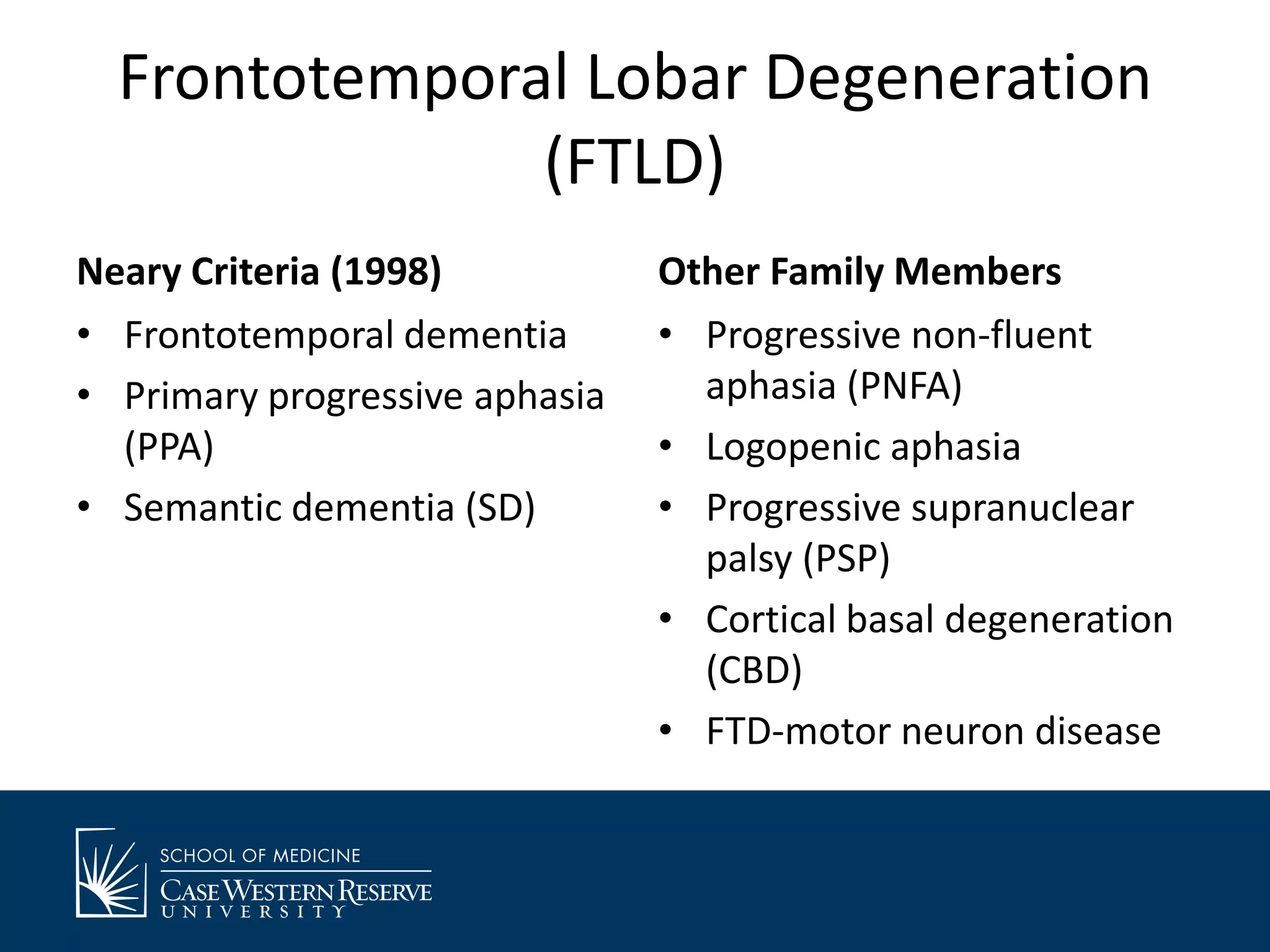
Frontotemporal Lobar Degeneration
(FTLD)
Neary Criteria (1998)
• Frontotemporal dementia
• Primary progressive aphasia
(PPA)
• Semantic dementia (SD)

Other Family Members
• Progressive non-fluent
aphasia (PNFA)
• Logopenic aphasia
• Progressive supranuclear
palsy (PSP)
• Cortical basal degeneration
(CBD)
• FTD-motor neuron disease
Causes
• Sporadic
• Familial (~25%)
• Environmental Risk Factors (?)
– Traumatic brain injury
– Pathology of chronic traumatic encephalopathy is
similar to FTD with some important differences
Appleby BS, Dementi Geriatr Cog Disord 2008
Papageorgiou S, et al. Alzheimer Dis Assoc Disord, 2009

AD

FTLD
Survival Time

Garcin B, Neurology 2009
Frontotemporal dementia (55%)

Primary progressive aphasia Semantic dementia
(25%)
(20%)
Frontotemporal Dementia
• Mean age of onset: 55-65 years-of-age
• Male>Female
• Prominent frontal lobe symptoms
– Disinhibition
– Poor insight/judgment
– Loss of social graces
– Perseverative behaviors
– Apathy
FTD Case Study
• 58 y.o. AAM attorney with h/o dyslexia with
a 2 yr h/o cognitive decline and personality
change
• Distracted, poor concentration, low
mood, fatigued
• Only reads comic books and watches
cartoons, often the same ones repeatedly
Exam
General: Asked to leave room several times to
walk around. Buccal stereotypies (i.e.,
blowing)
Speech: Sparse, poverty of content
Affect: Flat, no brightening
MMSE: 19/30
Brain MRI: Mild generalized atrophy
Further Work-up

Brain SPECT
Hemispheric Asymmetry (MRI and PET)
Primary Progressive Aphasia
•
•
•
•
•

Progressive non-fluent aphasia
Decreased speech output
Speech apraxia
Changes in grammar use
Neuropathology is often progressive
supranuclear palsy or corticobasal
degeneration

Josephs KA, Brain 2006
PPA Case Study
•
•
•
•
•
•

60 y.o. WM with no past neuropsych hx
Initial complaint is stuttering/stammering
Phonemic paraphrasic errors on exam
MoCA=28/30
“f”=2 words, “animals”=18
At next visit, has complaints of poor
concentration and distractibility
Semantic Dementia
Animal

Bird
Semantic Dementia Case Study
• 77 y.o. WF with a 2 year history of “losing
words”
• Initial symptom was forgetting the essence of
and word for “furnace filter”
• Calls everyone “honey-child”
• More frontal behaviors/personality changes
• Obsessed with puzzles
Exam
Speech: fluent, but lacks content and is vague
with generalization of word usage
Verbal fluency: “f”=12 words, “animals”=1
Behaviors: Some perseverative picking
Memory and visuospatial skills were completely
intact
Progressive Supranuclear Palsy
Case Study
• 60 y.o. WF with h/o rheumatic
fever, GERD, vit D def, osteopenia, and
liver/brain hemangiomas
• 1 yr h/o progressive strabismus with
diplopia (repaired with return 1 mo
later), parkinsonism, dysarthria, and shortterm amnesia, fatigue, anxiety, panic
attacks
Exam
Speech: hypophonic, sparse, dysarthric
Thought Process: bradyphrenic
Affect: stable, flat without brightening
MMSE: 7/30
UPDRS II: 43
Neuro: vertical gaze impairment, choppy
saccades, hypomimia, axial rigidity
Cortical Basal Degeneration
Case Study
• 50 y.o. female from Spain with 4 yr h/o
gradual executive dysfxn, short-term
amnesia, progressive non-fluent aphasia,
parkinsonism, and myoclonus
• Paces frequently, apathetic, crying when
frustrated, seen responding to internal
stimuli, and sometimes thinks others are
stealing from her
Exam (1/2)
Gait: slow, shuffling, leans to left
Speech: Effortful, paraphrasic errors
MMSE: 5/30
3MS: 17/100
Clock: 1/5
UPDRS II: 44
• Myoclonus with speech and action
• Left-sided neglect, finger agnosia
Exam (2/2)
Pentagons

Clock
Cohort

n

C9ORF72

PGRN

SOD1

TARDBP

FUS

fFTLD-TDP

66

25 (38%)

13 (20%)

n/a

n/a

n/a

sFTLD-TDP

53

8 (15%)

8 (15%)

n/a

n/a

n/a

fALS

34

8 (24%)

n/a

4 (12%)

1 (3%)

1 (3%)

sALS

195

8 (4%)

n/a

0 (0%)

2 (1%)

3 (1.5%)

f=familial, s=sporadic

Other mutations: MAPT, VCP, CHMP2B
Adapted from: DeJesus-Hernandez M, Neuron 2011
Treatment/Management
Cholinesterase Inhibitors

Cholinesterase inhibitors worsened cognition and behavior
Irwin D, Am J Alzheimers Dis Other Disord 2010
Memantine
• Increases brain FDG-PET metabolism in FTD
and SD (Chow 2011, 2012)
• No improvement in behavior/cognition (DiehlSchmid 2008, Vercelletto 2011)

• Transient improvement in neuropsych
symptoms in FTD and PPA (Swanberg 2007, Boxer 2009)
• Large double-blind, RCT, no effects (Boxer A, Lancet
Neurol 2013)
Antipsychotics
• Often used because of behavioral symptoms
• Mounting evidence of hypersensitivity to EPS
in FTD (Mendez 2001, Pijnenburg 2003, Czarnecki 2008)
• Think of overlap of FTLD with “Parkinson’sPlus” disorders
Benzodiazepines
“Do you really want to give a disinhibiting
medication to a demented person with no
frontal lobes?”
Antidepressants
• Loss of serotonergic neurons->replete with
serotonergic drugs
• Trazodone (Lebert 2004)
• SSRIs (Swartz 1997, Moretti 2003, Herrmann 2011)
• Paroxetine: no effect, worsened cognition (Deakin
2004)
Citalopram 40mg/day

Herrmann N, Am J Geriatr Psychiatry 2012
Brain 2011
The Other Patient

CAREGIVERS
CJD
ZBI=Zarit Burden Interview

FTD

SD

PPA

AD

CBD

Johns Hopkins FTD/YOD
Neuropsychiatric Comorbidity

Boutoleau-Bretonnière C, Dement Geriatr Cogn Disord 2008
Chow T, JAD 2012
Chow T, JAD 2012
Recommendations
• FTD-specific support group
• “What if it isn’t Alzheimer’s?” by Lisa Radin
• At least ½ day per week of personal time for
caregivers
• Speak to children early and often
• Social Security Disability Insurance (SSDI)
Compassionate Allowances (“fast track”)
Resources
• Alzheimer’s Association (www.alz.org)
• Association for Frontotemporal Dementia
(AFTD) (www.theaftd.org)
• FTD specific support groups (Alz Assoc/AFTD)
(Columbus, Akron, Cleveland)
Frontotemporal Dementia Centered Activites

• TauRx Clinical Trial for FTD
• FTD Support Group (Alz Assoc/AFTD)
• More to come…
Thank You

The Frontotemporal Dementias

  • 1.
    The Frontotemporal Dementias BrianS. Appleby, M.D. Associate Professor of Neurology University Hospitals-Case Medical Center
  • 2.
    Disclosures • Co-PI: Memantinefor FTD • Co-PI: TauRx for FTD
  • 3.
    Objectives 1. Provide anoverview of the cause underlying frontotemporal dementia (FTD) 2. Provide an overview of the clinical symptoms and diagnosis of FTD 3. Explore caregiver burdens of caring for individuals with FTD and subsequent management options
  • 4.
    Dementia (Symptom notDiagnosis) Chest Pain • Heart attack • Pneumonia • Muscle strain Dementia • Reversible causes – Vitamin deficiency – Depression • Progressive brain diseases – Alzheimer’s disease – Frontotemporal dementia – Dementia with Lewy bodies
  • 5.
    Neurodegenerative Dementias Protein MisfoldingDisorders (PMD) Disease Protein Alzheimer’s disease A-beta (plaques) Phosphorylated tau (tangles) Parkinson’s disease Alpha-synuclein (Lewy bodies) Prion disease Prion protein Frontotemporal dementias Various - Phosphorylated tau - Ubiquinated inclusions (TDP-43)
  • 6.
    PMD Origins Root Causes Example Overproductionof proteins Trisomy 21, AD Inefficient protein metabolism Presenilin mutations in AD Impaired protein clearance Tauopathies-impaired transport Neurotoxicity Protein oligomers in most PMD Exictotoxicity “Working overtime”-glutamate toxicity Unfolded protein response Stop making the normal proteins AD=Alzheimer’s disease; PMD=protein misfolding disorders
  • 7.
    The Crazy FTDLexicon PGRN MAPT AGD Semantic dementia PPA C9ORF72 FTD FTD-MND FUS PSP NIFID CBD HSD IBMPFD
  • 8.
    Timeline of FTDDiscoveries • Frontal and temporal atrophy in dementia (Pick 1892) • Pick bodies (Alzheimer & Pick 1911) • Pathology criteria (3 types) (Brun 1994) • Clinical criteria (3 types) (Neary 1998) Brun A, J Mol Neurosci 2011
  • 9.
    Frontotemporal Lobar Degeneration (FTLD) NearyCriteria (1998) • Frontotemporal dementia • Primary progressive aphasia (PPA) • Semantic dementia (SD) Other Family Members • Progressive non-fluent aphasia (PNFA) • Logopenic aphasia • Progressive supranuclear palsy (PSP) • Cortical basal degeneration (CBD) • FTD-motor neuron disease
  • 10.
    Causes • Sporadic • Familial(~25%) • Environmental Risk Factors (?) – Traumatic brain injury – Pathology of chronic traumatic encephalopathy is similar to FTD with some important differences
  • 11.
    Appleby BS, DementiGeriatr Cog Disord 2008
  • 12.
    Papageorgiou S, etal. Alzheimer Dis Assoc Disord, 2009 AD FTLD
  • 13.
  • 14.
    Frontotemporal dementia (55%) Primaryprogressive aphasia Semantic dementia (25%) (20%)
  • 15.
    Frontotemporal Dementia • Meanage of onset: 55-65 years-of-age • Male>Female • Prominent frontal lobe symptoms – Disinhibition – Poor insight/judgment – Loss of social graces – Perseverative behaviors – Apathy
  • 16.
    FTD Case Study •58 y.o. AAM attorney with h/o dyslexia with a 2 yr h/o cognitive decline and personality change • Distracted, poor concentration, low mood, fatigued • Only reads comic books and watches cartoons, often the same ones repeatedly
  • 17.
    Exam General: Asked toleave room several times to walk around. Buccal stereotypies (i.e., blowing) Speech: Sparse, poverty of content Affect: Flat, no brightening MMSE: 19/30 Brain MRI: Mild generalized atrophy
  • 18.
  • 19.
  • 20.
    Primary Progressive Aphasia • • • • • Progressivenon-fluent aphasia Decreased speech output Speech apraxia Changes in grammar use Neuropathology is often progressive supranuclear palsy or corticobasal degeneration Josephs KA, Brain 2006
  • 21.
    PPA Case Study • • • • • • 60y.o. WM with no past neuropsych hx Initial complaint is stuttering/stammering Phonemic paraphrasic errors on exam MoCA=28/30 “f”=2 words, “animals”=18 At next visit, has complaints of poor concentration and distractibility
  • 22.
  • 23.
    Semantic Dementia CaseStudy • 77 y.o. WF with a 2 year history of “losing words” • Initial symptom was forgetting the essence of and word for “furnace filter” • Calls everyone “honey-child” • More frontal behaviors/personality changes • Obsessed with puzzles
  • 24.
    Exam Speech: fluent, butlacks content and is vague with generalization of word usage Verbal fluency: “f”=12 words, “animals”=1 Behaviors: Some perseverative picking Memory and visuospatial skills were completely intact
  • 25.
    Progressive Supranuclear Palsy CaseStudy • 60 y.o. WF with h/o rheumatic fever, GERD, vit D def, osteopenia, and liver/brain hemangiomas • 1 yr h/o progressive strabismus with diplopia (repaired with return 1 mo later), parkinsonism, dysarthria, and shortterm amnesia, fatigue, anxiety, panic attacks
  • 26.
    Exam Speech: hypophonic, sparse,dysarthric Thought Process: bradyphrenic Affect: stable, flat without brightening MMSE: 7/30 UPDRS II: 43 Neuro: vertical gaze impairment, choppy saccades, hypomimia, axial rigidity
  • 27.
    Cortical Basal Degeneration CaseStudy • 50 y.o. female from Spain with 4 yr h/o gradual executive dysfxn, short-term amnesia, progressive non-fluent aphasia, parkinsonism, and myoclonus • Paces frequently, apathetic, crying when frustrated, seen responding to internal stimuli, and sometimes thinks others are stealing from her
  • 28.
    Exam (1/2) Gait: slow,shuffling, leans to left Speech: Effortful, paraphrasic errors MMSE: 5/30 3MS: 17/100 Clock: 1/5 UPDRS II: 44 • Myoclonus with speech and action • Left-sided neglect, finger agnosia
  • 29.
  • 30.
    Cohort n C9ORF72 PGRN SOD1 TARDBP FUS fFTLD-TDP 66 25 (38%) 13 (20%) n/a n/a n/a sFTLD-TDP 53 8(15%) 8 (15%) n/a n/a n/a fALS 34 8 (24%) n/a 4 (12%) 1 (3%) 1 (3%) sALS 195 8 (4%) n/a 0 (0%) 2 (1%) 3 (1.5%) f=familial, s=sporadic Other mutations: MAPT, VCP, CHMP2B Adapted from: DeJesus-Hernandez M, Neuron 2011
  • 31.
  • 32.
    Cholinesterase Inhibitors Cholinesterase inhibitorsworsened cognition and behavior Irwin D, Am J Alzheimers Dis Other Disord 2010
  • 33.
    Memantine • Increases brainFDG-PET metabolism in FTD and SD (Chow 2011, 2012) • No improvement in behavior/cognition (DiehlSchmid 2008, Vercelletto 2011) • Transient improvement in neuropsych symptoms in FTD and PPA (Swanberg 2007, Boxer 2009) • Large double-blind, RCT, no effects (Boxer A, Lancet Neurol 2013)
  • 34.
    Antipsychotics • Often usedbecause of behavioral symptoms • Mounting evidence of hypersensitivity to EPS in FTD (Mendez 2001, Pijnenburg 2003, Czarnecki 2008) • Think of overlap of FTLD with “Parkinson’sPlus” disorders
  • 35.
    Benzodiazepines “Do you reallywant to give a disinhibiting medication to a demented person with no frontal lobes?”
  • 36.
    Antidepressants • Loss ofserotonergic neurons->replete with serotonergic drugs • Trazodone (Lebert 2004) • SSRIs (Swartz 1997, Moretti 2003, Herrmann 2011) • Paroxetine: no effect, worsened cognition (Deakin 2004)
  • 37.
    Citalopram 40mg/day Herrmann N,Am J Geriatr Psychiatry 2012
  • 38.
  • 39.
  • 40.
  • 41.
  • 42.
  • 43.
  • 44.
    Recommendations • FTD-specific supportgroup • “What if it isn’t Alzheimer’s?” by Lisa Radin • At least ½ day per week of personal time for caregivers • Speak to children early and often • Social Security Disability Insurance (SSDI) Compassionate Allowances (“fast track”)
  • 45.
    Resources • Alzheimer’s Association(www.alz.org) • Association for Frontotemporal Dementia (AFTD) (www.theaftd.org) • FTD specific support groups (Alz Assoc/AFTD) (Columbus, Akron, Cleveland)
  • 46.
    Frontotemporal Dementia CenteredActivites • TauRx Clinical Trial for FTD • FTD Support Group (Alz Assoc/AFTD) • More to come…
  • 47.

Editor's Notes