A D E W I J A Y A , M D – M A R C H 2 0 2 0
AGNOSIA
Introduction
 Is a rare disorder whereby a patient is unable to
recognize and identify objects, persons, or sounds
using one or more of their senses despite otherwise
normally functioning senses
 The deficit cannot be explained by memory,
attention, language problems, or unfamiliarity to the
stimuli.
 Usually, one of the sensory modalities is affected
De Renzi E. [Agnosia]. Recenti Prog Med. 1989 Dec;80(12):633-7.
APPERCEPTIVE ASSOCIATIVE
Failure in recognition
due to deficits in the
early stages of
perceptual processing
A failure in recognition
despite no deficit in
perception.
Associative agnosia
patients can typically
draw, match or copy
objects while
apperceptive agnosia
patients cannot.
Agnosia
Coslett HB. Sensory Agnosias. In: Gottfried JA, editor. Neurobiology of Sensation and Reward. CRC Press/Taylor & Francis; Boca Raton (FL): 2011.
De Renzi E. [Agnosia]. Recenti Prog Med. 1989 Dec;80(12):633-7.
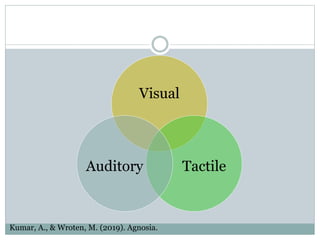
Visual
TactileAuditory
Kumar, A., & Wroten, M. (2019). Agnosia.
Visual Agnosia
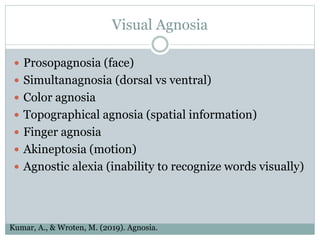
 Prosopagnosia (face)
 Simultanagnosia (dorsal vs ventral)
 Color agnosia
 Topographical agnosia (spatial information)
 Finger agnosia
 Akineptosia (motion)
 Agnostic alexia (inability to recognize words visually)
Kumar, A., & Wroten, M. (2019). Agnosia.
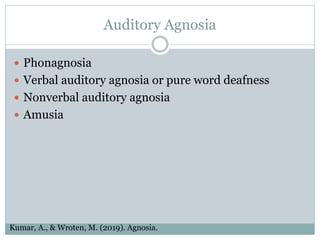
Auditory Agnosia
 Phonagnosia
 Verbal auditory agnosia or pure word deafness
 Nonverbal auditory agnosia
 Amusia
Kumar, A., & Wroten, M. (2019). Agnosia.
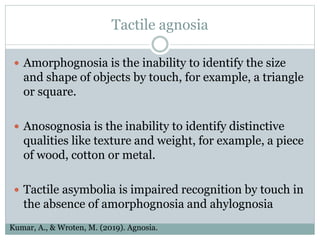
Tactile agnosia
 Amorphognosia is the inability to identify the size
and shape of objects by touch, for example, a triangle
or square.
 Anosognosia is the inability to identify distinctive
qualities like texture and weight, for example, a piece
of wood, cotton or metal.
 Tactile asymbolia is impaired recognition by touch in
the absence of amorphognosia and ahylognosia
Kumar, A., & Wroten, M. (2019). Agnosia.
Etiology
 Strokes
 Tumors
 Infections
 Dementia
 Hypoxia
 Toxins such as carbon monoxide poisoning
 Head injury
 Developmental disorders
 Other neurological conditions
Kumar, A., & Wroten, M. (2019). Agnosia.
Epidemiology
 Very rare
 Less than 1 %
 Visual agnosis is the most common
De Renzi E. [Agnosia]. Recenti Prog Med. 1989 Dec;80(12):633-7.
Coslett HB. Sensory Agnosias. In: Gottfried JA, editor. Neurobiology of Sensation and Reward. CRC Press/Taylor & Francis; Boca Raton (FL): 2011.
Diagnosis
 History
 Physical examination
 Memory and cognitive testings
 Neuroimaging
Kumar, A., & Wroten, M. (2019). Agnosia.
Management
 Treat the underlying cause
 Rehabilitation, speech, and occupational therapy
 Alternative Cues and Strategies
 Organizational Strategies:
- Provide a predictable environment and consistency
- Declutter, for example, things patients use every day
should be kept out in one place
- Label everything
Burns MS. Clinical management of agnosia. Top Stroke Rehabil. 2004 Winter;11(1):1-9.
Heutink J, Indorf DL, Cordes C. The neuropsychological rehabilitation of visual agnosia and Balint's syndrome. Neuropsychol Rehabil. 2019 Dec;29(10):1489-1508.
Trivelli C, Turnbull OH, Sala SD. Recovery of object recognition in a case of simultanagnosia. Appl Neuropsychol. 1996 Aug-Nov;3(3-4):166-73.
Differential Diagnosis
 Dementia, aphasia, acute confusional states
(delirium), disturbance of attention, and
unfamiliarity with stimuli.
 Also, clinicians need to confirm make sure no actual
sensory impairment such as color blindness,
cataracts, hearing loss, neuropathy, among others
Kumar, A., & Wroten, M. (2019). Agnosia.
Prognosis
 Few patients with agnosia regain their sensory
function.
 Most recovery occurs within the first three months
and to a variable degree may continue up to a year.
 Prognosis depends on the patient's age, etiology,
type, size and location of the area affected, the extent
of impairment, effectiveness of therapy.
Kumar, A., & Wroten, M. (2019). Agnosia.
THANK YOU

Agnosia

  • 1.
    A D EW I J A Y A , M D – M A R C H 2 0 2 0 AGNOSIA
  • 2.
    Introduction  Is arare disorder whereby a patient is unable to recognize and identify objects, persons, or sounds using one or more of their senses despite otherwise normally functioning senses  The deficit cannot be explained by memory, attention, language problems, or unfamiliarity to the stimuli.  Usually, one of the sensory modalities is affected De Renzi E. [Agnosia]. Recenti Prog Med. 1989 Dec;80(12):633-7.
  • 3.
    APPERCEPTIVE ASSOCIATIVE Failure inrecognition due to deficits in the early stages of perceptual processing A failure in recognition despite no deficit in perception. Associative agnosia patients can typically draw, match or copy objects while apperceptive agnosia patients cannot. Agnosia Coslett HB. Sensory Agnosias. In: Gottfried JA, editor. Neurobiology of Sensation and Reward. CRC Press/Taylor & Francis; Boca Raton (FL): 2011. De Renzi E. [Agnosia]. Recenti Prog Med. 1989 Dec;80(12):633-7.
  • 4.
    Visual TactileAuditory Kumar, A., &Wroten, M. (2019). Agnosia.
  • 5.
    Visual Agnosia  Prosopagnosia(face)  Simultanagnosia (dorsal vs ventral)  Color agnosia  Topographical agnosia (spatial information)  Finger agnosia  Akineptosia (motion)  Agnostic alexia (inability to recognize words visually) Kumar, A., & Wroten, M. (2019). Agnosia.
  • 6.
    Auditory Agnosia  Phonagnosia Verbal auditory agnosia or pure word deafness  Nonverbal auditory agnosia  Amusia Kumar, A., & Wroten, M. (2019). Agnosia.
  • 7.
    Tactile agnosia  Amorphognosiais the inability to identify the size and shape of objects by touch, for example, a triangle or square.  Anosognosia is the inability to identify distinctive qualities like texture and weight, for example, a piece of wood, cotton or metal.  Tactile asymbolia is impaired recognition by touch in the absence of amorphognosia and ahylognosia Kumar, A., & Wroten, M. (2019). Agnosia.
  • 8.
    Etiology  Strokes  Tumors Infections  Dementia  Hypoxia  Toxins such as carbon monoxide poisoning  Head injury  Developmental disorders  Other neurological conditions Kumar, A., & Wroten, M. (2019). Agnosia.
  • 9.
    Epidemiology  Very rare Less than 1 %  Visual agnosis is the most common De Renzi E. [Agnosia]. Recenti Prog Med. 1989 Dec;80(12):633-7. Coslett HB. Sensory Agnosias. In: Gottfried JA, editor. Neurobiology of Sensation and Reward. CRC Press/Taylor & Francis; Boca Raton (FL): 2011.
  • 10.
    Diagnosis  History  Physicalexamination  Memory and cognitive testings  Neuroimaging Kumar, A., & Wroten, M. (2019). Agnosia.
  • 11.
    Management  Treat theunderlying cause  Rehabilitation, speech, and occupational therapy  Alternative Cues and Strategies  Organizational Strategies: - Provide a predictable environment and consistency - Declutter, for example, things patients use every day should be kept out in one place - Label everything Burns MS. Clinical management of agnosia. Top Stroke Rehabil. 2004 Winter;11(1):1-9. Heutink J, Indorf DL, Cordes C. The neuropsychological rehabilitation of visual agnosia and Balint's syndrome. Neuropsychol Rehabil. 2019 Dec;29(10):1489-1508. Trivelli C, Turnbull OH, Sala SD. Recovery of object recognition in a case of simultanagnosia. Appl Neuropsychol. 1996 Aug-Nov;3(3-4):166-73.
  • 12.
    Differential Diagnosis  Dementia,aphasia, acute confusional states (delirium), disturbance of attention, and unfamiliarity with stimuli.  Also, clinicians need to confirm make sure no actual sensory impairment such as color blindness, cataracts, hearing loss, neuropathy, among others Kumar, A., & Wroten, M. (2019). Agnosia.
  • 13.
    Prognosis  Few patientswith agnosia regain their sensory function.  Most recovery occurs within the first three months and to a variable degree may continue up to a year.  Prognosis depends on the patient's age, etiology, type, size and location of the area affected, the extent of impairment, effectiveness of therapy. Kumar, A., & Wroten, M. (2019). Agnosia.
  • 14.