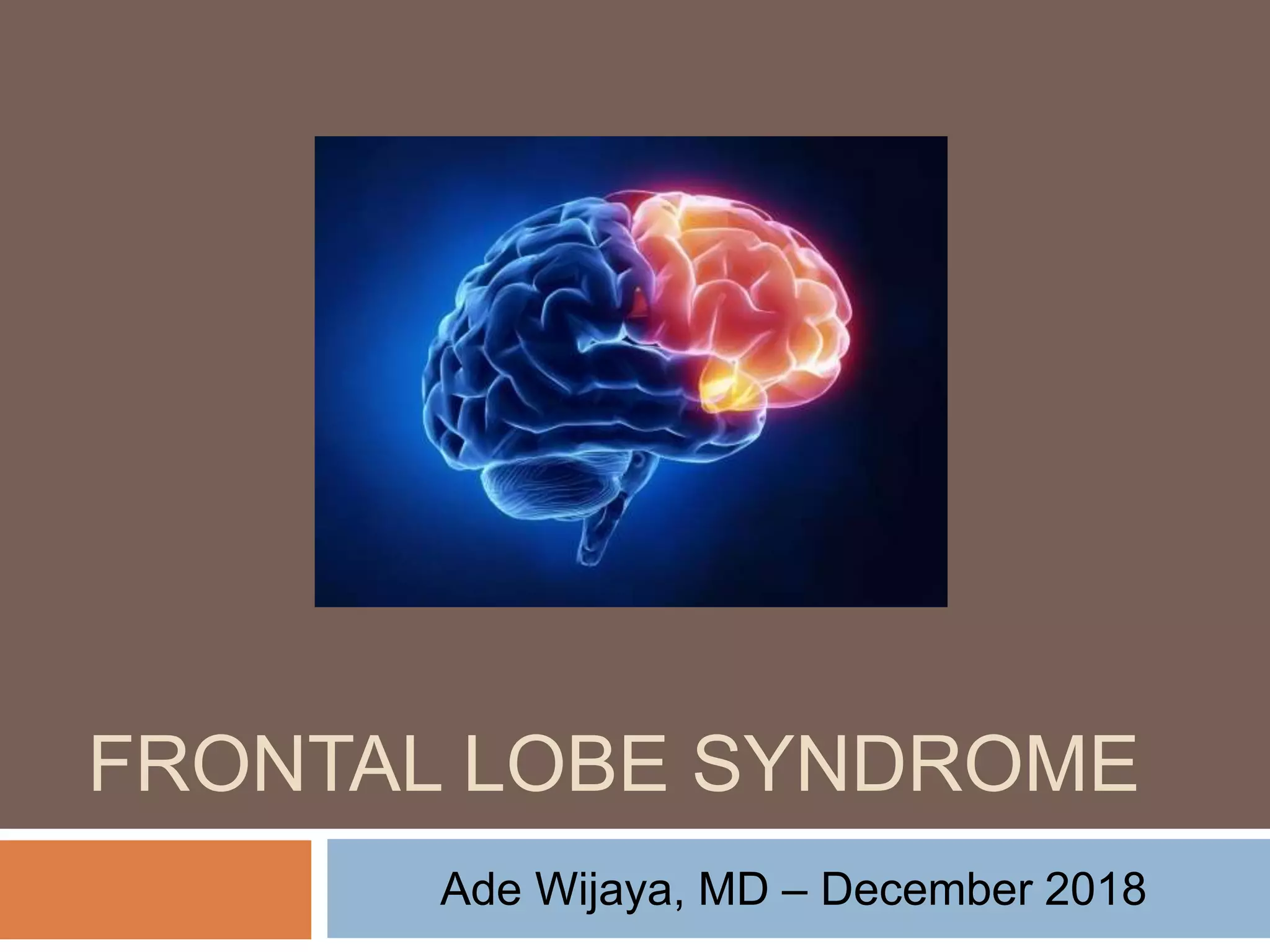
FRONTAL LOBE SYNDROME
Ade Wijaya, MD – December 2018
History
 The French anatomist Francois Chaussier
(1746-1828)  brain lobes division
 The philosopher and theologian Emanuel
Swedenborg (1688-1772) : Frontal lobes
linked to a number of functions: imagination,
memory, thought and suffering,
 Phineas Gage mid-19th century: a survivor of
frontal lobe damage  behavioral changes
Filley CM. Chapter 35: the frontal lobes. Handb Clin Neurol 2010;95:557-70.
Macmillan MB. A wonderful journey through skull and brains: the travels of Mr. Gage’s tamping iron.Brain Cogn 1986;5:67-107.
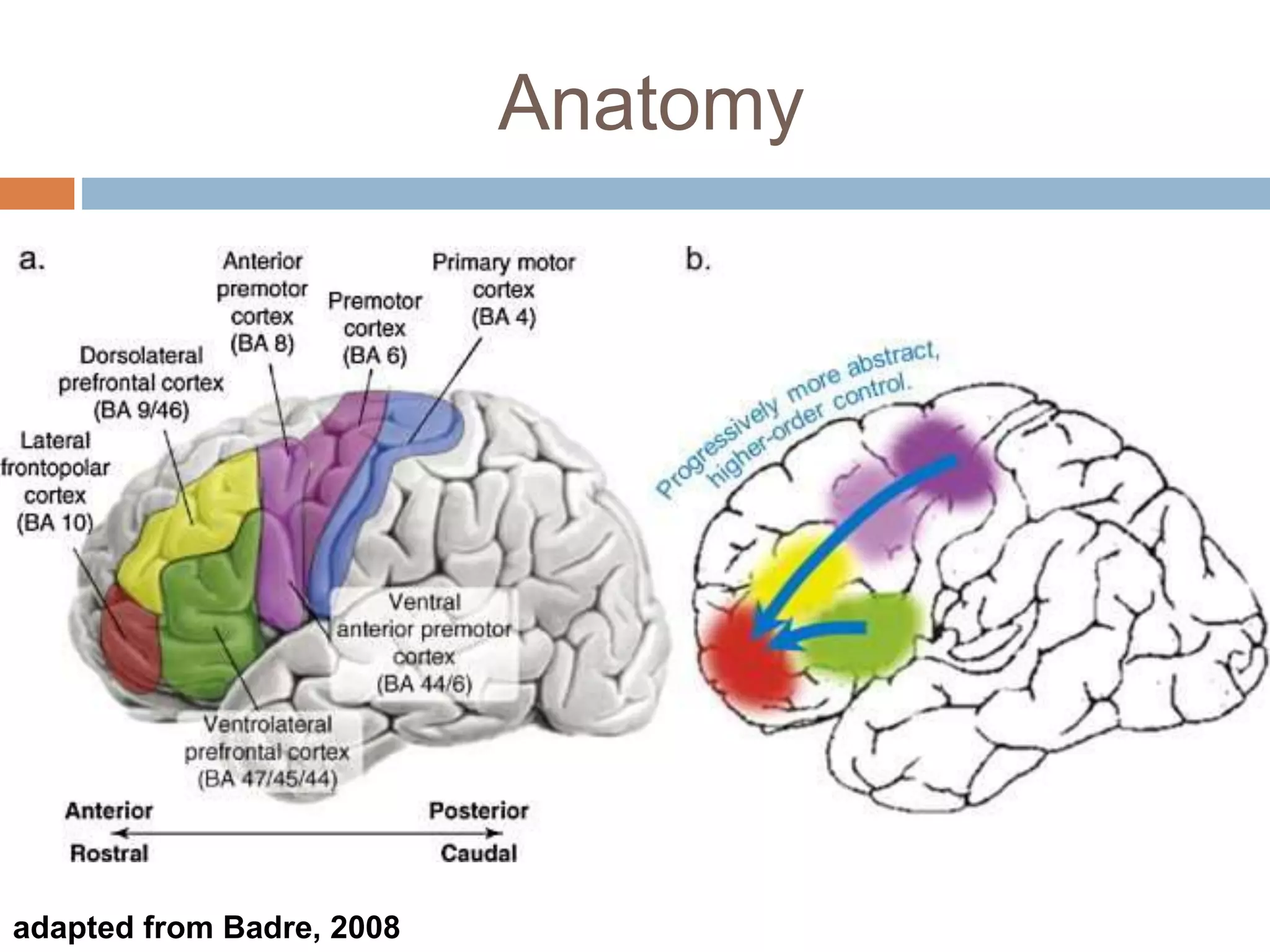
Anatomy
adapted from Badre, 2008
Clinical Features of FLS
 Restlessness
 Impulsiveness
 Disinhibition
 Perseveration
 Aggression
 Euphoria
 Imitation
 Utilization
 Compulsive or
ritualistic behavior
 Inappropriate social
behavior
 Impaired empathy
 Impaired theory of
mind (the ability to
attribute mental
states to others and
to oneself )
Miller B, Cummings J. The human frontal lobes . The Guilford Press, 2007:3-666
Bonelli RM, Cummings JL. Frontal-ubcortical circuitry and behavior. Dialogues Clin Neurosci 2007;9:141-51.
Cummings JL. Frontal-subcortical circuits and human behavior. Arch Neurol 1993;50:873-80.
ORBITOFRONTAL
Clinical Features of FLS
 Impaired organization, generation of ideas and
planning
 Inflexibility,
 Poor abstraction skills and distractibility
DORSOLATERAL PREFRONTAL
Bonelli RM, Cummings JL. Frontal-ubcortical circuitry and behavior. Dialogues Clin Neurosci 2007;9:141-51.
Cummings JL. Frontal-subcortical circuits and human behavior. Arch Neurol 1993;50:873-80.
Miller B, Cummings J. The human frontal lobes . The Guilford Press, 2007:3-666
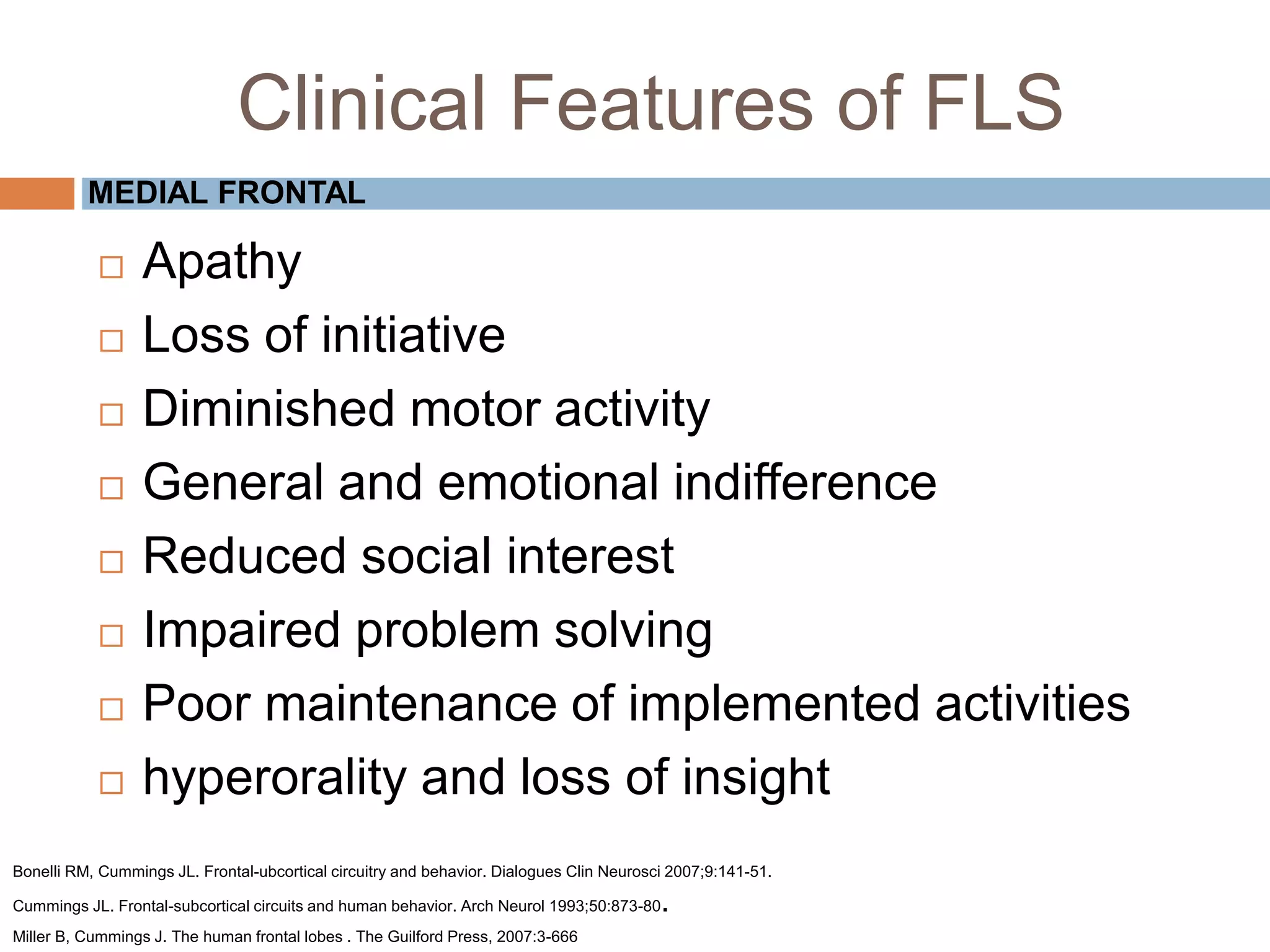
Clinical Features of FLS
 Apathy
 Loss of initiative
 Diminished motor activity
 General and emotional indifference
 Reduced social interest
 Impaired problem solving
 Poor maintenance of implemented activities
 hyperorality and loss of insight
MEDIAL FRONTAL
Bonelli RM, Cummings JL. Frontal-ubcortical circuitry and behavior. Dialogues Clin Neurosci 2007;9:141-51.
Cummings JL. Frontal-subcortical circuits and human behavior. Arch Neurol 1993;50:873-80.
Miller B, Cummings J. The human frontal lobes . The Guilford Press, 2007:3-666
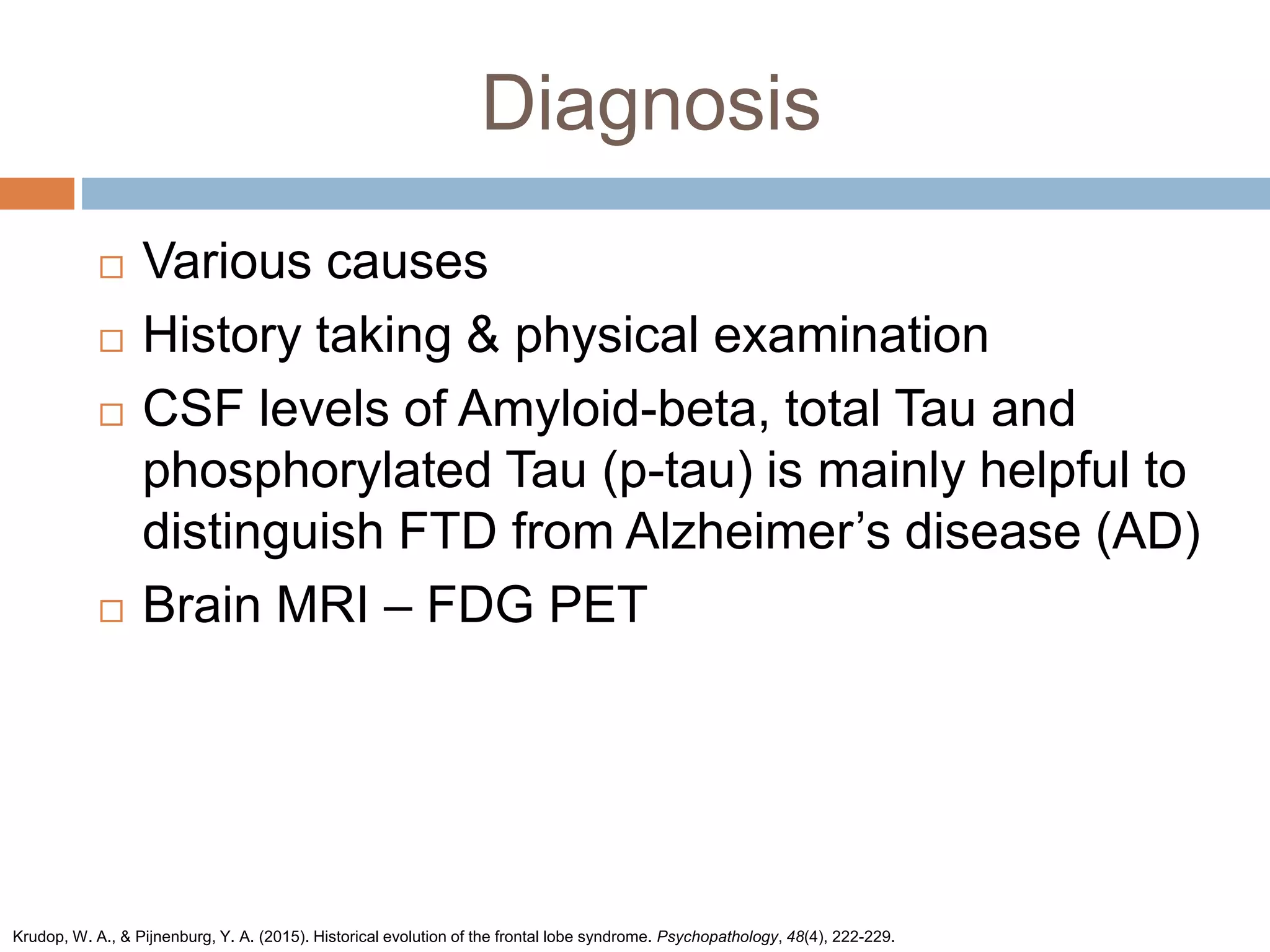
Diagnosis
 Various causes
 History taking & physical examination
 CSF levels of Amyloid-beta, total Tau and
phosphorylated Tau (p-tau) is mainly helpful to
distinguish FTD from Alzheimer’s disease (AD)
 Brain MRI – FDG PET
Krudop, W. A., & Pijnenburg, Y. A. (2015). Historical evolution of the frontal lobe syndrome. Psychopathology, 48(4), 222-229.
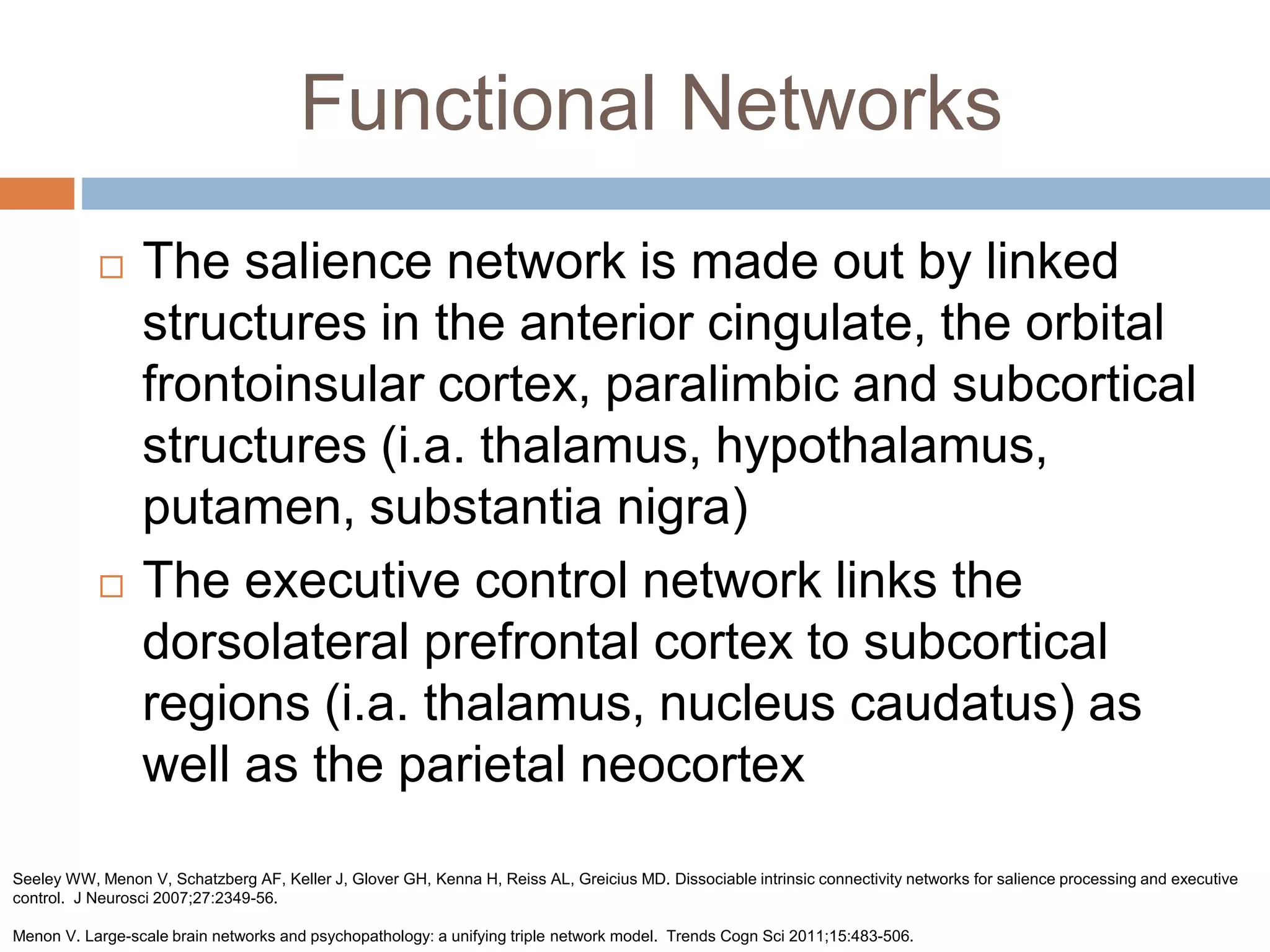
Functional Networks
 The salience network is made out by linked
structures in the anterior cingulate, the orbital
frontoinsular cortex, paralimbic and subcortical
structures (i.a. thalamus, hypothalamus,
putamen, substantia nigra)
 The executive control network links the
dorsolateral prefrontal cortex to subcortical
regions (i.a. thalamus, nucleus caudatus) as
well as the parietal neocortex
Seeley WW, Menon V, Schatzberg AF, Keller J, Glover GH, Kenna H, Reiss AL, Greicius MD. Dissociable intrinsic connectivity networks for salience processing and executive
control. J Neurosci 2007;27:2349-56.
Menon V. Large-scale brain networks and psychopathology: a unifying triple network model. Trends Cogn Sci 2011;15:483-506.
Functional Networks
These two networks are involved in:
 Stressor-associated anxiety and behavior,
 Integrating sensory data with internal stimuli
 Emotional homeostatic regulation
 Directing attention and controlling oneself within a
context.
Disruption of the salience network activity has been
demonstrated in various disorders like bvFTD,
schizophrenia or autism spectrum disorders
Menon V. Large-scale brain networks and psychopathology: a unifying triple network model. Trends Cogn Sci 2011;15:483-506.
Zhou J, Seeley WW. Network Dysfunction in Alzheimer’s Disease and Frontotemporal Dementia: Implications for Psychiatry. Biol Psychiatry 2014;75:565-73
Instruments
 Executive function test: TMT-A/B, letter (and
category) fluency list generation, the Rey complex
figure test or the Wisconsin Card Sorting Test.
 Inhibitory functioning test: the Iowa Gambling
Test, the Stroop test or the Hayling test of
sentence completion.
 Reduced abstraction test: Wechsler Adult
Intelligence Scale or the rule shift cards of the
Behavioural Assessment of the Dysexecutive
Syndrome
Krudop, W. A., & Pijnenburg, Y. A. (2015). Historical evolution of the frontal lobe syndrome. Psychopathology, 48(4), 222-229.
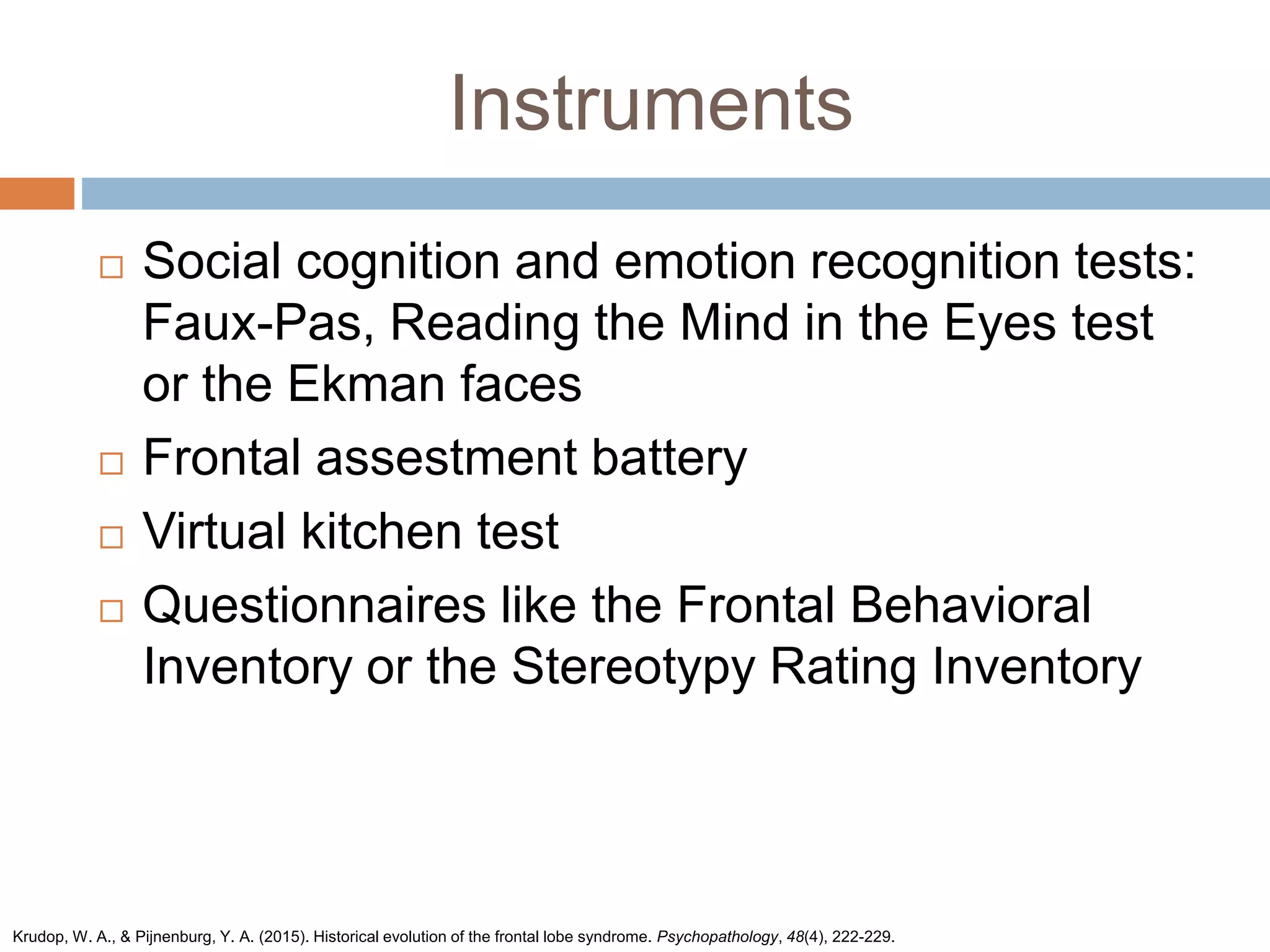
Instruments
 Social cognition and emotion recognition tests:
Faux-Pas, Reading the Mind in the Eyes test
or the Ekman faces
 Frontal assestment battery
 Virtual kitchen test
 Questionnaires like the Frontal Behavioral
Inventory or the Stereotypy Rating Inventory
Krudop, W. A., & Pijnenburg, Y. A. (2015). Historical evolution of the frontal lobe syndrome. Psychopathology, 48(4), 222-229.
Management
 Pharmacological interventions are limited and
no disease-modifying treatment is currently
available.
 non-pharmacological interventions may
provide a mean to decrease symptom severity
as well as caregiver burden
 Treat the underlying causes
Kortte KB, Rogalski EJ. Behavioural interventions for enhancing life participation in behavioural variant frontotemporal dementia and primary progressive aphasia. Int Rev
Psychiatry 2013;25:237-45.
Lough S, Hodges JR. Measuring and modifying abnormal social cognition in frontal variant frontotemporal dementia.
J Psychosom Res 2002;53:639-46.
SUMMARY
 FLS: The broad spectrum of behavioral and
executive impairments associated with fronto-
subcortical dysfunction.
 Various etiologies
 Functional networks
 Biomarkers + MRI
 Instruments
 Pharmacological interventions are limited and no
disease-modifying treatment is currently available.
 Non-pharmacological + treat underlying causes
THANK YOU

Frontal Lobe Syndrome

  • 1.
    FRONTAL LOBE SYNDROME AdeWijaya, MD – December 2018
  • 2.
    History  The Frenchanatomist Francois Chaussier (1746-1828)  brain lobes division  The philosopher and theologian Emanuel Swedenborg (1688-1772) : Frontal lobes linked to a number of functions: imagination, memory, thought and suffering,  Phineas Gage mid-19th century: a survivor of frontal lobe damage  behavioral changes Filley CM. Chapter 35: the frontal lobes. Handb Clin Neurol 2010;95:557-70. Macmillan MB. A wonderful journey through skull and brains: the travels of Mr. Gage’s tamping iron.Brain Cogn 1986;5:67-107.
  • 3.
  • 4.
    Clinical Features ofFLS  Restlessness  Impulsiveness  Disinhibition  Perseveration  Aggression  Euphoria  Imitation  Utilization  Compulsive or ritualistic behavior  Inappropriate social behavior  Impaired empathy  Impaired theory of mind (the ability to attribute mental states to others and to oneself ) Miller B, Cummings J. The human frontal lobes . The Guilford Press, 2007:3-666 Bonelli RM, Cummings JL. Frontal-ubcortical circuitry and behavior. Dialogues Clin Neurosci 2007;9:141-51. Cummings JL. Frontal-subcortical circuits and human behavior. Arch Neurol 1993;50:873-80. ORBITOFRONTAL
  • 5.
    Clinical Features ofFLS  Impaired organization, generation of ideas and planning  Inflexibility,  Poor abstraction skills and distractibility DORSOLATERAL PREFRONTAL Bonelli RM, Cummings JL. Frontal-ubcortical circuitry and behavior. Dialogues Clin Neurosci 2007;9:141-51. Cummings JL. Frontal-subcortical circuits and human behavior. Arch Neurol 1993;50:873-80. Miller B, Cummings J. The human frontal lobes . The Guilford Press, 2007:3-666
  • 6.
    Clinical Features ofFLS  Apathy  Loss of initiative  Diminished motor activity  General and emotional indifference  Reduced social interest  Impaired problem solving  Poor maintenance of implemented activities  hyperorality and loss of insight MEDIAL FRONTAL Bonelli RM, Cummings JL. Frontal-ubcortical circuitry and behavior. Dialogues Clin Neurosci 2007;9:141-51. Cummings JL. Frontal-subcortical circuits and human behavior. Arch Neurol 1993;50:873-80. Miller B, Cummings J. The human frontal lobes . The Guilford Press, 2007:3-666
  • 7.
    Diagnosis  Various causes History taking & physical examination  CSF levels of Amyloid-beta, total Tau and phosphorylated Tau (p-tau) is mainly helpful to distinguish FTD from Alzheimer’s disease (AD)  Brain MRI – FDG PET Krudop, W. A., & Pijnenburg, Y. A. (2015). Historical evolution of the frontal lobe syndrome. Psychopathology, 48(4), 222-229.
  • 8.
    Functional Networks  Thesalience network is made out by linked structures in the anterior cingulate, the orbital frontoinsular cortex, paralimbic and subcortical structures (i.a. thalamus, hypothalamus, putamen, substantia nigra)  The executive control network links the dorsolateral prefrontal cortex to subcortical regions (i.a. thalamus, nucleus caudatus) as well as the parietal neocortex Seeley WW, Menon V, Schatzberg AF, Keller J, Glover GH, Kenna H, Reiss AL, Greicius MD. Dissociable intrinsic connectivity networks for salience processing and executive control. J Neurosci 2007;27:2349-56. Menon V. Large-scale brain networks and psychopathology: a unifying triple network model. Trends Cogn Sci 2011;15:483-506.
  • 9.
    Functional Networks These twonetworks are involved in:  Stressor-associated anxiety and behavior,  Integrating sensory data with internal stimuli  Emotional homeostatic regulation  Directing attention and controlling oneself within a context. Disruption of the salience network activity has been demonstrated in various disorders like bvFTD, schizophrenia or autism spectrum disorders Menon V. Large-scale brain networks and psychopathology: a unifying triple network model. Trends Cogn Sci 2011;15:483-506. Zhou J, Seeley WW. Network Dysfunction in Alzheimer’s Disease and Frontotemporal Dementia: Implications for Psychiatry. Biol Psychiatry 2014;75:565-73
  • 10.
    Instruments  Executive functiontest: TMT-A/B, letter (and category) fluency list generation, the Rey complex figure test or the Wisconsin Card Sorting Test.  Inhibitory functioning test: the Iowa Gambling Test, the Stroop test or the Hayling test of sentence completion.  Reduced abstraction test: Wechsler Adult Intelligence Scale or the rule shift cards of the Behavioural Assessment of the Dysexecutive Syndrome Krudop, W. A., & Pijnenburg, Y. A. (2015). Historical evolution of the frontal lobe syndrome. Psychopathology, 48(4), 222-229.
  • 11.
    Instruments  Social cognitionand emotion recognition tests: Faux-Pas, Reading the Mind in the Eyes test or the Ekman faces  Frontal assestment battery  Virtual kitchen test  Questionnaires like the Frontal Behavioral Inventory or the Stereotypy Rating Inventory Krudop, W. A., & Pijnenburg, Y. A. (2015). Historical evolution of the frontal lobe syndrome. Psychopathology, 48(4), 222-229.
  • 12.
    Management  Pharmacological interventionsare limited and no disease-modifying treatment is currently available.  non-pharmacological interventions may provide a mean to decrease symptom severity as well as caregiver burden  Treat the underlying causes Kortte KB, Rogalski EJ. Behavioural interventions for enhancing life participation in behavioural variant frontotemporal dementia and primary progressive aphasia. Int Rev Psychiatry 2013;25:237-45. Lough S, Hodges JR. Measuring and modifying abnormal social cognition in frontal variant frontotemporal dementia. J Psychosom Res 2002;53:639-46.
  • 13.
    SUMMARY  FLS: Thebroad spectrum of behavioral and executive impairments associated with fronto- subcortical dysfunction.  Various etiologies  Functional networks  Biomarkers + MRI  Instruments  Pharmacological interventions are limited and no disease-modifying treatment is currently available.  Non-pharmacological + treat underlying causes
  • 14.