ACUTE LEUKEMIA 
Dr Rosline Hassan 
Hematology Department 
School of Medical Sciences 
USM
OBJECTIVE 
 Define acute leukemia 
 Classify leukemia 
 Understand the pathogenesis 
 Understand the pathophysiology 
 Able to list down the laboratory 
investigations required for diagnosis 
 Understand the basic management of 
leukemia patients
Acute Leukaemia 
 Define : heterogenous group of malignant 
disorders which is characterised by 
uncontrolled clonal and accumulation of 
blasts cells in the bone marrow and body 
tissues 
 Sudden onset 
 If left untreated is fatal within a few weeks or 
months 
 Incidence 1.8/100,000 –M’sia
Acute Leukemia 
 Classification : 
 Acute 
 Acute lymphoblastic leukemia (T-ALL & B-ALL) 
 Acute myeloid leukemia 
 Chronic 
 Chronic myeloid leukemia 
 Chronic lymphocytic leukemia
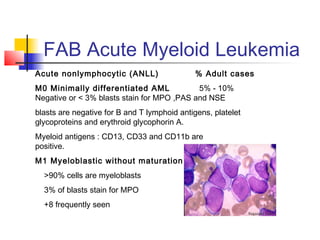
FAB Acute Myeloid Leukemia 
Acute nonlymphocytic (ANLL) % Adult cases 
M0 Minimally differentiated AML 5% - 10% 
Negative or < 3% blasts stain for MPO ,PAS and NSE 
blasts are negative for B and T lymphoid antigens, platelet 
glycoproteins and erythroid glycophorin A. 
Myeloid antigens : CD13, CD33 and CD11b are 
positive. 
M1 Myeloblastic without maturation 10 - 20% 
>90% cells are myeloblasts 
3% of blasts stain for MPO 
+8 frequently seen
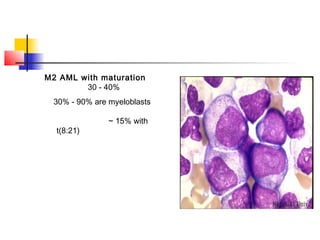
M2 AML with maturation 
30 - 40% 
30% - 90% are myeloblasts 
~ 15% with 
t(8:21)
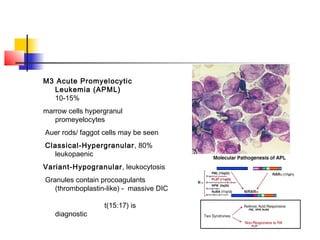
M3 Acute Promyelocytic 
Leukemia (APML) 
10-15% 
marrow cells hypergranul 
promeyelocytes 
Auer rods/ faggot cells may be seen 
Classical-Hypergranular, 80% 
leukopaenic 
Variant-Hypogranular, leukocytosis 
Granules contain procoagulants 
(thromboplastin-like) - massive DIC 
t(15:17) is 
diagnostic
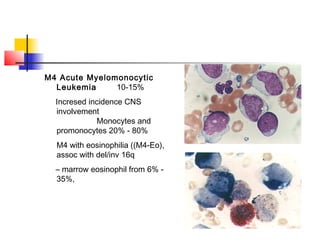
M4 Acute Myelomonocytic 
Leukemia 10-15% 
Incresed incidence CNS 
involvement 
Monocytes and 
promonocytes 20% - 80% 
M4 with eosinophilia ((M4-Eo), 
assoc with del/inv 16q 
– marrow eosinophil from 6% - 
35%,
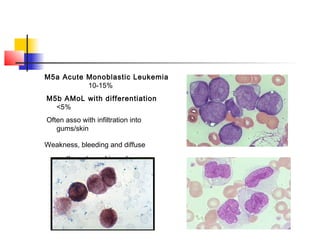
M5a Acute Monoblastic Leukemia 
10-15% 
M5b AMoL with differentiation 
<5% 
Often asso with infiltration into 
gums/skin 
Weakness, bleeding and diffuse 
erythematous skin rash
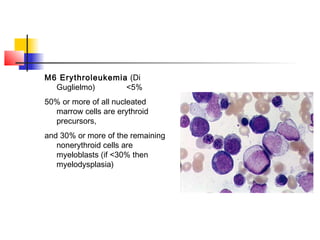
M6 Erythroleukemia (Di 
Guglielmo) <5% 
50% or more of all nucleated 
marrow cells are erythroid 
precursors, 
and 30% or more of the remaining 
nonerythroid cells are 
myeloblasts (if <30% then 
myelodysplasia)
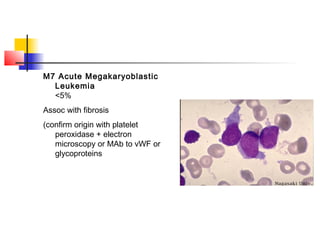
M7 Acute Megakaryoblastic 
Leukemia 
<5% 
Assoc with fibrosis 
(confirm origin with platelet 
peroxidase + electron 
microscopy or MAb to vWF or 
glycoproteins
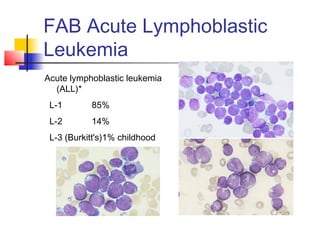
FAB Acute Lymphoblastic 
Leukemia 
Acute lymphoblastic leukemia 
(ALL)* 
L-1 85% 
L-2 14% 
L-3 (Burkitt's)1% childhood
Acute Leukaemogenesis 
Develop as a result of a genetic 
alteration within single cell in the 
bone marrow 
a) Epidemiological evidence : 
1. Hereditary Factors 
	 	 · Fanconi’s anaemia 
	 	 · Down’s syndrome 
	 	 · Ataxia telangiectasia
Acute Leukaemogenesis 
2. Radiation, 
Chemicals and 
Drugs 
3. Virus related 
Leukemias 
 Retrovirus :- 
HTLV 1 & EBV
Acute Leukaemogenesis 
b)Molecular Evidence 
 Oncogenes : 
 Gene that code for proteins involved in 
cell proliferation or differentiation 
 Tumour Suppressor Genes : 
 Changes within oncogene or 
suppressor genes are necessary to 
cause malignant transformation.
Acute Leukaemogenesis 
Oncogene can be activated by : 
· chromosomal translocation 
· point mutations 
· inactivation 
 In general, several genes have to be 
altered to effect neoplastic 
transformation
Pathophysiology 
 Acute leukemia cause morbidity and 
mortality through :- 
 Deficiency in blood cell number and 
function 
 Invasion of vital organs 
 Systemic disturbances by metabolic 
imbalance
Pathophysiology 
A. Deficiency in blood cell number or 
function 
i. Infection 
- Most common cause of death 
- Due to impairment of phagocytic 
function and neutropenia
Pathophysiology 
ii. Hemorrhage 
- Due to thrombocytopenia or 2o 
DIVC or liver disease 
iii. Anaemia 
- normochromic-normocytic 
- severity of anaemia reflects severity of 
disease 
- Due to ineffective erythropoiesis
Pathophysiology 
B. Invasion of vital organs 
- vary according to subtype 
i.Hyperleukocytosis 
- cause increase in blood viscosity 
- Predispose to microthrombi or 
acute bleeding 
- Organ invole : brain, lung, eyes 
- Injudicious used of packed cell 
transfusion precipitate 
hyperviscosity
Pathophysiology 
ii. Leucostatic tumour 
- Rare 
- blast cell lodge in vascular system 
forming macroscopic pseudotumour – 
erode vessel wall cause bleeding 
iii. Hidden site relapse 
- testes and meninges
Pathophysiology 
C. Metabolic imbalance 
- Due to disease or treatment 
- Hyponatremia vasopressin-like subst. by 
myeloblast 
- Hypokalemia due to lysozyme release by 
myeloblast 
- Hyperuricaemia- spont lysis of leukemic 
blast release purines into plasma
Acute Lymphoblastic 
Leukaemia 
 Cancer of the blood affecting the white 
blood cell known as LYMPHOCYTES. 
 Commonest in the age 2-10 years 
 Peak at 3-4 years. 
 Incidence decreases with age, and a 
secondary rise after 40 years. 
 In children - most common malignant 
disease 
 85% of childhood leukaemia
Acute Lymphoblastic 
Leukemia 
Specific manifestation : 
*bone pain, arthritis 
*lymphadenopathy 
*hepatosplenomegaly 
*mediastinal mass 
*testicular swelling 
*meningeal syndrome
Acute Myeloid Leukemia 
 Arise from the malignant transformation 
of a myeloid precursor 
 Rare in childhood (10%-15%) 
 The incidence increases with age 
 80% in adults 
 Most frequent leukemia in neonate
Acute Myeloid Leukemia 
Specific manifestation : 
- Gum hypertrophy 
 Hepatosplenomegaly 
 Skins deposit 
 Lymphadenopathy 
 Renal damage 
 DIVC
Investigations 
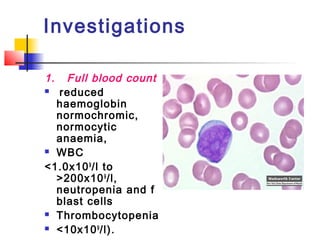
1. Full blood count 
 reduced 
haemoglobin 
normochromic, 
normocytic 
anaemia, 
 WBC 
<1.0x10⁹/l to 
>200x109/l, 
neutropenia and f 
blast cells 
 Thrombocytopenia 
 <10x109/l).
Investigations 
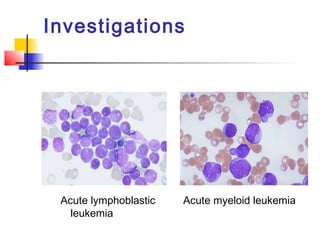
Acute lymphoblastic 
leukemia 
Acute myeloid leukemia
Investigations 
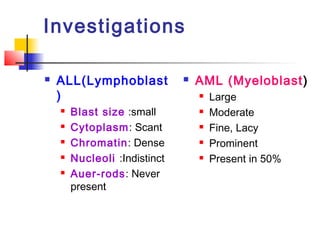
 ALL(Lymphoblast 
) 
 Blast size :small 
 Cytoplasm: Scant 
 Chromatin: Dense 
 Nucleoli :Indistinct 
 Auer-rods: Never 
present 
 AML (Myeloblast) 
 Large 
 Moderate 
 Fine, Lacy 
 Prominent 
 Present in 50%
Investigations 
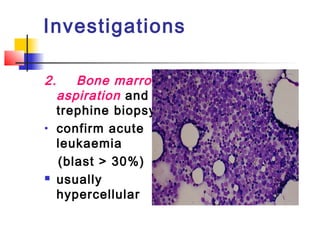
2. Bone marrow 
aspiration and 
trephine biopsy 
· confirm acute 
leukaemia 
(blast > 30%) 
 usually 
hypercellular
Investigations 
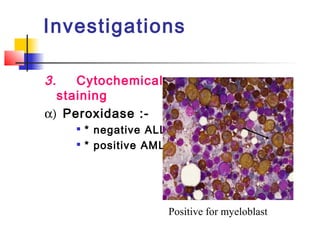
3. Cytochemical 
staining 
a)	 Peroxidase :- 
 * negative ALL 
 * positive AML 
Positive for myeloblast
Investigations 
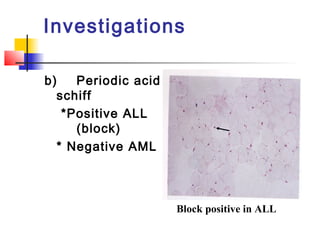
b) Periodic acid 
schiff 
*Positive ALL 
(block) 
* Negative AML 
Block positive in ALL
Investigations 
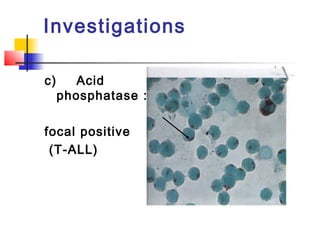
c) Acid 
phosphatase : 
focal positive 
(T-ALL)
Investigations 
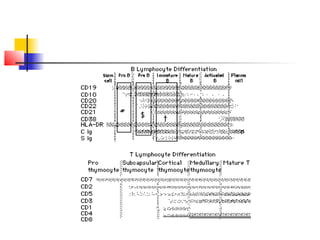
4.Immunophenotyping 
· identify antigens present on the blast 
cells 
· determine whether the leukaemia is 
lymphoid or myeloid(especially important 
when cytochemical markers are negative or 
equivocal. E.g : AML-MO) 
· differentiate T-ALL and B-ALL
 Certain antigens have prognostic 
significance 
 Rare cases of biphenotypic where both 
myeloid and lymphoid antigen are 
expressed 
 Able to identify the subtype of leukemia. 
E.g : AML-M7 has a specific surface 
marker of CD 61 etc
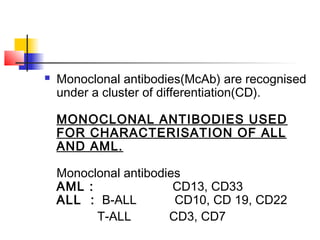
 Monoclonal antibodies(McAb) are recognised 
under a cluster of differentiation(CD). 
MONOCLONAL ANTIBODIES USED 
FOR CHARACTERISATION OF ALL 
AND AML. 
Monoclonal antibodies 
AML : CD13, CD33 
ALL : B-ALL CD10, CD 19, CD22 
T-ALL CD3, CD7
Investigations 
5. Cytogenetics and molecular studies 
 detect abnormalities within the 
leukaemic clone 
 diagnostic or prognostic value 
 E.g : the Philadelphia chromosome : 
the product of a translocation between 
chromosomes 9 and 22 
 confers a very poor prognosis in ALL
Investigations 
COMMON CHROMOSOME 
ABNORMALITIES ASSOCIATED WITH 
ACUTE LEUKEMIA 
 t(8;21) AML with maturation (M2) 
 t(15;17) AML-M3(APML) 
 Inv 16 AML-M4 
 t(9;22) Chronic granulocytic leukemia 
 t(8;14) B-ALL
Others Invx 
6. Biochemical screening 
 leucocyte count very high - renal 
impairment and hyperuricaemia 
7. Chest radiography 
· mediastinal mass - present in up 
to 70% of patients with T -ALL 
In childhood ALL bone lesions 
may also seen.
Others Invx 
8.Lumbar puncture 
 initial staging inv. to detect 
leukaemic cells in the 
cerebrospinal fluid, indicating 
involvement of the CNS 
 Done in acute lymphoblastic leukemia
Management 
Supportive care 
1. Central venous catheter inserted 
to : 
 facilitate blood product 
 adm. of chemotherapy and antibiotics 
 frequent blood sampling
Management 
2. Blood support :- 
 platelet con. for bleeding episodes or 
if the platelet count is <10x109/l 
with fever 
 fresh frozen plasma if the coagulation 
screen results are abnormal 
 packed red cell for severe anaemia 
(caution : if white cell count is 
extremely high)
Management 
3.	 Prevention and control infection 
 barrier nursed 
 Intravenous antimicrobial agents 
if there is a fever or sign of 
infection
Management 
4.Physiologic 
al and 
social 
support
Specific treatment 
Used of cytotoxic chemotherapy. 
 Aim : 
· To induce remission 
 (absence of any clinical or conventional 
laboratory evidence of the disease) 
 To eliminate the hidden leukemic cells
Cytotoxic chemotherapy 
 Anti-metabolites 
 Methotrexate 
 Cytosine arabinoside 
 Act: inhibit purine & pyrimidine synt or incorp into DNA 
 S/E : mouth ulcer, cerebellar toxicity 
 DNA binding 
 Dounorubicin 
 Act : bind DNA and interfere with mitosis 
 S/E : Cardiac toxicity, hair loss
Cytotoxic chemotherapy 
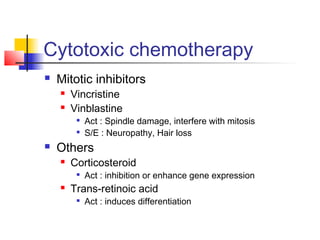
 Mitotic inhibitors 
 Vincristine 
 Vinblastine 
 Act : Spindle damage, interfere with mitosis 
 S/E : Neuropathy, Hair loss 
 Others 
 Corticosteroid 
 Act : inhibition or enhance gene expression 
 Trans-retinoic acid 
 Act : induces differentiation
Complications 
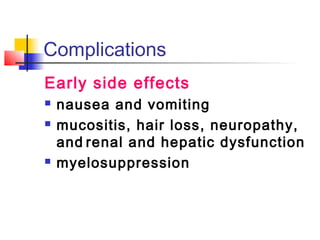
Early side effects 
 nausea and vomiting 
 mucositis, hair loss, neuropathy, 
and renal and hepatic dysfunction 
 myelosuppression
Complications 
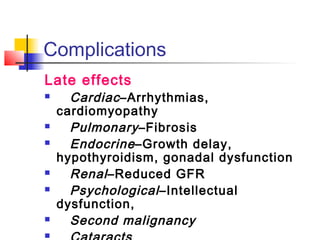
Late effects 
 Cardiac –Arrhythmias, 
cardiomyopathy 
 Pulmonary –Fibrosis 
 Endocrine –Growth delay, 
hypothyroidism, gonadal dysfunction 
 Renal –Reduced GFR 
 Psychological –Intellectual 
dysfunction, 
 Second malignancy 
 Cataracts
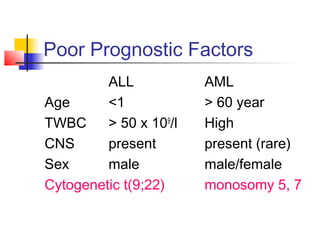
Poor Prognostic Factors 
ALL AML 
Age <1 > 60 year 
TWBC > 50 x 109/l High 
CNS present present (rare) 
Sex male male/female 
Cytogenetic t(9;22) monosomy 5, 7

Acute leukaemia

  • 1.
    ACUTE LEUKEMIA DrRosline Hassan Hematology Department School of Medical Sciences USM
  • 2.
    OBJECTIVE  Defineacute leukemia  Classify leukemia  Understand the pathogenesis  Understand the pathophysiology  Able to list down the laboratory investigations required for diagnosis  Understand the basic management of leukemia patients
  • 3.
    Acute Leukaemia Define : heterogenous group of malignant disorders which is characterised by uncontrolled clonal and accumulation of blasts cells in the bone marrow and body tissues  Sudden onset  If left untreated is fatal within a few weeks or months  Incidence 1.8/100,000 –M’sia
  • 4.
    Acute Leukemia Classification :  Acute  Acute lymphoblastic leukemia (T-ALL & B-ALL)  Acute myeloid leukemia  Chronic  Chronic myeloid leukemia  Chronic lymphocytic leukemia
  • 5.
    FAB Acute MyeloidLeukemia Acute nonlymphocytic (ANLL) % Adult cases M0 Minimally differentiated AML 5% - 10% Negative or < 3% blasts stain for MPO ,PAS and NSE blasts are negative for B and T lymphoid antigens, platelet glycoproteins and erythroid glycophorin A. Myeloid antigens : CD13, CD33 and CD11b are positive. M1 Myeloblastic without maturation 10 - 20% >90% cells are myeloblasts 3% of blasts stain for MPO +8 frequently seen
  • 6.
    M2 AML withmaturation 30 - 40% 30% - 90% are myeloblasts ~ 15% with t(8:21)
  • 7.
    M3 Acute Promyelocytic Leukemia (APML) 10-15% marrow cells hypergranul promeyelocytes Auer rods/ faggot cells may be seen Classical-Hypergranular, 80% leukopaenic Variant-Hypogranular, leukocytosis Granules contain procoagulants (thromboplastin-like) - massive DIC t(15:17) is diagnostic
  • 8.
    M4 Acute Myelomonocytic Leukemia 10-15% Incresed incidence CNS involvement Monocytes and promonocytes 20% - 80% M4 with eosinophilia ((M4-Eo), assoc with del/inv 16q – marrow eosinophil from 6% - 35%,
  • 9.
    M5a Acute MonoblasticLeukemia 10-15% M5b AMoL with differentiation <5% Often asso with infiltration into gums/skin Weakness, bleeding and diffuse erythematous skin rash
  • 10.
    M6 Erythroleukemia (Di Guglielmo) <5% 50% or more of all nucleated marrow cells are erythroid precursors, and 30% or more of the remaining nonerythroid cells are myeloblasts (if <30% then myelodysplasia)
  • 11.
    M7 Acute Megakaryoblastic Leukemia <5% Assoc with fibrosis (confirm origin with platelet peroxidase + electron microscopy or MAb to vWF or glycoproteins
  • 12.
    FAB Acute Lymphoblastic Leukemia Acute lymphoblastic leukemia (ALL)* L-1 85% L-2 14% L-3 (Burkitt's)1% childhood
  • 14.
    Acute Leukaemogenesis Developas a result of a genetic alteration within single cell in the bone marrow a) Epidemiological evidence : 1. Hereditary Factors · Fanconi’s anaemia · Down’s syndrome · Ataxia telangiectasia
  • 15.
    Acute Leukaemogenesis 2.Radiation, Chemicals and Drugs 3. Virus related Leukemias  Retrovirus :- HTLV 1 & EBV
  • 16.
    Acute Leukaemogenesis b)MolecularEvidence  Oncogenes :  Gene that code for proteins involved in cell proliferation or differentiation  Tumour Suppressor Genes :  Changes within oncogene or suppressor genes are necessary to cause malignant transformation.
  • 17.
    Acute Leukaemogenesis Oncogenecan be activated by : · chromosomal translocation · point mutations · inactivation  In general, several genes have to be altered to effect neoplastic transformation
  • 18.
    Pathophysiology  Acuteleukemia cause morbidity and mortality through :-  Deficiency in blood cell number and function  Invasion of vital organs  Systemic disturbances by metabolic imbalance
  • 19.
    Pathophysiology A. Deficiencyin blood cell number or function i. Infection - Most common cause of death - Due to impairment of phagocytic function and neutropenia
  • 20.
    Pathophysiology ii. Hemorrhage - Due to thrombocytopenia or 2o DIVC or liver disease iii. Anaemia - normochromic-normocytic - severity of anaemia reflects severity of disease - Due to ineffective erythropoiesis
  • 21.
    Pathophysiology B. Invasionof vital organs - vary according to subtype i.Hyperleukocytosis - cause increase in blood viscosity - Predispose to microthrombi or acute bleeding - Organ invole : brain, lung, eyes - Injudicious used of packed cell transfusion precipitate hyperviscosity
  • 22.
    Pathophysiology ii. Leucostatictumour - Rare - blast cell lodge in vascular system forming macroscopic pseudotumour – erode vessel wall cause bleeding iii. Hidden site relapse - testes and meninges
  • 23.
    Pathophysiology C. Metabolicimbalance - Due to disease or treatment - Hyponatremia vasopressin-like subst. by myeloblast - Hypokalemia due to lysozyme release by myeloblast - Hyperuricaemia- spont lysis of leukemic blast release purines into plasma
  • 24.
    Acute Lymphoblastic Leukaemia  Cancer of the blood affecting the white blood cell known as LYMPHOCYTES.  Commonest in the age 2-10 years  Peak at 3-4 years.  Incidence decreases with age, and a secondary rise after 40 years.  In children - most common malignant disease  85% of childhood leukaemia
  • 25.
    Acute Lymphoblastic Leukemia Specific manifestation : *bone pain, arthritis *lymphadenopathy *hepatosplenomegaly *mediastinal mass *testicular swelling *meningeal syndrome
  • 26.
    Acute Myeloid Leukemia  Arise from the malignant transformation of a myeloid precursor  Rare in childhood (10%-15%)  The incidence increases with age  80% in adults  Most frequent leukemia in neonate
  • 27.
    Acute Myeloid Leukemia Specific manifestation : - Gum hypertrophy  Hepatosplenomegaly  Skins deposit  Lymphadenopathy  Renal damage  DIVC
  • 28.
    Investigations 1. Fullblood count  reduced haemoglobin normochromic, normocytic anaemia,  WBC <1.0x10⁹/l to >200x109/l, neutropenia and f blast cells  Thrombocytopenia  <10x109/l).
  • 29.
    Investigations Acute lymphoblastic leukemia Acute myeloid leukemia
  • 30.
    Investigations  ALL(Lymphoblast )  Blast size :small  Cytoplasm: Scant  Chromatin: Dense  Nucleoli :Indistinct  Auer-rods: Never present  AML (Myeloblast)  Large  Moderate  Fine, Lacy  Prominent  Present in 50%
  • 31.
    Investigations 2. Bonemarrow aspiration and trephine biopsy · confirm acute leukaemia (blast > 30%)  usually hypercellular
  • 32.
    Investigations 3. Cytochemical staining a) Peroxidase :-  * negative ALL  * positive AML Positive for myeloblast
  • 33.
    Investigations b) Periodicacid schiff *Positive ALL (block) * Negative AML Block positive in ALL
  • 34.
    Investigations c) Acid phosphatase : focal positive (T-ALL)
  • 35.
    Investigations 4.Immunophenotyping ·identify antigens present on the blast cells · determine whether the leukaemia is lymphoid or myeloid(especially important when cytochemical markers are negative or equivocal. E.g : AML-MO) · differentiate T-ALL and B-ALL
  • 36.
     Certain antigenshave prognostic significance  Rare cases of biphenotypic where both myeloid and lymphoid antigen are expressed  Able to identify the subtype of leukemia. E.g : AML-M7 has a specific surface marker of CD 61 etc
  • 38.
     Monoclonal antibodies(McAb)are recognised under a cluster of differentiation(CD). MONOCLONAL ANTIBODIES USED FOR CHARACTERISATION OF ALL AND AML. Monoclonal antibodies AML : CD13, CD33 ALL : B-ALL CD10, CD 19, CD22 T-ALL CD3, CD7
  • 39.
    Investigations 5. Cytogeneticsand molecular studies  detect abnormalities within the leukaemic clone  diagnostic or prognostic value  E.g : the Philadelphia chromosome : the product of a translocation between chromosomes 9 and 22  confers a very poor prognosis in ALL
  • 40.
    Investigations COMMON CHROMOSOME ABNORMALITIES ASSOCIATED WITH ACUTE LEUKEMIA  t(8;21) AML with maturation (M2)  t(15;17) AML-M3(APML)  Inv 16 AML-M4  t(9;22) Chronic granulocytic leukemia  t(8;14) B-ALL
  • 41.
    Others Invx 6.Biochemical screening  leucocyte count very high - renal impairment and hyperuricaemia 7. Chest radiography · mediastinal mass - present in up to 70% of patients with T -ALL In childhood ALL bone lesions may also seen.
  • 42.
    Others Invx 8.Lumbarpuncture  initial staging inv. to detect leukaemic cells in the cerebrospinal fluid, indicating involvement of the CNS  Done in acute lymphoblastic leukemia
  • 43.
    Management Supportive care 1. Central venous catheter inserted to :  facilitate blood product  adm. of chemotherapy and antibiotics  frequent blood sampling
  • 44.
    Management 2. Bloodsupport :-  platelet con. for bleeding episodes or if the platelet count is <10x109/l with fever  fresh frozen plasma if the coagulation screen results are abnormal  packed red cell for severe anaemia (caution : if white cell count is extremely high)
  • 45.
    Management 3. Preventionand control infection  barrier nursed  Intravenous antimicrobial agents if there is a fever or sign of infection
  • 46.
    Management 4.Physiologic aland social support
  • 47.
    Specific treatment Usedof cytotoxic chemotherapy.  Aim : · To induce remission  (absence of any clinical or conventional laboratory evidence of the disease)  To eliminate the hidden leukemic cells
  • 48.
    Cytotoxic chemotherapy Anti-metabolites  Methotrexate  Cytosine arabinoside  Act: inhibit purine & pyrimidine synt or incorp into DNA  S/E : mouth ulcer, cerebellar toxicity  DNA binding  Dounorubicin  Act : bind DNA and interfere with mitosis  S/E : Cardiac toxicity, hair loss
  • 49.
    Cytotoxic chemotherapy Mitotic inhibitors  Vincristine  Vinblastine  Act : Spindle damage, interfere with mitosis  S/E : Neuropathy, Hair loss  Others  Corticosteroid  Act : inhibition or enhance gene expression  Trans-retinoic acid  Act : induces differentiation
  • 50.
    Complications Early sideeffects  nausea and vomiting  mucositis, hair loss, neuropathy, and renal and hepatic dysfunction  myelosuppression
  • 51.
    Complications Late effects  Cardiac –Arrhythmias, cardiomyopathy  Pulmonary –Fibrosis  Endocrine –Growth delay, hypothyroidism, gonadal dysfunction  Renal –Reduced GFR  Psychological –Intellectual dysfunction,  Second malignancy  Cataracts
  • 52.
    Poor Prognostic Factors ALL AML Age <1 > 60 year TWBC > 50 x 109/l High CNS present present (rare) Sex male male/female Cytogenetic t(9;22) monosomy 5, 7