Metals
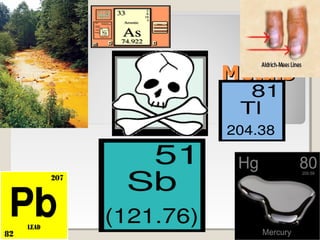
 Toxic   metals are metals that form poisonous
  soluble compounds and have no biological
  role, or are in the wrong form[
 Toxic metals comprise a group of minerals
  that have no known function in the body and,
  in fact, are harmful.
 Today mankind is exposed to the highest
  levels of these metals in recorded history.
 This is due to their industrial use, the
  unrestricted burning of coal, natural gas and
  petroleum, and incineration of waste
  materials worldwide.
 Toxic metals are now everywhere and affect
  everyone on planet earth. They have become
  a major cause of illness, aging and even
  genetic defects.
 toxicmetals sometimes imitate the action of an
  essential element in the body, interfering with
  the metabolic process to cause illness.
 Toxicity is a function of solubility. Insoluble
  compounds as well as the metallic forms often
  exhibit negligible toxicity. In some cases,
  organometallic forms, such as dimethyl mercury
  and tetraethyl lead, can be extremely toxic.
 Decontamination for toxic metals is different
  from organic toxins: because toxic metals are
  elements, they cannot be destroyed. Toxic
  metals may be made insoluble or collected,
  possibly by the aid of chelating agents.
 Minerals are the building blocks of our bodies.
 They are required for body structure, fluid balance,
  protein structures and to produce hormones.
 They act as co-factors, catalysts or inhibitors of all
  enzymes in the body.
 Copper and iron, for example, along with other
  minerals are required for the electron transport
  system, and thus needed for all cellular energy
  production.
Minerals are classified into four groups:
The macrominerals, or those needed in large
 quantity,
  ◦ calcium, magnesium, sodium, potassium,
    phosphorus, sulfur, iron, copper and zinc.
 Required trace minerals
  ◦ manganese, chromium, selenium, boron,
    bromine, silicon, iodine, vanadium, lithium,
    molybdenum, cobalt, germanium
Possibly   required trace minerals
 ◦ fluorine, arsenic, rubidium, tin, niobium,
   strontium, gold, silver and nickel.
Toxic   metals
 ◦ beryllium, mercury, lead, cadmium, aluminum,
   antimony, bismuth, barium, uranium and
   others.
Minerals needed in lesser quantities are
 usually toxic in greater amounts.
 ◦ Examples are copper, iron, manganese,
   selenium and vanadium.
Even calcium and sodium are quite toxic in
 excess.
Today   mankind is exposed to the highest
 levels in recorded history of lead,
 mercury, arsenic, aluminum, copper,
 nickel, tin, antimony, bromine, bismuth
 and vanadium.
Dr. Henry Schroeder, MD
 ◦ “Most organic substances are degradable by
   natural processes. However, no metal is
   degradable…they are here to stay for a long
   time”.
1.       Ability to conduct electricity
     ◦     Diminishes with increasing temperature
1.       Excellent conductivity of heat
2.       High reflectivity of light from a polished
         surface commonly known as metallic
         luster
3.       Malleable
     ◦     Deform rather than shatter on impact or
           under pressure


Distinguishing Physical
Characteristics
5. Metal oxides reacts with water forming
 basic solutions – basic anhydrides or basic
 oxides
6. Metals combine with non-metal to form
 ionic compounds
 ◦ Metals can be fused with other metals to form
   new metallic compounds called ALLOYS 
   hard, tough, resistance to corrosion and with
   mechanical strength


Cont…
AR
Widely  distributed in soil
Used as weed killers, wood preservatives,
 pesticides, rodenticides and hardening
 agents
Exposure may be during production of
 pigments, glass and silicon chips and
 smelting of copper ores.


ARSENIC
Irritants:skin, mucous membranes,
 respiratory and gastrointestinal tract
Once absorbed, arsenic disrupts cellular
 metabolism by binding to sulfhydryl
 groups on variety of enzyme


Mechanism of Toxicity
A.       Arsenic compounds may be organic or
         inorganic
        Pentavalent (arsenate)
     ◦     Ubiquitous in nature, rapidly excreted by the
           kidneys
        Trivalent (arsenite)
     ◦     Absorbed more readily and are found in
           concentration in the leukocytes
     ◦     Crosses the placenta but not the blood brain
           barrier
     ◦     Highly toxic


B. Known CARCINOGEN
5 – 10% is excreted in the feces
90% is excreted in the urine
Lethal dose is 120 to 200mg (very toxic)


Toxicity
1.       Acute exposure
     ◦     Symptoms occur rapidly after ingestion
           (throat and abdominal pain)
     ◦     Vomiting and profuse diarrhea: profound
           fluid and electrolyte loss may cause death
           within 24 hours
     ◦     Delirium and coma have been reported
     ◦     Survivors may develop peripheral sensory
           neuropathy, exfoliative dermatitis and hair
           loss


Clinical Presentation
2. Chronic exposure
Irritation of the skin and mucous membrane
 and respiratory tract with occasionally
 perforation of the nasal septum
Systemic effects: weakness, anorexia,
 nausea, vomiting, diarrhea, hepatitis,
 peripheral sensory neuropathy and alopecia
Skin hyperpigmentation and transverse white
 lines on the nails (MEES LINES)
Associated to lung and skin cancers


Cont…
BAL  or Dimercaprol is administer 3-
 5mg//Kg intramuscularly every 4 to 6
 hours
Oral chelation therapy may be given with
 penicillamine after patient has been
 stabilized
Decontamination by
 ◦ inducing emesis or performing gastric lavage
 ◦ Administration of activated charcoal


Treatment
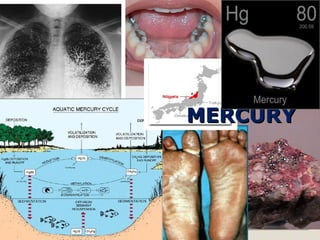
MERCURY
Several forms:
 Metallic (elemental) mercury
  Extraction of gold and silver from ore
  Dental amalgams
  Technical equipments
 Mercury   salts
  Antiseptics and stool preservatives
  Diuretics
 Organic   mercury
  Fungicides and anticeptics
  Methyl mercury may accumulate in sea waters after
   environmental contamination


MERCURY
Mercury reacts with sulfhydryl groups –
 binding to proteins and causes to inactivate
 enzymes
Metallic mercury vapor is well absorbed by
 the CNS
  ◦ Irritates the lungs
Inorganic  mercuric salts are highly corrosives
 to the skin, eyes and GIT
  ◦ Nephrotoxic
Organomercurialcompounds are toxic to the
 CNS and methyl mercury is teratogenic


Mechanism of toxicity
Acute  toxicity depends largely on the form
 and route of exposure (inhalation,
 ingestion or percutaneous)


Toxic dose
Metallic mercury
vapor
  ◦ PEL is 0.05 mg/cu.m as an 8 hour time
    weighed average
  ◦ IDLH is 28 mg/cu.m
Crosses   the blood brain barrier BBB and
 placenta
Half-life is 60 days


Chronic exposure
Inorganic    mercuric salts
  ◦ LD of mercuric chloride is 1mg
  ◦ Accumulates primarily in the kidneys
  ◦ Distributed in the liver, red blood cells, bone
    marrow, spleen, lungs, intestines and skin
Half-life   is 40 days


Cont…
Organic     mercury compounds
  ◦ Highly lipid soluble and freely passes through
    the placenta and blood brain barrier and enters
    the breast milk
Half-life
         is 70 days
Minamata Disease – Japan where there is
 methylation of mercury salt waste


Cont…
Acute inhalation of high concentration of
 metallic mercury vapor may cause severe
 chemical pneumonias and noncardiogenic
 pulmonary edema
Acute ingestion of inorganic mercuric salts
 causes vomiting, diarrhea (often bloody)
 and shock
 ◦ Renal failure occurs within 24 hours
   (proteinuria and hematuria
 ◦ Hepatitis may occur


Clinical Presentation
Chronic   inorganic mercury poisoning
 (vapor)
 ◦ Causes permanent CNS toxicity, including
   irritability, memory loss, shyness, depression,
   insomnia and tremor (erythism)
 ◦ Gingivitis, stomatitis and salivation are
   common


Cont…
Acute organic mercury poisoning
Causes parethesias, ataxia, visual and
 hearing disturbances


Cont…
CBC,   electrolytes, glucose, BUN,
 creatinine, liver function tests and
 urinalysis
Specific levels
Normal whole blood mercury is usually
 below 10 ug/dL and normal urine level is
 below 50ug/dL


Diagnosis
Supportive   measures
 ◦ Vapor – oxygen
 ◦ Ingestion – IV fluid replacement and
   hemodialysis for 1 to 2 weeks
 ◦ Monitoring of patient
Drugs
Dimercaprol   3-5 mg/Kg IM every 6 hours
Oral penicillamine


Treatment
ANTIMONY
Widely used as hardening agent in soft
 metal alloys
Coloring agents in dyes, varnishes, paints
 and glasses
Organic antimony compounds are used as
 antiparasitic drugs
Colorless
         gas; rotten egg odor
Formed when antimony is contacted with
 acids


Stibine (antimony hydride)
Antimony
Binds with sulfhydryl groups and causes
 inactivation of enzymes
Stibine
Hemolysis and irritates the URT


Mechanism of toxicity
Acute   ingestion
 ◦ Nausea, vomiting and diarrhea (often bloody)
 ◦ Hepatitis and renal insufficiency occur
Acute   stibine inhalation
 ◦ Acute hemolysis  anemia and jaundice,
   hemoglobinuria and renal failure
Chronic   exposure to dust and fumes
 ◦ Headache, anorexia and dermatitis (antimony
   spots)


Clinical Presentation
Antimony
 ◦ IV fluid replacement
Stibine
 ◦ May require blood transfusion
Drugs
 ◦ BAL and penicillamine


Treatment
BISMUTH
Hard  brittle, lustrous pinkish silver-white
 metal which is usually covered with a film
 of bismuth oxide
Good conductor of electricity but a poor
 conductor of heat
Trioxides are present in areas as an
 impurity in manufacturing lead and copper
Anti-syphilitic
              drugs and a component in
 cosmetic powders
Added in aluminum alloys, steels and
 other alloys


Industrial uses
Foul breath
Black line ate the alveolar margins
Black spots seen in the mouth and throat
Stomatitis
Chronic: malaise, albuminuria, diarrhea
 and dermatitis
hepatitis


Toxicity
LEAD
Found  in all animals
Batteries
Paints
Pots and ceramics
Leaded gasoline
Under   steady conditions 95% of lead is
 found in the red blood cells
In adults, 90% are stored in the bones
Half-life is 24 to 40 days
Lead  displaces other metals such as iron,
 zinc and copper from normal binding sites
 to produce some of its biochemical effect
Binds to sulfhydryl groups and disrupt
 cellular metabolism
Primary organs affected are CNS and
 kidneys and the reproductive and
 hematopoietic system


Mechanism of toxicity
THALLIUM
Soft metal that quickly oxidizes upon
 exposure to air
Used in optical lenses, photoelectric cells
Also used as rodenticides
Affects the mitochondria and a variety of
 enzymes resulting to cellular toxicity
Inhibit potassium flux across the
 membrane


Mechanism of toxicity
Toxic  dose is 12-15mg/Kg
More soluble (thallous acetate and thallic
 chloride) slightly more toxic than insoluble
 thallium (Thallic oxide and thallous iodide)
Acute:  abdominal pain, vomiting and
 diarrhea  shock
Chronic: muscle weakness and atrophy;
 hair loss and nail dystrophy (MEES lines)
 may appear in 2 to 4 weeks


Clinical Presentation
Dimercaprol   (BAL)
 ◦ Diffuses into the erythrocytes and enhances
   fecal and urinary excretion
EDETATE    (EDTA)
 ◦ Administered through IV or IM
SUCCIMER     (dimercapto-succinic acid)
 ◦ Water soluble orally administered
PENICILLAMINE
 ◦ Only commercially available oral chelating
   agent


Chelating agents

Metal poisoning

  • 1.
  • 2.
     Toxic metals are metals that form poisonous soluble compounds and have no biological role, or are in the wrong form[  Toxic metals comprise a group of minerals that have no known function in the body and, in fact, are harmful.  Today mankind is exposed to the highest levels of these metals in recorded history.  This is due to their industrial use, the unrestricted burning of coal, natural gas and petroleum, and incineration of waste materials worldwide.  Toxic metals are now everywhere and affect everyone on planet earth. They have become a major cause of illness, aging and even genetic defects.
  • 3.
     toxicmetals sometimesimitate the action of an essential element in the body, interfering with the metabolic process to cause illness.  Toxicity is a function of solubility. Insoluble compounds as well as the metallic forms often exhibit negligible toxicity. In some cases, organometallic forms, such as dimethyl mercury and tetraethyl lead, can be extremely toxic.  Decontamination for toxic metals is different from organic toxins: because toxic metals are elements, they cannot be destroyed. Toxic metals may be made insoluble or collected, possibly by the aid of chelating agents.
  • 4.
     Minerals arethe building blocks of our bodies.  They are required for body structure, fluid balance, protein structures and to produce hormones.  They act as co-factors, catalysts or inhibitors of all enzymes in the body.  Copper and iron, for example, along with other minerals are required for the electron transport system, and thus needed for all cellular energy production. Minerals are classified into four groups: The macrominerals, or those needed in large quantity, ◦ calcium, magnesium, sodium, potassium, phosphorus, sulfur, iron, copper and zinc.  Required trace minerals ◦ manganese, chromium, selenium, boron, bromine, silicon, iodine, vanadium, lithium, molybdenum, cobalt, germanium
  • 5.
    Possibly required trace minerals ◦ fluorine, arsenic, rubidium, tin, niobium, strontium, gold, silver and nickel. Toxic metals ◦ beryllium, mercury, lead, cadmium, aluminum, antimony, bismuth, barium, uranium and others. Minerals needed in lesser quantities are usually toxic in greater amounts. ◦ Examples are copper, iron, manganese, selenium and vanadium. Even calcium and sodium are quite toxic in excess.
  • 6.
    Today mankind is exposed to the highest levels in recorded history of lead, mercury, arsenic, aluminum, copper, nickel, tin, antimony, bromine, bismuth and vanadium. Dr. Henry Schroeder, MD ◦ “Most organic substances are degradable by natural processes. However, no metal is degradable…they are here to stay for a long time”.
  • 7.
    1. Ability to conduct electricity ◦ Diminishes with increasing temperature 1. Excellent conductivity of heat 2. High reflectivity of light from a polished surface commonly known as metallic luster 3. Malleable ◦ Deform rather than shatter on impact or under pressure Distinguishing Physical Characteristics
  • 8.
    5. Metal oxidesreacts with water forming basic solutions – basic anhydrides or basic oxides 6. Metals combine with non-metal to form ionic compounds ◦ Metals can be fused with other metals to form new metallic compounds called ALLOYS  hard, tough, resistance to corrosion and with mechanical strength Cont…
  • 9.
  • 10.
    Widely distributedin soil Used as weed killers, wood preservatives, pesticides, rodenticides and hardening agents Exposure may be during production of pigments, glass and silicon chips and smelting of copper ores. ARSENIC
  • 11.
    Irritants:skin, mucous membranes, respiratory and gastrointestinal tract Once absorbed, arsenic disrupts cellular metabolism by binding to sulfhydryl groups on variety of enzyme Mechanism of Toxicity
  • 12.
    A. Arsenic compounds may be organic or inorganic  Pentavalent (arsenate) ◦ Ubiquitous in nature, rapidly excreted by the kidneys  Trivalent (arsenite) ◦ Absorbed more readily and are found in concentration in the leukocytes ◦ Crosses the placenta but not the blood brain barrier ◦ Highly toxic B. Known CARCINOGEN
  • 13.
    5 – 10%is excreted in the feces 90% is excreted in the urine Lethal dose is 120 to 200mg (very toxic) Toxicity
  • 14.
    1. Acute exposure ◦ Symptoms occur rapidly after ingestion (throat and abdominal pain) ◦ Vomiting and profuse diarrhea: profound fluid and electrolyte loss may cause death within 24 hours ◦ Delirium and coma have been reported ◦ Survivors may develop peripheral sensory neuropathy, exfoliative dermatitis and hair loss Clinical Presentation
  • 15.
    2. Chronic exposure Irritationof the skin and mucous membrane and respiratory tract with occasionally perforation of the nasal septum Systemic effects: weakness, anorexia, nausea, vomiting, diarrhea, hepatitis, peripheral sensory neuropathy and alopecia Skin hyperpigmentation and transverse white lines on the nails (MEES LINES) Associated to lung and skin cancers Cont…
  • 16.
    BAL orDimercaprol is administer 3- 5mg//Kg intramuscularly every 4 to 6 hours Oral chelation therapy may be given with penicillamine after patient has been stabilized Decontamination by ◦ inducing emesis or performing gastric lavage ◦ Administration of activated charcoal Treatment
  • 17.
  • 18.
    Several forms:  Metallic(elemental) mercury  Extraction of gold and silver from ore  Dental amalgams  Technical equipments  Mercury salts  Antiseptics and stool preservatives  Diuretics  Organic mercury  Fungicides and anticeptics  Methyl mercury may accumulate in sea waters after environmental contamination MERCURY
  • 19.
    Mercury reacts withsulfhydryl groups – binding to proteins and causes to inactivate enzymes Metallic mercury vapor is well absorbed by the CNS ◦ Irritates the lungs Inorganic mercuric salts are highly corrosives to the skin, eyes and GIT ◦ Nephrotoxic Organomercurialcompounds are toxic to the CNS and methyl mercury is teratogenic Mechanism of toxicity
  • 20.
    Acute toxicitydepends largely on the form and route of exposure (inhalation, ingestion or percutaneous) Toxic dose
  • 21.
    Metallic mercury vapor ◦ PEL is 0.05 mg/cu.m as an 8 hour time weighed average ◦ IDLH is 28 mg/cu.m Crosses the blood brain barrier BBB and placenta Half-life is 60 days Chronic exposure
  • 22.
    Inorganic mercuric salts ◦ LD of mercuric chloride is 1mg ◦ Accumulates primarily in the kidneys ◦ Distributed in the liver, red blood cells, bone marrow, spleen, lungs, intestines and skin Half-life is 40 days Cont…
  • 23.
    Organic mercury compounds ◦ Highly lipid soluble and freely passes through the placenta and blood brain barrier and enters the breast milk Half-life is 70 days Minamata Disease – Japan where there is methylation of mercury salt waste Cont…
  • 24.
    Acute inhalation ofhigh concentration of metallic mercury vapor may cause severe chemical pneumonias and noncardiogenic pulmonary edema Acute ingestion of inorganic mercuric salts causes vomiting, diarrhea (often bloody) and shock ◦ Renal failure occurs within 24 hours (proteinuria and hematuria ◦ Hepatitis may occur Clinical Presentation
  • 25.
    Chronic inorganic mercury poisoning (vapor) ◦ Causes permanent CNS toxicity, including irritability, memory loss, shyness, depression, insomnia and tremor (erythism) ◦ Gingivitis, stomatitis and salivation are common Cont…
  • 26.
    Acute organic mercurypoisoning Causes parethesias, ataxia, visual and hearing disturbances Cont…
  • 27.
    CBC, electrolytes, glucose, BUN, creatinine, liver function tests and urinalysis Specific levels Normal whole blood mercury is usually below 10 ug/dL and normal urine level is below 50ug/dL Diagnosis
  • 28.
    Supportive measures ◦ Vapor – oxygen ◦ Ingestion – IV fluid replacement and hemodialysis for 1 to 2 weeks ◦ Monitoring of patient Drugs Dimercaprol 3-5 mg/Kg IM every 6 hours Oral penicillamine Treatment
  • 29.
  • 30.
    Widely used ashardening agent in soft metal alloys Coloring agents in dyes, varnishes, paints and glasses Organic antimony compounds are used as antiparasitic drugs
  • 31.
    Colorless gas; rotten egg odor Formed when antimony is contacted with acids Stibine (antimony hydride)
  • 32.
    Antimony Binds with sulfhydrylgroups and causes inactivation of enzymes Stibine Hemolysis and irritates the URT Mechanism of toxicity
  • 33.
    Acute ingestion ◦ Nausea, vomiting and diarrhea (often bloody) ◦ Hepatitis and renal insufficiency occur Acute stibine inhalation ◦ Acute hemolysis  anemia and jaundice, hemoglobinuria and renal failure Chronic exposure to dust and fumes ◦ Headache, anorexia and dermatitis (antimony spots) Clinical Presentation
  • 34.
    Antimony ◦ IVfluid replacement Stibine ◦ May require blood transfusion Drugs ◦ BAL and penicillamine Treatment
  • 35.
  • 36.
    Hard brittle,lustrous pinkish silver-white metal which is usually covered with a film of bismuth oxide Good conductor of electricity but a poor conductor of heat Trioxides are present in areas as an impurity in manufacturing lead and copper
  • 37.
    Anti-syphilitic drugs and a component in cosmetic powders Added in aluminum alloys, steels and other alloys Industrial uses
  • 38.
    Foul breath Black lineate the alveolar margins Black spots seen in the mouth and throat Stomatitis Chronic: malaise, albuminuria, diarrhea and dermatitis hepatitis Toxicity
  • 39.
  • 40.
    Found inall animals Batteries Paints Pots and ceramics Leaded gasoline
  • 41.
    Under steady conditions 95% of lead is found in the red blood cells In adults, 90% are stored in the bones Half-life is 24 to 40 days
  • 42.
    Lead displacesother metals such as iron, zinc and copper from normal binding sites to produce some of its biochemical effect Binds to sulfhydryl groups and disrupt cellular metabolism Primary organs affected are CNS and kidneys and the reproductive and hematopoietic system Mechanism of toxicity
  • 43.
  • 44.
    Soft metal thatquickly oxidizes upon exposure to air Used in optical lenses, photoelectric cells Also used as rodenticides
  • 45.
    Affects the mitochondriaand a variety of enzymes resulting to cellular toxicity Inhibit potassium flux across the membrane Mechanism of toxicity
  • 46.
    Toxic doseis 12-15mg/Kg More soluble (thallous acetate and thallic chloride) slightly more toxic than insoluble thallium (Thallic oxide and thallous iodide)
  • 47.
    Acute: abdominalpain, vomiting and diarrhea  shock Chronic: muscle weakness and atrophy; hair loss and nail dystrophy (MEES lines) may appear in 2 to 4 weeks Clinical Presentation
  • 48.
    Dimercaprol (BAL) ◦ Diffuses into the erythrocytes and enhances fecal and urinary excretion EDETATE (EDTA) ◦ Administered through IV or IM SUCCIMER (dimercapto-succinic acid) ◦ Water soluble orally administered PENICILLAMINE ◦ Only commercially available oral chelating agent Chelating agents