Objectives
Define and classify
vasculitis
Describe the cause ,
pathogenesis ,
morphology and clinical
presentation of various
types of vasculitis
Vasculitis
Vessel wall
inflammation
Pathogenesis
• Immune mediated
inflammation
• Direct invasion of vessel
wall by infectious pathology.
Non-
infectious
vasculitis
Cause – Local or systemic
immune response
Immunologic Injury is
caused by -
• Immune complex deposition
• Antineutrophil cytoplasmic
antibodies
• Antiendothelial antibody
• Autoreactive T cells
Antineutrophil Cytoplasmic
Antibodies (ANCAs)
• Heterogeneous group of autoantibodies
directed against
o neutrophil primary granules,
o monocyte lysosomes, and
o endothelial cells.
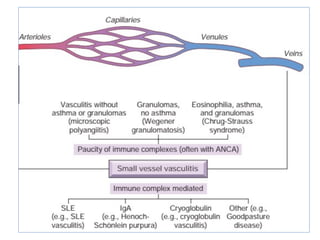
• ANCA associated vasculitis is
“pauci-immune” as vascular lesions do not
contain demonstrable antibody or
complement.
MCQ
SAQ
– Classified according to antigen specificity/
intracellular distribution of target antigen
– Anti-proteinase-3 (PR3-ANCA) / c -ANCA
• Neutrophil azurophilic granule constituent.
• trigerred by some infections
• Eg. Wegener granulomatosis/ Polyangitis
• Anti-myeloperoxidase (MPO-ANCA) / p-ANCA
– MPO is a lysosomal granule involved in generating
oxygen free radicals.
– induced by therapeutic agents- propylthiouracil
– Eg. Microscopic polyangiitis and Churg-Strauss
syndrome
ANCAs- MCQ’S ***
Antiendothelial
antibodies
Induced by
defects in immune
regulation
Eg. Kawasaki
disease
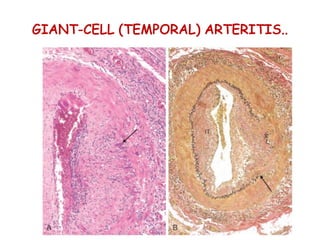
GIANT-CELL (TEMPORAL) ARTERITIS
• chronic, typically granulomatous
inflammation of large to small-
sized arteries.
• Most common form of vasculitis
• Elderly**, Rare before 50 years.
•
• Affects arteries in head
(temporal arteries-thickened,
nodular and tender) followed by
vertebral and ophthalmic
arteries.
GIANT-CELL
(TEMPORAL)
ARTERITIS..
C/F - vague and constitutional—
fever, fatigue, weight loss, facial
pain or headache
Giant-cell arteritis is a medical
emergency - prompt recognition
and treatment.
Ophthalmic arterial involvement
- permanent blindness
GIANT-CELL (TEMPORAL) ARTERITIS..
• Inflammatory lesions are segmental.
(biopsy -2- to 3-cm length of artery)
- nodular intimal thickening
- reduced luminal diameter.
• Classic lesions
- medial granulomatous inflammation that
leads to elastic lamina fragmentation.
- Multinucleated giant cells (75%)
Negative biopsy result does not exclude the
diagnosis
GIANT-CELL (TEMPORAL) ARTERITIS..
TAKAYASU ARTERITIS/ PULSELESS DISEASE
• Granulomatous vasculitis of medium and
larger arteries.
• Clinical features:
1. Ocular disturbances
2. marked weakening of pulses in upper
extremities.
• Age : less than 50 years **
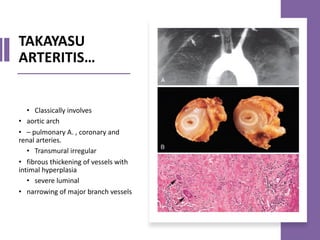
TAKAYASU
ARTERITIS…
• Classically involves
• aortic arch
• – pulmonary A. , coronary and
renal arteries.
• Transmural irregular
• fibrous thickening of vessels with
intimal hyperplasia
• severe luminal
• narrowing of major branch vessels
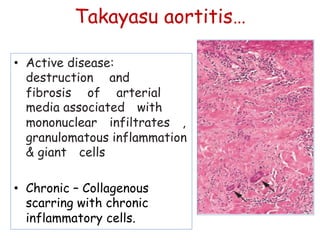
Takayasu aortitis…
• Active disease:
destruction and
fibrosis of arterial
media associated with
mononuclear infiltrates ,
granulomatous inflammation
& giant cells
• Chronic – Collagenous
scarring with chronic
inflammatory cells.
Polyarteritis nodosa (PAN)
• Systemic vasculitis of medium or small-sized
muscular arteries.
• Typically involving renal and visceral vessels but
sparing the pulmonary circulation.
• ~ 30% of patients with PAN have chronic
hepatitis B and HBsAg is positive
– immune complex mediated etiology
• Types- Classic idiopathic PAN , Cutaneous PAN,
PAN associated with chronic hepatitis
MCQ
Polyarteritis
nodosa..
Typically Young adults.
Clinical features
- Malaise, fever, and weight loss
• Hypertension due to renal involvement
• Abdominal pain and malena
• Diffuse muscular aches and pains
• Peripheral neuritis
Therapy - corticosteroids and
cyclophosphamide
Polyarteritis nodosa..
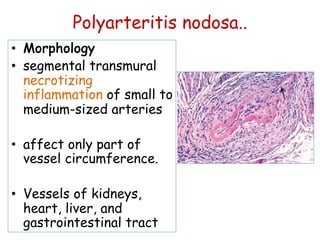
• Morphology
• segmental transmural
necrotizing
inflammation of small to
medium-sized arteries
• affect only part of
vessel circumference.
• Vessels of kidneys,
heart, liver, and
gastrointestinal tract
Polyarteritis nodosa..
• Acute phase -
– transmural inflammation of arterial wall
– mixed infiltrate of neutrophils, eosinophils,
and mononuclear cells.
– fibrinoid necrosis
• Later phase -
- fibrous thickening of vessel wall.
• All stages of activity (early to late) coexist in
different vessels or within same vessel-
suggesting ongoing and recurrent insults.
MCQ
KAWASAKI
DISEASE/
Mucocutaneous
lymph node
syndrome
Acute febrile, self-limited illness of
infancy and childhood
arteritis affecting large to medium-
sized, and small vessels
Predilection for coronary artery
involvement - cause aneurysms -
rupture or thrombose - acute
myocardial infarctions
KAWASAKI
DISEASE…
Pathogenesis
unknown
infectious agents (viral) in triggering disease in
genetically susceptible.
Vascular damage is mediated by
activated T cells and monocytes /
macrophages
KAWASAKI DISEASE…
• Morphology –
– inflammation affecting entire thickness of
vessel wall
– fibrinoid necrosis is usually less prominent
• C/F –
– conjunctival and oral erythema and erosion
– edema of hands and feet
– erythema of palms and soles
– a desquamative rash
– cervical lymph node enlargement
(Mucocutaneous lymph node syndrome)
Microscopic polyangiitis/
hypersensitivity / leukocytoclastic vasculitis
Necrotizing vasculitis affecting capillaries,
arterioles and venules.
Necrotizing glomerulonephritis (90%) and
pulmonary capillaritis are common.
Skin, mucous membrane, lung, brain, heart, GIT,
kidney , Muscle- involvement
All lesions tend to be of same age are distributed
widely
MCQ
Microscopic polyangiitis- Pathogenesis
Antibody response to antigens – drugs
(Penicillin), micro-organisms(streptococci),
heterologous or tumour proteins.
Immune complex
deposition
recruitment & activation of
neutrophils within affected
vascular beds
Secondary immune
response – MPO ANCA
Clinical
manifestations-
Microscopic polyangiitis- Morphology
1. Segmental fibrinoid necrosis
of media
2. focal transmural necrotizing
lesions
3. granulomatous inflammation
is absent.
• Spare medium and larger
arteries- infarcts uncommon.
• In postcapillary venules only
infiltrating neutrophils, many
undergoing apoptosis-
leukocytoclastic vasculitis
• Little or no immunoglobulin
(“pauci-immune injury”).
Churg-Strauss
Syndrome /
Allergic
granulomatosis
and angitis
• Small-vessel necrotizing
vasculitis
• Associated with asthma,
allergic rhinitis, lung
infiltrates, peripheral
hypereosinophilia, and
extravascular necrotizing
granulomas.
• Mechanism : hyper
responsiveness to an
allergic stimulus in
patients with asthma
• Trigger : leukotriene
receptor antagonists
Churg-
Strauss
Syndrome…
Vascular lesions- segmental transmural
necrotizing inflammation , granulomas and
eosinophils.
MPO-ANCAs present (50%)
Multisystem diseases with -
• cutaneous involvement (palpable purpura),
• gastrointestinal tract bleeding
• renal disease (focal and segmental glomerulosclerosis)
• Myocardial involvement- cardiomyopathy
Wegener Granulomatosis/ Granulomatosis
with polyangitis
Necrotizing vasculitis characterized by –
• Necrotizing granulomas
of upper (ear, nose, sinuses, throat) or lower
respiratory tract (lung) or both
• Necrotizing or granulomatous vasculitis
small to medium-sized vessels of most
commonly lungs and upper airways
• Focal necrotizing, crescentic glomerulonephritis
MCQ
Wegener
Granulomatosis-
Pathogenesis
PR3-ANCAs (up to 95%)-
marker of disease activity,
prognosis and disease
pathogenesis.
T-cell–mediated hypersensitivity
response
Wegener Granulomatosis-
Morphology
• Upper respiratory tract lesions- Iinflammatory sinusitis
with mucosal granulomas to ulcerative lesions of nose,
palate, or pharynx, rimmed by granulomas with geographic
patterns of central necrosis and vasculitis
• Multiple granulomas coalesce to produce nodules in lung -
cavitate
• late stage - Granulomatous involvement of parenchyma and
alveolar hemorrhage
• Lesions may ultimately undergo progressive fibrosis and
organization.
Wegener’s granulomatosis…
Wegener Granulomatosis- Morphology
• Renal Lesions –
• Early : Glomeruli focal necrosism with isolated capillary
loop thrombosis (Focal and segmental necrotising
glomerulonephritis)
• Advanced: Diffuse necrosis with excuberant parietal
cell proliferation – cresent formation – (Cresentric
glomerulonephritis)
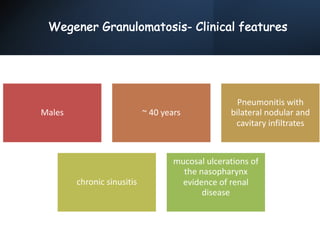
Wegener Granulomatosis- Clinical features
Males ~ 40 years
Pneumonitis with
bilateral nodular and
cavitary infiltrates
chronic sinusitis
mucosal ulcerations of
the nasopharynx
evidence of renal
disease
Behcet’s
disease
Small- to medium-vessel
neutrophilic
vasculitis
presents as a clinical triad of
recurrent oral aphthous
ulcers, genital ulcers, and
uveitis
Thromboangiitis Obliterans
(Buerger Disease)
Segmental,
thrombosing, acute and
chronic inflammation of
medium-sized and small
arteries,
tibial and radial arteries,
With secondary
extension into veins and
nerves of extremities
Leads to vascular
insufficiency of
extremities.
exclusively in heavy
cigarette smokers,
usually
before age 35
Vasculitis Associated with Other Noninfectious Disorders
Vasculitis resembling
hypersensitivity angiitis
or classic polyarteritis
nodosa
Rheumatoid arthritis-
Rheumatoid vasculitis
systemic lupus
erythematosus- Lupus
vasculitis
antiphospholipid
antibody syndrome
malignancy
Systemic illnesses-
mixed
cryoglobulinemia, and
Henoch-Schönlein
purpura.
Infectious
vasculitis
Direct invasion of
infectious agents-
Pseudomonas or fungi
Aspergillus and Mucor
species.
Mycotic aneurysms-
induce thrombosis and
infarction.

Vasculitis pathology

  • 1.
    Objectives Define and classify vasculitis Describethe cause , pathogenesis , morphology and clinical presentation of various types of vasculitis
  • 2.
    Vasculitis Vessel wall inflammation Pathogenesis • Immunemediated inflammation • Direct invasion of vessel wall by infectious pathology.
  • 3.
    Non- infectious vasculitis Cause – Localor systemic immune response Immunologic Injury is caused by - • Immune complex deposition • Antineutrophil cytoplasmic antibodies • Antiendothelial antibody • Autoreactive T cells
  • 4.
    Antineutrophil Cytoplasmic Antibodies (ANCAs) •Heterogeneous group of autoantibodies directed against o neutrophil primary granules, o monocyte lysosomes, and o endothelial cells. • ANCA associated vasculitis is “pauci-immune” as vascular lesions do not contain demonstrable antibody or complement. MCQ SAQ
  • 5.
    – Classified accordingto antigen specificity/ intracellular distribution of target antigen – Anti-proteinase-3 (PR3-ANCA) / c -ANCA • Neutrophil azurophilic granule constituent. • trigerred by some infections • Eg. Wegener granulomatosis/ Polyangitis • Anti-myeloperoxidase (MPO-ANCA) / p-ANCA – MPO is a lysosomal granule involved in generating oxygen free radicals. – induced by therapeutic agents- propylthiouracil – Eg. Microscopic polyangiitis and Churg-Strauss syndrome ANCAs- MCQ’S ***
  • 6.
    Antiendothelial antibodies Induced by defects inimmune regulation Eg. Kawasaki disease
  • 9.
    GIANT-CELL (TEMPORAL) ARTERITIS •chronic, typically granulomatous inflammation of large to small- sized arteries. • Most common form of vasculitis • Elderly**, Rare before 50 years. • • Affects arteries in head (temporal arteries-thickened, nodular and tender) followed by vertebral and ophthalmic arteries.
  • 10.
    GIANT-CELL (TEMPORAL) ARTERITIS.. C/F - vagueand constitutional— fever, fatigue, weight loss, facial pain or headache Giant-cell arteritis is a medical emergency - prompt recognition and treatment. Ophthalmic arterial involvement - permanent blindness
  • 11.
    GIANT-CELL (TEMPORAL) ARTERITIS.. •Inflammatory lesions are segmental. (biopsy -2- to 3-cm length of artery) - nodular intimal thickening - reduced luminal diameter. • Classic lesions - medial granulomatous inflammation that leads to elastic lamina fragmentation. - Multinucleated giant cells (75%) Negative biopsy result does not exclude the diagnosis
  • 12.
  • 13.
    TAKAYASU ARTERITIS/ PULSELESSDISEASE • Granulomatous vasculitis of medium and larger arteries. • Clinical features: 1. Ocular disturbances 2. marked weakening of pulses in upper extremities. • Age : less than 50 years **
  • 14.
    TAKAYASU ARTERITIS… • Classically involves •aortic arch • – pulmonary A. , coronary and renal arteries. • Transmural irregular • fibrous thickening of vessels with intimal hyperplasia • severe luminal • narrowing of major branch vessels
  • 15.
    Takayasu aortitis… • Activedisease: destruction and fibrosis of arterial media associated with mononuclear infiltrates , granulomatous inflammation & giant cells • Chronic – Collagenous scarring with chronic inflammatory cells.
  • 16.
    Polyarteritis nodosa (PAN) •Systemic vasculitis of medium or small-sized muscular arteries. • Typically involving renal and visceral vessels but sparing the pulmonary circulation. • ~ 30% of patients with PAN have chronic hepatitis B and HBsAg is positive – immune complex mediated etiology • Types- Classic idiopathic PAN , Cutaneous PAN, PAN associated with chronic hepatitis MCQ
  • 17.
    Polyarteritis nodosa.. Typically Young adults. Clinicalfeatures - Malaise, fever, and weight loss • Hypertension due to renal involvement • Abdominal pain and malena • Diffuse muscular aches and pains • Peripheral neuritis Therapy - corticosteroids and cyclophosphamide
  • 18.
    Polyarteritis nodosa.. • Morphology •segmental transmural necrotizing inflammation of small to medium-sized arteries • affect only part of vessel circumference. • Vessels of kidneys, heart, liver, and gastrointestinal tract
  • 19.
    Polyarteritis nodosa.. • Acutephase - – transmural inflammation of arterial wall – mixed infiltrate of neutrophils, eosinophils, and mononuclear cells. – fibrinoid necrosis • Later phase - - fibrous thickening of vessel wall. • All stages of activity (early to late) coexist in different vessels or within same vessel- suggesting ongoing and recurrent insults. MCQ
  • 20.
    KAWASAKI DISEASE/ Mucocutaneous lymph node syndrome Acute febrile,self-limited illness of infancy and childhood arteritis affecting large to medium- sized, and small vessels Predilection for coronary artery involvement - cause aneurysms - rupture or thrombose - acute myocardial infarctions
  • 21.
    KAWASAKI DISEASE… Pathogenesis unknown infectious agents (viral)in triggering disease in genetically susceptible. Vascular damage is mediated by activated T cells and monocytes / macrophages
  • 22.
    KAWASAKI DISEASE… • Morphology– – inflammation affecting entire thickness of vessel wall – fibrinoid necrosis is usually less prominent • C/F – – conjunctival and oral erythema and erosion – edema of hands and feet – erythema of palms and soles – a desquamative rash – cervical lymph node enlargement (Mucocutaneous lymph node syndrome)
  • 23.
    Microscopic polyangiitis/ hypersensitivity /leukocytoclastic vasculitis Necrotizing vasculitis affecting capillaries, arterioles and venules. Necrotizing glomerulonephritis (90%) and pulmonary capillaritis are common. Skin, mucous membrane, lung, brain, heart, GIT, kidney , Muscle- involvement All lesions tend to be of same age are distributed widely MCQ
  • 24.
    Microscopic polyangiitis- Pathogenesis Antibodyresponse to antigens – drugs (Penicillin), micro-organisms(streptococci), heterologous or tumour proteins. Immune complex deposition recruitment & activation of neutrophils within affected vascular beds Secondary immune response – MPO ANCA Clinical manifestations-
  • 25.
    Microscopic polyangiitis- Morphology 1.Segmental fibrinoid necrosis of media 2. focal transmural necrotizing lesions 3. granulomatous inflammation is absent. • Spare medium and larger arteries- infarcts uncommon. • In postcapillary venules only infiltrating neutrophils, many undergoing apoptosis- leukocytoclastic vasculitis • Little or no immunoglobulin (“pauci-immune injury”).
  • 26.
    Churg-Strauss Syndrome / Allergic granulomatosis and angitis •Small-vessel necrotizing vasculitis • Associated with asthma, allergic rhinitis, lung infiltrates, peripheral hypereosinophilia, and extravascular necrotizing granulomas. • Mechanism : hyper responsiveness to an allergic stimulus in patients with asthma • Trigger : leukotriene receptor antagonists
  • 27.
    Churg- Strauss Syndrome… Vascular lesions- segmentaltransmural necrotizing inflammation , granulomas and eosinophils. MPO-ANCAs present (50%) Multisystem diseases with - • cutaneous involvement (palpable purpura), • gastrointestinal tract bleeding • renal disease (focal and segmental glomerulosclerosis) • Myocardial involvement- cardiomyopathy
  • 28.
    Wegener Granulomatosis/ Granulomatosis withpolyangitis Necrotizing vasculitis characterized by – • Necrotizing granulomas of upper (ear, nose, sinuses, throat) or lower respiratory tract (lung) or both • Necrotizing or granulomatous vasculitis small to medium-sized vessels of most commonly lungs and upper airways • Focal necrotizing, crescentic glomerulonephritis MCQ
  • 29.
    Wegener Granulomatosis- Pathogenesis PR3-ANCAs (up to95%)- marker of disease activity, prognosis and disease pathogenesis. T-cell–mediated hypersensitivity response
  • 30.
    Wegener Granulomatosis- Morphology • Upperrespiratory tract lesions- Iinflammatory sinusitis with mucosal granulomas to ulcerative lesions of nose, palate, or pharynx, rimmed by granulomas with geographic patterns of central necrosis and vasculitis • Multiple granulomas coalesce to produce nodules in lung - cavitate • late stage - Granulomatous involvement of parenchyma and alveolar hemorrhage • Lesions may ultimately undergo progressive fibrosis and organization.
  • 31.
  • 32.
    Wegener Granulomatosis- Morphology •Renal Lesions – • Early : Glomeruli focal necrosism with isolated capillary loop thrombosis (Focal and segmental necrotising glomerulonephritis) • Advanced: Diffuse necrosis with excuberant parietal cell proliferation – cresent formation – (Cresentric glomerulonephritis)
  • 33.
    Wegener Granulomatosis- Clinicalfeatures Males ~ 40 years Pneumonitis with bilateral nodular and cavitary infiltrates chronic sinusitis mucosal ulcerations of the nasopharynx evidence of renal disease
  • 34.
    Behcet’s disease Small- to medium-vessel neutrophilic vasculitis presentsas a clinical triad of recurrent oral aphthous ulcers, genital ulcers, and uveitis
  • 35.
    Thromboangiitis Obliterans (Buerger Disease) Segmental, thrombosing,acute and chronic inflammation of medium-sized and small arteries, tibial and radial arteries, With secondary extension into veins and nerves of extremities Leads to vascular insufficiency of extremities. exclusively in heavy cigarette smokers, usually before age 35
  • 36.
    Vasculitis Associated withOther Noninfectious Disorders Vasculitis resembling hypersensitivity angiitis or classic polyarteritis nodosa Rheumatoid arthritis- Rheumatoid vasculitis systemic lupus erythematosus- Lupus vasculitis antiphospholipid antibody syndrome malignancy Systemic illnesses- mixed cryoglobulinemia, and Henoch-Schönlein purpura.
  • 37.
    Infectious vasculitis Direct invasion of infectiousagents- Pseudomonas or fungi Aspergillus and Mucor species. Mycotic aneurysms- induce thrombosis and infarction.