ACUTE
LEUKEMIA
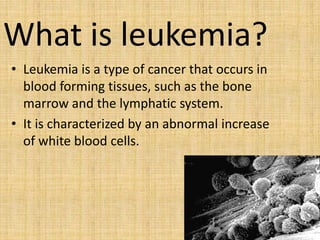
What is leukemia?
• Leukemia is a type of cancer that occurs in
blood forming tissues, such as the bone
marrow and the lymphatic system.
• It is characterized by an abnormal increase
of white blood cells.
Signs & Symptoms
• Leukemia symptoms vary on the type of
leukemia, but a few common symptoms
include:
– Fever or chills
– Persistent fatigue or weakness
– Bone pain or tenderness
– Excessive sweating
– Frequent infections
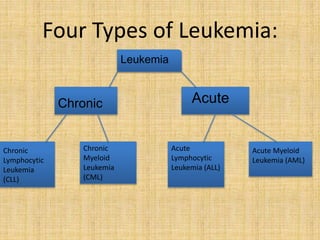
Four Types of Leukemia:
Leukemia

Chronic

Chronic
Lymphocytic
Leukemia
(CLL)

Chronic
Myeloid
Leukemia
(CML)

Acute

Acute
Lymphocytic
Leukemia (ALL)

Acute Myeloid
Leukemia (AML)
Acute leukaemia is a clonal ( derived from a
single cell) malignant disorder characterised
by the accumulation of immature blast cells in
the BM, which replace normal marrow tissue,
including haemopoietic precursor cells.
This results in BM failure, reflected by peripheral
blood cytopenias and circulating blast cells.
Infiltration of various organs is also a
feature of some forms of leukaemia
(a) acute lymphoblastic leukemia (ALL), in which the
abnormal proliferation is in the immature
lymphocytes
(b) acute myeloid leukemia (AML), which involves the
myeloid lineages ( cells from which neutrophils,
eosinophils, monocytes, basophils, megakaryocytes,
etc. are derived).
• The distinction between the two leukemias is
based on morphological, cytochemical,
immunological and cytogenetic differences and is of
paramount importance as the treatment and
prognosis are usually different
Subclassification
• It is further subdivided on the basis of
morphological criteria:
• ALL into FAB
(French-American-British) subtypes L1, L2, and
L3, and
• AML into FAB subtypes M0 to M7
FAB for AML
M0 AML with minimal differentiation
M1 AML without maturation
M2 AML with maturation
M3 Acute promyelocytic leukaemia
M4 Acute myelomonocytic leukaemia
M5 Acute monocytic/monoblastic leukaemia
M6 Acute erythroleukaemia
M7 Acute megakaryoblastic leukaemia
FAB Classification of ALL
L1: Small homogeneous blasts; mostly in
children
L2: Large heterogeneous blasts; mostly in
adults
L3: “Burkitt” large basophilic B-cell blasts with
vacuoles
Incidence for ALL
ALL is most common in the age 2-10 years, (
peak at 3-4).
Secondary rise after 40 years.
In children it is the most common malignant
disease and accounts for 85% of childhood
leukaemia
Incidence for AML
AML accounts for 10-15% of childhood
leukemia, but it is the commonest leukaemia
of adulthood. The incidence increases with
age, and the median age at presentation is 60
years.
Acute myelogenous leukemia
• (AML) is a clonal hematopoietic disorder resulting from
genetic alterations in normal hematopoietic stem cells.
• These changes alter normal hematopoietic growth and
differentiation, resulting in an accumulation of large
numbers of abnormal, immature myeloid cells in the
bone marrow and peripheral blood.
• These cells are capable of dividing and proliferating,
but cannot differentiate into mature hematopoietic
cells.
• AML is more common in men than women.
• AML is the most common acute leukemia affecting
adults, and its incidence increases with age.
Pathogenesis
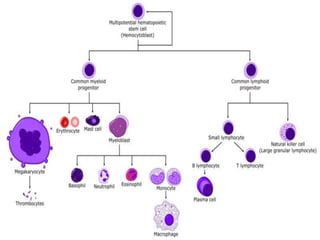
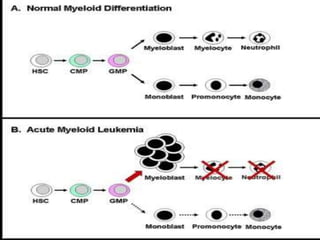
• The malignant cell in AML is the myeloblast.
• In normal hematopoiesis, the myeloblast is an
immature precursor of myeloid white blood
cells; a normal myeloblast will gradually
mature into a mature white blood cell.
• In AML, though, a single myeloblast
accumulates genetic changes which "freeze"
the cell in its immature state and
prevent differentiation.
Chromosomal translocation
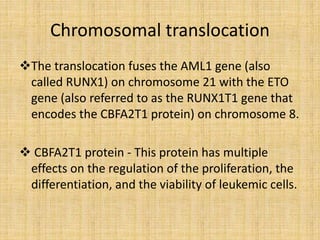
The translocation fuses the AML1 gene (also
called RUNX1) on chromosome 21 with the ETO
gene (also referred to as the RUNX1T1 gene that
encodes the CBFA2T1 protein) on chromosome 8.
 CBFA2T1 protein - This protein has multiple
effects on the regulation of the proliferation, the
differentiation, and the viability of leukemic cells.
•
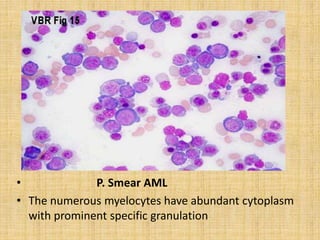
P. Smear AML
• The numerous myelocytes have abundant cytoplasm
with prominent specific granulation
•

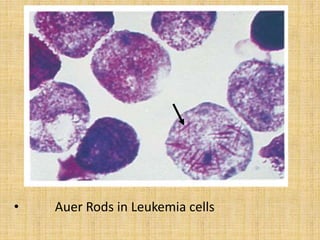
Auer Rods in Leukemia cells
Presentation FOR AML
•
•
•
•
•
•
•
•
•
•
•
•

Epistaxis
Bleeding gums
Bruising/contusions
Bone pain or tenderness
Fatigue
Fever
Heavy menstrual periods
Pallor
Shortness of breath (gets worse with exercise)
Skin rash or lesion
Swollen gums (rare)
Weight loss
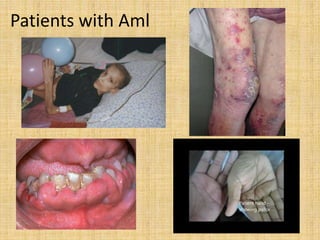
Patients with Aml
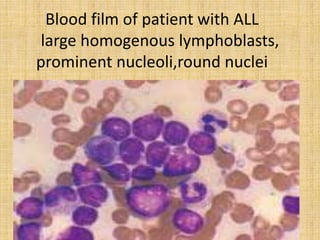
Blood film of patient with ALL
large homogenous lymphoblasts,
prominent nucleoli,round nuclei
Presentation for ALL
Organ infiltration: in ALL is bone pain, superficial
lymphadenopathy, abdominal distension due to
abdominal lymphadenopathy and
hepatosplenomegaly, respiratory embarrassment
due to a large mediastinal mass, testicular
enlargement, or a meningeal syndrome.
Gum hypertrophy and skin infiltration are more
commonly seen in AML than in ALL
DIAGNOSIS

• Physical exam
• CBC(Complete Blood Count) usually but not invariably shows reduced Hb conc.
and platelet count. The WBC can vary from 1000 to
200000, and the differential WBC is often abnormal,
with neutropenia and the presence of blast cells.
The anaemia is a normochromic, normocytic
anaemia, and the thrombocytopenia may be severe
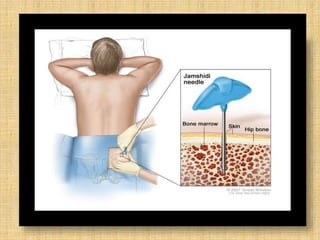
• Bone marrow aspiration: with or without
trephine bx is essential to confirm acute
leukaemia. The marrow is usually
hypercellular, with a predominance of
immature (blast) cells
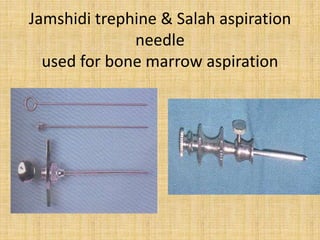
Jamshidi trephine & Salah aspiration
needle
used for bone marrow aspiration
Biochemical screening
• when the leucocyte count is very high, there
may be evidence of renal impairment and
hyperuricaemia
TREATMENT
• Immediate (same day) referral to specialist
• Prompt diagnosis
• Intensive supportive care
• Systemic chemotherapy
• Treatment directed at CNS (in children and in
adult ALL)
• Minimising early and late toxicity of treatment
• Prophylactic PLT transfusions are given if PLT
count is 10000.
• Clotting abnormalities may result from a DIC
where infusions of FFP and cryoprecipitate
may be beneficial.
• Packed red cell transfusions are given for
symptomatic anaemia, though these are
contraindicated if the WBC is extremely high.
In most patients a central venous catheter is
inserted to facilitate blood product support,
administration of chemotherapy and
antibiotics, and frequent blood sampling
Chemotherapy
In AML:
• treated with 4 or 5 courses of intensive
chemotherapy when there is intent to cure. Each
course consists of 10 days of chemotherapy.
Subsequent courses are started after cell counts
have recovered and response to treatment is
established. In AML M3 the drug ATRA (all-transretinoic acid) is used as an adjunct to
chemotherapy as it causes differentiation of the
malignant clone.
• In ALL the induction course is followed by two
or more consolidation periods and by
treatment directed at the CNS, followed by
long term maintenance or continuation
treatment for up to two years. This has been
shown to improve long term cure rates in ALL,
though not in AML
Distinguishing AML from ALL
– AML: Auer rods, cytoplasmic granules
– ALL: no Auer rods or granules.
Prognosis
• Poor prognosis in ALL
Age
< 1 year or > 10 years
Sex
Male
Presenting WBC
50000

CNS disease
at presentation

Presence of blasts in CSF

Remission problems Failure to remit after first induction
treatment
Cytogenetics
Philadelphia positive—that is,
t(9;22)or t(4;11) ALL
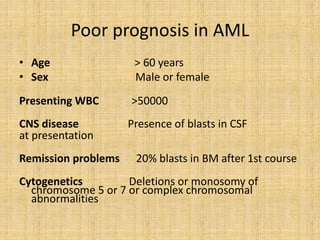
Poor prognosis in AML
• Age
• Sex

> 60 years
Male or female

Presenting WBC

>50000

CNS disease
at presentation
Remission problems

Presence of blasts in CSF
20% blasts in BM after 1st course

Cytogenetics
Deletions or monosomy of
chromosome 5 or 7 or complex chromosomal
abnormalities
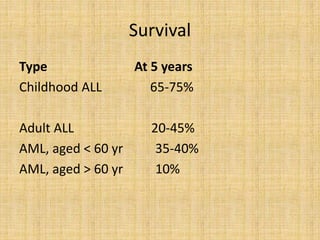
Survival
Type
Childhood ALL
Adult ALL
AML, aged < 60 yr
AML, aged > 60 yr

At 5 years
65-75%
20-45%
35-40%
10%

Acute leukemia

  • 1.
  • 2.
    What is leukemia? •Leukemia is a type of cancer that occurs in blood forming tissues, such as the bone marrow and the lymphatic system. • It is characterized by an abnormal increase of white blood cells.
  • 3.
    Signs & Symptoms •Leukemia symptoms vary on the type of leukemia, but a few common symptoms include: – Fever or chills – Persistent fatigue or weakness – Bone pain or tenderness – Excessive sweating – Frequent infections
  • 4.
    Four Types ofLeukemia: Leukemia Chronic Chronic Lymphocytic Leukemia (CLL) Chronic Myeloid Leukemia (CML) Acute Acute Lymphocytic Leukemia (ALL) Acute Myeloid Leukemia (AML)
  • 5.
    Acute leukaemia isa clonal ( derived from a single cell) malignant disorder characterised by the accumulation of immature blast cells in the BM, which replace normal marrow tissue, including haemopoietic precursor cells. This results in BM failure, reflected by peripheral blood cytopenias and circulating blast cells. Infiltration of various organs is also a feature of some forms of leukaemia
  • 6.
    (a) acute lymphoblasticleukemia (ALL), in which the abnormal proliferation is in the immature lymphocytes (b) acute myeloid leukemia (AML), which involves the myeloid lineages ( cells from which neutrophils, eosinophils, monocytes, basophils, megakaryocytes, etc. are derived). • The distinction between the two leukemias is based on morphological, cytochemical, immunological and cytogenetic differences and is of paramount importance as the treatment and prognosis are usually different
  • 7.
    Subclassification • It isfurther subdivided on the basis of morphological criteria: • ALL into FAB (French-American-British) subtypes L1, L2, and L3, and • AML into FAB subtypes M0 to M7
  • 8.
    FAB for AML M0AML with minimal differentiation M1 AML without maturation M2 AML with maturation M3 Acute promyelocytic leukaemia M4 Acute myelomonocytic leukaemia M5 Acute monocytic/monoblastic leukaemia M6 Acute erythroleukaemia M7 Acute megakaryoblastic leukaemia
  • 9.
    FAB Classification ofALL L1: Small homogeneous blasts; mostly in children L2: Large heterogeneous blasts; mostly in adults L3: “Burkitt” large basophilic B-cell blasts with vacuoles
  • 10.
    Incidence for ALL ALLis most common in the age 2-10 years, ( peak at 3-4). Secondary rise after 40 years. In children it is the most common malignant disease and accounts for 85% of childhood leukaemia
  • 11.
    Incidence for AML AMLaccounts for 10-15% of childhood leukemia, but it is the commonest leukaemia of adulthood. The incidence increases with age, and the median age at presentation is 60 years.
  • 12.
    Acute myelogenous leukemia •(AML) is a clonal hematopoietic disorder resulting from genetic alterations in normal hematopoietic stem cells. • These changes alter normal hematopoietic growth and differentiation, resulting in an accumulation of large numbers of abnormal, immature myeloid cells in the bone marrow and peripheral blood. • These cells are capable of dividing and proliferating, but cannot differentiate into mature hematopoietic cells. • AML is more common in men than women. • AML is the most common acute leukemia affecting adults, and its incidence increases with age.
  • 13.
    Pathogenesis • The malignantcell in AML is the myeloblast. • In normal hematopoiesis, the myeloblast is an immature precursor of myeloid white blood cells; a normal myeloblast will gradually mature into a mature white blood cell. • In AML, though, a single myeloblast accumulates genetic changes which "freeze" the cell in its immature state and prevent differentiation.
  • 16.
    Chromosomal translocation The translocationfuses the AML1 gene (also called RUNX1) on chromosome 21 with the ETO gene (also referred to as the RUNX1T1 gene that encodes the CBFA2T1 protein) on chromosome 8.  CBFA2T1 protein - This protein has multiple effects on the regulation of the proliferation, the differentiation, and the viability of leukemic cells.
  • 17.
    • P. Smear AML •The numerous myelocytes have abundant cytoplasm with prominent specific granulation
  • 18.
    • Auer Rods inLeukemia cells
  • 19.
    Presentation FOR AML • • • • • • • • • • • • Epistaxis Bleedinggums Bruising/contusions Bone pain or tenderness Fatigue Fever Heavy menstrual periods Pallor Shortness of breath (gets worse with exercise) Skin rash or lesion Swollen gums (rare) Weight loss
  • 20.
  • 21.
    Blood film ofpatient with ALL large homogenous lymphoblasts, prominent nucleoli,round nuclei
  • 22.
    Presentation for ALL Organinfiltration: in ALL is bone pain, superficial lymphadenopathy, abdominal distension due to abdominal lymphadenopathy and hepatosplenomegaly, respiratory embarrassment due to a large mediastinal mass, testicular enlargement, or a meningeal syndrome. Gum hypertrophy and skin infiltration are more commonly seen in AML than in ALL
  • 23.
    DIAGNOSIS • Physical exam •CBC(Complete Blood Count) usually but not invariably shows reduced Hb conc. and platelet count. The WBC can vary from 1000 to 200000, and the differential WBC is often abnormal, with neutropenia and the presence of blast cells. The anaemia is a normochromic, normocytic anaemia, and the thrombocytopenia may be severe
  • 24.
    • Bone marrowaspiration: with or without trephine bx is essential to confirm acute leukaemia. The marrow is usually hypercellular, with a predominance of immature (blast) cells
  • 25.
    Jamshidi trephine &Salah aspiration needle used for bone marrow aspiration
  • 27.
    Biochemical screening • whenthe leucocyte count is very high, there may be evidence of renal impairment and hyperuricaemia
  • 28.
    TREATMENT • Immediate (sameday) referral to specialist • Prompt diagnosis • Intensive supportive care • Systemic chemotherapy • Treatment directed at CNS (in children and in adult ALL) • Minimising early and late toxicity of treatment
  • 29.
    • Prophylactic PLTtransfusions are given if PLT count is 10000. • Clotting abnormalities may result from a DIC where infusions of FFP and cryoprecipitate may be beneficial. • Packed red cell transfusions are given for symptomatic anaemia, though these are contraindicated if the WBC is extremely high. In most patients a central venous catheter is inserted to facilitate blood product support, administration of chemotherapy and antibiotics, and frequent blood sampling
  • 30.
    Chemotherapy In AML: • treatedwith 4 or 5 courses of intensive chemotherapy when there is intent to cure. Each course consists of 10 days of chemotherapy. Subsequent courses are started after cell counts have recovered and response to treatment is established. In AML M3 the drug ATRA (all-transretinoic acid) is used as an adjunct to chemotherapy as it causes differentiation of the malignant clone.
  • 31.
    • In ALLthe induction course is followed by two or more consolidation periods and by treatment directed at the CNS, followed by long term maintenance or continuation treatment for up to two years. This has been shown to improve long term cure rates in ALL, though not in AML
  • 32.
    Distinguishing AML fromALL – AML: Auer rods, cytoplasmic granules – ALL: no Auer rods or granules.
  • 33.
    Prognosis • Poor prognosisin ALL Age < 1 year or > 10 years Sex Male Presenting WBC 50000 CNS disease at presentation Presence of blasts in CSF Remission problems Failure to remit after first induction treatment Cytogenetics Philadelphia positive—that is, t(9;22)or t(4;11) ALL
  • 34.
    Poor prognosis inAML • Age • Sex > 60 years Male or female Presenting WBC >50000 CNS disease at presentation Remission problems Presence of blasts in CSF 20% blasts in BM after 1st course Cytogenetics Deletions or monosomy of chromosome 5 or 7 or complex chromosomal abnormalities
  • 35.
    Survival Type Childhood ALL Adult ALL AML,aged < 60 yr AML, aged > 60 yr At 5 years 65-75% 20-45% 35-40% 10%