ACUTE LYMPHOBLASTIC LEUKEMIA PROF.S.TITO’S UNIT M5 DR.M.ARIVUMANI
Acute lymphoblastic leuKemia is malignant disease of marrow in which early lymphoid precursors proliferate and replace the normal haematop oietic cells
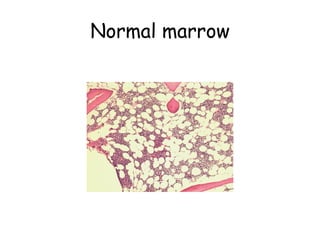
Normal marrow
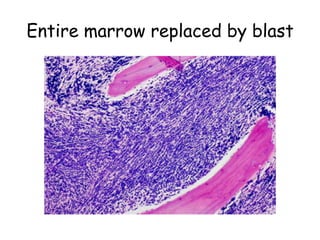
Entire marrow replaced by blast
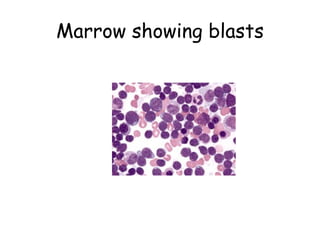
Marrow showing blasts
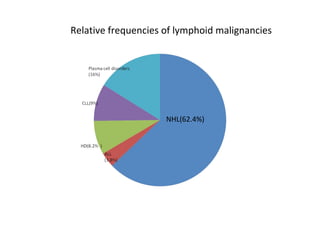
Relative frequencies of lymphoid malignancies NHL(62.4%)
Epidemiology pea K  incidence in 2 to 6 years more in boys than girls. median age in adults-35years Etiology less studied environmental and genetic  factors
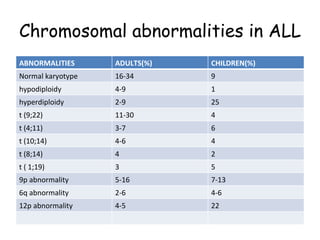
Chromosomal abnormalities in ALL ABNORMALITIES ADULTS(%) CHILDREN(%) Normal karyotype 16-34 9 hypodiploidy 4-9 1 hyperdiploidy 2-9 25 t (9;22) 11-30 4 t (4;11) 3-7 6 t (10;14) 4-6 4 t (8;14) 4 2 t ( 1;19) 3 5 9p abnormality 5-16 7-13 6q abnormality 2-6 4-6 12p abnormality 4-5 22
Factors predisposing ALL GENETIC ENVRONMENTAL Downs,turner, klinefelter Ionising radiation Fanconi,diamond blackfan Drugs NF Type1 alkylating agents Ataxia telengiectasia nitrosourea SCID epipodophyllotoxin PNH benzene exposure Li-fraumeni syndrome advanced maternal age Blooms syndrome paternal smoking
FAB CLASSIFICATION OF ALL CYTOLOGIC FEATURES L1 L2 L3 Cell size Small cells predominate,homogenous Large,heterogenous in size Large homogenous cytoplasm Scanty Variable,often moderately abundant Moderately abundant nucleoli Small One or more,often large One or more,prominent Nuclear shape Homogenous Variable, heterogenous Stippled, homogenous Nuclear shape Regular Irregular clefts regular Cyt.basophilia variable variable Intensely basophilic Cyt.vacuolation variable variable prominent
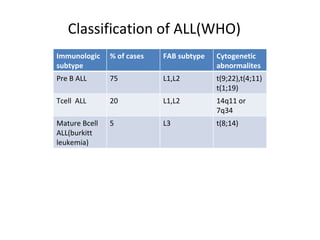
Classification of ALL(WHO) Immunologic subtype % of cases FAB subtype Cytogenetic  abnormalites Pre B ALL 75 L1,L2 t(9;22),t(4;11)t(1;19) Tcell  ALL 20 L1,L2 14q11 or 7q34 Mature Bcell ALL(burkitt leukemia) 5 L3 t(8;14)
Pre B ALL(L1) Small blasts wth thin rim of cytoplasm
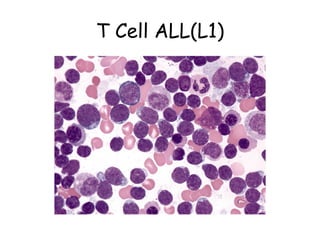
T Cell ALL(L1)
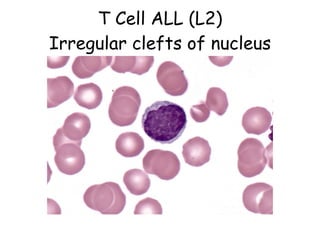
T Cell ALL (L2) Irregular clefts of nucleus
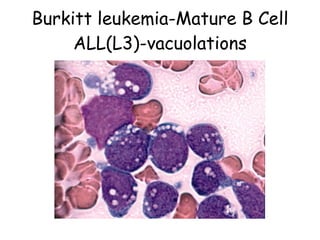
Burkitt leukemia-Mature B Cell ALL(L3)-vacuolations
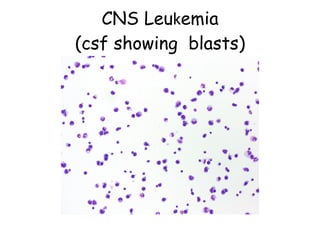
CNS Leu k emia (csf showing  blasts)
B Cell ALL (85%) type tdt CALLA Surface  Ig Early pro B ALL positive negative negative Pre Bcell ALL positive positive negative Mature B ALL negative positive positive
T Cell ALL(15%) Early subtype CD3 -, CD4-,CD8- or CD3-,CD4+,CD8+. Later subtype CD3+ with CD4+ or CD8+
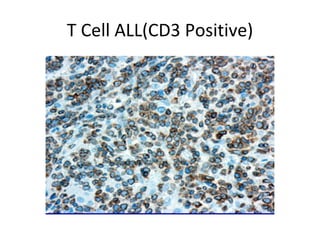
T Cell ALL(CD3 Positive)
CLINICAL FEATURES Due to infiltration of marrow SYMPTOMS  Due to decreased production of  normal marrow elements
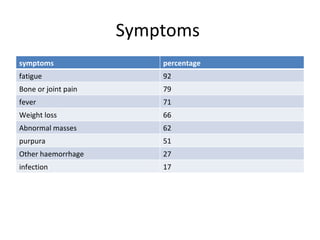
Symptoms  symptoms percentage fatigue 92 Bone or joint pain 79 fever 71 Weight loss 66 Abnormal masses 62 purpura 51 Other haemorrhage 27 infection 17
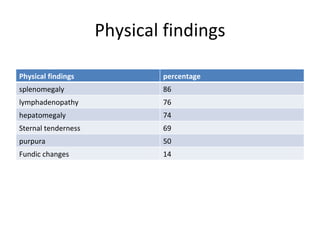
Physical findings Physical findings percentage splenomegaly 86 lymphadenopathy 76 hepatomegaly 74 Sternal tenderness 69 purpura 50 Fundic changes 14
Investigations CBC-Anemia,thrombocytopenia,leucopenia or leucocytosis. Peripheral smear study-circulating blast can be seen.
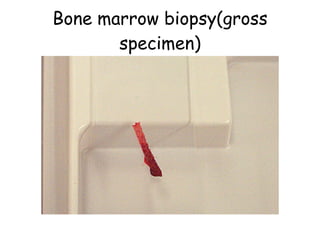
Confirmatory  Bone marrow aspiration/biopsy
Bone marrow biopsy(gross specimen)
Criteria for diagnosis Bone marrow or peripheral smear showing  Aleast 30% blast(FAB) Atleast 20%blast (WHO) MPO  Negative,tdt positive is hallmar k  of Lymphoblast,however in L3 tdt  is negative
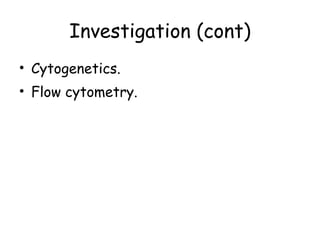
Investigation (cont) Cytogenetics. Flow cytometry.
Investigation (cont) LDH,Serum uric acid Coagulation profile LFT,RFT Chest xray,CT chest Blood culture Baseline Echo,ECG
Treatment Pre Chemotherapy supportive care Chemotherapy Preinduction Remission induction-phase 1 & 2 Reinduction CNS preventive therapy consolidation Maintenance therapy Allogenic stem cell transplantation Newer drugs Supportive care Treatment of relapse Effects of treatment
Supportive care Treat metabolic complications hyperuricemia-hydration,rasburicase hyperphosphatemia-po4 binders hypocalcemia-Ca supplements Hyperleuc k ocytosis-leu k opharesis Infection control-broad spectrum  antibiotics Hematologic support
Preinduction Prednisolone 1mg/ k g  p.ofor 5 days   Rechec k  blast after 5 days, if blast count dropped-good response.
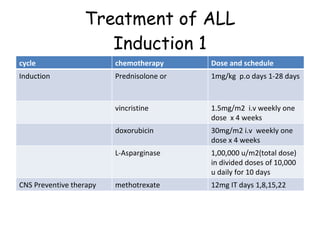
Treatment of ALL Induction 1 cycle chemotherapy Dose and schedule Induction Prednisolone or 1mg/kg  p.o days 1-28 days vincristine 1.5mg/m2  i.v weekly one dose  x 4 weeks doxorubicin 30mg/m2 i.v  weekly one dose x 4 weeks L-Asparginase 1,00,000 u/m2(total dose) in divided doses of 10,000  u daily for 10 days CNS Preventive therapy methotrexate 12mg IT days 1,8,15,22
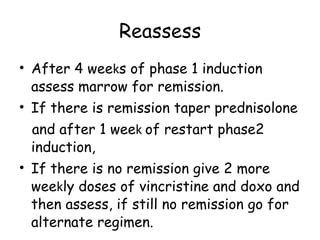
Reassess After 4 wee k s of phase 1 induction assess marrow for remission. If there is remission taper prednisolone and after 1 wee k  of restart phase2 induction, If there is no remission give 2 more wee k ly doses of vincristine and doxo and then assess, if still no remission go for alternate regimen.
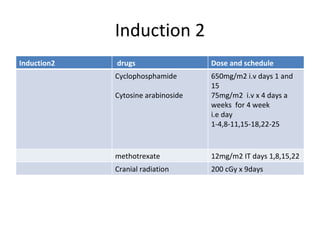
Induction 2 Induction2  drugs Dose and schedule Cyclophosphamide Cytosine arabinoside 650mg/m2 i.v days 1 and 15 75mg/m2  i.v x 4 days a weeks  for 4 week i.e day 1-4,8-11,15-18,22-25 methotrexate 12mg/m2 IT days 1,8,15,22 Cranial radiation 200 cGy x 9days
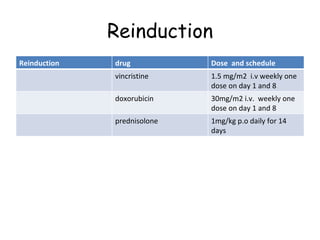
Reinduction Reinduction drug Dose  and schedule vincristine 1.5 mg/m2  i.v weekly one dose on day 1 and 8 doxorubicin 30mg/m2 i.v.  weekly one dose on day 1 and 8 prednisolone 1mg/kg p.o daily for 14 days
consolidation  consoldation drugs Dose and schedule cyclophosphamide 750/m2 .i.v days 1 and 15 Cytosine arabinoside 75mg/m2  doses days 1-4 and 15-18
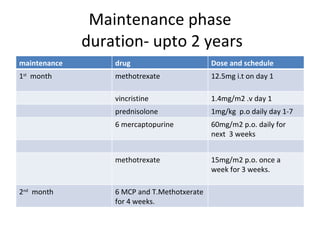
Maintenance phase  duration- upto 2 years maintenance drug Dose and schedule 1 st   month methotrexate 12.5mg i.t on day 1 vincristine 1.4mg/m2 .v day 1 prednisolone 1mg/kg  p.o daily day 1-7 6 mercaptopurine 60mg/m2 p.o. daily for next  3 weeks  methotrexate 15mg/m2 p.o. once a  week for 3 weeks. 2 nd   month 6 MCP and T.Methotxerate for 4 weeks.
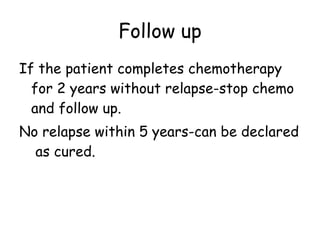
Follow up If the patient completes chemotherapy for 2 years without relapse-stop chemo and follow up. No relapse within 5 years-can be declared  as cured.
Refractory ALL
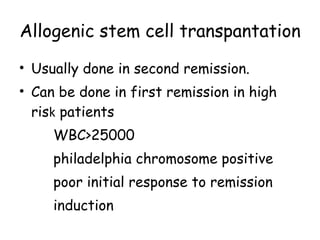
Allogenic stem cell transpantation Usually done in second remission. Can be done in first remission in high ris k  patients  WBC>25000 philadelphia chromosome positive poor initial response to remission induction
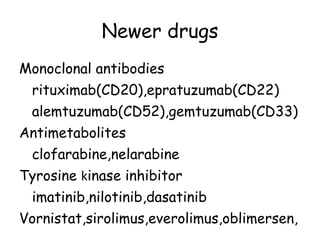
Newer drugs Monoclonal antibodies rituximab(CD20),epratuzumab(CD22) alemtuzumab(CD52),gemtuzumab(CD33) Antimetabolites clofarabine,nelarabine Tyrosine  k inase inhibitor imatinib,nilotinib,dasatinib Vornistat,sirolimus,everolimus,oblimersen,
Late effects of treatment Cranial irradiation-cognitive and intellectual impairment,cns neoplaysms Chemotherapeutic drugs-secondary AML Endorine dysfunctions-short stature,obesity,growth retardation Anthracycline-cardiotoxicity Steroid-avascular necrosis of bone.
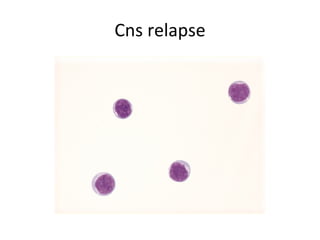
Relapse Reappearance of blast at any site in the body after initial remisson during chemotherapy or after comleting chemo. Marrow relapse-poor outcome Hyper CVAD regimen allogenic BM transplant CNS relapse  -Triple IT –alternate days till csf clears,then twice  wee k ly 6 doses.then one dose every wee k 6  doses. - cranial irradiation Testicular relapse -chemotherapy plus b/l testicular  radiation
Cns relapse
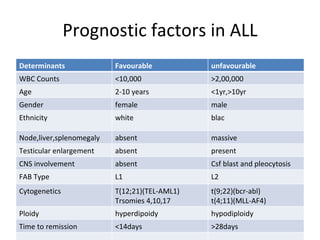
Prognostic factors in ALL Determinants Favourable unfavourable WBC Counts <10,000 >2,00,000 Age 2-10 years <1yr,>10yr Gender female male Ethnicity white blac Node,liver,splenomegaly absent massive Testicular enlargement absent present CNS involvement absent Csf blast and pleocytosis FAB Type L1 L2 Cytogenetics T(12;21)(TEL-AML1) Trsomies 4,10,17 t(9;22)(bcr-abl) t(4;11)(MLL-AF4) Ploidy hyperdipoidy hypodiploidy Time to remission <14days >28days
References. 1.Harrison’s principles of internal medicine 17 th  edition 2.Williams hematology 8 th  edition 3.Wintrobe’s clinical hematology  4.Nelson textboo K  of paediatrics 5.ash.hematologylibrary.com/image ban k.
THANK YOU

Acute Lymphoblastic Leukaemia

  • 1.
    ACUTE LYMPHOBLASTIC LEUKEMIAPROF.S.TITO’S UNIT M5 DR.M.ARIVUMANI
  • 2.
    Acute lymphoblastic leuKemiais malignant disease of marrow in which early lymphoid precursors proliferate and replace the normal haematop oietic cells
  • 3.
  • 4.
  • 5.
  • 6.
    Relative frequencies oflymphoid malignancies NHL(62.4%)
  • 7.
    Epidemiology pea K incidence in 2 to 6 years more in boys than girls. median age in adults-35years Etiology less studied environmental and genetic factors
  • 8.
    Chromosomal abnormalities inALL ABNORMALITIES ADULTS(%) CHILDREN(%) Normal karyotype 16-34 9 hypodiploidy 4-9 1 hyperdiploidy 2-9 25 t (9;22) 11-30 4 t (4;11) 3-7 6 t (10;14) 4-6 4 t (8;14) 4 2 t ( 1;19) 3 5 9p abnormality 5-16 7-13 6q abnormality 2-6 4-6 12p abnormality 4-5 22
  • 9.
    Factors predisposing ALLGENETIC ENVRONMENTAL Downs,turner, klinefelter Ionising radiation Fanconi,diamond blackfan Drugs NF Type1 alkylating agents Ataxia telengiectasia nitrosourea SCID epipodophyllotoxin PNH benzene exposure Li-fraumeni syndrome advanced maternal age Blooms syndrome paternal smoking
  • 10.
    FAB CLASSIFICATION OFALL CYTOLOGIC FEATURES L1 L2 L3 Cell size Small cells predominate,homogenous Large,heterogenous in size Large homogenous cytoplasm Scanty Variable,often moderately abundant Moderately abundant nucleoli Small One or more,often large One or more,prominent Nuclear shape Homogenous Variable, heterogenous Stippled, homogenous Nuclear shape Regular Irregular clefts regular Cyt.basophilia variable variable Intensely basophilic Cyt.vacuolation variable variable prominent
  • 11.
    Classification of ALL(WHO)Immunologic subtype % of cases FAB subtype Cytogenetic abnormalites Pre B ALL 75 L1,L2 t(9;22),t(4;11)t(1;19) Tcell ALL 20 L1,L2 14q11 or 7q34 Mature Bcell ALL(burkitt leukemia) 5 L3 t(8;14)
  • 12.
    Pre B ALL(L1)Small blasts wth thin rim of cytoplasm
  • 13.
  • 14.
    T Cell ALL(L2) Irregular clefts of nucleus
  • 15.
    Burkitt leukemia-Mature BCell ALL(L3)-vacuolations
  • 16.
    CNS Leu kemia (csf showing blasts)
  • 17.
    B Cell ALL(85%) type tdt CALLA Surface Ig Early pro B ALL positive negative negative Pre Bcell ALL positive positive negative Mature B ALL negative positive positive
  • 18.
    T Cell ALL(15%)Early subtype CD3 -, CD4-,CD8- or CD3-,CD4+,CD8+. Later subtype CD3+ with CD4+ or CD8+
  • 19.
    T Cell ALL(CD3Positive)
  • 20.
    CLINICAL FEATURES Dueto infiltration of marrow SYMPTOMS Due to decreased production of normal marrow elements
  • 21.
    Symptoms symptomspercentage fatigue 92 Bone or joint pain 79 fever 71 Weight loss 66 Abnormal masses 62 purpura 51 Other haemorrhage 27 infection 17
  • 22.
    Physical findings Physicalfindings percentage splenomegaly 86 lymphadenopathy 76 hepatomegaly 74 Sternal tenderness 69 purpura 50 Fundic changes 14
  • 23.
    Investigations CBC-Anemia,thrombocytopenia,leucopenia orleucocytosis. Peripheral smear study-circulating blast can be seen.
  • 24.
    Confirmatory Bonemarrow aspiration/biopsy
  • 25.
  • 26.
    Criteria for diagnosisBone marrow or peripheral smear showing Aleast 30% blast(FAB) Atleast 20%blast (WHO) MPO Negative,tdt positive is hallmar k of Lymphoblast,however in L3 tdt is negative
  • 27.
  • 28.
    Investigation (cont) LDH,Serumuric acid Coagulation profile LFT,RFT Chest xray,CT chest Blood culture Baseline Echo,ECG
  • 29.
    Treatment Pre Chemotherapysupportive care Chemotherapy Preinduction Remission induction-phase 1 & 2 Reinduction CNS preventive therapy consolidation Maintenance therapy Allogenic stem cell transplantation Newer drugs Supportive care Treatment of relapse Effects of treatment
  • 30.
    Supportive care Treatmetabolic complications hyperuricemia-hydration,rasburicase hyperphosphatemia-po4 binders hypocalcemia-Ca supplements Hyperleuc k ocytosis-leu k opharesis Infection control-broad spectrum antibiotics Hematologic support
  • 31.
    Preinduction Prednisolone 1mg/k g p.ofor 5 days Rechec k blast after 5 days, if blast count dropped-good response.
  • 32.
    Treatment of ALLInduction 1 cycle chemotherapy Dose and schedule Induction Prednisolone or 1mg/kg p.o days 1-28 days vincristine 1.5mg/m2 i.v weekly one dose x 4 weeks doxorubicin 30mg/m2 i.v weekly one dose x 4 weeks L-Asparginase 1,00,000 u/m2(total dose) in divided doses of 10,000 u daily for 10 days CNS Preventive therapy methotrexate 12mg IT days 1,8,15,22
  • 33.
    Reassess After 4wee k s of phase 1 induction assess marrow for remission. If there is remission taper prednisolone and after 1 wee k of restart phase2 induction, If there is no remission give 2 more wee k ly doses of vincristine and doxo and then assess, if still no remission go for alternate regimen.
  • 34.
    Induction 2 Induction2 drugs Dose and schedule Cyclophosphamide Cytosine arabinoside 650mg/m2 i.v days 1 and 15 75mg/m2 i.v x 4 days a weeks for 4 week i.e day 1-4,8-11,15-18,22-25 methotrexate 12mg/m2 IT days 1,8,15,22 Cranial radiation 200 cGy x 9days
  • 35.
    Reinduction Reinduction drugDose and schedule vincristine 1.5 mg/m2 i.v weekly one dose on day 1 and 8 doxorubicin 30mg/m2 i.v. weekly one dose on day 1 and 8 prednisolone 1mg/kg p.o daily for 14 days
  • 36.
    consolidation consoldationdrugs Dose and schedule cyclophosphamide 750/m2 .i.v days 1 and 15 Cytosine arabinoside 75mg/m2 doses days 1-4 and 15-18
  • 37.
    Maintenance phase duration- upto 2 years maintenance drug Dose and schedule 1 st month methotrexate 12.5mg i.t on day 1 vincristine 1.4mg/m2 .v day 1 prednisolone 1mg/kg p.o daily day 1-7 6 mercaptopurine 60mg/m2 p.o. daily for next 3 weeks methotrexate 15mg/m2 p.o. once a week for 3 weeks. 2 nd month 6 MCP and T.Methotxerate for 4 weeks.
  • 38.
    Follow up Ifthe patient completes chemotherapy for 2 years without relapse-stop chemo and follow up. No relapse within 5 years-can be declared as cured.
  • 39.
  • 40.
    Allogenic stem celltranspantation Usually done in second remission. Can be done in first remission in high ris k patients WBC>25000 philadelphia chromosome positive poor initial response to remission induction
  • 41.
    Newer drugs Monoclonalantibodies rituximab(CD20),epratuzumab(CD22) alemtuzumab(CD52),gemtuzumab(CD33) Antimetabolites clofarabine,nelarabine Tyrosine k inase inhibitor imatinib,nilotinib,dasatinib Vornistat,sirolimus,everolimus,oblimersen,
  • 42.
    Late effects oftreatment Cranial irradiation-cognitive and intellectual impairment,cns neoplaysms Chemotherapeutic drugs-secondary AML Endorine dysfunctions-short stature,obesity,growth retardation Anthracycline-cardiotoxicity Steroid-avascular necrosis of bone.
  • 43.
    Relapse Reappearance ofblast at any site in the body after initial remisson during chemotherapy or after comleting chemo. Marrow relapse-poor outcome Hyper CVAD regimen allogenic BM transplant CNS relapse -Triple IT –alternate days till csf clears,then twice wee k ly 6 doses.then one dose every wee k 6 doses. - cranial irradiation Testicular relapse -chemotherapy plus b/l testicular radiation
  • 44.
  • 45.
    Prognostic factors inALL Determinants Favourable unfavourable WBC Counts <10,000 >2,00,000 Age 2-10 years <1yr,>10yr Gender female male Ethnicity white blac Node,liver,splenomegaly absent massive Testicular enlargement absent present CNS involvement absent Csf blast and pleocytosis FAB Type L1 L2 Cytogenetics T(12;21)(TEL-AML1) Trsomies 4,10,17 t(9;22)(bcr-abl) t(4;11)(MLL-AF4) Ploidy hyperdipoidy hypodiploidy Time to remission <14days >28days
  • 46.
    References. 1.Harrison’s principlesof internal medicine 17 th edition 2.Williams hematology 8 th edition 3.Wintrobe’s clinical hematology 4.Nelson textboo K of paediatrics 5.ash.hematologylibrary.com/image ban k.
  • 47.