CHAPTER - 4
ACIDS, BASES & SALTS
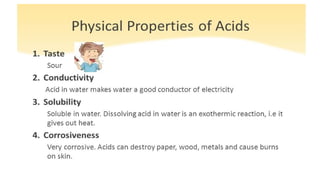
• An acid is a chemical substance
that has a sour taste.
• The word acid comes from the
Latin word acere – means sour
• Many food items such as
lemons, curd, vinegar and
orange taste sour because of the
presence of acid in them.
• Acidic Substances are the
substances that contain acid in
them.
ACIDS
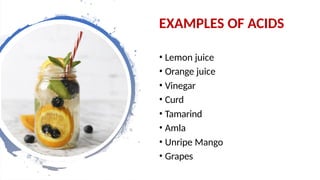
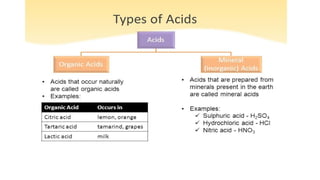
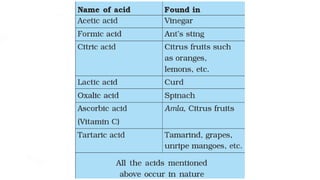
EXAMPLES OF ACIDS
• Lemon juice
• Orange juice
• Vinegar
• Curd
• Tamarind
• Amla
• Unripe Mango
• Grapes
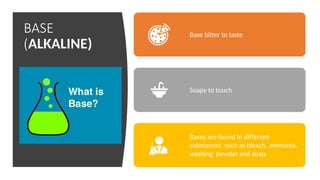
BASE
(ALKALINE)
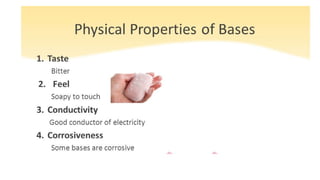
Base bitter to taste
Soapy to touch
Bases are found in different
substances such as bleach, ammonia,
washing powder and soap.
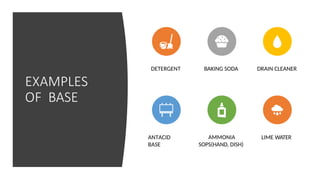
EXAMPLES
OF BASE
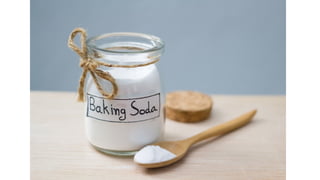
DETERGENT BAKING SODA DRAIN CLEANER
ANTACID
BASE
AMMONIA
SOPS(HAND, DISH)
LIME WATER
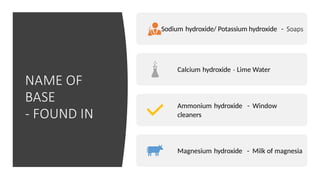
NAME OF
BASE
- FOUND IN
Sodium hydroxide/ Potassium hydroxide - Soaps
Calcium hydroxide - Lime Water
Ammonium hydroxide - Window
cleaners
Magnesium hydroxide - Milk of magnesia
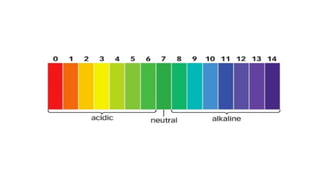
NEUTRAL SUBSTANCE
Neutral Substance is any
substance which is neither acidic
nor basic in nature. Examples are
pure water, table salt, sugar
solution etc.
INDICATORS
•We cannot taste every object
and find its nature.
•Special type of substances used
to test whether a substance is
acidic or basic -indicators.
•The indicators indicate the
presence of an acid or base in a
substance by changing their
colour.
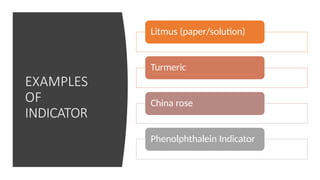
EXAMPLES
OF
INDICATOR
Litmus (paper/solution)
Turmeric
China rose
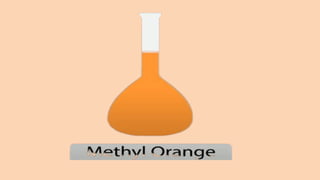
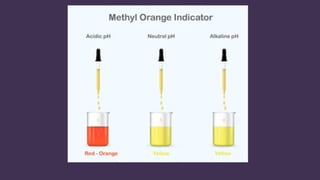
Phenolphthalein Indicator
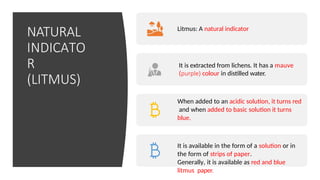
NATURAL
INDICATO
R
(LITMUS)
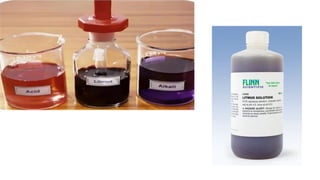
Litmus: A natural indicator
It is extracted from lichens. It has a mauve
(purple) colour in distilled water.
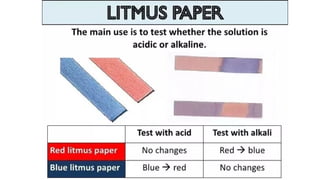
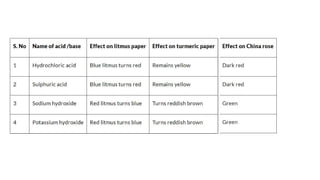
When added to an acidic solution, it turns red
and when added to basic solution it turns
blue.
It is available in the form of a solution or in
the form of strips of paper.
Generally, it is available as red and blue
litmus paper.
ACTIVITIES
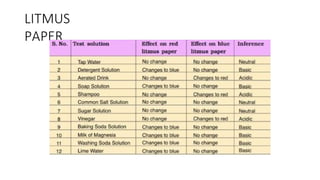
LITMUS
PAPER
Can we expect the same
result using solid baking
soda and dry litmus paper??
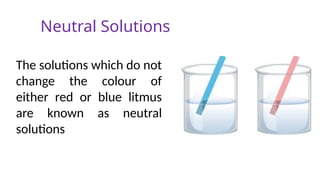
Neutral Solutions
The solutions which do not
change the colour of
either red or blue litmus
are known as neutral
solutions
TURMERIC
(NATURAL
INDICATOR
)
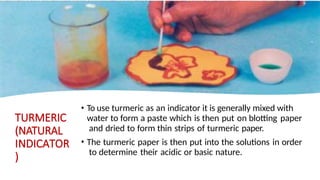
• To use turmeric as an indicator it is generally mixed with
water to form a paste which is then put on blotting paper
and dried to form thin strips of turmeric paper.
• The turmeric paper is then put into the solutions in order
to determine their acidic or basic nature.
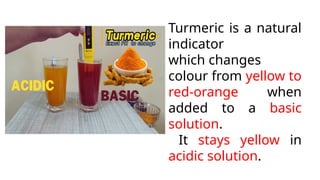
Turmeric is a natural
indicator
which changes
colour from yellow to
red-orange when
added to a basic
solution.
It stays yellow in
acidic solution.
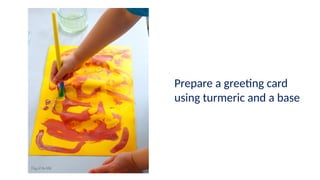
Prepare a greeting card
using turmeric and a base
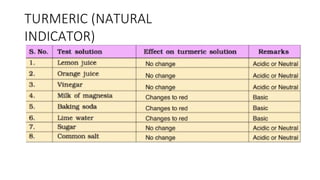
TURMERIC (NATURAL
INDICATOR)
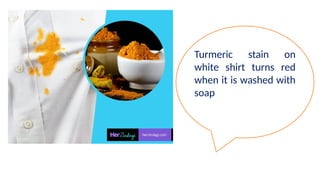
Turmeric stain on
white shirt turns red
when it is washed with
soap
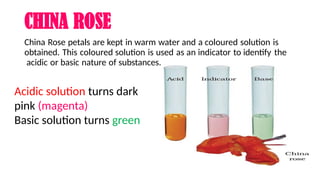
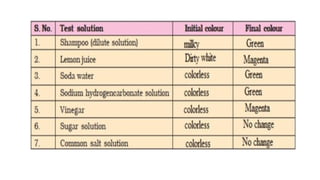
CHINA ROSE
China Rose petals are kept in warm water and a coloured solution is
obtained. This coloured solution is used as an indicator to identify the
acidic or basic nature of substances.
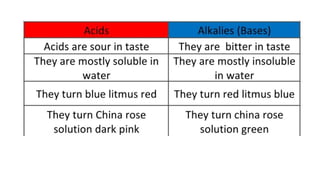
Acidic solution turns dark
pink (magenta)
Basic solution turns green
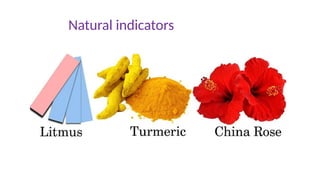
Natural indicators
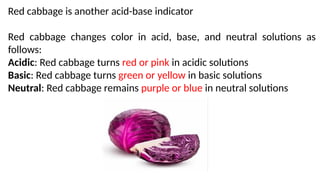
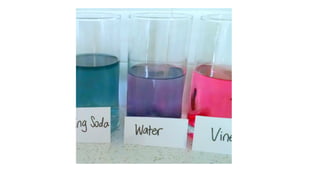
Red cabbage is another acid-base indicator
Red cabbage changes color in acid, base, and neutral solutions as
follows:
Acidic: Red cabbage turns red or pink in acidic solutions
Basic: Red cabbage turns green or yellow in basic solutions
Neutral: Red cabbage remains purple or blue in neutral solutions
Acid Rain
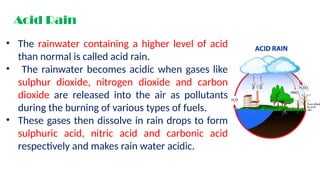
• The rainwater containing a higher level of acid
than normal is called acid rain.
• The rainwater becomes acidic when gases like
sulphur dioxide, nitrogen dioxide and carbon
dioxide are released into the air as pollutants
during the burning of various types of fuels.
• These gases then dissolve in rain drops to form
sulphuric acid, nitric acid and carbonic acid
respectively and makes rain water acidic.
Impact of Acid Rain on the Environment
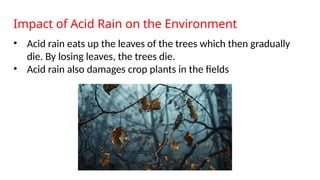
• Acid rain eats up the leaves of the trees which then gradually
die. By losing leaves, the trees die.
• Acid rain also damages crop plants in the fields
Impact of Acid Rain on the Environment
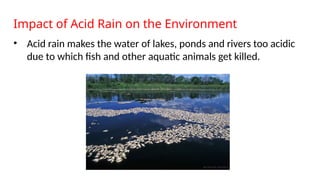
• Acid rain makes the water of lakes, ponds and rivers too acidic
due to which fish and other aquatic animals get killed.
Impact of Acid Rain on the Environment
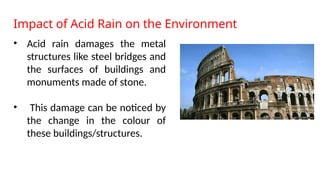
• Acid rain damages the metal
structures like steel bridges and
the surfaces of buildings and
monuments made of stone.
• This damage can be noticed by
the change in the colour of
these buildings/structures.
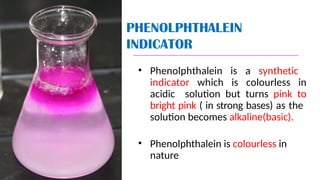
PHENOLPHTHALEIN
INDICATOR
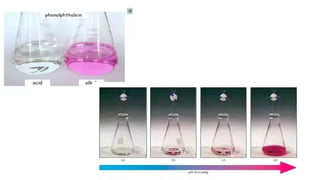
• Phenolphthalein is a synthetic
indicator which is colourless in
acidic solution but turns pink to
bright pink ( in strong bases) as the
solution becomes alkaline(basic).
• Phenolphthalein is colourless in
nature
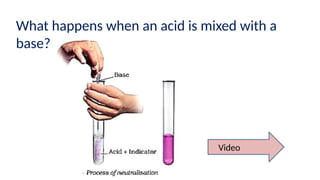
What happens when an acid is mixed with a
base?
Video
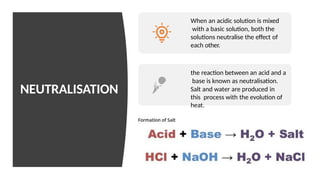
NEUTRALISATION
When an acidic solution is mixed
with a basic solution, both the
solutions neutralise the effect of
each other.
the reaction between an acid and a
base is known as neutralisation.
Salt and water are produced in
this process with the evolution of
heat.
• When an acid and a base are mixed, they react to form water and
a salt.
• This reaction is called an acid-base reaction or a neutralization
reaction.
• In neutralization reaction heat is always produced or evolved. And
this raises the temperature of the reaction mixture.
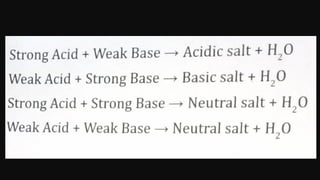
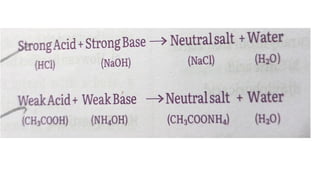
• The salt formed may be acidic, basic or neutral in nature.
• This depends upon the relative strength of acids and bas used in
the reaction.
• Salt has two parents: an acid and a base.
• Therefore, the name of a salt consists of two parts.
• The first part of the salt's name is derived from the name of the
base and the second part of the salt's name is derived from the
name of the acid.
• Hence, the name of the salt 'sodium chloride' comes from
'sodium hydroxide' and 'hydrochloric acid'.
Boojo added dilute sulphuric acid to lime water.
Will the reaction mixture become hot or cool ?
NEUTRALIZATION IN EVERYDAY
LIFE
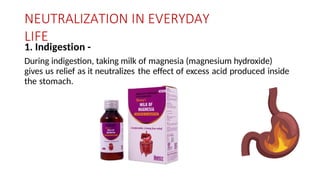
1. Indigestion -
During indigestion, taking milk of magnesia (magnesium hydroxide)
gives us relief as it neutralizes the effect of excess acid produced inside
the stomach.
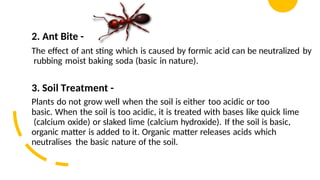
2. Ant Bite -
The effect of ant sting which is caused by formic acid can be neutralized by
rubbing moist baking soda (basic in nature).
3. Soil Treatment -
Plants do not grow well when the soil is either too acidic or too
basic. When the soil is too acidic, it is treated with bases like quick lime
(calcium oxide) or slaked lime (calcium hydroxide). If the soil is basic,
organic matter is added to it. Organic matter releases acids which
neutralises the basic nature of the soil.
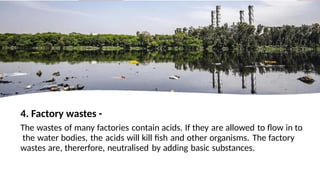
4. Factory wastes -
The wastes of many factories contain acids. If they are allowed to flow in to
the water bodies, the acids will kill fish and other organisms. The factory
wastes are, thererfore, neutralised by adding basic substances.
Thank you

Acids, Bases and Salts Class 7 Science.pptx

  • 1.
    CHAPTER - 4 ACIDS,BASES & SALTS
  • 3.
    • An acidis a chemical substance that has a sour taste. • The word acid comes from the Latin word acere – means sour • Many food items such as lemons, curd, vinegar and orange taste sour because of the presence of acid in them. • Acidic Substances are the substances that contain acid in them. ACIDS
  • 4.
    EXAMPLES OF ACIDS •Lemon juice • Orange juice • Vinegar • Curd • Tamarind • Amla • Unripe Mango • Grapes
  • 9.
    BASE (ALKALINE) Base bitter totaste Soapy to touch Bases are found in different substances such as bleach, ammonia, washing powder and soap.
  • 10.
    EXAMPLES OF BASE DETERGENT BAKINGSODA DRAIN CLEANER ANTACID BASE AMMONIA SOPS(HAND, DISH) LIME WATER
  • 11.
    NAME OF BASE - FOUNDIN Sodium hydroxide/ Potassium hydroxide - Soaps Calcium hydroxide - Lime Water Ammonium hydroxide - Window cleaners Magnesium hydroxide - Milk of magnesia
  • 13.
    NEUTRAL SUBSTANCE Neutral Substanceis any substance which is neither acidic nor basic in nature. Examples are pure water, table salt, sugar solution etc.
  • 15.
    INDICATORS •We cannot tasteevery object and find its nature. •Special type of substances used to test whether a substance is acidic or basic -indicators. •The indicators indicate the presence of an acid or base in a substance by changing their colour.
  • 16.
  • 17.
    NATURAL INDICATO R (LITMUS) Litmus: A naturalindicator It is extracted from lichens. It has a mauve (purple) colour in distilled water. When added to an acidic solution, it turns red and when added to basic solution it turns blue. It is available in the form of a solution or in the form of strips of paper. Generally, it is available as red and blue litmus paper.
  • 20.
  • 21.
  • 22.
    Can we expectthe same result using solid baking soda and dry litmus paper??
  • 23.
    Neutral Solutions The solutionswhich do not change the colour of either red or blue litmus are known as neutral solutions
  • 24.
    TURMERIC (NATURAL INDICATOR ) • To useturmeric as an indicator it is generally mixed with water to form a paste which is then put on blotting paper and dried to form thin strips of turmeric paper. • The turmeric paper is then put into the solutions in order to determine their acidic or basic nature.
  • 25.
    Turmeric is anatural indicator which changes colour from yellow to red-orange when added to a basic solution. It stays yellow in acidic solution.
  • 26.
    Prepare a greetingcard using turmeric and a base
  • 27.
  • 28.
    Turmeric stain on whiteshirt turns red when it is washed with soap
  • 29.
    CHINA ROSE China Rosepetals are kept in warm water and a coloured solution is obtained. This coloured solution is used as an indicator to identify the acidic or basic nature of substances. Acidic solution turns dark pink (magenta) Basic solution turns green
  • 31.
  • 32.
    Red cabbage isanother acid-base indicator Red cabbage changes color in acid, base, and neutral solutions as follows: Acidic: Red cabbage turns red or pink in acidic solutions Basic: Red cabbage turns green or yellow in basic solutions Neutral: Red cabbage remains purple or blue in neutral solutions
  • 35.
    Acid Rain • Therainwater containing a higher level of acid than normal is called acid rain. • The rainwater becomes acidic when gases like sulphur dioxide, nitrogen dioxide and carbon dioxide are released into the air as pollutants during the burning of various types of fuels. • These gases then dissolve in rain drops to form sulphuric acid, nitric acid and carbonic acid respectively and makes rain water acidic.
  • 36.
    Impact of AcidRain on the Environment • Acid rain eats up the leaves of the trees which then gradually die. By losing leaves, the trees die. • Acid rain also damages crop plants in the fields
  • 37.
    Impact of AcidRain on the Environment • Acid rain makes the water of lakes, ponds and rivers too acidic due to which fish and other aquatic animals get killed.
  • 38.
    Impact of AcidRain on the Environment • Acid rain damages the metal structures like steel bridges and the surfaces of buildings and monuments made of stone. • This damage can be noticed by the change in the colour of these buildings/structures.
  • 39.
    PHENOLPHTHALEIN INDICATOR • Phenolphthalein isa synthetic indicator which is colourless in acidic solution but turns pink to bright pink ( in strong bases) as the solution becomes alkaline(basic). • Phenolphthalein is colourless in nature
  • 41.
    What happens whenan acid is mixed with a base? Video
  • 42.
    NEUTRALISATION When an acidicsolution is mixed with a basic solution, both the solutions neutralise the effect of each other. the reaction between an acid and a base is known as neutralisation. Salt and water are produced in this process with the evolution of heat.
  • 43.
    • When anacid and a base are mixed, they react to form water and a salt. • This reaction is called an acid-base reaction or a neutralization reaction. • In neutralization reaction heat is always produced or evolved. And this raises the temperature of the reaction mixture. • The salt formed may be acidic, basic or neutral in nature. • This depends upon the relative strength of acids and bas used in the reaction.
  • 44.
    • Salt hastwo parents: an acid and a base. • Therefore, the name of a salt consists of two parts. • The first part of the salt's name is derived from the name of the base and the second part of the salt's name is derived from the name of the acid. • Hence, the name of the salt 'sodium chloride' comes from 'sodium hydroxide' and 'hydrochloric acid'.
  • 47.
    Boojo added dilutesulphuric acid to lime water. Will the reaction mixture become hot or cool ?
  • 51.
    NEUTRALIZATION IN EVERYDAY LIFE 1.Indigestion - During indigestion, taking milk of magnesia (magnesium hydroxide) gives us relief as it neutralizes the effect of excess acid produced inside the stomach.
  • 52.
    2. Ant Bite- The effect of ant sting which is caused by formic acid can be neutralized by rubbing moist baking soda (basic in nature). 3. Soil Treatment - Plants do not grow well when the soil is either too acidic or too basic. When the soil is too acidic, it is treated with bases like quick lime (calcium oxide) or slaked lime (calcium hydroxide). If the soil is basic, organic matter is added to it. Organic matter releases acids which neutralises the basic nature of the soil.
  • 53.
    4. Factory wastes- The wastes of many factories contain acids. If they are allowed to flow in to the water bodies, the acids will kill fish and other organisms. The factory wastes are, thererfore, neutralised by adding basic substances.
  • 54.