Chapter 15.2 “ Acids, Bases, and Salts ”
Properties of Acids They taste  sour  (don’t try this at home). They can  conduct electricity . Can be strong or weak electrolytes in aqueous solution React with metals  to form H 2  gas. Change the color  of indicators  (for example: blue litmus turns to red). React with bases  (metallic hydroxides) to form water and a salt.
Properties of Acids They have a  pH of less than 7  (more on this concept of pH in a later lesson) They  react with carbonates and bicarbonates  to produce a salt, water, and carbon dioxide gas How do you know if a chemical is an acid? It usually starts with Hydrogen. H Cl,  H 2 SO 4 ,  H NO 3 , etc. (but not water!)
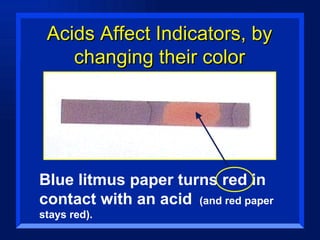
Acids Affect Indicators, by changing their color Blue litmus paper turns red in contact with an acid  (and red paper stays red).
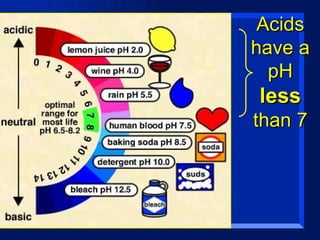
Acids have a pH  less   than 7
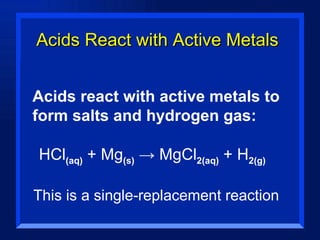
Acids React with Active Metals Acids react with active metals to form salts and hydrogen gas: HCl (aq)  + Mg (s)   -> MgCl 2(aq)  + H 2(g) This is a single-replacement reaction
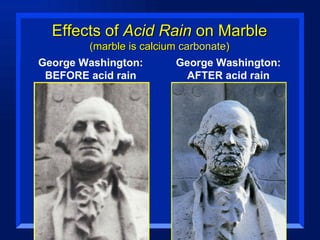
Effects of  Acid Rain  on Marble (marble is calcium  carbonate ) George Washington: BEFORE acid rain George Washington: AFTER acid rain
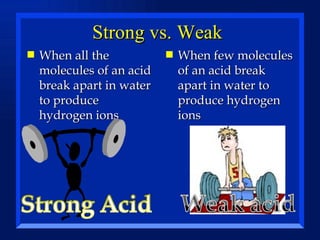
Strong vs. Weak When all the molecules of an acid break apart in water to produce hydrogen ions When few molecules of an acid break apart in water to produce hydrogen ions
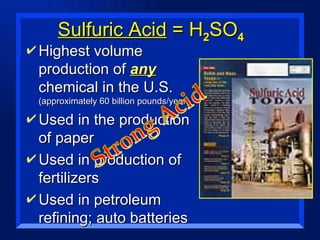
Sulfuric Acid  = H 2 SO 4 Highest volume production of  any  chemical in the U.S.  (approximately 60 billion pounds/year) Used in the production of paper Used in production of fertilizers Used in petroleum refining; auto batteries
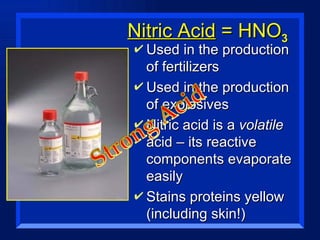
Nitric Acid  = HNO 3 Used in the production of fertilizers Used in the production of explosives Nitric acid is a  volatile  acid – its reactive components evaporate easily Stains proteins yellow (including skin!)
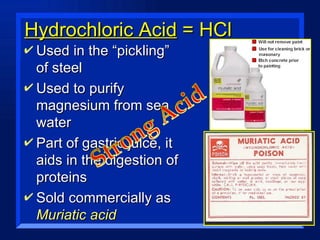
Hydrochloric Acid  = HCl Used in the “pickling” of steel Used to purify magnesium from sea water Part of gastric juice, it aids in the digestion of proteins Sold commercially as  Muriatic acid
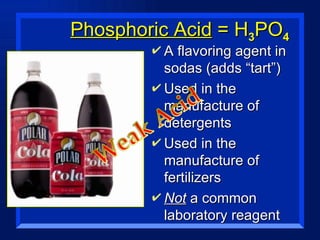
Phosphoric Acid  = H 3 PO 4 A flavoring agent in sodas (adds “tart”) Used in the manufacture of detergents Used in the manufacture of fertilizers Not  a common laboratory reagent
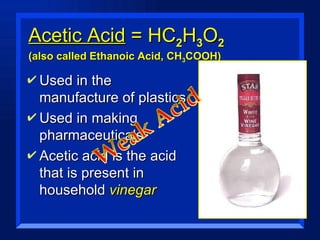
Acetic Acid  = HC 2 H 3 O 2  (also called Ethanoic Acid, CH 3 COOH) Used in the manufacture of plastics Used in making pharmaceuticals Acetic acid is the acid that is present in household  vinegar
Acids  Neutralize  Bases HCl + NaOH  ->  NaCl + H 2 O - Neutralization reactions ALWAYS produce a salt (which is an  ionic compound ) and water. -Of course, it takes the  right proportion  of acid and base to produce a neutral salt
Acid and Bases Can water dissociate(break apart)? H 2 O  H +   +  OH - High concentration of H +  ions indicate an acidic solution. High concentration of OH -  ion indicate a basic solution (also called alkaline)
Properties of Bases   (metallic hydroxides) React with acids  to form water and a salt. Taste  bitter . Feel slippery  (don’t try this either). Can be strong or weak  electrolytes  in aqueous solution Change the color  of indicators (red litmus turns blue).
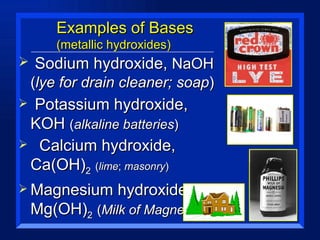
Examples of Bases (metallic hydroxides) Sodium hydroxide,  NaOH   ( lye for drain cleaner; soap ) Potassium hydroxide, KOH  ( alkaline batteries ) Calcium hydroxide, Ca(OH) 2   ( lime ;  masonry ) Magnesium hydroxide, Mg(OH) 2   ( Milk of Magnesia )
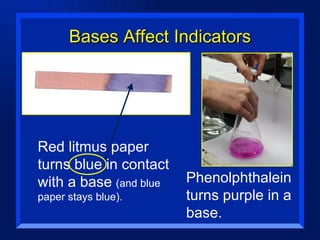
Bases Affect Indicators Red litmus paper turns blue in contact with a base  (and blue paper stays blue). Phenolphthalein turns purple in a base.
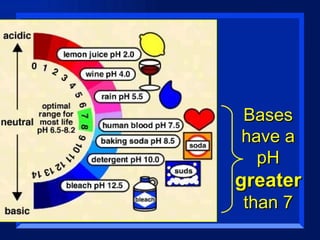
Bases have a pH  greater   than 7
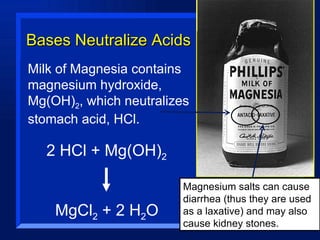
Bases Neutralize Acids Milk of Magnesia contains magnesium hydroxide, Mg(OH) 2 , which neutralizes stomach acid, HCl. 2 HCl + Mg(OH) 2 MgCl 2  + 2 H 2 O Magnesium salts can cause diarrhea (thus they are used as a laxative) and may also cause kidney stones.
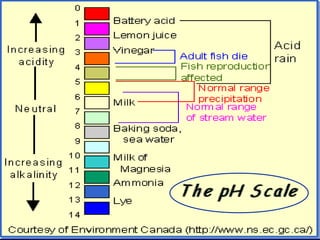
The pH concept – from 0 to 14 pH =  pouvoir hydrogene  (Fr.)      “hydrogen power” definition:  pH = -log[H + ] in  neutral  pH =  7 in  acidic  solution=< 7  pH  <  -log(10 -7 ) pH < 7  (from 0 to 7 is the acid range) in  base , pH > 7  (7 to 14 is base range)
 
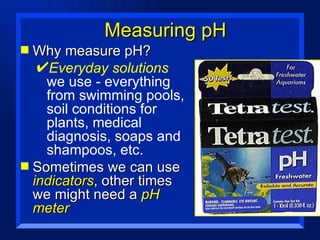
Measuring pH Why measure pH? Everyday solutions  we use - everything from swimming pools, soil conditions for plants, medical diagnosis, soaps and shampoos, etc. Sometimes we can use  indicators , other times we might need a  pH meter
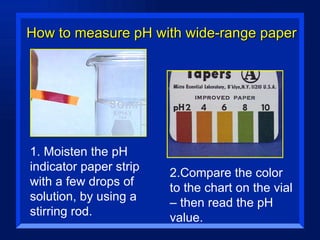
How to measure pH with wide-range paper 1. Moisten the pH indicator paper strip with a few drops of solution, by using a stirring rod. 2.Compare the color to the chart on the vial – then read the pH value.
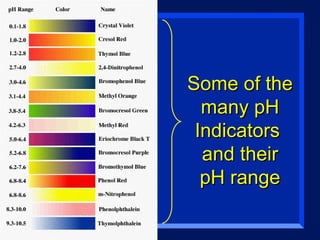
Some of the many pH Indicators  and their pH range
Acid-Base Indicators Although useful, there are  limitations   to indicators: usually given for a  certain temperature  (25  o C), thus may change at different temperatures what if the solution  already has a color , like paint? the  ability of the human eye  to distinguish colors is limited
Acid-Base Indicators A  pH meter  may give more definitive results some are  large , others portable works by measuring the  voltage  between two electrodes; typically accurate to within 0.01 pH unit of the true pH Instruments need to be  calibrated
Acid-Base Reactions Acid + Base    Water + Salt Properties related to every day: antacids depend on neutralization farmers adjust the soil pH human body kidney stones from insoluble salts
Salt A  salt  is an ionic compound that: comes from the  anion  of an acid comes from the  cation  of a base is formed from a neutralization reaction some neutral; others acidic or basic

Chapter 19 acids, bases, and salts probe

  • 1.
    Chapter 15.2 “Acids, Bases, and Salts ”
  • 2.
    Properties of AcidsThey taste sour (don’t try this at home). They can conduct electricity . Can be strong or weak electrolytes in aqueous solution React with metals to form H 2 gas. Change the color of indicators (for example: blue litmus turns to red). React with bases (metallic hydroxides) to form water and a salt.
  • 3.
    Properties of AcidsThey have a pH of less than 7 (more on this concept of pH in a later lesson) They react with carbonates and bicarbonates to produce a salt, water, and carbon dioxide gas How do you know if a chemical is an acid? It usually starts with Hydrogen. H Cl, H 2 SO 4 , H NO 3 , etc. (but not water!)
  • 4.
    Acids Affect Indicators,by changing their color Blue litmus paper turns red in contact with an acid (and red paper stays red).
  • 5.
    Acids have apH less than 7
  • 6.
    Acids React withActive Metals Acids react with active metals to form salts and hydrogen gas: HCl (aq) + Mg (s) -> MgCl 2(aq) + H 2(g) This is a single-replacement reaction
  • 7.
    Effects of Acid Rain on Marble (marble is calcium carbonate ) George Washington: BEFORE acid rain George Washington: AFTER acid rain
  • 8.
    Strong vs. WeakWhen all the molecules of an acid break apart in water to produce hydrogen ions When few molecules of an acid break apart in water to produce hydrogen ions
  • 9.
    Sulfuric Acid = H 2 SO 4 Highest volume production of any chemical in the U.S. (approximately 60 billion pounds/year) Used in the production of paper Used in production of fertilizers Used in petroleum refining; auto batteries
  • 10.
    Nitric Acid = HNO 3 Used in the production of fertilizers Used in the production of explosives Nitric acid is a volatile acid – its reactive components evaporate easily Stains proteins yellow (including skin!)
  • 11.
    Hydrochloric Acid = HCl Used in the “pickling” of steel Used to purify magnesium from sea water Part of gastric juice, it aids in the digestion of proteins Sold commercially as Muriatic acid
  • 12.
    Phosphoric Acid = H 3 PO 4 A flavoring agent in sodas (adds “tart”) Used in the manufacture of detergents Used in the manufacture of fertilizers Not a common laboratory reagent
  • 13.
    Acetic Acid = HC 2 H 3 O 2 (also called Ethanoic Acid, CH 3 COOH) Used in the manufacture of plastics Used in making pharmaceuticals Acetic acid is the acid that is present in household vinegar
  • 14.
    Acids Neutralize Bases HCl + NaOH -> NaCl + H 2 O - Neutralization reactions ALWAYS produce a salt (which is an ionic compound ) and water. -Of course, it takes the right proportion of acid and base to produce a neutral salt
  • 15.
    Acid and BasesCan water dissociate(break apart)? H 2 O H + + OH - High concentration of H + ions indicate an acidic solution. High concentration of OH - ion indicate a basic solution (also called alkaline)
  • 16.
    Properties of Bases (metallic hydroxides) React with acids to form water and a salt. Taste bitter . Feel slippery (don’t try this either). Can be strong or weak electrolytes in aqueous solution Change the color of indicators (red litmus turns blue).
  • 17.
    Examples of Bases(metallic hydroxides) Sodium hydroxide, NaOH ( lye for drain cleaner; soap ) Potassium hydroxide, KOH ( alkaline batteries ) Calcium hydroxide, Ca(OH) 2 ( lime ; masonry ) Magnesium hydroxide, Mg(OH) 2 ( Milk of Magnesia )
  • 18.
    Bases Affect IndicatorsRed litmus paper turns blue in contact with a base (and blue paper stays blue). Phenolphthalein turns purple in a base.
  • 19.
    Bases have apH greater than 7
  • 20.
    Bases Neutralize AcidsMilk of Magnesia contains magnesium hydroxide, Mg(OH) 2 , which neutralizes stomach acid, HCl. 2 HCl + Mg(OH) 2 MgCl 2 + 2 H 2 O Magnesium salts can cause diarrhea (thus they are used as a laxative) and may also cause kidney stones.
  • 21.
    The pH concept– from 0 to 14 pH = pouvoir hydrogene (Fr.) “hydrogen power” definition: pH = -log[H + ] in neutral pH = 7 in acidic solution=< 7 pH < -log(10 -7 ) pH < 7 (from 0 to 7 is the acid range) in base , pH > 7 (7 to 14 is base range)
  • 22.
  • 23.
    Measuring pH Whymeasure pH? Everyday solutions we use - everything from swimming pools, soil conditions for plants, medical diagnosis, soaps and shampoos, etc. Sometimes we can use indicators , other times we might need a pH meter
  • 24.
    How to measurepH with wide-range paper 1. Moisten the pH indicator paper strip with a few drops of solution, by using a stirring rod. 2.Compare the color to the chart on the vial – then read the pH value.
  • 25.
    Some of themany pH Indicators and their pH range
  • 26.
    Acid-Base Indicators Althoughuseful, there are limitations to indicators: usually given for a certain temperature (25 o C), thus may change at different temperatures what if the solution already has a color , like paint? the ability of the human eye to distinguish colors is limited
  • 27.
    Acid-Base Indicators A pH meter may give more definitive results some are large , others portable works by measuring the voltage between two electrodes; typically accurate to within 0.01 pH unit of the true pH Instruments need to be calibrated
  • 28.
    Acid-Base Reactions Acid+ Base  Water + Salt Properties related to every day: antacids depend on neutralization farmers adjust the soil pH human body kidney stones from insoluble salts
  • 29.
    Salt A salt is an ionic compound that: comes from the anion of an acid comes from the cation of a base is formed from a neutralization reaction some neutral; others acidic or basic