CHAPTER 2:
CARBON COMPOUNDS
A: CARBON COMPOUNDS
-are compounds that contain Carbon as one of
their constituent elements
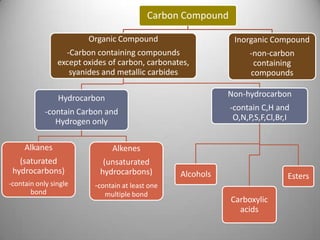
Carbon Compound
Organic Compound

Inorganic Compound

-Carbon containing compounds
except oxides of carbon, carbonates,
syanides and metallic carbides

-non-carbon
containing
compounds

Hydrocarbon

Non-hydrocarbon

-contain Carbon and
Hydrogen only

-contain C,H and
O,N,P,S,F,Cl,Br,I

Alkanes

Alkenes

(saturated
hydrocarbons)

(unsaturated
hydrocarbons)

-contain only single
bond

-contain at least one
multiple bond

Alcohols

Esters
Carboxylic
acids
Inorganic Carbon
compound

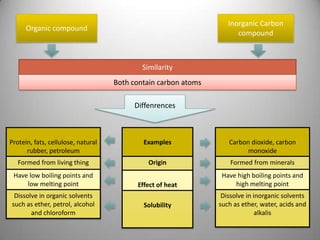
Organic compound

Similarity
Both contain carbon atoms
Diffenrences

Protein, fats, cellulose, natural
rubber, petroleum

Examples

Carbon dioxide, carbon
monoxide

Formed from living thing

Origin

Formed from minerals

Effect of heat

Have high boiling points and
high melting point

Have low boiling points and
low melting point
Dissolve in organic solvents
such as ether, petrol, alcohol
and chloroform

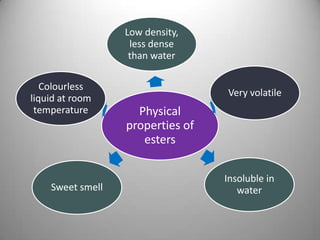
Solubility

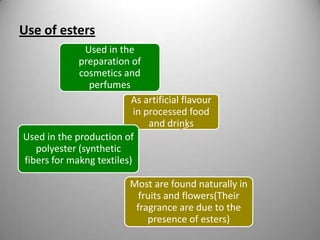
Dissolve in inorganic solvents
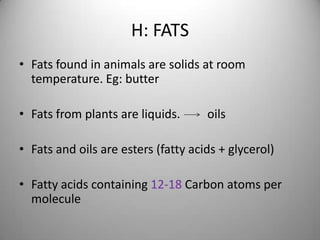
such as ether, water, acids and
alkalis
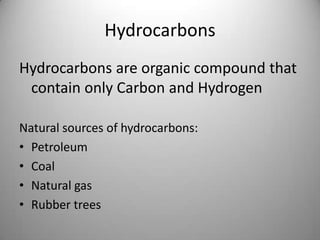
Hydrocarbons
Hydrocarbons are organic compound that
contain only Carbon and Hydrogen
Natural sources of hydrocarbons:
• Petroleum
• Coal
• Natural gas
• Rubber trees
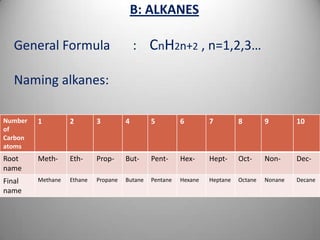
B: ALKANES
: CnH2n+2 , n=1,2,3…

General Formula
Naming alkanes:
Number
of
Carbon
atoms

1

2

3

4

5

6

7

8

9

10

Root
name

Meth-

Eth-

Prop-

But-

Pent-

Hex-

Hept-

Oct-

Non-

Dec-

Final
name

Methane

Ethane

Propane

Butane

Pentane

Hexane

Heptane

Octane

Nonane

Decane
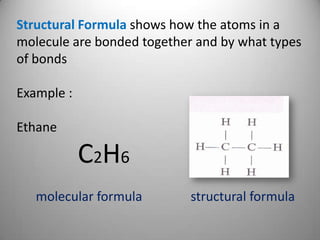
Structural Formula shows how the atoms in a
molecule are bonded together and by what types
of bonds
Example :
Ethane

C2H6
molecular formula

structural formula
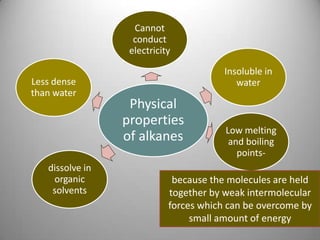
Cannot
conduct
electricity
Less dense
than water

dissolve in
organic
solvents

Insoluble in
water

Physical
properties
of alkanes

Low melting
and boiling
points-

because the molecules are held
together by weak intermolecular
forces which can be overcome by
small amount of energy
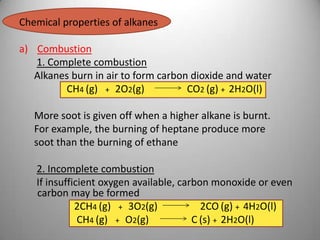
Chemical properties of alkanes
a) Combustion
1. Complete combustion
Alkanes burn in air to form carbon dioxide and water
CH4 (g) + 2O2(g)
CO2 (g) + 2H2O(l)
More soot is given off when a higher alkane is burnt.
For example, the burning of heptane produce more
soot than the burning of ethane
2. Incomplete combustion
If insufficient oxygen available, carbon monoxide or even
carbon may be formed
2CH4 (g) + 3O2(g)
2CO (g) + 4H2O(l)
CH4 (g) + O2(g)
C (s) + 2H2O(l)
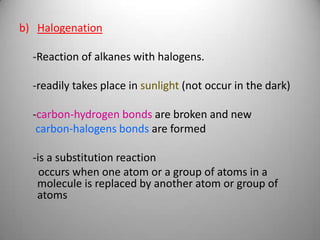
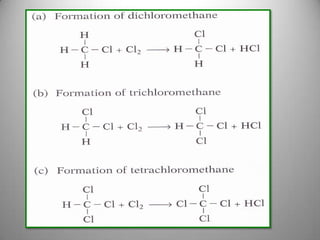
b) Halogenation
-Reaction of alkanes with halogens.

-readily takes place in sunlight (not occur in the dark)
-carbon-hydrogen bonds are broken and new
carbon-halogens bonds are formed
-is a substitution reaction
occurs when one atom or a group of atoms in a
molecule is replaced by another atom or group of
atoms
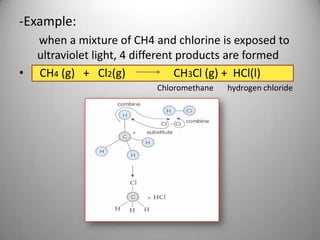
-Example:

•

when a mixture of CH4 and chlorine is exposed to
ultraviolet light, 4 different products are formed
CH4 (g) + Cl2(g)
CH3Cl (g) + HCl(l)
Chloromethane

hydrogen chloride
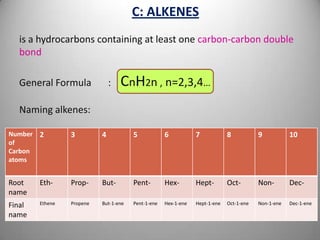
C: ALKENES
is a hydrocarbons containing at least one carbon-carbon double
bond
General Formula

:

CnH2n , n=2,3,4…

Naming alkenes:
Number 2
of
Carbon
atoms

3

4

5

6

7

8

9

10

Root
name

Eth-

Prop-

But-

Pent-

Hex-

Hept-

Oct-

Non-

Dec-

Final
name

Ethene

Propene

But-1-ene

Pent-1-ene

Hex-1-ene

Hept-1-ene

Oct-1-ene

Non-1-ene

Dec-1-ene
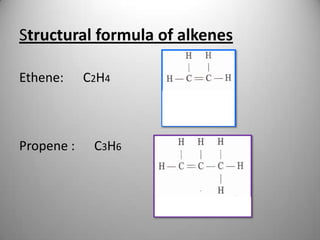
Structural formula of alkenes
Ethene:

Propene :

C2H4

C3H6
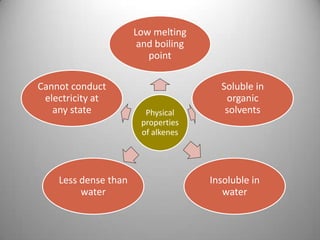
Low melting
and boiling
point
Cannot conduct
electricity at
any state

Less dense than
water

Physical
properties
of alkenes

Soluble in
organic
solvents

Insoluble in
water
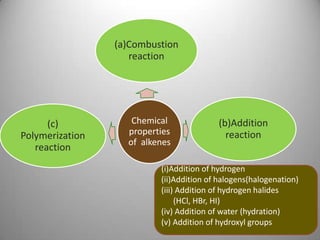
(a)Combustion
reaction

(c)
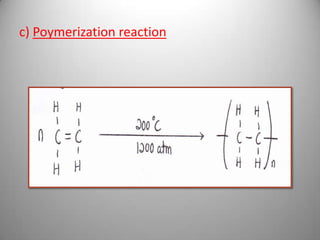
Polymerization
reaction

Chemical
properties
of alkenes

(b)Addition
reaction

(i)Addition of hydrogen
(ii)Addition of halogens(halogenation)
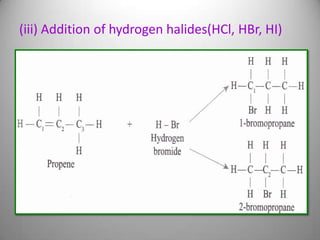
(iii) Addition of hydrogen halides
(HCl, HBr, HI)
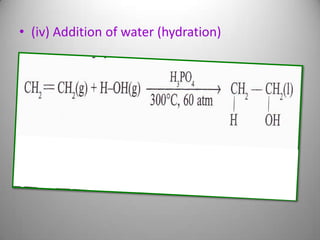
(iv) Addition of water (hydration)
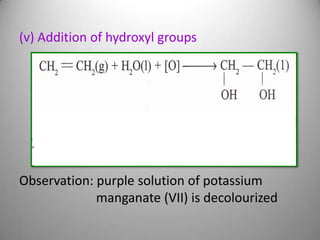
(v) Addition of hydroxyl groups
Chemical properties of alkenes

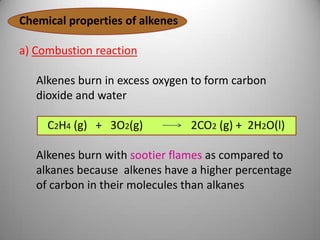
a) Combustion reaction
Alkenes burn in excess oxygen to form carbon
dioxide and water
C2H4 (g) + 3O2(g)

2CO2 (g) + 2H2O(l)

Alkenes burn with sootier flames as compared to
alkanes because alkenes have a higher percentage
of carbon in their molecules than alkanes
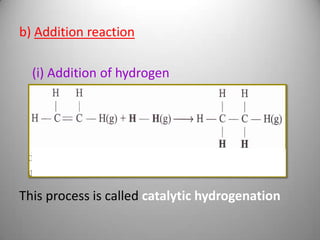
b) Addition reaction
(i) Addition of hydrogen

This process is called catalytic hydrogenation
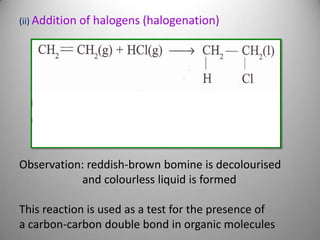
(ii) Addition of halogens (halogenation)

Observation: reddish-brown bomine is decolourised
and colourless liquid is formed
This reaction is used as a test for the presence of
a carbon-carbon double bond in organic molecules
(iii) Addition of hydrogen halides(HCl, HBr, HI)
• (iv) Addition of water (hydration)
(v) Addition of hydroxyl groups

Observation: purple solution of potassium
manganate (VII) is decolourized
c) Poymerization reaction
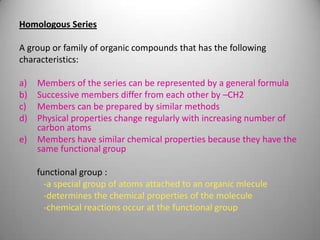
Homologous Series
A group or family of organic compounds that has the following
characteristics:

a)
b)
c)
d)
e)

Members of the series can be represented by a general formula
Successive members differ from each other by –CH2
Members can be prepared by similar methods
Physical properties change regularly with increasing number of
carbon atoms
Members have similar chemical properties because they have the
same functional group
functional group :
-a special group of atoms attached to an organic mlecule
-determines the chemical properties of the molecule
-chemical reactions occur at the functional group
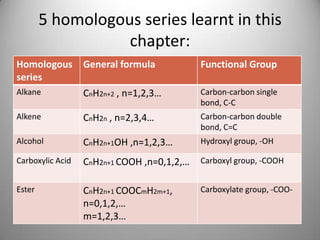
5 homologous series learnt in this
chapter:
Homologous
series

General formula

Functional Group

Alkane

CnH2n+2 , n=1,2,3…

Carbon-carbon single
bond, C-C

Alkene

CnH2n , n=2,3,4…

Carbon-carbon double
bond, C=C

Alcohol

CnH2n+1OH ,n=1,2,3…

Hydroxyl group, -OH

Carboxylic Acid

CnH2n+1 COOH ,n=0,1,2,…

Carboxyl group, -COOH

Ester

CnH2n+1 COOCmH2m+1,
n=0,1,2,…
m=1,2,3…

Carboxylate group, -COO-
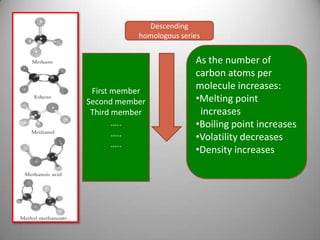
Descending
homologous series

First member
Second member
Third member
…..
…..
…..

As the number of
carbon atoms per
molecule increases:
•Melting point
increases
•Boiling point increases
•Volatility decreases
•Density increases
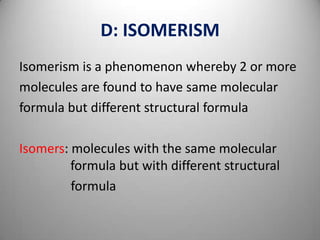
D: ISOMERISM
Isomerism is a phenomenon whereby 2 or more
molecules are found to have same molecular
formula but different structural formula
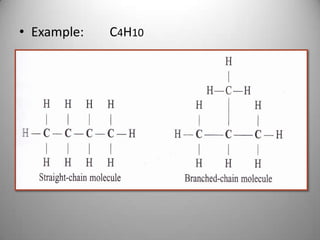
Isomers: molecules with the same molecular
formula but with different structural
formula
• Example:

C4H10
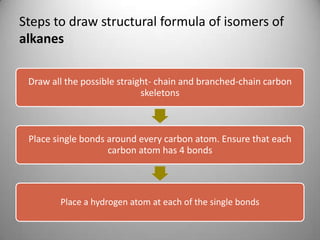
Steps to draw structural formula of isomers of
alkanes
Draw all the possible straight- chain and branched-chain carbon
skeletons

Place single bonds around every carbon atom. Ensure that each
carbon atom has 4 bonds

Place a hydrogen atom at each of the single bonds
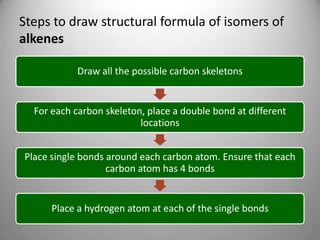
Steps to draw structural formula of isomers of
alkenes
Draw all the possible carbon skeletons

For each carbon skeleton, place a double bond at different
locations
Place single bonds around each carbon atom. Ensure that each
carbon atom has 4 bonds

Place a hydrogen atom at each of the single bonds
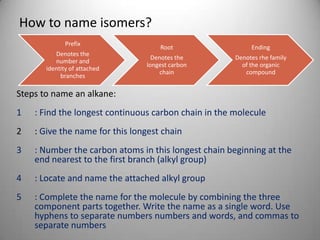
How to name isomers?
Prefix
Denotes the
number and
identity of attached
branches

Root

Ending

Denotes the
longest carbon
chain

Denotes rhe family
of the organic
compound

Steps to name an alkane:
1

: Find the longest continuous carbon chain in the molecule

2

: Give the name for this longest chain

3

: Number the carbon atoms in this longest chain beginning at the
end nearest to the first branch (alkyl group)

4

: Locate and name the attached alkyl group

5

: Complete the name for the molecule by combining the three
component parts together. Write the name as a single word. Use
hyphens to separate numbers numbers and words, and commas to
separate numbers
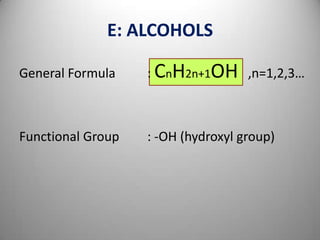
E: ALCOHOLS
General Formula

: CnH2n+1OH ,n=1,2,3…

Functional Group

: -OH (hydroxyl group)
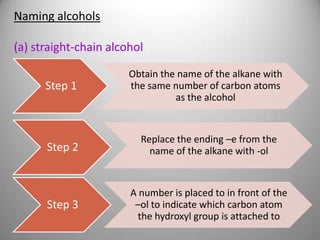
Naming alcohols
(a) straight-chain alcohol
Step 1

Obtain the name of the alkane with
the same number of carbon atoms
as the alcohol

Step 2

Replace the ending –e from the
name of the alkane with -ol

Step 3

A number is placed to in front of the
–ol to indicate which carbon atom
the hydroxyl group is attached to
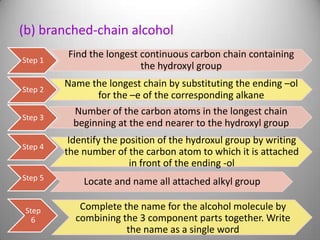
(b) branched-chain alcohol
Step 1

Find the longest continuous carbon chain containing
the hydroxyl group

Step 2

Name the longest chain by substituting the ending –ol
for the –e of the corresponding alkane

Step 3

Number of the carbon atoms in the longest chain
beginning at the end nearer to the hydroxyl group

Step 4

Step 5

Step
6

Identify the position of the hydroxul group by writing
the number of the carbon atom to which it is attached
in front of the ending -ol
Locate and name all attached alkyl group
Complete the name for the alcohol molecule by
combining the 3 component parts together. Write
the name as a single word
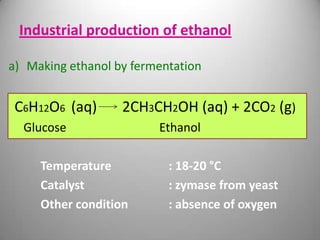
Industrial production of ethanol
a) Making ethanol by fermentation

C6H12O6 (aq)

2CH3CH2OH (aq) + 2CO2 (g)

Glucose
Temperature
Catalyst
Other condition

Ethanol
: 18-20 °C
: zymase from yeast
: absence of oxygen
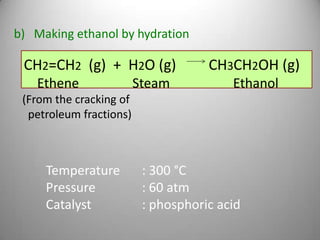
b) Making ethanol by hydration

CH2=CH2 (g) + H2O (g)
Ethene

Steam

CH3CH2OH (g)
Ethanol

(From the cracking of
petroleum fractions)

Temperature
Pressure
Catalyst

: 300 °C
: 60 atm
: phosphoric acid
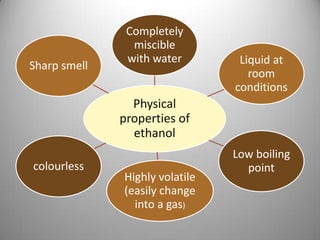
Sharp smell

Completely
miscible
with water

Liquid at
room
conditions

Physical
properties of
ethanol
colourless

Highly volatile
(easily change
into a gas)

Low boiling
point
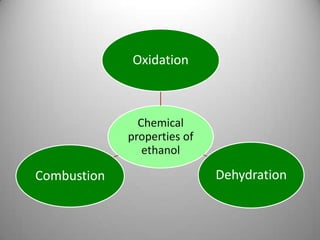
Oxidation

Chemical
properties of
ethanol

Combustion

Dehydration
Chemical properties of ethanol
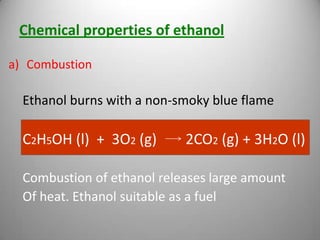
a) Combustion

Ethanol burns with a non-smoky blue flame

C2H5OH (l) + 3O2 (g)

2CO2 (g) + 3H2O (l)

Combustion of ethanol releases large amount
Of heat. Ethanol suitable as a fuel
b) Oxidation

CH3CH2OH (l) + 2[O]

CH3COOH (l) + H2O (l)
ethanoic acid

oxidising agent: acidified potassium dichromate (VI) solution
( colour change from orange to green)
acidified potassium manganate (VII) solution
( colour change from purple to colourless)
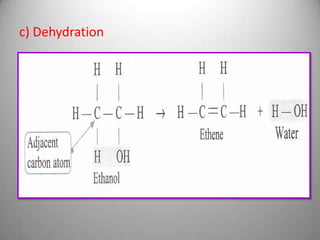
c) Dehydration
txt bk pg 64
module pg 72
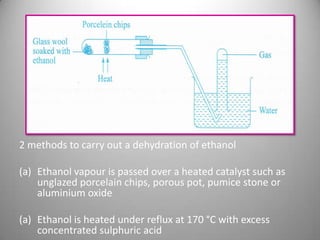
2 methods to carry out a dehydration of ethanol
(a) Ethanol vapour is passed over a heated catalyst such as
unglazed porcelain chips, porous pot, pumice stone or
aluminium oxide
(a) Ethanol is heated under reflux at 170 °C with excess
concentrated sulphuric acid
Uses of alcohols
(a) As a solvent

(a) as a fuel

-perfumes, cosmetics
-thinners for lacquers, varnishers

- a mixture of petrolwith 10-20 % ethanol (gasohol)
- methanol (as a fuel for racing cars)

(a) As a source of chemicals
- as a raw material in the manufacture of
polymers, fibres, explosives and plastics
- ethanol
ethanoic acid (vinegar)
(a) As a source of medicinal products
- ethanol- as a solvent in the preparation of
cough syrups
- propan-2-ol –as a rubbing alcohol (bring down high
fever)
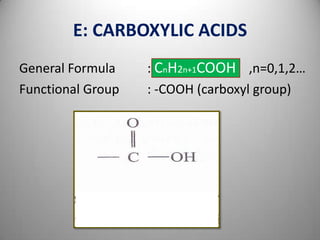
E: CARBOXYLIC ACIDS
General Formula
Functional Group

: CnH2n+1COOH ,n=0,1,2…
: -COOH (carboxyl group)
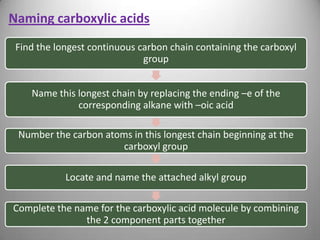
Naming carboxylic acids
Find the longest continuous carbon chain containing the carboxyl
group
Name this longest chain by replacing the ending –e of the
corresponding alkane with –oic acid
Number the carbon atoms in this longest chain beginning at the
carboxyl group
Locate and name the attached alkyl group
Complete the name for the carboxylic acid molecule by combining
the 2 component parts together
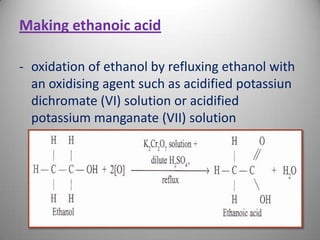
Making ethanoic acid
- oxidation of ethanol by refluxing ethanol with
an oxidising agent such as acidified potassiun
dichromate (VI) solution or acidified
potassium manganate (VII) solution
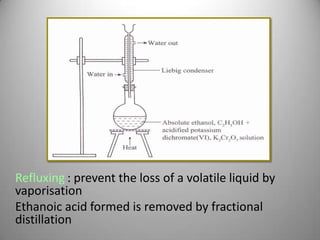
Refluxing : prevent the loss of a volatile liquid by
vaporisation
Ethanoic acid formed is removed by fractional
distillation
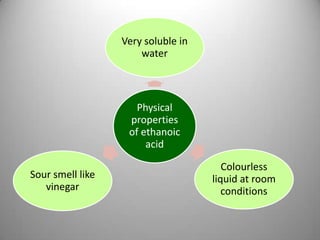
Very soluble in
water

Physical
properties
of ethanoic
acid
Sour smell like
vinegar

Colourless
liquid at room
conditions
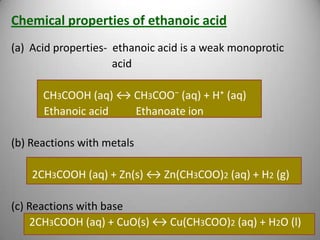
Chemical properties of ethanoic acid
(a) Acid properties- ethanoic acid is a weak monoprotic
acid
CH3COOH (aq) ↔ CH3COO⁻ (aq) + H⁺ (aq)
Ethanoic acid
Ethanoate ion

(b) Reactions with metals
2CH3COOH (aq) + Zn(s) ↔ Zn(CH3COO)2 (aq) + H2 (g)
(c) Reactions with base
2CH3COOH (aq) + CuO(s) ↔ Cu(CH3COO)2 (aq) + H2O (l)
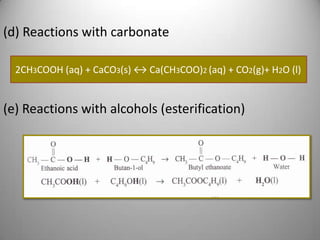
(d) Reactions with carbonate
2CH3COOH (aq) + CaCO3(s) ↔ Ca(CH3COO)2 (aq) + CO2(g)+ H2O (l)

(e) Reactions with alcohols (esterification)
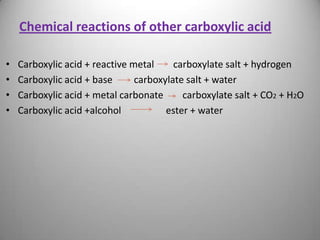
Chemical reactions of other carboxylic acid
•
•
•
•

Carboxylic acid + reactive metal
carboxylate salt + hydrogen
Carboxylic acid + base
carboxylate salt + water
Carboxylic acid + metal carbonate
carboxylate salt + CO2 + H2O
Carboxylic acid +alcohol
ester + water
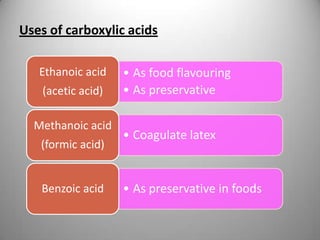
Uses of carboxylic acids
Ethanoic acid
(acetic acid)
Methanoic acid
(formic acid)

Benzoic acid

• As food flavouring
• As preservative
• Coagulate latex

• As preservative in foods
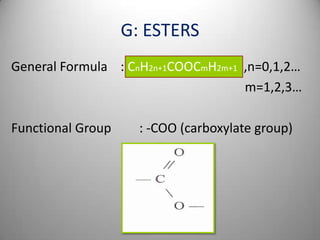
G: ESTERS
General Formula : CnH2n+1COOCmH2m+1 ,n=0,1,2…
m=1,2,3…
Functional Group

: -COO (carboxylate group)
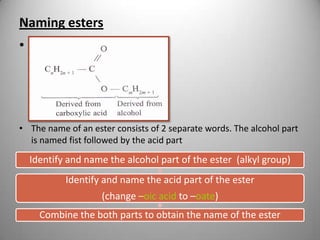
Naming esters
• pg 77

• The name of an ester consists of 2 separate words. The alcohol part
is named fist followed by the acid part

Identify and name the alcohol part of the ester (alkyl group)

Identify and name the acid part of the ester
(change –oic acid to –oate)
Combine the both parts to obtain the name of the ester
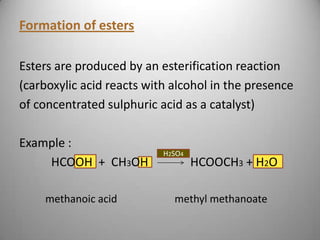
Formation of esters
Esters are produced by an esterification reaction
(carboxylic acid reacts with alcohol in the presence
of concentrated sulphuric acid as a catalyst)

Example :
HCOOH + CH3OH
methanoic acid

H2SO4

HCOOCH3 + H2O

methyl methanoate
Low density,
less dense
than water
Colourless
liquid at room
temperature

Sweet smell

Very volatile

Physical
properties of
esters
Insoluble in
water
Use of esters
Used in the
preparation of
cosmetics and
perfumes
As artificial flavour
in processed food
and drinks
Used in the production of
polyester (synthetic
fibers for makng textiles)
Most are found naturally in
fruits and flowers(Their
fragrance are due to the
presence of esters)
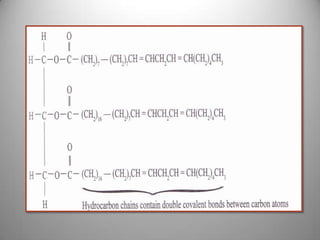
H: FATS
• Fats found in animals are solids at room
temperature. Eg: butter
• Fats from plants are liquids.

oils

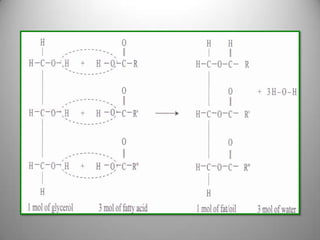
• Fats and oils are esters (fatty acids + glycerol)
• Fatty acids containing 12-18 Carbon atoms per
molecule
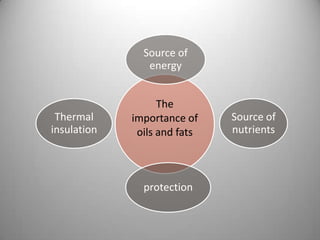
Source of
energy

Thermal
insulation

The
importance of
oils and fats

protection

Source of
nutrients
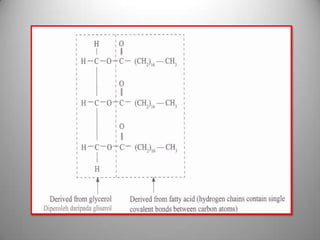
Saturated and unsaturated fats
Saturated fats

• Fats which contain esters of glycerols and saturated
fatty acids
• saturated fatty acids :
has all carbon atoms joined together by
carbon-carbon single bond
Unsaturated fats

• Fats which contain esters of glycerols and
unsaturated fatty acids
• Unsaturated fatty acids:
carbon chain has one or more carboncarbon double bond
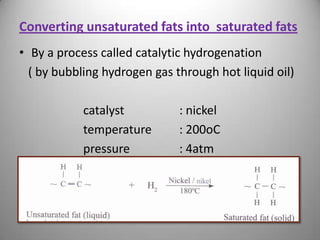
Converting unsaturated fats into saturated fats
• By a process called catalytic hydrogenation
( by bubbling hydrogen gas through hot liquid oil)
catalyst
temperature
pressure
Module 88

: nickel
: 200oC
: 4atm
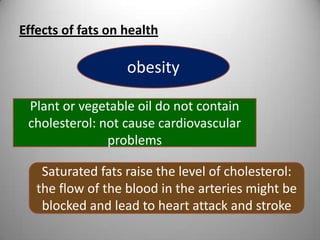
Effects of fats on health

obesity
Plant or vegetable oil do not contain
cholesterol: not cause cardiovascular
problems
Saturated fats raise the level of cholesterol:
the flow of the blood in the arteries might be
blocked and lead to heart attack and stroke
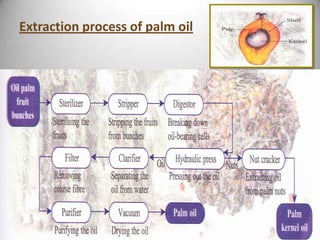
Extraction process of palm oil
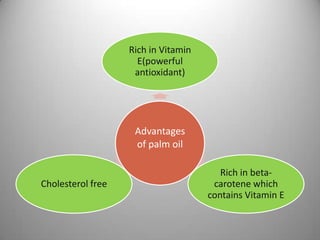
Rich in Vitamin
E(powerful
antioxidant)

Advantages
of palm oil

Cholesterol free

Rich in betacarotene which
contains Vitamin E
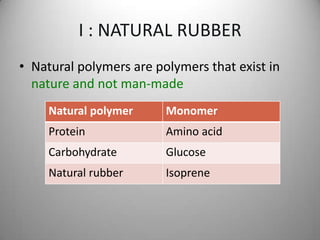
I : NATURAL RUBBER
• Natural polymers are polymers that exist in
nature and not man-made
Natural polymer

Monomer

Protein

Amino acid

Carbohydrate

Glucose

Natural rubber

Isoprene
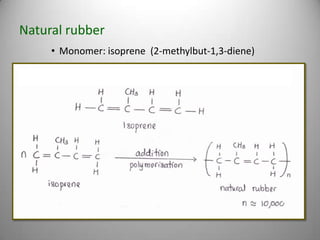
Natural rubber
• Monomer: isoprene (2-methylbut-1,3-diene)

• Nota pg 38
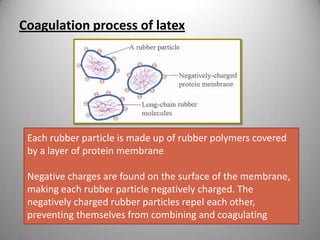
Coagulation process of latex

Each rubber particle is made up of rubber polymers covered
by a layer of protein membrane
Negative charges are found on the surface of the membrane,
making each rubber particle negatively charged. The
negatively charged rubber particles repel each other,
preventing themselves from combining and coagulating
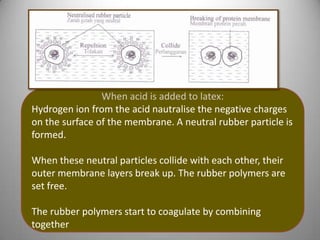
When acid is added to latex:
Hydrogen ion from the acid nautralise the negative charges
on the surface of the membrane. A neutral rubber particle is
formed.
When these neutral particles collide with each other, their
outer membrane layers break up. The rubber polymers are
set free.
The rubber polymers start to coagulate by combining
together
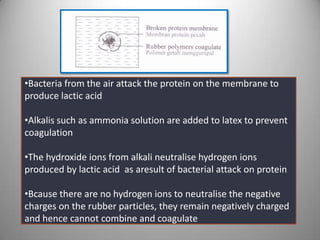
•Bacteria from the air attack the protein on the membrane to
produce lactic acid
•Alkalis such as ammonia solution are added to latex to prevent
coagulation
•The hydroxide ions from alkali neutralise hydrogen ions
produced by lactic acid as aresult of bacterial attack on protein

•Bcause there are no hydrogen ions to neutralise the negative
charges on the rubber particles, they remain negatively charged
and hence cannot combine and coagulate
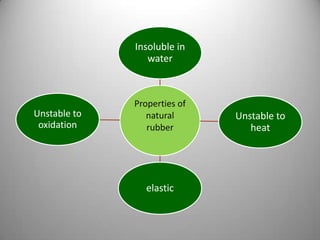
Insoluble in
water

Unstable to
oxidation

Properties of
natural
rubber

elastic

Unstable to
heat
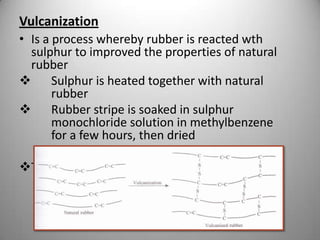
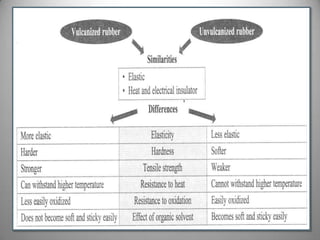
Vulcanization
• Is a process whereby rubber is reacted wth
sulphur to improved the properties of natural
rubber

Sulphur is heated together with natural
rubber

Rubber stripe is soaked in sulphur
monochloride solution in methylbenzene
for a few hours, then dried
Txt bk 95
Chapter 2  carbon compound notes

Chapter 2 carbon compound notes

  • 1.
  • 2.
    A: CARBON COMPOUNDS -arecompounds that contain Carbon as one of their constituent elements
  • 3.
    Carbon Compound Organic Compound InorganicCompound -Carbon containing compounds except oxides of carbon, carbonates, syanides and metallic carbides -non-carbon containing compounds Hydrocarbon Non-hydrocarbon -contain Carbon and Hydrogen only -contain C,H and O,N,P,S,F,Cl,Br,I Alkanes Alkenes (saturated hydrocarbons) (unsaturated hydrocarbons) -contain only single bond -contain at least one multiple bond Alcohols Esters Carboxylic acids
  • 4.
    Inorganic Carbon compound Organic compound Similarity Bothcontain carbon atoms Diffenrences Protein, fats, cellulose, natural rubber, petroleum Examples Carbon dioxide, carbon monoxide Formed from living thing Origin Formed from minerals Effect of heat Have high boiling points and high melting point Have low boiling points and low melting point Dissolve in organic solvents such as ether, petrol, alcohol and chloroform Solubility Dissolve in inorganic solvents such as ether, water, acids and alkalis
  • 5.
    Hydrocarbons Hydrocarbons are organiccompound that contain only Carbon and Hydrogen Natural sources of hydrocarbons: • Petroleum • Coal • Natural gas • Rubber trees
  • 6.
    B: ALKANES : CnH2n+2, n=1,2,3… General Formula Naming alkanes: Number of Carbon atoms 1 2 3 4 5 6 7 8 9 10 Root name Meth- Eth- Prop- But- Pent- Hex- Hept- Oct- Non- Dec- Final name Methane Ethane Propane Butane Pentane Hexane Heptane Octane Nonane Decane
  • 7.
    Structural Formula showshow the atoms in a molecule are bonded together and by what types of bonds Example : Ethane C2H6 molecular formula structural formula
  • 8.
    Cannot conduct electricity Less dense than water dissolvein organic solvents Insoluble in water Physical properties of alkanes Low melting and boiling points- because the molecules are held together by weak intermolecular forces which can be overcome by small amount of energy
  • 9.
    Chemical properties ofalkanes a) Combustion 1. Complete combustion Alkanes burn in air to form carbon dioxide and water CH4 (g) + 2O2(g) CO2 (g) + 2H2O(l) More soot is given off when a higher alkane is burnt. For example, the burning of heptane produce more soot than the burning of ethane 2. Incomplete combustion If insufficient oxygen available, carbon monoxide or even carbon may be formed 2CH4 (g) + 3O2(g) 2CO (g) + 4H2O(l) CH4 (g) + O2(g) C (s) + 2H2O(l)
  • 10.
    b) Halogenation -Reaction ofalkanes with halogens. -readily takes place in sunlight (not occur in the dark) -carbon-hydrogen bonds are broken and new carbon-halogens bonds are formed -is a substitution reaction occurs when one atom or a group of atoms in a molecule is replaced by another atom or group of atoms
  • 11.
    -Example: • when a mixtureof CH4 and chlorine is exposed to ultraviolet light, 4 different products are formed CH4 (g) + Cl2(g) CH3Cl (g) + HCl(l) Chloromethane hydrogen chloride
  • 13.
    C: ALKENES is ahydrocarbons containing at least one carbon-carbon double bond General Formula : CnH2n , n=2,3,4… Naming alkenes: Number 2 of Carbon atoms 3 4 5 6 7 8 9 10 Root name Eth- Prop- But- Pent- Hex- Hept- Oct- Non- Dec- Final name Ethene Propene But-1-ene Pent-1-ene Hex-1-ene Hept-1-ene Oct-1-ene Non-1-ene Dec-1-ene
  • 14.
    Structural formula ofalkenes Ethene: Propene : C2H4 C3H6
  • 15.
    Low melting and boiling point Cannotconduct electricity at any state Less dense than water Physical properties of alkenes Soluble in organic solvents Insoluble in water
  • 16.
    (a)Combustion reaction (c) Polymerization reaction Chemical properties of alkenes (b)Addition reaction (i)Addition ofhydrogen (ii)Addition of halogens(halogenation) (iii) Addition of hydrogen halides (HCl, HBr, HI) (iv) Addition of water (hydration) (v) Addition of hydroxyl groups
  • 17.
    Chemical properties ofalkenes a) Combustion reaction Alkenes burn in excess oxygen to form carbon dioxide and water C2H4 (g) + 3O2(g) 2CO2 (g) + 2H2O(l) Alkenes burn with sootier flames as compared to alkanes because alkenes have a higher percentage of carbon in their molecules than alkanes
  • 18.
    b) Addition reaction (i)Addition of hydrogen This process is called catalytic hydrogenation
  • 19.
    (ii) Addition ofhalogens (halogenation) Observation: reddish-brown bomine is decolourised and colourless liquid is formed This reaction is used as a test for the presence of a carbon-carbon double bond in organic molecules
  • 20.
    (iii) Addition ofhydrogen halides(HCl, HBr, HI)
  • 21.
    • (iv) Additionof water (hydration)
  • 22.
    (v) Addition ofhydroxyl groups Observation: purple solution of potassium manganate (VII) is decolourized
  • 23.
  • 24.
    Homologous Series A groupor family of organic compounds that has the following characteristics: a) b) c) d) e) Members of the series can be represented by a general formula Successive members differ from each other by –CH2 Members can be prepared by similar methods Physical properties change regularly with increasing number of carbon atoms Members have similar chemical properties because they have the same functional group functional group : -a special group of atoms attached to an organic mlecule -determines the chemical properties of the molecule -chemical reactions occur at the functional group
  • 25.
    5 homologous serieslearnt in this chapter: Homologous series General formula Functional Group Alkane CnH2n+2 , n=1,2,3… Carbon-carbon single bond, C-C Alkene CnH2n , n=2,3,4… Carbon-carbon double bond, C=C Alcohol CnH2n+1OH ,n=1,2,3… Hydroxyl group, -OH Carboxylic Acid CnH2n+1 COOH ,n=0,1,2,… Carboxyl group, -COOH Ester CnH2n+1 COOCmH2m+1, n=0,1,2,… m=1,2,3… Carboxylate group, -COO-
  • 26.
    Descending homologous series First member Secondmember Third member ….. ….. ….. As the number of carbon atoms per molecule increases: •Melting point increases •Boiling point increases •Volatility decreases •Density increases
  • 27.
    D: ISOMERISM Isomerism isa phenomenon whereby 2 or more molecules are found to have same molecular formula but different structural formula Isomers: molecules with the same molecular formula but with different structural formula
  • 28.
  • 29.
    Steps to drawstructural formula of isomers of alkanes Draw all the possible straight- chain and branched-chain carbon skeletons Place single bonds around every carbon atom. Ensure that each carbon atom has 4 bonds Place a hydrogen atom at each of the single bonds
  • 30.
    Steps to drawstructural formula of isomers of alkenes Draw all the possible carbon skeletons For each carbon skeleton, place a double bond at different locations Place single bonds around each carbon atom. Ensure that each carbon atom has 4 bonds Place a hydrogen atom at each of the single bonds
  • 31.
    How to nameisomers? Prefix Denotes the number and identity of attached branches Root Ending Denotes the longest carbon chain Denotes rhe family of the organic compound Steps to name an alkane: 1 : Find the longest continuous carbon chain in the molecule 2 : Give the name for this longest chain 3 : Number the carbon atoms in this longest chain beginning at the end nearest to the first branch (alkyl group) 4 : Locate and name the attached alkyl group 5 : Complete the name for the molecule by combining the three component parts together. Write the name as a single word. Use hyphens to separate numbers numbers and words, and commas to separate numbers
  • 32.
    E: ALCOHOLS General Formula :CnH2n+1OH ,n=1,2,3… Functional Group : -OH (hydroxyl group)
  • 33.
    Naming alcohols (a) straight-chainalcohol Step 1 Obtain the name of the alkane with the same number of carbon atoms as the alcohol Step 2 Replace the ending –e from the name of the alkane with -ol Step 3 A number is placed to in front of the –ol to indicate which carbon atom the hydroxyl group is attached to
  • 34.
    (b) branched-chain alcohol Step1 Find the longest continuous carbon chain containing the hydroxyl group Step 2 Name the longest chain by substituting the ending –ol for the –e of the corresponding alkane Step 3 Number of the carbon atoms in the longest chain beginning at the end nearer to the hydroxyl group Step 4 Step 5 Step 6 Identify the position of the hydroxul group by writing the number of the carbon atom to which it is attached in front of the ending -ol Locate and name all attached alkyl group Complete the name for the alcohol molecule by combining the 3 component parts together. Write the name as a single word
  • 35.
    Industrial production ofethanol a) Making ethanol by fermentation C6H12O6 (aq) 2CH3CH2OH (aq) + 2CO2 (g) Glucose Temperature Catalyst Other condition Ethanol : 18-20 °C : zymase from yeast : absence of oxygen
  • 36.
    b) Making ethanolby hydration CH2=CH2 (g) + H2O (g) Ethene Steam CH3CH2OH (g) Ethanol (From the cracking of petroleum fractions) Temperature Pressure Catalyst : 300 °C : 60 atm : phosphoric acid
  • 37.
    Sharp smell Completely miscible with water Liquidat room conditions Physical properties of ethanol colourless Highly volatile (easily change into a gas) Low boiling point
  • 38.
  • 39.
    Chemical properties ofethanol a) Combustion Ethanol burns with a non-smoky blue flame C2H5OH (l) + 3O2 (g) 2CO2 (g) + 3H2O (l) Combustion of ethanol releases large amount Of heat. Ethanol suitable as a fuel
  • 40.
    b) Oxidation CH3CH2OH (l)+ 2[O] CH3COOH (l) + H2O (l) ethanoic acid oxidising agent: acidified potassium dichromate (VI) solution ( colour change from orange to green) acidified potassium manganate (VII) solution ( colour change from purple to colourless)
  • 41.
    c) Dehydration txt bkpg 64 module pg 72
  • 42.
    2 methods tocarry out a dehydration of ethanol (a) Ethanol vapour is passed over a heated catalyst such as unglazed porcelain chips, porous pot, pumice stone or aluminium oxide (a) Ethanol is heated under reflux at 170 °C with excess concentrated sulphuric acid
  • 43.
    Uses of alcohols (a)As a solvent (a) as a fuel -perfumes, cosmetics -thinners for lacquers, varnishers - a mixture of petrolwith 10-20 % ethanol (gasohol) - methanol (as a fuel for racing cars) (a) As a source of chemicals - as a raw material in the manufacture of polymers, fibres, explosives and plastics - ethanol ethanoic acid (vinegar) (a) As a source of medicinal products - ethanol- as a solvent in the preparation of cough syrups - propan-2-ol –as a rubbing alcohol (bring down high fever)
  • 44.
    E: CARBOXYLIC ACIDS GeneralFormula Functional Group : CnH2n+1COOH ,n=0,1,2… : -COOH (carboxyl group)
  • 45.
    Naming carboxylic acids Findthe longest continuous carbon chain containing the carboxyl group Name this longest chain by replacing the ending –e of the corresponding alkane with –oic acid Number the carbon atoms in this longest chain beginning at the carboxyl group Locate and name the attached alkyl group Complete the name for the carboxylic acid molecule by combining the 2 component parts together
  • 46.
    Making ethanoic acid -oxidation of ethanol by refluxing ethanol with an oxidising agent such as acidified potassiun dichromate (VI) solution or acidified potassium manganate (VII) solution
  • 47.
    Refluxing : preventthe loss of a volatile liquid by vaporisation Ethanoic acid formed is removed by fractional distillation
  • 48.
    Very soluble in water Physical properties ofethanoic acid Sour smell like vinegar Colourless liquid at room conditions
  • 49.
    Chemical properties ofethanoic acid (a) Acid properties- ethanoic acid is a weak monoprotic acid CH3COOH (aq) ↔ CH3COO⁻ (aq) + H⁺ (aq) Ethanoic acid Ethanoate ion (b) Reactions with metals 2CH3COOH (aq) + Zn(s) ↔ Zn(CH3COO)2 (aq) + H2 (g) (c) Reactions with base 2CH3COOH (aq) + CuO(s) ↔ Cu(CH3COO)2 (aq) + H2O (l)
  • 50.
    (d) Reactions withcarbonate 2CH3COOH (aq) + CaCO3(s) ↔ Ca(CH3COO)2 (aq) + CO2(g)+ H2O (l) (e) Reactions with alcohols (esterification)
  • 51.
    Chemical reactions ofother carboxylic acid • • • • Carboxylic acid + reactive metal carboxylate salt + hydrogen Carboxylic acid + base carboxylate salt + water Carboxylic acid + metal carbonate carboxylate salt + CO2 + H2O Carboxylic acid +alcohol ester + water
  • 52.
    Uses of carboxylicacids Ethanoic acid (acetic acid) Methanoic acid (formic acid) Benzoic acid • As food flavouring • As preservative • Coagulate latex • As preservative in foods
  • 53.
    G: ESTERS General Formula: CnH2n+1COOCmH2m+1 ,n=0,1,2… m=1,2,3… Functional Group : -COO (carboxylate group)
  • 54.
    Naming esters • pg77 • The name of an ester consists of 2 separate words. The alcohol part is named fist followed by the acid part Identify and name the alcohol part of the ester (alkyl group) Identify and name the acid part of the ester (change –oic acid to –oate) Combine the both parts to obtain the name of the ester
  • 55.
    Formation of esters Estersare produced by an esterification reaction (carboxylic acid reacts with alcohol in the presence of concentrated sulphuric acid as a catalyst) Example : HCOOH + CH3OH methanoic acid H2SO4 HCOOCH3 + H2O methyl methanoate
  • 56.
    Low density, less dense thanwater Colourless liquid at room temperature Sweet smell Very volatile Physical properties of esters Insoluble in water
  • 57.
    Use of esters Usedin the preparation of cosmetics and perfumes As artificial flavour in processed food and drinks Used in the production of polyester (synthetic fibers for makng textiles) Most are found naturally in fruits and flowers(Their fragrance are due to the presence of esters)
  • 58.
    H: FATS • Fatsfound in animals are solids at room temperature. Eg: butter • Fats from plants are liquids. oils • Fats and oils are esters (fatty acids + glycerol) • Fatty acids containing 12-18 Carbon atoms per molecule
  • 60.
    Source of energy Thermal insulation The importance of oilsand fats protection Source of nutrients
  • 61.
    Saturated and unsaturatedfats Saturated fats • Fats which contain esters of glycerols and saturated fatty acids • saturated fatty acids : has all carbon atoms joined together by carbon-carbon single bond
  • 63.
    Unsaturated fats • Fatswhich contain esters of glycerols and unsaturated fatty acids • Unsaturated fatty acids: carbon chain has one or more carboncarbon double bond
  • 65.
    Converting unsaturated fatsinto saturated fats • By a process called catalytic hydrogenation ( by bubbling hydrogen gas through hot liquid oil) catalyst temperature pressure Module 88 : nickel : 200oC : 4atm
  • 66.
    Effects of fatson health obesity Plant or vegetable oil do not contain cholesterol: not cause cardiovascular problems Saturated fats raise the level of cholesterol: the flow of the blood in the arteries might be blocked and lead to heart attack and stroke
  • 67.
  • 68.
    Rich in Vitamin E(powerful antioxidant) Advantages ofpalm oil Cholesterol free Rich in betacarotene which contains Vitamin E
  • 69.
    I : NATURALRUBBER • Natural polymers are polymers that exist in nature and not man-made Natural polymer Monomer Protein Amino acid Carbohydrate Glucose Natural rubber Isoprene
  • 70.
    Natural rubber • Monomer:isoprene (2-methylbut-1,3-diene) • Nota pg 38
  • 71.
    Coagulation process oflatex Each rubber particle is made up of rubber polymers covered by a layer of protein membrane Negative charges are found on the surface of the membrane, making each rubber particle negatively charged. The negatively charged rubber particles repel each other, preventing themselves from combining and coagulating
  • 72.
    When acid isadded to latex: Hydrogen ion from the acid nautralise the negative charges on the surface of the membrane. A neutral rubber particle is formed. When these neutral particles collide with each other, their outer membrane layers break up. The rubber polymers are set free. The rubber polymers start to coagulate by combining together
  • 73.
    •Bacteria from theair attack the protein on the membrane to produce lactic acid •Alkalis such as ammonia solution are added to latex to prevent coagulation •The hydroxide ions from alkali neutralise hydrogen ions produced by lactic acid as aresult of bacterial attack on protein •Bcause there are no hydrogen ions to neutralise the negative charges on the rubber particles, they remain negatively charged and hence cannot combine and coagulate
  • 74.
    Insoluble in water Unstable to oxidation Propertiesof natural rubber elastic Unstable to heat
  • 75.
    Vulcanization • Is aprocess whereby rubber is reacted wth sulphur to improved the properties of natural rubber  Sulphur is heated together with natural rubber  Rubber stripe is soaked in sulphur monochloride solution in methylbenzene for a few hours, then dried Txt bk 95