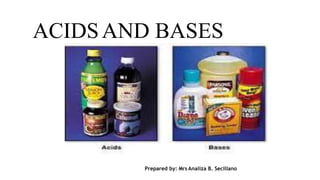
ACIDSAND BASES
Prepared by: Mrs Analiza B. Secillano
ACIDS
• An acid is a substance that releases H+ ions in an
aqueous solution
– Aqueous means water
• Example: when hydrochloric acid is dissolved in
water, the compound separates into chlorine
ions (Cl-) and hydrogen ions (H+)
When we think of acids and bases we tend to think
of science labs and chemicals…but did you know
Acids cause:
 Lemons to be sour
 Acid rain to eat away at
sculptures
 Framed paintings to be
damaged
 Cavities in your teeth
 Food to digest in your stomach
 Ants and bees use it to sting
STRONG ACIDS
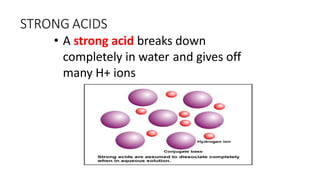
• A strong acid breaks down
completely in water and gives off
many H+ ions
WEAK ACID
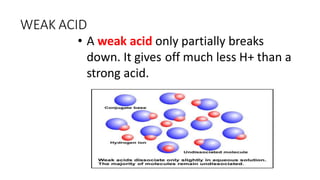
• A weak acid only partially breaks
down. It gives off much less H+ than a
strong acid.
Characteristics of
Acids
• Acids have a sour taste
• Acids react with metals &
carbonates to produce gas
• Acids contain hydrogen
H
Characteristics of Acids: Taste Sour
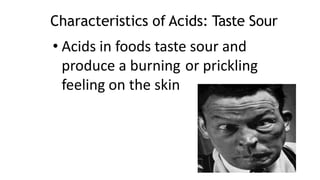
• Acids in foods taste sour and
produce a burning or prickling
feeling on the skin
Characteristics of Acids
•Since tasting or touching an
unknown chemical is
extremely dangerous,
other methods are needed
to tell whether a solution is
an acid
Characteristics of Acids: Reacts with Carbonate
• A safe way to test to
see if a solution is an
acid is to place a few
drops on a
compound that
contains a carbonate
(CO3)
• Example: limestone is a
rock that contains
calcium carbonate
(CaCO3) When an acid
touches a piece of
limestone, a reaction
occurs that produces
carbon dioxide gas
Characteristics of Acids: Reacts with Metal
• Acids also reacts with most metals
• The reaction produces hydrogen gas,
which you
•can see as bubbles
Characteristics of Acids: Contain
Hydrogen
BASES
• A base is a substance that releases
hydroxide (OH-) ions in an aqueous
solution
• Example: When sodium hydroxide
(NaOH) is dissolved in water, the
compound separates into sodium ions
(Na+) and hydroxide ions (OH-)
Characteristics of Bases
Turn red litmus
taste bitter
Negatively charged
hydroxide ions (OH–)
Feel slippery
Bases neutralize acids
Poisonous and can
cause severe burns
Strong Bases are Caustic.
Characteristics of Bases: Taste Bitter
•Example: Baking soda
•Mild bases in foods taste bitter and
feel slippery, but as with acids, tasting
and touching are not safe ways of
testing whether a solution is a base
•In fact, some strong bases can burn
the skin as badly as strong acids
•Bases feel soapy or slippery
because they react with acid
molecules in your skin called
fatty acids
• In fact, this is exactly how soap is made.
Mixing base- usually sodium hydroxide
– with fatty acids produces soap
• So when a base touches your skin, the
combination of the base with your own
fatty acids actually makes a small
amount of soap
Properties of Acids & Bases
• Similarities between acids and bases
–Dissolve in water
–Conduct electricity in aqueous solution
–Can irritate or burn skin
Properties of Acids and Bases
Acids
turn blue litmus red
taste sour
Acids corrode metals
positively charged
hydrogen ions (H+)
Bases
turn red litmus blue
taste bitter
Negatively charged hydroxide ions
(OH–)
Feel slippery
Most hand soaps and drain cleaners
are bases
Properties of Acids and Bases
Acid-Base Strength
•pH stands for “potential
hydrogen” and is a
measure of how many
H+ ions there are in
solution.
Acid-Base Strength
•The strength of an
acid or base is
usually measured
using a pH scale
Acid-Base Strength
•The more H+ there
are, the lower the
pH will be
Understanding the pH Scale
pH stands for (presence of Hydrogen)
Numbered from 0 to 14.
Understanding the pH Scale
The lower the pH number – the higher
Acid
That means more Hydrogen Ions (H+)
Understanding the pH Scale
The higher the pH - the higher
the Base
That means less Hydrogen Ions (H+)
•The numbers of the pH
scale usually range from0
– 14, but numbers outside
this range are possible
Understanding the pH Scale
•The middle number,
7, represents a
neutral solution
Understanding the pH Scale
•A neutral substance is
neither an acid nor a
base. Pure water has a
pH of 7
Understanding the pH Scale
Acid-Base Strength
pH < 7 indicate acidic solution
pH = 7 indicate neutral solution
pH > 7 indicate basic solution
A concentrated strong acid has a
low pH value
A concentrated strong base has a
high pH value
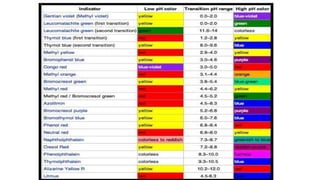
Acid-Base Indicators
• An acid-base indicator is a compound
that will change color in the presence of
an acid or base
• Litmus is a plant extract that can be blue
or red (pink)
–Litmus turns red/pink in an acidic solution
–Litmus turns blue in a basic solution
Acid-Base Indicators
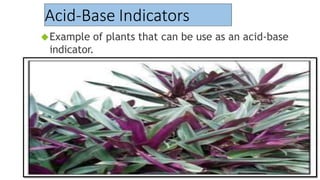
Example of plants that can be use as an acid-base
indicator.
Acid-Base Indicators
Example of plants that can be use as an acid-base
indicator.
Acid-Base Indicators
Example of plants that can be use as an acid-base
indicator.
Acid-Base Indicators
Example of plants that can be use as an acid-base
indicator.
Acid-Base Indicators
Example of plants that can be use as an acid-base
indicator.
Acid-Base Indicators
Example of plants that can be use as an acid-base
indicator.
ANTHOCYANIN
A plant pigments
produce specific
colors in solutions
of different acidity
or basicity.
• It would be impossible to determine
the pH of all solutions using just one
indicator, such as litmus
• Several other acid-base indicators
exist, each producing a color change
at a specific pH level
Acid-Base Indicators
•A universal indicator is a
mixture of chemicals that
changes color through a wide
range of pH values
Acid-Base Indicators
pH paper (Universal Indicator)
•An even more
precise way of
determine pH is
to use a pH
meter
Acid-Base Indicators
Acids and Bases Neutralize Each Other
• When an acid and base react with each
other, the characteristic properties of both
are destroyed. This is called neutralization.
• The salts formed may be
soluble in water or can be
insoluble
• If the salt is insoluble, a
precipitate will form
• Recall: a precipitate is a
suspension of a small, solid
particles formed during a
chemical reaction
Acids and Bases Neutralize Each Other
• A common example of neutralization
reaction occurs when you swallow an
antacid tablet to relieve an upset
stomach.
• The acid in your stomach has a pH of
about 1.5 due to mostly hydrochloric
acid produced by the stomach lining
Acids and Bases Neutralize Each Other
•An antacid tablet contains a base,
such as sodium bicarbonate,
magnesium hydroxide or calcium
carbonate. The base reacts with
the stomach acid and produces a
salt and water.
Acids and Bases Neutralize Each Other
•This reaction lowers the acidity
and raises to pH to its normal
value (about 2)
Acids and Bases Neutralize Each Other
•Using toothpaste to avoid tooth
decay. Bacteria in mouth can change
sweet types of food into acid. The acid
attacks the outermost part of the tooth
and leads to tooth decay. Toothpaste
contains bases that can neutralize the
acid in the mouth.
Acids and Bases Neutralize Each Other
•Treating soil. Some plants grow well
in acidic soil while others prefer
basic soil. Farmers need to know the
pH of their soil. Most often, the soil
gets too acidic.
Acids and Bases Neutralize Each Other
•When this happens, the soil is
treated with bases such as quicklime
(calcium oxide), slaked lime (calcium
hydroxide) or calcium carbonate.
The base is usually spread on the
soil by spraying.
Acids and Bases Neutralize Each Other
QUIZ TIME
Multiple Choice: Choose the letter of the best
answer.
1. Which of the following materials can be a source
of natural acid-base indicator?
A. sodium chloride C. vinegar
B. red cabbage D. calamansi juice
2. Which of the following mixtures will not change
the color of red litmus paper?
A. bleach B. detergent C. vinegar D. drain
cleaner
3. Plant extract is either acidic or basic in
nature. If a plant extract is acidic, which of
the following pairs of characteristics can be
observed?
A. tastes bitter, changes blue litmus paper to red.
B. tastes sour, changes litmus red paper to blue.
C. tastes sour turns blue litmus paper to red.
D. tastes bitter, turns red litmus paper to blue.
4. Which of the following sets of
pH values is acidic?
A. 1, 7, 8.5 B. 4.5, 3, 0
C. 7.5, 8, 9.5 D. 0, 8, 11
5. Which of the following statement
does not describe bases?
A. Bases turn litmus paper to blue.
B. Bases improve the strength of
metals.
C. Bases have pH values greater
than 7.
D. Bases neutralize acids.
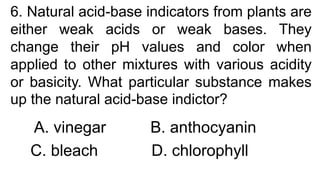
6. Natural acid-base indicators from plants are
either weak acids or weak bases. They
change their pH values and color when
applied to other mixtures with various acidity
or basicity. What particular substance makes
up the natural acid-base indictor?
A. vinegar B. anthocyanin
C. bleach D. chlorophyll
7. Which of the following materials
contains acidic mixtures?
A. fruit drinks C.detergent powder
B. chlorinated drink D. shampoo
8. Which of the given pH value is a
neutral solution?
A. 0 B. 7 C. 11 D. 14
9. Which one of the following is a
weak acid?
A. kalamansi B. baking soda
C. cola D. saliva
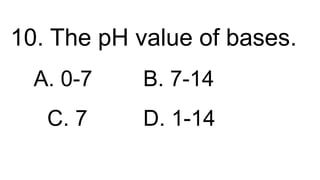
10. The pH value of bases.
A. 0-7 B. 7-14
C. 7 D. 1-14
11. Which of the following statements is
TRUE about acids and bases?
A. acids and base do not react with each other.
B. acids mixed with bases make stronger bases.
C. acids mixed with bases make stronger acids.
D. acids mixed with the bases neutralize each
other.
12. Which is the correct property of a base?
A. sour taste, corrosive, change litmus from
red to blue.
B. sour taste, corrosive, change litmus from
blue to red.
C. bitter taste, slippery, change litmus from
red to blue.
D. sour taste, slippery, change litmus from
blue to red.
13. Which of the following is
mostly likely an acidic
substance?
A. shampoo B. baking soda
C. detergent bar D. vinegar
14. Which of the following pH
values change red litmus paper to
blue?
A. 7 B. 6.2 C. 8.7 D. 3.1
15. Which of the following
acids is considered the
strongest?
A. calamansi extract
B. muriatic acid
C. soda
D. sprite
1.B 11. D
2. C 12. C
3. C 13. D
4. B 14. A
5. B 15. B
6. B
7. A
8. B
9. C
10. B
ACIDS AND BASES.pptx

ACIDS AND BASES.pptx

  • 1.
    ACIDSAND BASES Prepared by:Mrs Analiza B. Secillano
  • 2.
    ACIDS • An acidis a substance that releases H+ ions in an aqueous solution – Aqueous means water • Example: when hydrochloric acid is dissolved in water, the compound separates into chlorine ions (Cl-) and hydrogen ions (H+)
  • 3.
    When we thinkof acids and bases we tend to think of science labs and chemicals…but did you know Acids cause:  Lemons to be sour  Acid rain to eat away at sculptures  Framed paintings to be damaged  Cavities in your teeth  Food to digest in your stomach  Ants and bees use it to sting
  • 4.
    STRONG ACIDS • Astrong acid breaks down completely in water and gives off many H+ ions
  • 5.
    WEAK ACID • Aweak acid only partially breaks down. It gives off much less H+ than a strong acid.
  • 6.
    Characteristics of Acids • Acidshave a sour taste • Acids react with metals & carbonates to produce gas • Acids contain hydrogen H
  • 7.
    Characteristics of Acids:Taste Sour • Acids in foods taste sour and produce a burning or prickling feeling on the skin
  • 8.
    Characteristics of Acids •Sincetasting or touching an unknown chemical is extremely dangerous, other methods are needed to tell whether a solution is an acid
  • 9.
    Characteristics of Acids:Reacts with Carbonate • A safe way to test to see if a solution is an acid is to place a few drops on a compound that contains a carbonate (CO3) • Example: limestone is a rock that contains calcium carbonate (CaCO3) When an acid touches a piece of limestone, a reaction occurs that produces carbon dioxide gas
  • 10.
    Characteristics of Acids:Reacts with Metal • Acids also reacts with most metals • The reaction produces hydrogen gas, which you •can see as bubbles
  • 11.
    Characteristics of Acids:Contain Hydrogen
  • 12.
    BASES • A baseis a substance that releases hydroxide (OH-) ions in an aqueous solution • Example: When sodium hydroxide (NaOH) is dissolved in water, the compound separates into sodium ions (Na+) and hydroxide ions (OH-)
  • 13.
    Characteristics of Bases Turnred litmus taste bitter Negatively charged hydroxide ions (OH–) Feel slippery Bases neutralize acids Poisonous and can cause severe burns Strong Bases are Caustic.
  • 14.
    Characteristics of Bases:Taste Bitter •Example: Baking soda
  • 15.
    •Mild bases infoods taste bitter and feel slippery, but as with acids, tasting and touching are not safe ways of testing whether a solution is a base •In fact, some strong bases can burn the skin as badly as strong acids
  • 16.
    •Bases feel soapyor slippery because they react with acid molecules in your skin called fatty acids
  • 18.
    • In fact,this is exactly how soap is made. Mixing base- usually sodium hydroxide – with fatty acids produces soap • So when a base touches your skin, the combination of the base with your own fatty acids actually makes a small amount of soap
  • 19.
    Properties of Acids& Bases • Similarities between acids and bases –Dissolve in water –Conduct electricity in aqueous solution –Can irritate or burn skin
  • 20.
  • 21.
    Properties of Acidsand Bases Acids turn blue litmus red taste sour Acids corrode metals positively charged hydrogen ions (H+)
  • 22.
    Bases turn red litmusblue taste bitter Negatively charged hydroxide ions (OH–) Feel slippery Most hand soaps and drain cleaners are bases Properties of Acids and Bases
  • 23.
    Acid-Base Strength •pH standsfor “potential hydrogen” and is a measure of how many H+ ions there are in solution.
  • 24.
    Acid-Base Strength •The strengthof an acid or base is usually measured using a pH scale
  • 25.
    Acid-Base Strength •The moreH+ there are, the lower the pH will be
  • 26.
    Understanding the pHScale pH stands for (presence of Hydrogen) Numbered from 0 to 14.
  • 27.
    Understanding the pHScale The lower the pH number – the higher Acid That means more Hydrogen Ions (H+)
  • 28.
    Understanding the pHScale The higher the pH - the higher the Base That means less Hydrogen Ions (H+)
  • 29.
    •The numbers ofthe pH scale usually range from0 – 14, but numbers outside this range are possible Understanding the pH Scale
  • 30.
    •The middle number, 7,represents a neutral solution Understanding the pH Scale
  • 31.
    •A neutral substanceis neither an acid nor a base. Pure water has a pH of 7 Understanding the pH Scale
  • 32.
    Acid-Base Strength pH <7 indicate acidic solution pH = 7 indicate neutral solution pH > 7 indicate basic solution A concentrated strong acid has a low pH value A concentrated strong base has a high pH value
  • 33.
    Acid-Base Indicators • Anacid-base indicator is a compound that will change color in the presence of an acid or base • Litmus is a plant extract that can be blue or red (pink) –Litmus turns red/pink in an acidic solution –Litmus turns blue in a basic solution
  • 34.
    Acid-Base Indicators Example ofplants that can be use as an acid-base indicator.
  • 35.
    Acid-Base Indicators Example ofplants that can be use as an acid-base indicator.
  • 36.
    Acid-Base Indicators Example ofplants that can be use as an acid-base indicator.
  • 37.
    Acid-Base Indicators Example ofplants that can be use as an acid-base indicator.
  • 38.
    Acid-Base Indicators Example ofplants that can be use as an acid-base indicator.
  • 39.
    Acid-Base Indicators Example ofplants that can be use as an acid-base indicator.
  • 40.
    ANTHOCYANIN A plant pigments producespecific colors in solutions of different acidity or basicity.
  • 41.
    • It wouldbe impossible to determine the pH of all solutions using just one indicator, such as litmus • Several other acid-base indicators exist, each producing a color change at a specific pH level Acid-Base Indicators
  • 43.
    •A universal indicatoris a mixture of chemicals that changes color through a wide range of pH values Acid-Base Indicators
  • 44.
  • 45.
    •An even more preciseway of determine pH is to use a pH meter Acid-Base Indicators
  • 46.
    Acids and BasesNeutralize Each Other • When an acid and base react with each other, the characteristic properties of both are destroyed. This is called neutralization.
  • 47.
    • The saltsformed may be soluble in water or can be insoluble • If the salt is insoluble, a precipitate will form • Recall: a precipitate is a suspension of a small, solid particles formed during a chemical reaction Acids and Bases Neutralize Each Other
  • 48.
    • A commonexample of neutralization reaction occurs when you swallow an antacid tablet to relieve an upset stomach. • The acid in your stomach has a pH of about 1.5 due to mostly hydrochloric acid produced by the stomach lining Acids and Bases Neutralize Each Other
  • 50.
    •An antacid tabletcontains a base, such as sodium bicarbonate, magnesium hydroxide or calcium carbonate. The base reacts with the stomach acid and produces a salt and water. Acids and Bases Neutralize Each Other
  • 51.
    •This reaction lowersthe acidity and raises to pH to its normal value (about 2) Acids and Bases Neutralize Each Other
  • 52.
    •Using toothpaste toavoid tooth decay. Bacteria in mouth can change sweet types of food into acid. The acid attacks the outermost part of the tooth and leads to tooth decay. Toothpaste contains bases that can neutralize the acid in the mouth. Acids and Bases Neutralize Each Other
  • 53.
    •Treating soil. Someplants grow well in acidic soil while others prefer basic soil. Farmers need to know the pH of their soil. Most often, the soil gets too acidic. Acids and Bases Neutralize Each Other
  • 54.
    •When this happens,the soil is treated with bases such as quicklime (calcium oxide), slaked lime (calcium hydroxide) or calcium carbonate. The base is usually spread on the soil by spraying. Acids and Bases Neutralize Each Other
  • 59.
  • 60.
    Multiple Choice: Choosethe letter of the best answer. 1. Which of the following materials can be a source of natural acid-base indicator? A. sodium chloride C. vinegar B. red cabbage D. calamansi juice 2. Which of the following mixtures will not change the color of red litmus paper? A. bleach B. detergent C. vinegar D. drain cleaner
  • 61.
    3. Plant extractis either acidic or basic in nature. If a plant extract is acidic, which of the following pairs of characteristics can be observed? A. tastes bitter, changes blue litmus paper to red. B. tastes sour, changes litmus red paper to blue. C. tastes sour turns blue litmus paper to red. D. tastes bitter, turns red litmus paper to blue.
  • 62.
    4. Which ofthe following sets of pH values is acidic? A. 1, 7, 8.5 B. 4.5, 3, 0 C. 7.5, 8, 9.5 D. 0, 8, 11
  • 63.
    5. Which ofthe following statement does not describe bases? A. Bases turn litmus paper to blue. B. Bases improve the strength of metals. C. Bases have pH values greater than 7. D. Bases neutralize acids.
  • 64.
    6. Natural acid-baseindicators from plants are either weak acids or weak bases. They change their pH values and color when applied to other mixtures with various acidity or basicity. What particular substance makes up the natural acid-base indictor? A. vinegar B. anthocyanin C. bleach D. chlorophyll
  • 65.
    7. Which ofthe following materials contains acidic mixtures? A. fruit drinks C.detergent powder B. chlorinated drink D. shampoo
  • 66.
    8. Which ofthe given pH value is a neutral solution? A. 0 B. 7 C. 11 D. 14 9. Which one of the following is a weak acid? A. kalamansi B. baking soda C. cola D. saliva
  • 67.
    10. The pHvalue of bases. A. 0-7 B. 7-14 C. 7 D. 1-14
  • 68.
    11. Which ofthe following statements is TRUE about acids and bases? A. acids and base do not react with each other. B. acids mixed with bases make stronger bases. C. acids mixed with bases make stronger acids. D. acids mixed with the bases neutralize each other.
  • 69.
    12. Which isthe correct property of a base? A. sour taste, corrosive, change litmus from red to blue. B. sour taste, corrosive, change litmus from blue to red. C. bitter taste, slippery, change litmus from red to blue. D. sour taste, slippery, change litmus from blue to red.
  • 70.
    13. Which ofthe following is mostly likely an acidic substance? A. shampoo B. baking soda C. detergent bar D. vinegar
  • 71.
    14. Which ofthe following pH values change red litmus paper to blue? A. 7 B. 6.2 C. 8.7 D. 3.1
  • 72.
    15. Which ofthe following acids is considered the strongest? A. calamansi extract B. muriatic acid C. soda D. sprite
  • 73.
    1.B 11. D 2.C 12. C 3. C 13. D 4. B 14. A 5. B 15. B 6. B 7. A 8. B 9. C 10. B