Chemical Equation
shorthand representation of a
chemical change with symbols and
formulas.
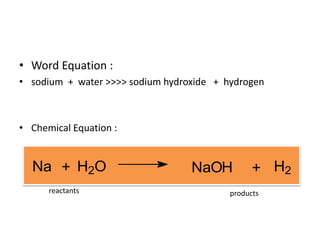
• Word Equation :
• sodium + water >>>> sodium hydroxide + hydrogen
• Chemical Equation :
Na H2O NaOH H2+ +
reactants products
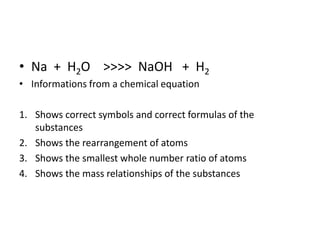
• Na + H2O >>>> NaOH + H2
• Informations from a chemical equation
1. Shows correct symbols and correct formulas of the
substances
2. Shows the rearrangement of atoms
3. Shows the smallest whole number ratio of atoms
4. Shows the mass relationships of the substances
Symbol Where it is placed Meaning
(S) After a substance Substance is a soild
(g) After a substance Substance is a gas
After a substance( l )
Substance ia liquid
After a substance
After a substance
Evolution of
A gas
Formation of
A precipitate
After a substance
Dissolved
In water
( aq )
Between reactants
And products
Reaction is
reversible
= Between reactants
And products
Reaction has
Attained equilibrium
Between reactants
And products
Heat is
needed
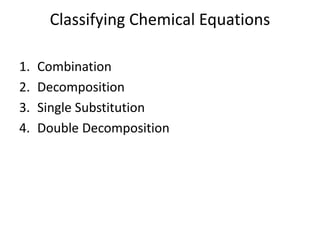
Classifying Chemical Equations
1. Combination
2. Decomposition
3. Single Substitution
4. Double Decomposition
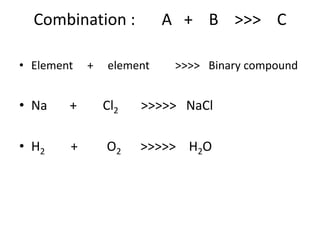
Combination : A + B >>> C
• Element + element >>>> Binary compound
• Na + Cl2 >>>>> NaCl
• H2 + O2 >>>>> H2O
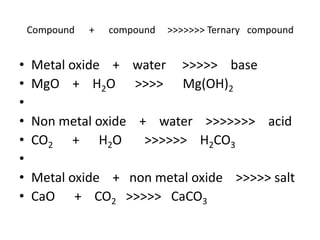
Compound + compound >>>>>>> Ternary compound
• Metal oxide + water >>>>> base
• MgO + H2O >>>> Mg(OH)2
•
• Non metal oxide + water >>>>>>> acid
• CO2 + H2O >>>>>> H2CO3
•
• Metal oxide + non metal oxide >>>>> salt
• CaO + CO2 >>>>> CaCO3
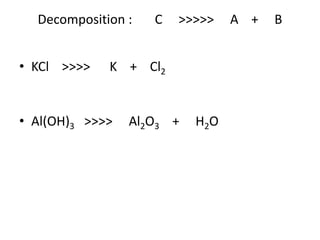
Decomposition : C >>>>> A + B
• KCl >>>> K + Cl2
• Al(OH)3 >>>> Al2O3 + H2O
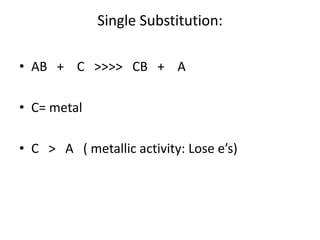
Single Substitution:
• AB + C >>>> CB + A
• C= metal
• C > A ( metallic activity: Lose e’s)
Activity Series :
• K > Ba> Ca > Na > Mg > Al > Zn > Cr > Fe> Ni >
• Sn > Pb > H > Cu > Bi > Hg > Ag > Pt > Au
•
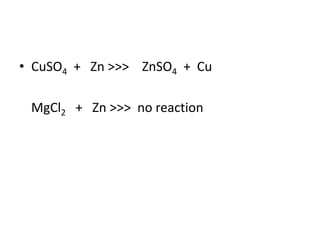
• CuSO4 + Zn >>> ZnSO4 + Cu
MgCl2 + Zn >>> no reaction
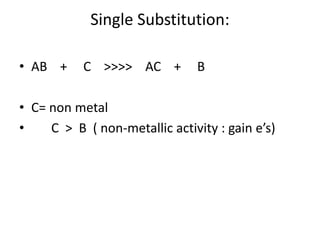
Single Substitution:
• AB + C >>>> AC + B
• C= non metal
• C > B ( non-metallic activity : gain e’s)
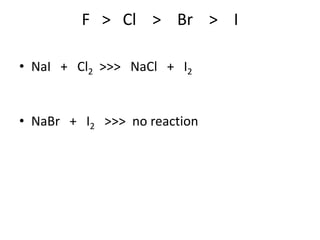
F > Cl > Br > I
• NaI + Cl2 >>> NaCl + I2
• NaBr + I2 >>> no reaction
Single Substitution:
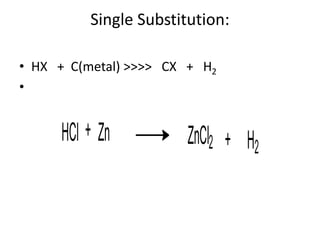
• HX + C(metal) >>>> CX + H2
•
HCl Zn ZnCl2 H2
+ +
Double Replacement Reaction
• reaction where there is total exchange of ions
• AB + CD >>> AD + CB
• Na2S + HBr >>> NaBr + H2S (g)
•
• KI + Pb(NO3)2 >>>> KNO3 + PbI2 (ppt.)
•
• HCl + NaOH >>>> NaCl + HOH
Balancing Chemical Equations
• Methods
1. . Inspection Method
2. Change in Oxidation State (Number) Method
Inspection Method
1. Write correct symbols and correct formulas of the
substances involved in the reaction
2. As equation is being balanced do not change the
formulas and symbols
3. It is best to start balancing a formula unit which
contains the highest number of atoms of an
element . This atom should not be H should not be
O
4. If a radical is present and remained together ,
balance it as one entity
5. Next to balance is H, followed by O
Balanced chemical equation - 0ne in which the number of atoms of all
elements shown on the reactant side is equal to the number of all elements
shown on the product side
NaOH H3PO4 Na3PO4 H2O+ +3 3
reactant side product side
3 Na 3 Na
1 P 1 P
6 H 6 H
7 O 7 O
In principle: An infinite number of balanced equations can be written for
any reaction
N2H4 2 N2O4 6N2 8H2O+ +4
2N2H4 N2O4 3N2 4H2O+ +
But the simplest number of
coefficients is preferred
Change in Oxidation State (Number) Method
1. Determine which substance is oxidized which
substance is reduced by assigning oxidation states to
all the elements in the equation
2. Indicate the change in oxidation states for the
elements involve
3. Determine the minimum number of electrons that
will allow the same number of electrons to be lost
and to be gained
4. Determine the number of oxidizing agent and the
number of reducing agent that will allow the same
number of electrons to be lost and to be gained.
5. Balance the rest by inspection
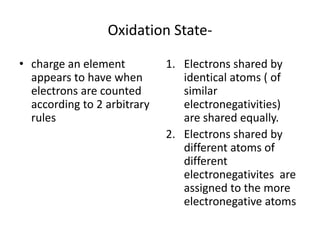
Oxidation State-
• charge an element
appears to have when
electrons are counted
according to 2 arbitrary
rules
1. Electrons shared by
identical atoms ( of
similar
electronegativities)
are shared equally.
2. Electrons shared by
different atoms of
different
electronegativites are
assigned to the more
electronegative atoms
Oxidation State can be
• zero,
• positive number
• negative number
• fraction
Rules in assigning oxidation states
• The oxidation state of an atom in free state is
zero
S
o
Cl2
o
The oxidation state of a monoatomic ion is equal to the charge of the
ion
IA II A III A IV A V A V I A VII A
+1 +2 +3
+4 and
or -4 -3
-2
-1
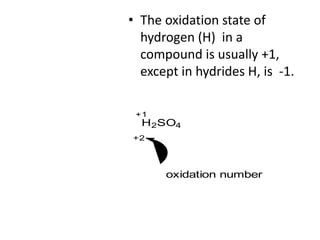
• The oxidation state of
hydrogen (H) in a
compound is usually +1,
except in hydrides H, is -1.
H2SO4
+1
+2
oxidation number
• The oxidation state of
oxygen in a compound is
usually -2.
H2SO4
-2
-8
oxidation number
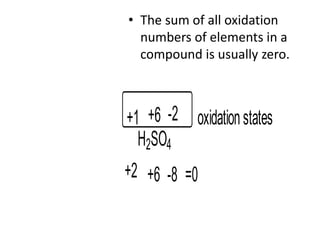
• The sum of all oxidation
numbers of elements in a
compound is usually zero.
H2SO4
+1 -2
+2 -8+6 =0
+6 oxidationstates
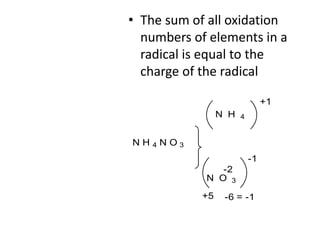
• The sum of all oxidation
numbers of elements in a
radical is equal to the
charge of the radical
N H 4 N O 3
N O 3
-2
-6 = -1+5
-1
N H 4
+1

Chemical equation

  • 1.
    Chemical Equation shorthand representationof a chemical change with symbols and formulas.
  • 2.
    • Word Equation: • sodium + water >>>> sodium hydroxide + hydrogen • Chemical Equation : Na H2O NaOH H2+ + reactants products
  • 3.
    • Na +H2O >>>> NaOH + H2 • Informations from a chemical equation 1. Shows correct symbols and correct formulas of the substances 2. Shows the rearrangement of atoms 3. Shows the smallest whole number ratio of atoms 4. Shows the mass relationships of the substances
  • 4.
    Symbol Where itis placed Meaning (S) After a substance Substance is a soild (g) After a substance Substance is a gas After a substance( l ) Substance ia liquid After a substance After a substance Evolution of A gas Formation of A precipitate After a substance Dissolved In water ( aq ) Between reactants And products Reaction is reversible = Between reactants And products Reaction has Attained equilibrium Between reactants And products Heat is needed
  • 5.
    Classifying Chemical Equations 1.Combination 2. Decomposition 3. Single Substitution 4. Double Decomposition
  • 6.
    Combination : A+ B >>> C • Element + element >>>> Binary compound • Na + Cl2 >>>>> NaCl • H2 + O2 >>>>> H2O
  • 7.
    Compound + compound>>>>>>> Ternary compound • Metal oxide + water >>>>> base • MgO + H2O >>>> Mg(OH)2 • • Non metal oxide + water >>>>>>> acid • CO2 + H2O >>>>>> H2CO3 • • Metal oxide + non metal oxide >>>>> salt • CaO + CO2 >>>>> CaCO3
  • 8.
    Decomposition : C>>>>> A + B • KCl >>>> K + Cl2 • Al(OH)3 >>>> Al2O3 + H2O
  • 9.
    Single Substitution: • AB+ C >>>> CB + A • C= metal • C > A ( metallic activity: Lose e’s)
  • 10.
    Activity Series : •K > Ba> Ca > Na > Mg > Al > Zn > Cr > Fe> Ni > • Sn > Pb > H > Cu > Bi > Hg > Ag > Pt > Au •
  • 11.
    • CuSO4 +Zn >>> ZnSO4 + Cu MgCl2 + Zn >>> no reaction
  • 12.
    Single Substitution: • AB+ C >>>> AC + B • C= non metal • C > B ( non-metallic activity : gain e’s)
  • 13.
    F > Cl> Br > I • NaI + Cl2 >>> NaCl + I2 • NaBr + I2 >>> no reaction
  • 14.
    Single Substitution: • HX+ C(metal) >>>> CX + H2 • HCl Zn ZnCl2 H2 + +
  • 15.
    Double Replacement Reaction •reaction where there is total exchange of ions • AB + CD >>> AD + CB
  • 16.
    • Na2S +HBr >>> NaBr + H2S (g) • • KI + Pb(NO3)2 >>>> KNO3 + PbI2 (ppt.) • • HCl + NaOH >>>> NaCl + HOH
  • 17.
    Balancing Chemical Equations •Methods 1. . Inspection Method 2. Change in Oxidation State (Number) Method
  • 18.
    Inspection Method 1. Writecorrect symbols and correct formulas of the substances involved in the reaction 2. As equation is being balanced do not change the formulas and symbols 3. It is best to start balancing a formula unit which contains the highest number of atoms of an element . This atom should not be H should not be O 4. If a radical is present and remained together , balance it as one entity 5. Next to balance is H, followed by O
  • 19.
    Balanced chemical equation- 0ne in which the number of atoms of all elements shown on the reactant side is equal to the number of all elements shown on the product side NaOH H3PO4 Na3PO4 H2O+ +3 3 reactant side product side 3 Na 3 Na 1 P 1 P 6 H 6 H 7 O 7 O
  • 20.
    In principle: Aninfinite number of balanced equations can be written for any reaction N2H4 2 N2O4 6N2 8H2O+ +4 2N2H4 N2O4 3N2 4H2O+ + But the simplest number of coefficients is preferred
  • 21.
    Change in OxidationState (Number) Method 1. Determine which substance is oxidized which substance is reduced by assigning oxidation states to all the elements in the equation 2. Indicate the change in oxidation states for the elements involve 3. Determine the minimum number of electrons that will allow the same number of electrons to be lost and to be gained 4. Determine the number of oxidizing agent and the number of reducing agent that will allow the same number of electrons to be lost and to be gained. 5. Balance the rest by inspection
  • 22.
    Oxidation State- • chargean element appears to have when electrons are counted according to 2 arbitrary rules 1. Electrons shared by identical atoms ( of similar electronegativities) are shared equally. 2. Electrons shared by different atoms of different electronegativites are assigned to the more electronegative atoms
  • 23.
    Oxidation State canbe • zero, • positive number • negative number • fraction
  • 24.
    Rules in assigningoxidation states • The oxidation state of an atom in free state is zero S o Cl2 o
  • 25.
    The oxidation stateof a monoatomic ion is equal to the charge of the ion IA II A III A IV A V A V I A VII A +1 +2 +3 +4 and or -4 -3 -2 -1
  • 26.
    • The oxidationstate of hydrogen (H) in a compound is usually +1, except in hydrides H, is -1. H2SO4 +1 +2 oxidation number
  • 27.
    • The oxidationstate of oxygen in a compound is usually -2. H2SO4 -2 -8 oxidation number
  • 28.
    • The sumof all oxidation numbers of elements in a compound is usually zero. H2SO4 +1 -2 +2 -8+6 =0 +6 oxidationstates
  • 29.
    • The sumof all oxidation numbers of elements in a radical is equal to the charge of the radical N H 4 N O 3 N O 3 -2 -6 = -1+5 -1 N H 4 +1