A dual active bridge dc-dc converter for
application in a smart user network
G. Barone, G. Brusco, A. Burgio, M. Motta, D. Menniti, A.
Pinnarelli, N. Sorrentino
Dept. of of Mechanical, Energy and Management
University of Calabria, Italy
INTRODUCING TO THE SUN
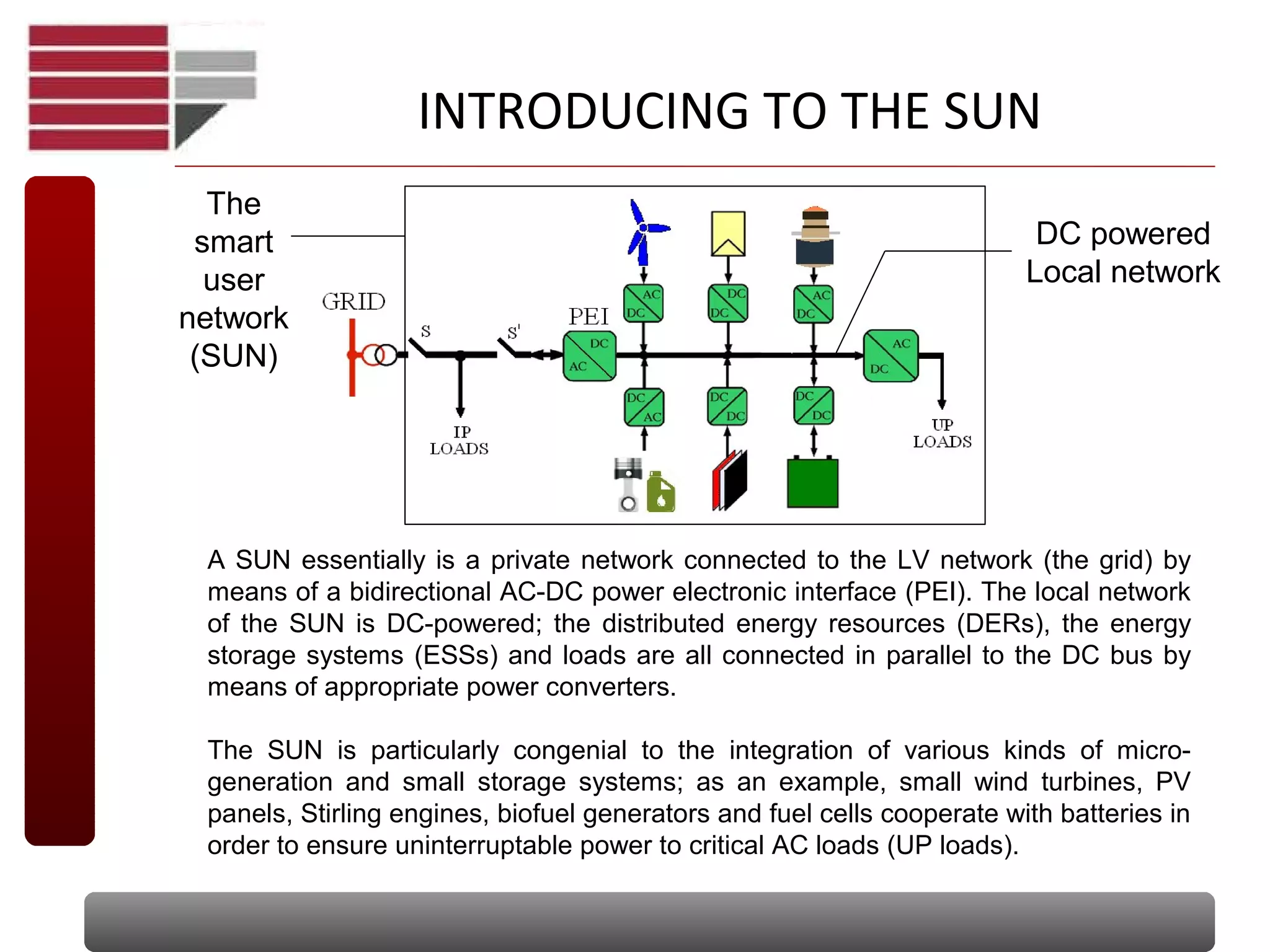
A SUN essentially is a private network connected to the LV network (the grid) by
means of a bidirectional AC-DC power electronic interface (PEI). The local network
of the SUN is DC-powered; the distributed energy resources (DERs), the energy
storage systems (ESSs) and loads are all connected in parallel to the DC bus by
means of appropriate power converters.
The SUN is particularly congenial to the integration of various kinds of micro-
generation and small storage systems; as an example, small wind turbines, PV
panels, Stirling engines, biofuel generators and fuel cells cooperate with batteries in
order to ensure uninterruptable power to critical AC loads (UP loads).
The
smart
user
network
(SUN)
DC powered
Local network
INTRODUCING TO THE SUN
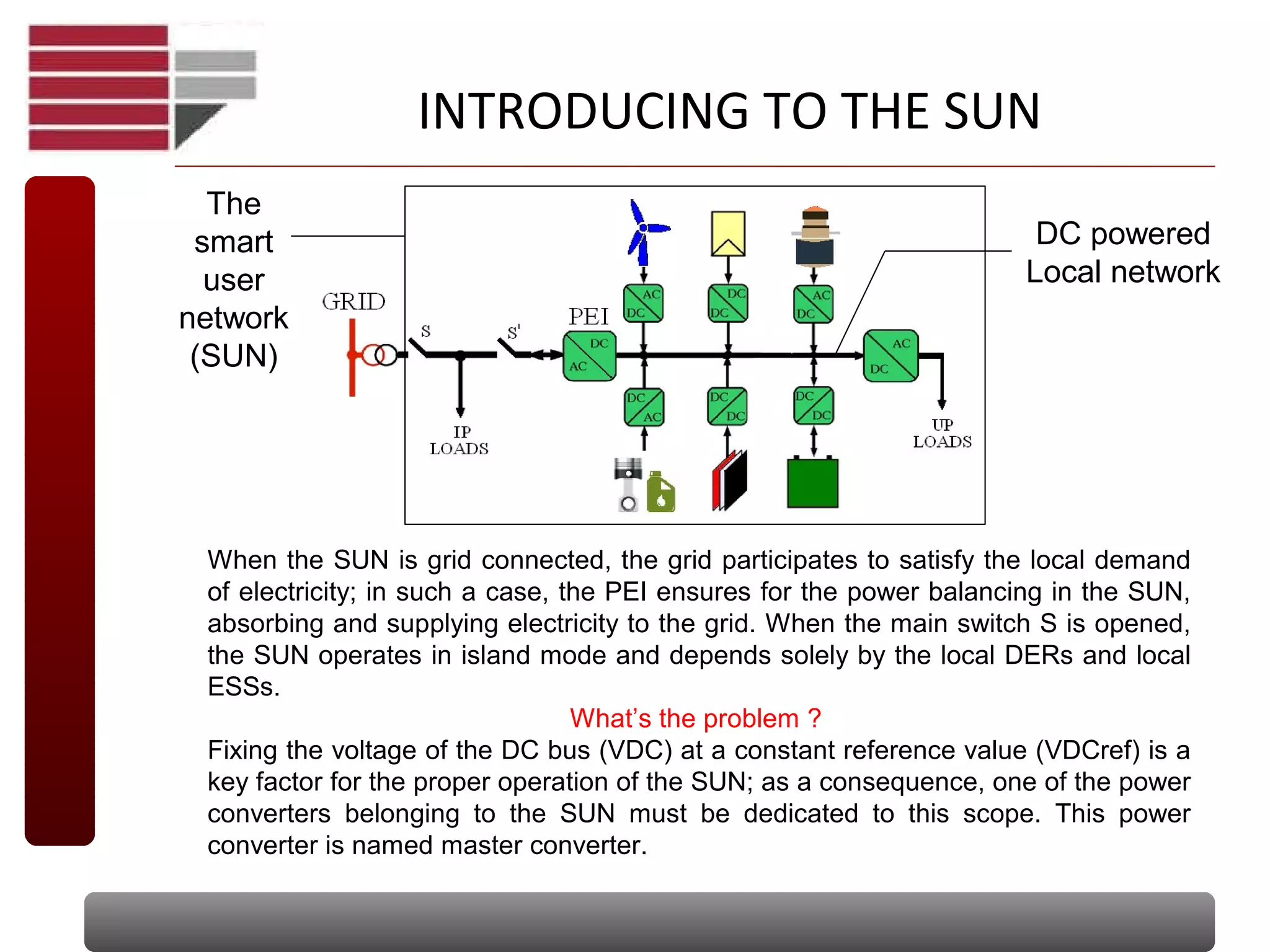
When the SUN is grid connected, the grid participates to satisfy the local demand
of electricity; in such a case, the PEI ensures for the power balancing in the SUN,
absorbing and supplying electricity to the grid. When the main switch S is opened,
the SUN operates in island mode and depends solely by the local DERs and local
ESSs.
What’s the problem ?
Fixing the voltage of the DC bus (VDC) at a constant reference value (VDCref) is a
key factor for the proper operation of the SUN; as a consequence, one of the power
converters belonging to the SUN must be dedicated to this scope. This power
converter is named master converter.
The
smart
user
network
(SUN)
DC powered
Local network
THE MASTER CONVERTER
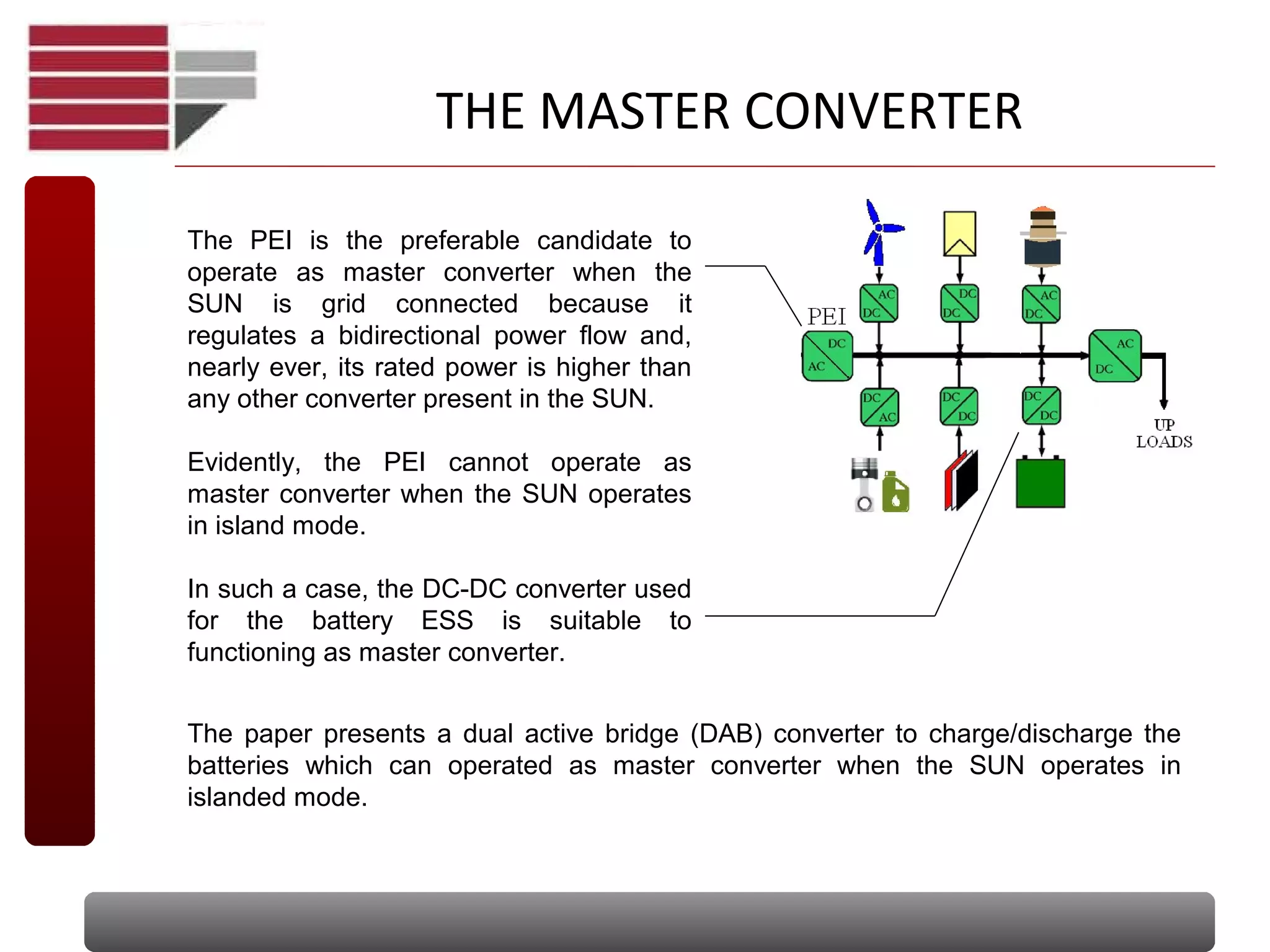
The PEI is the preferable candidate to
operate as master converter when the
SUN is grid connected because it
regulates a bidirectional power flow and,
nearly ever, its rated power is higher than
any other converter present in the SUN.
Evidently, the PEI cannot operate as
master converter when the SUN operates
in island mode.
In such a case, the DC-DC converter used
for the battery ESS is suitable to
functioning as master converter.
The paper presents a dual active bridge (DAB) converter to charge/discharge the
batteries which can operated as master converter when the SUN operates in
islanded mode.
BASIC PRINCIPLES OF A DAB
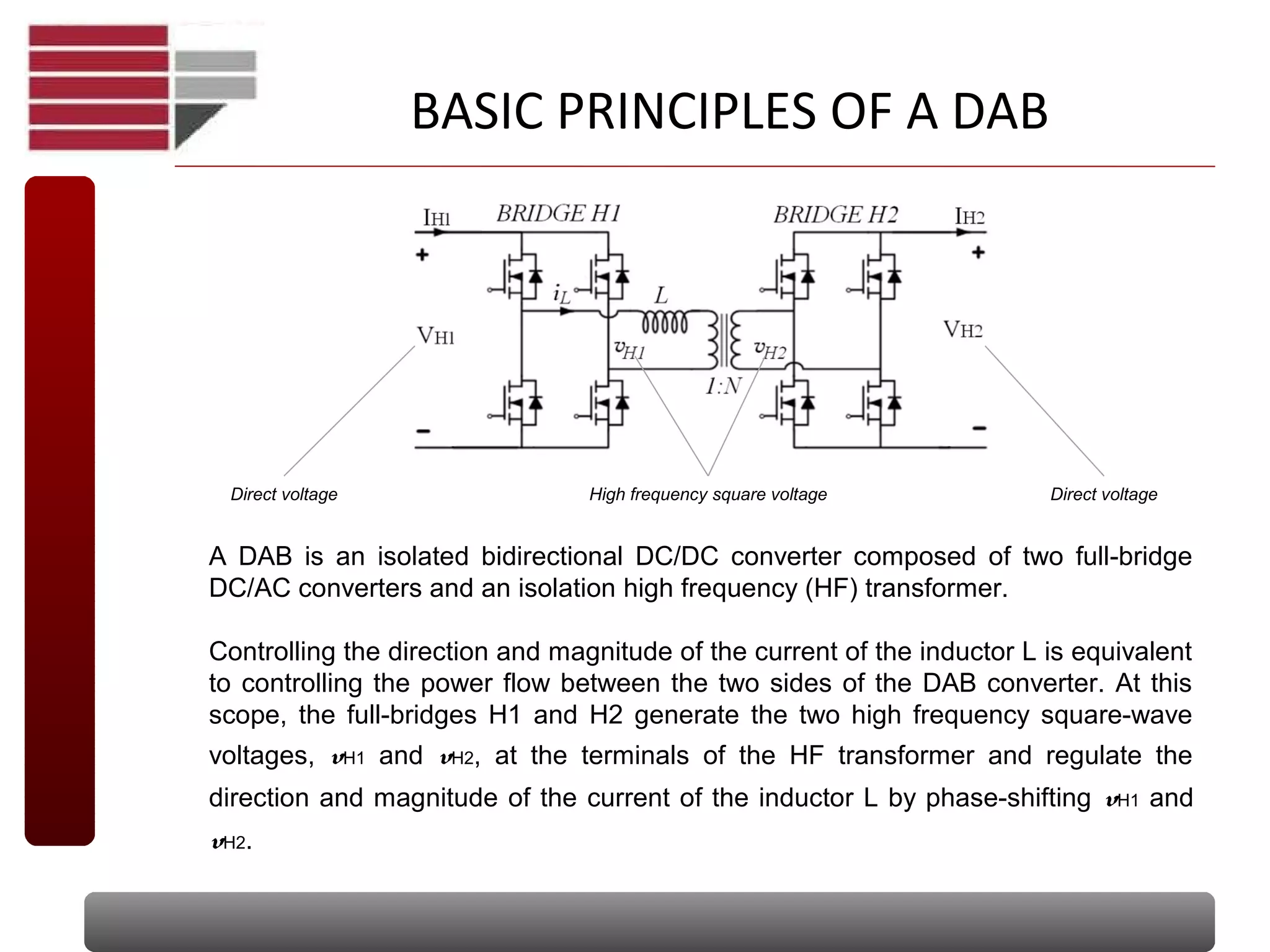
A DAB is an isolated bidirectional DC/DC converter composed of two full-bridge
DC/AC converters and an isolation high frequency (HF) transformer.
Controlling the direction and magnitude of the current of the inductor L is equivalent
to controlling the power flow between the two sides of the DAB converter. At this
scope, the full-bridges H1 and H2 generate the two high frequency square-wave
voltages, vH1 and vH2, at the terminals of the HF transformer and regulate the
direction and magnitude of the current of the inductor L by phase-shifting vH1 and
vH2.
High frequency square voltageDirect voltage Direct voltage
BASIC PRINCIPLES OF A DAB
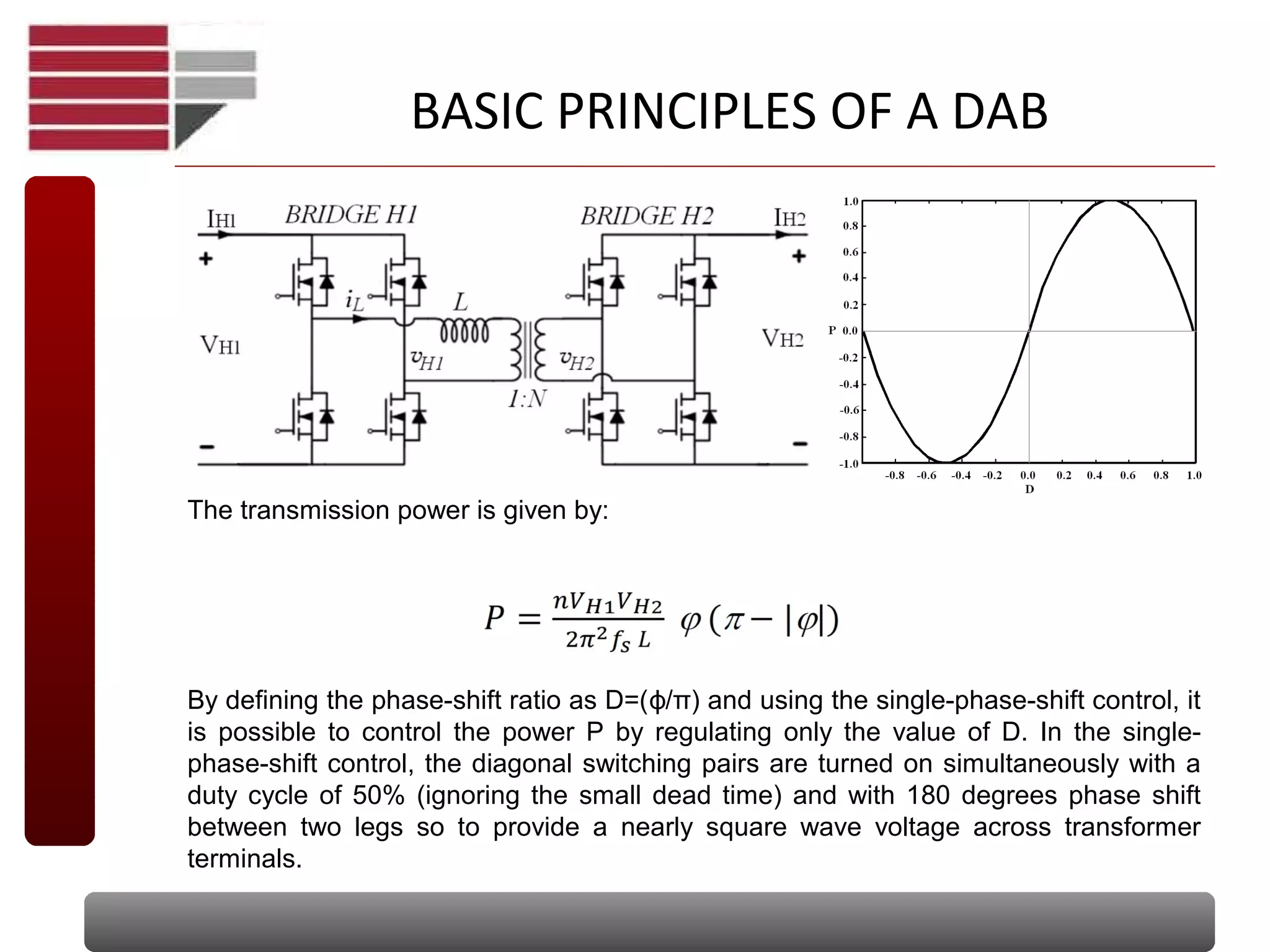
The transmission power is given by:
By defining the phase-shift ratio as D=( /π) and using the single-phase-shift control, itϕ
is possible to control the power P by regulating only the value of D. In the single-
phase-shift control, the diagonal switching pairs are turned on simultaneously with a
duty cycle of 50% (ignoring the small dead time) and with 180 degrees phase shift
between two legs so to provide a nearly square wave voltage across transformer
terminals.
FEEDBACK CONTROL SCHEME
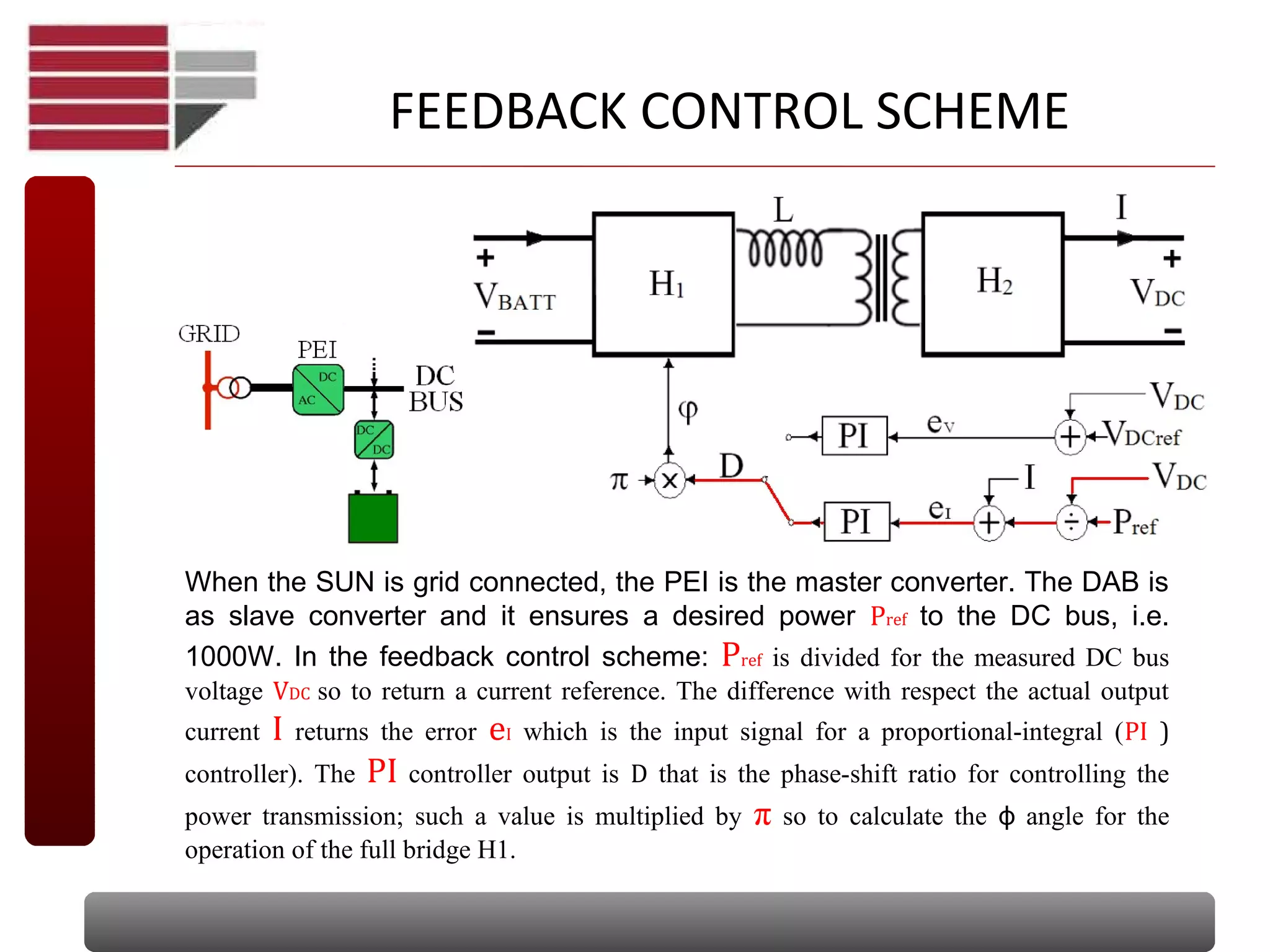
When the SUN is grid connected, the PEI is the master converter. The DAB is
as slave converter and it ensures a desired power Pref to the DC bus, i.e.
1000W. In the feedback control scheme: Pref is divided for the measured DC bus
voltage VDC so to return a current reference. The difference with respect the actual output
current I returns the error eI which is the input signal for a proportional-integral (PI )
controller). The PI controller output is D that is the phase-shift ratio for controlling the
power transmission; such a value is multiplied by π so to calculate the angle for theϕ
operation of the full bridge H1.
FEEDBACK CONTROL SCHEME
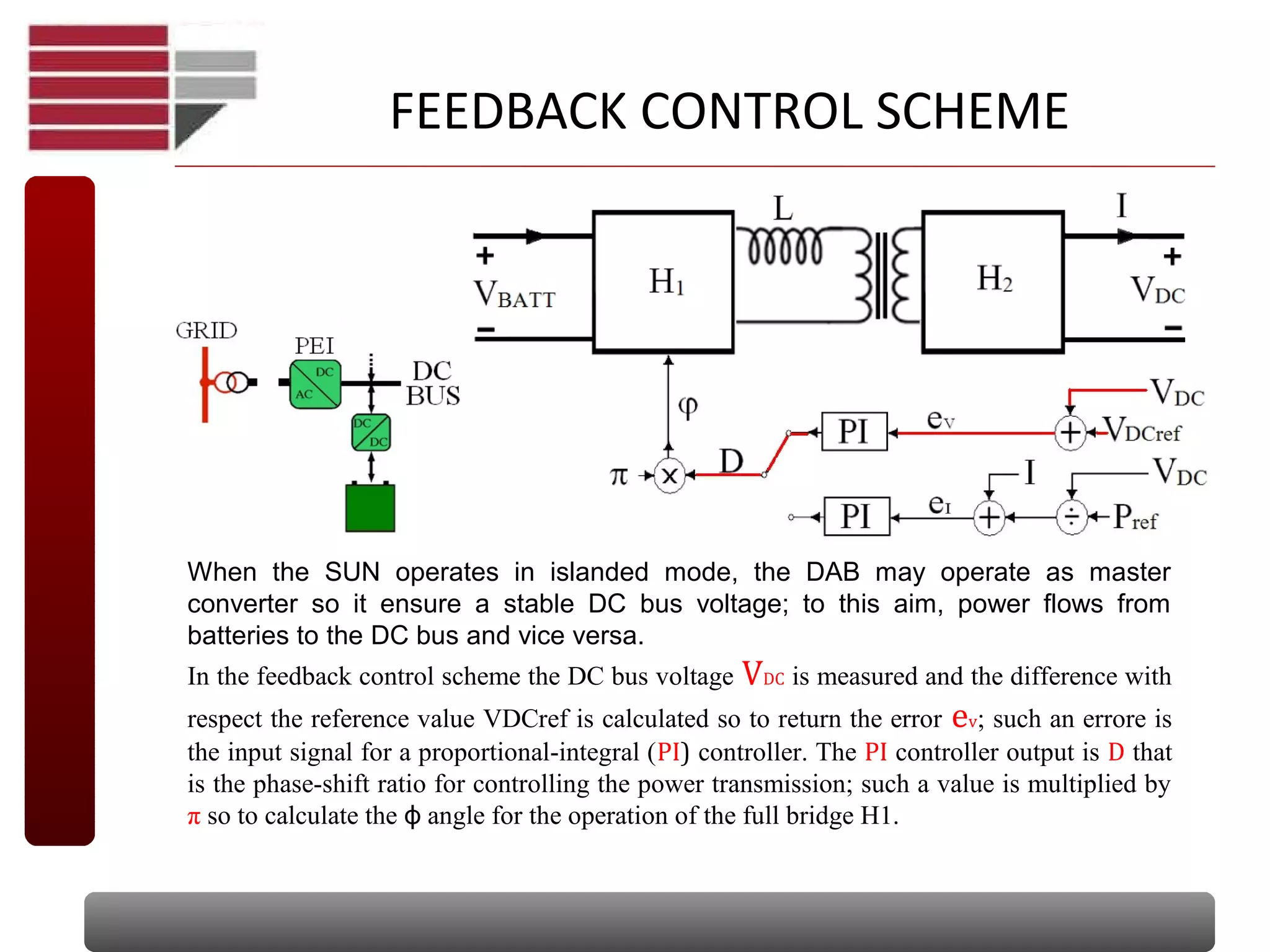
When the SUN operates in islanded mode, the DAB may operate as master
converter so it ensure a stable DC bus voltage; to this aim, power flows from
batteries to the DC bus and vice versa.
In the feedback control scheme the DC bus voltage VDC is measured and the difference with
respect the reference value VDCref is calculated so to return the error ev; such an errore is
the input signal for a proportional-integral (PI) controller. The PI controller output is D that
is the phase-shift ratio for controlling the power transmission; such a value is multiplied by
π so to calculate the angle for the operation of the full bridge H1.ϕ
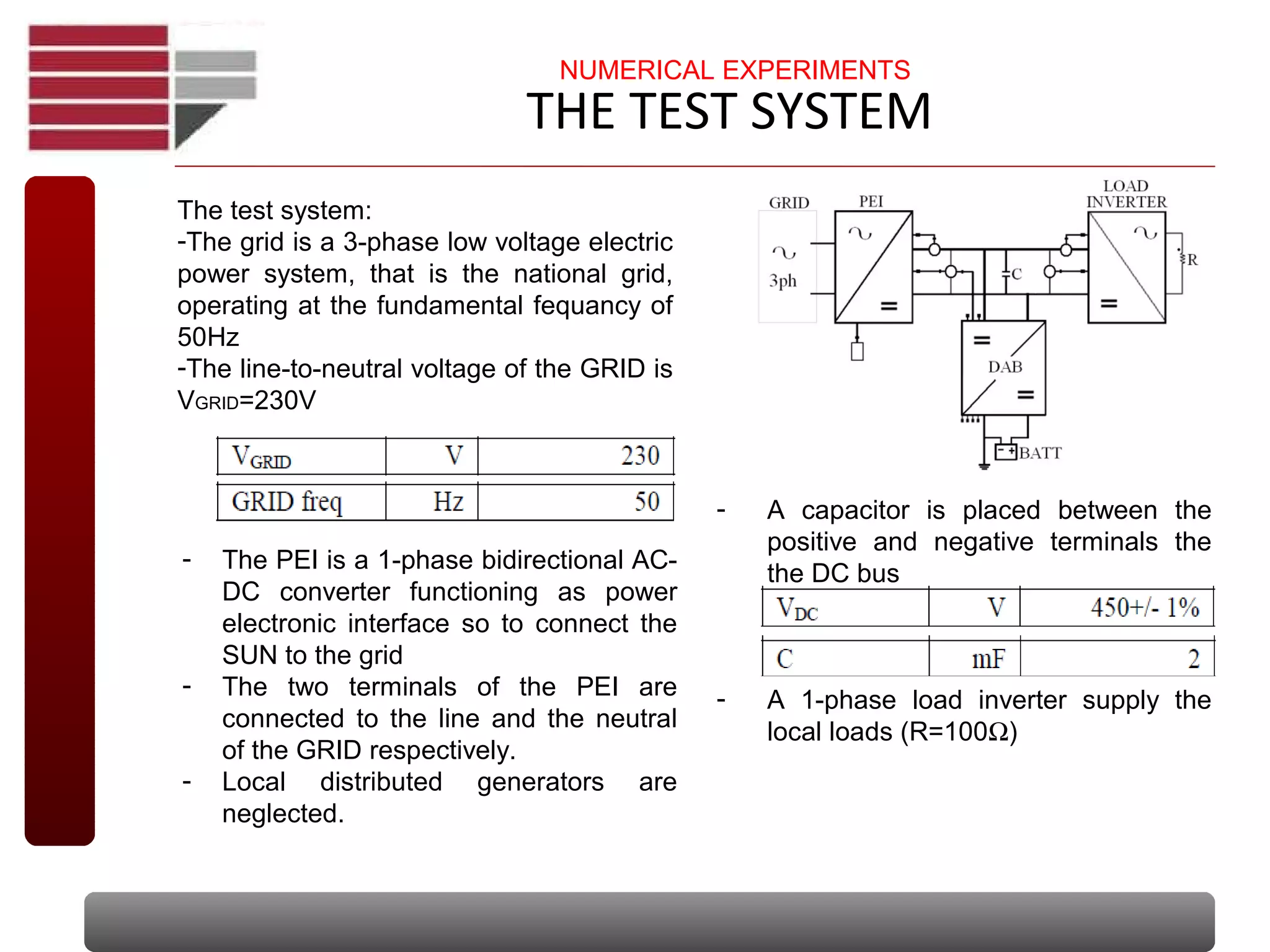
THE TEST SYSTEM
The test system:
-The grid is a 3-phase low voltage electric
power system, that is the national grid,
operating at the fundamental fequancy of
50Hz
-The line-to-neutral voltage of the GRID is
VGRID=230V
- The PEI is a 1-phase bidirectional AC-
DC converter functioning as power
electronic interface so to connect the
SUN to the grid
- The two terminals of the PEI are
connected to the line and the neutral
of the GRID respectively.
- Local distributed generators are
neglected.
- A capacitor is placed between the
positive and negative terminals the
the DC bus
- A 1-phase load inverter supply the
local loads (R=100Ω)
NUMERICAL EXPERIMENTS
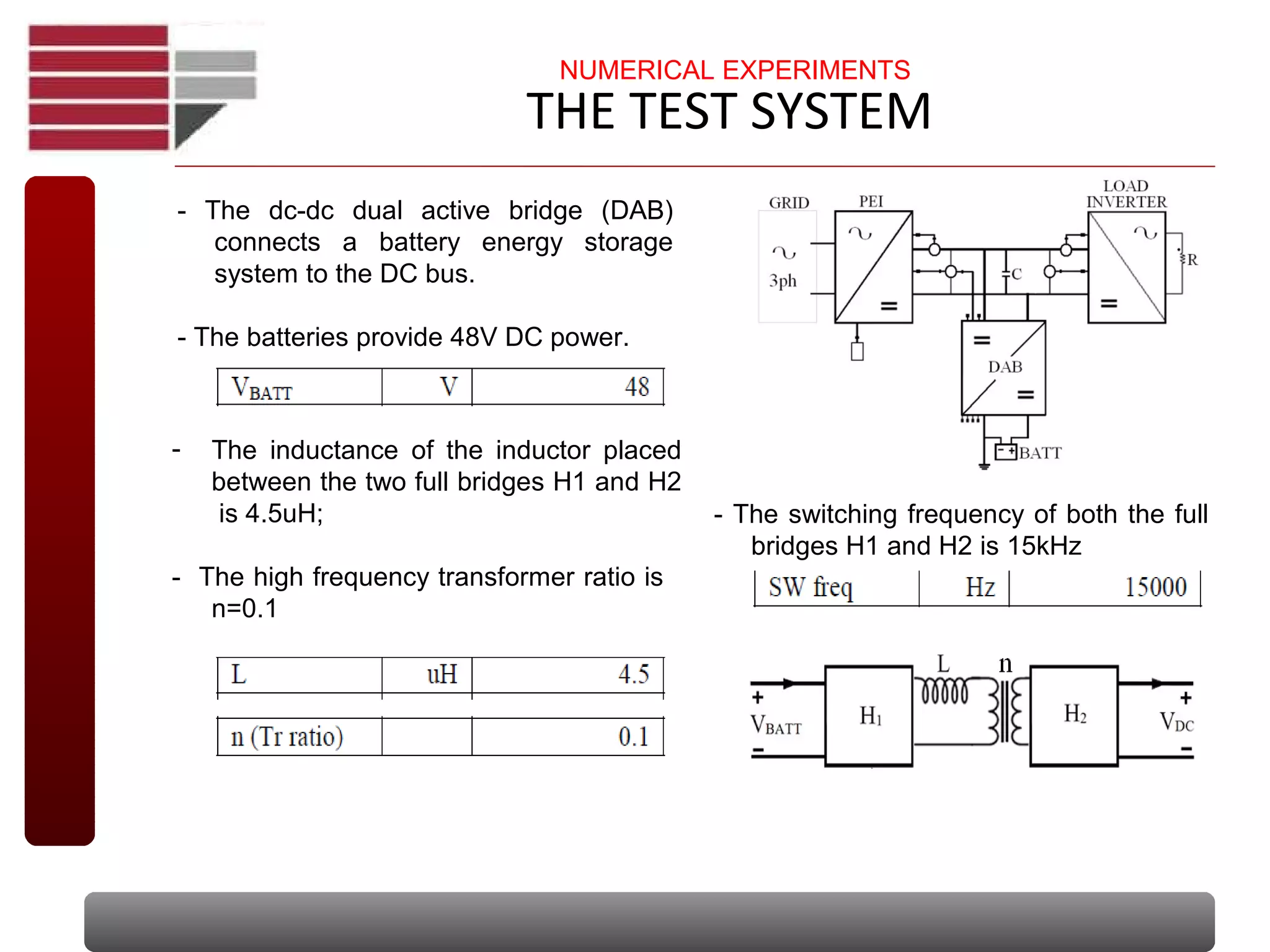
THE TEST SYSTEM
- The dc-dc dual active bridge (DAB)
connects a battery energy storage
system to the DC bus.
- The batteries provide 48V DC power.
- The inductance of the inductor placed
between the two full bridges H1 and H2
is 4.5uH;
- The high frequency transformer ratio is
n=0.1
- The switching frequency of both the full
bridges H1 and H2 is 15kHz
NUMERICAL EXPERIMENTS
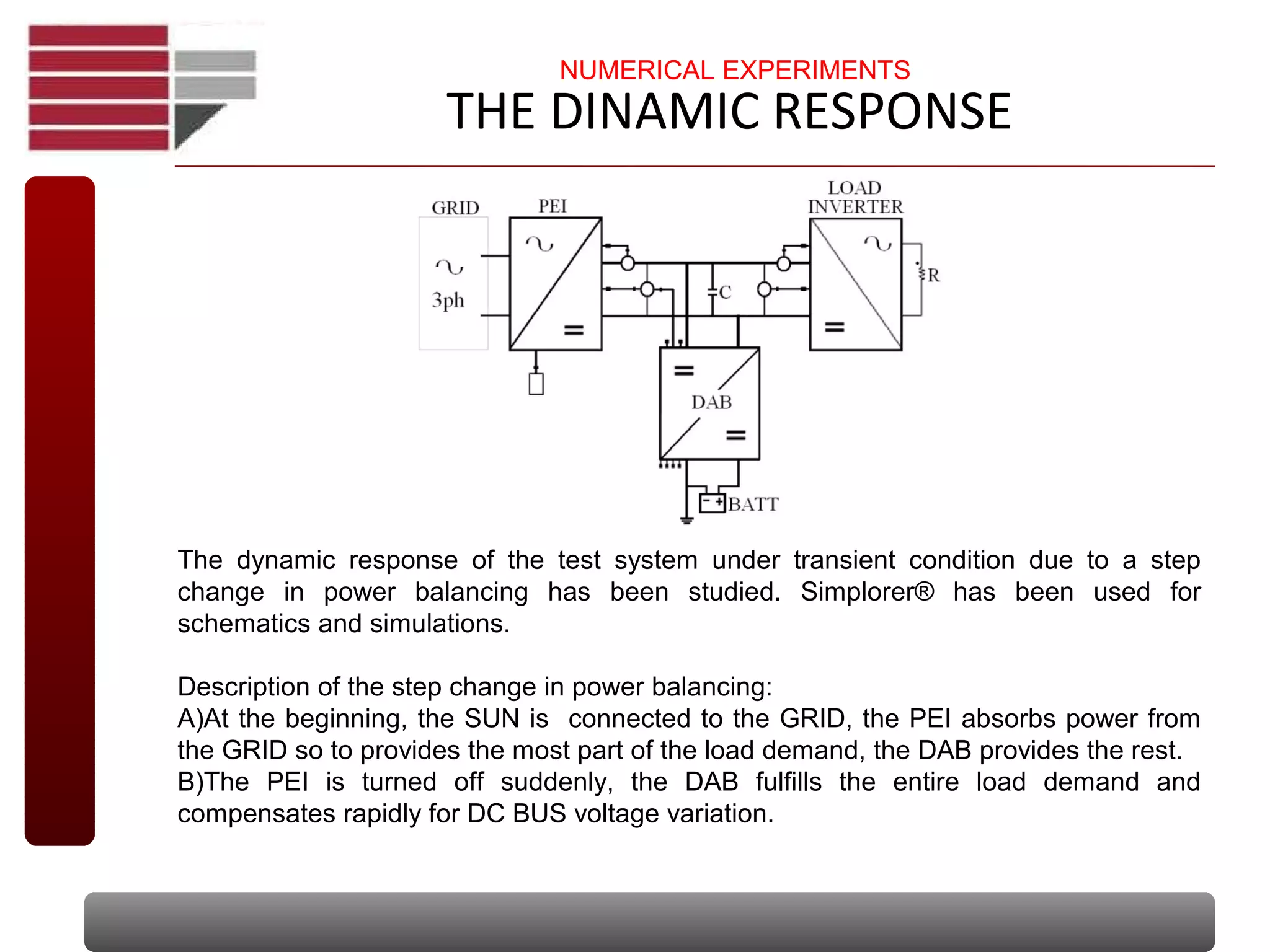
THE DINAMIC RESPONSE
The dynamic response of the test system under transient condition due to a step
change in power balancing has been studied. Simplorer® has been used for
schematics and simulations.
Description of the step change in power balancing:
A)At the beginning, the SUN is connected to the GRID, the PEI absorbs power from
the GRID so to provides the most part of the load demand, the DAB provides the rest.
B)The PEI is turned off suddenly, the DAB fulfills the entire load demand and
compensates rapidly for DC BUS voltage variation.
NUMERICAL EXPERIMENTS
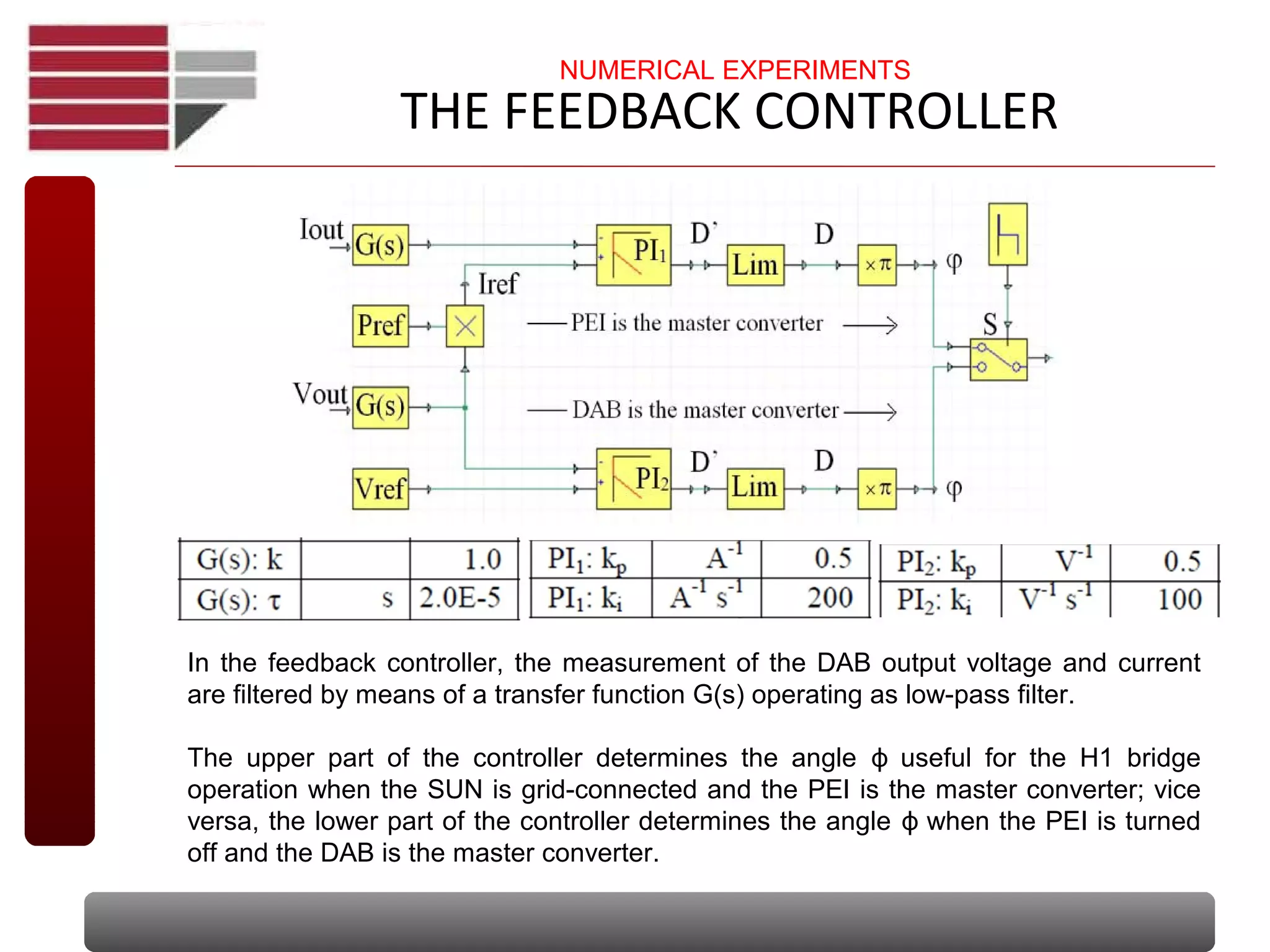
THE FEEDBACK CONTROLLER
In the feedback controller, the measurement of the DAB output voltage and current
are filtered by means of a transfer function G(s) operating as low-pass filter.
The upper part of the controller determines the angle useful for the H1 bridgeϕ
operation when the SUN is grid-connected and the PEI is the master converter; vice
versa, the lower part of the controller determines the angle when the PEI is turnedϕ
off and the DAB is the master converter.
NUMERICAL EXPERIMENTS
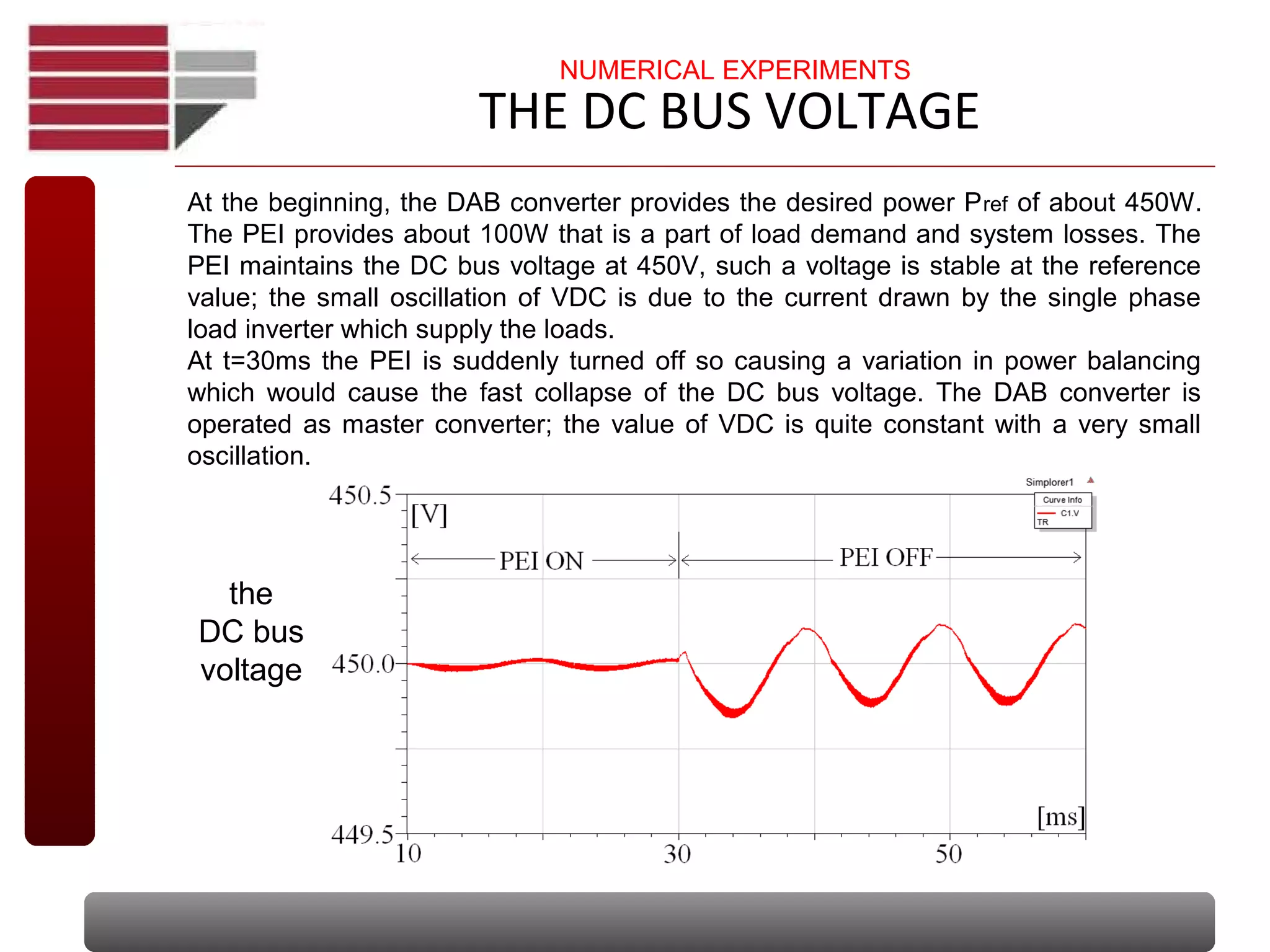
THE DC BUS VOLTAGE
At the beginning, the DAB converter provides the desired power Pref of about 450W.
The PEI provides about 100W that is a part of load demand and system losses. The
PEI maintains the DC bus voltage at 450V, such a voltage is stable at the reference
value; the small oscillation of VDC is due to the current drawn by the single phase
load inverter which supply the loads.
At t=30ms the PEI is suddenly turned off so causing a variation in power balancing
which would cause the fast collapse of the DC bus voltage. The DAB converter is
operated as master converter; the value of VDC is quite constant with a very small
oscillation.
the
DC bus
voltage
NUMERICAL EXPERIMENTS
THE ERROR OF THE DC BUS VOLTAGE
Thanks to the DAB action, the value of VDC is quite constant with a very small
oscillation between 449.75V and 450.24 V.
The DAB converter is able to maintain the error between -0.1 V and 0.15 V (that is
the 0.03% of Vref),
NUMERICAL EXPERIMENTS
THE ANGLE FOR THE DAB OPERATION
Such a fast response of the DAB converter is evidently due to the fast control of the
angle for the switching of the full bridge H1.ϕ
NUMERICAL EXPERIMENTS
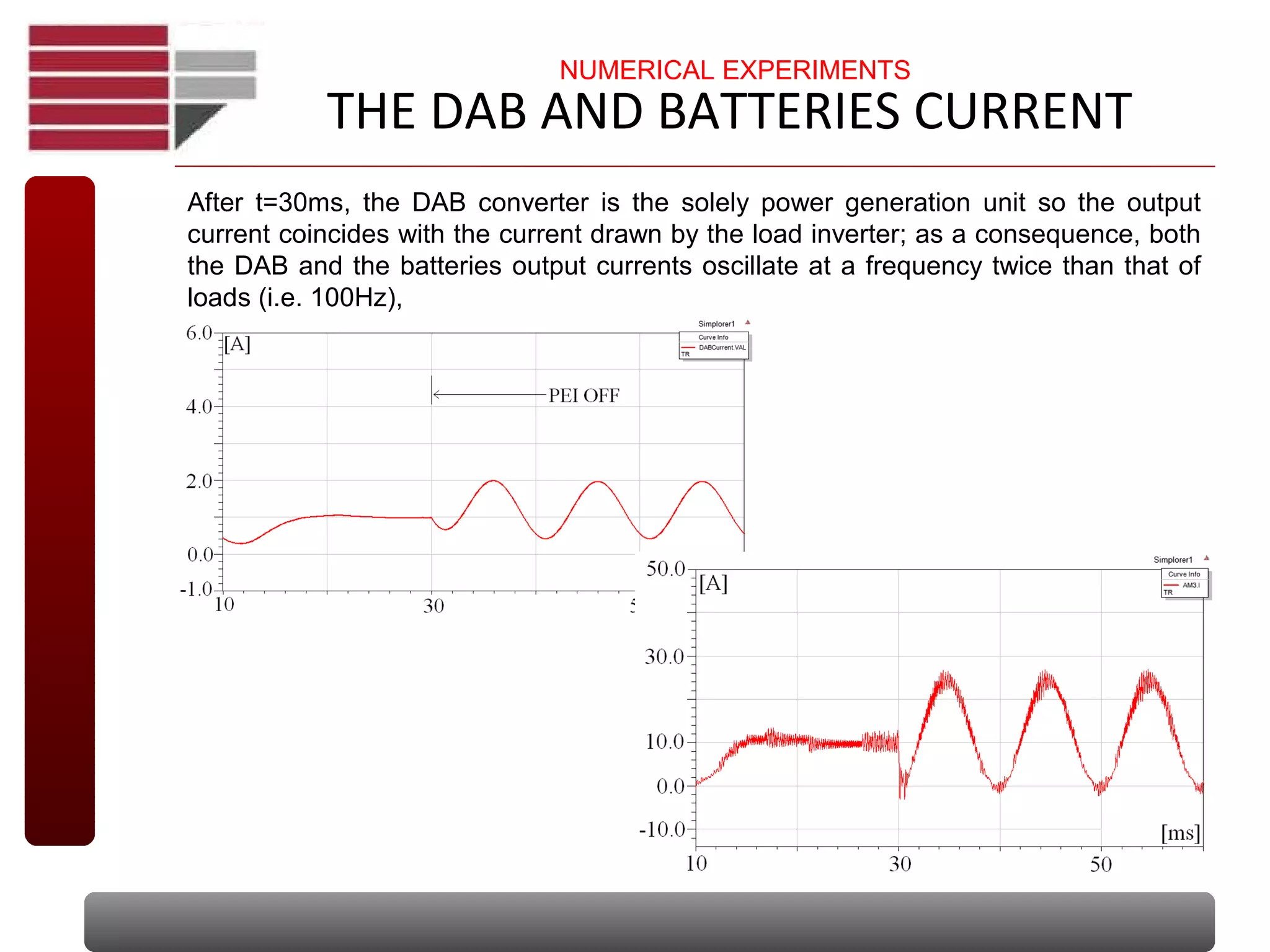
THE DAB AND BATTERIES CURRENT
After t=30ms, the DAB converter is the solely power generation unit so the output
current coincides with the current drawn by the load inverter; as a consequence, both
the DAB and the batteries output currents oscillate at a frequency twice than that of
loads (i.e. 100Hz),
NUMERICAL EXPERIMENTS
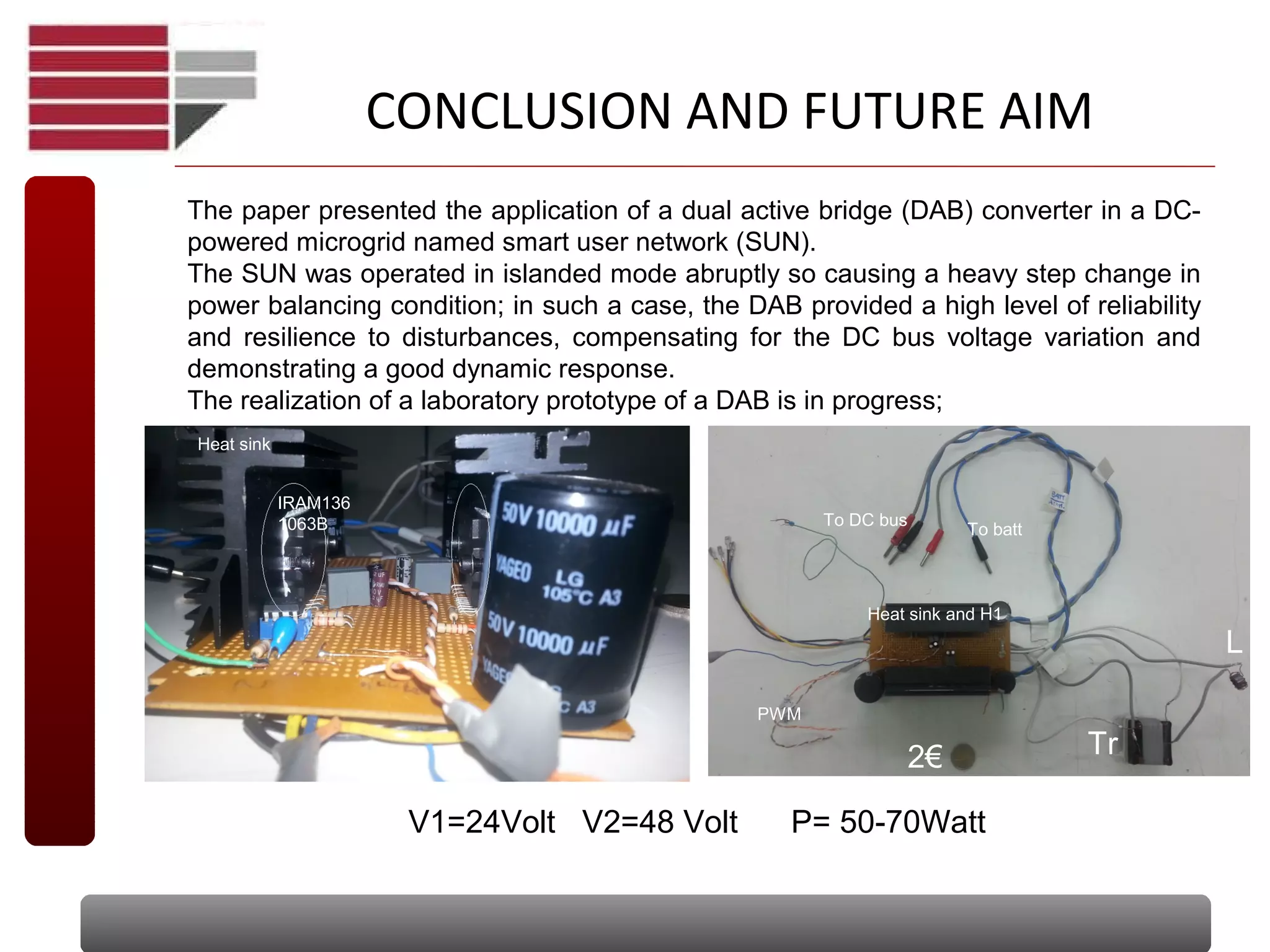
The paper presented the application of a dual active bridge (DAB) converter in a DC-
powered microgrid named smart user network (SUN).
The SUN was operated in islanded mode abruptly so causing a heavy step change in
power balancing condition; in such a case, the DAB provided a high level of reliability
and resilience to disturbances, compensating for the DC bus voltage variation and
demonstrating a good dynamic response.
The realization of a laboratory prototype of a DAB is in progress;
CONCLUSION AND FUTURE AIM
2€
L
Tr
Heat sink and H1
To DC bus
To batt
Heat sink
IRAM136
1063B
V1=24Volt V2=48 Volt P= 50-70Watt
PWM

A dual active bridge dc-dc converter for application in a smart user network

  • 1.
    A dual activebridge dc-dc converter for application in a smart user network G. Barone, G. Brusco, A. Burgio, M. Motta, D. Menniti, A. Pinnarelli, N. Sorrentino Dept. of of Mechanical, Energy and Management University of Calabria, Italy
  • 2.
    INTRODUCING TO THESUN A SUN essentially is a private network connected to the LV network (the grid) by means of a bidirectional AC-DC power electronic interface (PEI). The local network of the SUN is DC-powered; the distributed energy resources (DERs), the energy storage systems (ESSs) and loads are all connected in parallel to the DC bus by means of appropriate power converters. The SUN is particularly congenial to the integration of various kinds of micro- generation and small storage systems; as an example, small wind turbines, PV panels, Stirling engines, biofuel generators and fuel cells cooperate with batteries in order to ensure uninterruptable power to critical AC loads (UP loads). The smart user network (SUN) DC powered Local network
  • 3.
    INTRODUCING TO THESUN When the SUN is grid connected, the grid participates to satisfy the local demand of electricity; in such a case, the PEI ensures for the power balancing in the SUN, absorbing and supplying electricity to the grid. When the main switch S is opened, the SUN operates in island mode and depends solely by the local DERs and local ESSs. What’s the problem ? Fixing the voltage of the DC bus (VDC) at a constant reference value (VDCref) is a key factor for the proper operation of the SUN; as a consequence, one of the power converters belonging to the SUN must be dedicated to this scope. This power converter is named master converter. The smart user network (SUN) DC powered Local network
  • 4.
    THE MASTER CONVERTER ThePEI is the preferable candidate to operate as master converter when the SUN is grid connected because it regulates a bidirectional power flow and, nearly ever, its rated power is higher than any other converter present in the SUN. Evidently, the PEI cannot operate as master converter when the SUN operates in island mode. In such a case, the DC-DC converter used for the battery ESS is suitable to functioning as master converter. The paper presents a dual active bridge (DAB) converter to charge/discharge the batteries which can operated as master converter when the SUN operates in islanded mode.
  • 5.
    BASIC PRINCIPLES OFA DAB A DAB is an isolated bidirectional DC/DC converter composed of two full-bridge DC/AC converters and an isolation high frequency (HF) transformer. Controlling the direction and magnitude of the current of the inductor L is equivalent to controlling the power flow between the two sides of the DAB converter. At this scope, the full-bridges H1 and H2 generate the two high frequency square-wave voltages, vH1 and vH2, at the terminals of the HF transformer and regulate the direction and magnitude of the current of the inductor L by phase-shifting vH1 and vH2. High frequency square voltageDirect voltage Direct voltage
  • 6.
    BASIC PRINCIPLES OFA DAB The transmission power is given by: By defining the phase-shift ratio as D=( /π) and using the single-phase-shift control, itϕ is possible to control the power P by regulating only the value of D. In the single- phase-shift control, the diagonal switching pairs are turned on simultaneously with a duty cycle of 50% (ignoring the small dead time) and with 180 degrees phase shift between two legs so to provide a nearly square wave voltage across transformer terminals.
  • 7.
    FEEDBACK CONTROL SCHEME Whenthe SUN is grid connected, the PEI is the master converter. The DAB is as slave converter and it ensures a desired power Pref to the DC bus, i.e. 1000W. In the feedback control scheme: Pref is divided for the measured DC bus voltage VDC so to return a current reference. The difference with respect the actual output current I returns the error eI which is the input signal for a proportional-integral (PI ) controller). The PI controller output is D that is the phase-shift ratio for controlling the power transmission; such a value is multiplied by π so to calculate the angle for theϕ operation of the full bridge H1.
  • 8.
    FEEDBACK CONTROL SCHEME Whenthe SUN operates in islanded mode, the DAB may operate as master converter so it ensure a stable DC bus voltage; to this aim, power flows from batteries to the DC bus and vice versa. In the feedback control scheme the DC bus voltage VDC is measured and the difference with respect the reference value VDCref is calculated so to return the error ev; such an errore is the input signal for a proportional-integral (PI) controller. The PI controller output is D that is the phase-shift ratio for controlling the power transmission; such a value is multiplied by π so to calculate the angle for the operation of the full bridge H1.ϕ
  • 9.
    THE TEST SYSTEM Thetest system: -The grid is a 3-phase low voltage electric power system, that is the national grid, operating at the fundamental fequancy of 50Hz -The line-to-neutral voltage of the GRID is VGRID=230V - The PEI is a 1-phase bidirectional AC- DC converter functioning as power electronic interface so to connect the SUN to the grid - The two terminals of the PEI are connected to the line and the neutral of the GRID respectively. - Local distributed generators are neglected. - A capacitor is placed between the positive and negative terminals the the DC bus - A 1-phase load inverter supply the local loads (R=100Ω) NUMERICAL EXPERIMENTS
  • 10.
    THE TEST SYSTEM -The dc-dc dual active bridge (DAB) connects a battery energy storage system to the DC bus. - The batteries provide 48V DC power. - The inductance of the inductor placed between the two full bridges H1 and H2 is 4.5uH; - The high frequency transformer ratio is n=0.1 - The switching frequency of both the full bridges H1 and H2 is 15kHz NUMERICAL EXPERIMENTS
  • 11.
    THE DINAMIC RESPONSE Thedynamic response of the test system under transient condition due to a step change in power balancing has been studied. Simplorer® has been used for schematics and simulations. Description of the step change in power balancing: A)At the beginning, the SUN is connected to the GRID, the PEI absorbs power from the GRID so to provides the most part of the load demand, the DAB provides the rest. B)The PEI is turned off suddenly, the DAB fulfills the entire load demand and compensates rapidly for DC BUS voltage variation. NUMERICAL EXPERIMENTS
  • 12.
    THE FEEDBACK CONTROLLER Inthe feedback controller, the measurement of the DAB output voltage and current are filtered by means of a transfer function G(s) operating as low-pass filter. The upper part of the controller determines the angle useful for the H1 bridgeϕ operation when the SUN is grid-connected and the PEI is the master converter; vice versa, the lower part of the controller determines the angle when the PEI is turnedϕ off and the DAB is the master converter. NUMERICAL EXPERIMENTS
  • 13.
    THE DC BUSVOLTAGE At the beginning, the DAB converter provides the desired power Pref of about 450W. The PEI provides about 100W that is a part of load demand and system losses. The PEI maintains the DC bus voltage at 450V, such a voltage is stable at the reference value; the small oscillation of VDC is due to the current drawn by the single phase load inverter which supply the loads. At t=30ms the PEI is suddenly turned off so causing a variation in power balancing which would cause the fast collapse of the DC bus voltage. The DAB converter is operated as master converter; the value of VDC is quite constant with a very small oscillation. the DC bus voltage NUMERICAL EXPERIMENTS
  • 14.
    THE ERROR OFTHE DC BUS VOLTAGE Thanks to the DAB action, the value of VDC is quite constant with a very small oscillation between 449.75V and 450.24 V. The DAB converter is able to maintain the error between -0.1 V and 0.15 V (that is the 0.03% of Vref), NUMERICAL EXPERIMENTS
  • 15.
    THE ANGLE FORTHE DAB OPERATION Such a fast response of the DAB converter is evidently due to the fast control of the angle for the switching of the full bridge H1.ϕ NUMERICAL EXPERIMENTS
  • 16.
    THE DAB ANDBATTERIES CURRENT After t=30ms, the DAB converter is the solely power generation unit so the output current coincides with the current drawn by the load inverter; as a consequence, both the DAB and the batteries output currents oscillate at a frequency twice than that of loads (i.e. 100Hz), NUMERICAL EXPERIMENTS
  • 17.
    The paper presentedthe application of a dual active bridge (DAB) converter in a DC- powered microgrid named smart user network (SUN). The SUN was operated in islanded mode abruptly so causing a heavy step change in power balancing condition; in such a case, the DAB provided a high level of reliability and resilience to disturbances, compensating for the DC bus voltage variation and demonstrating a good dynamic response. The realization of a laboratory prototype of a DAB is in progress; CONCLUSION AND FUTURE AIM 2€ L Tr Heat sink and H1 To DC bus To batt Heat sink IRAM136 1063B V1=24Volt V2=48 Volt P= 50-70Watt PWM