THE APPLICATION OF BONE MORPHOGENETIC
PROTEINS TO DENTAL TISSUE ENGINEERING
A review article by:
Misako Nakashima & A Hari Reddi
Source :-
NATURE BIOTECHNOLOGY, VOLUME 21, NO. 9, SEPT 2003
Presented by:-
ROSHNI MAURYA
INTRODUCTION
Progress in understanding the role of bone morphogenetic
proteins (BMPs) in craniofacial and tooth development ,
demonstration of stem cells in dental pulp and
accumulating knowledge on biomaterial scaffolds have set
the stage for tissue engineering and regenerative therapy
of craniofacial complex. Recent approval of FDA
(Rockville, MD, USA) of recombinant human BMPs for
accelerating bone fusion in slow-healing fractures
indicates that this protein family may prove useful in
designing regenerative treatments in dental applications.
In future, these advances are likely to be applied to
endodontics and periodontal surgery; that may facilitate
approaches to regenerating whole teeth for use in tooth
replacement.
 The Craniofacial complex includes :-
a)Teeth
b)Periodontium
c)Bones
d)Salivary glands
e)TMJ
 Homeostasis and maintenance of teeth, along with
periodontal structures anchoring them into alveolar bones of
the jaws, deteriorate progressively both with age and
metabolic maladies (diabetes ; osteoporosis).
 Acc to US National Institute of Dental and Craniofacial
Research (Bethesda, MD, USA) .
a) 86% of adults over 70 yrs associated with moderate
periodontitiis,
b) over a quarter have lost their teeth.
Therefore , in aged decline in tooth function has serious
repercussion for health and quality of life.
 Tissue engineering offers a new option to supplement
existing treatment regimes for periodontal disease.
 Potential of regenerative treatment in this fields will require
integration of 3 keys elements :-
a) inductive morphogenetic signals
b) responding progenitor / stem cells
c) extracellular matrix scaffold
 These elements must be combined to facilitate a
development cascade of pattern formation ; craniofacial
plan establishment and creation of mirror – image bilateral
symmetry of teeth in maxilla and mandible.[ oral cavity offers
distinct advantages such as ease of observation and accessibility].
 It will also require a recapitulation of some of the
mechanism of embryonic development and morphogenesis.
MORPHOGENS:-
 Are extracellularly secreted signals governing morphogenesis
during epithelial mesenchymal interactions.
 Comprise 4 evolutionarily conserved protein families :-
a) BMPs , b) FGFs , c) Hhs , d) Wnts
 These protein families exhibit redundant and reiterative
signaling, each with distinct temporal and spatial expression
during initiation, pattern formation, morphogenesis and
cytodifferentiation.
 They govern pattering and morphogenesis of teeth and
associated periodontal structures .
 The promise of oral tissue engineering is that applications of
recombinant morphogens, regenerative progenitor / stem cell in
appropriate scaffolds; and ultimately gene therapies will enable
new dental treatments for caries, endodontic, periodontal and
oral-maxillofacial surgery , alveolar ridge augmentation and
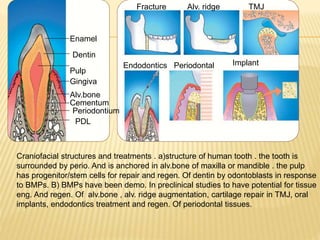
Enamel
Dentin
Pulp
Gingiva
Alv.bone
Cementum
Periodontium
PDL
Fracture Alv. ridge TMJ
Endodontics Periodontal Implant
Craniofacial structures and treatments . a)structure of human tooth . the tooth is
surrounded by perio. And is anchored in alv.bone of maxilla or mandible . the pulp
has progenitor/stem cells for repair and regen. Of dentin by odontoblasts in response
to BMPs. B) BMPs have been demo. In preclinical studies to have potential for tissue
eng. And regen. Of alv.bone , alv. ridge augmentation, cartilage repair in TMJ, oral
implants, endodontics treatment and regen. Of periodontal tissues.
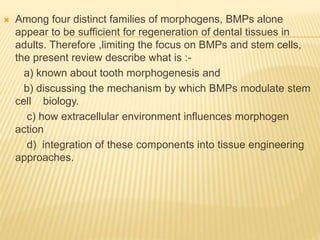
 Among four distinct families of morphogens, BMPs alone
appear to be sufficient for regeneration of dental tissues in
adults. Therefore ,limiting the focus on BMPs and stem cells,
the present review describe what is :-
a) known about tooth morphogenesis and
b) discussing the mechanism by which BMPs modulate stem
cell biology.
c) how extracellular environment influences morphogen
action
d) integration of these components into tissue engineering
approaches.
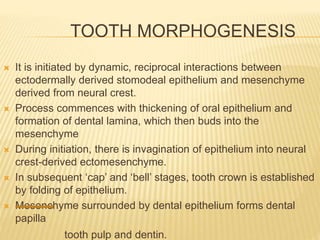
TOOTH MORPHOGENESIS
 It is initiated by dynamic, reciprocal interactions between
ectodermally derived stomodeal epithelium and mesenchyme
derived from neural crest.
 Process commences with thickening of oral epithelium and
formation of dental lamina, which then buds into the
mesenchyme
 During initiation, there is invagination of epithelium into neural
crest-derived ectomesenchyme.
 In subsequent ‘cap’ and ‘bell’ stages, tooth crown is established
by folding of epithelium.
 Mesenchyme surrounded by dental epithelium forms dental
papilla
tooth pulp and dentin.
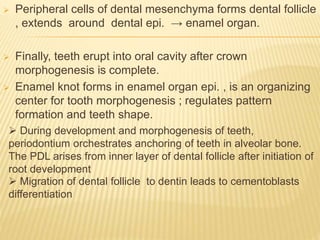
 Peripheral cells of dental mesenchyma forms dental follicle
, extends around dental epi. → enamel organ.
 Finally, teeth erupt into oral cavity after crown
morphogenesis is complete.
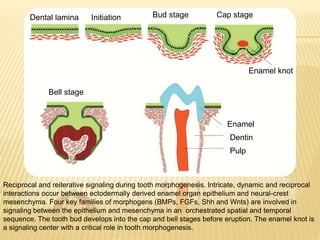
 Enamel knot forms in enamel organ epi. , is an organizing
center for tooth morphogenesis ; regulates pattern
formation and teeth shape.
 During development and morphogenesis of teeth,
periodontium orchestrates anchoring of teeth in alveolar bone.
The PDL arises from inner layer of dental follicle after initiation of
root development
 Migration of dental follicle to dentin leads to cementoblasts
differentiation
Reciprocal and reiterative signaling during tooth morphogenesis. Intricate, dynamic and reciprocal
interactions occur between ectodermally derived enamel organ epithelium and neural-crest
mesenchyma. Four key families of morphogens (BMPs, FGFs, Shh and Wnts) are involved in
signaling between the epithelium and mesenchyma in an orchestrated spatial and temporal
sequence. The tooth bud develops into the cap and bell stages before eruption. The enamel knot is
a signaling center with a critical role in tooth morphogenesis.
Enamel
Dentin
Pulp
Enamel knot
Dental lamina Initiation Bud stage Cap stage
Bell stage
 Epithelial mesenchymal interactions are critical for PDL
formation and are accompanied by expression of genes
encoding cell surface proteoglycans , extracellular matrix
glycoproteins, TGF Beta-1 and Beta-2 and Msx-like
homeoproteins.
 Fibronectin implicated in migration of mesenchymal cells
into spaces b/w epithelial cells and their differentiation into
fibroblasts of PDL and precise anchoring of PDL fibrils to
root surface.
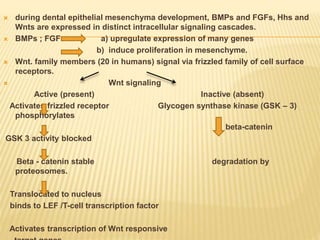
 during dental epithelial mesenchyma development, BMPs and FGFs, Hhs and
Wnts are expressed in distinct intracellular signaling cascades.
 BMPs ; FGFs : a) upregulate expression of many genes
b) induce proliferation in mesenchyme.
 Wnt. family members (20 in humans) signal via frizzled family of cell surface
receptors.
 Wnt signaling
Active (present) Inactive (absent)
Activates frizzled receptor Glycogen synthase kinase (GSK – 3)
phosphorylates
beta-catenin
GSK 3 activity blocked
Beta - catenin stable degradation by
proteosomes.
Translocated to nucleus
binds to LEF /T-cell transcription factor
Activates transcription of Wnt responsive
 Sonic hedgehog (Shh) :- Critical for regulating growth and
shaping teeth; binds to patched receptor as well as
transmembrane protein , smoothened. This signal
activates transcription factors of Gli family (critical for
carniofacial and tooth morphogenesis )
 Members of Wnt and Shh families are mutually inhibitory .
Such reciprocal regulatory interaction are critical in
establishing distinct boundaries b/w oral dental ectoderm
during tooth development and morphogenesis.
BONE MORPHOGENTIC PROTEIN :-
 Bone grafts have been used for over a century by orthopedic surgeons to aid
recalcitrant bone union.
 In 1965, Urist made the key discovery that demineralized, lyophilized
segments of rabbit bone induce new bone in intramuscular sites.
 Subsequently, BMPs were isolated from adult bone matrix in 4M guanidine,
heparin affinity chromatography and preparative electrophoresis.
 Activity of reconstituted purified BMPs assayed by implantation with
insoluble collagenous bone matrix in vivo.
 Resultant stage of new bone development are reminiscent of embryonic bone
morphogenesis, complete with 3 key steps:-
a) chemotaxis, b) mitosis, c) differentiation of progenitor /stem cells.
 Human genome encodes 20 BMPs. These are dimeric
molecules critically dependent on single
intermolecular disulfide bone for biological activity.
 Monomeric subunit has about 120 aa, including
conserved cysteine residues.
 BMP family BMP 2 ; 4
BMP 3 ; BMP 3B (GDF 10)
BMP 5, 6, 7, 8
GDFs 5, 6, 7
 BMP1 not a member of BMP family, a procollagen C
proteinase involved in proteolytic processing of soluble
procollagen, leading to self assembly of insoluble
collagen fibers in extracellular matrix.
 A single recombination BMP can have
pleiotropic effects on different steps in bone
morphogenesis depending on its conc.:-
higher conc. Promote mitogenesis and
differentiation
femtomolar conc. Promote chemotaxis.
 BMPs play pivotal roles in development of brain, eyes, heart,
kidneys, skin, bones and teeth .
 Actions includes establishment of body plan, initiation and
maintenance during regeneration of bone; formation of skeletal
tissue during embryogenesis, growth and remodeling ;
induction and creation of new bone.
 In post-natal skeleton, BMPs are intimately associated with
collagenous extracellular matrix and are localized in periosteal
cells and in mesenchymal cells of marrow stroma during
fracture repair.
 BMPs are implicated in inductive interactions b/w dental
epi. and mesenchyme in a stage dependent, reiteractive
manner.
 BMPs 2, 4, 7 are expressed in dental epi.; recombinant
BMPs 2, 4 can be used as substitute for dental epi. in
inducing mesenchyme differentiation.
 BMPs expressed in enamel knot are associated with
differentiating odontoblasts and ameloblasts.
 BMP3 and BMP7 immunolocalized to developing alveolar
bone.
 BMP2 localized only in alveolar bone during root
morphogenesis.
 BMP3: role in cementoblasts lineage by its localization in
root lining cells
 Expression of members of BMP family in rat incisor dental
pulp during different stages of odontoblasts development.
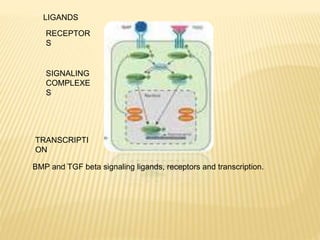
BMP and TGF beta signaling ligands, receptors and transcription.
LIGANDS
RECEPTOR
S
SIGNALING
COMPLEXE
S
TRANSCRIPTI
ON
PROGENITOR STEM CELLS
 Studies indicate that progenitor/stem cells are present both in
dental pulp and in the PDL . During wound healing, dental pulp
cells have the potential to proliferate and to differentiate into
odontoblasts to form dentin.
 It is accompanied by the expression of dentin matrix protein 1,
dentin sialoprotein (Dsp) and dentin phosphoprotein (Dpp)
 .In addition, both increased expression of osteocalcin (a marker
for differentiated odontoblasts) and matrix mineralization occurs
during the culture period
 When transplanted into ectopic sites in
immunocompromised mice, cells isolated from human
dental pulp give rise to dentin-like structures lined with
odontoblast-like cells.
 A recent paper also reports the presence of stem cells in
exfoliated deciduous human teeth .Together, these results
provide evidence that the pulp contains pulp progenitor/stem
cells.
 Although specific markers for the dental pulp stem cells
have yet to be characterized, cultured pulp cells express
BMP2, BMP4, BMP6 and BMP7 mRNA and their receptors
in a stage-dependent manner. In response to treatment with
recombinant human BMP2, pulp-derived mesenchymal cells
differentiate into dentin-forming odontoblasts
 An ongoing challenge for the field is to isolate progenitor
stem cells with well-defined markers from both dental pulp
tissue and PDL and to expand these cell types in vitro.
 Current research in several centers is focusing on the
isolation of universal human stem cells with defined markers
that potentially could be used to circumvent immune
histocompatibility barriers. Such cells ultimately may allow
the development of stem cells for use as shuttle vectors in
cellular/gene therapy.
GENE THERAPY AND TOOTH REPAIR
 Gene therapy approach has clear advantages:
 As half life of BMPs is limiting and high conc. are
require to induce tissue regeneration, morphogen
production from transduced tissues is advantageous
compared to direct application of protein.
 Ease of visual observation and accessibility of
mouth/oral cavity makes these tissues more
amenable to gene delivery approaches than visceral
organs and tissues. Thus, delivery methods like
electroporation or sonoporation have been used to
transfer the Gdf11 gene(encodes BMP11) to
amputated dental pulp, stimulating formation of
reparative dentin.
EXTRACELLULAR MATRIX AND BIOMIMETIC
SCAFFOLDS
 Tissue engineering of teeth and associated tissues requires
that the scaffolding of the extracellular matrix be faithfully
duplicated. Both developing and adult teeth are surrounded by
the PDL and anchored to alveolar bone by cementum. These
connective tissues have in common an extracellular matrix that
includes collagens, proteoglycans, an assortment of
noncollagenous glycoproteins
 Laboratories (A.H.Reddi) have shown that critical role of
extracellular matrix substrata in bone induction by BMPs.
Esp. in craniofacial morphogenesis and regeneration
(contact-mediated; short range).
 Recombinant BMP4 binds to heparan sulfate, heparin,
types I and IV collagen of extracellular matrix; thus tether
active morphogens to confer optimal conformation and
perhaps protect them from proteolysis.
 Binding soluble BMP4 to an extracellular matrix component
converts morphogen into a solid state
initiate contact mediated interactions
modulated by extracellular matrix.
 BMPs binds to collagen I and IV; type II procollagen,
heparan sulfate, fibrillins, proteoglycans, BMP binding
proteins noggin, chordin and DAN. Noggin- an BMP
antagonist; interact with heparan sulfate and heparin in
extracellular matrix.
 Rate of release of growth factor from scaffold can
profoundly affect results of tissues of tissue eng.
strategies. Polylactic glycolic acid; polyethylene glycol
copolymers (used in implantable devices) are effective
in releasing growth factors; are useful in BMP delivery.
 Pharmacokinetics of recombinant BMP in conjunction with
biomaterials (collagen,hydroxyapatite) may be different from
kinetics in alv. bone periodontium and teeth as retention is
dependent on charge characteristics and isoelectric point of
morphogens
 Mineral phase in alv. bone ,cementum and teeth is carbonate rich
hydroxyapatite. Affinity of proteins for HDA makes it a natural
protein delivery system.
 Comparison of potential carriers of BMPs-
collagen,HDA,TCP,glass beads and PMMC,a bone cement:
revealed that insoluble collagen and HDA are optimal for bone
induction.
 In case of HDA, geometry of scaffold is imp. Discs of it with
BMPs are osteo-inductive, whereas granules are consistently
feeble in bone induction, even their chemical composition and
pore sizes are identical. Cellular and molecular mechanism
underlying this role is unclear.
 Demineralized tooth matrix can also elicit new bone
formation.A.H.Reddi shown that geometry of demin. tooth matrix
derived from lower incisors of rats influences induced
phenotype.When whole demin. incisors are implanted
s.c.,cartilage from in pulp chamber and persists.
 When apical portion of tooth is amputated and resulting tooth tubes are
implanted, cartilage formation is transient in middle of tube and is
replaced completely by bone. In this instance , angiogenesis and
vascular invasion from both sides of tooth tube result in bone formation
throughout .These exp. Demo. Critical role of geometry of matrix
scaffold in determining developmental outcome.
 Methods; dose of irradiation have a profound effect on outcome. A.H.
Reddi published work demonstrating that irradiation by a CO 60 source
at doses exceeding 5 mega RADs may lead to premature mineralization
of implanted matrix.
 Extracellular matrix in alv.bone, periodontium and teeth releases
morphogens locally to elicit bone repair .Tissue scaffolding is crucial in
healing segmental defects .It functions as a delivery system and as an
osteoconductive substratum.
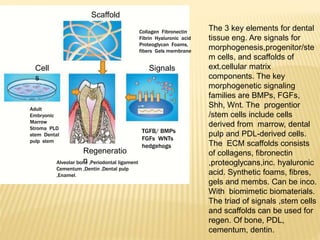
 Surface geometry ,porosity , pore size, bulk properties are critical. Triad
of morphogens, stem cells and scaffolds are prerequisite for tissue eng.
Scaffold
Collagen Fibronectin
Fibrin Hyaluronic acid
Proteoglycan Foams,
fibers Gels membrane
SignalsCell
s
Adult
Embryonic
Marrow
Stroma PLD
stem Dental
pulp stem
Regeneratio
nAlveolar bone ,Periodontal ligament
Cementum ,Dentin ,Dental pulp
,Enamel.
TGFB/ BMPs
FGFs WNTs
hedgehogs
The 3 key elements for dental
tissue eng. Are signals for
morphogenesis,progenitor/ste
m cells, and scaffolds of
ext.cellular matrix
components. The key
morphogenetic signaling
families are BMPs, FGFs,
Shh, Wnt. The progentior
/stem cells include cells
derived from marrow, dental
pulp and PDL-derived cells.
The ECM scaffolds consists
of collagens, fibronectin
,proteoglycans,inc. hyaluronic
acid. Synthetic foams, fibres,
gels and membs. Can be inco.
With biomimetic biomaterials.
The triad of signals ,stem cells
and scaffolds can be used for
regen. Of bone, PDL,
cementum, dentin.
REGENERATION OF DENTIN –PULP COMPLEX
 Dentin-pulp complex protects teeth from caries and trauma by maintaining
hydration of extracellular matrix.
 Goal of endodontics and cons.dentistry- restore/regenerate dentin-pulp
complex to maintain vitality , function and aesthetics of teeth.
 BMPs might have a therapeutic role in endo. As evidenced by role of BMP4
in inductive epithelial mesenchymal interaction; effects of demineralized
tooth matrix on repair of amputated pulp.
 Ideal therapy- anti- inflammatory ; antibacterial-stimulates proliferation of
pulp stem cells-induce diff. into odontoblasts - enhance healing potential
,rapid dentin formation.
 Using an in vivo model, M. Nakashima demo. that recom. Human BMP2
AND BMP4 can induce new dentin.
 Reparative dentin is also induced on freshly cut healthy pulp tissue in non
human primate using recom. human BMP7 with an insoluble type I collagen
matrix.
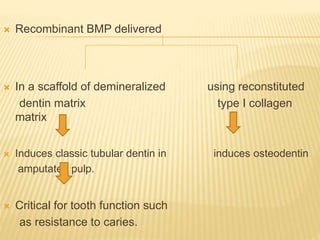
 Recombinant BMP delivered
 In a scaffold of demineralized using reconstituted
dentin matrix type I collagen
matrix
 Induces classic tubular dentin in induces osteodentin
amputated pulp.
 Critical for tooth function such
as resistance to caries.
 Size ,shape of inductive material controls size and shape of
reparative dentin.
 Reparative dentin initially appears with cellular and soft tissue
inclusions, a portion of which changes into a more tubular form of
matrix with associated odontoblasts like cells attached to mass of
atubular matrix .
 Hence, ext. matrix scaffolding is a critical component & a prerequisite
to odontoblast differentiation and tubular dentin formation.
 Optimally engineered reparative dentin may consist of a combination
of osteodentin and tubular dentin.
PERIODONTAL REGENERATION
 The periodontium( cementum, PDL, alv. Bone) functions to
anchor the teeth to the jaws.
 Critical challenge for clinical dentistry: application of tissue
engineering concepts to obtain total regeneration of
periodontium
 Ultimate goal of peri.reg. –restoration of functional anchorage
of teeth by foll. sequential steps:
i)restoration of PDL ,inc. optimal orientation, insertion of Sharpey’s
fibers into exposed root surfaces and bone.
ii)formation of new cementum by cementoblasts on root’s surface.
iii)restoration of alv. Bone to CEJ.
 Morphogenetic potential of BMPs make them ideal
candidates for use in periodontal regeneration.
 Using a baboon model, recom. BMP7 and baboon type I
collagen has been used as a biomimetic scaffold to reg,
surgical created furcation defects in molars.
 Healing of a perio. Wound is complicated by several factors
that limit predictable delivery of agents to root surface:
perimucosal envir. Of avascular mineralized tooth surface
traversing ging. soft tissue; complex microbiota.
 Early approaches- curettage, open-flap debridement, bone
grafts.
 Results : variable, unpredictable becoz of paucity of
progenitor cells; presence of microbes in perio. environment,
periodontium enriched in matrix metalloproteinases and
may be detrimental to inductive signals, inc.
morphogens,growth factors, responding stem cells,
scaffolds.
 Migration of ging. epi. onto root surface is inhibitory to
periodontal reg. The technique of GTR has been key in
preventing epithelial migration.
 To obtain optimal outcome,this may be improved by
combining osteo – inductive bone grafts with a membrane
barrier.
CRANIOFACIAL REGENERATION AND IMPLANTS
 The remarkable capacity of BMPs to induce bone has set stage for
their application in craniofacial surgery for correcting acquired or
inherited craniofacial anomalies, the effects of head trauma, to treat
large bone defects after excision of neoplasms.
 Administration of single recom. BMP(2,4,7) can initiate entire
cascade of osteogenesis .When used in supraphysiological doses,
can stimulate bone resorption and turnover, eliciting a
counterproductive response rather than achieving intended objective
of bone formation, BMP also used for repair of maxillary sinus and
filling of regen. tissue in extraction sockets.
 Metallic implants might also benefit from combined use with
BMPs. For an implant to be placed correctly, it must be stably
anchored in alv. Bone.
 BMPs may be used to stimulate bone growth in and around
metallic implants to attain optimal integration of dental implants
in jaw bone.
 It could offset loosening of teeth caused by micromotion,
thermal or pressure necrosis and/or osteolysis.
 Two studies demo. that host-tissue response to be dependent
on dose of BMPs and collagen carrier.
CONCLUSION
 Although our understanding of molecular pathways underlying
tooth morphogenesis and reg. is increasing, the translation of
this knowledge into dental tissue engineering strategies
remains in its early stages. In the near term , it is likely that
recombinant protein morphogens recently approved by FDA,
such as BMP2, BMP7, could be applied in dentistry to facilitate
the repair of craniofacial structures. Looking ahead, further
characterization and analysis of dental pulp stem cells may
permit new types endodontic therapy (either alone or in
combination with BMPs) and the refinement of biomimetic
scaffolds may facilitate novel approaches to periodontal
surgery.
THANK U

Bone morphogentic protein

  • 1.
    THE APPLICATION OFBONE MORPHOGENETIC PROTEINS TO DENTAL TISSUE ENGINEERING A review article by: Misako Nakashima & A Hari Reddi Source :- NATURE BIOTECHNOLOGY, VOLUME 21, NO. 9, SEPT 2003 Presented by:- ROSHNI MAURYA
  • 2.
    INTRODUCTION Progress in understandingthe role of bone morphogenetic proteins (BMPs) in craniofacial and tooth development , demonstration of stem cells in dental pulp and accumulating knowledge on biomaterial scaffolds have set the stage for tissue engineering and regenerative therapy of craniofacial complex. Recent approval of FDA (Rockville, MD, USA) of recombinant human BMPs for accelerating bone fusion in slow-healing fractures indicates that this protein family may prove useful in designing regenerative treatments in dental applications. In future, these advances are likely to be applied to endodontics and periodontal surgery; that may facilitate approaches to regenerating whole teeth for use in tooth replacement.
  • 3.
     The Craniofacialcomplex includes :- a)Teeth b)Periodontium c)Bones d)Salivary glands e)TMJ  Homeostasis and maintenance of teeth, along with periodontal structures anchoring them into alveolar bones of the jaws, deteriorate progressively both with age and metabolic maladies (diabetes ; osteoporosis).  Acc to US National Institute of Dental and Craniofacial Research (Bethesda, MD, USA) . a) 86% of adults over 70 yrs associated with moderate periodontitiis, b) over a quarter have lost their teeth. Therefore , in aged decline in tooth function has serious repercussion for health and quality of life.
  • 4.
     Tissue engineeringoffers a new option to supplement existing treatment regimes for periodontal disease.  Potential of regenerative treatment in this fields will require integration of 3 keys elements :- a) inductive morphogenetic signals b) responding progenitor / stem cells c) extracellular matrix scaffold  These elements must be combined to facilitate a development cascade of pattern formation ; craniofacial plan establishment and creation of mirror – image bilateral symmetry of teeth in maxilla and mandible.[ oral cavity offers distinct advantages such as ease of observation and accessibility].  It will also require a recapitulation of some of the mechanism of embryonic development and morphogenesis.
  • 5.
    MORPHOGENS:-  Are extracellularlysecreted signals governing morphogenesis during epithelial mesenchymal interactions.  Comprise 4 evolutionarily conserved protein families :- a) BMPs , b) FGFs , c) Hhs , d) Wnts  These protein families exhibit redundant and reiterative signaling, each with distinct temporal and spatial expression during initiation, pattern formation, morphogenesis and cytodifferentiation.  They govern pattering and morphogenesis of teeth and associated periodontal structures .  The promise of oral tissue engineering is that applications of recombinant morphogens, regenerative progenitor / stem cell in appropriate scaffolds; and ultimately gene therapies will enable new dental treatments for caries, endodontic, periodontal and oral-maxillofacial surgery , alveolar ridge augmentation and
  • 6.
    Enamel Dentin Pulp Gingiva Alv.bone Cementum Periodontium PDL Fracture Alv. ridgeTMJ Endodontics Periodontal Implant Craniofacial structures and treatments . a)structure of human tooth . the tooth is surrounded by perio. And is anchored in alv.bone of maxilla or mandible . the pulp has progenitor/stem cells for repair and regen. Of dentin by odontoblasts in response to BMPs. B) BMPs have been demo. In preclinical studies to have potential for tissue eng. And regen. Of alv.bone , alv. ridge augmentation, cartilage repair in TMJ, oral implants, endodontics treatment and regen. Of periodontal tissues.
  • 7.
     Among fourdistinct families of morphogens, BMPs alone appear to be sufficient for regeneration of dental tissues in adults. Therefore ,limiting the focus on BMPs and stem cells, the present review describe what is :- a) known about tooth morphogenesis and b) discussing the mechanism by which BMPs modulate stem cell biology. c) how extracellular environment influences morphogen action d) integration of these components into tissue engineering approaches.
  • 8.
    TOOTH MORPHOGENESIS  Itis initiated by dynamic, reciprocal interactions between ectodermally derived stomodeal epithelium and mesenchyme derived from neural crest.  Process commences with thickening of oral epithelium and formation of dental lamina, which then buds into the mesenchyme  During initiation, there is invagination of epithelium into neural crest-derived ectomesenchyme.  In subsequent ‘cap’ and ‘bell’ stages, tooth crown is established by folding of epithelium.  Mesenchyme surrounded by dental epithelium forms dental papilla tooth pulp and dentin.
  • 9.
     Peripheral cellsof dental mesenchyma forms dental follicle , extends around dental epi. → enamel organ.  Finally, teeth erupt into oral cavity after crown morphogenesis is complete.  Enamel knot forms in enamel organ epi. , is an organizing center for tooth morphogenesis ; regulates pattern formation and teeth shape.  During development and morphogenesis of teeth, periodontium orchestrates anchoring of teeth in alveolar bone. The PDL arises from inner layer of dental follicle after initiation of root development  Migration of dental follicle to dentin leads to cementoblasts differentiation
  • 10.
    Reciprocal and reiterativesignaling during tooth morphogenesis. Intricate, dynamic and reciprocal interactions occur between ectodermally derived enamel organ epithelium and neural-crest mesenchyma. Four key families of morphogens (BMPs, FGFs, Shh and Wnts) are involved in signaling between the epithelium and mesenchyma in an orchestrated spatial and temporal sequence. The tooth bud develops into the cap and bell stages before eruption. The enamel knot is a signaling center with a critical role in tooth morphogenesis. Enamel Dentin Pulp Enamel knot Dental lamina Initiation Bud stage Cap stage Bell stage
  • 11.
     Epithelial mesenchymalinteractions are critical for PDL formation and are accompanied by expression of genes encoding cell surface proteoglycans , extracellular matrix glycoproteins, TGF Beta-1 and Beta-2 and Msx-like homeoproteins.  Fibronectin implicated in migration of mesenchymal cells into spaces b/w epithelial cells and their differentiation into fibroblasts of PDL and precise anchoring of PDL fibrils to root surface.
  • 12.
     during dentalepithelial mesenchyma development, BMPs and FGFs, Hhs and Wnts are expressed in distinct intracellular signaling cascades.  BMPs ; FGFs : a) upregulate expression of many genes b) induce proliferation in mesenchyme.  Wnt. family members (20 in humans) signal via frizzled family of cell surface receptors.  Wnt signaling Active (present) Inactive (absent) Activates frizzled receptor Glycogen synthase kinase (GSK – 3) phosphorylates beta-catenin GSK 3 activity blocked Beta - catenin stable degradation by proteosomes. Translocated to nucleus binds to LEF /T-cell transcription factor Activates transcription of Wnt responsive
  • 13.
     Sonic hedgehog(Shh) :- Critical for regulating growth and shaping teeth; binds to patched receptor as well as transmembrane protein , smoothened. This signal activates transcription factors of Gli family (critical for carniofacial and tooth morphogenesis )  Members of Wnt and Shh families are mutually inhibitory . Such reciprocal regulatory interaction are critical in establishing distinct boundaries b/w oral dental ectoderm during tooth development and morphogenesis.
  • 14.
    BONE MORPHOGENTIC PROTEIN:-  Bone grafts have been used for over a century by orthopedic surgeons to aid recalcitrant bone union.  In 1965, Urist made the key discovery that demineralized, lyophilized segments of rabbit bone induce new bone in intramuscular sites.  Subsequently, BMPs were isolated from adult bone matrix in 4M guanidine, heparin affinity chromatography and preparative electrophoresis.  Activity of reconstituted purified BMPs assayed by implantation with insoluble collagenous bone matrix in vivo.  Resultant stage of new bone development are reminiscent of embryonic bone morphogenesis, complete with 3 key steps:- a) chemotaxis, b) mitosis, c) differentiation of progenitor /stem cells.
  • 15.
     Human genomeencodes 20 BMPs. These are dimeric molecules critically dependent on single intermolecular disulfide bone for biological activity.  Monomeric subunit has about 120 aa, including conserved cysteine residues.  BMP family BMP 2 ; 4 BMP 3 ; BMP 3B (GDF 10) BMP 5, 6, 7, 8 GDFs 5, 6, 7  BMP1 not a member of BMP family, a procollagen C proteinase involved in proteolytic processing of soluble procollagen, leading to self assembly of insoluble collagen fibers in extracellular matrix.
  • 16.
     A singlerecombination BMP can have pleiotropic effects on different steps in bone morphogenesis depending on its conc.:- higher conc. Promote mitogenesis and differentiation femtomolar conc. Promote chemotaxis.
  • 17.
     BMPs playpivotal roles in development of brain, eyes, heart, kidneys, skin, bones and teeth .  Actions includes establishment of body plan, initiation and maintenance during regeneration of bone; formation of skeletal tissue during embryogenesis, growth and remodeling ; induction and creation of new bone.  In post-natal skeleton, BMPs are intimately associated with collagenous extracellular matrix and are localized in periosteal cells and in mesenchymal cells of marrow stroma during fracture repair.
  • 18.
     BMPs areimplicated in inductive interactions b/w dental epi. and mesenchyme in a stage dependent, reiteractive manner.  BMPs 2, 4, 7 are expressed in dental epi.; recombinant BMPs 2, 4 can be used as substitute for dental epi. in inducing mesenchyme differentiation.  BMPs expressed in enamel knot are associated with differentiating odontoblasts and ameloblasts.
  • 19.
     BMP3 andBMP7 immunolocalized to developing alveolar bone.  BMP2 localized only in alveolar bone during root morphogenesis.  BMP3: role in cementoblasts lineage by its localization in root lining cells  Expression of members of BMP family in rat incisor dental pulp during different stages of odontoblasts development.
  • 20.
    BMP and TGFbeta signaling ligands, receptors and transcription. LIGANDS RECEPTOR S SIGNALING COMPLEXE S TRANSCRIPTI ON
  • 21.
    PROGENITOR STEM CELLS Studies indicate that progenitor/stem cells are present both in dental pulp and in the PDL . During wound healing, dental pulp cells have the potential to proliferate and to differentiate into odontoblasts to form dentin.  It is accompanied by the expression of dentin matrix protein 1, dentin sialoprotein (Dsp) and dentin phosphoprotein (Dpp)  .In addition, both increased expression of osteocalcin (a marker for differentiated odontoblasts) and matrix mineralization occurs during the culture period
  • 22.
     When transplantedinto ectopic sites in immunocompromised mice, cells isolated from human dental pulp give rise to dentin-like structures lined with odontoblast-like cells.  A recent paper also reports the presence of stem cells in exfoliated deciduous human teeth .Together, these results provide evidence that the pulp contains pulp progenitor/stem cells.  Although specific markers for the dental pulp stem cells have yet to be characterized, cultured pulp cells express BMP2, BMP4, BMP6 and BMP7 mRNA and their receptors in a stage-dependent manner. In response to treatment with recombinant human BMP2, pulp-derived mesenchymal cells differentiate into dentin-forming odontoblasts
  • 23.
     An ongoingchallenge for the field is to isolate progenitor stem cells with well-defined markers from both dental pulp tissue and PDL and to expand these cell types in vitro.  Current research in several centers is focusing on the isolation of universal human stem cells with defined markers that potentially could be used to circumvent immune histocompatibility barriers. Such cells ultimately may allow the development of stem cells for use as shuttle vectors in cellular/gene therapy.
  • 24.
    GENE THERAPY ANDTOOTH REPAIR  Gene therapy approach has clear advantages:  As half life of BMPs is limiting and high conc. are require to induce tissue regeneration, morphogen production from transduced tissues is advantageous compared to direct application of protein.  Ease of visual observation and accessibility of mouth/oral cavity makes these tissues more amenable to gene delivery approaches than visceral organs and tissues. Thus, delivery methods like electroporation or sonoporation have been used to transfer the Gdf11 gene(encodes BMP11) to amputated dental pulp, stimulating formation of reparative dentin.
  • 25.
    EXTRACELLULAR MATRIX ANDBIOMIMETIC SCAFFOLDS  Tissue engineering of teeth and associated tissues requires that the scaffolding of the extracellular matrix be faithfully duplicated. Both developing and adult teeth are surrounded by the PDL and anchored to alveolar bone by cementum. These connective tissues have in common an extracellular matrix that includes collagens, proteoglycans, an assortment of noncollagenous glycoproteins
  • 26.
     Laboratories (A.H.Reddi)have shown that critical role of extracellular matrix substrata in bone induction by BMPs. Esp. in craniofacial morphogenesis and regeneration (contact-mediated; short range).  Recombinant BMP4 binds to heparan sulfate, heparin, types I and IV collagen of extracellular matrix; thus tether active morphogens to confer optimal conformation and perhaps protect them from proteolysis.  Binding soluble BMP4 to an extracellular matrix component converts morphogen into a solid state initiate contact mediated interactions modulated by extracellular matrix.
  • 27.
     BMPs bindsto collagen I and IV; type II procollagen, heparan sulfate, fibrillins, proteoglycans, BMP binding proteins noggin, chordin and DAN. Noggin- an BMP antagonist; interact with heparan sulfate and heparin in extracellular matrix.  Rate of release of growth factor from scaffold can profoundly affect results of tissues of tissue eng. strategies. Polylactic glycolic acid; polyethylene glycol copolymers (used in implantable devices) are effective in releasing growth factors; are useful in BMP delivery.
  • 28.
     Pharmacokinetics ofrecombinant BMP in conjunction with biomaterials (collagen,hydroxyapatite) may be different from kinetics in alv. bone periodontium and teeth as retention is dependent on charge characteristics and isoelectric point of morphogens  Mineral phase in alv. bone ,cementum and teeth is carbonate rich hydroxyapatite. Affinity of proteins for HDA makes it a natural protein delivery system.  Comparison of potential carriers of BMPs- collagen,HDA,TCP,glass beads and PMMC,a bone cement: revealed that insoluble collagen and HDA are optimal for bone induction.
  • 29.
     In caseof HDA, geometry of scaffold is imp. Discs of it with BMPs are osteo-inductive, whereas granules are consistently feeble in bone induction, even their chemical composition and pore sizes are identical. Cellular and molecular mechanism underlying this role is unclear.  Demineralized tooth matrix can also elicit new bone formation.A.H.Reddi shown that geometry of demin. tooth matrix derived from lower incisors of rats influences induced phenotype.When whole demin. incisors are implanted s.c.,cartilage from in pulp chamber and persists.
  • 30.
     When apicalportion of tooth is amputated and resulting tooth tubes are implanted, cartilage formation is transient in middle of tube and is replaced completely by bone. In this instance , angiogenesis and vascular invasion from both sides of tooth tube result in bone formation throughout .These exp. Demo. Critical role of geometry of matrix scaffold in determining developmental outcome.  Methods; dose of irradiation have a profound effect on outcome. A.H. Reddi published work demonstrating that irradiation by a CO 60 source at doses exceeding 5 mega RADs may lead to premature mineralization of implanted matrix.  Extracellular matrix in alv.bone, periodontium and teeth releases morphogens locally to elicit bone repair .Tissue scaffolding is crucial in healing segmental defects .It functions as a delivery system and as an osteoconductive substratum.  Surface geometry ,porosity , pore size, bulk properties are critical. Triad of morphogens, stem cells and scaffolds are prerequisite for tissue eng.
  • 31.
    Scaffold Collagen Fibronectin Fibrin Hyaluronicacid Proteoglycan Foams, fibers Gels membrane SignalsCell s Adult Embryonic Marrow Stroma PLD stem Dental pulp stem Regeneratio nAlveolar bone ,Periodontal ligament Cementum ,Dentin ,Dental pulp ,Enamel. TGFB/ BMPs FGFs WNTs hedgehogs The 3 key elements for dental tissue eng. Are signals for morphogenesis,progenitor/ste m cells, and scaffolds of ext.cellular matrix components. The key morphogenetic signaling families are BMPs, FGFs, Shh, Wnt. The progentior /stem cells include cells derived from marrow, dental pulp and PDL-derived cells. The ECM scaffolds consists of collagens, fibronectin ,proteoglycans,inc. hyaluronic acid. Synthetic foams, fibres, gels and membs. Can be inco. With biomimetic biomaterials. The triad of signals ,stem cells and scaffolds can be used for regen. Of bone, PDL, cementum, dentin.
  • 32.
    REGENERATION OF DENTIN–PULP COMPLEX  Dentin-pulp complex protects teeth from caries and trauma by maintaining hydration of extracellular matrix.  Goal of endodontics and cons.dentistry- restore/regenerate dentin-pulp complex to maintain vitality , function and aesthetics of teeth.  BMPs might have a therapeutic role in endo. As evidenced by role of BMP4 in inductive epithelial mesenchymal interaction; effects of demineralized tooth matrix on repair of amputated pulp.  Ideal therapy- anti- inflammatory ; antibacterial-stimulates proliferation of pulp stem cells-induce diff. into odontoblasts - enhance healing potential ,rapid dentin formation.  Using an in vivo model, M. Nakashima demo. that recom. Human BMP2 AND BMP4 can induce new dentin.  Reparative dentin is also induced on freshly cut healthy pulp tissue in non human primate using recom. human BMP7 with an insoluble type I collagen matrix.
  • 33.
     Recombinant BMPdelivered  In a scaffold of demineralized using reconstituted dentin matrix type I collagen matrix  Induces classic tubular dentin in induces osteodentin amputated pulp.  Critical for tooth function such as resistance to caries.
  • 34.
     Size ,shapeof inductive material controls size and shape of reparative dentin.  Reparative dentin initially appears with cellular and soft tissue inclusions, a portion of which changes into a more tubular form of matrix with associated odontoblasts like cells attached to mass of atubular matrix .  Hence, ext. matrix scaffolding is a critical component & a prerequisite to odontoblast differentiation and tubular dentin formation.  Optimally engineered reparative dentin may consist of a combination of osteodentin and tubular dentin.
  • 35.
    PERIODONTAL REGENERATION  Theperiodontium( cementum, PDL, alv. Bone) functions to anchor the teeth to the jaws.  Critical challenge for clinical dentistry: application of tissue engineering concepts to obtain total regeneration of periodontium  Ultimate goal of peri.reg. –restoration of functional anchorage of teeth by foll. sequential steps: i)restoration of PDL ,inc. optimal orientation, insertion of Sharpey’s fibers into exposed root surfaces and bone. ii)formation of new cementum by cementoblasts on root’s surface. iii)restoration of alv. Bone to CEJ.
  • 36.
     Morphogenetic potentialof BMPs make them ideal candidates for use in periodontal regeneration.  Using a baboon model, recom. BMP7 and baboon type I collagen has been used as a biomimetic scaffold to reg, surgical created furcation defects in molars.  Healing of a perio. Wound is complicated by several factors that limit predictable delivery of agents to root surface: perimucosal envir. Of avascular mineralized tooth surface traversing ging. soft tissue; complex microbiota.
  • 37.
     Early approaches-curettage, open-flap debridement, bone grafts.  Results : variable, unpredictable becoz of paucity of progenitor cells; presence of microbes in perio. environment, periodontium enriched in matrix metalloproteinases and may be detrimental to inductive signals, inc. morphogens,growth factors, responding stem cells, scaffolds.  Migration of ging. epi. onto root surface is inhibitory to periodontal reg. The technique of GTR has been key in preventing epithelial migration.  To obtain optimal outcome,this may be improved by combining osteo – inductive bone grafts with a membrane barrier.
  • 38.
    CRANIOFACIAL REGENERATION ANDIMPLANTS  The remarkable capacity of BMPs to induce bone has set stage for their application in craniofacial surgery for correcting acquired or inherited craniofacial anomalies, the effects of head trauma, to treat large bone defects after excision of neoplasms.  Administration of single recom. BMP(2,4,7) can initiate entire cascade of osteogenesis .When used in supraphysiological doses, can stimulate bone resorption and turnover, eliciting a counterproductive response rather than achieving intended objective of bone formation, BMP also used for repair of maxillary sinus and filling of regen. tissue in extraction sockets.
  • 39.
     Metallic implantsmight also benefit from combined use with BMPs. For an implant to be placed correctly, it must be stably anchored in alv. Bone.  BMPs may be used to stimulate bone growth in and around metallic implants to attain optimal integration of dental implants in jaw bone.  It could offset loosening of teeth caused by micromotion, thermal or pressure necrosis and/or osteolysis.  Two studies demo. that host-tissue response to be dependent on dose of BMPs and collagen carrier.
  • 40.
    CONCLUSION  Although ourunderstanding of molecular pathways underlying tooth morphogenesis and reg. is increasing, the translation of this knowledge into dental tissue engineering strategies remains in its early stages. In the near term , it is likely that recombinant protein morphogens recently approved by FDA, such as BMP2, BMP7, could be applied in dentistry to facilitate the repair of craniofacial structures. Looking ahead, further characterization and analysis of dental pulp stem cells may permit new types endodontic therapy (either alone or in combination with BMPs) and the refinement of biomimetic scaffolds may facilitate novel approaches to periodontal surgery.
  • 41.