Guided by ; Presented by
Mrs. DEEPA M U Ajmal khan N
Asst. Pro., EEE Dept. Roll. No: 03
EEE, S7
1
CONTENTS
 INTRODUCTION
 FLYBACK CONVERTER
 CHALLENGES OF FLYBACK CONVERTER
 DISCONTINUOUS CURRENT MODE
 BLOCK DIAGRAM
 CONVERTER DESCRIPTION AND OPERATING PRINCIPLE
 CONVERTER ANALYSIS
 FLYBACK TRANSFORMER DESIGN
 CONTROL SYSTEM DESIGN
 SIMULATION RESULTS
 EXPERIMENTAL RESULTS
 CONCLUSION
 REFERENCES
2
INTRODUCTION
 Electricity is the most versatile and widely used form of
energy.
 It’s global demand is increasing.
 The solar energy is considered as the most renewable
and freely available source of energy.
 The research and development in the solar field is in rise.
 The low cost is greatly important.
3
FLYBACK CONVERTER
 It’s the lowest cost converter among the isolated
topologies-it uses least number of components.
 It combines the inductor with the transformer.
 In other type of isolated topologies the inductor and
the transformer are separate elements.
 Inductor is responsible for energy storage , while the
transformer is responsible for energy transfer.
4
CHALLENGES OF FLYBACK
CONVERTER TO HIGH POWER
 Transformer with relatively large energy storage is
always a challenge.
 For large energy storage it needs large air gap.
Large
air
gap
Magnetizing inductance
Leakage inductance
Poor coupling
Poor energy transfer efficiencyLeads to
5
Discontinuous Current Mode
 Advantages
 Very fast dynamic
response-better
stability.
 No reverse recovery
problem.
 No turn on losses
 Easy control.
 Small size of the
transformer.
 Disadvantages
 Higher form factor.
 More power loss.
 Current pulses-large peak ,high
discontinuity.
6
What is the solution?????
 INTERLEAVING OF CELLS
 Interleaving of high power flyback stages-increases the
ripple component at the waveform-proportion to the no.
of interleaved cells.
 Which leads to easy filtering and using smaller sized
filtering elements.
 current in each cells –less peak but same amount of
discontinuity.
7
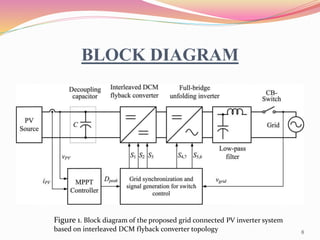
BLOCK DIAGRAM
Figure 1. Block diagram of the proposed grid connected PV inverter system
based on interleaved DCM flyback converter topology 8
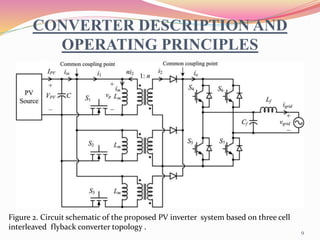
CONVERTER DESCRIPTION AND
OPERATING PRINCIPLES
Figure 2. Circuit schematic of the pr0posed PV inverter system based on three cell
interleaved flyback converter topology .
9
 OPERATION
 When flyback switches are turned on-current flows from
PV to magnetizing inductance of flyback transformer-
energy is stored.
 During on time no current flows to the output
 Therefore energy is supplied by the capacitor Cf &
inductor Lf.
10
 When switches are off ,energy stored is transferred
into the grid in the form of current.
 To reduce the variations at the terminal volatge a
decoupling capacitor is placed at the flyback converter
output.
 The full bridge inverter used for unfolding the
sinusoidally modulated dc current back to ac at the
right moment of the grid voltage.
11
CONVERTER ANALYSIS
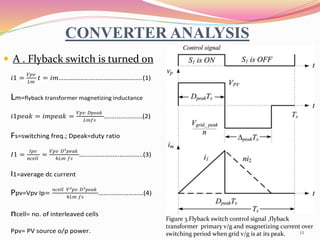
 A . Flyback switch is turned on
Figure 3.Flyback switch control signal ,flyback
transformer primary v/g and magnetizing current over
switching period when grid v/g is at its peak.
𝑖1 =
𝑉𝑝𝑣
𝐿𝑚
𝑡 = 𝑖𝑚…………………………………………..(1)
Lm=flyback transformer magnetizing inductance
𝑖1𝑝𝑒𝑎𝑘 = 𝑖𝑚𝑝𝑒𝑎𝑘 =
𝑉𝑝𝑣 𝐷𝑝𝑒𝑎𝑘
𝐿𝑚𝑓𝑠
.....................(2)
Fs=switching freq.; Dpeak=duty ratio
𝐼1 =
𝐼𝑝𝑣
𝑛𝑐𝑒𝑙𝑙
=
𝑉𝑝𝑣 𝐷²𝑝𝑒𝑎𝑘
4𝐿𝑚 𝑓𝑠
………………………………..(3)
I1=average dc current
Ppv=Vpv Ip=
𝑛𝑐𝑒𝑙𝑙 𝑉²𝑝𝑣 𝐷²𝑝𝑒𝑎𝑘
4𝐿𝑚 𝑓𝑠
………………………(4)
ncell= no. of interleaved cells
Ppv= PV source o/p power. 12
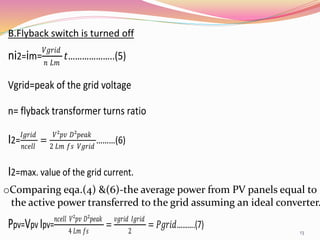
B.Flyback switch is turned off
ni2=im=
𝑉𝑔𝑟𝑖𝑑
𝑛 𝐿𝑚
𝑡………………..(5)
Vgrid=peak of the grid voltage
n= flyback transformer turns ratio
I2=
𝐼𝑔𝑟𝑖𝑑
𝑛𝑐𝑒𝑙𝑙
=
𝑉²𝑝𝑣 𝐷²𝑝𝑒𝑎𝑘
2 𝐿𝑚 𝑓𝑠 𝑉𝑔𝑟𝑖𝑑
………(6)
I2=max. value of the grid current.
oComparing eqa.(4) &(6)-the average power from PV panels equal to
the active power transferred to the grid assuming an ideal converter.
Ppv=Vpv Ipv=
𝑛𝑐𝑒𝑙𝑙 𝑉²𝑝𝑣 𝐷²𝑝𝑒𝑎𝑘
4 𝐿𝑚 𝑓𝑠
=
𝑣𝑔𝑟𝑖𝑑 𝐼𝑔𝑟𝑖𝑑
2
= 𝑃𝑔𝑟𝑖𝑑……….(7)
13
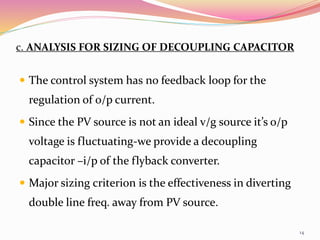
c. ANALYSIS FOR SIZING OF DECOUPLING CAPACITOR
 The control system has no feedback loop for the
regulation of o/p current.
 Since the PV source is not an ideal v/g source it’s o/p
voltage is fluctuating-we provide a decoupling
capacitor –i/p of the flyback converter.
 Major sizing criterion is the effectiveness in diverting
double line freq. away from PV source.
14
 Peak to peak voltage ripple across the decoupling capacitor,
ΔVpv=ΔVc= Xc ΔIc………..(8) ΔIc= current ripple
 CONVERTER ANALYSIS
 Switching freq. is 40khz-higher efficiency with smaller sized
magnetics.
 A clamp or a snubber is provided to keep switching transients
within safe operating area .
 Flyback transformer will use the most optimum winding
strategy for the lowest leakage inductance practically
possible.
𝑐 ≥
2𝐼𝑝𝑣
2𝜋100 𝛥𝑉𝑝𝑣
…………….(9)
15
Flyback Transformer Design
 Air gap length of the flyback transformer can be found
using….
 Lowest leakage inductance can be achieved by……
 Making coil & core heights longer
 Reducing the number of winding layers –less space b/t layers.
 Using sandwiched windings –magnetic field inside the
window area is reduced-reduces leakage inductance.
𝑙𝑔 =
𝑁²µ˳ 𝐴𝑐𝑜𝑟𝑒
𝐿𝑚
16
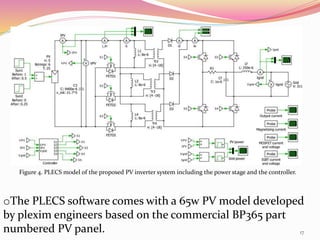
Figure 4. PLECS model of the proposed PV inverter system including the power stage and the controller.
oThe PLECS software comes with a 65w PV model developed
by plexim engineers based on the commercial BP365 part
numbered PV panel. 17
CONTROL SYSTEM DESIGN
 The control system is designed for two functions
simultaneously without feedback loop.
 Harvesting the max. power & pump the power to utility
grid with high quality.
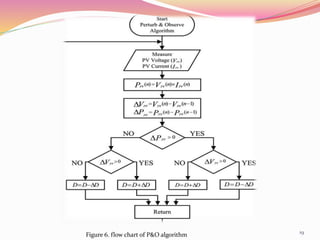
 Because of implementation simplicity, the perturb and
observe (P&O) method is selected .
 Figure 6 shows the flow chart of the P&O algorithm
implemented in the DSP controller.
18
Figure 6. flow chart of P&O algorithm 19
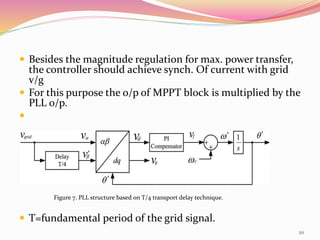
 Besides the magnitude regulation for max. power transfer,
the controller should achieve synch. Of current with grid
v/g
 For this purpose the o/p of MPPT block is multiplied by the
PLL o/p.

 T=fundamental period of the grid signal.
Figure 7. PLL structure based on T/4 transport delay technique.
20
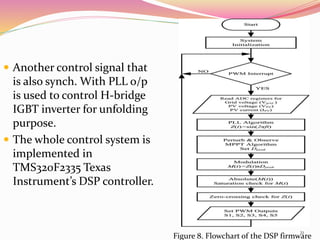
 Another control signal that
is also synch. With PLL o/p
is used to control H-bridge
IGBT inverter for unfolding
purpose.
 The whole control system is
implemented in
TMS320F2335 Texas
Instrument’s DSP controller.
Figure 8. Flowchart of the DSP firmware
21
SIMULATION RESULTS
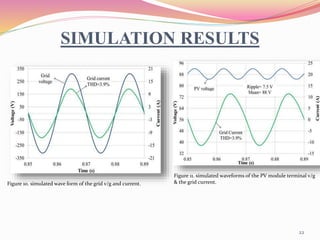
Figure 10. simulated wave form of the grid v/g and current.
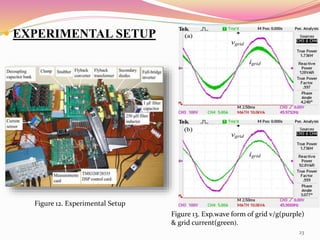
Figure 11. simulated waveforms of the PV module terminal v/g
& the grid current.
22
 EXPERIMENTAL SETUP
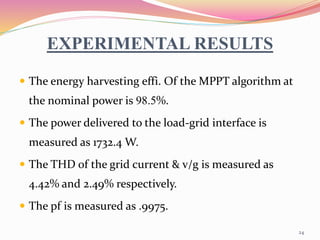
Figure 12. Experimental Setup
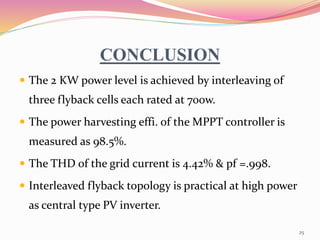
Figure 13. Exp.wave form of grid v/g(purple)
& grid current(green).
23
EXPERIMENTAL RESULTS
 The energy harvesting effi. Of the MPPT algorithm at
the nominal power is 98.5%.
 The power delivered to the load-grid interface is
measured as 1732.4 W.
 The THD of the grid current & v/g is measured as
4.42% and 2.49% respectively.
 The pf is measured as .9975.
24
CONCLUSION
 The 2 KW power level is achieved by interleaving of
three flyback cells each rated at 700w.
 The power harvesting effi. of the MPPT controller is
measured as 98.5%.
 The THD of the grid current is 4.42% & pf =.998.
 Interleaved flyback topology is practical at high power
as central type PV inverter.
25
REFERENCES
[1] Solar energy (2013, July 23). [Online]. Available: http://www.conserveenerg
future.com/SolarEnergy.php.
[2] Europe Photovoltaic Industry Association (EPIA) (2013, July 23) Global market
outlook for photovoltaics 2013–2017.
[3] Y. Xue, L. Chang, S. B. Kjaer, J. Bordonau, and T. Shimizu, “Topologies of
single-phase inverters for small distributed power generators: An overview,”
IEEE Trans. Power Electron., vol. 19, no. 5, pp. 1305–1314, Sep. 2004.
[4] S. B. Kjaer, J. K. Pedersen, and F. Blaabjerg, “A review of singlephase grid-
connected inverters for photovoltaic modules,” IEEE Trans. Ind. Appl., vol. 41,
no. 5, pp. 1292–1306, Sep. 2005.
26

FLYBACK CONVERTER PPT

  • 1.
    Guided by ;Presented by Mrs. DEEPA M U Ajmal khan N Asst. Pro., EEE Dept. Roll. No: 03 EEE, S7 1
  • 2.
    CONTENTS  INTRODUCTION  FLYBACKCONVERTER  CHALLENGES OF FLYBACK CONVERTER  DISCONTINUOUS CURRENT MODE  BLOCK DIAGRAM  CONVERTER DESCRIPTION AND OPERATING PRINCIPLE  CONVERTER ANALYSIS  FLYBACK TRANSFORMER DESIGN  CONTROL SYSTEM DESIGN  SIMULATION RESULTS  EXPERIMENTAL RESULTS  CONCLUSION  REFERENCES 2
  • 3.
    INTRODUCTION  Electricity isthe most versatile and widely used form of energy.  It’s global demand is increasing.  The solar energy is considered as the most renewable and freely available source of energy.  The research and development in the solar field is in rise.  The low cost is greatly important. 3
  • 4.
    FLYBACK CONVERTER  It’sthe lowest cost converter among the isolated topologies-it uses least number of components.  It combines the inductor with the transformer.  In other type of isolated topologies the inductor and the transformer are separate elements.  Inductor is responsible for energy storage , while the transformer is responsible for energy transfer. 4
  • 5.
    CHALLENGES OF FLYBACK CONVERTERTO HIGH POWER  Transformer with relatively large energy storage is always a challenge.  For large energy storage it needs large air gap. Large air gap Magnetizing inductance Leakage inductance Poor coupling Poor energy transfer efficiencyLeads to 5
  • 6.
    Discontinuous Current Mode Advantages  Very fast dynamic response-better stability.  No reverse recovery problem.  No turn on losses  Easy control.  Small size of the transformer.  Disadvantages  Higher form factor.  More power loss.  Current pulses-large peak ,high discontinuity. 6
  • 7.
    What is thesolution?????  INTERLEAVING OF CELLS  Interleaving of high power flyback stages-increases the ripple component at the waveform-proportion to the no. of interleaved cells.  Which leads to easy filtering and using smaller sized filtering elements.  current in each cells –less peak but same amount of discontinuity. 7
  • 8.
    BLOCK DIAGRAM Figure 1.Block diagram of the proposed grid connected PV inverter system based on interleaved DCM flyback converter topology 8
  • 9.
    CONVERTER DESCRIPTION AND OPERATINGPRINCIPLES Figure 2. Circuit schematic of the pr0posed PV inverter system based on three cell interleaved flyback converter topology . 9
  • 10.
     OPERATION  Whenflyback switches are turned on-current flows from PV to magnetizing inductance of flyback transformer- energy is stored.  During on time no current flows to the output  Therefore energy is supplied by the capacitor Cf & inductor Lf. 10
  • 11.
     When switchesare off ,energy stored is transferred into the grid in the form of current.  To reduce the variations at the terminal volatge a decoupling capacitor is placed at the flyback converter output.  The full bridge inverter used for unfolding the sinusoidally modulated dc current back to ac at the right moment of the grid voltage. 11
  • 12.
    CONVERTER ANALYSIS  A. Flyback switch is turned on Figure 3.Flyback switch control signal ,flyback transformer primary v/g and magnetizing current over switching period when grid v/g is at its peak. 𝑖1 = 𝑉𝑝𝑣 𝐿𝑚 𝑡 = 𝑖𝑚…………………………………………..(1) Lm=flyback transformer magnetizing inductance 𝑖1𝑝𝑒𝑎𝑘 = 𝑖𝑚𝑝𝑒𝑎𝑘 = 𝑉𝑝𝑣 𝐷𝑝𝑒𝑎𝑘 𝐿𝑚𝑓𝑠 .....................(2) Fs=switching freq.; Dpeak=duty ratio 𝐼1 = 𝐼𝑝𝑣 𝑛𝑐𝑒𝑙𝑙 = 𝑉𝑝𝑣 𝐷²𝑝𝑒𝑎𝑘 4𝐿𝑚 𝑓𝑠 ………………………………..(3) I1=average dc current Ppv=Vpv Ip= 𝑛𝑐𝑒𝑙𝑙 𝑉²𝑝𝑣 𝐷²𝑝𝑒𝑎𝑘 4𝐿𝑚 𝑓𝑠 ………………………(4) ncell= no. of interleaved cells Ppv= PV source o/p power. 12
  • 13.
    B.Flyback switch isturned off ni2=im= 𝑉𝑔𝑟𝑖𝑑 𝑛 𝐿𝑚 𝑡………………..(5) Vgrid=peak of the grid voltage n= flyback transformer turns ratio I2= 𝐼𝑔𝑟𝑖𝑑 𝑛𝑐𝑒𝑙𝑙 = 𝑉²𝑝𝑣 𝐷²𝑝𝑒𝑎𝑘 2 𝐿𝑚 𝑓𝑠 𝑉𝑔𝑟𝑖𝑑 ………(6) I2=max. value of the grid current. oComparing eqa.(4) &(6)-the average power from PV panels equal to the active power transferred to the grid assuming an ideal converter. Ppv=Vpv Ipv= 𝑛𝑐𝑒𝑙𝑙 𝑉²𝑝𝑣 𝐷²𝑝𝑒𝑎𝑘 4 𝐿𝑚 𝑓𝑠 = 𝑣𝑔𝑟𝑖𝑑 𝐼𝑔𝑟𝑖𝑑 2 = 𝑃𝑔𝑟𝑖𝑑……….(7) 13
  • 14.
    c. ANALYSIS FORSIZING OF DECOUPLING CAPACITOR  The control system has no feedback loop for the regulation of o/p current.  Since the PV source is not an ideal v/g source it’s o/p voltage is fluctuating-we provide a decoupling capacitor –i/p of the flyback converter.  Major sizing criterion is the effectiveness in diverting double line freq. away from PV source. 14
  • 15.
     Peak topeak voltage ripple across the decoupling capacitor, ΔVpv=ΔVc= Xc ΔIc………..(8) ΔIc= current ripple  CONVERTER ANALYSIS  Switching freq. is 40khz-higher efficiency with smaller sized magnetics.  A clamp or a snubber is provided to keep switching transients within safe operating area .  Flyback transformer will use the most optimum winding strategy for the lowest leakage inductance practically possible. 𝑐 ≥ 2𝐼𝑝𝑣 2𝜋100 𝛥𝑉𝑝𝑣 …………….(9) 15
  • 16.
    Flyback Transformer Design Air gap length of the flyback transformer can be found using….  Lowest leakage inductance can be achieved by……  Making coil & core heights longer  Reducing the number of winding layers –less space b/t layers.  Using sandwiched windings –magnetic field inside the window area is reduced-reduces leakage inductance. 𝑙𝑔 = 𝑁²µ˳ 𝐴𝑐𝑜𝑟𝑒 𝐿𝑚 16
  • 17.
    Figure 4. PLECSmodel of the proposed PV inverter system including the power stage and the controller. oThe PLECS software comes with a 65w PV model developed by plexim engineers based on the commercial BP365 part numbered PV panel. 17
  • 18.
    CONTROL SYSTEM DESIGN The control system is designed for two functions simultaneously without feedback loop.  Harvesting the max. power & pump the power to utility grid with high quality.  Because of implementation simplicity, the perturb and observe (P&O) method is selected .  Figure 6 shows the flow chart of the P&O algorithm implemented in the DSP controller. 18
  • 19.
    Figure 6. flowchart of P&O algorithm 19
  • 20.
     Besides themagnitude regulation for max. power transfer, the controller should achieve synch. Of current with grid v/g  For this purpose the o/p of MPPT block is multiplied by the PLL o/p.   T=fundamental period of the grid signal. Figure 7. PLL structure based on T/4 transport delay technique. 20
  • 21.
     Another controlsignal that is also synch. With PLL o/p is used to control H-bridge IGBT inverter for unfolding purpose.  The whole control system is implemented in TMS320F2335 Texas Instrument’s DSP controller. Figure 8. Flowchart of the DSP firmware 21
  • 22.
    SIMULATION RESULTS Figure 10.simulated wave form of the grid v/g and current. Figure 11. simulated waveforms of the PV module terminal v/g & the grid current. 22
  • 23.
     EXPERIMENTAL SETUP Figure12. Experimental Setup Figure 13. Exp.wave form of grid v/g(purple) & grid current(green). 23
  • 24.
    EXPERIMENTAL RESULTS  Theenergy harvesting effi. Of the MPPT algorithm at the nominal power is 98.5%.  The power delivered to the load-grid interface is measured as 1732.4 W.  The THD of the grid current & v/g is measured as 4.42% and 2.49% respectively.  The pf is measured as .9975. 24
  • 25.
    CONCLUSION  The 2KW power level is achieved by interleaving of three flyback cells each rated at 700w.  The power harvesting effi. of the MPPT controller is measured as 98.5%.  The THD of the grid current is 4.42% & pf =.998.  Interleaved flyback topology is practical at high power as central type PV inverter. 25
  • 26.
    REFERENCES [1] Solar energy(2013, July 23). [Online]. Available: http://www.conserveenerg future.com/SolarEnergy.php. [2] Europe Photovoltaic Industry Association (EPIA) (2013, July 23) Global market outlook for photovoltaics 2013–2017. [3] Y. Xue, L. Chang, S. B. Kjaer, J. Bordonau, and T. Shimizu, “Topologies of single-phase inverters for small distributed power generators: An overview,” IEEE Trans. Power Electron., vol. 19, no. 5, pp. 1305–1314, Sep. 2004. [4] S. B. Kjaer, J. K. Pedersen, and F. Blaabjerg, “A review of singlephase grid- connected inverters for photovoltaic modules,” IEEE Trans. Ind. Appl., vol. 41, no. 5, pp. 1292–1306, Sep. 2005. 26