Remote control of nanogrids:
a cost-effective solution
in a laboratory setup
Department of Mechanical, Energy
and Management Engineering
Laboratory of Electric Power Systems
and Renewables Energy Sources
G. Barone, A. Burgio, D. Menniti, M. Motta, A. Pinnarelli and N. Sorrentino
Department of Mechanical, Energy and Management Engineering
University of Calabria, Italy
Presenter: Alessandro Burgio
Milan 6-9 June 2017 - IEEE 17th International Conference on Environment and Electrical
Engineering (EEEIC)
Smart Grids Smart Cities Smart World
Demand response programs: “Today’s killer app for Smart Grid” and “The key for
engaging consumers in the Smart Grid”.
Microgrids: integrated platform for supply-side, storage units and demand resources
located in a local distribution grid.
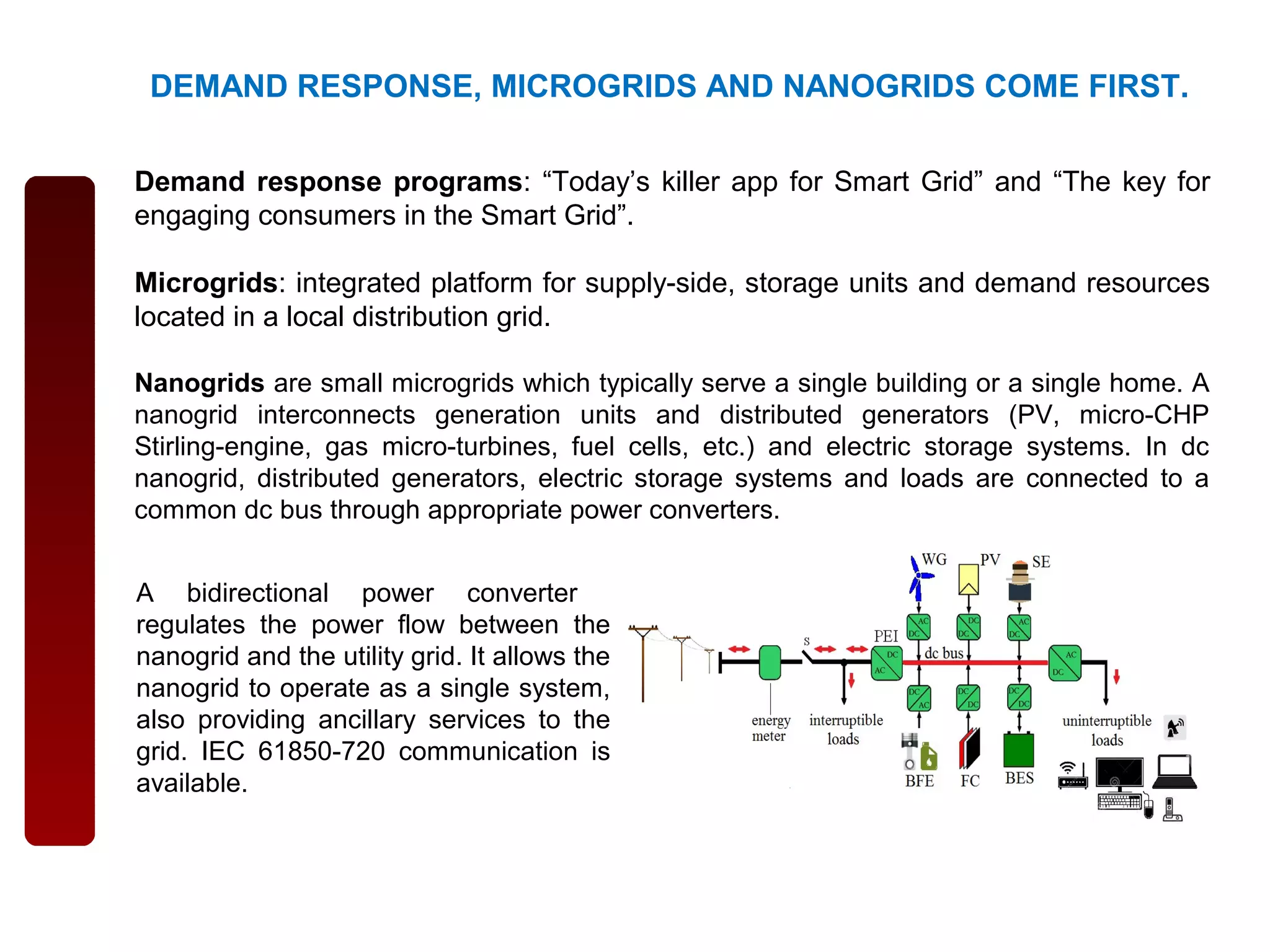
Nanogrids are small microgrids which typically serve a single building or a single home. A
nanogrid interconnects generation units and distributed generators (PV, micro-CHP
Stirling-engine, gas micro-turbines, fuel cells, etc.) and electric storage systems. In dc
nanogrid, distributed generators, electric storage systems and loads are connected to a
common dc bus through appropriate power converters.
A bidirectional power converter
regulates the power flow between the
nanogrid and the utility grid. It allows the
nanogrid to operate as a single system,
also providing ancillary services to the
grid. IEC 61850-720 communication is
available.
DEMAND RESPONSE, MICROGRIDS AND NANOGRIDS COME FIRST.
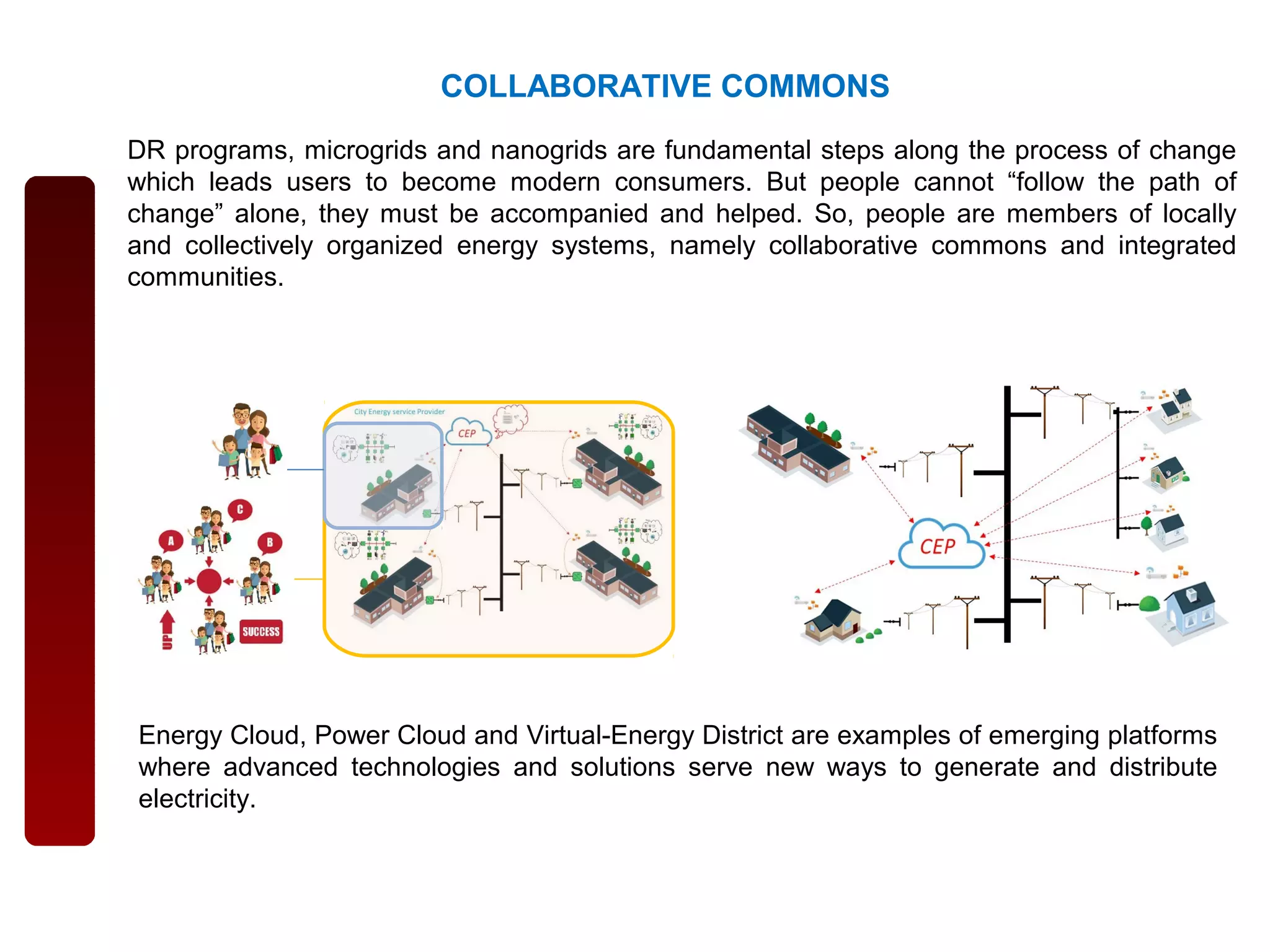
DR programs, microgrids and nanogrids are fundamental steps along the process of change
which leads users to become modern consumers. But people cannot “follow the path of
change” alone, they must be accompanied and helped. So, people are members of locally
and collectively organized energy systems, namely collaborative commons and integrated
communities.
COLLABORATIVE COMMONS
Energy Cloud, Power Cloud and Virtual-Energy District are examples of emerging platforms
where advanced technologies and solutions serve new ways to generate and distribute
electricity.
Citizens may produce energy and participate in the electricity market, selling energy to the
formers. The electricity market is accessible to all citizens that become real market operators
in aggregate form. Such a transformation would have an immediate economic return, relying
on price margins that exist between the wholesale and retail prices.
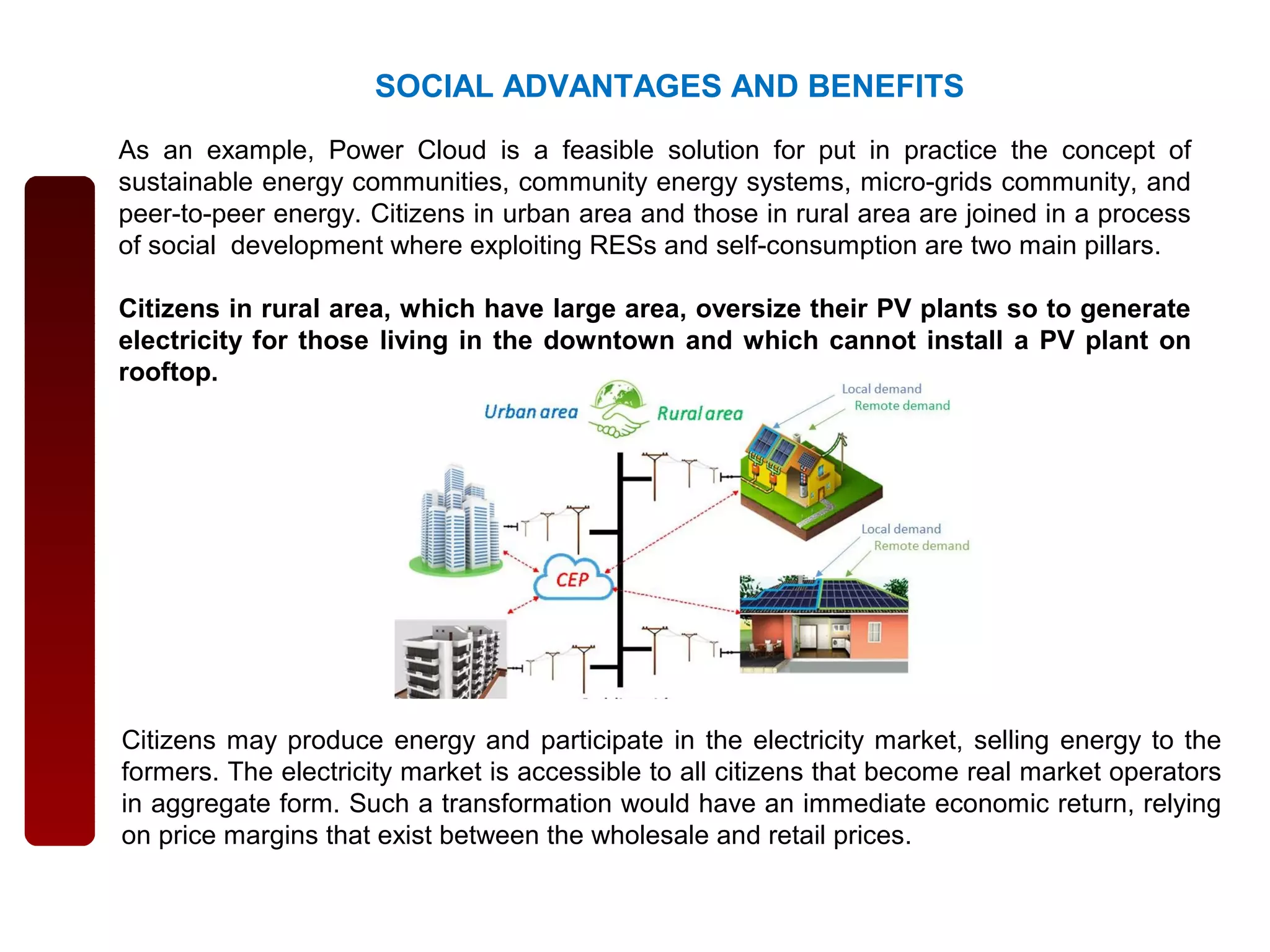
As an example, Power Cloud is a feasible solution for put in practice the concept of
sustainable energy communities, community energy systems, micro-grids community, and
peer-to-peer energy. Citizens in urban area and those in rural area are joined in a process
of social development where exploiting RESs and self-consumption are two main pillars.
Citizens in rural area, which have large area, oversize their PV plants so to generate
electricity for those living in the downtown and which cannot install a PV plant on
rooftop.
SOCIAL ADVANTAGES AND BENEFITS
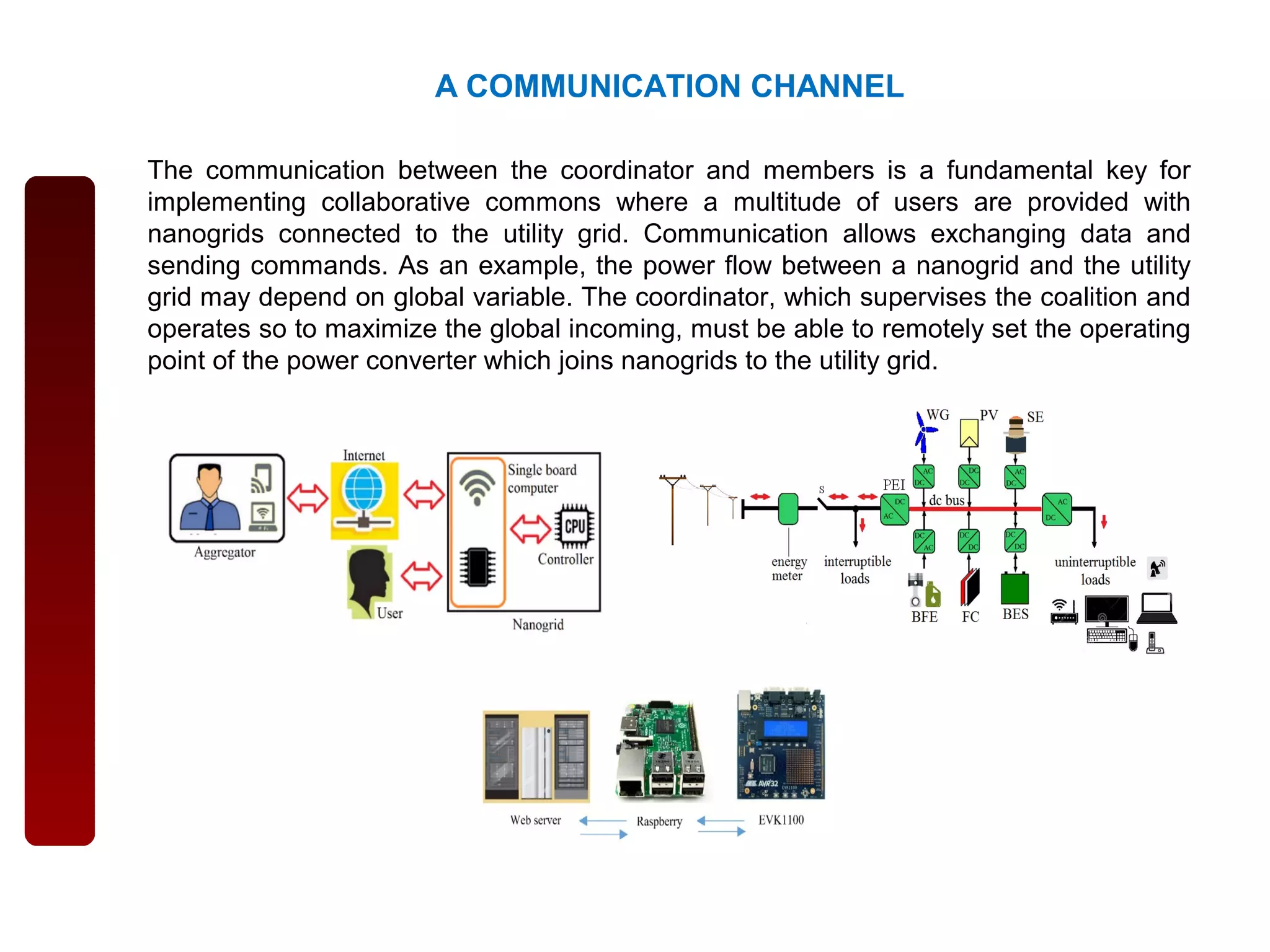
The communication between the coordinator and members is a fundamental key for
implementing collaborative commons where a multitude of users are provided with
nanogrids connected to the utility grid. Communication allows exchanging data and
sending commands. As an example, the power flow between a nanogrid and the utility
grid may depend on global variable. The coordinator, which supervises the coalition and
operates so to maximize the global incoming, must be able to remotely set the operating
point of the power converter which joins nanogrids to the utility grid.
A COMMUNICATION CHANNEL
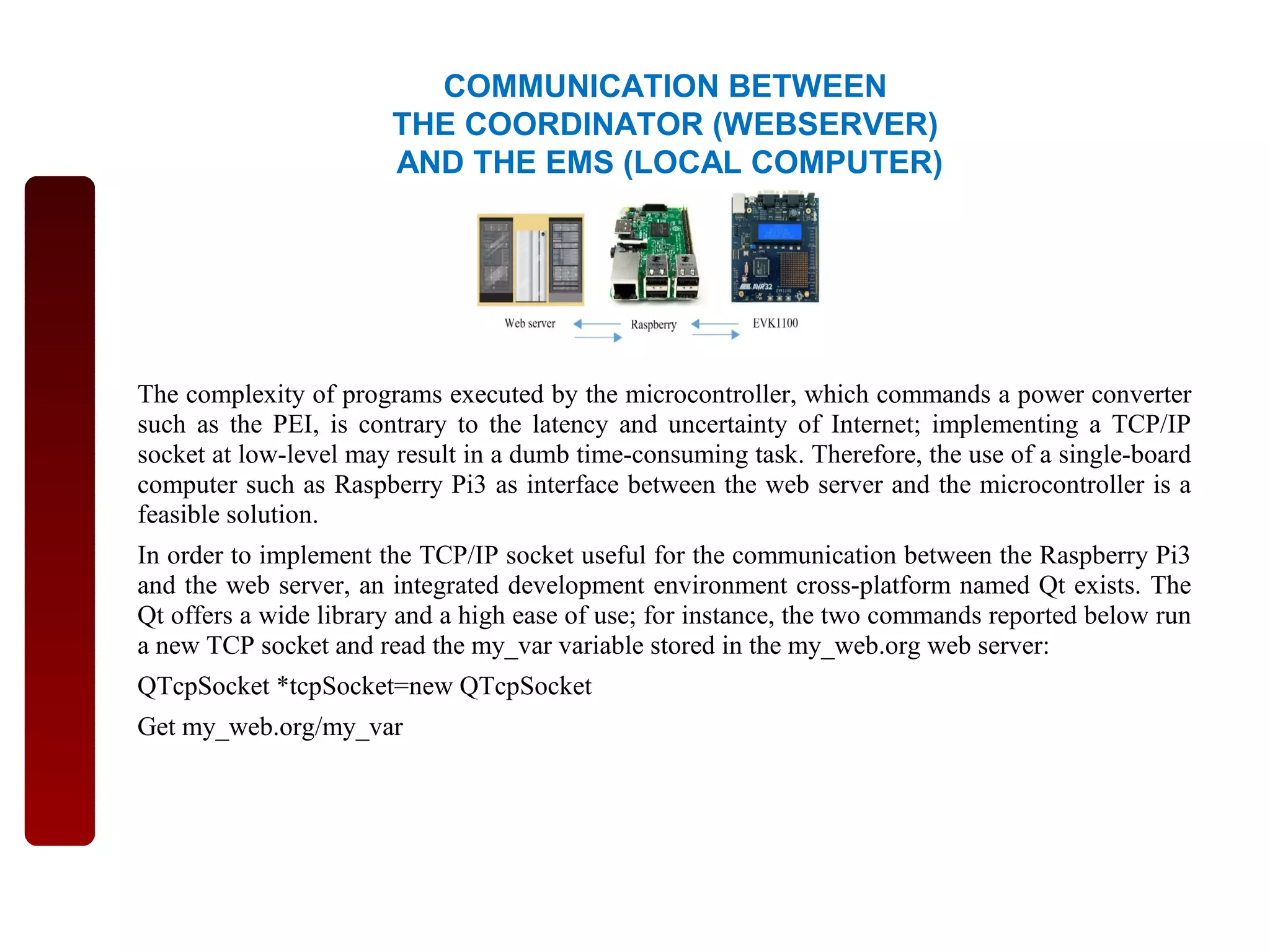
The complexity of programs executed by the microcontroller, which commands a power converter
such as the PEI, is contrary to the latency and uncertainty of Internet; implementing a TCP/IP
socket at low-level may result in a dumb time-consuming task. Therefore, the use of a single-board
computer such as Raspberry Pi3 as interface between the web server and the microcontroller is a
feasible solution.
In order to implement the TCP/IP socket useful for the communication between the Raspberry Pi3
and the web server, an integrated development environment cross-platform named Qt exists. The
Qt offers a wide library and a high ease of use; for instance, the two commands reported below run
a new TCP socket and read the my_var variable stored in the my_web.org web server:
QTcpSocket *tcpSocket=new QTcpSocket
Get my_web.org/my_var
COMMUNICATION BETWEEN
THE COORDINATOR (WEBSERVER)
AND THE EMS (LOCAL COMPUTER)
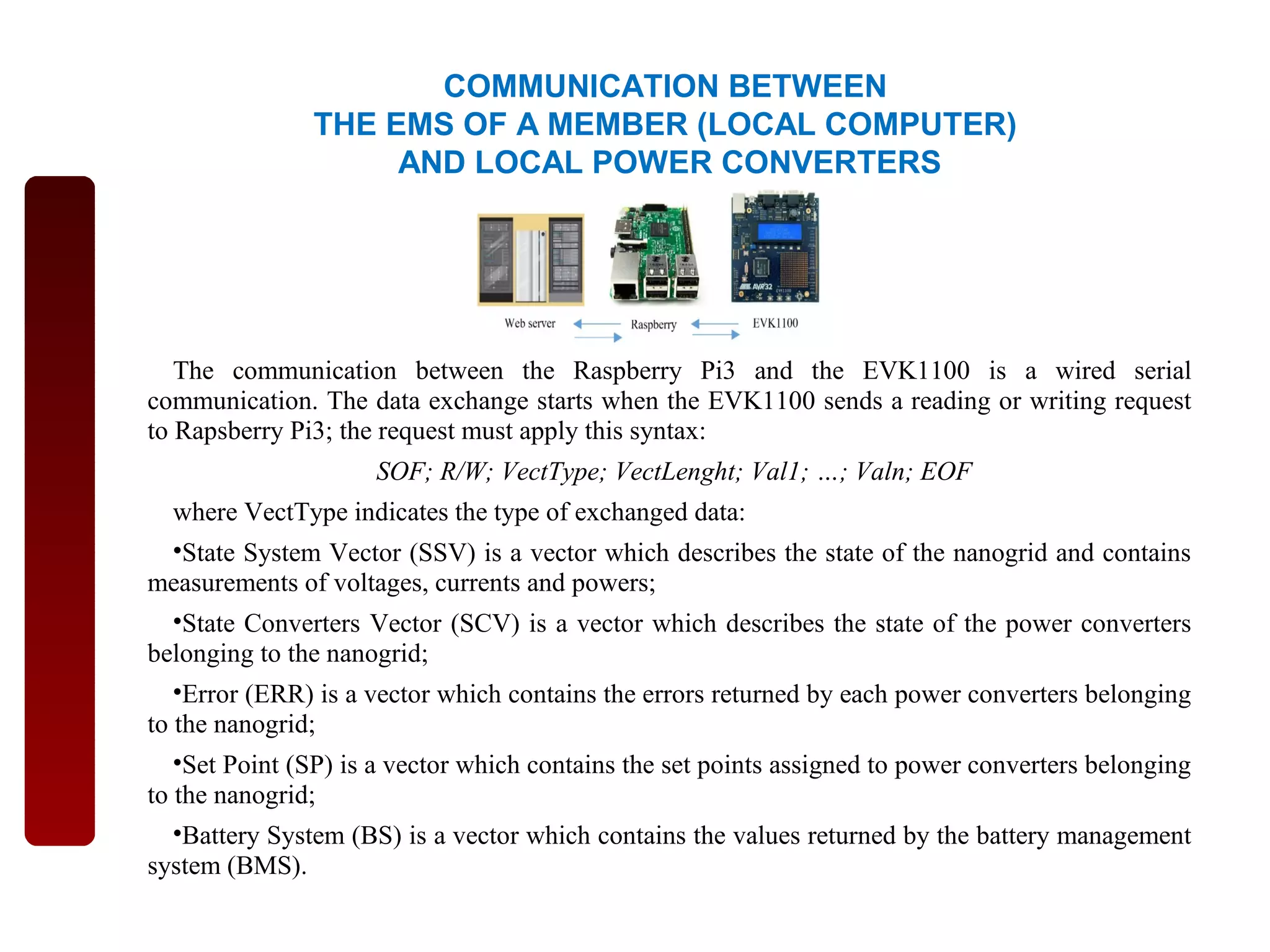
The communication between the Raspberry Pi3 and the EVK1100 is a wired serial
communication. The data exchange starts when the EVK1100 sends a reading or writing request
to Rapsberry Pi3; the request must apply this syntax:
SOF; R/W; VectType; VectLenght; Val1; …; Valn; EOF
where VectType indicates the type of exchanged data:
•State System Vector (SSV) is a vector which describes the state of the nanogrid and contains
measurements of voltages, currents and powers;
•State Converters Vector (SCV) is a vector which describes the state of the power converters
belonging to the nanogrid;
•Error (ERR) is a vector which contains the errors returned by each power converters belonging
to the nanogrid;
•Set Point (SP) is a vector which contains the set points assigned to power converters belonging
to the nanogrid;
•Battery System (BS) is a vector which contains the values returned by the battery management
system (BMS).
COMMUNICATION BETWEEN
THE EMS OF A MEMBER (LOCAL COMPUTER)
AND LOCAL POWER CONVERTERS
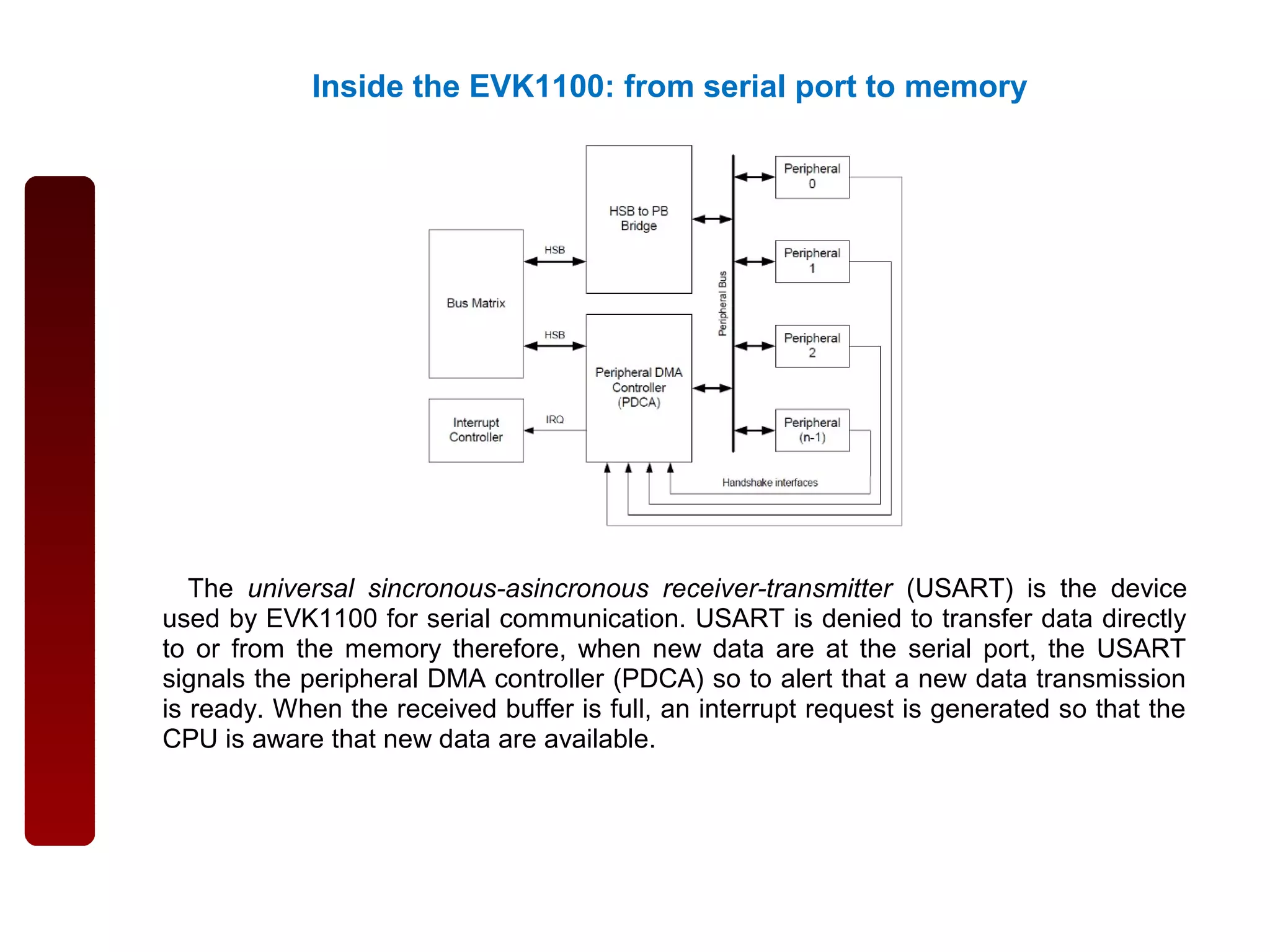
The universal sincronous-asincronous receiver-transmitter (USART) is the device
used by EVK1100 for serial communication. USART is denied to transfer data directly
to or from the memory therefore, when new data are at the serial port, the USART
signals the peripheral DMA controller (PDCA) so to alert that a new data transmission
is ready. When the received buffer is full, an interrupt request is generated so that the
CPU is aware that new data are available.
Inside the EVK1100: from serial port to memory
THE LABORATORY SETUP
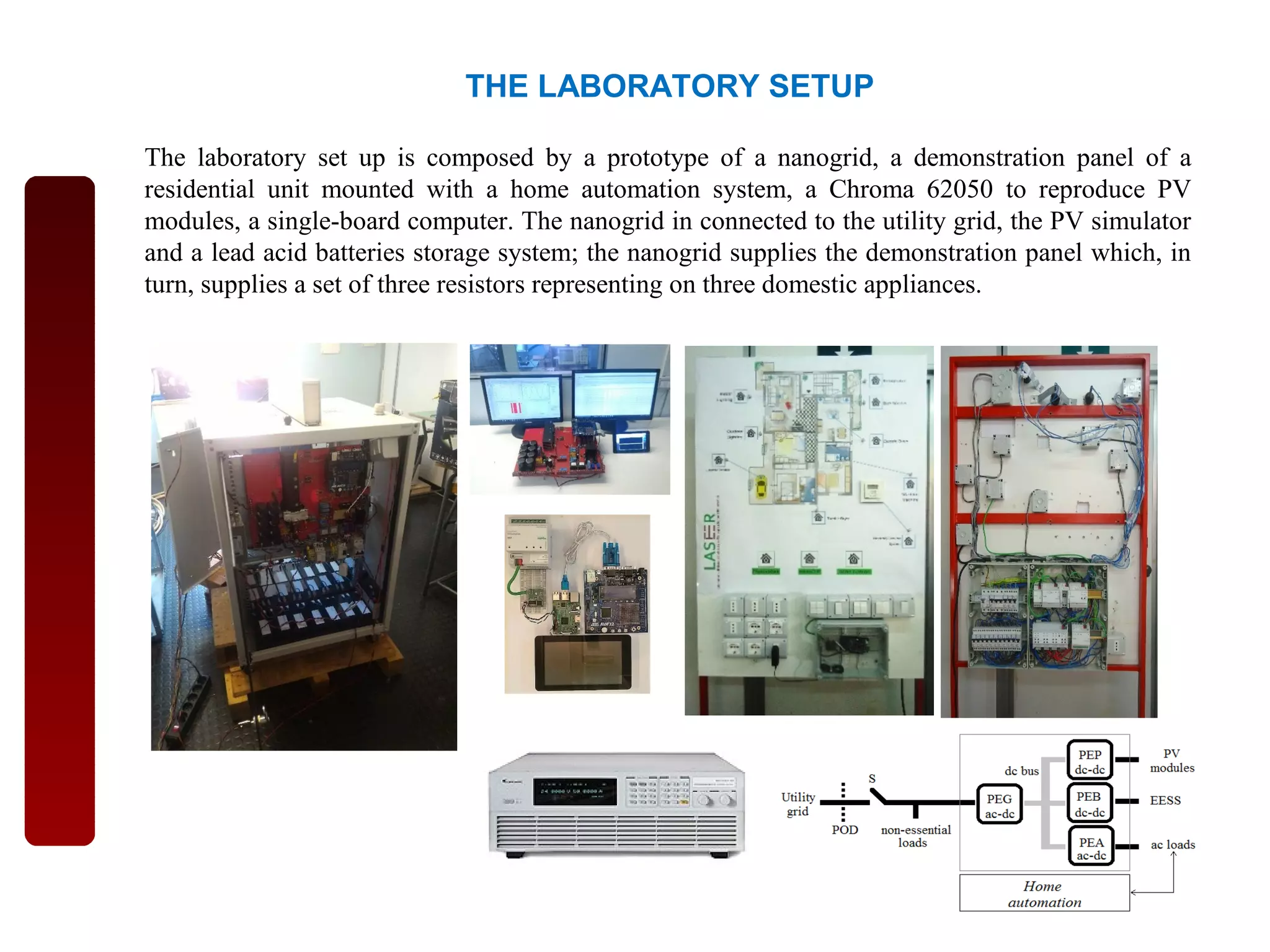
The laboratory set up is composed by a prototype of a nanogrid, a demonstration panel of a
residential unit mounted with a home automation system, a Chroma 62050 to reproduce PV
modules, a single-board computer. The nanogrid in connected to the utility grid, the PV simulator
and a lead acid batteries storage system; the nanogrid supplies the demonstration panel which, in
turn, supplies a set of three resistors representing on three domestic appliances.
THE LABORATORY EXPERIMENT
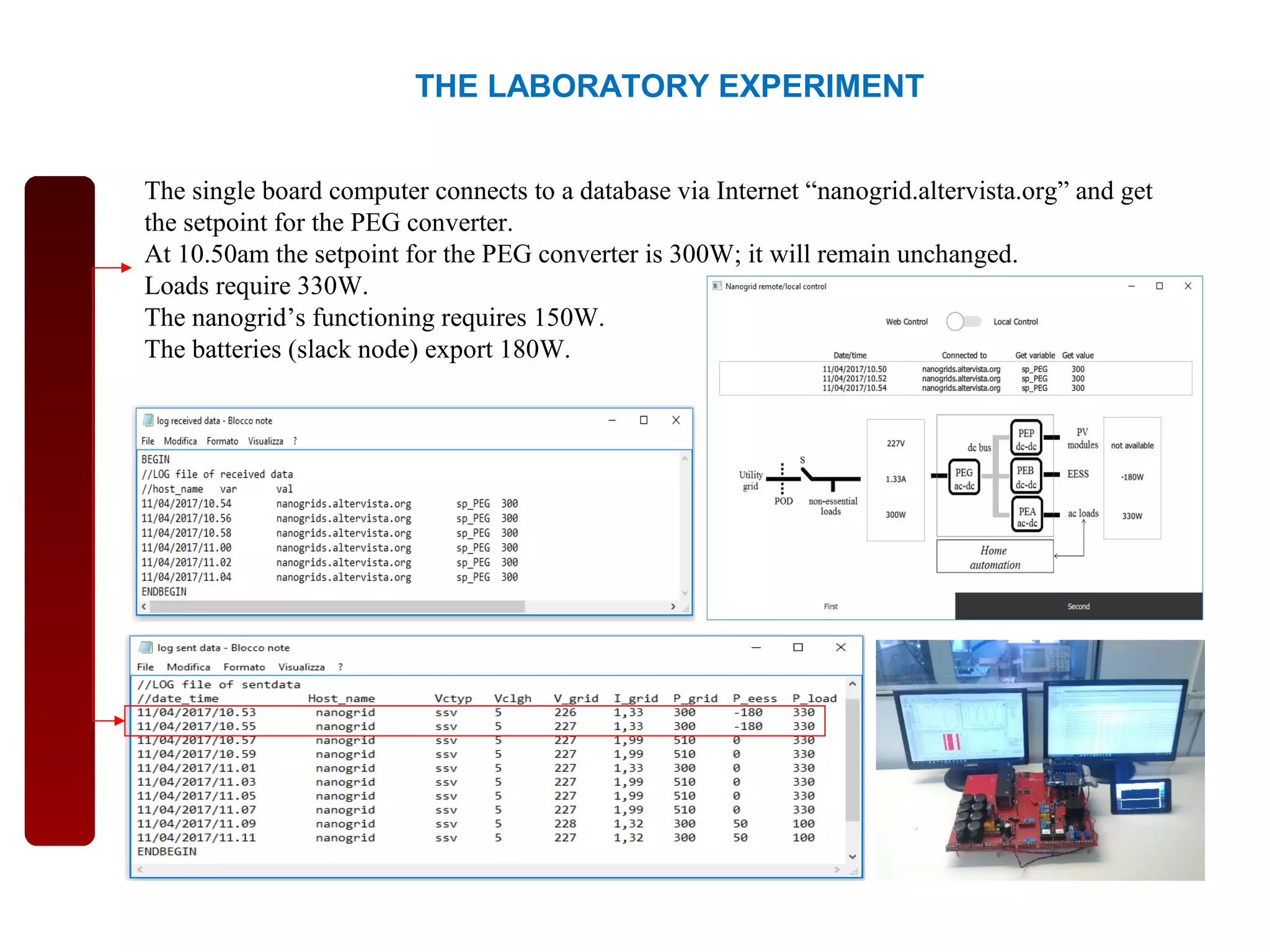
The single board computer connects to a database via Internet “nanogrid.altervista.org” and get
the setpoint for the PEG converter.
At 10.50am the setpoint for the PEG converter is 300W; it will remain unchanged.
Loads require 330W.
The nanogrid’s functioning requires 150W.
The batteries (slack node) export 180W.
THE LABORATORY EXPERIMENT
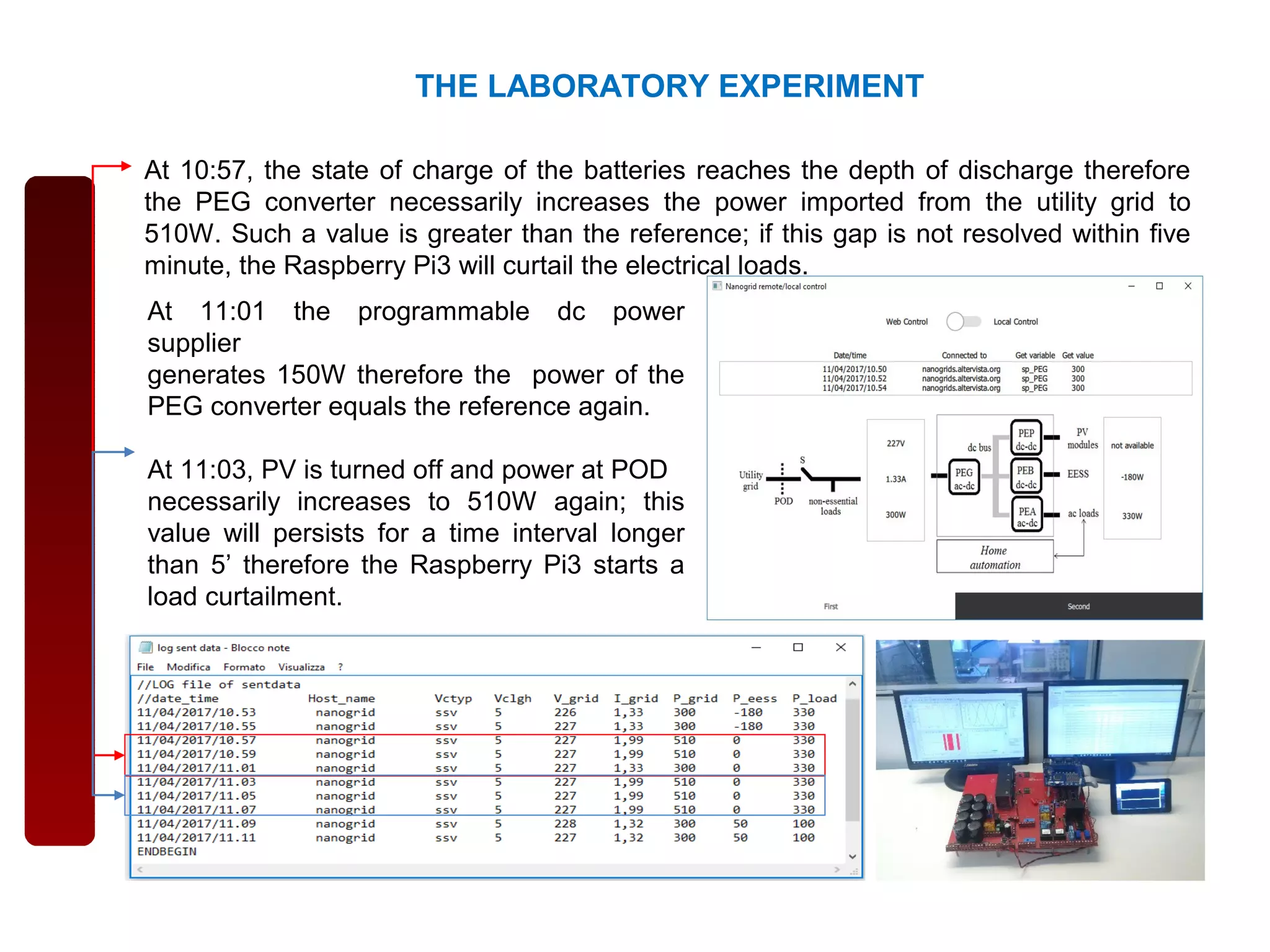
At 10:57, the state of charge of the batteries reaches the depth of discharge therefore
the PEG converter necessarily increases the power imported from the utility grid to
510W. Such a value is greater than the reference; if this gap is not resolved within five
minute, the Raspberry Pi3 will curtail the electrical loads.
At 11:01 the programmable dc power
supplier
generates 150W therefore the power of the
PEG converter equals the reference again.
At 11:03, PV is turned off and power at POD
necessarily increases to 510W again; this
value will persists for a time interval longer
than 5’ therefore the Raspberry Pi3 starts a
load curtailment.
THE LABORATORY EXPERIMENT
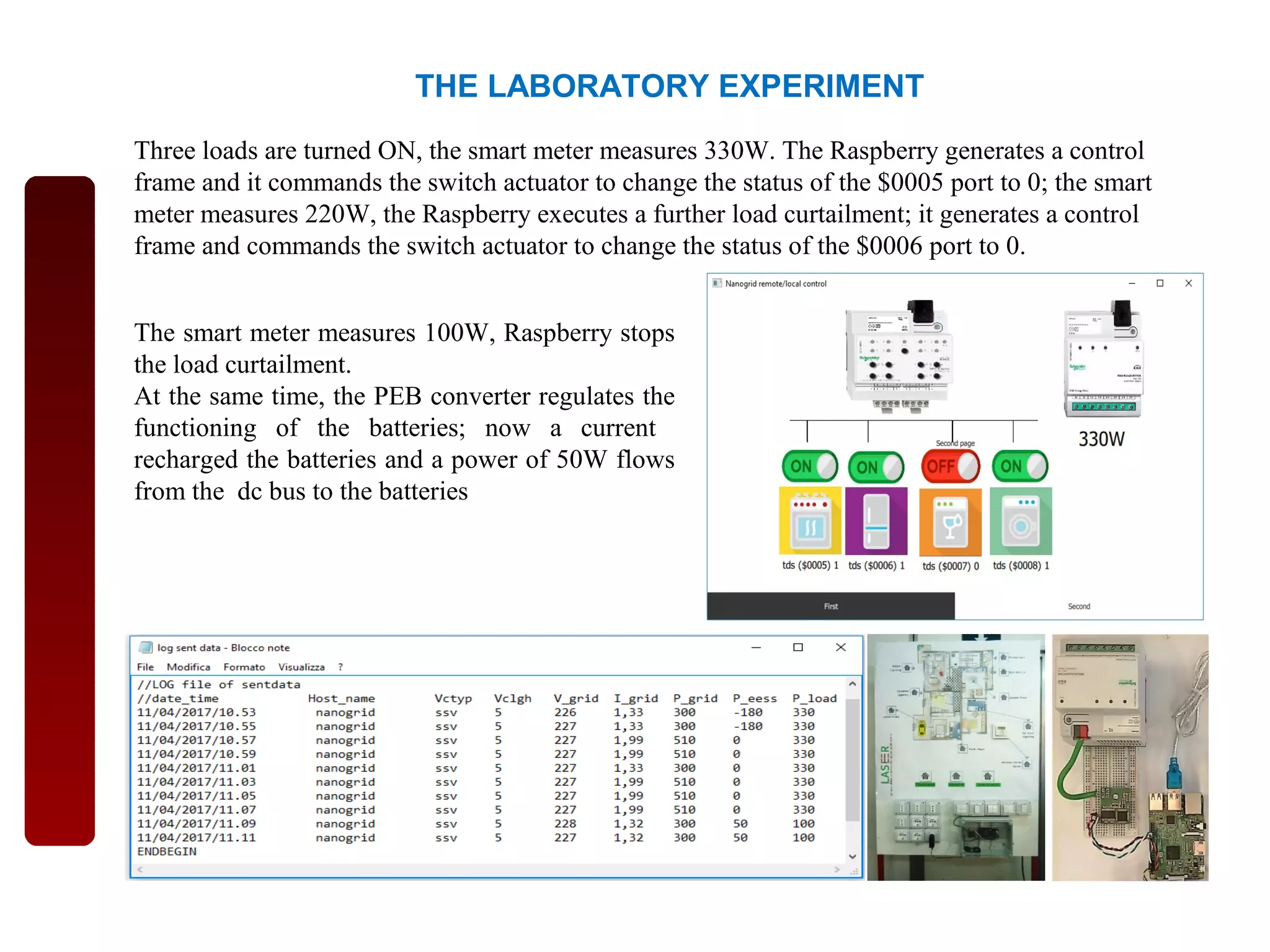
Three loads are turned ON, the smart meter measures 330W. The Raspberry generates a control
frame and it commands the switch actuator to change the status of the $0005 port to 0; the smart
meter measures 220W, the Raspberry executes a further load curtailment; it generates a control
frame and commands the switch actuator to change the status of the $0006 port to 0.
The smart meter measures 100W, Raspberry stops
the load curtailment.
At the same time, the PEB converter regulates the
functioning of the batteries; now a current
recharged the batteries and a power of 50W flows
from the dc bus to the batteries
Thank you for your attention.
alessandro.burgio@unical.it

Remote Control of Nanogrids: a Cost-effective Solution in a Laboratory Setup

  • 1.
    Remote control ofnanogrids: a cost-effective solution in a laboratory setup Department of Mechanical, Energy and Management Engineering Laboratory of Electric Power Systems and Renewables Energy Sources G. Barone, A. Burgio, D. Menniti, M. Motta, A. Pinnarelli and N. Sorrentino Department of Mechanical, Energy and Management Engineering University of Calabria, Italy Presenter: Alessandro Burgio Milan 6-9 June 2017 - IEEE 17th International Conference on Environment and Electrical Engineering (EEEIC)
  • 2.
    Smart Grids SmartCities Smart World
  • 3.
    Demand response programs:“Today’s killer app for Smart Grid” and “The key for engaging consumers in the Smart Grid”. Microgrids: integrated platform for supply-side, storage units and demand resources located in a local distribution grid. Nanogrids are small microgrids which typically serve a single building or a single home. A nanogrid interconnects generation units and distributed generators (PV, micro-CHP Stirling-engine, gas micro-turbines, fuel cells, etc.) and electric storage systems. In dc nanogrid, distributed generators, electric storage systems and loads are connected to a common dc bus through appropriate power converters. A bidirectional power converter regulates the power flow between the nanogrid and the utility grid. It allows the nanogrid to operate as a single system, also providing ancillary services to the grid. IEC 61850-720 communication is available. DEMAND RESPONSE, MICROGRIDS AND NANOGRIDS COME FIRST.
  • 4.
    DR programs, microgridsand nanogrids are fundamental steps along the process of change which leads users to become modern consumers. But people cannot “follow the path of change” alone, they must be accompanied and helped. So, people are members of locally and collectively organized energy systems, namely collaborative commons and integrated communities. COLLABORATIVE COMMONS Energy Cloud, Power Cloud and Virtual-Energy District are examples of emerging platforms where advanced technologies and solutions serve new ways to generate and distribute electricity.
  • 5.
    Citizens may produceenergy and participate in the electricity market, selling energy to the formers. The electricity market is accessible to all citizens that become real market operators in aggregate form. Such a transformation would have an immediate economic return, relying on price margins that exist between the wholesale and retail prices. As an example, Power Cloud is a feasible solution for put in practice the concept of sustainable energy communities, community energy systems, micro-grids community, and peer-to-peer energy. Citizens in urban area and those in rural area are joined in a process of social development where exploiting RESs and self-consumption are two main pillars. Citizens in rural area, which have large area, oversize their PV plants so to generate electricity for those living in the downtown and which cannot install a PV plant on rooftop. SOCIAL ADVANTAGES AND BENEFITS
  • 6.
    The communication betweenthe coordinator and members is a fundamental key for implementing collaborative commons where a multitude of users are provided with nanogrids connected to the utility grid. Communication allows exchanging data and sending commands. As an example, the power flow between a nanogrid and the utility grid may depend on global variable. The coordinator, which supervises the coalition and operates so to maximize the global incoming, must be able to remotely set the operating point of the power converter which joins nanogrids to the utility grid. A COMMUNICATION CHANNEL
  • 7.
    The complexity ofprograms executed by the microcontroller, which commands a power converter such as the PEI, is contrary to the latency and uncertainty of Internet; implementing a TCP/IP socket at low-level may result in a dumb time-consuming task. Therefore, the use of a single-board computer such as Raspberry Pi3 as interface between the web server and the microcontroller is a feasible solution. In order to implement the TCP/IP socket useful for the communication between the Raspberry Pi3 and the web server, an integrated development environment cross-platform named Qt exists. The Qt offers a wide library and a high ease of use; for instance, the two commands reported below run a new TCP socket and read the my_var variable stored in the my_web.org web server: QTcpSocket *tcpSocket=new QTcpSocket Get my_web.org/my_var COMMUNICATION BETWEEN THE COORDINATOR (WEBSERVER) AND THE EMS (LOCAL COMPUTER)
  • 8.
    The communication betweenthe Raspberry Pi3 and the EVK1100 is a wired serial communication. The data exchange starts when the EVK1100 sends a reading or writing request to Rapsberry Pi3; the request must apply this syntax: SOF; R/W; VectType; VectLenght; Val1; …; Valn; EOF where VectType indicates the type of exchanged data: •State System Vector (SSV) is a vector which describes the state of the nanogrid and contains measurements of voltages, currents and powers; •State Converters Vector (SCV) is a vector which describes the state of the power converters belonging to the nanogrid; •Error (ERR) is a vector which contains the errors returned by each power converters belonging to the nanogrid; •Set Point (SP) is a vector which contains the set points assigned to power converters belonging to the nanogrid; •Battery System (BS) is a vector which contains the values returned by the battery management system (BMS). COMMUNICATION BETWEEN THE EMS OF A MEMBER (LOCAL COMPUTER) AND LOCAL POWER CONVERTERS
  • 9.
    The universal sincronous-asincronousreceiver-transmitter (USART) is the device used by EVK1100 for serial communication. USART is denied to transfer data directly to or from the memory therefore, when new data are at the serial port, the USART signals the peripheral DMA controller (PDCA) so to alert that a new data transmission is ready. When the received buffer is full, an interrupt request is generated so that the CPU is aware that new data are available. Inside the EVK1100: from serial port to memory
  • 10.
    THE LABORATORY SETUP Thelaboratory set up is composed by a prototype of a nanogrid, a demonstration panel of a residential unit mounted with a home automation system, a Chroma 62050 to reproduce PV modules, a single-board computer. The nanogrid in connected to the utility grid, the PV simulator and a lead acid batteries storage system; the nanogrid supplies the demonstration panel which, in turn, supplies a set of three resistors representing on three domestic appliances.
  • 11.
    THE LABORATORY EXPERIMENT Thesingle board computer connects to a database via Internet “nanogrid.altervista.org” and get the setpoint for the PEG converter. At 10.50am the setpoint for the PEG converter is 300W; it will remain unchanged. Loads require 330W. The nanogrid’s functioning requires 150W. The batteries (slack node) export 180W.
  • 12.
    THE LABORATORY EXPERIMENT At10:57, the state of charge of the batteries reaches the depth of discharge therefore the PEG converter necessarily increases the power imported from the utility grid to 510W. Such a value is greater than the reference; if this gap is not resolved within five minute, the Raspberry Pi3 will curtail the electrical loads. At 11:01 the programmable dc power supplier generates 150W therefore the power of the PEG converter equals the reference again. At 11:03, PV is turned off and power at POD necessarily increases to 510W again; this value will persists for a time interval longer than 5’ therefore the Raspberry Pi3 starts a load curtailment.
  • 13.
    THE LABORATORY EXPERIMENT Threeloads are turned ON, the smart meter measures 330W. The Raspberry generates a control frame and it commands the switch actuator to change the status of the $0005 port to 0; the smart meter measures 220W, the Raspberry executes a further load curtailment; it generates a control frame and commands the switch actuator to change the status of the $0006 port to 0. The smart meter measures 100W, Raspberry stops the load curtailment. At the same time, the PEB converter regulates the functioning of the batteries; now a current recharged the batteries and a power of 50W flows from the dc bus to the batteries
  • 14.
    Thank you foryour attention. alessandro.burgio@unical.it