Download to read offline
![Design And Performance Of A Bidirectional Isolated Dc-Dc Converter For Renewable Power System
www.iosrjournals.org 87 | Page
the efficiency when input voltage is varied over a wide range. improve the overall efficiency of the proposed
system.
References:
[1] Bai H. &Mi, C. (2008). Eliminate Reactive Power and Increase System Efficiency of Isolated Bidirectional Dual-Active-Bridge DC–
DC Converters Using Novel Dual-Phase-Shift Control. IEEE Transactions on Power Electronics, Vol. 23, No. 6, (Nov. 2008), pp.
2905-2914, ISSN 0885-8993
[2] De Doncker, R.W.A.A., Divan, D. M. &Kheraluwala, M. H. (1991).A three-phase softswitched high-power-density DC/DC converter
for high-power applications. IEEE Transactions on Industry Applications, Vol. 27, No. 1, (Jan./Feb. 1991), pp. 63-73, ISSN 0093-9994
[3] Inoue, S. &Akagi, H. (2007). A Bidirectional DC-DC converter for an Energy storage system With Galvanic Isolation. IEEE
Transactions on Power Electronics, Vol. 22, No. 6, (2007), pp. 2299-2306, ISSN 0885-8993
[4] Jain, A. K. &Ayyanar, R. (2010). PWM Control of Dual Active Bridge: Comprehensive Analysis and Experimental Verification. IEEE
Transactions on Power Electronics, Vol. PP, No. 99, (2008), pp. 1, ISSN 0885-8993
[5] Kheraluwala, M. N., Gascoigne, R. W., Divan, D. M. & Baumann E..D.(1992). Performance characterization of a high-power dual
active bridge DC-to-DC converter," IEEE Transactions on Industry Applications, Vol. 28, No. 6, (Nov./Dec. 1992), pp. 1294-1301,
ISSN 0093-9994
[6] T.Funaki“Evaluating energy storage efficiency by modeling the voltageand temperature dependency in EDLC Electrical
Characteristics,” IEEETrans. Power Electron., vol. 25, no. 5, pp. 1231–1239, May 2010.
[7] H. Matsumoto, “Charge characteristics by exciting-axis voltage vibrationmethod in boost driver with EDLCs,” IEEE Trans. Power
Electron.,vol. 25, no. 8, pp. 1998–2009, Aug. 2010.
[8] D.D.-C. Lu and . G. Agelidis, “Photovoltaic-battery-powered DC bussystem for common portable electronic devices,” IEEE Trans.
PowerElectron., vol. 24, no. 3, pp. 849–855, Mar. 2009.
[9] J. Shen, K. Rigbers, and R. W. De Doncker, “A novel phase-interleaving algorithm for multiterminal systems,” IEEE Trans. Power
Electron., vol. 25,no. 3, pp. 741–750, Mar. 2010.
[10] Z. Zhang, O. C. Thomsen, and M. A. E. Andersen, “A two-stage dc–dcconverter for the fuel cell-supercapacitor hybrid system,” in
Proc. IEEEEnergy Convers. Congr.Expo., Sep. 2009, pp. 1425–1431.](https://image.slidesharecdn.com/l0728187-140505004432-phpapp01/85/Design-and-Performance-of-a-Bidirectional-Isolated-Dc-Dc-Converter-for-Renewable-Power-System-7-320.jpg)

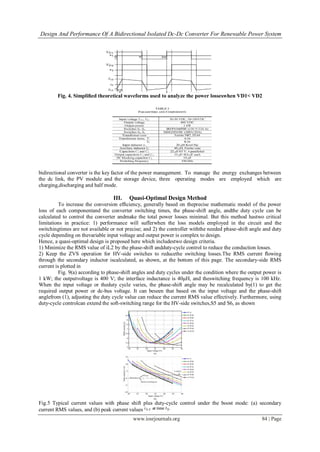
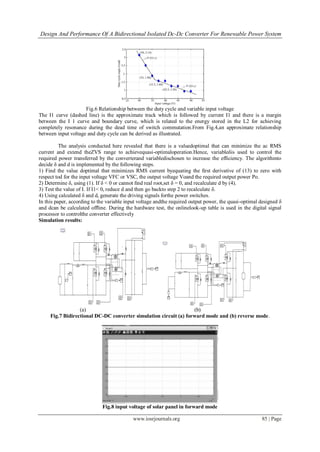
1) The document describes a bidirectional isolated DC-DC converter for renewable power systems. The proposed converter uses a coupled inductor with the same winding turns on the primary and secondary sides, allowing for higher step-up and step-down voltage gains than conventional bidirectional converters. 2) A simulation of the proposed converter in a photovoltaic system is implemented in Simulink. The simulation results show the input voltage from the solar panel and output voltage in both forward and reverse modes of operation. 3) A quasi-optimal design method is presented to minimize conduction losses by reducing the RMS current value and extend zero-voltage switching to improve conversion efficiency. Duty cycle control is used to achieve this while accommodating variations in


![[IJET V2I5P9] Authors: Anju John Gray, Beena M Vargheese, Miss. Geethu James](https://cdn.slidesharecdn.com/ss_thumbnails/ijet-v2i5p9-161107141042-thumbnail.jpg?width=640&height=640&fit=bounds)


